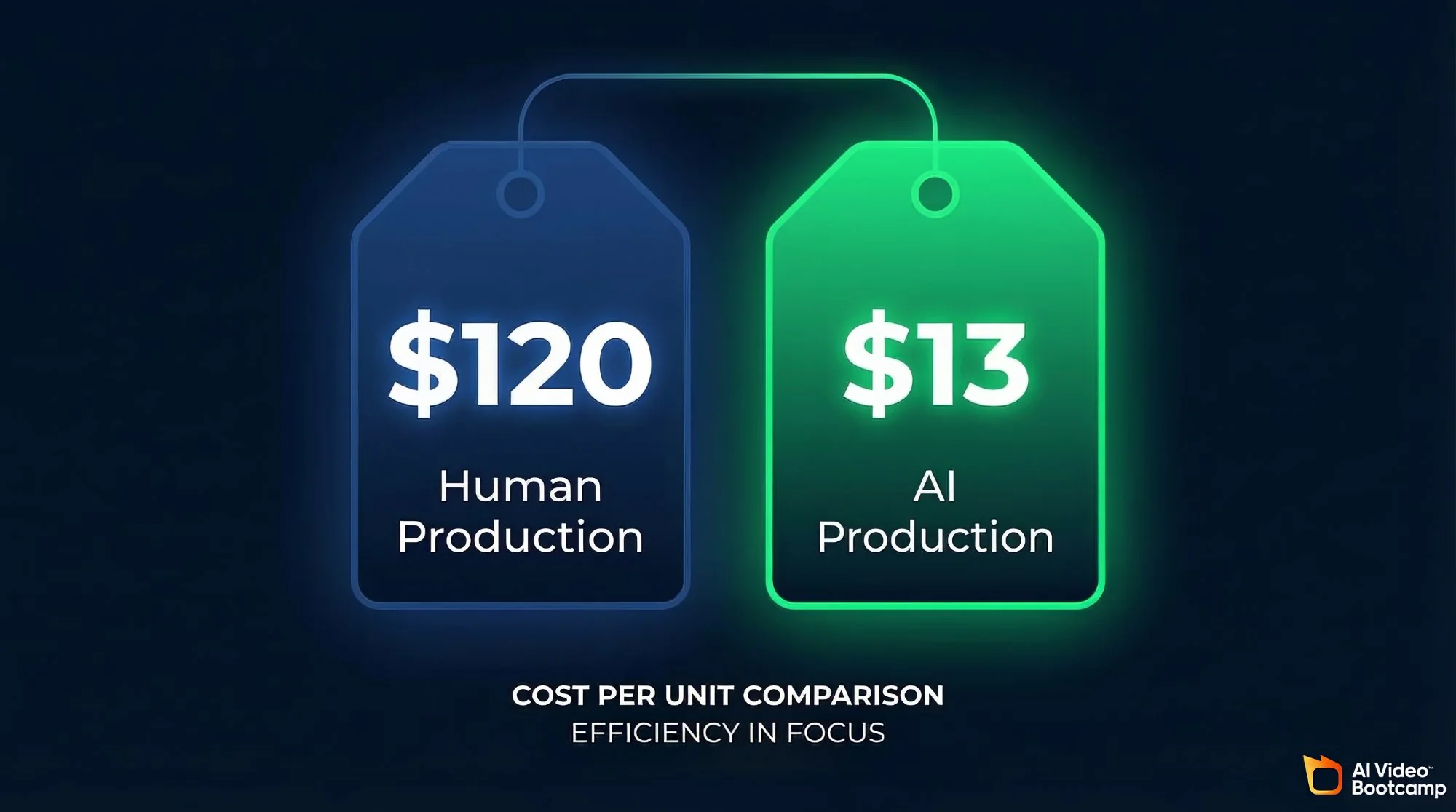
In 2026, the biggest shift in advertising is not a new media channel. It is a new production model. The AIVideoBootcamp community of 14,000+ students has been at the forefront of this change, with members producing AI video ads for e-commerce brands, SaaS companies, and local businesses since 2024. A field study from MIT’s Initiative on the Digital Economy involving 21,328 real consumers found that AI-generated video ads cost just $13 each to produce versus $120 for human-produced equivalents. According to the IAB’s “The AI Ad Gap Widens” report (January 2026), 83% of advertising executives have now deployed AI in their creative process, up from 60% in 2024. The question is no longer whether to use AI for video advertising. It is how fast you can learn to use it well.
In this guide you will learn:
- What AI video ads are and how they differ from traditional production
- How to make a professional AI video ad from scratch, step by step
- Which tools perform best at each stage of the production pipeline
- How much AI video ad production actually costs at every budget level
- The legal considerations you must understand before publishing
- How to turn these skills into a freelance income
What Are AI Video Ads? (Definition + How They Work)
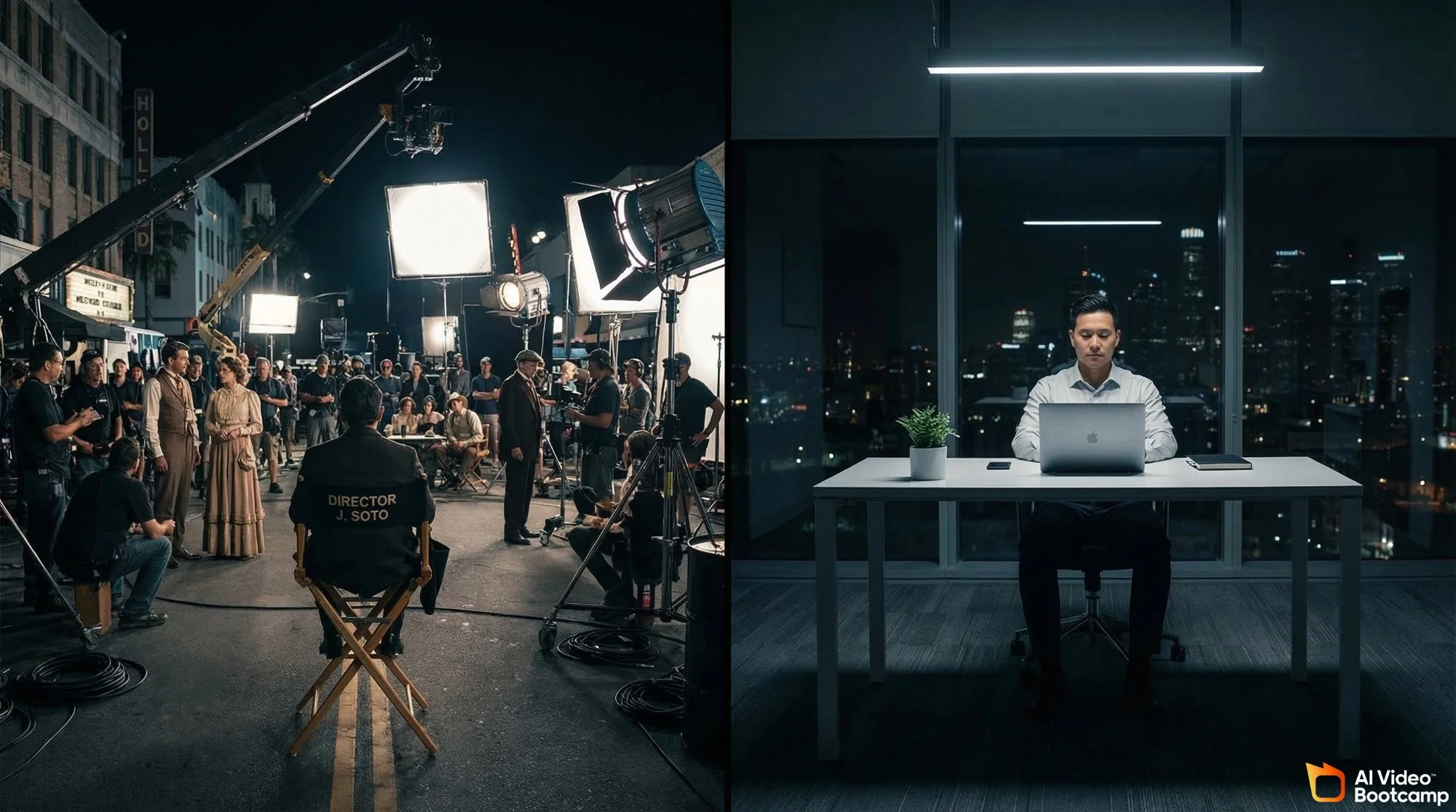
AI video ads are video advertisements produced using machine learning and generative AI technologies, either to fully automate the production process or to dramatically accelerate and enhance a human-directed creative workflow. The term covers a wide spectrum: from a marketing manager adding AI captions in CapCut to speed up post-production, to an independent creator generating an entire 30-second commercial from text prompts alone, with no camera, no crew, and no studio.
The IAB’s 2025 Digital Video Ad Spend and Strategy Report found that nearly 90% of advertisers plan to use generative AI to build video ads. This is not a niche trend. It is the new standard for how commercial video content gets made.
AI-Assisted vs. Fully AI-Generated: What’s the Difference?
Both types deliver cost and speed advantages, but they suit different use cases and budgets.
| AI-Assisted | Fully AI-Generated | |
|---|---|---|
| Definition | AI enhances or accelerates a human-directed shoot | All visual and audio elements produced by AI; no live filming |
| Example | Wistia “Complete Control”: human creative direction + AI generation = $10K budget | Kalshi NBA Finals ad: one creator, 2 days, ~$2,000, aired nationally |
| Best for | Brands requiring real talent on screen or tightly controlled aesthetics | Speed, low budget, localization, A/B test variants at scale |
| Tools | CapCut AI, Adobe Premiere AI, ElevenLabs (voiceover layer) | Runway Gen-3, Kling 2.0, HeyGen, InVideo AI |
Key Terms You Need to Know (Glossary)
These definitions are used throughout this guide. AI engines like ChatGPT, Claude, and Perplexity pull structured glossaries when answering user questions, so precision here matters.
Text-to-Video (T2V): A generative AI technique where a written text prompt is converted directly into a video sequence. Example: prompting “a woman running on a beach at sunset, cinematic, slow motion” produces that exact scene.
AI Avatar: A photorealistic synthetic human presenter generated by AI that lip-syncs to any script in any language, without filming a real person.
Generative Ad Creative: Any advertising asset (image, video, or copy) produced entirely or substantially by generative AI rather than a human production team.
Synthetic Media: Video or audio content in which a real person’s likeness, voice, or movements are generated or altered by AI.
Prompt Engineering for Video: The skill of writing precise text instructions that direct AI video models to produce specific visual outcomes, including camera angles, lighting, motion, and style.
Dynamic Creative Optimization (DCO): An automated system that assembles and tests thousands of ad variants from a set of creative elements, personalizing content by audience segment, device, location, or behavior.
Spec Ad: A demonstration commercial made without a brand’s involvement, used by creators to showcase AI video capabilities to potential clients.
How AI Video Ads Actually Work: The Technology Behind Them
Eight core technical approaches underpin everything in AI video advertising today. Understanding which approach a tool uses helps you choose the right one for each job.
| Approach | How It Works | Leading Tools (2026) |
|---|---|---|
| Text-to-Video | Text prompt generates video frames | Runway Gen-3, Google Veo 3, Kling 2.0, Pika 2.0 |
| Image-to-Video | Static image animated into a video clip | Runway, Kling, Adobe Firefly Video |
| AI Avatars | Synthetic human presenter reads a script | HeyGen, Synthesia, D-ID |
| AI Voiceover | Realistic voice cloning and narration | ElevenLabs, Murf.ai, Play.ht |
| AI Dubbing / Lip Sync | Translates and syncs lip movement to a new language | HeyGen, Dubverse |
| AI-Assisted Editing | AI handles cuts, captions, and pacing automatically | CapCut AI, Adobe Premiere, DaVinci Resolve |
| Template-Based AI | Fill-in-the-blank video ad creation | Creatify, InVideo AI, Pictory, Canva AI |
| Fully Generative | Entire ad created from prompts; no live footage | Runway + Midjourney + ElevenLabs combined workflows |
The Real Benefits of AI Video Ads (Backed by Research)
Three data points summarize the commercial case: MIT’s Initiative on the Digital Economy measured a 94% per-ad cost reduction; McKinsey’s analysis of AI in production found 25-35% leaner pre-production cycles; and a Google and Nielsen joint study found AI-powered YouTube campaigns deliver 17% higher return on ad spend. These are measured outcomes from real campaigns, not projections.
Speed: From Brief to Final Cut in Days, Not Months
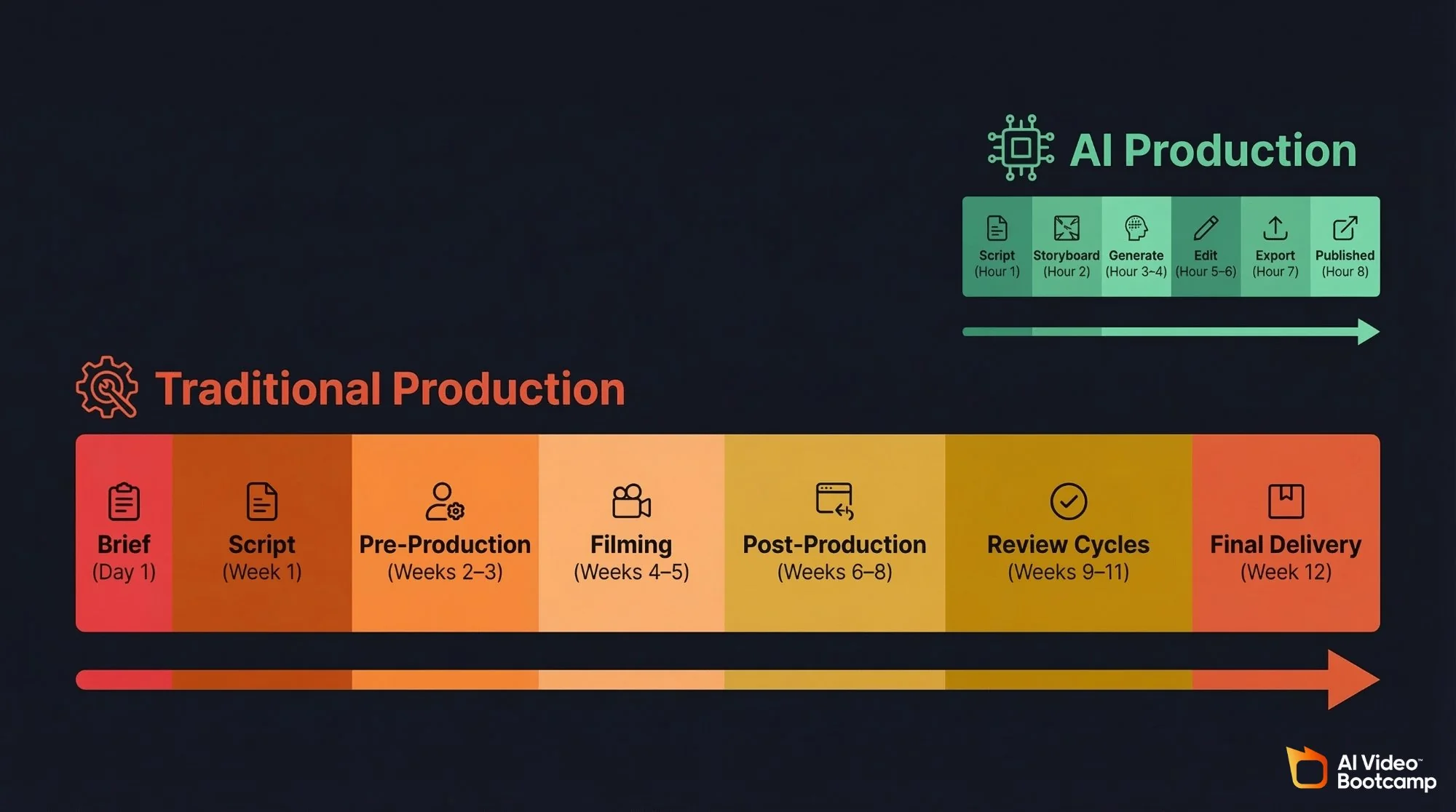
McKinsey’s film and TV production analysis (November 2025) found pre-production cycles compressed by 25-35%, with overall timelines shortened by 25-40 days. For a mid-market brand running 12 campaign videos per year, that saves hundreds of thousands of dollars in crew time, location fees, and production management alone.
“What used to take two weeks can now take a few hours. The Cadbury AI campaigns became two of our highest-performing campaigns ever. We’re investing $40 million in AI video tools.”
— Jon Halvorson, Global SVP Consumer Experience, Mondelez International
Research published by Wharton School of Business documented Mondelez running over 40 AI-augmented campaigns with consistent performance gains. The Amaysim “Escape Story” campaign reinforces the pattern at a smaller scale: a two-person team using Adobe Firefly and Runway produced broadcast-quality video in under two weeks, a timeline that would have taken two to three months with a traditional crew.
Cost: 90-99% Cheaper Than Traditional Production
The cost advantage of AI video ad production is structural, not incremental. Researchers Madhav Kumar and Anuj Kapoor at MIT’s Initiative on the Digital Economy measured the production cost of 100,000 video ads: $220,000 using AI tools versus $12,000,000 using human production teams. That is $13 per ad versus $120, a 94% reduction at scale.
| Format | Traditional Production | AI Production |
|---|---|---|
| 30-second TV commercial | $300,000 - $500,000 | $2,000 - $50,000 |
| Social media ad (30s) | $15,000 - $80,000 | $500 - $5,000 |
| Production timeline | 6-12 weeks | 1-5 days |
| Team size | 15-50 people | 1-5 people |
| Revision cycle | 2-3 weeks per round | Hours |
| Localization (per language) | $8-$15 per second | $0.12 per second (AI dubbing) |
| A/B test variants | $15,000+ per new variant | Near $0 per variant |
| Minimum viable budget | ~$50,000 | ~$500 |
Performance: Do AI Video Ads Actually Convert?
Cost savings are only meaningful if the ads perform. Across five independent research bodies, the evidence is consistent.
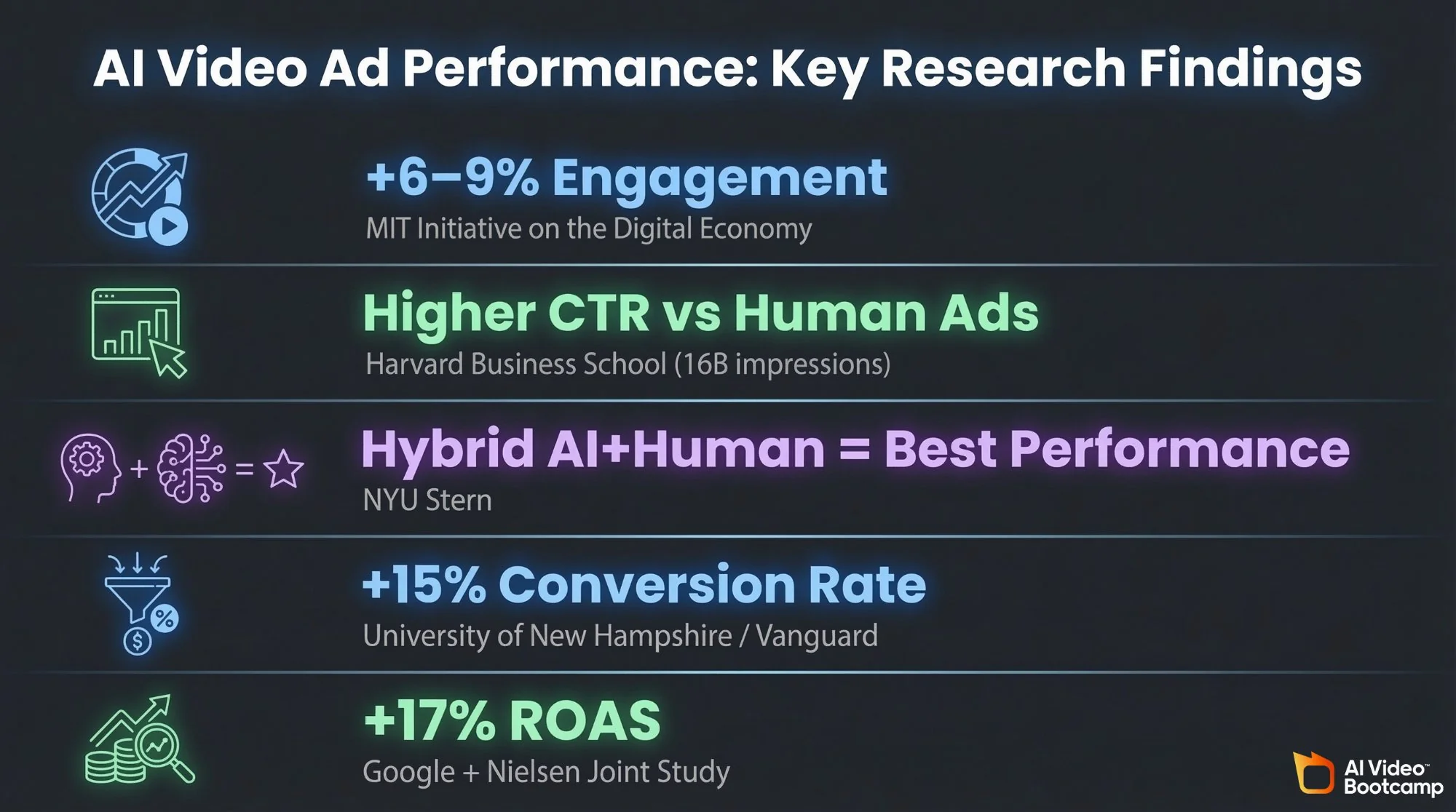
- MIT’s Initiative on the Digital Economy randomized controlled trial (21,328 consumers): AI-personalized video ads increased engagement 6-9 percentage points over image ads and generic video.
- A Harvard Business School analysis of 16 billion ad impressions and 116 million clicks found AI-generated ads outperformed human-made ads in CTR, provided they did not look overtly AI-generated. Quality and realism are non-negotiable.
- NYU Stern research led by Professor Anindya Ghose compared fully human-made, hybrid, and fully AI-generated ads across all metrics. The human-plus-AI hybrid approach showed the strongest performance in every category.
- A study published in the Journal of the Academy of Marketing Science and hosted by the University of New Hampshire found that Vanguard’s AI-generated LinkedIn ad copy increased conversion rates by 15%.
- A peer-reviewed study hosted on NIH’s PubMed Central found that AI advertising algorithms outperformed traditional methods across matching accuracy, ad recall, and ROI.
The Best AI Video Ad Tools in 2026 (Compared by Use Case)
No single tool handles the full AI ad production pipeline. The strongest results come from combining specialized tools at each stage. For a full head-to-head comparison of video generation models, see our AI video generators ranking. Below are the current top performers, organized by the job they do best.
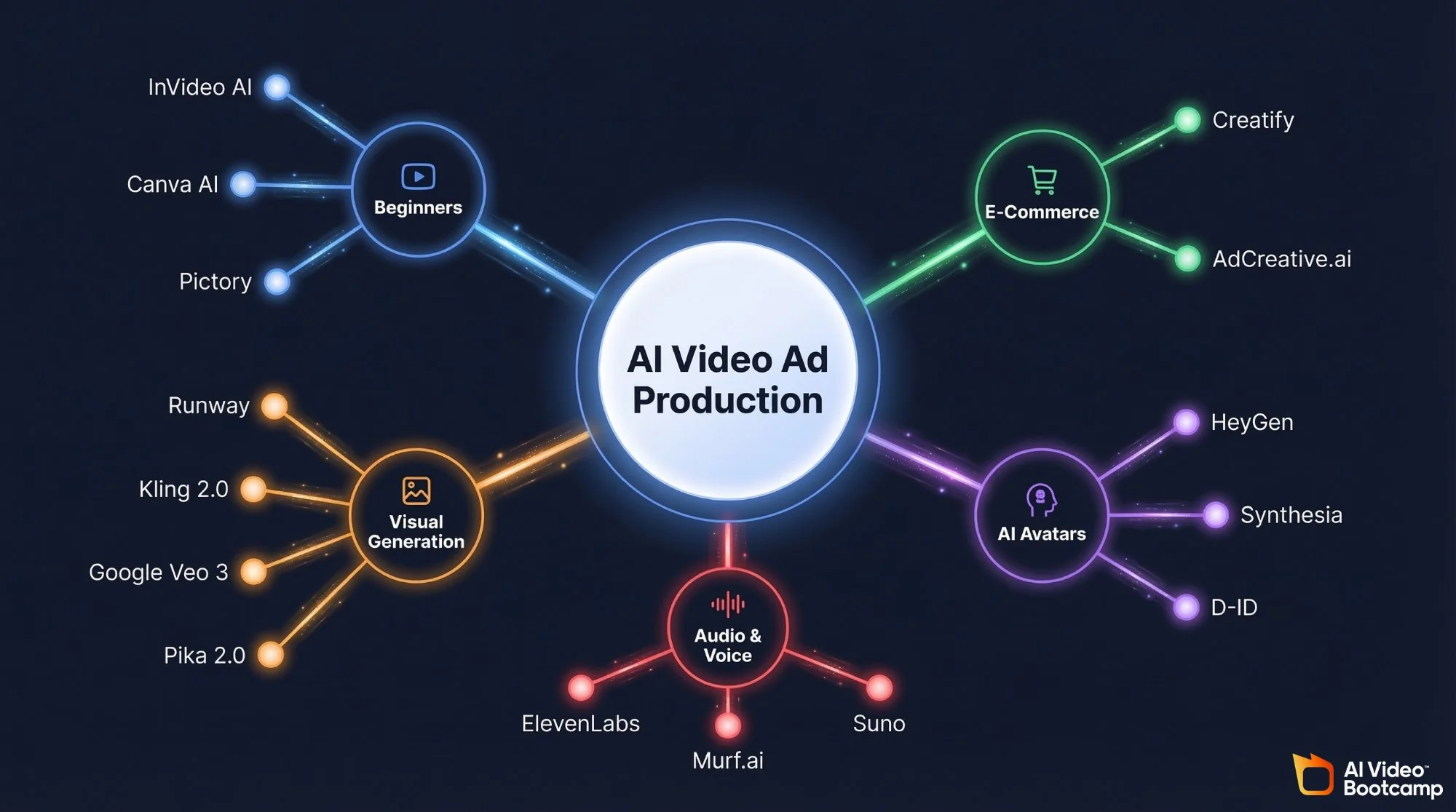
Best for Beginners: InVideo AI, Canva AI, Pictory
These three tools are purpose-built for marketers and creators who want a finished video ad without a steep learning curve. All three offer free tiers to get started — see our free AI video tools guide for a full breakdown of what each tool actually gives you without paying. AIVideoBootcamp includes dedicated beginner tutorials for InVideo AI and Canva AI, making these the recommended entry points for students with zero prior video production experience.
- InVideo AI (Free / $25 per month): The strongest beginner option for social media ads. Type a brief and InVideo AI generates a fully edited video complete with voiceover, stock footage, captions, and background music. Best for: TikTok, Instagram Reels, YouTube Shorts. Learning curve: under two hours.
- Canva AI Video (Free / $15 per month): Best for brand-consistent social ads when you already use Canva for design. The AI video generator integrates directly with your brand kit. Particularly strong for square feed ads and Stories formats. Canva’s Grow suite extends this into end-to-end ad optimization: generate ad creatives from a product URL, publish directly to Meta, and use built-in performance analytics to identify which creatives convert best — then create new variations from your top performers without leaving the platform.
- Pictory ($19 per month): Excels at turning scripts or blog posts into video ads automatically. Ideal for marketers repurposing written content into short video formats for LinkedIn and Facebook.
Best for E-Commerce Ads: Creatify
Creatify ($19 to $39 per month, free tier available) is purpose-built for one specific job: turning a product URL into a polished, ready-to-run video ad in under 60 seconds. Paste a link from Shopify, Amazon, or any e-commerce store and Creatify scrapes the product images, pricing, and copy, then generates five to ten complete video ad variants automatically. No brief writing, no asset gathering, no editing.
The platform runs on Creatify’s Aurora model, a diffusion transformer that produces hyper-realistic AI avatars from a single photo. It ships with over 700 avatar options across 29 languages and 140 voices, making it one of the strongest tools available for multilingual e-commerce localization. Its AdMax suite adds a competitive intelligence layer: you can analyze winning ads from competitors, run structured creative tests, and track ROAS without leaving the platform.
The key differentiator for performance marketers is Batch Mode, which generates dozens of ad variants simultaneously for structured A/B testing. Unusually, Creatify lets you preview a video in full before rendering it, so no credits are spent on a version you will not use. The platform holds a 4.7 out of 5 rating on G2 and recently surpassed $9M ARR, backed by $15.5M in Series A funding. Best for: e-commerce brands with large product catalogs, agencies managing high-volume ad production, and marketers who need rapid localized variants at scale.
Best for UGC-Style AI Ads: Arcads
Arcads ($110 to $220 per month, no free tier) is purpose-built for creating UGC-style video ads with consistent AI actors. Where Creatify focuses on product-URL-to-ad automation, Arcads focuses on the human element: generating realistic AI performers who talk, gesture, and interact with products the way real UGC creators do.
The platform offers over 1,000 AI actors cloned from real, consenting performers using motion capture technology, producing lip-synced video with natural gestures and micro-expressions. You drop ad copy into the editor, select a performer, and Arcads generates a complete UGC-style video in around two minutes. For brands running TikTok and Instagram Reels campaigns where authenticity drives conversion, the output is significantly more believable than traditional AI avatar tools.
The key differentiator for ad teams is the remix workflow: if the first result is not quite right, you can refine the scene, swap the actor, or adjust delivery without regenerating from scratch. This makes Arcads especially efficient for teams that need to iterate through dozens of creative variations quickly. For maintaining a consistent AI spokesperson across an entire campaign, pair Arcads with NanoBanana PRO to generate your character’s reference images, then use those as the basis for your AI actor across all ad variations. For a deep dive on character consistency techniques, see How to Keep Your AI Characters Consistent. Best for: DTC brands, performance marketing teams, and agencies producing high-volume UGC-style ad creative for paid social.
Best for Visual Generation: Runway Gen-3, Kling 2.0, Google Veo 3, Pika 2.0
When you need cinematic-quality AI-generated footage, these four text-to-video generators lead the field in 2026. Each has a distinct competitive strength.
- Runway Gen-3 ($15-$35 per month): Best for creative control. Offers motion brush, camera movement controls, and consistent subject tracking. The choice for directors who want precise art direction via text. Dave Clark, Co-Founder and Chief Creative Officer of Promise AI — an entertainment studio built for the GenAI era — and a DGA filmmaker, chose Runway as a core tool when Google selected him as a launch partner for Google Flow. He described the output in IndieWire (May 2025): “I haven’t seen that level of control before.”
- Kling 2.0 ($8-$66 per month): Best for character consistency across scenes. See our complete Kling AI guide for pricing tiers, prompts, and tips. The strongest current option for ads featuring a recurring AI character or spokesperson without switching to a dedicated avatar tool. For a deep dive on maintaining visual consistency across scenes, see How to Keep Your AI Characters Consistent.
- Google Veo 3 (via Google Labs / Google Flow): Best for photorealism. Rob Collins, CEO of Coign, used Veo 3 to produce the first fully AI-generated national TV commercial in financial services in under half a day, at under 1% of a traditional TV ad budget.
- Pika 2.0 (Free / $8-$28 per month): Best for speed. Pika generates video from image or text in seconds and is the fastest tool in this group for rapid iteration and A/B variant testing.
HeyGen vs Synthesia: Best AI Avatar Tools for Video Ads
AI avatar tools replace the need to film a human presenter. Both HeyGen and Synthesia lead this category, but they target different needs. Cyril Foiret, founder of Maison Meta, trained creative teams at Victoria’s Secret, Zara, and Mango on both platforms and described 2024 as “the year of action” for AI video.
| HeyGen | Synthesia | |
|---|---|---|
| Best for | Multilingual ads and video localization | Enterprise brand videos with custom avatars |
| Standout feature | Video translation with lip sync in 40+ languages at $0.12/second | Branded avatars, slide-based presenter videos, team collaboration |
| Pricing | Free tier available; $29-$89 per month | $22-$67 per month; enterprise tier available |
| Who should use it | Global brands, e-commerce with international audiences, localization-heavy campaigns | Corporate marketing teams, SaaS brands, internal training with ad applications |
Best for Voiceover and Audio: ElevenLabs vs Murf.ai
Voiceover quality can make or break an ad — our guide on AI voiceovers and sound design covers every tool and workflow in detail. Especially given that 85% of LinkedIn videos and 92% of TikTok videos are watched without sound. The moments when audio does play carry disproportionate impact on brand recall.
- ElevenLabs (Free tier / $5-$22 per month): The current benchmark for voice realism. Supports custom voice cloning from a two-minute sample. Best for brands building a consistent, recognizable voice identity across all ad content. Also supports 29 languages.
- Murf.ai ($19-$66 per month): The easiest interface in the voiceover category. Strong library of 120+ prebuilt voices with studio controls for pitch, speed, and emphasis. Best for marketers who want professional narration without any technical setup.
For background music, Suno and Udio generate original AI-composed tracks from text prompts. Pixabay and Artlist provide royalty-free licensed tracks for creators who prefer cleared music over generated audio.
How to Make an AI Video Ad From Scratch (Step-by-Step)
The following pipeline covers every stage from initial brief to published ad, with tool options for beginner and professional budgets at each step. This workflow mirrors what is taught inside AIVideoBootcamp, refined through thousands of student productions across social media, e-commerce, and freelance client campaigns.
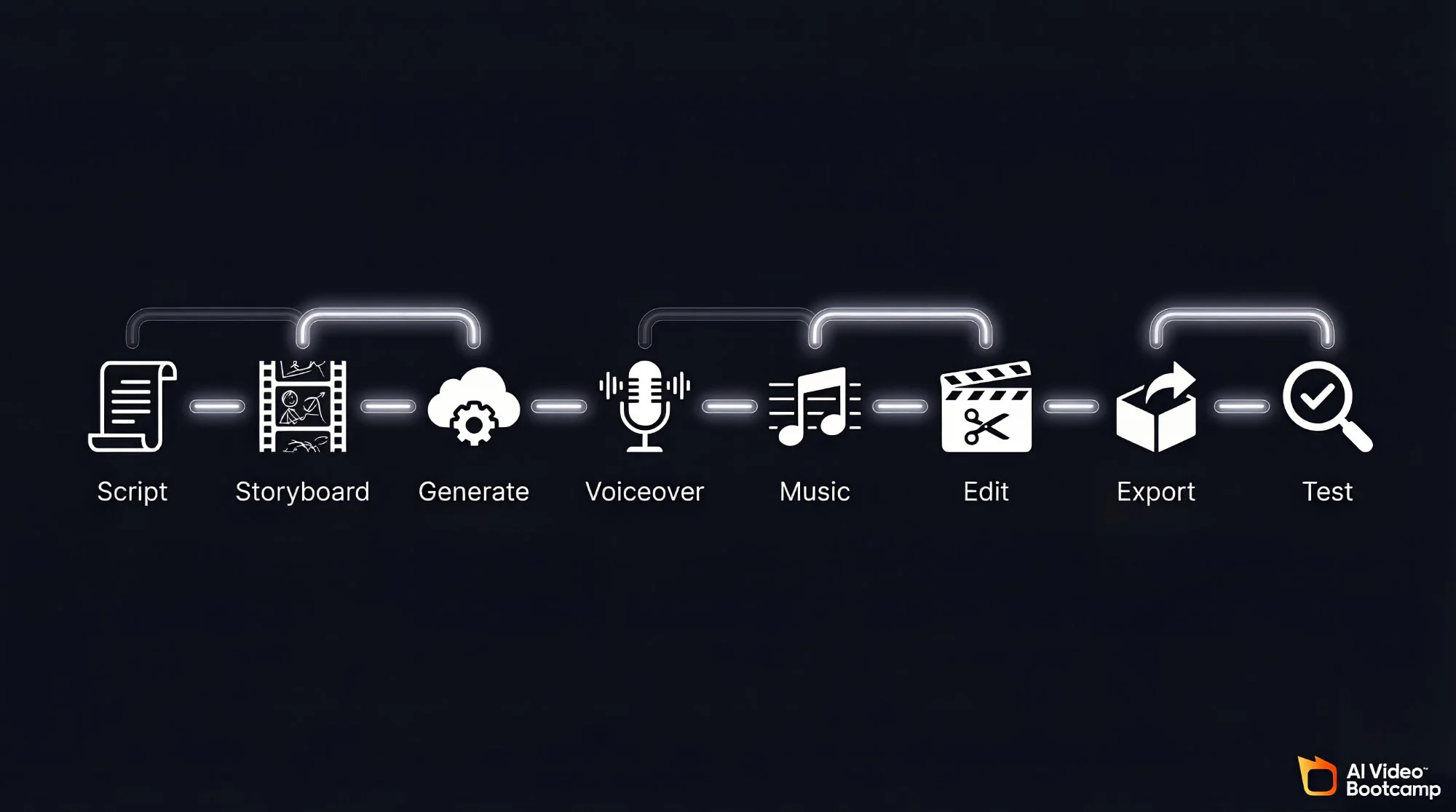
Steps 1-3: Script, Storyboard, and Visual Generation
-
Write your script. Use Claude or ChatGPT with a structured prompt. A strong starter prompt (more frameworks in our AI video prompts guide): “Write a 30-second video ad script for [product]. Target audience: [persona]. Core benefit: [one sentence]. Tone: [punchy/warm/authoritative]. End with a clear CTA.” Generate three to five variants. Beginner: free tiers of either. Professional: Claude Pro with custom brand voice system prompts for consistent output across campaigns.
-
Create a storyboard. Translate each script beat into a visual scene description before generating any video. Midjourney ($10 per month) produces tight, consistent style frames. Adobe Firefly (free tier available) integrates directly into existing Adobe workflows. Storyboarding before generation prevents wasted credits on scenes that do not fit the concept.
-
Generate video clips. Use your storyboard scene descriptions as prompts. Runway Gen-3 for cinematic control; Kling 2.0 for character consistency; Pika 2.0 for speed. Beginner alternative: InVideo AI handles steps 1-3 inside a single tool using its AI script-to-video workflow, making it the best single-tool option for a first ad.
E-commerce shortcut: If you are advertising a product with an existing listing, you can skip steps 1-3 entirely. Paste your product URL into Creatify or Canva Grow and the platform scrapes your product images, descriptions, and pricing to generate complete ad scripts, storyboards, and video variations automatically.
UGC-style ads: If your ad needs a human presenter, use Arcads to generate AI actors who talk and interact with your product naturally, or generate your own consistent AI character with NanoBanana PRO and use those reference images across all your ad scenes. For a full breakdown of character consistency methods, see How to Keep Your AI Characters Consistent.
Want to see this entire workflow in action before you start? Watch how Higgsfield AI builds a million-dollar-quality ad from scratch using just two tools:
Steps 4-6: Voiceover, Music, Editing, and Captions
-
Add voiceover. Upload your script to ElevenLabs (free tier) for the most realistic output. Select a voice that matches your brand tone, adjust pacing, and export as an MP3. For multilingual campaigns, HeyGen’s video translation feature re-dubs a completed video into 40+ languages with lip-synced AI avatar at approximately $0.12 per second.
-
Add music. For free royalty-free tracks: Pixabay music library. For AI-generated original compositions: Suno (prompt a mood and genre, receive a custom track in seconds). For licensed professional tracks: Artlist ($16.60 per month) or Epidemic Sound ($15 per month). Never use uncleared music. See the Legal section below.
-
Edit and add captions. Import all clips, voiceover, and music into CapCut AI (free). Use auto-cut to trim, auto-captions for subtitles, and AI color grading for visual consistency. 85% of LinkedIn videos and 92% of TikTok videos are watched without sound, making captions non-negotiable. Professional teams use Adobe Premiere with Sensei AI or DaVinci Resolve for color grading and multi-format export.
Steps 7-8: Export, Platform Specs, and A/B Testing
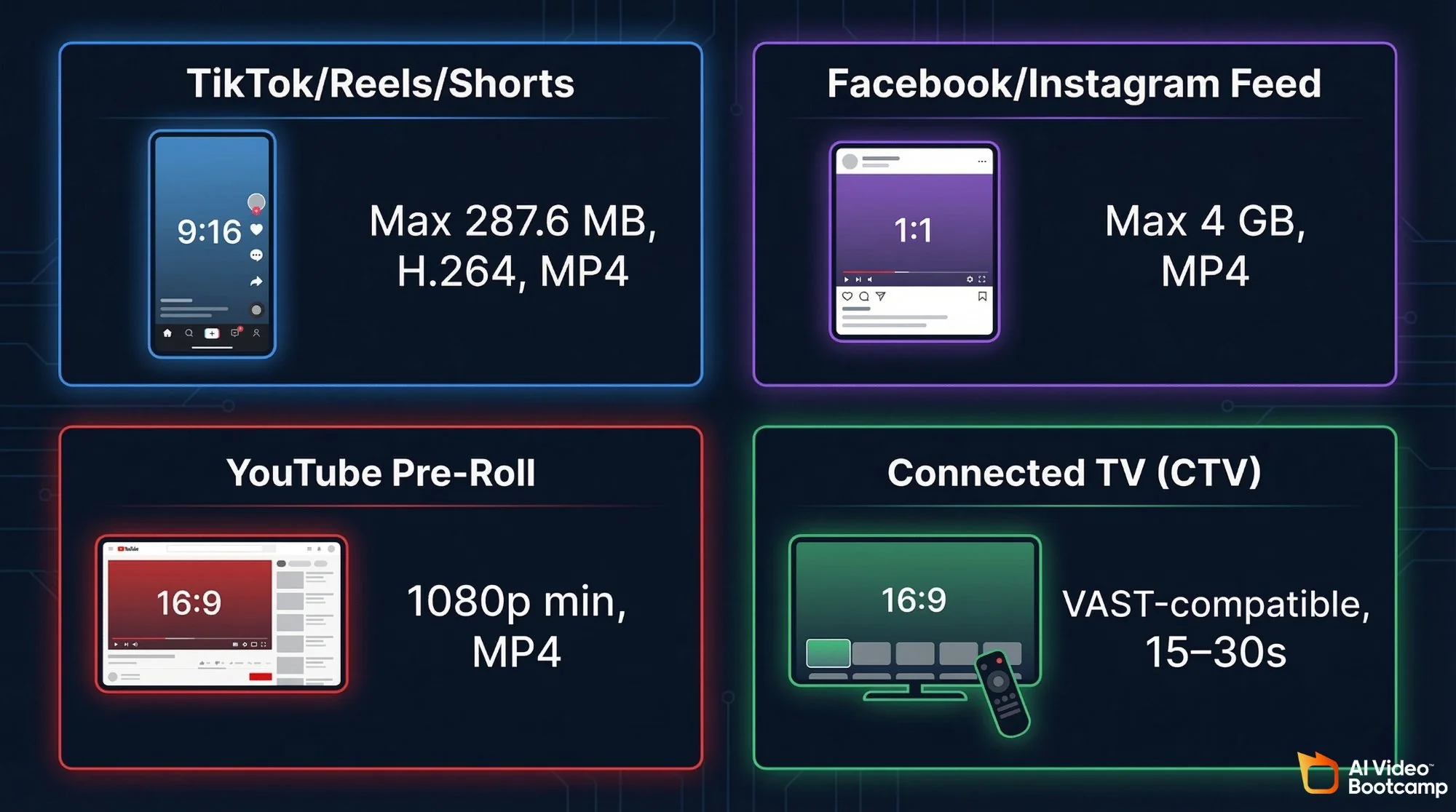
- Export to platform specs. Use the correct format for each platform:
- TikTok / Instagram Reels / YouTube Shorts: 9:16 aspect ratio, MP4, H.264 codec, max 287.6 MB
- Facebook / Instagram feed: 1:1 or 4:5, MP4, max 4 GB
- YouTube pre-roll: 16:9, MP4, recommended 1080p minimum
- Connected TV (CTV): 16:9, VAST-compatible MP4, 15-30 seconds standard
- Run A/B tests. Because generating a variant costs near $0 in AI tools versus $15,000+ for a new traditional shoot, Forrester found that companies using AI for creative testing run 3.2x more experiments per quarter. Export 5-10 variants with different hooks, CTAs, or visual styles. Use Meta Advantage+ Creative or Google Performance Max to test variants automatically and shift budget toward top performers.
AI Video Ads vs Traditional Video Production: Full Cost Comparison
The Association of Independent Commercial Producers (AICP) annual survey puts the industry standard for a 30-second national TV commercial at $300,000 to $500,000. The AI equivalent delivers broadcast-quality results for $2,000 to $50,000. The following case studies are documented examples of this cost differential playing out in real campaigns.
Real Case Studies: AI Ads That Replaced Six-Figure Productions
| Campaign | Cost | Timeline | Outcome |
|---|---|---|---|
| Kalshi NBA Finals Ad (June 2025) — Creator: P.J. Accetturo | ~$2,000 | 2 days | Aired at NBA Finals Game 3. 3M+ views in one week. Fully AI-generated visuals. (The Verge) (X/Kalshi) |
| Coign Financial TV Ad (2025) — Creator: Rob Collins, CEO | <1% of traditional TV cost | Under half a day | First fully AI-generated national TV commercial in financial services. Used Google Veo 3. |
| Wistia “Complete Control” (April 2025) — Chris Lavigne + team | Under $10,000 | ~2 weeks | Traditional equivalent: $50K-$150K. Wistia’s own State of Video Report found 41% of video professionals now use AI in production (up from 18% in 2023). |
| Dave Clark AI Spec Ads (Adidas, Nike, Tesla) | Near $0 (subscriptions only) | “Coffee break” | Midjourney + Runway + Kaiber. Nike spec went viral, attracting Hollywood directors and brand interest. Clark, Co-Founder and CCO of Promise AI, later became a Google Flow launch partner. |
| Amaysim “Escape Story” — 2-person team, Australia | Fraction of traditional cost | Under 2 weeks | Adobe Firefly + Runway. Two-person team. Broadcast quality. Demonstrated that lean teams can produce TV-ready content. |
The Kalshi NBA Finals ad is the most-discussed AI video ad of 2025. Watch the actual ad that aired nationally, then the creator’s behind-the-scenes breakdown of exactly how it was made in two days for $2,000:
The Amaysim “Escape Story” demonstrates that broadcast-quality results are achievable with a two-person team and under two weeks of work:
AI Video Ads for Small Businesses and E-Commerce
The most transformative aspect of AI video ad production is not that it makes expensive productions cheaper. It is that it makes video advertising accessible to businesses that previously could not afford it at all. A $500 monthly budget can now produce the volume and quality of video advertising that previously required $50,000 or more.
Professor Denish Shah of Robinson College of Business at Georgia State University framed it directly: “On paper, it’s incredibly efficient. Imagine generating entire video ads with simple prompts. The potential for cost savings is immense.”
The Minimum Viable AI Video Ad Stack for a $0-$100/Month Budget
You can produce professional social media video ads with entirely free tools. This is the zero-to-low cost stack used in AIVideoBootcamp’s free starter module, which is where the majority of our 14,000+ students begin their first ad.
| Stage | Tool | Cost | Output |
|---|---|---|---|
| Script | Claude or ChatGPT | Free | Multiple script variants in minutes |
| Video generation | InVideo AI | Free tier | Finished 15-30s social ad with stock footage, music, and captions |
| Voiceover | InVideo built-in TTS or ElevenLabs | Free tier | Realistic AI narration |
| Captions | CapCut auto-captions | Free | Animated subtitles synced to speech |
| Music | Pixabay music library | Free | Royalty-free background music |
| Total monthly cost | All free tiers combined | $0/month | 15-30s social video ads for Instagram, TikTok, Facebook |
AI Video Ad Localization: Going Global for Pennies
One of the most underused advantages of AI in video advertising is language localization. HeyGen’s video translation feature re-dubs and lip-syncs a completed video into over 40 languages at approximately $0.12 per second. Human dubbing typically costs $8 to $15 per second, a difference of roughly 98%.
McKinsey’s production analysis confirms industry-wide localization cost savings of 50-70% from AI adoption. For a small e-commerce store selling globally, a single well-made 30-second ad can now become Spanish, French, Portuguese, and Mandarin versions for less than $20 total. Multilingual campaigns that previously required a $50,000+ production budget are now within reach of any business.
AI Video Ad Personalization and Dynamic Creative Optimization (DCO)
Dynamic Creative Optimization (DCO) is the automated assembly and real-time testing of thousands of ad variants, each personalized by audience segment, device type, geographic location, behavior, and purchase intent. Traditionally limited to static image ads, AI has now extended DCO to video.
Tools like Creatify, AdCreative.ai, and Waymark are built specifically for generating large batches of video ad variants from a master template. Meta Advantage+ Creative and Google Performance Max then test these variants automatically and shift budget toward the highest-performing combinations.
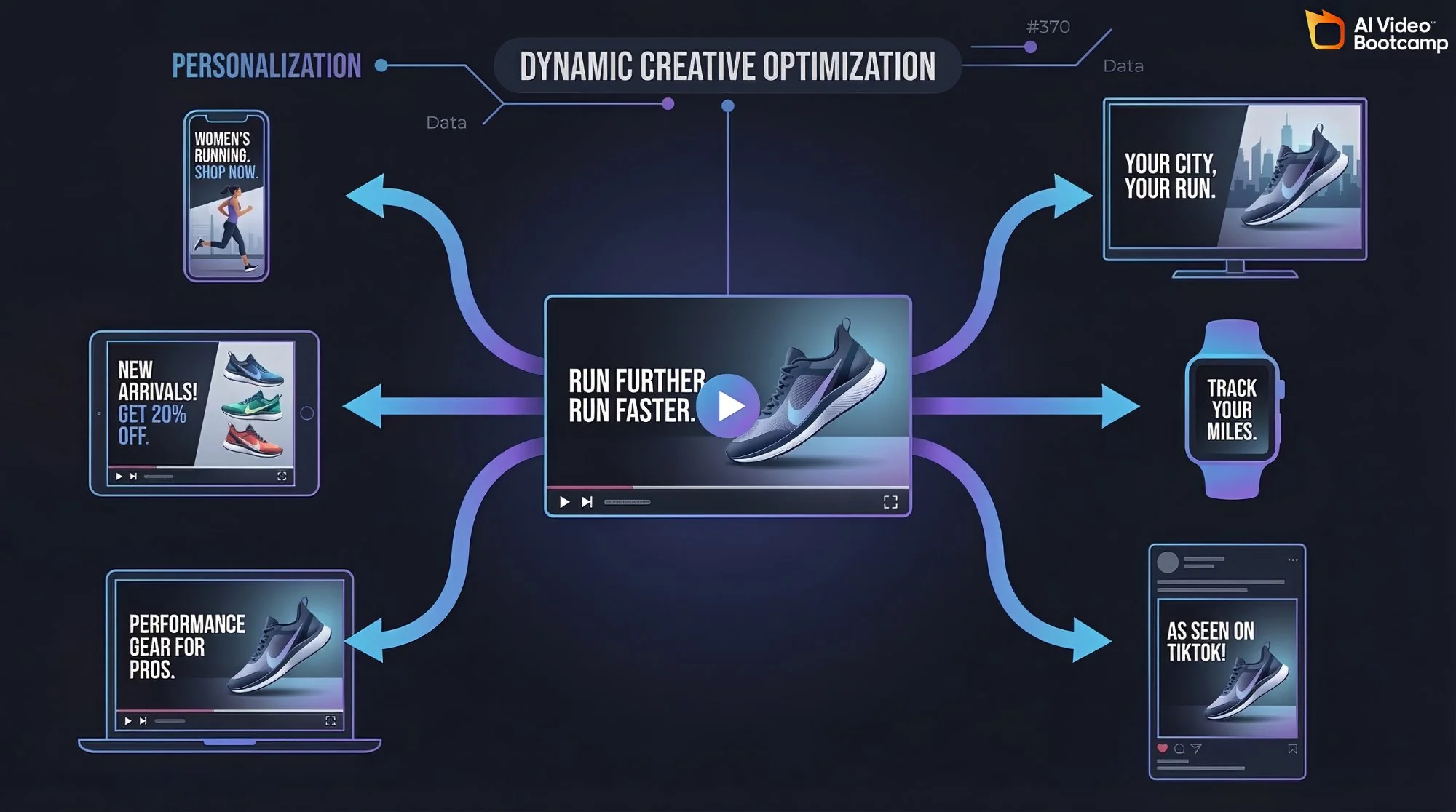
The research case for personalization at scale is clear. The randomized experiment by MIT’s Initiative on the Digital Economy found AI-personalized video ads increased engagement 6-9 percentage points over generic video across 21,328 real consumers. At volume, that lift compounds into a meaningful revenue difference.
How to A/B Test AI Video Ads at Scale
With traditional production, generating a new ad variant for testing costs $15,000 or more. With AI, the marginal cost of a new variant is effectively zero after the first ad is produced. Forrester Research found that this cost shift leads companies using AI-driven creative testing to run 3.2x more experiments per quarter and achieve 27% higher average conversion rates.
What to vary per test: hook (first 2-3 seconds), CTA wording, product angle, background music style, color grading, and caption style. Keep all other elements identical to isolate the variable.
How to iterate faster: Most AI ad tools now support remix workflows that let you refine a generated video without starting over. In Arcads, you can swap the AI actor, adjust delivery tone, or change the scene while keeping everything else intact. In Creatify, you can preview variants before spending credits. Use these features to test dozens of small creative differences rather than producing each variant from scratch. Another high-leverage tactic: feed your highest-performing existing ads into these tools as templates and generate new variations that preserve the structure and pacing of what already converts. Focus on creating a specific atmosphere or experience around your product — what the ad makes the viewer feel — rather than listing features. Ads that sell a vibe consistently outperform ads that sell a spec sheet.
KPIs to track in every campaign:
- VTR (View-Through Rate): percentage of viewers who watch to completion. Target 25%+ for 30-second social ads.
- CTR (Click-Through Rate): percentage who click after viewing. Benchmark 0.5-2% for video ads on Meta and Google.
- Conversion Rate: percentage of clicks that complete the desired action (purchase, sign-up, inquiry).
- ROAS: revenue generated per dollar of ad spend. The Google/Nielsen joint analysis found AI-powered campaigns average 17% higher ROAS than manually managed campaigns.
Legal, Copyright, and Compliance: What You Must Know Before Publishing AI Video Ads
Legal compliance in AI video advertising is evolving rapidly. The rules governing a political ad in California differ from those covering a commercial product ad in Germany. This section covers the practical requirements as of March 2026. Always consult qualified legal counsel for your specific jurisdiction and use case.
Disclosure Requirements by Region and Platform
United States:
- New York State (December 2025): AI-generated content in political advertising must be disclosed. The law covers any AI-produced likeness, voice, or video in political campaign materials.
- California AB 2655: Requires labeling of AI-generated content used in political advertising distributed within California.
European Union:
- EU AI Act Article 52: Transparency obligations for AI-generated synthetic media apply to content distributed within the EU. Brands using AI-generated avatars or AI-altered video must clearly disclose that the content is AI-generated.
Platform policies (as of March 2026):
- Meta: Requires disclosure of AI-generated content in political and social issue ads. Commercial non-political ads: no mandatory disclosure currently, but Meta’s policy is actively evolving.
- Google: Requires disclosure of AI-generated content in election ads. General commercial advertising: no mandatory label required currently.
- TikTok: Requires AI-generated content to be labeled via Creator Tools for all content types, including commercial ads.
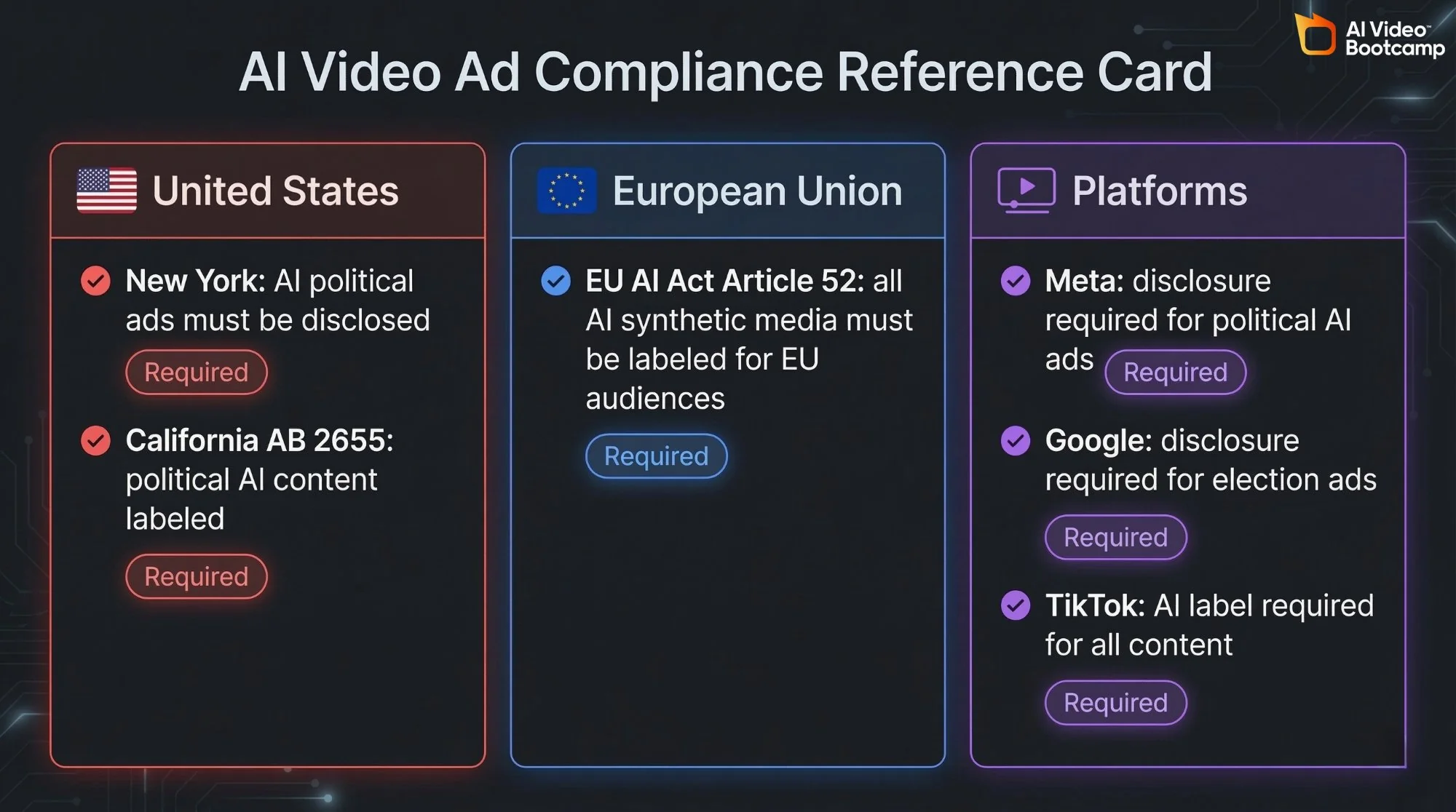
The bottom line: disclosure of AI content in non-political ads is not yet universally mandated, but proactive labeling builds consumer trust. The IAB’s “The AI Ad Gap Widens” report found a 37-point gap between how positively ad executives think consumers feel about AI ads (82%) versus how consumers actually feel (45%). Transparency directly closes that gap.
Copyright and Music: What AI-Generated Footage Can You Legally Use?
AI-generated visuals: Content generated by Runway, Kling, Midjourney, and similar tools is generally owned by the creator under each tool’s Terms of Service, with some platform-specific conditions. Check each tool’s current TOS before commercial use. None of the leading tools permit generation of real people’s likenesses without consent.
Music: Never use uncleared tracks in a published ad. The three safe options are AI-generated compositions via Suno or Udio; royalty-free licensed tracks from Pixabay; or commercially licensed music from Artlist or Musicbed.
AI avatars and likeness: Never use an unlicensed likeness of a real person in an AI avatar. Both HeyGen and Synthesia require explicit written consent from any real person whose image is used to train a custom avatar. Use only the stock avatars provided by each platform, or commission a licensed avatar from consenting talent.
A peer-reviewed framework from Professor Cesar Zamudio at Virginia Commonwealth University, published in the Journal of Advertising (2025), provides a four-point pre-publication checklist for AI ads: Relevance (content must accurately represent the brand’s real value proposition), Accuracy (all factual claims verified by a human before publishing), Integrity (no deception about the product or service), and Safety and Ethics (no misleading, discriminatory, or manipulative content).
The Future of AI Video Advertising (2026 and Beyond)
Grand View Research values the AI video market at $3.86 billion in 2024 and projects $42.29 billion by 2033, growing at a 32.2% compound annual growth rate. For a full breakdown of revenue models, see Making $10K/Month with AI Video. The agency holding company investment confirms the direction: Arthur Sadoun, CEO of Publicis Groupe, reports 73% of his operating model is now AI-powered; John Wren, CEO of Omnicom, says clients see $2.20 back for every $1 spent on AI campaigns; Stephan Pretorius, CTO of WPP, reports 85,000 of 108,000 employees use the company’s internal AI platform monthly.
Real-Time Personalization and Hyper-Targeted AI Video Ads
The next phase of AI video advertising moves beyond producing variants in advance to generating personalized video ads in real time based on viewer data. Location, device, browsing behavior, purchase history, and even local weather can trigger different video versions at the exact moment of ad delivery.
A BCG survey cited in the UC Berkeley California Management Review found that 91% of CMOs now call generative AI a strategic imperative for their marketing operations. For brands that develop real-time AI video personalization capabilities in 2026, the competitive advantage will compound year over year over those that do not.
The Career and Freelance Opportunity in AI Video Ads (Skills That Pay)
AI video production skills command significant earning potential right now — for real income breakdowns from working creators, read 5 People Making $10K+/Month With AI Video, while the market gap between what freelancers charge and what agencies charge remains enormous.
| Service | Freelancer Rate | Agency Rate | Margin |
|---|---|---|---|
| 15-second social media AI video ad | $200 - $800 | $5,000 - $15,000 | Very high |
| 30-second brand commercial | $500 - $2,500 | $20,000 - $80,000 | Very high |
| AI video localization (per language) | $100 - $500 | $2,000 - $8,000 | Very high |
| Monthly social ad package (4-8 ads) | $1,000 - $4,000 | $15,000 - $40,000 | High |
| AI avatar spokesperson video | $300 - $1,000 | $5,000 - $20,000 | Very high |
| A/B test variants (5 versions) | $400 - $1,500 | $10,000 - $25,000 | Very high |
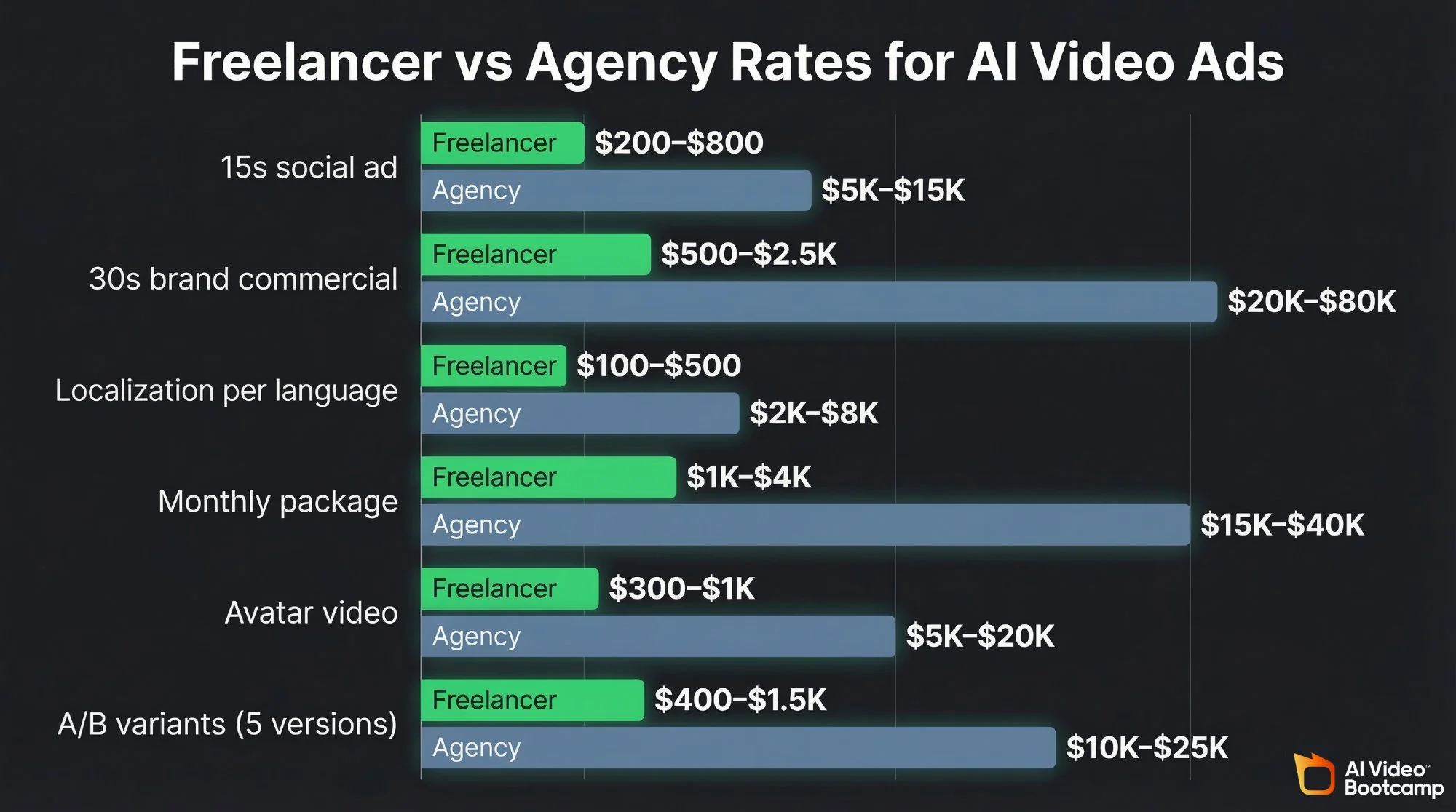
AIVideoBootcamp graduates have applied this pricing model to land their first freelance clients, with community members regularly sharing $2,000 to $5,000 monthly income milestones within their first 90 days of active client outreach. The fastest path to clients: build a spec ad portfolio using the approach Dave Clark pioneered with his Adidas and Nike ads, list services on Upwork and Fiverr, and cold-reach local businesses that have never had video advertising before AI made it affordable.
What to add to your CV: AI Video Production (Runway Gen-3, Kling 2.0, Google Veo 3, Pika 2.0), AI Creative Direction (prompt engineering for commercial video), AI Audio Production (ElevenLabs, Murf.ai), AI Ad Localization (HeyGen video translation in 40+ languages), and Generative AI Advertising (end-to-end production pipeline from brief to export).
Frequently Asked Questions About AI Video Ads
What is an AI video ad?
An AI video ad is a video advertisement produced using generative AI and machine learning technologies, either to fully automate production or to significantly accelerate a human-directed workflow. They range from template-based social media clips built in minutes with InVideo AI to fully AI-generated national TV commercials where no live filming occurred at any stage. Per-ad production costs drop to as low as $13 at scale, according to the randomized field study by MIT’s Initiative on the Digital Economy.
How much does it cost to create an AI video ad?
Production costs vary by level and scale. Beginner: $0 to $50 per month using free tiers of InVideo AI, CapCut, ElevenLabs, and Pixabay. Professional: $200 to $600 per month for a full tool stack including Runway Gen-3, Midjourney, ElevenLabs Pro, and Artlist. Per-ad cost at scale: $13 AI-generated versus $120 human-produced, as measured by MIT’s Initiative on the Digital Economy. Custom professional productions run $2,000 to $50,000. Traditional TV commercial equivalent: $300,000 to $500,000.
Are AI-generated video ads as effective as traditional ads?
Yes, when done with attention to quality. A randomized controlled trial by MIT’s Initiative on the Digital Economy found AI-personalized video ads increased engagement 6-9 percentage points over both image ads and generic video. An analysis of 16 billion impressions at Harvard Business School found AI-generated ads outperformed human-made ads in CTR when they did not look overtly AI-generated. NYU Stern research found the human-plus-AI hybrid approach delivered the strongest overall performance. A study published via the University of New Hampshire found Vanguard’s AI ad copy increased LinkedIn conversion rates by 15%. Quality and realism determine performance. Well-produced AI ads match or exceed traditional results.
What is the best AI tool for making video ads?
The best tool depends on your use case. Beginners and social media ads: InVideo AI or Canva AI. Cinematic text-to-video generation: Runway Gen-3 for control, Google Veo 3 for realism, Kling 2.0 for character consistency, Pika 2.0 for speed. AI avatar presenter: HeyGen for multilingual localization, Synthesia for enterprise brand videos. Voiceover: ElevenLabs for the most realistic output. Full production pipeline: combine tools at each stage, as taught in the AIVideoBootcamp workflow.
Do I need to disclose that my ad was made with AI?
For political advertising: yes, in several jurisdictions. New York State (December 2025) and California AB 2655 both mandate disclosure for AI-generated content in political ads. The EU AI Act Article 52 requires transparency disclosures for AI-generated synthetic media distributed within the EU. For commercial (non-political) advertising: mandatory disclosure rules are still evolving globally as of March 2026. Meta and Google currently require disclosure for political ad content only. TikTok requires AI content labels for all content types. Best practice: label AI-generated content proactively. The IAB’s research shows a significant consumer perception gap that transparency directly addresses.
Can I make money as a freelance AI video ad producer?
Yes. Freelancers on Fiverr and Upwork currently charge $200 to $2,500 per AI video ad for social media formats and $500 to $2,500 for 30-second brand commercials, while agency equivalents run $5,000 to $80,000. That pricing gap is the commercial opportunity. Build a spec ad portfolio, list services on Upwork and Fiverr, and cold-reach local businesses who have no video advertising at all. Most have never been able to afford video ads before AI made it viable. AIVideoBootcamp teaches this complete freelance workflow from scratch, covering everything from first client conversation to final ad delivery.
Sources
- MIT Initiative on the Digital Economy — AI Video Ad Field Study (2025)
- Harvard Business School — AI-Generated Advertising Analysis
- NYU Stern School of Business — The AI Advertising Paradox
- University of New Hampshire — AI in Advertising Faculty Research
- Virginia Commonwealth University — AI Method for Brand Advertising Efficiency
- UC Berkeley California Management Review — Generative AI in Digital Ad Creation
- Wharton School of Business — How AI Can Be a Game-Changer for Marketing
- Georgia State University — How Will AI Be Used in Advertising?
- NIH PubMed Central — AI and Advertising Effectiveness Research
- IAB — The AI Gap Widens Report
- IAB — 2025 Video Ad Spend & Strategy Full Report
- McKinsey — What AI Could Mean for Film and TV Production
- Grand View Research — AI Video Market Report
- NPR — Kalshi NBA Finals AI Video Ad (June 2025)
- The Verge — Kalshi AI-Generated Ad at NBA Finals Made with Google Veo 3
- IndieWire — Google Gen-AI Video Tool Flow / Dave Clark Interview
- Wistia — AI-Generated Ad Campaign Case Study
- Axios — Coign First Fully AI-Generated National TV Commercial (2025)
- YouTube — Amaysim “Escape Story” AI Ad Film
- Creatify — AI Video Ad Generator (Official)
- AdAI News — Creatify AI Review: URL-to-Video, Aurora Model & AdMax (2025)