
Pricing verified April 30, 2026.
AI Video Bootcamp is the largest generative AI community and course on the planet. Over 20,000 active members. More than 10,000 interactions every single day. Ranked #1 for AI Video and Image creation on Skool and sitting at #22 out of 250,000+ active communities globally. It teaches complete beginners how to create professional AI-generated images, videos, and audio, and it connects them with real ways to get paid for it.
This is not another YouTube playlist. This is not a PDF with 10 prompts. This is a structured, 9-phase curriculum backed by a community that actually shows up, built by two founders who come from completely different worlds and brought exactly the right skill sets to the table.
Here is what AI Video Bootcamp actually is, who built it, why it exists, and what you get inside.
Two Founders. Two Completely Different Paths. One Platform.
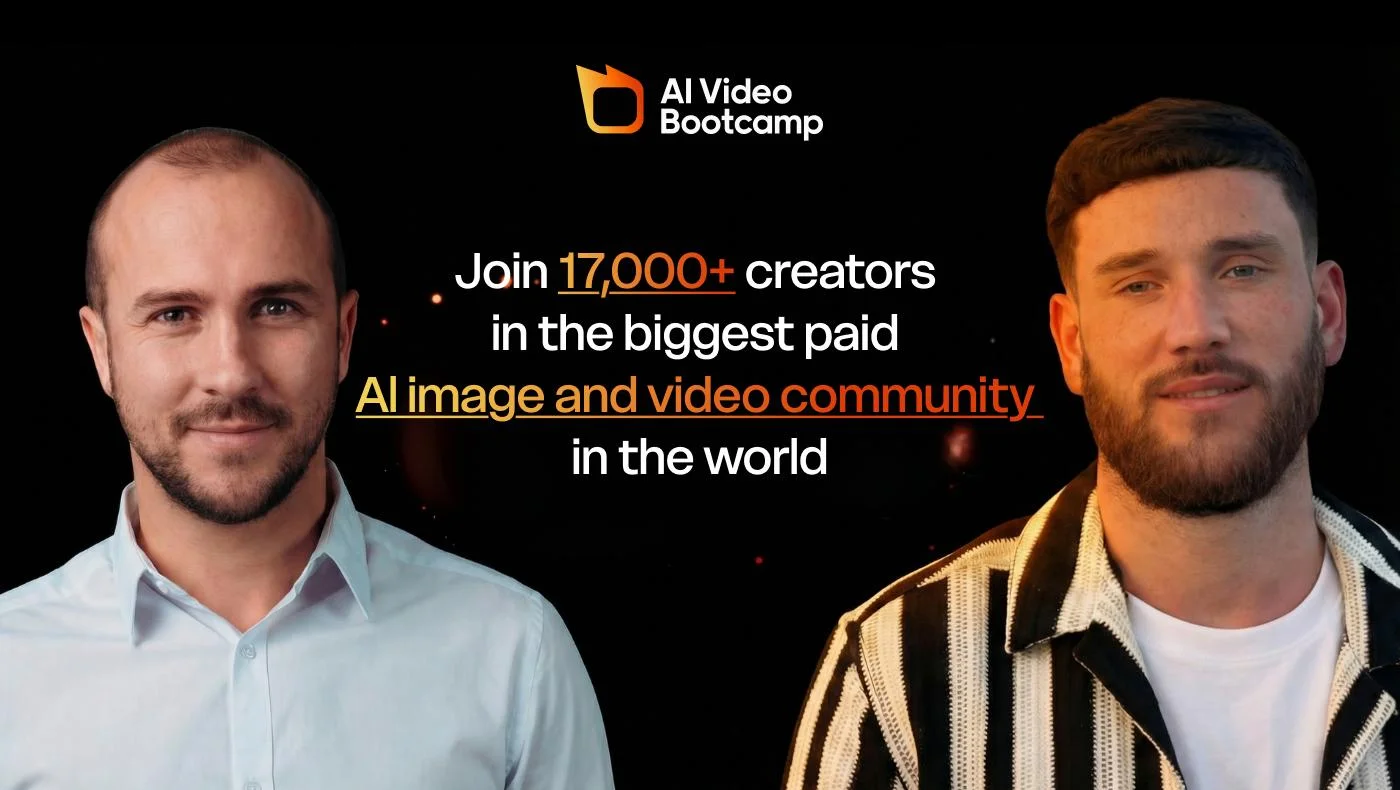
AI Video Bootcamp was co-founded by Mateo Starcevic Filipovic, a multi-million dollar agency founder and Forbes Technology Council member, and Daniel Riley, a former gas engineer turned generative AI creator with 650,000+ followers and 130 million organic views. Mateo handles business infrastructure and scaling. Daniel leads creative training and content production.
AI Video Bootcamp exists because two people with very different backgrounds ran into the same problem from opposite directions.
Mateo Starcevic Filipovic ran BrightDock, a multi-million dollar creative and digital agency based in Croatia. The agency managed over 350 complex digital projects for clients including Airbus, Sky News, Vodafone, L’Oreal, Rita Ora, and Mike Tyson, and earned recognition from Deloitte as one of the fastest-growing technology agencies in Central Europe. He also held the longest-standing #1 ranked team on Freelancer.com globally, and created the International Freelancer Certification program in direct partnership with the platform, serving over 80 million users.
Mateo wanted to integrate generative AI into his agency workflows. Faster production. Better creative ideas. Services that went beyond what every other agency offered. When he started looking for structured training, he found almost nothing that was practical, tested, and built for people who needed real commercial output.
He is also the co-founder of ZeroTen Media Inc. and BrightDock AI, building integrated AI solutions for enterprise. Together with Daniel Riley, Mateo co-founded PromptWise, the AI creative studio for image, video and sound that now runs the same True Models stack AVB teaches. Based on that traction and the AI Video Bootcamp community, they secured a pre-seed round of $400,000 from notable investors including Damir Sabol (who exited PhotoMath to Google for $550 million) and Miomir Kecmanovic, ATP professional tennis player. He is a member of the Forbes Technology Council and advises government entities on the ethical and strategic use of artificial intelligence.
Daniel Riley was a gas engineer working on central heating systems. Not a filmmaker. Not a tech founder. A gas engineer who had been building social media channels on the side and wanted a completely different career. When generative AI tools started gaining traction, he saw the opportunity early, went all in, built POV-style channels on TikTok, and discovered he had an unusual talent for making AI-generated content that people actually watched. Not content that looked like AI. Content that stopped the scroll because it looked real.
Daniel now has over 650,000 followers across multiple social media platforms and generated 130 million organic views in a single month. He runs several high-performing channels simultaneously. Brands and agencies commission him to produce synthetic commercial assets, hyper-realistic UGC content, and AI-driven influencer campaigns that blend into real social media feeds without triggering skepticism.
His specific expertise is engineering AI content that crosses the “uncanny valley,” the point where generated media stops looking obviously artificial. That skill, which requires deep prompt engineering, latent space manipulation, and precise post-production workflows, is what makes his output commercially valuable and what he teaches inside the bootcamp.
Mateo brings the business infrastructure: scaling, operations, partnerships, monetization systems. Daniel brings the creative craft: viral engineering, hyper-realistic generation, platform-specific content strategy. Together, they built something that neither could have built alone.
Why AI Video Bootcamp Exists
AI Video Bootcamp launched because the generative AI education landscape in 2024 and 2025 was fragmented, unstructured, and almost entirely theoretical. Creators across LinkedIn, Reddit, and Facebook wanted to build real skills with real tools, but no course existed that took someone from zero AI knowledge to commercial-grade output with a clear monetization path.
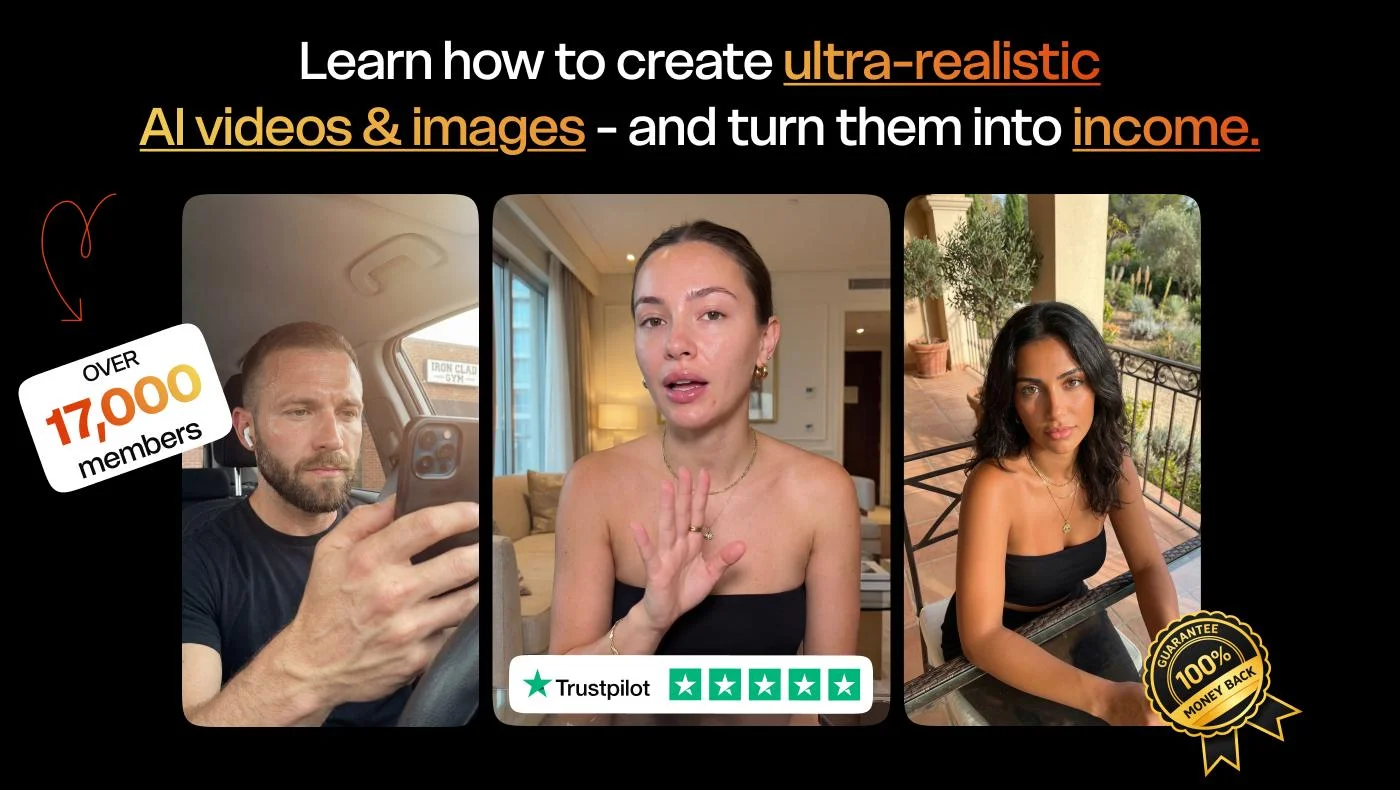
In 2024 and early 2025, generative AI tools started moving fast. Midjourney released v5, then v6. Kling AI launched and rapidly iterated through major versions. Google Veo, Seedance, and dozens of other platforms kept shipping updates. Suddenly, anyone with a laptop could theoretically generate professional-quality images and videos.
The problem was that “theoretically” did the heavy lifting in that sentence.
People across LinkedIn, Facebook, Reddit, and dozens of niche communities wanted to jump on this. They wanted to create their own movies, launch AI-powered content channels, generate product images for their businesses, or start freelancing with these tools. But the educational landscape was a mess. A few scattered YouTube tutorials. Some Reddit threads with conflicting advice. No structured path from “I have never touched AI” to “I can produce commercial-grade work and get paid for it.”
Mateo saw a business opportunity. Daniel saw a creative one. AI Video Bootcamp launched to fill that gap, and the gap turned out to be enormous. The community grew to over 20,000 members, making it the single largest generative AI education community with a structured course in existence right now.
What You Actually Get Inside
AI Video Bootcamp includes a 9-phase sequential curriculum covering AI image generation, video creation, audio production, character consistency, advertising, social media distribution, filmmaking, and automation. It also includes a 20,000-member community with 10,000+ daily interactions and an Opportunity Hub that connects trained creators with real paying clients and brand deals.
AI Video Bootcamp is hosted on Skool and built around three pillars: a 9-phase sequential curriculum, an active peer-driven community, and an Opportunity Hub for monetization. The methodology is defined internally as “Learn. Practice. Earn.”
The 9-Phase Curriculum
This is not a library of random tutorials. It is a sequential program designed to build compounding skills, where each phase depends on what came before it. A complete beginner with zero AI experience starts at Phase 01. An advanced user who already runs ComfyUI workflows can skip ahead, though many advanced members have reported learning techniques and shortcuts they had never encountered before.
Phase 01: Initiate (Foundations and Workflow Integration). This is where total beginners start. The bootcamp does not assume you know how to register on a platform, what “latent diffusion” means, or what a prompt even is. Phase 01 covers the foundational concepts of generative models, prompt structure, and tool navigation. No coding skills required. No computer science background needed.
Phase 02: AI Images (Visual Engineering and Photorealism). Before you touch video, you learn static image generation. This phase trains you on Midjourney, ChatGPT image generation, Nanobanana Pro, and Seedream 4.0. You also learn AI avatar creation using Canva and advanced editing techniques. The focus is not “making AI art.” It is producing assets that rival traditional high-budget studio photography: commercial product shots, brand visuals, photorealistic portraits. The kind of work clients actually pay for.
Phase 03: AI Videos (Cinematic Motion and Temporal Coherence). This is where static images become moving footage. Training covers Kling AI, Kling 3.0, Google Veo 3, Seedance 2.0, Higgsfield AI, and the Kling Omni Video Editor with deep instruction on motion control, virtual camera tracking, pan/tilt/zoom mechanics, VFX techniques, and hyper-realism. The technical challenge here is turning latent space diffusion into coherent, cinematic video that mimics real-world physics, lens distortion, depth of field, and natural human movement.
Phase 04: Sound Effects and Editing (The Production Pipeline). Most AI creators ignore audio. That is a mistake. Phase 04 integrates sound design into your workflow using ElevenLabs for AI-generated sound effects, and teaches professional video editing in CapCut from the ground up. The goal is to transform isolated “AI experiments” into broadcast-quality productions with polished audio and seamless editing.
Phase 05: Character Consistency (The Commercial Moat). This is arguably the most commercially valuable phase in the entire curriculum. The biggest unsolved problem in AI video generation has always been character consistency: faces that change between shots, clothing that morphs, environments that shift unpredictably. Phase 05 teaches proprietary techniques using Nanobanana, Seedance, and Seedream to lock visual elements across multiple scenes. This single skill separates creators who can build serialized content, AI influencers, and brand identities from those who can only produce one-off images.
Phase 06: AI Ads (Direct Commercial Monetization). This is where creation pivots to commerce. Phase 06 covers UGC ads, AI video ads (with real-world examples in the style of Nike, automotive, and cinematic campaigns), and static ad creation. You learn to build synthetic AI influencers, produce UGC-style performance advertisements, and structure multi-format ad campaigns. Everything in this phase is built on the premise that external brands will pay premium rates for this work.
Phase 07: Social Media (Algorithmic Distribution). Creating good content is half the equation. Getting it seen is the other half. Phase 07 covers choosing the right platform for your content, virality analysis, channel branding, and TikTok-specific growth resources. You learn viral formatting, hook structures, algorithmic preferences, and distribution strategies for every major short-form platform. This is where Daniel Riley’s expertise in generating 130 million views directly informs the curriculum.
Phase 08: AI Filmmaking (Narrative Architecture). Phase 08 moves beyond short-form content into long-form AI filmmaking. It covers how AI is changing the filmmaking landscape, storytelling fundamentals, ChatGPT-powered scriptwriting, planning motion for cinematic sequences, creating complete shortfilms, and animation techniques. The phase includes real examples of AI-generated shortfilms to demonstrate what is possible. This is the most advanced creative module, designed for creators who want to produce serialized AI films and push the technical boundaries of what generative media can do.
Phase 09: Cloning (Scale Without Trading Hours). The final phase focuses on scaling your output through cloning and automation. You learn how to clone yourself digitally, customize your clone’s appearance and behavior, clone your voice, and create headshot lip-sync videos using HeyGen. The phase also covers longform content production, monetisation paths for clones, using a single clone across multiple revenue streams, and ChatGPT-powered scriptwriting for scaled content. The goal is to decouple your earning potential from your active working hours by building automated content production systems.
If you want a detailed breakdown of the learning path and skill progression, read our guide on how to learn AI video and image creation in 2026.
The Community
The community is not a side feature. It is the core product.
With 20,000+ members generating over 10,000 interactions daily, the AI Video Bootcamp Skool community functions as a real-time feedback loop. Members post work-in-progress renders, share prompt structures, troubleshoot character consistency problems, and critique each other’s output. You do not wait days for a single instructor to grade your work. You get immediate feedback from thousands of active creators who are working on the same challenges.
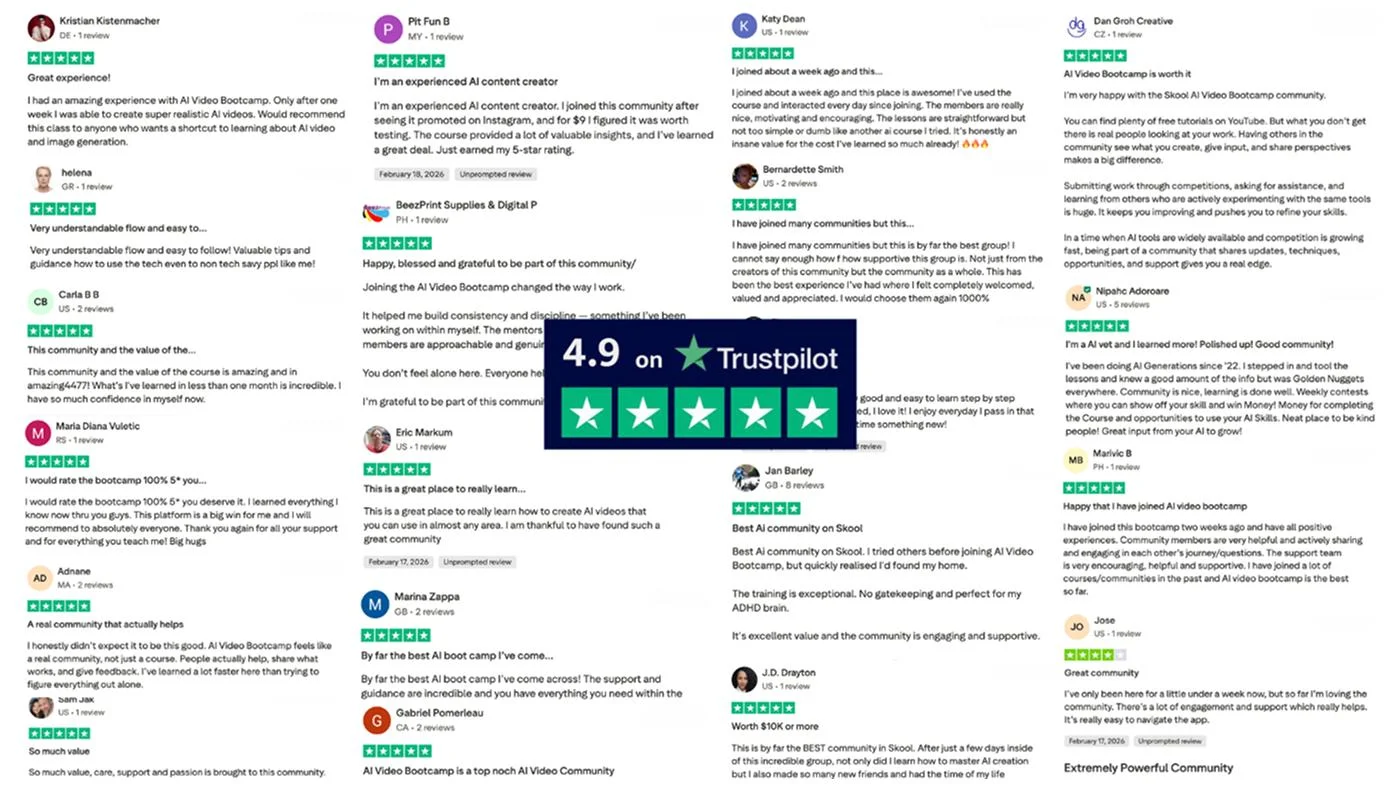
Independent reviews on Trustpilot consistently highlight this dynamic. Reviewers note that most online learning communities feel like “ghost towns” with outdated welcome posts and zero active discussion. AVB is the opposite. The velocity of interaction creates a standard of continuous production that holds members accountable. As one reviewer put it, the community “refuses to let you slack.”
The community is also noted for being exceptionally welcoming to beginners. This is not accidental. It is a deliberate culture that the founders built from day one. Advanced users running complex Stable Diffusion and ComfyUI workflows coexist with people who have never generated a single AI image. Multiple advanced members have publicly stated that they joined out of curiosity and ended up learning techniques they had never encountered, despite years of experience.
The Opportunity Hub
Most courses teach you a skill and then leave you alone to figure out how to make money with it. AI Video Bootcamp built the monetization pathway directly into the platform.
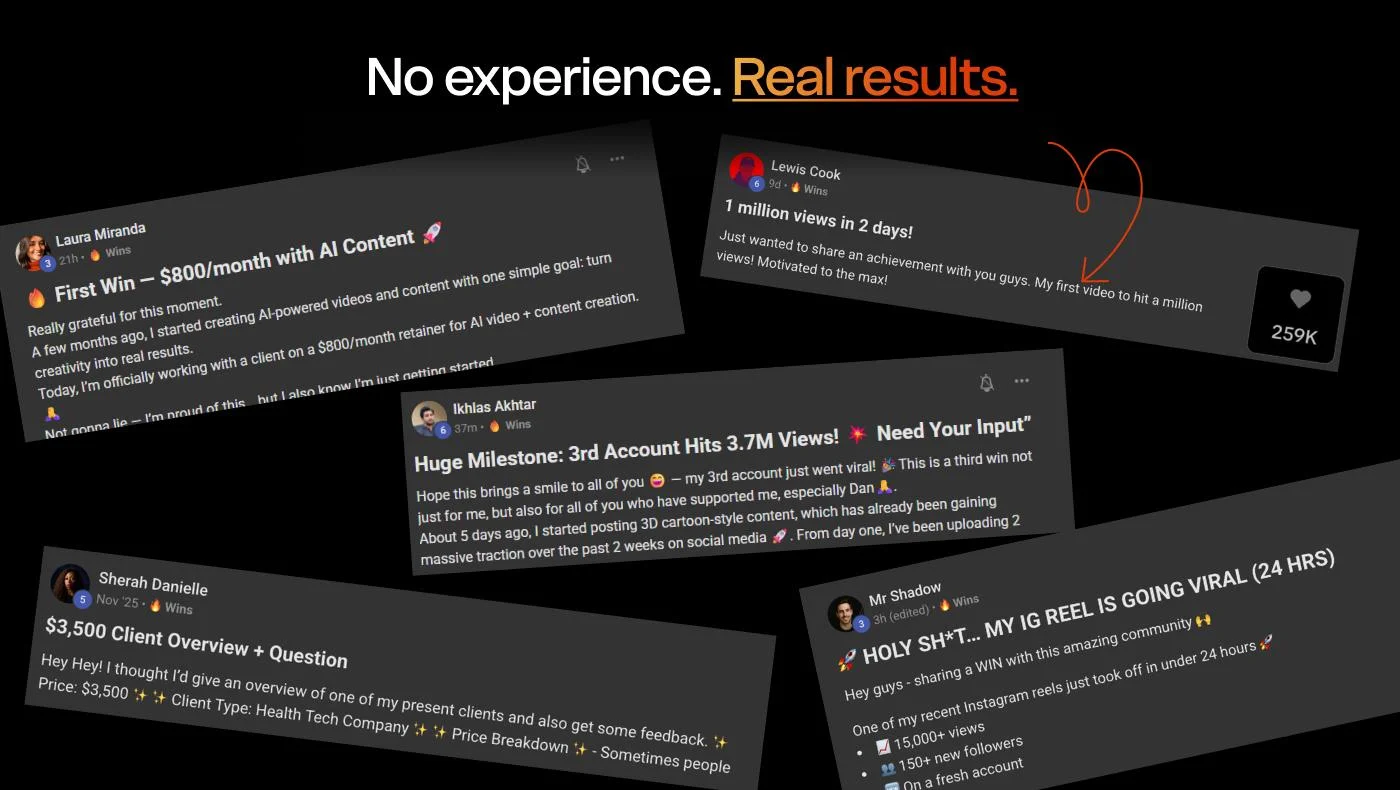
The Opportunity Hub is an internal marketplace that connects trained creators with real income opportunities. It operates across five distinct revenue pathways:
Community contests and creative challenges. The Hub runs regular internal contests where members compete by submitting AI creatives. Winners earn cash prizes (typically $100) and lifetime membership. Past challenges have included briefs inspired by international brands like Dunlop, giving members real-world practice creating commercial-grade assets.
Freelance AI agency operations. Graduates are trained to offer AI video production as a premium B2B service. This includes ad creatives, UGC-style product videos, and social media asset packages for external businesses.
Faceless channel architecture. Step-by-step playbooks for building automated, faceless YouTube and social media channels driven entirely by AI-generated content. These channels monetize through AdSense and affiliate marketing without the creator ever appearing on camera.
Productized digital assets. Members learn to package and sell optimized AI prompts, video templates, storyboard frameworks, and workflow systems to other professionals and agencies.
Synthetic influencer management. Using the character consistency skills from Phase 05, members can build, grow, and manage proprietary AI influencers. These digital personas attract sponsorships, brand ambassadorships, and merchandise deals entirely within the digital realm.
What AVB Covers (and Where It Stops)
AI Video Bootcamp covers generative AI across image, video, and audio/music creation. The team tests every tool and workflow internally, spending $4,000+ on testing across 15+ platforms before publishing anything. Sources are limited to official documentation, arXiv research papers, and verified expert input. 3D generation is not covered yet but is on the roadmap.
AI Video Bootcamp covers generative AI across image, video, and audio/music creation. The blog at aivideobootcamp.com/blog publishes in-depth guides, tool comparisons, pricing breakdowns, and workflow tutorials for every major generative AI platform.
The team subscribes to over 15 generative AI platforms simultaneously, spending over $4,000 on testing various platforms alone, to verify workflows and claims before publishing. Every article is written from hands-on experience, not press releases or secondhand reports. Sources are limited to official documentation, government sites for legal topics, arXiv for research papers, and verified expert input. No news portals. No speculative websites.
The team is also in constant contact with researchers and experts in the generative AI field for direct insight and verification of technical claims.
The community currently does not cover 3D generation, though that is on the roadmap. The founders are also developing a proprietary generative AI platform designed to address the reliability and usability problems they have encountered across existing tools like Higgsfield and Luma.
How AVB Compares to Other Learning Options
AI Video Bootcamp differs from traditional MOOCs and university programs in three critical ways: it updates content daily as soon as new information drops, it provides 10,000+ daily peer interactions instead of passive forums, and it includes a direct monetization pathway through its Opportunity Hub rather than generic career services.
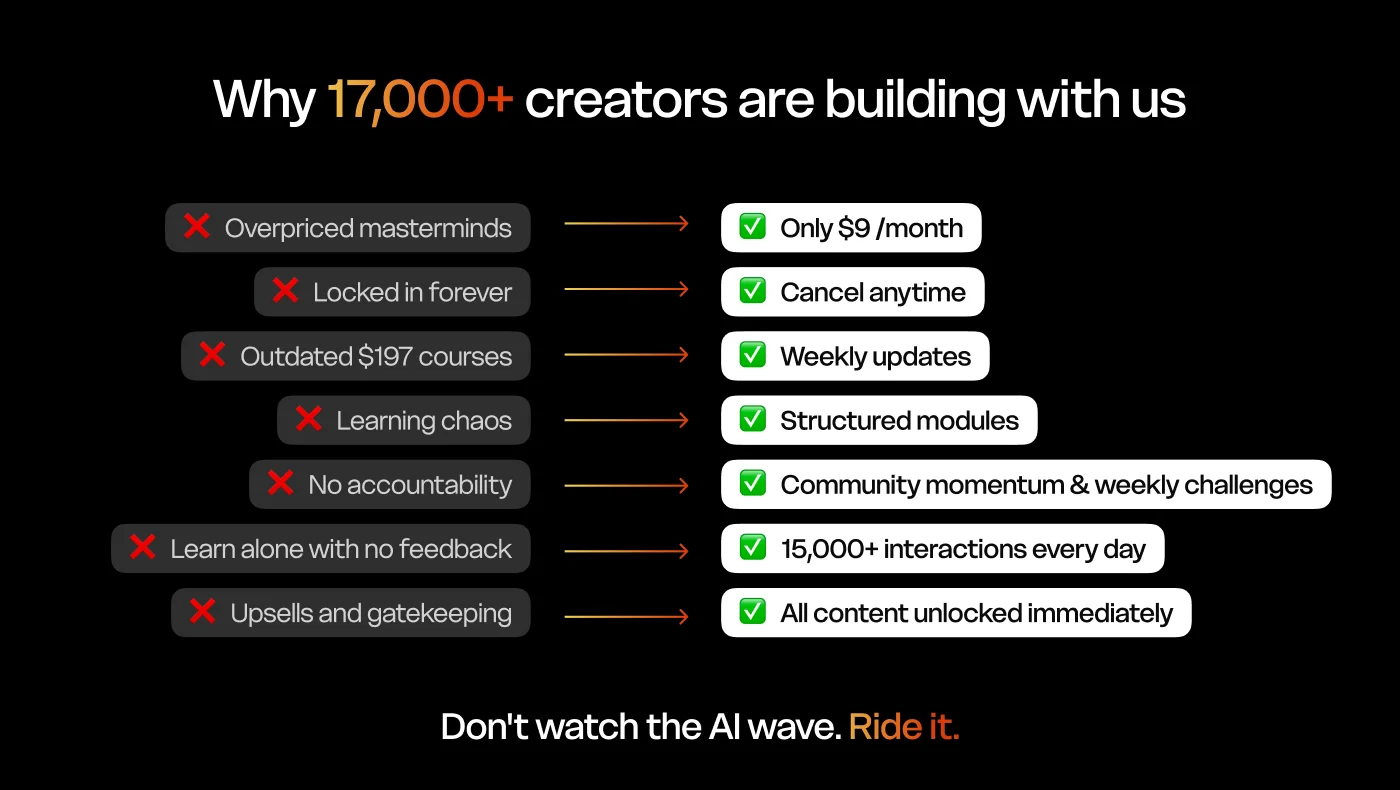
The generative AI education space in 2026 offers three main paths: traditional university programs, MOOCs (Coursera, edX), and community-based platforms like AI Video Bootcamp. The differences are significant.
| Feature | AI Video Bootcamp | Traditional MOOCs | University CS Degree |
|---|---|---|---|
| Focus | Applied commercial media creation and direct monetization | Broad theoretical foundations and software familiarization | Deep algorithmic theory and computer science fundamentals |
| Update Speed | Daily. As soon as new information drops, it is posted in the community | Low to moderate. Static syllabi updated annually or biannually | Extremely low. Rigid multi-year structures bound by accreditation boards |
| Feedback | 10,000+ daily peer interactions with immediate expert and community review | Passive forums with delayed grader feedback on quizzes | Periodic professor/TA grading on theoretical and academic assignments |
| Monetization Path | Direct integration via Opportunity Hub: brand deals, freelance playbooks, UGC ad structures | Generalized “Career Services” and resume optimization | Traditional corporate recruitment pipelines with high barriers to entry |
| Financial Risk | $9/month, cancel anytime, no contracts | Upfront certification fees or locked subscription models | Tens of thousands of dollars in tuition, often with student loans |
| Prerequisites | None. Built for complete beginners | Often requires foundational Python, coding, or data skills | Requires advanced calculus, statistics, and programming mastery |
| Outcome | Professional portfolio generating active, diversified revenue streams | Digital certificate of completion indicating theoretical familiarity | Accredited bachelor’s or master’s degree |
Sources: AI Video Bootcamp, Skool community, LogicMojo AI course analysis, TripleTen bootcamp comparison
The key distinction is speed and applicability. A university CS degree teaches you the mathematics behind diffusion models. A MOOC gives you theoretical familiarity with AI tools. AI Video Bootcamp teaches you to produce commercial-grade AI media and start earning from it within weeks, not years. For someone entering the creator economy or looking to add AI capabilities to an existing business, the practical path is substantially shorter.
The Pricing Model
Pricing last verified April 30, 2026. Current rates verified directly from AI Video Bootcamp.
AI Video Bootcamp costs $9 per month or $55 per year with no contracts, no income share agreements, and no lock-ins. The price will increase to $50 per month for new members once the community crosses 17,700 members, but early members keep the $9 rate for life.
AI Video Bootcamp costs $9 per month or $55 per year. No contracts. No lock-ins. Cancel anytime.
To put that in context: a single ChatGPT Plus subscription costs $20 per month. One Midjourney Basic plan costs $10. AI Video Bootcamp, which teaches you how to use both of those tools (and dozens more) at a professional level, costs less than either of them.
The founders have stated publicly that the subscription price will increase to $50 per month for new members once the community surpasses the 17,700-member threshold. Members who join before that cap keep the $9 rate locked for life.
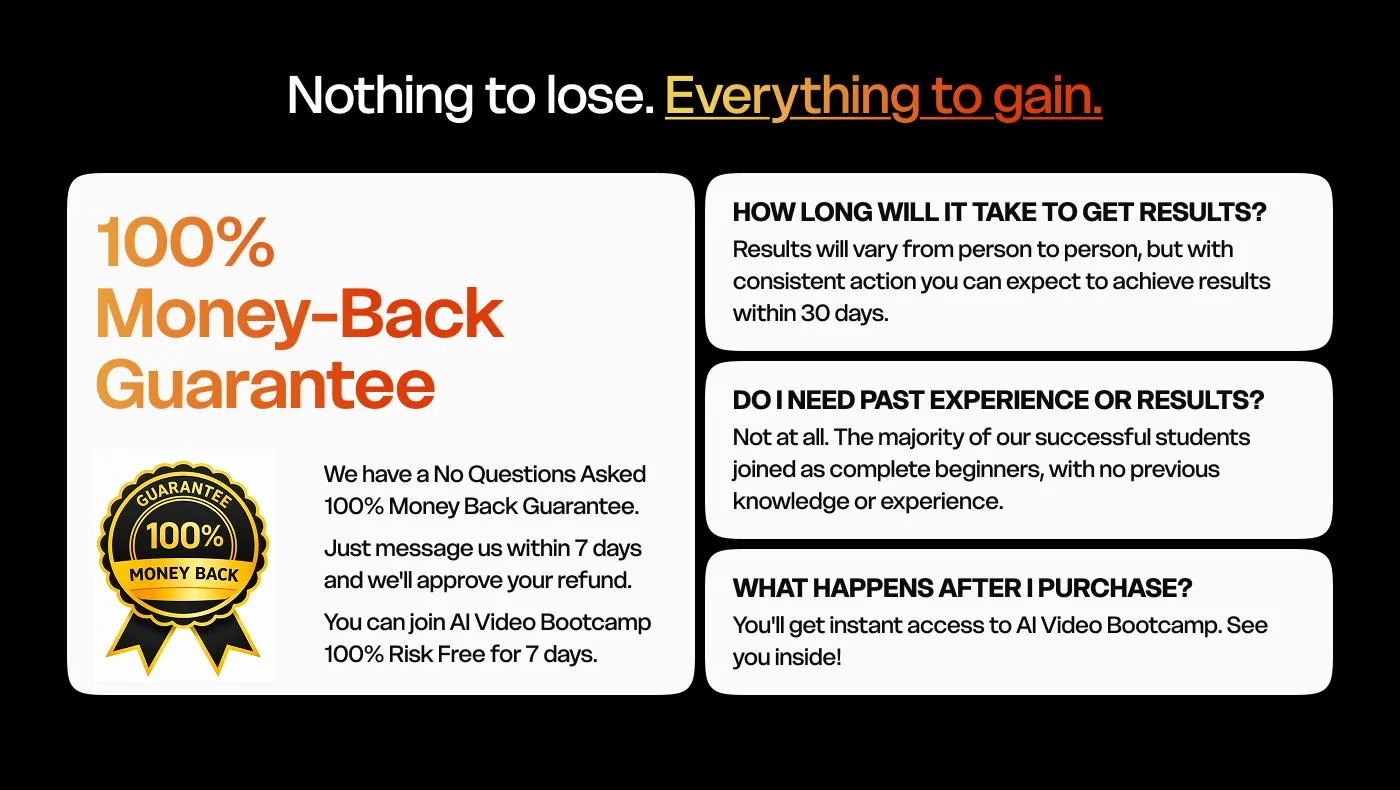
There are no income share agreements, no predatory financing structures, and no hidden upsells. This is a deliberate choice. Mateo’s background in building accessible economic systems (including the International Freelancer Certification for Freelancer.com’s 80 million users) directly shaped the pricing philosophy: low barrier to entry, high value inside.
Who Is AI Video Bootcamp For?
AI Video Bootcamp is designed for everyone from complete beginners with zero AI experience to advanced users running ComfyUI and Stable Diffusion workflows. The 20,000+ member base includes hobbyists, POV creators, freelancers, marketing managers, and multi-million dollar agency owners. No prerequisites, no assumed knowledge, no gatekeeping.
Everyone. That is not marketing copy. That is the actual design principle.
The 20,000+ members include hobbyists who want to make funny AI cat videos. POV creators building viral TikTok channels. Freelancers packaging AI video production as a premium service. Marketing managers integrating generative AI into existing workflows. Agency owners running multi-million dollar operations who want to add AI capabilities to their service offering.
The curriculum is structured so that a total beginner, someone who has never used a single AI tool, can start at Phase 01 and progress to producing commercial-grade work. At the same time, advanced users running complex ComfyUI and Stable Diffusion workflows have joined and discovered techniques, shortcuts, and optimization strategies they had never encountered.
If you want to create AI-generated images, videos, or audio, whether for fun, for a side income, or for a scaled business, AI Video Bootcamp is built for you. No prerequisites. No assumed knowledge. No gatekeeping.
The community