
You’ve probably seen the thumbnails. “I made $50K last month with AI videos!” Next to a screenshot of an AdSense dashboard and a shocked face.
Most of it is garbage. Recycled advice from people who’ve never actually done it.
But here’s the thing: some people really are making serious money with AI video. Not theoretical money. Not “potential” money. Real, documented, screenshot-verified income.
I spent weeks digging through Fortune profiles, Reddit threads, Fiverr seller pages, Upwork job boards, and creator communities to find them. I wanted specifics. Names. Tools. Monthly costs. Revenue numbers. Timelines. The stuff that actually helps you decide if this is worth pursuing.
What I found surprised me. The biggest earner makes content his audience literally sleeps through. The fastest path to $1K doesn’t involve YouTube at all. And the lowest-cost approach runs on $20/month in API fees. For detailed data on the broader creator economy and AI video market growth, see our generative AI statistics report.
Here are five real people (and real composites from verified communities) making $10K or more per month with AI video, broken down to the dollar.
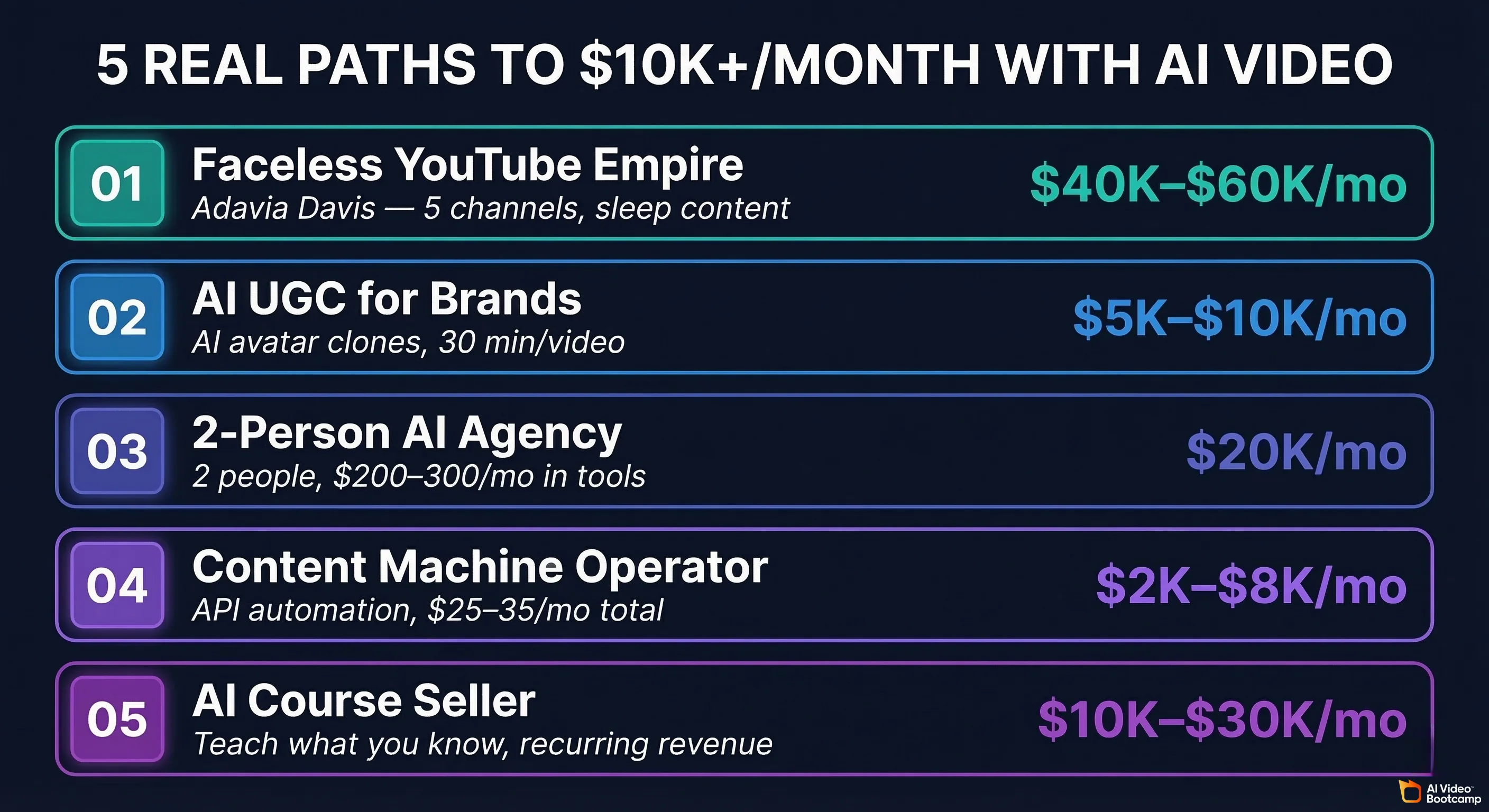
Case Study #1: Adavia Davis and the Faceless YouTube Empire ($60K/Month)
Adavia Davis is 22 years old. He dropped out of college in Mississippi. He makes between $40,000 and $60,000 every single month from YouTube.
His viewers are asleep.
That’s not a joke. Adavia runs multiple faceless YouTube channels, and his biggest earner is a channel called “Boring History” that publishes 6-hour documentary-style videos designed specifically as background content for people falling asleep. Think “history to sleep to” narrated by an AI voice over AI-generated visuals.
Fortune magazine verified his income with actual AdSense screenshots in December 2025. This isn’t some anonymous Reddit claim. It’s documented journalism.
How He Actually Does It
Adavia doesn’t sit at a computer editing videos for 12 hours a day. He oversees everything for about 2 hours daily. The heavy lifting comes from a system he built with his business partner Eddie Eizner, who developed a proprietary pipeline called TubeGen.
Here’s the stack:
- Scripts: Claude AI generates the narration scripts
- Voice: ElevenLabs handles the AI narration
- Visuals: AI-generated imagery throughout
- Pipeline: TubeGen (custom software) stitches everything together
- Team: Small salaried teams managing different niche channels
He runs 5 active channels spanning history documentaries, Minecraft compilations, animal compilations, celebrity gossip, and anime edits. The production cost for a single 6-hour video can be as low as $60.
The Monthly Numbers
| Item | Cost |
|---|---|
| Salaried teams (across all channels) | ~$6,500/month |
| AI tools (ElevenLabs, Claude, etc.) | ~$200/month |
| Total monthly costs | ~$6,700/month |
| Monthly revenue | $40,000-$60,000 |
| Profit margin | 85-89% |
What Beginners Need to Understand
Before you rush off to create a faceless YouTube channel, here’s the context that matters:
Adavia started YouTube when he was 10 years old. That was 2014. He spent years understanding the algorithm, testing formats, and learning what drives watch time before AI tools even existed. He sold his first successful channel to a brand and used the money to buy a Tesla (spending his last savings on the bet).
His partner built custom software that most beginners will never have access to. The real competitive advantage isn’t any single AI tool. It’s the system, the pipeline, the understanding of what YouTube rewards.
Could you replicate his exact approach? Probably not. Could you build a smaller version earning $2,000 to $5,000 per month? That’s much more realistic, and we’ll talk about timelines later.
Key insight from Adavia: “If I stayed in school, I was going to be broke and distracted.” He went all in. That level of commitment matters more than any tool.
If you want to understand how faceless channels work from a technical perspective, our complete beginner guide to making AI videos walks through the exact production workflow step by step.
Case Study #2: The AI UGC Creator ($5,000-$10,000/Month)
This case study is a composite drawn from multiple verified creators in the r/UGCcreators community, Argil AI’s creator network, and platforms like JoinBrands and Billo. I’m combining them because the model is remarkably consistent across successful AI UGC creators.
UGC stands for User Generated Content. Brands pay real people to create short product videos: testimonials, unboxings, how-to demos, ad creatives. Traditionally, UGC creators film themselves, edit the video, and deliver it to the brand.
AI UGC flips this model. You film yourself once. Then you use AI avatar tools to generate infinite variations of yourself presenting different products, reading different scripts, in different styles. One filming session becomes hundreds of potential deliverables.
How It Works Day to Day
The typical AI UGC creator follows this workflow:
- Film a high-quality “base video” of yourself talking to camera (once)
- Use an AI avatar tool like Argil AI, MakeUGC, or HeyGen to clone your likeness
- When a brand sends a brief, feed the script to your AI clone
- The tool generates a video of “you” presenting the product
- Edit in CapCut, add captions, deliver to client
The turnaround time drops from 3-4 hours per video (traditional UGC) to about 30 minutes. That’s what makes the math work.
The Pricing Breakdown
Here’s what successful AI UGC creators charge, pulled directly from a full-time creator’s rate card shared on Reddit:
| Deliverable | Price |
|---|---|
| Base rate (30-second video, 90-day usage) | $250 |
| Additional hook variations | +$25 each |
| Unlimited usage rights upgrade | +100% markup |
| Top-end single deliverable | $1,000 |
That $1,000 figure breaks down as $400 base + $100 in hooks + $500 for unlimited usage rights. These deals happen regularly for brands running heavy ad spend who need lots of creative variations.
To hit $5,000 to $10,000 per month, you need 20 to 40 videos delivered. That’s 1-2 per day, which is very doable when AI handles the heavy lifting.
Monthly Cost Breakdown
| Tool | Cost |
|---|---|
| Argil AI or HeyGen (avatar generation) | $30-$100/month |
| CapCut Pro (editing) | $8/month |
| ChatGPT or Claude (script assistance) | $20/month |
| Total monthly costs | $58-$128/month |
| Monthly revenue at scale | $5,000-$10,000 |
How to Find Clients
The creator community consistently points to these channels:
- JoinBrands and Billo: Marketplace platforms where brands post UGC briefs
- Direct outreach on LinkedIn: Message marketing managers at DTC brands
- Fiverr and Upwork: List your services (be aware the competition is fierce)
- Portfolio posts on TikTok/Instagram: Show your work, tag brands, attract inbound
One interesting Reddit observation: “You have to be careful with Fiverr because most creators there are using AI even if you specify that you don’t want AI content.” The market is already shifting toward AI UGC as the default.
Realistic Timeline
- Month 1-2: Build your portfolio. Do some work at $50-$100 per video just to get testimonials and samples.
- Month 3-4: Raise your prices. Get repeat clients. Start charging $250+ per deliverable.
- Month 6+: Hit $5K/month if you’ve been consistent with outreach and delivery.
Key insight: AI UGC is probably the fastest path to your first $1,000 in AI video because you’re selling directly to businesses who already have budgets allocated for this exact content. You don’t need to build an audience first.
Case Study #3: The 2-Person AI Video Agency ($20K/Month)
This one comes from a Reddit post on r/passive_income that got significant traction. A user described their friend’s operation: a 2-person AI video agency making $20,000 per month. The team is just the founder and a creative strategist.
They produce AI-generated ad creatives, localized corporate videos, and social media content packages for businesses. The clients don’t care (or often even know) that AI is involved. They care about results: more engagement, more conversions, more content for less money.
The Service Stack
Here’s what they offer and what they charge:
| Service | Price Range |
|---|---|
| Single AI ad creative | $500-$1,000 |
| Video localization (one video into multiple languages) | $1,500-$2,500 |
| Social media content package (monthly) | $2,000-$5,000/month retainer |
| Corporate explainer video | $1,000-$2,500 |
One particularly clever service: using AI to localize a single corporate video into 20 languages. One project, $2,500. The AI handles the translation, voice synthesis, and lip-sync. The manual effort is quality control and delivery.
Tool Stack and Costs
| Tool | Purpose | Cost |
|---|---|---|
| Runway Gen-4.5 | Video generation | $76/month |
| Kling AI | Video generation (alternative) | $66/month |
| ElevenLabs | Voice generation and dubbing | $22/month |
| HeyGen or Synthesia | AI avatar presenters | $59-$89/month |
| Premiere Pro or CapCut | Assembly and finishing | $23/month or free |
| Total monthly tools | $200-$300/month | |
| Monthly revenue | $20,000 |
The profit margins are extraordinary because the primary input is expertise and time, not expensive equipment or large teams.
Why This Works So Well
Traditional video agencies charge $5,000 to $50,000 per project and take weeks to deliver. They need camera operators, editors, actors, studio space. A 2-person AI video agency can deliver comparable (sometimes better) output in days for a fraction of the cost.
The Reddit poster was direct about it: “They started from 0 with some videography skills.” That’s it. They understood video enough to know what good output looks like, then used AI tools to produce it at scale.
As of February 2026, Upwork lists over 4,200 open AI video jobs. Freelancers on the platform charge $50 to $150 per hour for AI video production. One Fiverr seller built a million-dollar business over several years by pivoting to AI-enhanced cinematic brand videos during COVID.
The Freelancer-to-Agency Pipeline
Most successful AI video agencies start as solo freelancers:
- Week 1-2: Set up profiles on Upwork and Fiverr. Offer AI video creation at competitive rates.
- Month 1-2: Land first clients. Build a portfolio of real work.
- Month 3-4: Raise rates. Start offering package deals and retainers.
- Month 5-6: Bring on one partner or contractor. You’re now an “agency.”
Key insight: You’re not selling “AI videos.” You’re selling results. More content, faster delivery, lower cost. The AI is the back end. The client sees professional output that grows their business.
Case Study #4: The Content Machine Operator ($2,000-$8,000/Month)
This case study comes from one of the most honest posts I’ve ever read about AI content creation. A solo operator on r/passive_income, whose post got 106 upvotes, laid out exactly how they build automated AI content systems across TikTok, Instagram, and YouTube Shorts.
Their opening line was the most useful thing anyone has ever said about making money with AI video:
“Month 1 you will probably make nothing. Like actually nothing. I didn’t see real traction until around week 6. Most people have already quit by then.”
That single quote is worth more than a hundred “make money fast” YouTube videos.
The System
This creator doesn’t manually create content in ChatGPT and Midjourney like a beginner would. They built an automated pipeline:
- API-based generation: Not clicking buttons in a web interface. Programmatic content creation through APIs.
- Batch processing: Generating dozens or hundreds of pieces of content at once.
- Automated posting: Scheduled distribution across multiple platforms.
- Data-driven iteration: Upload 100 variations, check the data, find winners, scale to 1,000 more.
The daily maintenance once the system is running? About 30 minutes.
The Insanely Low Cost Structure
| Item | Cost |
|---|---|
| API costs (image and video generation) | $15-$20/month |
| Production cost per image | 2-5 cents |
| Scheduling tools | $10-$15/month |
| Total monthly costs | $25-$35/month |
| Monthly revenue | $2,000-$8,000 |
Read those numbers again. The monthly cost to run this operation is less than a Netflix subscription. The margins are unlike almost any other business model.
Where the Money Comes From
Short-form AI content earns through multiple streams:
- TikTok Creator Fund: $1,000-$1,500/month with consistent viral content (though TikTok pays poorly per view)
- YouTube Shorts revenue share: YouTube gives creators 45% of ad revenue on Shorts
- Affiliate marketing: Product links in bio, promoted in videos
- Brand deals: Once you have followers, brands pay $200-$2,000 per sponsored post
- Cross-platform leverage: The same content goes to TikTok, Reels, Shorts, and Pinterest simultaneously
Another creator from r/aitubers broke down the volume math that makes this work:
- Traditional approach: 1 team, 1 year, $10K budget = 3,000 videos
- AI approach: 3 minutes of setup, $800 = comparable output
Their advice: “Your job isn’t to chase the next big genius idea. Your job is to find a formula that works, then mass-produce it.”
The Failure Mode Everyone Hits
This creator was brutally honest about why most people fail at this:
“The content strategy matters 10x more than the tech. I’ve seen people with perfect setups make $0 because they have no idea what actually performs.”
The tools are the easy part. Understanding what content resonates on each platform, what hooks drive engagement, what topics have commercial potential… that’s the actual skill. Without it, you’re just “posting random AI content and praying,” which earns exactly $0.
The Honest Ceiling
Let me be direct: TikTok pays terribly for views. Millions of views might only generate a few hundred dollars in direct creator fund payments. The real money comes from converting viewers to other platforms, building an email list, or promoting affiliate products.
The creators making $8,000+ per month from content machines are stacking 4-5 revenue streams across multiple platforms. They’re not relying on any single income source.
For the technical side of building this kind of content pipeline, start with our guide on the best AI video tools for beginners and work up from there.
Case Study #5: The AI Video Course Seller ($10,000-$30,000/Month)
This is the meta-play. The one that makes the most money but requires the most credibility to pull off.
Across YouTube, Udemy, Skool, and Teachable, creators who learned AI video production and then started teaching it are earning $10,000 to $30,000+ per month. Some earn significantly more.
This isn’t unique to AI video. It’s the classic “info product” model applied to a hot niche. But what makes it work right now is that the demand for AI video education is enormous and the supply of credible teachers is still relatively small.
The Revenue Ladder
Successful course sellers in this space use a pricing ladder that looks like this:
| Product | Price | Purpose |
|---|---|---|
| Free YouTube tutorials | $0 | Attract audience, build trust |
| Low-ticket course (Udemy, Skillshare) | $20-$50 | Capture beginners, build email list |
| Mid-tier program (Teachable, own site) | $497-$997 | Core revenue driver |
| High-ticket coaching (1-on-1 or small group) | $2,000+ | Premium offering for serious students |
| Community membership (Skool, Discord) | $49-$99/month | Recurring revenue |
The math gets exciting quickly. A mid-tier course at $497 needs only 20 sales per month to hit $10,000. A community at $99/month needs just 100 members for recurring five-figure income.
Monthly Cost Breakdown
| Tool | Cost |
|---|---|
| Teachable or Kajabi (course hosting) | $39-$149/month |
| Synthesia or Descript (course video creation) | $24-$89/month |
| Email marketing (ConvertKit, etc.) | $29-$79/month |
| Skool (community, if applicable) | $99/month |
| Total monthly costs | $150-$400/month |
| Monthly revenue at scale | $10,000-$30,000+ |
Why This Works Right Now
Multiple Udemy courses on “Faceless YouTube with AI” sell for $20-$50 each and have thousands of students. Forbes covered the broader course-selling model in detail, highlighting how creators layer courses + coaching + templates + speaking engagements for compounding revenue.
The creators doing this best follow a specific pattern:
- Actually make money with AI video first. Pick any method from cases 1-4.
- Document the journey publicly. Post on YouTube, Twitter/X, share results.
- Build an audience of people who want your results. This happens naturally if step 2 is genuine.
- Sell the system. Package your knowledge into courses, coaching, or community.
The Honest Warning
This is where the “AI video” space gets messy. For every legitimate teacher sharing real experience, there are ten people who watched a few YouTube videos, made $0 actually creating AI content, and launched a $997 course teaching others how to make money.
The market is getting crowded with “gurus.” Differentiation comes from one thing: proof. Real screenshots, real case studies, real results that people can verify.
If you’re considering this path, build the portfolio and track record first. Spend 3-6 months actually doing the work. Then teach from experience, not theory.
Key insight: The biggest money in the AI video space is in teaching, not producing. But you need to produce first to have anything worth teaching.
What About AI Stock Footage? (The Honest Answer)
I’m including this section because you’ll see people recommending it, and I want to save you time.
AI stock footage is not a $10K/month path for most people. Here’s the reality:
- One creator uploaded 100 AI images to Adobe Stock and earns about $30/month. Ninety percent of that income comes from a single image.
- AI video payouts on stock platforms range from $2.80 to $86 per sale.
- One creator’s best month selling AI images on stock platforms over two years was roughly $350.
- Stock platforms now require “Generative AI” labels, and many buyers filter those out.
Could you make $100-$500/month with a large, well-tagged library of niche AI stock footage? Maybe. But it takes months to build that library, the market is getting flooded, and the returns are modest compared to every other method in this article.
I’d recommend stock footage as a supplement to other income, not a primary strategy.
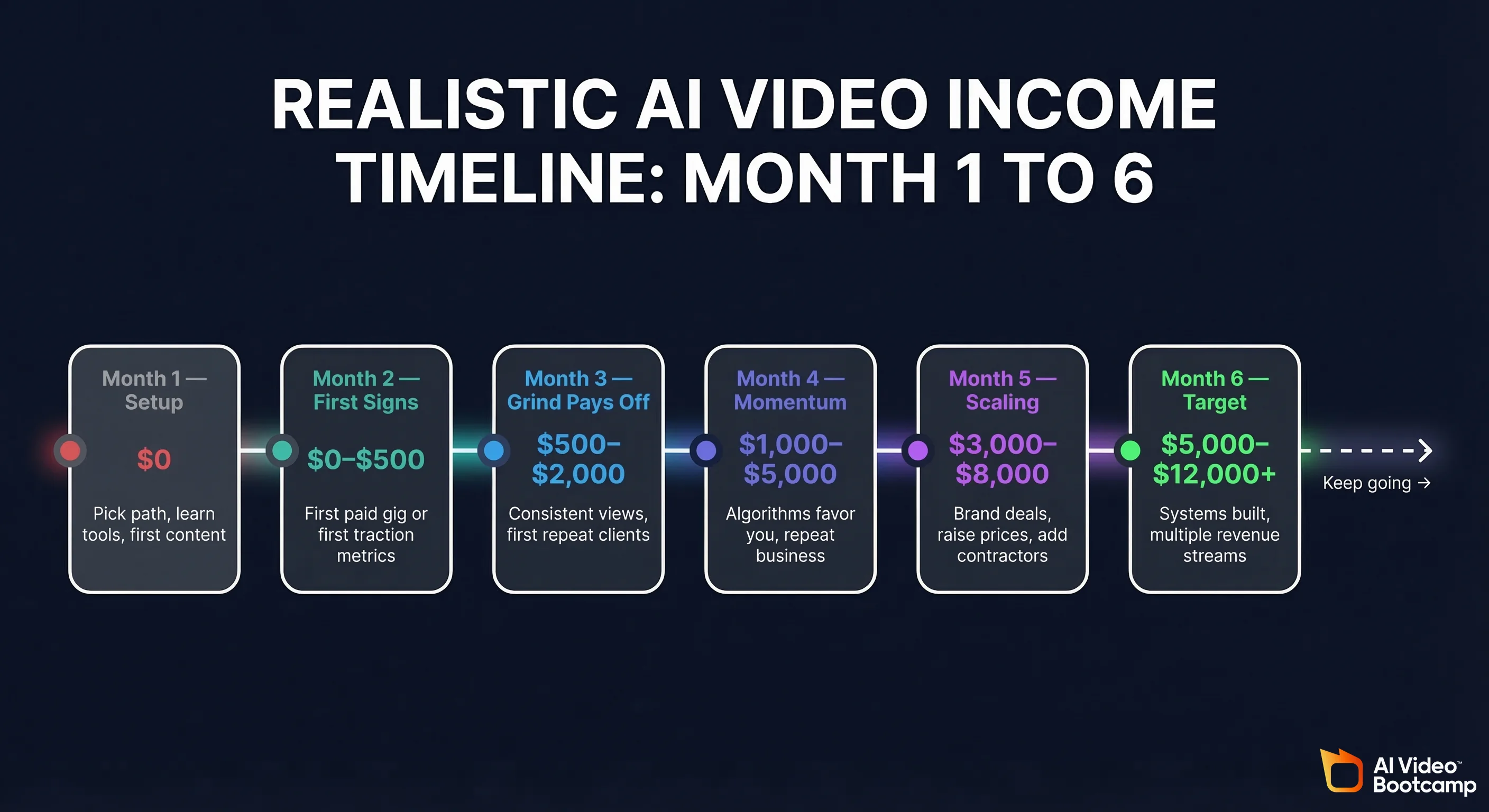
The Realistic Timeline: Month 1 Through Month 6
This is the section most “make money with AI” articles skip. Every successful creator I researched told a similar story about timelines, so let me lay it out honestly.
Month 1: The Setup Month ($0 Revenue)
You’re picking your path, learning tools, and producing your first content. If you’re going the UGC or agency route, you’re building your portfolio and setting up profiles on platforms. If you’re going the YouTube or content machine route, you’re publishing your first videos to zero views.
What to spend your time on:
- Learn one AI video tool deeply (not five tools superficially)
- Produce 10-20 pieces of content or portfolio samples
- Study what’s already working in your chosen niche
- Set up accounts on relevant platforms
Expected revenue: $0. This is normal. Do not panic.
Month 2: First Signs of Life ($0-$500)
Agency and UGC creators might land their first paid gig this month, even if it’s a low-ball $50-$100 project for portfolio building. Content creators are still publishing into the void but starting to see some traction metrics (views going from 0 to hundreds).
What to focus on:
- Double your output volume
- Analyze what’s getting any traction at all
- Start outreach if you’re doing services (minimum 10 cold messages per day)
- Iterate on your production pipeline to get faster
Expected revenue: $0-$500. Most of this comes from service work, not content.
Month 3: The Grind Pays Off ($500-$2,000)
This is where the “week 6-8” traction kicks in. Content creators start seeing consistent views. Service providers have a few clients and testimonials. You’re getting faster at production and your quality is improving.
What to focus on:
- Raise your prices if you’re doing services (you’ve been undercharging)
- Scale what’s working, cut what isn’t
- Build systems so you’re not doing everything manually
- Start thinking about multiple revenue streams
Expected revenue: $500-$2,000
Month 4: Building Momentum ($1,000-$5,000)
Repeat clients start appearing. Content algorithms begin favoring your accounts. You have enough data to know which topics, formats, and approaches generate the best returns.
What to focus on:
- Automation and efficiency
- Client retention (repeat business is easier than new business)
- Cross-platform distribution
- Start documenting your journey (this becomes valuable later)
Expected revenue: $1,000-$5,000
Month 5: Scaling ($3,000-$8,000)
You’re now experienced enough to work faster, charge more, and be selective about projects. Content creators may start getting brand deal inquiries. Agency builders might bring on their first contractor.
What to focus on:
- Raise prices again
- Consider hiring help for repetitive tasks
- Explore additional revenue streams (affiliates, brand deals)
- Build an email list or community
Expected revenue: $3,000-$8,000
Month 6: The $10K Target ($5,000-$12,000+)
The creators who didn’t quit are now hitting meaningful income. Not all will be at $10K yet. Some will be at $5K and growing. Some will have blown past $10K. The variance depends heavily on which path you chose and how aggressively you executed.
What to focus on:
- Systematize everything so it’s not dependent on your daily effort
- Stack revenue streams (the $10K+ earners always have multiple income sources)
- Consider the course/coaching path if you’ve built credibility
- Plan for the next 6 months
Expected revenue: $5,000-$12,000+
The Reality Check
Most people who start this journey will quit in month 1 or 2. The ones who make it to month 6 almost always find a way to make it work. The barrier isn’t talent or tools. It’s persistence through the months where nothing seems to happen.
What Separates Winners From Everyone Else
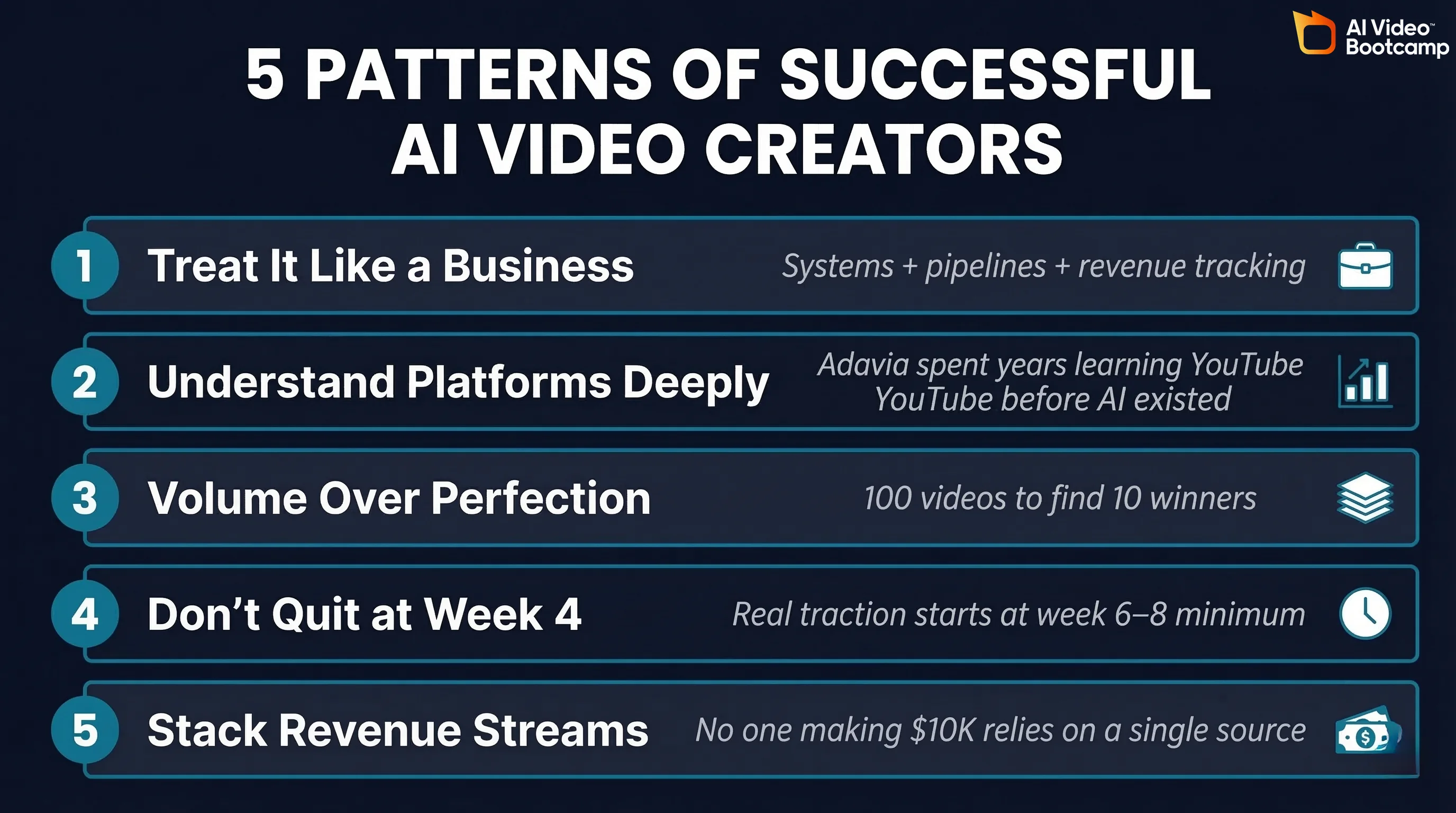
After studying dozens of successful AI video creators, five patterns emerge consistently. For broader context on the AI video creator economy and market trends, see our 2026 trends analysis.
1. They treat it as a business, not a hobby. Systems, pipelines, automation, revenue tracking. Not “I’ll make a cool video when I feel inspired.”
2. They understand platforms deeply. What works on YouTube is completely different from what works on TikTok. The successful creators study platform algorithms obsessively. Adavia Davis spent years learning YouTube before AI tools existed.
3. They focus on volume over perfection. Make 100 videos to find 10 winners. Don’t spend 3 days perfecting one video while someone else made 1,000 in that time.
4. They don’t quit at week 4. Real traction starts at week 6-8 minimum. The window where most people give up is exactly when things are about to start working.
5. They stack revenue streams. Nobody making $10K/month relies on a single income source. It’s AdSense plus affiliates plus brand deals plus services plus digital products. Each stream might only be $2,000-$3,000, but together they compound.
The Common Failure Patterns
I want to be equally specific about what doesn’t work, because avoiding these mistakes is just as valuable as following the success patterns.
“Just use ChatGPT and Midjourney.” This is the most common beginner approach, and it doesn’t scale. Everyone does this. There’s no competitive advantage in using the same tools the same way as millions of other people.
Spending 3 days perfecting one video. While you polished one piece of content, the person who built a system published 200. The math always favors volume in the early stages.
Posting random AI content with no strategy. No niche, no target audience, no content calendar. Just “here’s a cool thing AI made.” This earns $0, consistently.
Expecting passive income in month 1. AI video income is active work for months before it becomes even semi-passive. Anyone telling you otherwise is selling something.
Not building a system. If your process requires you to manually do every step for every video, you’re doing freelance labor with AI tools. That’s fine for agency work, but content creation needs automation to scale.
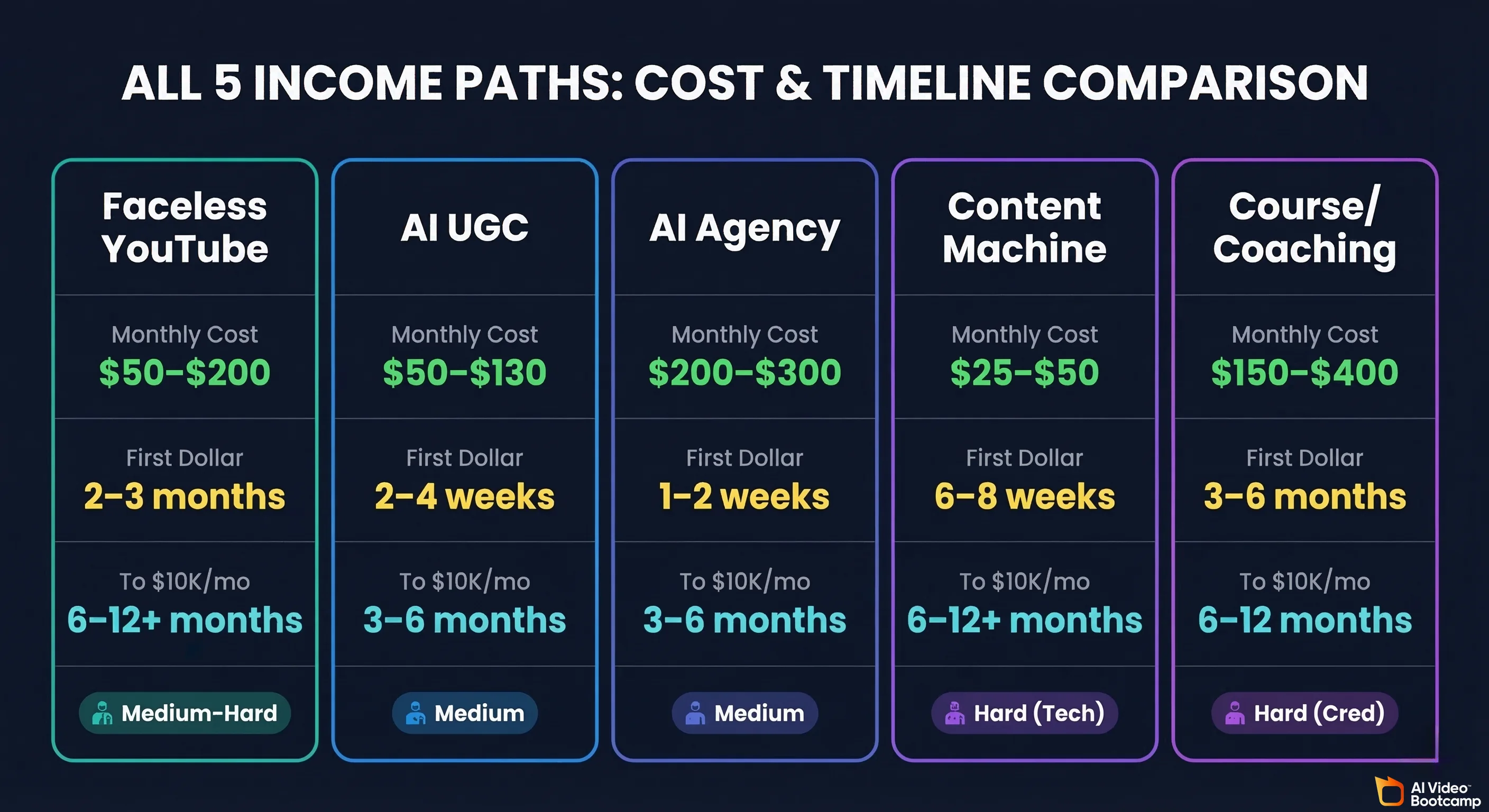
Monthly Cost Comparison: All Five Approaches
Here’s every approach side by side so you can plan your budget:
| Approach | Monthly Tool Cost | Time to First Dollar | Time to $10K/Month | Difficulty |
|---|---|---|---|---|
| Faceless YouTube | $50-$200 | 2-3 months | 6-12+ months | Medium-Hard |
| AI UGC for Brands | $50-$130 | 2-4 weeks | 3-6 months | Medium |
| AI Video Agency | $200-$300 | 1-2 weeks | 3-6 months | Medium |
| Content Machine | $25-$50 | 6-8 weeks | 6-12+ months | Hard (technical) |
| Course/Coaching | $150-$400 | 3-6 months | 6-12 months | Hard (requires credibility) |
The fastest path to your first dollar is the agency model (you can land a client in week one if you hustle on Upwork). The fastest path to $10K is the agency model or AI UGC, because you’re exchanging value directly for money rather than building an audience first.
The highest long-term ceiling belongs to faceless YouTube and course selling, but they require the most patience upfront.
The Common Tool Stack (What You’ll Actually Need)
Regardless of which path you choose, here’s what the successful creators use:
For video generation: Kling AI, Runway, Veo, or InVideo AI. Start with one. Master it before adding others. If you’re on a tight budget, check our guide to free AI video tools that are actually free.
For AI voices: ElevenLabs ($5-$22/month) is the industry standard. It’s used by almost every creator I researched.
For scripts: Claude or ChatGPT ($20/month). Some creators use both.
For AI avatars (UGC/agency work): HeyGen, Synthesia, or Argil ($30-$100/month).
For editing: CapCut (free) handles 90% of what you need. Descript ($24/month) is great for podcast-style or talking-head content. Premiere Pro if you need advanced features.
For thumbnails and images: Midjourney, DALL-E, or Canva. Our guide on AI video visuals and character consistency covers this in detail.
You don’t need all of these. A beginner stack of CapCut (free) + one AI video generator ($12-$30/month) + ElevenLabs ($5/month) gets you started for under $50/month.
Frequently Asked Questions
Is AI Video Income Actually Passive?
Not at first. Every successful creator I researched described months of active daily work before their systems ran semi-autonomously. Adavia Davis still spends 2 hours per day overseeing his channels. The content machine operator spends 30 minutes daily on maintenance. The UGC creators and agency owners are actively doing client work.
“Passive” is a spectrum. After 6-12 months of building systems and audience, the income becomes more leveraged (meaning less hours per dollar earned), but it never becomes truly hands-off. If someone promises you completely passive AI video income, they’re selling you a fantasy.
Can I Start With Zero Technical Skills?
Yes, but your path matters. AI UGC creation and agency work have the lowest technical barriers. You need to learn the tools, but you don’t need to code or build automated pipelines.
The content machine approach has a higher technical bar because building API-based automation requires some programming knowledge (or the willingness to learn it). Faceless YouTube sits in the middle: you can start manually and automate gradually.
Start with the complete beginner guide for AI video creation and work through your first project. You’ll know within a week whether you enjoy the process enough to pursue it seriously.
How Much Money Do I Need to Start?
Less than you think. Here are the minimums:
- Content machine: $25/month (API costs)
- Faceless YouTube: $50/month (AI tools + editing)
- AI UGC: $60/month (avatar tool + editing)
- Agency: $200/month (multiple AI tools for client variety)
- Courses: $150/month (hosting + creation tools) plus 3-6 months of credibility-building first
If you’re truly broke, start with free tools. Google AI Studio gives you access to Veo 3.1 for free. CapCut is free. You can create content with $0 upfront and upgrade tools as revenue starts coming in.
Will AI Video Still Be Profitable in 2027?
The tools will get cheaper and more accessible, which means more competition. But the demand for video content is growing faster than the supply of people who can create it well, even with AI.
The creators who will still be profitable are the ones who build systems, audiences, and brands now while the market is still relatively uncrowded. The window for being “early” is closing, but it’s not closed yet.
The specific opportunities will shift. Today’s faceless YouTube formula might not work the same way in 18 months. But the underlying skills (understanding platforms, building content systems, serving businesses with video) will remain valuable regardless of which AI tools exist.
Is This Ethical? What About “AI Slop”?
This is a fair question. Some AI video content is genuinely low quality and designed purely to extract ad revenue. Fortune’s profile of Adavia Davis uses the term “AI slop” directly.
Here’s my take: the ethics depend on the value you’re providing. Background sleep content that helps people fall asleep? That has genuine utility, even if it’s AI-generated. AI UGC that helps small brands create affordable ad content? That’s solving a real business problem. A course that teaches genuine skills with real results? Valuable.
Where it gets ethically questionable is when AI content is deliberately deceptive (fake testimonials, misleading information) or when it floods platforms with zero-value content purely for ad revenue. The line between “efficient content creation” and “spam” is real, and where you draw it matters.
The most sustainable approach is to create content that genuinely serves an audience, using AI to do it faster and cheaper than you could otherwise.
What’s the Single Best Path for a Complete Beginner?
If I had to pick one path for someone starting from zero with limited capital, I’d say AI UGC for brands. Here’s why:
- Lowest barrier to entry (you just need yourself and basic AI tools)
- Fastest path to first dollar (clients pay directly, no audience building needed)
- Clear pricing model (you know exactly what you’re selling and what to charge)
- Scalable (AI avatars let you multiply your output without multiplying your time)
- Builds skills transferable to every other path on this list
Start there. Make your first $1,000-$3,000/month. Then decide if you want to expand into agency work, build YouTube channels, create courses, or all of the above.
The Bottom Line
Five real paths to $10K+ per month with AI video exist right now. They range from a 22-year-old’s faceless YouTube empire generating $60K/month to solo operators running content machines on $25/month in API fees.
None of them are easy. None of them are overnight. All of them require 3-6 months of consistent effort before the income becomes meaningful.
But the people doing this aren’t geniuses. They’re not technical wizards. They’re people who picked a path, built a system, and didn’t quit when month one produced zero dollars.
The tools are cheap. The demand is enormous. The window is open.
The only question is whether you’ll still be working at this when week 6 hits and the traction finally starts.
Ready to build your first AI video? Start with our complete beginner guide and make your first video today. Not tomorrow. Today.