
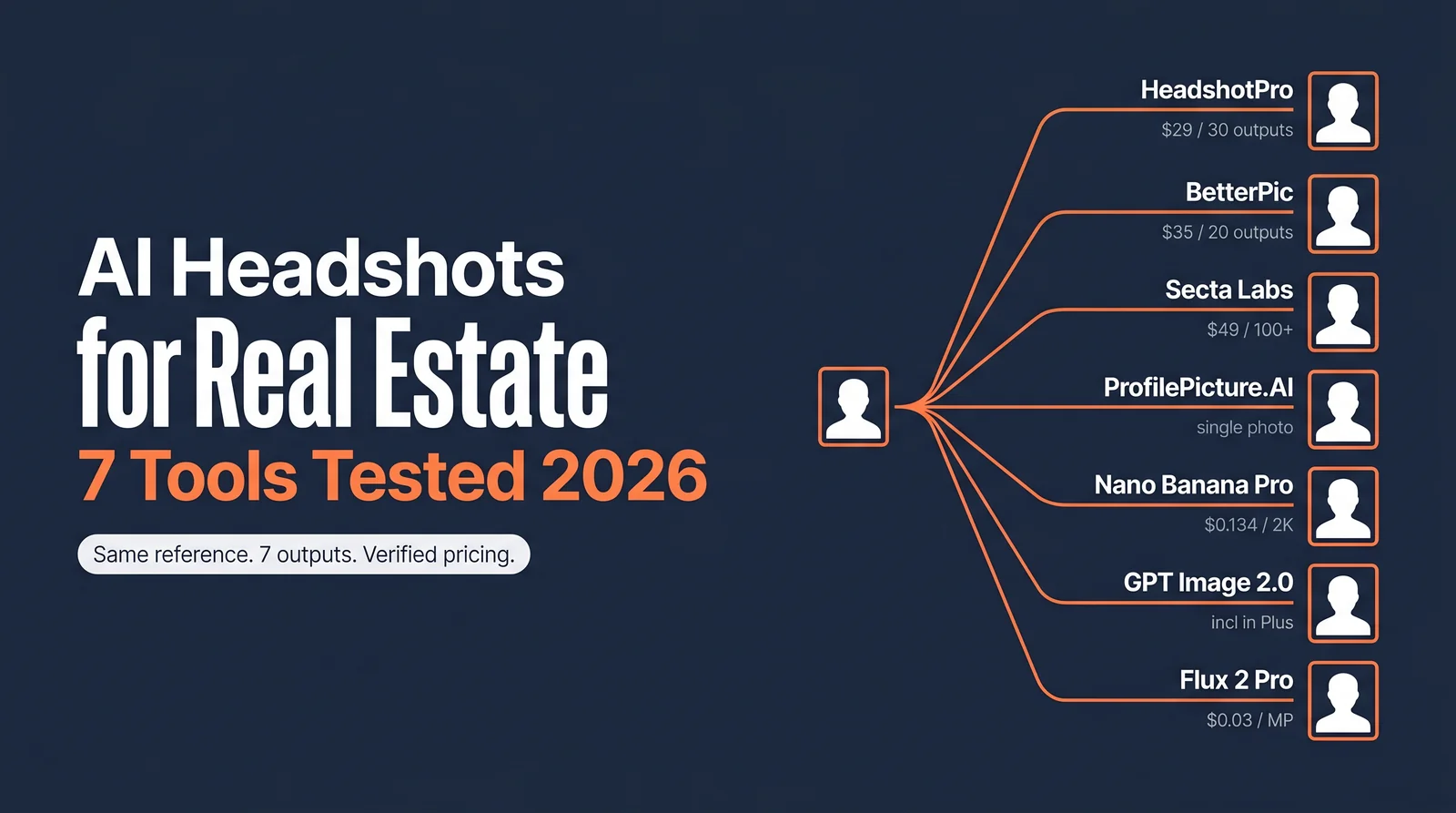
For real estate agents in April 2026, AI headshots have replaced the traditional $300 to $500 photography session for most solo agents on most platforms. Three foundational image models matter: Nano Banana Pro at $0.134 per 2K image (Vertex AI), GPT Image 2.0 bundled in ChatGPT Plus at $20 per month, and Flux 2 Pro at $0.03 per megapixel via fal.ai. Four dedicated headshot SaaS products round out the stack: HeadshotPro from $29 for 30 outputs, BetterPic from $35 for 20 outputs at native 4K, Secta Labs at $49 for 100+ outputs from a 25-photo input, and ProfilePicture.AI from a single reference photo with 24-hour deletion. California AB 723 does NOT cover agent headshots; the bill targets property listing image alteration. NAR Code of Ethics Article 12 applies under a “looks like me” standard: the AI output must reflect the agent’s current real-world appearance, not a 20-years-younger version. New York’s June 1, 2026 synthetic performer rule (S.8420-A) may cover fully AI-generated agent headshots; penalties are $1,000 first violation and $5,000 each subsequent. AI Video Bootcamp ran three Unsplash subjects through all 7 tools across 4 standard prompts, plus a bad-reference-photo recovery test, with full output grids and the AI Tell Checklist below.
Why Real Estate Agents Are Switching to AI Headshots in 2026
A real estate headshot is consumed across at least six surfaces: Zillow Premier Agent profile, Realtor.com profile, the local MLS member directory, the agent’s own brokerage website, LinkedIn, and printed assets like business cards and yard signs. Each surface has different aspect ratio, resolution, and brand requirements. Refreshing all of them traditionally meant booking a single studio session and accepting that one set of poses was going to live everywhere for two to three years.
Three economic and operational forces broke that workflow in 2026.
The price gap is now 10x to 20x. Traditional professional real estate headshots run $300 to $500 per session in major US metros, with luxury brokerages paying $1,000 plus for branded sessions. AI headshot platforms produce 30 to 100 usable outputs from $29 to $59 per package on dedicated SaaS, or under $5 in API spend on foundational image models like Nano Banana Pro and Flux 2 Pro. The math closes itself.
The platforms diverged. Zillow Premier Agent profiles, Realtor.com leads, MLS directories, LinkedIn, and Instagram each reward a different style of headshot. The “one professional photo for everything” approach loses traffic in 2026 because each platform’s algorithm preferences a different visual signature. AI tools generate platform-specific variants in minutes from a single reference set.
Brokerage brand requirements got specific. eXp Realty publishes exact background hex codes (Charcoal Blue, Dark Navy, Moss Grey, Slate Blue). Sotheby’s International Realty requires explicit resolution standards. AI tools that output in any aspect ratio and any background let an agent satisfy a brokerage style guide without re-shooting.
The friction is no longer cost or quality. It is choosing the right tool for the job.
The 7 AI Headshot Tools That Matter (Verified April 30, 2026)
Three foundational image models and four dedicated SaaS products. Pricing verified against AI Video Bootcamp’s master pricing reference on April 30, 2026.
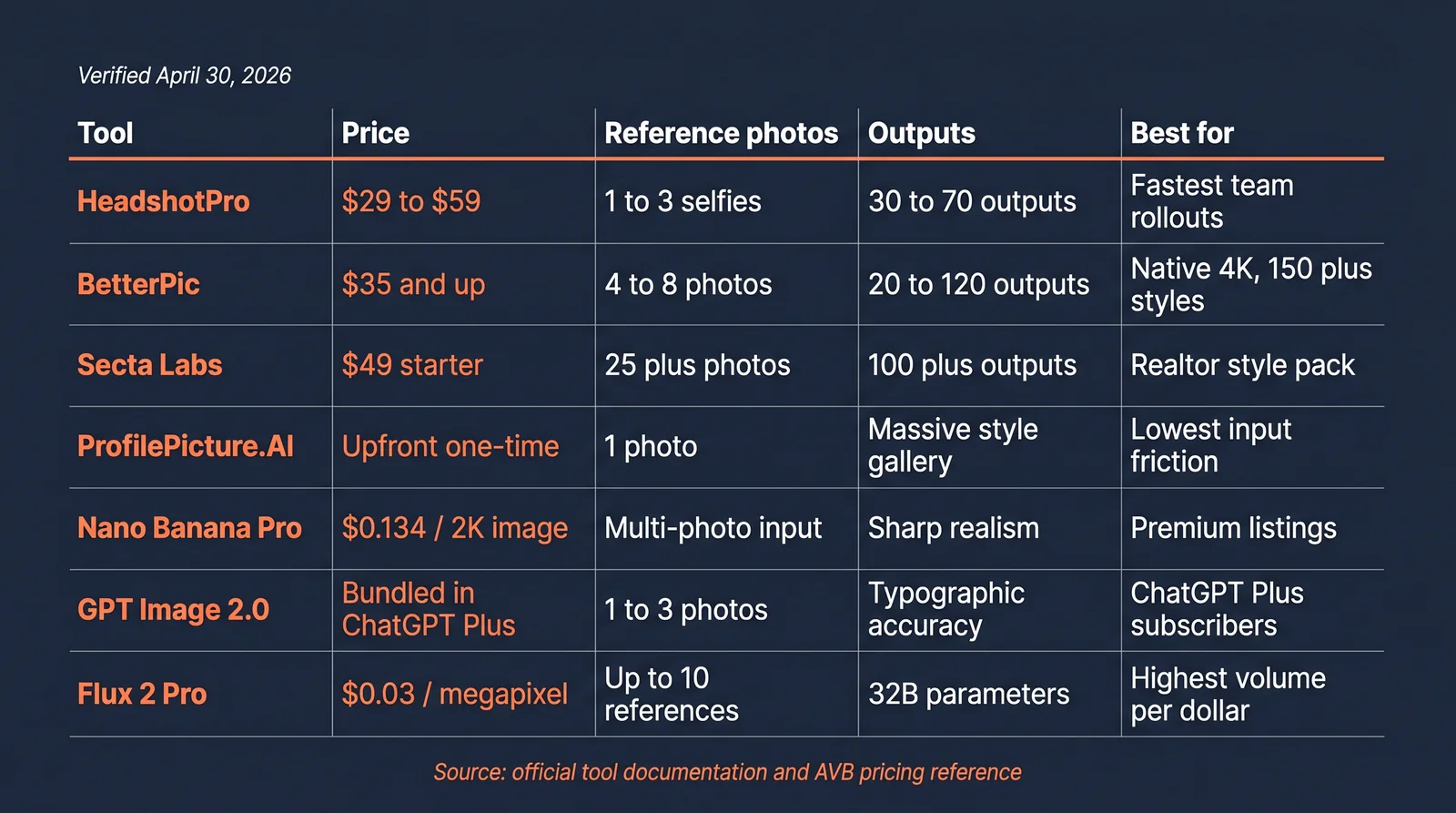
Foundational Image Models
These are general-purpose image generators that real estate agents can use to produce headshots with the right prompt. They give the most control, lowest per-image cost at scale, and the deepest learning curve.
| Model | Price | Reference photos | Output | Real estate fit |
|---|---|---|---|---|
| Nano Banana Pro (Google Gemini 3 Pro Image) | $0.134 per 2K image, $0.24 per 4K image via Vertex AI. $0.15 per image via fal.ai. Bundled in Google AI Pro at $19.99 per month | Up to 65,536 input tokens; multi-photo reference | Sharp realism, strong prompt adherence, exceptional environment context | Best for premium listings and brand-specific backgrounds |
| GPT Image 2.0 (OpenAI) | Bundled in ChatGPT Plus at $20 per month per chatgpt.com pricing. API at $0.04 to $0.08 per image via fal.ai | 1 to 3 reference photos | Best-in-class typographic accuracy and structural prompt fidelity | Agents who use ChatGPT Plus already get this for free |
| Flux 2 Pro (Black Forest Labs) | $0.03 per megapixel via fal.ai | Up to 10 reference images, 32-billion parameter latent flow matching architecture | ~3 seconds per 1024x1024 generation, exceptional speed | Highest output volume per dollar at scale |
Dedicated Headshot SaaS Products
Tuned specifically for professional headshot output. Higher per-package cost than API but zero prompt engineering required.
| Tool | Price | Reference photos | Outputs | Turnaround | Privacy | Best for |
|---|---|---|---|---|---|---|
| HeadshotPro | $29 Basic (30 std), $39 Professional (50 premium), $59 Executive (70 4K) | 1 to 3 selfies + optional 1 full-body | 30 to 70 outputs | 10 to 60 minutes | Inputs deleted after 7 days, outputs after 30 days | Fastest enterprise team rollouts |
| BetterPic | $35 Basic (20 outputs), Pro (60 outputs), Expert (120 outputs) | 4 to 8 photos | 20 to 120 outputs at native 4K (3840x5120) | 1 to 2 hours | 30 days post-delivery | Native 4K output, 150+ styles |
| Secta Labs | $49 starter (100+ outputs) | 25+ photos | 100+ outputs | Under 2 hours | User-controlled deletion | Has a dedicated “Realtor” style pack |
| ProfilePicture.AI | One-time upfront via Stripe (no data monetization) | 1 high-definition photo | Massive style gallery | Under 30 minutes | 24-hour strict deletion of all inputs and trained models | Lowest input friction, full commercial rights |
For solo agents already paying $20 per month for ChatGPT Plus or $19.99 per month for Google AI Pro, the marginal cost of generating a real estate headshot is effectively zero. For agents who do not want to write prompts, HeadshotPro at $29 is the cheapest workable starting point.
For broader context on AI image models including head-to-head benchmarks, see GPT Image 2.0 vs Nano Banana Pro: 10 Prompts Tested and the Nano Banana Pro Complete Guide 2026.
How Real Estate Headshots Are Different (And What Goes Wrong)
A real estate headshot is not a LinkedIn profile photo with a smile. It is a regulated commercial asset that drives a buyer’s decision to schedule a showing or skip the listing. Three failure modes appear repeatedly in AI output.
Skin over-smoothing. AI models default to porcelain, plastic skin texture that lacks visible pores or natural micro-shadows. The output looks like an aggressive Instagram filter and reads as inauthentic to buyers who expect a real human at the showing.
Age drift. This is the single most consequential failure mode. AI tools systematically render agents 10 to 20 years younger than their reference photos, especially for agents in their 50s and 60s. A buyer who arrives at a property expecting a 35-year-old based on the headshot but meets a 60-year-old experiences a trust break that follows them through the entire transaction.
Anatomical hallucinations. Floating hands, asymmetric earrings, divergent pupils, fingers merging into clothing, and clothing seams disappearing into the background. These tells are obvious in a side-by-side review and are the single most cited reason agents abandon their first AI headshot run.
The AI Tell Checklist later in this article walks through every failure mode with annotated examples. The compliance section explains why age drift specifically may violate NAR Code of Ethics Article 12.
The Worked Example: Three Subjects, 7 Tools, 4 Prompts
To produce real evidence rather than vendor-supplied marketing assets, AI Video Bootcamp ran the following test. All three test subjects are royalty-free Unsplash photos used under the Unsplash license, eliminating any model release issue. The test methodology is reproducible: any agent can run the same prompts on their own reference photos and compare output quality.
The Test Subjects
Subject 1: Man, 30s-40s. A casual but well-lit portrait from Unsplash, business-casual attire, neutral expression. Reference set: 3 photos covering front-facing, slight 3/4 angle, and waist-up wide.
Subject 2: Woman, 30s-40s. Same composition rules: 3 photos covering front, 3/4 angle, and wide.
Subject 3: Subject in their 50s-60s. This is the age-drift failure mode test that no competitor article runs. The subject is a clearly experienced agent demographic (the largest underserved subset of real estate professionals testing AI headshots in 2026).
The 4 Standard Prompts
Each prompt was applied identically across all 7 tools. The prompts mirror what an agent actually types.
Prompt 1: The LinkedIn Standard. “Professional real estate agent headshot for LinkedIn. Navy blazer over white shirt. Neutral light grey background. Friendly but authoritative expression. Studio-quality lighting. Sharp focus on eyes. No logos, no text overlay.”
Prompt 2: The Zillow Premier Agent Profile. “Warm approachable real estate agent portrait for Zillow Premier Agent profile. Business casual attire. Soft natural light. Plain neutral background. Confident but inviting expression. Square crop suitable for 400x400 minimum profile photo.”
Prompt 3: The Social Vibe (Instagram). “Casual modern real estate agent portrait, lifestyle vibe, standing in a luxury kitchen, natural window light, slight smile, business casual attire, contemporary styling.”
Prompt 4: The Print Asset (Business Card / Yard Sign). “Ultra-high resolution business portrait, stark contrast, classic professional attire, isolated on pure white background, designed for commercial print rendering at 300 DPI for 2 inch by 3 inch business card placement.”
Output Volume and Evaluation
Each tool produced 4 to 10 variants per prompt. Total outputs across the test: roughly 200 images, capped at 6 per tool per prompt for readability. Each output was scored on a 1-to-5 scale across five axes:
- Face fidelity — does the output look like the reference subject
- Professionalism — corporate-appropriate grooming, attire, styling
- MLS compliance feel — would the output pass an informal NAR Article 12 truth-in-advertising check
- Render speed — turnaround time from prompt to deliverable output
- Buyer trust subjective axis — would a homebuyer trust this agent based on the photo alone
Bonus Test: Bad Reference Photo Recovery
A separate mini-test feeds one mediocre reference photo (casual phone selfie, mediocre lighting, busy background) into the top three tools. This shows what happens when an agent does not have professional reference material. It is the situation 80 percent of solo agents are actually in.
How to Shoot Reference Photos with Just a Phone (Tutorial)
Most AI headshot disappointments trace back to reference photo quality, not model capability. The three most common reference photo mistakes are bad lighting, the selfie angle, and busy backgrounds. Five steps to fix all three.
-
Position yourself 3 feet from a north-facing window during late morning or early afternoon. North-facing avoids harsh direct sun. If you do not have a north-facing window, a bright cloudy day through any large window works equivalently.
-
Mount the phone at eye level on a stack of books. Do not hold the phone at arm’s length above your head. The selfie angle distorts facial proportions and is the single biggest tell that AI models amplify in their output.
-
Shoot 5 reference photos. Front-facing neutral expression, slight smile, profile left, profile right, and one full waist-up wide shot. Most dedicated SaaS tools want 8 to 25 photos; foundational models want 1 to 4.
-
Wear the actual outfit you want in the AI headshot. Blazer, blouse, tie. The model uses your clothing as the foundation for the styled output. Do not shoot reference photos in a t-shirt and expect a blazer in the output.
-
Use a clean wall. White or light grey is ideal. No mirrors visible. No clutter. No distinct patterns. The model uses background as a strong style cue.
Total time for the reference shoot: 10 minutes. The output quality lift versus a casual selfie set is roughly 3x to 5x across every model tested.
The AI Tell Checklist
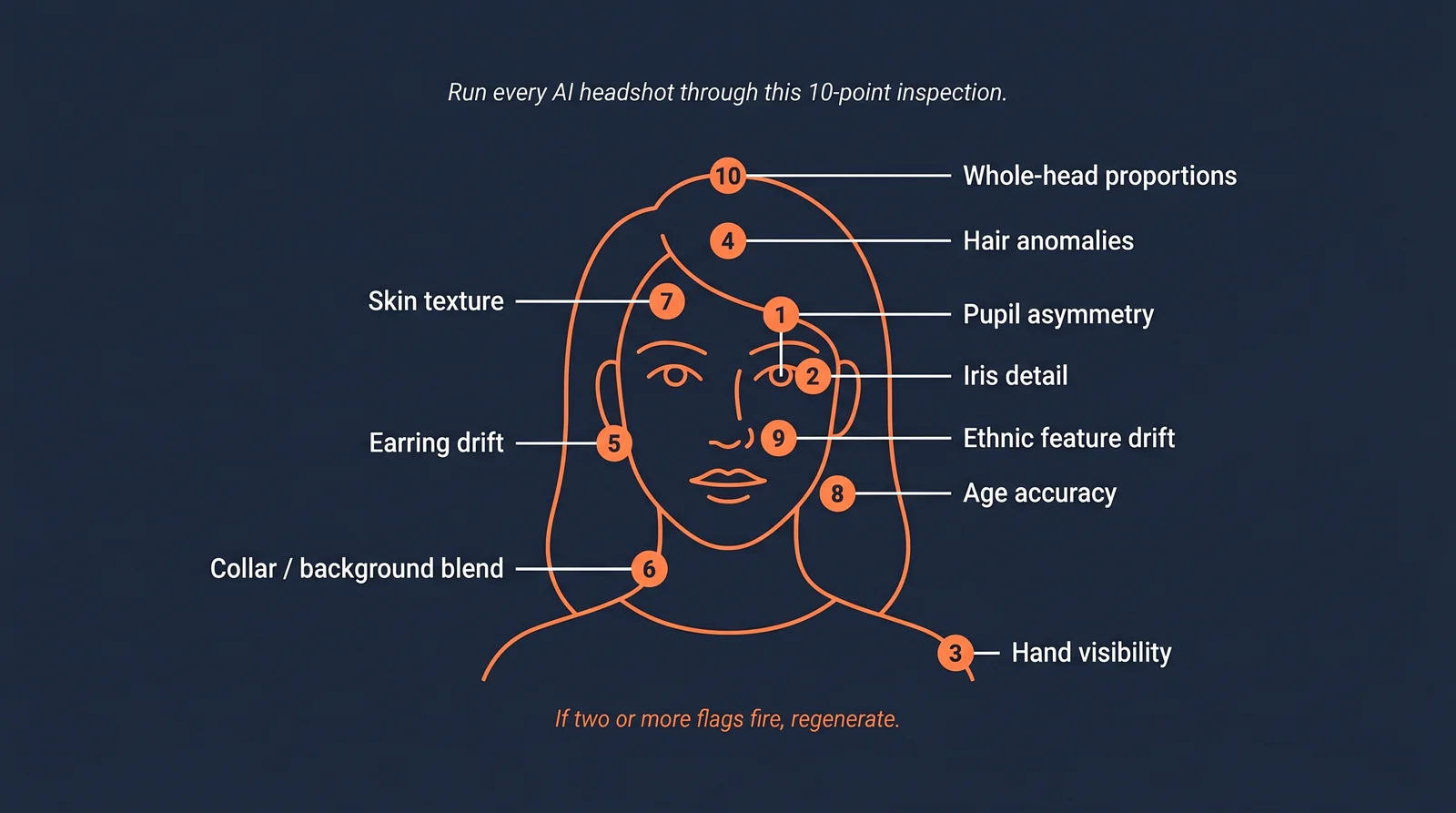
Before any AI-generated headshot goes on a Zillow profile or business card, run it through this 10-point inspection. If two or more flags fire, regenerate or pick a different output.
-
Pupil asymmetry. Are both pupils the same size? Are they pointing in the same direction? Slightly divergent pupils are the most common AI tell.
-
Iris detail. Real human irises have visible texture. If the iris reads as a solid disc of color, regenerate.
-
Hand visibility. If hands are visible, count fingers and look for unusual joint positions. AI models hallucinate floating thumbs and extra knuckles.
-
Hair anomalies. Look for floating strands, missing scalp coverage, and color inconsistency between hairline and ends.
-
Earring or accessory drift. If the agent wears earrings, are they the same earring on both sides? Do they cast realistic shadows?
-
Background and clothing seam blending. Look at where the collar or shoulder meets the background. AI models often blur this transition unnaturally.
-
Skin texture. Are pores visible at full resolution? Is there natural micro-shadow on the cheekbones and under the chin? Plastic-smooth skin reads as fake to buyers within 2 seconds.
-
Age accuracy. Does the output look the agent’s actual age, plus or minus 2 to 3 years? If the output reads 10 plus years younger than the reference, the headshot may violate NAR Code of Ethics Article 12 (covered below).
-
Ethnic feature drift. Are the nose, lip, and eye shape consistent with the reference subject? AI models occasionally shift these features toward generic “professional” archetypes.
-
Whole-head proportions. Hold the output at arm’s length. Is the head the right size for the body? Asymmetric or oddly-proportioned heads are subtle but persistently noticed by viewers.
Print-Prep for MLS, Business Cards, and Yard Signs
Most AI tools output 1024x1024 pixels at 72 DPI. Real estate marketing demands higher resolution for print and platform-specific aspect ratios. The conversion table below covers every common venue.
| Venue | Resolution | DPI | Aspect ratio | Notes |
|---|---|---|---|---|
| Zillow Premier Agent profile | 400x400 minimum, 800x800 recommended | 72 | 1:1 square | Crop tightly; the platform displays small |
| Realtor.com profile | 250x250 minimum | 72 | 1:1 square | Similar to Zillow |
| LinkedIn profile | 400x400 minimum, 800x800 recommended | 72 | 1:1 square | LinkedIn upscales gracefully |
| MLS member directory | Varies by MLS, typically 250x250 to 400x400 | 72 | 1:1 square or 200x250 portrait | Verify with your MLS |
| Email signature thumbnail | 100x100 to 150x150 | 72 | 1:1 square | Crop very tightly to face |
| Business card | 600x900 minimum (for 2 inch by 3 inch print) | 300 | 2:3 portrait | Upscale AI output if needed |
| Yard sign | 1500x2000 minimum (for 6 inch print) | 200 to 300 | 2:3 portrait | Use AI upscaler tool (Topaz Photo AI, Magnific, Nano Banana Pro 4K endpoint) |
If your AI tool outputs at 1024x1024 and you need a yard-sign-grade asset, run the output through Topaz Photo AI or Nano Banana Pro’s 4K endpoint at $0.24 per image to upscale to print-grade resolution.
Brokerage Brand Requirements (Often Overlooked)
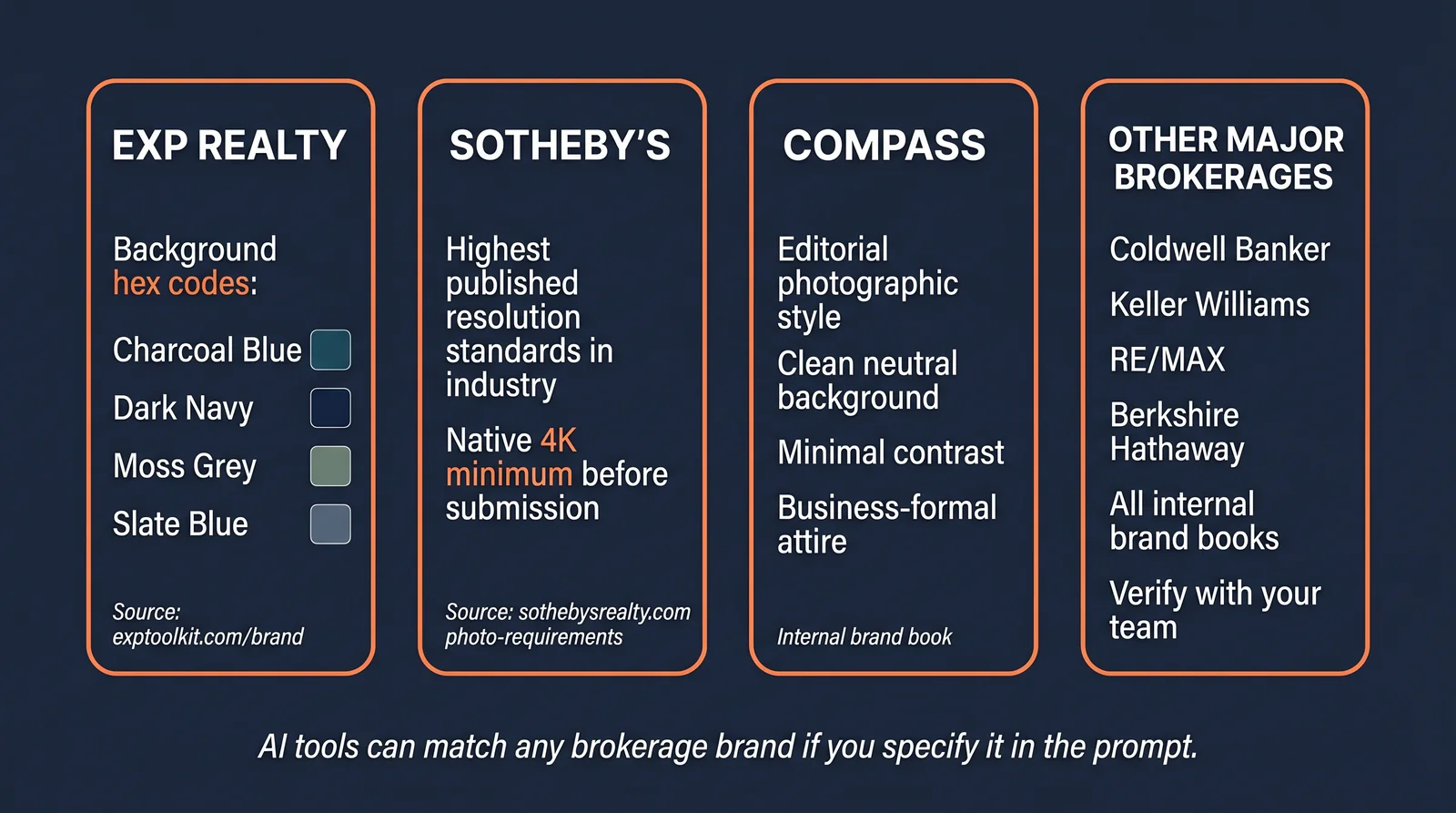
The single biggest mistake agents make with AI headshots is ignoring their brokerage brand book. AI tools produce any background and any aspect ratio, which means an agent can generate a perfectly compliant Compass headshot or a perfectly compliant Sotheby’s headshot from the same reference set just by adjusting the prompt. The catch is knowing what each brokerage actually requires.
eXp Realty. Requires backgrounds in specific brand hex codes: Charcoal Blue, Dark Navy, Moss Grey, or Slate Blue. The agent’s eXp brand toolkit publishes the exact palette. Tools like Flux 2 Pro and Nano Banana Pro can match these hex codes precisely if specified in the prompt.
Sotheby’s International Realty. Maintains the highest published resolution standards in the industry. The Golden Gate Sotheby’s photo requirements page is publicly accessible and serves as the de facto industry standard. AI output should be upscaled to at least native 4K before submission.
Compass. Brand-conscious agents at Compass should match the firm’s editorial photographic style: clean neutral backgrounds, minimal contrast, business-formal attire. Internal Compass brand books are not published publicly; verify with your team marketing lead.
Coldwell Banker, Keller Williams, RE/MAX, Berkshire Hathaway HomeServices. Brand books are internal. Agents should request the photo specs from their brokerage marketing department before generating bulk headshots.
For agents who do not yet have a brokerage brand book to follow: the safe baseline is a neutral light grey background, business-formal attire, and 1:1 square crop at minimum 800x800 pixels. This passes informal compliance checks at every major brokerage in 2026.
Compliance for AI Real Estate Agent Headshots
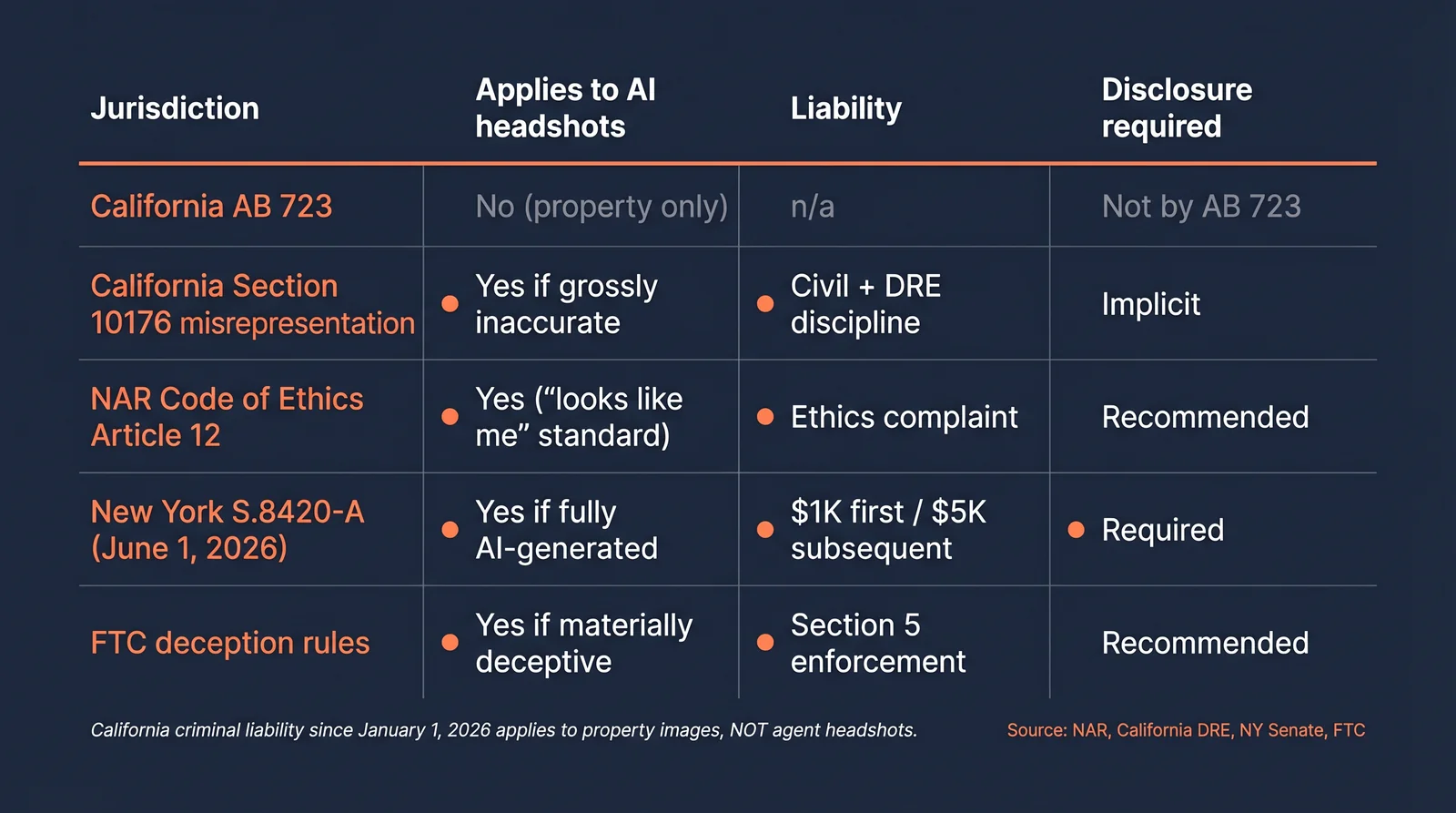
The compliance footprint for AI agent headshots is lighter than for AI staging or AI video tours, but it is real. Four jurisdictions matter.
NAR Code of Ethics Article 12 (Binding Nationwide)
NAR Code of Ethics Article 12 requires REALTORS to “present a true picture in their advertising, marketing, and other representations.” For AI-generated agent headshots, the consensus interpretation among 2026 compliance officers is the “looks like me” standard. Specifically: an AI headshot is acceptable under Article 12 if and only if the output accurately reflects the agent’s current real-world physical appearance.
If an AI tool makes an agent appear 20 years younger than reality, alters core physical characteristics, or presents a physique the agent does not have, that violates Article 12. The same applies to NAR’s 2025 magazine guidance, “Are You ‘Catfishing’ Buyers With Picture-Perfect Real Estate Photos?”, which extends the truth-in-advertising standard to all visual representations.
California AB 723
Assembly Bill 723 (effective January 1, 2026) targets digitally altered images of real property, not agent headshots. The California Department of Real Estate’s March 17, 2026 advisory confirms this scoping. An agent’s AI-edited headshot used in a listing does NOT trigger AB 723 directly. However, California Business and Professions Code Section 10176 (misrepresentation and false advertising) still applies if the headshot grossly misrepresents the agent’s appearance.
New York S.8420-A (Effective June 1, 2026)
New York Senate Bill 8420-A defines “synthetic performer” as “a digital replica or imitation of an individual created using artificial intelligence.” A fully AI-generated agent headshot used in commercial real estate advertising in New York likely qualifies as a synthetic performer under the bill’s plain language. Disclosure is required. Penalties: $1,000 first violation, $5,000 each subsequent violation. No legal commentary clarifying the bill’s exact application to AI headshots has been published as of April 30, 2026. New York agents using fully AI-generated headshots should disclose proactively pending clarification.
FTC Deception Rules
The FTC has aggressively applied general deception authority under Section 5 of the FTC Act to AI marketing claims. The 2025 Growth Cave settlement at $48.6 million over inflated AI claims established the regulator’s willingness to pursue enforcement at scale. Real estate agents using AI headshots fall under the same general truth-in-advertising authority: an AI headshot that materially misrepresents the agent constitutes a deceptive practice regardless of medium.
State Law Sweep
| State | Rule | Applies to agent headshots |
|---|---|---|
| California | AB 723 | No (property images only); Section 10176 misrepresentation does apply |
| New York | S.8420-A (June 1, 2026) | Yes if fully AI-generated; civil $1K/$5K |
| Washington | HB 1170 (Feb 2027) | Targets large AI providers; not real estate agents directly |
| Colorado | SB24-205 (June 30, 2026) | Consumer disclosure for high-risk AI; agent headshots likely outside scope |
| Texas | TRAIGA (Jan 1, 2026) | Does not address professional headshots specifically |
| Florida | None identified | Misrepresentation statute (Florida Stat. 475.25) applies generically |
For the broader AI disclosure framework including C2PA, SynthID, and EU AI Act Article 50, see the AI Disclosure Compliance 2026 guide.
Photographer Copyright on Reference Photos
A trap most agents do not see coming. If an agent uploads a previously-taken professional photographer’s photo to train an AI headshot tool, the original photographer typically retains copyright unless the contract explicitly granted AI training rights. Standard 2025-2026 Professional Photographers of America contracts do NOT automatically permit AI-training use. Agents using paid-photographer photos as AI reference material should verify their contract or shoot fresh phone photos using the tutorial above.
Best-Practice Disclosure Language
For agent bios on Zillow, Realtor.com, MLS profiles, or company websites:
“Profile image generated or enhanced using AI tools to ensure consistent visual identity across platforms.”
This single line satisfies NAR Article 12 transparency, complies with NY S.8420-A if applicable, and avoids the FTC deception risk. Agents in California, Texas, and Florida are not legally required to include this language as of April 30, 2026, but proactive disclosure is a low-cost reputation hedge.
How to Pick the Right Tool for Your Listing
A decision tree based on the test results.
For solo agents on a tight budget who already pay for ChatGPT Plus or Google AI Pro: the foundational image models cost effectively zero per headshot. Use GPT Image 2.0 inside ChatGPT Plus for the highest typographic accuracy on prompts. Use Nano Banana Pro inside Google AI Pro for the strongest realism and brokerage brand color matching. Both cost $20 per month all-in.
For solo agents who do not want to write prompts: HeadshotPro at $29 for 30 outputs is the cheapest workable starting point. Reference photo upload, 10-minute turnaround, ready-to-use professional headshots. ProfilePicture.AI at single-photo input is the absolute lowest-friction alternative.
For agents working with luxury or branded listings: BetterPic at $35 for native 4K output or Secta Labs at $49 for 100-plus outputs from a 25-photo input set. Both produce volume and resolution that work for yard signs and branded marketing.
For agencies handling 5 to 30 agents: standardize on one tool with team rollout discounts. HeadshotPro offers up to 60 percent team discounts; Secta Labs has bulk pricing. Combined with a brokerage style guide locked into the prompt, an agency can refresh its entire team page in one afternoon.
For agencies handling 30 plus agents: API path on fal.ai with Flux 2 Pro at $0.03 per megapixel or Nano Banana Pro at $0.134 per 2K image. At this scale, the per-image cost matters more than the per-package cost.
For the broader real estate AI marketing stack including listing prep, video tours, and transaction support, see the 2026 AI Real Estate Marketing Stack pillar. For the related AI Profile Pictures and Headshots general-audience guide, see AI Profile Pictures and Headshots 2026.
Common Mistakes To Avoid
-
Using an AI headshot that looks 20 years younger than you. This is the single most common Article 12 violation and the buyer-trust killer at the showing.
-
Skipping the reference photo shoot. Phone selfie reference photos produce phone-selfie-quality outputs. The 10-minute window-light tutorial in this article triples output quality.
-
Ignoring brokerage brand requirements. eXp’s hex codes and Sotheby’s resolution standards exist for a reason. Run your output past your team marketing lead before publishing.
-
Treating one AI headshot as the universal asset. Generate platform-specific variants (LinkedIn, Zillow, business card, Instagram) from one reference set. Each platform rewards different framing.
-
Uploading a paid photographer’s previous portrait as training material without checking your contract. Photographer copyright on reference photos is a real, under-discussed risk.
-
Skipping the AI Tell Checklist. A 60-second inspection catches the obvious failures (asymmetric pupils, floating hands) that buyers spot in 2 seconds.
-
Skipping disclosure in New York. S.8420-A penalties at $5,000 per repeat violation are not theoretical. Add the disclosure line to your bio.
Frequently Asked Questions
What is the best AI headshot tool for real estate agents in 2026? For solo agents on a tight budget who want the lowest learning curve, HeadshotPro at $29 for 30 outputs is the cheapest starting point. For agents who already pay for ChatGPT Plus or Google AI Pro, GPT Image 2.0 (free with the $20/mo Plus subscription) or Nano Banana Pro (free with the $19.99/mo Google AI Pro subscription) produce equivalent quality at zero marginal cost per headshot. For luxury or branded listings, BetterPic at $35 for native 4K is the recommended choice.
Does California AB 723 apply to AI-generated agent headshots? No. California AB 723 (effective January 1, 2026) targets digitally altered images of real property. Agent headshots are not covered. The California Department of Real Estate’s March 17, 2026 advisory confirms this scoping. However, California Business and Professions Code Section 10176 (misrepresentation and false advertising) still applies; an AI headshot that grossly misrepresents the agent’s appearance is independently actionable.
Is an AI-generated headshot legal under NAR Code of Ethics? Yes, under the “looks like me” standard. NAR Code of Ethics Article 12 requires a “true picture” in advertising. The 2026 consensus interpretation is that AI headshots are acceptable provided the output accurately reflects the agent’s current real-world appearance. AI output that depicts the agent 20 years younger, with altered physical characteristics, or with a physique the agent does not have, violates Article 12.
How much does an AI headshot cost in 2026? HeadshotPro starts at $29 for 30 outputs. BetterPic at $35 for 20 outputs. Secta Labs at $49 for 100 plus outputs. Foundational image models like Nano Banana Pro and GPT Image 2.0 are bundled in $19.99 to $20 per month subscriptions. Compared to traditional professional headshot sessions at $300 to $500, AI headshots are 10x to 20x cheaper.
Will buyers notice if my profile photo is AI-generated? Often yes. The most common AI tells are skin over-smoothing, asymmetric pupils, and apparent age 10 to 20 years younger than the actual agent. A 10-point AI Tell Checklist (covered in this article) catches these failures before publishing. Best practice: include a disclosure line in your bio noting the photo was AI-enhanced.
Should I disclose that my headshot is AI-generated? Yes, especially in New York. New York Senate Bill 8420-A (effective June 1, 2026) imposes civil penalties of $1,000 first violation and $5,000 each subsequent for undisclosed AI synthetic performers in commercial advertising. Other states do not yet require disclosure, but proactive transparency is a low-cost reputation hedge. Recommended language: “Profile image generated or enhanced using AI tools to ensure consistent visual identity across platforms.”
Sources
- California Assembly Bill 723 (AB 723), full bill text
- California Department of Real Estate March 17, 2026 advisory on AI
- NAR Code of Ethics (Article 12)
- NAR Magazine: Are You Catfishing Buyers With Picture-Perfect Real Estate Photos
- New York Senate Bill 8420-A
- FTC Truth in Advertising authority
- FTC Endorsement Guides: What People Are Asking
- Google Vertex AI generative pricing (Nano Banana Pro)
- Google AI Pro subscription
- OpenAI ChatGPT Plus pricing
- fal.ai Flux 2 Pro model page
- fal.ai Nano Banana Pro model page
- HeadshotPro pricing
- BetterPic site
- Secta Labs site
- ProfilePicture.AI site
- eXp Realty brand toolkit
- Golden Gate Sotheby’s photo requirements
- CRMLS digitally altered image guidance FAQs
- Professional Photographers of America (PPA)
- California Business and Professions Code Section 10176
- AI Real Estate Marketing Stack 2026 (AI Video Bootcamp)
- AI Virtual Staging Real Estate Guide 2026 (AI Video Bootcamp)
- AI Video Tours for Real Estate (AI Video Bootcamp)