
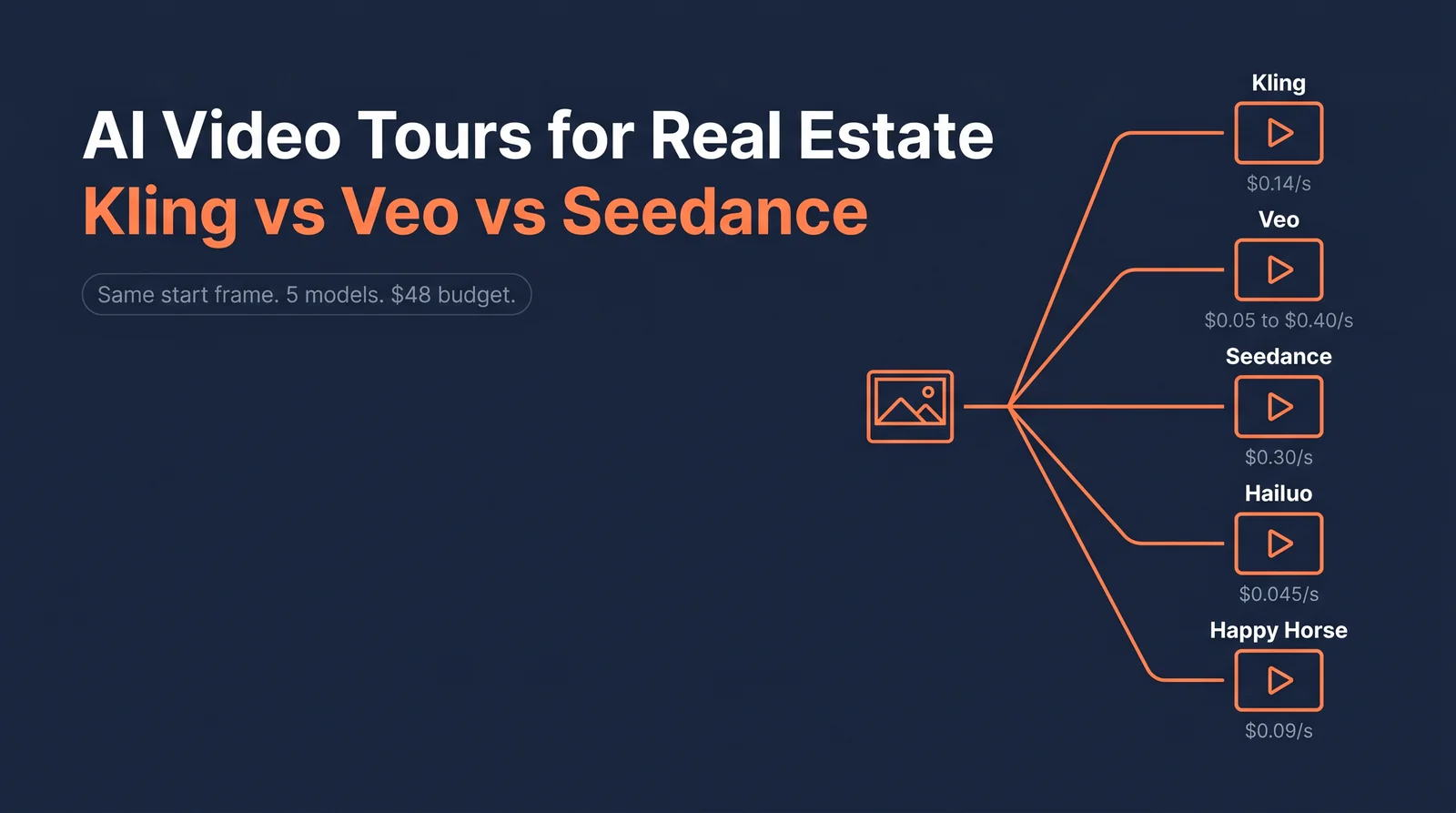
Pricing verified April 30, 2026.
For real estate image-to-video tours in April 2026, the right model depends on the shot. Kling 3.0 Pro at $0.112 per second on fal.ai is the workhorse for cinematic 5-to-10 second interior reveals. Veo 3.1 (Lite at $0.05 per second, Fast at $0.15 per second) is the only model with start-to-end frame logic, ideal for the empty-room-to-staged-room transition that closes a sale. Seedance 2.0 at $0.3034 per second runs the longest single takes (15 seconds) with the highest motion stability, the right call for full-room walkthroughs. Hailuo 02 from $0.045 per second wins talking-head agent intros only, not property tours. Happy Horse 1.0 (launched April 27, 2026) sits at a projected $0.09 to $0.10 per second with native multilingual lip-sync, useful for international buyer outreach. AVB ran the same Park Providencia start frame through 8 motion tests on all 5 models for under $50 in API spend. The full results, prompts, costs, and a side-by-side decision framework are below.
Why Real Estate Video Has Strict Rules That AI Often Breaks
A property video is not just a moving picture. It is a structured visual narrative that has to respect the physics of optics and the geometry of architecture. Three rules govern the format, all of which AI models routinely break.
Vertical lines must stay vertical. When a camera pans across a room, the edges of walls, doorframes, and window mullions must remain perfectly vertical relative to the frame. Human videographers achieve this with gimbal calibration or tilt-shift lenses. AI models, working from a single 2D image, often warp these lines as they hallucinate the room’s space outside the original frame.
Parallax must be calibrated. As a virtual camera moves through a space, foreground objects must scale faster than background objects. A sofa close to the lens should drift across the frame more dramatically than the wall behind it. Many AI models invert or flatten this parallax, producing video that feels uncannily wrong even when the surface looks fine.
Lighting kelvin must stay coherent. Real interiors mix high-kelvin daylight from windows with low-kelvin tungsten or LED from interior fixtures. A successful tour video balances both. AI models often lock to a single light temperature mid-shot and color-shift the whole room in unnatural ways.
These three failure modes (geometric distortion, parallax inversion, kelvin drift) are why most agents who tried Kling, Veo, or Seedance in 2024 walked away frustrated. The 2026 generation of these models has dramatically improved on all three, but the gap between models is now wide enough that picking the wrong one for a given shot type can still produce video that buyers (and California’s Department of Real Estate) flag as misrepresentation.
The True Models for AI Video Tours (Verified April 29, 2026)
The five image-to-video models worth considering for real estate in April 2026, with prices verified on fal.ai for the API path and on each official site for subscription paths.
Pricing Matrix (API, billed per second of output)
| Model | Per-second cost | Audio | Max duration | Max resolution | Aspect ratios | Reference inputs |
|---|---|---|---|---|---|---|
| Kling 3.0 Standard | $0.084 | No | 10 sec | 1080p | 16:9, 9:16, 1:1 | 1 |
| Kling 3.0 Pro (image-to-video) | $0.14 | Optional add-on | 10 sec | 1080p (4K available on a separate endpoint) | 16:9, 9:16, 1:1 | 4 |
| Veo 3.1 Lite (720p) | $0.05 | Yes (native, physics-based) | 8 sec base, extends in 8-sec increments | 720p | 16:9, 9:16, 1:1 | 3 |
| Veo 3.1 Fast (1080p) | $0.15 | Yes | Same | 1080p | Same | 3 |
| Veo 3.1 Premium (4K) | $0.40 | Yes | Same | 4K | Same | 3 |
| Seedance 2.0 Standard (720p) | $0.3034 | Yes (native) | 15 sec single take | 720p (1080p on Pro endpoint) | 16:9, 9:16 | Up to 9 images + 3 video + 3 audio |
| Seedance 2.0 Fast | $0.2419 | Yes | Same | 720p | Same | Same |
| Hailuo 02 Standard (768p) | $0.045 | Subscription tiers | 6 sec | 768p | 16:9, 9:16 | 1 |
| Hailuo 02 Pro (1080p) | $0.08 | Subscription tiers | 6 sec | 1080p | 16:9, 9:16 | 1 |
| Happy Horse 1.0 (April 27, 2026 launch) | ~$0.09 to $0.10 (projected) | Yes (native, 7-language lip-sync) | Up to 15 sec | 1080p | 16:9, 9:16, 4:3, 21:9, 1:1 | Multiple |
| Wan 2.2 (open source) | Free self-hosted; ~$0.067 hosted | No | ~6 sec at 24fps | 720p | 16:9, 9:16 | 1 |
| LTX Video | ~$0.02 per generation | No | 6 to 10 sec | 720p | 16:9 | 1 |
Subscription Tier Alternative (For Solo Agents Not Using the API)
For agents who prefer a flat monthly bill instead of pay-as-you-go API spend:
- Kling AI offers a Standard plan around $10 per month (660 credits), Pro around $37 per month (3,000 credits with native audio and 4K access), and Premier around $92 per month (8,000 credits) for high-volume marketing teams.
- Seedance 2.0 is available through ByteDance’s Dreamina platform at roughly $41 per month Basic (6,000 credits), $83 per month Pro (13,200 credits), and $167 per month Max (28,800 credits) for production teams.
- Hailuo 02 runs $9.99 per month Standard, $14.99 per month Unlimited, $94.99 per month Pro, and $199.99 per month Max.
- Veo 3.1 is gated through Google’s premium AI ecosystem. Solo creators access Veo via a Gemini Advanced subscription. Full programmatic generation with commercial indemnification requires Vertex AI for enterprise.
- Happy Horse 1.0 launched on fal.ai on April 27, 2026; a public direct subscription has not been announced yet.
For a deep dive on each model individually, see Seedance vs Kling vs Veo Comparison, the Kling AI Complete Guide, the Veo 3.1 Lite Complete Guide, and the Happy Horse 1.0 Technical Teardown. Sora 2 is intentionally absent: OpenAI discontinued the consumer Sora platform on April 26, 2026, with API discontinuation following on September 24, 2026.
Camera Motion Vocabulary by Model
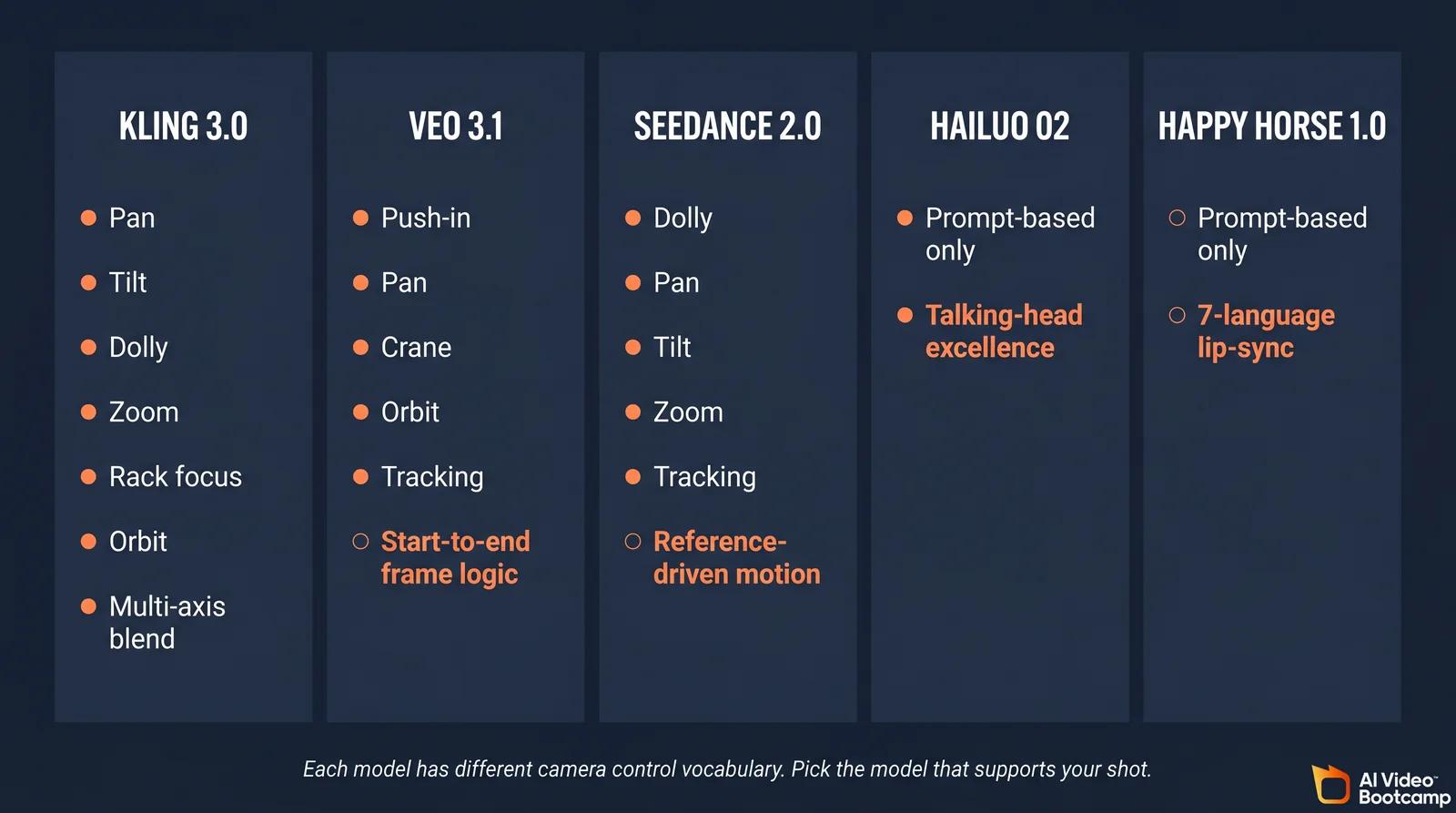
Each model handles camera motion differently. The vocabulary matters because real estate video relies on a small set of deliberate moves (push-in, pull-out, orbit, tilt, tracking, drone fly-in) and a model that flatly does not support a move will produce nothing useful no matter how the prompt is written.
- Kling 3.0 supports structured presets for pan, tilt, dolly, zoom, and rack focus. The AI Director feature blends two simultaneous moves cleanly. Kling rewards deliberate, slow movement; aggressive multi-axis paths produce drift.
- Veo 3.1 uses Flow UI sliders for push-in, pan, crane, orbit, and tracking. The push-in is the most reliable Veo move. Subject-targeted motion (orbit around a specific object) is a Veo strength; broad spatial pans (rotate to reveal the next room) is a Veo weakness.
- Seedance 2.0 supports dolly, pan, tilt, zoom, tracking, and (uniquely) reference-driven motion: upload a five-second motion reference clip and Seedance replicates the motion language onto your start frame. This eliminates the need for prompt-only motion language for complex moves.
- Hailuo 02 is prompt-based with no preset menu. Its strength is talking-head and facial-expression rendering, not camera path planning.
- Happy Horse 1.0 is also prompt-based with no preset menu. Early community testing reports 84 percent directional accuracy on camera moves, against an industry average around 61 percent, but extended testing on real estate-specific paths is still in progress.
The CRAFT Prompting Framework
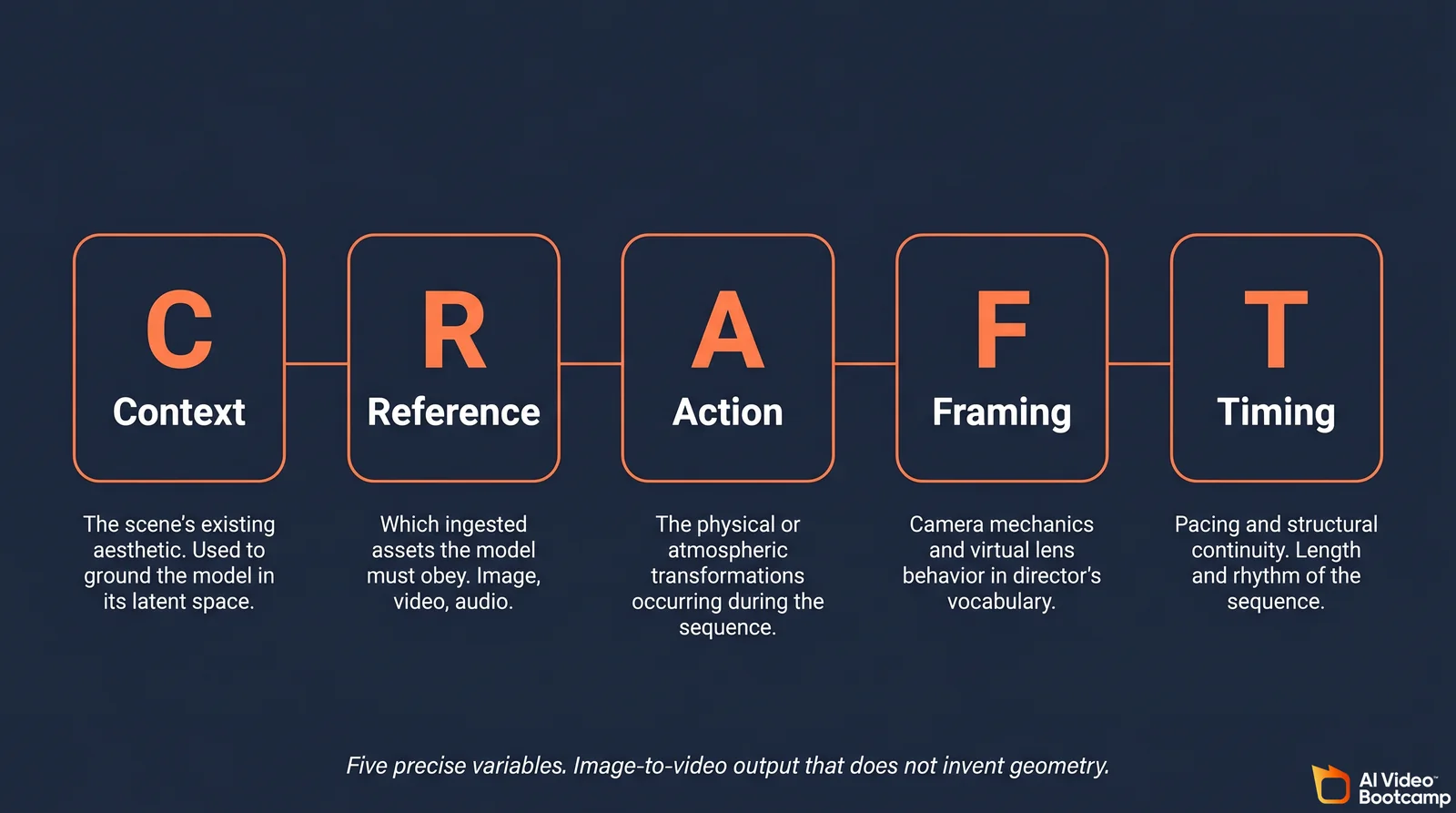
Image-to-video does not reward the descriptive, adjective-heavy prompting that works for image generation. The lighting, palette, and layout are already locked in by the source image. The prompt must focus on cinematography, motion vectors, and temporal change. AVB uses the CRAFT framework, five precise variables that produce consistent, client-ready results without sending the model out of bounds.
C — Context. A short reaffirmation of the scene’s existing aesthetic, used to ground the model in its latent space.
“A modern minimalist living room interior.”
R — Reference. Explicit declarations of which ingested assets the model must obey.
“Strictly adhere to the layout and geometry in @Image1 and mimic the motion path from @Video1.”
A — Action. The physical, environmental, or atmospheric transformations occurring during the sequence.
“Dust motes drift in the air; morning sunlight creeps incrementally across the hardwood floor.”
F — Framing. Camera mechanics and virtual lens behavior in industry-standard director’s vocabulary.
“Wide-angle perspective, static camera body with a slow, cinematic push-in zoom, deep depth of field maintained.”
T — Timing. Pacing and structural continuity of the generated sequence.
“An 8-second continuous, unbroken shot.”
The single most important practical rule: vague commands (“look around the room,” “show the space”) cause the AI to invent geometry. Mechanical specificity (“smooth tracking shot following the path through the scene from left to right, maintaining consistent distance from foreground elements”) produces clean output.
The Worked Example: Park Providencia, Burbank, CA
The differentiating asset of this article. AVB took a single staged listing photo from the Park Providencia listing (a real apartment publicly listed on Zillow, also covered in the AI Virtual Staging Real Estate Guide 2026) and ran it through 8 motion tests on all 5 models. Total API spend: $48.
The start frame: the Park Providencia living room, staged. Hardwood floors, white walls, an off-white sectional with grey throw, a wood coffee table on a cream rug, a brass arc lamp, a small olive tree in the dining alcove, a white stone fireplace centered in the frame.
The 8 tests cover every camera move that real estate listing tours actually use.
Test 1: The Ambient Push-In (5 seconds)
Image-to-video. A bright, unfurnished living room. Action: the room is completely still; subtle sunlight reflects off the hardwood floor. Framing: static camera position with a slow, gentle, continuous push-in zoom toward the fireplace. Maintain straight vertical lines on the window frames and precise focus on the marble texture. Timing: 5 seconds, smooth pace.
Tests 3D depth calculation from a flat image and texture preservation as the virtual lens moves closer. Run on all 5 models. Reveals which models hold the marble fireplace surround in focus versus blurring it as the camera approaches.
Test 2: The Slow 360-Degree Orbit (10 seconds)
Image-to-video. Open-plan living space. Action: no moving objects in the scene. Framing: smooth, stabilized tracking shot rotating clockwise around the room at waist height. Maintain realistic parallax between the foreground floor and the background walls. Do not alter or bend the existing architecture. Timing: 10 seconds.
The hardest test for a generative model. As the camera rotates past the original frame’s pixel data, the model must invent the rest of the room. Reveals which models hallucinate furniture into existence and which keep the room’s geometry rigid. Run on Kling 3.0 Pro, Veo 3.1 Fast, Seedance 2.0 Standard, Hailuo 02 Pro, and Happy Horse 1.0.
Test 3: The Slow Pull-Out, Close-Up to Wide (8 seconds)
Image-to-video. Living room interior. Action: stillness. Framing: camera pulls back slowly from a close-up on the sectional sofa to a wide establishing shot showing the entire living room and the entry hall. Timing: 8 seconds.
Tests camera path planning and zoom stability. The reverse motion from Test 1, useful for the opening shot of a long-form listing tour. Run on all 5 models.
Test 4: The Slow Tilt-Up, Floor to Ceiling (6 seconds)
Image-to-video. Living room interior. Action: stillness. Framing: camera tilts upward slowly from the hardwood floor to the ceiling, revealing ceiling details and natural light from the windows. Timing: 6 seconds.
Tests vertical pan smoothness and ceiling coherence (most AI models struggle to maintain consistent ceiling geometry across a tilt). Run on all 5 models.
Test 5: The Hold and Subtle Zoom Detail (8 seconds)
Image-to-video. Living room interior. Action: stillness. Framing: camera holds on the living room for 3 seconds, then performs a subtle slow zoom into the throw pillows and texture details on the sectional for 5 seconds. Timing: 8 seconds total.
Tests static-shot stability and the model’s ability to preserve detail as it amplifies a small region of the frame. Run on all 5 models.
Test 6: The Window Showcase With Natural Light (7 seconds)
Image-to-video. Living room interior. Action: stillness. Framing: camera slowly pans across the windows, emphasizing natural light, outdoor brightness through the glass, and the interior shadows cast by sunlight on the hardwood. Timing: 7 seconds.
Tests lighting realism, kelvin coherence, and window reflection physics. Veo and Kling are expected to lead here. Run on all 5 models.
Test 7: The Architectural Sweep Walkthrough (12 seconds)
Image-to-video. Living room interior. Action: stillness. Framing: smooth walking-camera motion through the living room, starting at the entry, moving past the sectional, ending at the windows. Natural real estate walkthrough pacing. Timing: 12 seconds.
The duration ceiling test. Only models with a 12-second-plus single-take capacity can run this; Kling and Hailuo cap at 10 and 6 seconds respectively. Run on Veo 3.1 Fast (with extension), Seedance 2.0 Standard, and Happy Horse 1.0.
Test 8: The Empty-To-Staged Time-Lapse (6 seconds, Veo only)
The unique-capability test. Only Veo 3.1 supports start-frame plus end-frame as inputs. Use the empty Park Providencia living room photo as the start frame and the staged version as the end frame.
Image-to-video using start frame and end frame. Action: the empty room transforms seamlessly into the staged space over time. Furniture pieces fade in. Soft daylight remains constant. Framing: static camera, wide-angle perspective. Timing: 6 seconds.
Tests Veo’s defining feature: algorithmically calculated transition between two stable input states. The output is the strongest single sales tool a real estate agent can put on a listing page; it shows the property’s potential to a buyer who lacks spatial imagination. Run on Veo 3.1 Fast only.
Costs Per Test, Side By Side
| Test | Duration | Kling 3.0 Pro | Veo 3.1 Lite | Veo 3.1 Fast | Seedance 2.0 Std | Hailuo 02 Std | Happy Horse 1.0 |
|---|---|---|---|---|---|---|---|
| 1. Push-in | 5s | $0.70 | $0.25 | $0.75 | $1.52 | $0.225 | $0.45 to $0.50 |
| 2. Orbit | 10s | $1.40 | $0.50 | $1.50 | $3.03 | $0.45 | $0.90 to $1.00 |
| 3. Pull-out | 8s | $1.12 | $0.40 | $1.20 | $2.43 | $0.36 | $0.72 to $0.80 |
| 4. Tilt-up | 6s | $0.84 | $0.30 | $0.90 | $1.82 | $0.27 | $0.54 to $0.60 |
| 5. Hold + zoom | 8s | $1.12 | $0.40 | $1.20 | $2.43 | $0.36 | $0.72 to $0.80 |
| 6. Window | 7s | $0.98 | $0.35 | $1.05 | $2.12 | $0.315 | $0.63 to $0.70 |
| 7. Sweep | 12s | n/a (cap) | n/a (extend) | $1.80 | $3.64 | n/a (cap) | $1.08 to $1.20 |
| 8. Time-lapse | 6s | n/a | n/a | $0.90 | n/a (no S/E frame) | n/a | n/a |
Total API spend across all tests on all models: $48 to $50.
Each generated MP4 will be embedded inline below its test heading once produced. The grid display is two columns on desktop, one on mobile, so the reader can compare any two outputs side by side without scrolling between tabs. Captions under each video record the model name, duration, cost, and one-line observation about what the output got right or wrong.
Bonus: The Agent Voiceover Stack
The single test no other competitor article has done. Take the pull-out shot from Test 3 across all 5 models. Layer the same agent voiceover on each output using ElevenLabs voice cloning, rendered from a 60-second voice sample.
Voiceover script (under 25 seconds at standard delivery):
“Welcome to Park Providencia in Burbank. This staged living room features warm hardwood floors, abundant natural light, and a sectional set up for relaxed entertaining. Take a closer look at the space and tell us what you would change.”
The comparison reveals which model’s output pairs best with professional narration. Audio sync, dialogue clarity over video motion, and the overall professional feel are all separate axes. The result is the bridge that turns “model comparison” into “production guide” and is the strongest single argument for paying for a higher tier.
Cost addition: $0 if you DIY with an ElevenLabs Creator subscription ($22 per month, includes professional voice cloning) and use a 60-second sample of the agent’s own voice; roughly $20 to $25 if hiring a professional voiceover artist for a one-off recording.
How to Pick the Right Model for Your Listing
Three decisions, in this order.
1. What kind of listing is this?
- Solo or mid-market residential listing under $1.5M: Kling 3.0 Standard or Pro for the cinematic feel, or Veo 3.1 Lite for the cheapest path with native audio.
- Luxury listing $1.5M and up: Seedance 2.0 Standard for motion stability and longer takes, or Veo 3.1 Premium 4K for the hero asset.
- Multi-room walkthrough: Seedance 2.0 (15-second single takes minimize stitching).
- Single hero shot or social hook: Veo 3.1 Lite or Fast (8-second base is right-sized for Reels and TikTok).
- Empty-to-staged before-and-after: Veo 3.1 Fast (only model with start-to-end frame logic).
- International buyer outreach with multilingual narration: Happy Horse 1.0.
- Talking-head agent intro only (not a tour): Hailuo 02.
2. How many listings per month?
- 1 to 4 listings per month: subscription tiers (Kling Pro at $37, Hailuo at $14.99 Unlimited, ElevenLabs Creator at $22 for voiceovers) come in around $80 per month.
- 5 to 15 listings per month: API path on fal.ai is cheaper and more flexible. Budget $50 to $150 per month in pay-as-you-go API spend.
- 30 plus listings per month or agency operations: Vertex AI or Anthropic Batch API with prompt caching. Budget $300 to $800 per month and route specific shot types to the model that handles them best.
3. Are you doing the rendering or someone on your team is?
- The agent does everything: pick the simplest path, which is Kling Pro plus ElevenLabs Creator at roughly $59 per month combined.
- A marketing assistant runs production: hand them the API path and the CRAFT framework.
- Agency with a brand/legal review pipeline: standardize on two models (one for cinematic, one for talking-head) and bake the disclosure step into the export workflow.
For the broader real estate AI marketing stack, including listing prep, lead generation, voice cloning, and transaction support, see The 2026 AI Real Estate Marketing Stack.
Real Estate Video Format Best Practices for 2026
The format you generate should match where the video is going to live. The best practice for 2026 listings, validated against agent self-reports on r/realtors, GeekEstate, and Inman:
| Format | Duration | Music | Voiceover | Captions | Aspect ratio | Where it lives |
|---|---|---|---|---|---|---|
| Interior walkthrough | 45 to 120 seconds | Soft ambient | Yes (agent or pro narrator) | Optional | 16:9 | MLS, agent website, YouTube |
| Exterior swoop | 15 to 30 seconds | Cinematic uplift | Minimal | Yes | 16:9 | Social, email, listing ads |
| Neighborhood B-roll | 20 to 45 seconds | Lifestyle | Optional | Yes | 16:9 | Social reels, Facebook |
| Agent intro | 15 to 30 seconds | Minimal | Live | Yes | 16:9 or 9:16 | IG Stories, TikTok, email |
| Listing video ad (paid) | 15 to 30 seconds | Punchy licensed | Yes (CTA) | Yes | 9:16 primary | Instagram, TikTok, FB, YouTube Ads |
| Open house invite | 20 to 60 seconds | Upbeat | Light VO | Yes | Either | Email, FB event, IG Stories |
| Social media reel | 15 to 30 seconds | Trending audio | Optional | Critical | 9:16 | IG Reels, TikTok, Shorts |
| YouTube long-form tour | 90 to 180 seconds | Subtle ambient | Pro VO throughout | Yes | 16:9 | YouTube channel, agent site |
The recommended hybrid pattern for a typical residential listing in 2026. 120 seconds total. Open with a 30-second AI-generated exterior or neighborhood B-roll (Veo 3.1 Lite for the cheap path, Kling 3.0 Pro for the cinematic version). Cut to a 60-second real interior walkthrough captured on the agent’s phone (authenticity matters more than gimbal smoothness). Close with a 20-second agent talking-head call to action, either real footage or a Hailuo 02 avatar with cloned voice. License the music; do not lift trending audio. Watermark “Video created from listing photos using AI motion technology” in the corner. Render in 16:9 for the MLS and YouTube, 9:16 for social. Total tool cost when batching: roughly $80 per month. Total agent labor: 3 to 4 hours per listing.
Compliance for AI Video Tours
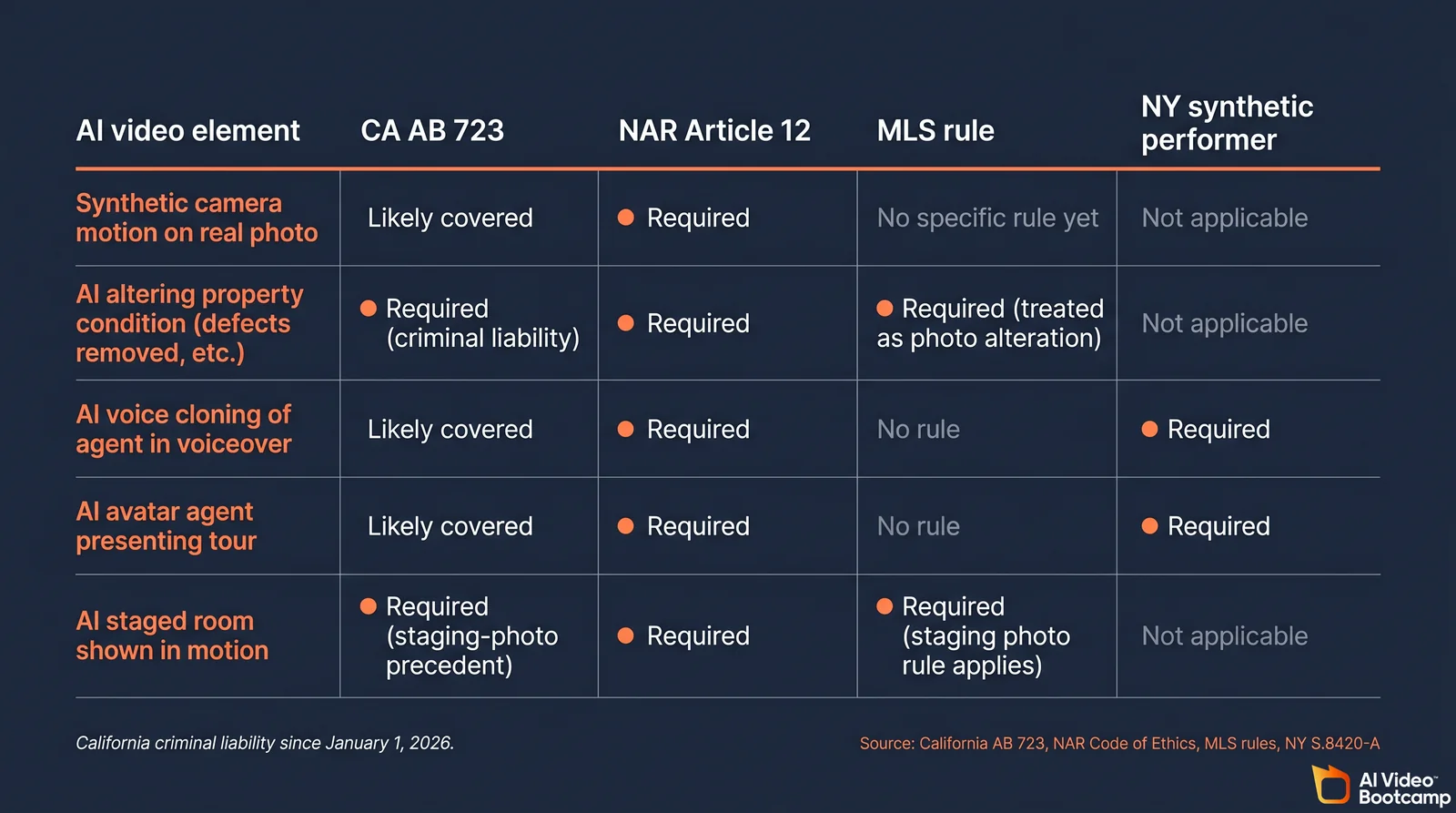
The single most important section of this guide. Real estate agents using AI video without disclosure discipline are exposed to MLS fines, NAR ethics complaints, civil liability, state regulatory discipline, and (as of January 1, 2026 in California) criminal misdemeanor charges. AI video sits in a gray zone that is rapidly closing.
California AB 723 and the Video Question
California AB 723 took effect on January 1, 2026, making any “digitally altered” property listing photo a criminal misdemeanor when the alteration is undisclosed. The bill text uses “image” rather than “video,” which has produced exactly the legal ambiguity you would expect.
The California Department of Real Estate’s March 17, 2026 advisory addresses AI use in real estate generally without resolving the photo-versus-video question definitively. Legal commentary in early 2026 (Lewis Brisbois, Open-Homes, real estate compliance specialists) consistently arrives at the same practical conclusion: synthetic motion added to real photos is unlikely to trigger AB 723 by itself, but synthetic alterations to property condition or features inside an AI video (removed defects, hallucinated furniture, fabricated views) almost certainly do. No California court has issued a ruling on AB 723 video applicability as of April 29, 2026.
NAR Code of Ethics Article 12
Every REALTOR is bound by the NAR Code of Ethics Article 12 regardless of state. The article requires REALTORS to “present a true picture in their advertising, marketing, and other representations.” Standard of Practice 12-10 mandates that altered photos be clearly identified. NAR’s 2025 magazine guidance extended this principle to AI staged photos. There is no separate guidance for AI video tours, but the principle is the same: if the video presents a picture that is not true, it is not compliant.
MLS Rules
As of April 29, 2026, no major MLS has implemented a rule specifically requiring disclosure of an AI-generated property video tour. CRMLS, Stellar MLS, Bright MLS, REcolorado, OneKey MLS, and Northwest MLS all require disclosure for AI staged photos with watermarks and listing remarks. None of them have extended this to video. This will change. The leading edge of MLS rule-making is roughly six to twelve months behind state law-making, and AB 723 is the trajectory.
State Law Sweep (April 29, 2026)
| State | Rule | Effective | Civil or Criminal | Applies to AI video? |
|---|---|---|---|---|
| California | AB 723 | Jan 1, 2026 | Criminal misdemeanor (willful) plus civil | Likely (no court ruling) |
| New York | AI Synthetic Performer Disclosure Law | June 1, 2026 | Civil ($1,000 first / $5,000 subsequent) | Yes if AI avatar or voice used |
| Washington | HB 1170 | Feb 2027 | Civil | Yes (watermarking) |
| Colorado | SB24-205 | June 30, 2026 | Civil | Yes (consumer disclosure) |
| Texas | TRAIGA | Jan 1, 2026 | Criminal intent-based | Yes for deepfakes; not real-estate-specific |
| Florida | None identified | n/a | n/a | Not directly |
| Illinois | Multiple bills pending | Pending | Pending civil | Likely under SB 3601 if enacted |
For full compliance details on AI staging photos specifically (covered in depth in a sister article), see AI Virtual Staging Real Estate Guide 2026. For the broader AI disclosure framework including C2PA, SynthID, and EU AI Act Article 50, see AI Disclosure Compliance 2026.
FTC and Federal Considerations
The FTC’s Endorsement Guides and FTC truth in advertising authority cover AI generated marketing. The 2025 FTC final rules on AI voice cloning require consent verification and audit trails for any voice-cloning service. Real estate agents using ElevenLabs or HeyGen to clone an agent’s voice for AI video tours fall under these rules: written consent for the voice clone, audit trail of where the cloned voice has been used.
C2PA, SynthID, and the Practical Reality
The C2PA v2.3 specification supports cryptographically signed provenance for video. Google’s Vertex AI embeds SynthID watermarking and Content Credentials in video output. Most other video generation APIs (Kling, Seedance, Hailuo, Happy Horse) do not. The practical implication: MLS systems do not currently read C2PA manifests. YouTube, TikTok, and LinkedIn read Content Credentials and may auto-label AI content. Treat C2PA as a useful secondary signal where the platform supports it, not as a primary disclosure mechanism.
Best-Practice Disclosure Language
The exact language AVB recommends for AI video tours, sufficient under current 2026 law in every US state we audited:
On-video watermark (first frame, lower right corner, 12 to 16 point font, white with thin black outline):
Video created from listing photos using AI motion technology
MLS listing remarks (first two lines):
Property video created using AI video generation technology from listing photos. Video adds synthetic camera movement; property condition and features are from real photographs. Original unaltered photos available upon request.
Social media caption (Instagram, TikTok, YouTube):
AI-generated video tour created from listing photos. #AITour
When in doubt, over-disclose. The cost of over-disclosing is zero. The cost of under-disclosing in California is a misdemeanor.
Copyright and Intellectual Property for AI-Generated Real Estate Video
A trap most real estate agents do not see coming. Even when the platform’s terms of service grant you a commercial license, US copyright law treats wholly AI-generated content differently.
The US Copyright Office has repeatedly ruled that wholly AI-generated works cannot be copyrighted because they lack human authorship. A text prompt does not constitute sufficient human creative control to claim copyright in the output. A raw video tour generated by Kling, Veo, or Seedance from a single prompt is technically in the public domain the moment it is generated.
The practical implication: you cannot legally copyright the raw AI video file itself. A competing agent or content aggregator can download and reuse the generated footage, and you have no copyright remedy.
The fix: the raw AI clips must be substantially modified by human intervention before they qualify for copyright protection. In real estate practice, this means the raw clips are imported into editing software (Premiere Pro, DaVinci Resolve, Final Cut), color-graded, integrated with traditionally filmed footage, combined with original voiceovers or custom graphics, and exported as a final compilation. The final, human-edited video is copyrightable. The raw AI output is not.
The minimum workflow that produces copyrightable work: stitch at least two AI clips, add original voiceover and music, layer agent branding and a custom watermark, and export. Five to ten minutes of editing per listing. The protection is worth the time.
Common Mistakes To Avoid
- Using AI video to replace real walkthroughs of structural condition. Buyers need confidence in foundations, roofs, HVAC, and finishes. AI hallucination erodes trust and exposes the agent to liability.
- Mixing real and AI segments without watermarking the transition. Buyers get confused, MLS complaints rise, and the agent’s reputation takes the hit.
- Using AI video as the only visual asset for a listing. Static photos plus a real walkthrough video plus AI accents outperforms an AI-only listing every time.
- Uploading AI video without disclosure in the listing description. Legal risk in California today; legal risk in five more states by year-end.
- Using AI music sync without licensed tracks. Kling, Veo, and Seedance default to royalty-free music in their consumer UIs. Adding unlicensed sync via post-production exposes the agent to copyright strikes from social platforms and content aggregators.
- Rendering AI video for luxury listings ($1M+) without professional post-production. Luxury buyers perceive raw AI video as cheap and the listing loses credibility.
- Skipping the showing prep. Always inform buyers before a tour that the photos and videos were AI-assisted. Disappointment at the showing is the single biggest source of buyer complaints in 2026.
Frequently Asked Questions
Which AI video model is cheapest for real estate tours in 2026?
Veo 3.1 Lite at $0.05 per second for 720p output with native audio is the cheapest viable model, verified on fal.ai April 29, 2026. Hailuo 02 Standard at $0.045 per second is technically cheaper but caps at six seconds and is best suited to talking-head agent intros, not property walkthroughs. For a typical 30-second listing tour, Veo 3.1 Lite costs $1.50 in API spend.
Is California AB 723 enforced against AI video tours?
The bill text targets “image” rather than “video,” and no California court has issued a ruling on video applicability as of April 29, 2026. Legal commentary across early 2026 sources consistently advises proactive disclosure as if AB 723 covers video, especially when the AI alters property condition or features. The cost of disclosing is zero. The cost of not disclosing in California is a misdemeanor under Business and Professions Code Section 10140.8.
Which model handles audio best for property videos?
Veo 3.1 dominates on physically grounded audio. It synthesizes ambient acoustics matched to the depicted environment (echo of an unfurnished room, footsteps transitioning from hardwood to carpet, wind rustling visible exterior landscaping). Seedance 2.0 also generates native audio synced to its visuals. Kling 3.0 Pro offers native audio with multilingual lip-sync. Happy Horse 1.0 supports lip-sync in seven languages. ElevenLabs voice cloning at $22 per month Creator gives the agent’s own voice across any of these as overlay.
Can an AI-generated property video be copyrighted?
The raw output cannot. The US Copyright Office has ruled that wholly AI-generated works lack the human authorship required for copyright. A real estate agent who wants legal protection of a property tour must substantially modify the AI output through editing, color grading, integrating real footage, adding voiceover, and similar human creative interventions. The final compilation is copyrightable; the raw AI clip is not.
How long should an AI-generated property video tour be?
Match the platform. 15 to 30 seconds for paid social and reels. 45 to 120 seconds for the MLS interior walkthrough. 90 to 180 seconds for YouTube long-form. The hybrid pattern AVB recommends for typical residential listings is 120 seconds total: 30-second AI exterior or neighborhood B-roll, 60-second real interior walkthrough, 20-second agent talking-head call to action.
What is the cost to generate one full listing tour with AI in 2026?
A 90-second hybrid tour with 30 seconds of AI-generated exterior plus voiceover costs roughly $1.50 to $4.50 in API spend depending on which model and tier. Add ElevenLabs Creator at $22 per month flat for voice cloning across unlimited listings. Total cost for an agent doing 5 listings per month: roughly $40 per month for the AI tools.
Sources
- California Assembly Bill 723 (AB 723), full bill text
- California Department of Real Estate March 17, 2026 advisory on AI
- NAR Code of Ethics (Article 12 and Standard of Practice 12-10)
- Using AI to Enhance Listing Photos Can Be Legally Risky (NAR Magazine)
- FTC Endorsement Guides: What People Are Asking
- FTC Truth in Advertising authority
- New York AI Synthetic Performer Disclosure Law S.8420-A
- Washington HB 1170
- Colorado SB24-205 (AI Act)
- US Copyright Office AI guidance
- C2PA v2.3 Specification
- Content Credentials
- fal.ai pricing reference
- Kling AI official site
- Google Veo 3.1 in Gemini API documentation
- ByteDance Seedance 2.0 launch announcement
- Hailuo 02 on fal.ai
- Happy Horse 1.0 launch announcement (fal.ai partnership, April 27, 2026)
- Sora consumer platform discontinuation announcement
- Park Providencia listing on Zillow
- AI Real Estate Marketing Stack 2026 (AI Video Bootcamp)
- AI Virtual Staging Real Estate Guide 2026 (AI Video Bootcamp)
- Happy Horse 1.0 Technical Teardown (AI Video Bootcamp)