
Pricing verified April 30, 2026.
The 2026 AI real estate marketing stack is not one platform. It is four composable workflow layers (Listing Prep, Lead Generation, Marketing Production, Transaction Support) powered by True Models with verified per-unit pricing and a strict compliance footprint. A solo agent runs the full stack for roughly $60 to $80 per month. An agency spends $800 to $2,000 per month. The bottleneck is no longer cost; it is cognitive load and prompting skill, both addressable with disciplined workflow design. This guide covers the full stack with verified April 2026 pricing, three pre-built reference stacks (Solo, Small Team, Agency), and a compliance crosswalk for California AB 723, NAR Code of Ethics, MLS rules, FTC voice cloning, and the New York and Colorado AI laws.
Why a Stack, Not a Single Platform
In 2026, no single platform handles listing prep, lead generation, marketing production, and transaction support with the depth a competitive agent needs. The category fractured. The best results come from composing four to six specialized tools around a workflow, not subscribing to an all-in-one product that does each task at 60 percent of the standard.
Two independent data points anchor the case. First, Zillow’s 2026 Agent Trends Survey reports that the typical real estate agent uses two to four discrete software tools in a typical week, and that “ease of use” now outranks pricing and raw performance as the top criterion when evaluating new technology. Second, an independent eight-agent residential firm case study published in early 2026 documented that swapping a manual intake process for a four-minute AI lead responder lifted lead-to-appointment conversion from 31 percent to 46 percent, and total closed transaction volume rose 48 percent over nine months. Those numbers came from one tool sitting inside a stack, not from buying a single platform that does everything.
The agents winning in 2026 are the ones who treat AI as a layered nervous system, not as a single brain.
The Four Workflow Layers
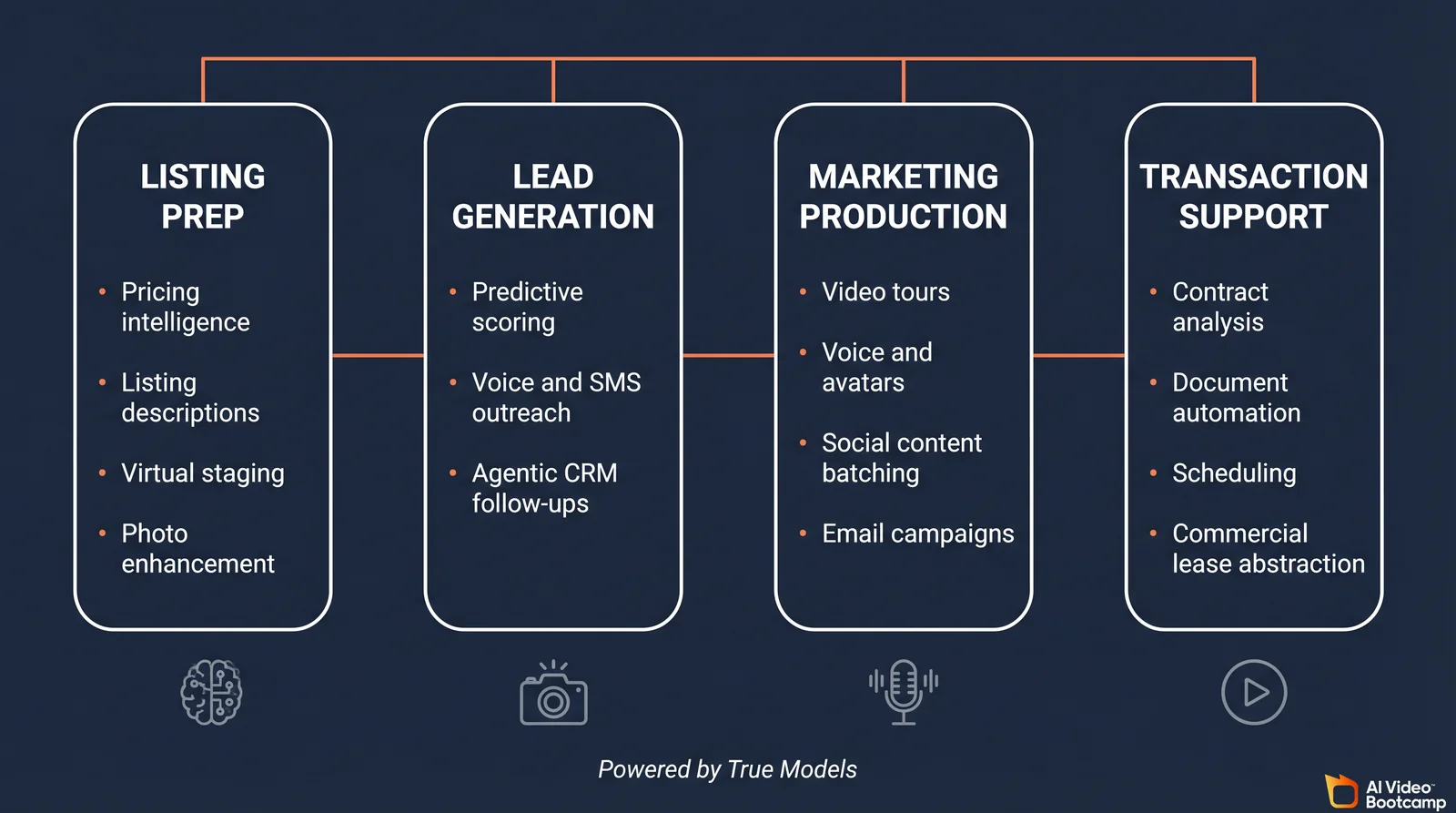
Every real estate marketing operation in 2026 reduces to four layers. Each layer has a clear job, a short list of tools that do that job well, and a specific compliance posture.
Listing Prep. Pricing intelligence, listing descriptions, virtual staging, photo enhancement. The job is to take a raw property and turn it into a market-ready asset with verified facts and compliant imagery.
Lead Generation. Prospecting, lead scoring, outreach, voice and SMS automation, CRM-resident agentic follow-ups. The job is to surface high-intent buyers and sellers and route them to the right human at the right time.
Marketing Production. Video tours, social content, voiceovers, AI avatars, email campaigns, paid ads. The job is to produce on-brand multimedia at the cadence each platform rewards, without burning the agent’s calendar.
Transaction Support. Contract analysis, document automation, scheduling, comparative market analyses (CMAs), follow-ups. The job is to compress the administrative tax of a deal so the agent can spend the saved hours on negotiation and showings.
Inside each layer, the stack mixes True Models (the foundational AI models like Kling 3.0 and Claude Opus 4.7) with real-estate-specific products that wrap those models in industry workflows (Lofty, BoldTrail, Rechat, ListingAI). The True Models do the heavy lifting. The real-estate products provide the integrations and the compliance posture.
The True Models: Verified April 2026 Pricing
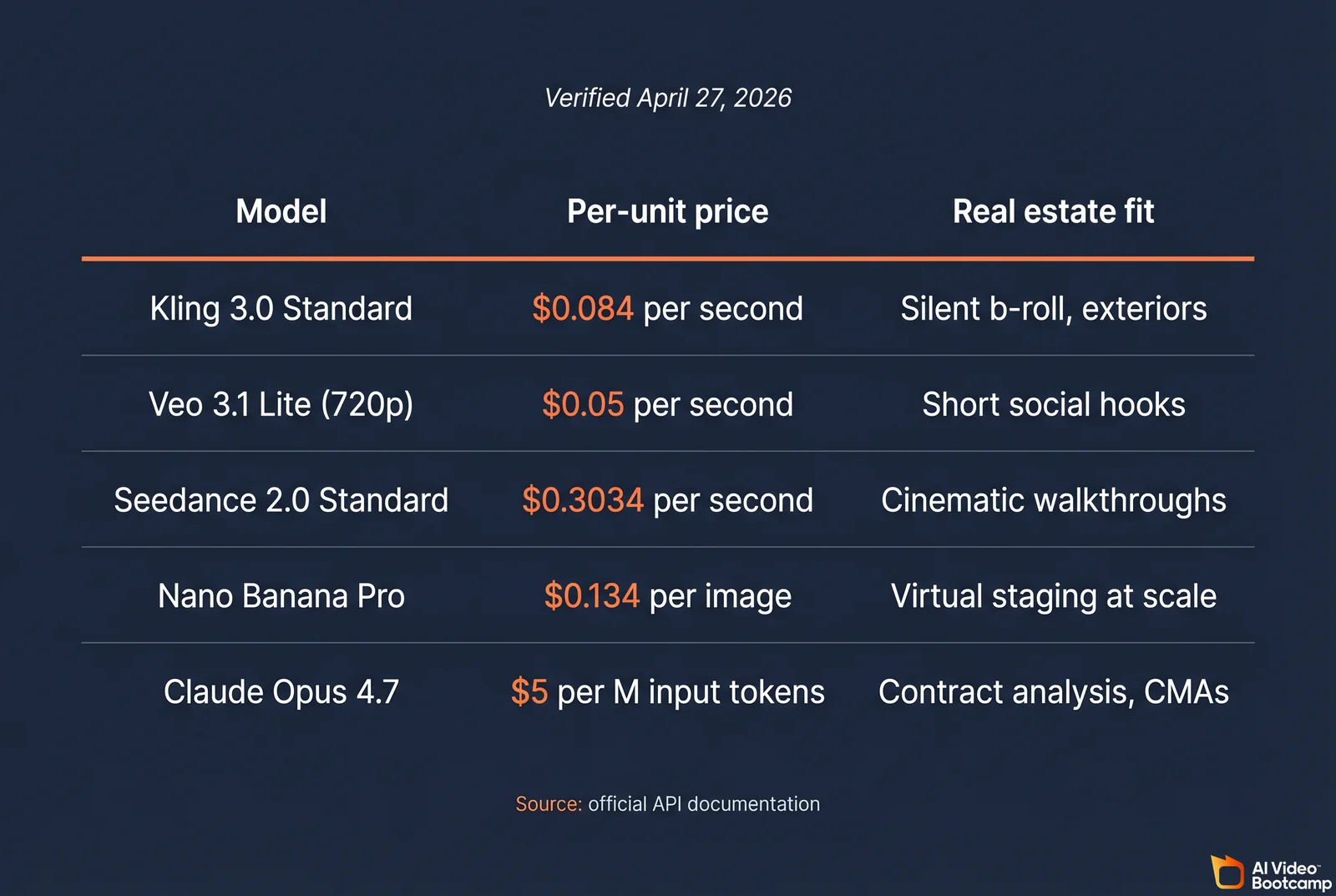
Per-unit API pricing, verified April 27 to 28, 2026 against official documentation: Kling 3.0 at $0.084 per second, Seedance 2.0 Standard at $0.3034 per second, Seedance 2.0 Fast at $0.2419 per second, Veo 3.1 Lite at $0.05 per second (720p), Veo 3.1 Fast at $0.15 per second, Veo 3.1 Premium at $0.40 per second, Hailuo 02 Standard (768p) at $0.045 per second, Hailuo 02 Pro (1080p) at $0.08 per second, Nano Banana Pro at $0.134 per 1K to 2K image, GPT Image 2.0 at $0.211 per high-quality 1024x1024 image, ElevenLabs Creator at $22 per month, and Claude Opus 4.7 at $5 per million input tokens plus $25 per million output tokens.
Video Models
| Model | Per-second cost | Audio | Notes | Real estate fit |
|---|---|---|---|---|
| Kling 3.0 Standard | $0.084 | No | Strong silent b-roll | Property exteriors, neighborhood pans |
| Kling 3.0 Pro w/audio | $0.168 | Yes | Adds $0.084/sec for audio | Multi-shot tours with native audio |
| Veo 3.1 Lite (720p) | $0.05 | Yes | New floor price for usable AI video | Short social hooks, low budget |
| Veo 3.1 Fast (1080p) | $0.15 | Yes | Mid-tier sweet spot | Mid-budget hooks, social cuts |
| Veo 3.1 Premium (4K) | $0.40 | Yes | True 4K hero shots | Luxury listings, hero asset |
| Seedance 2.0 Standard | $0.3034 | Yes | Up to 12 reference files | Cinematic walkthroughs from photo stacks |
| Seedance 2.0 Fast | $0.2419 | Yes | Slightly lower fidelity | Lifestyle B-roll, social hooks |
| Hailuo 02 Standard (768p) | $0.045 | Subscription tiers | Talking-head excellence | Agent-avatar property intros |
| Hailuo 02 Pro (1080p) | $0.08 | Subscription tiers | Higher fidelity, same talking-head strength | Premium agent-avatar tours |
| Wan 2.2 (hosted) | $0.067 | N/A | Self-hosted free with 16GB+ VRAM | Privacy-sensitive listings, DIY |
| LTX Video | ~$0.002 to $0.004 | N/A | Self-hosted open source | Fallback, privacy-first listings |
OpenAI’s Sora consumer platform was discontinued on April 26, 2026, with the API following on September 24, 2026. Agents who were using Sora 2 for property walkthroughs need to migrate to one of the models above before the API window closes.
For a deep dive on the video models, see Seedance vs Kling vs Veo Comparison, Kling AI Complete Guide, and Veo 3.1 Lite Complete Guide.
Image Models
| Model | Per-image / per-month cost | Best at | Real estate fit |
|---|---|---|---|
| Nano Banana Pro | $0.134 (1K/2K), $0.24 (4K), 50 percent batch discount via Batch API | Realism, iterative editing, character consistency | Virtual staging at scale, lifestyle imagery |
| GPT Image 2.0 | $0.211 per high-quality 1024x1024 image, medium ~$0.053 | Typographic accuracy, structural prompt fidelity | Yard signs, floor plan callouts, prompts with strict spatial logic |
| Midjourney V7 | $10 to $120 per month tiered (Basic to Mega), Draft Mode halves GPU time | Aesthetic mood boards, campaign direction | Luxury and editorial campaigns |
| Flux.2 Pro | $0.03 per megapixel via official BFL API | Hyperreal output, photographic style | Lifestyle hero images |
For a deep dive on image models, see GPT Image 2.0 vs Nano Banana Pro Head to Head, Nano Banana Pro Complete Guide 2026, and ChatGPT Images 2.0 Review.
The biggest economic lever for image work in real estate is Nano Banana Pro’s Batch API (50 percent discount when you accept a 12 to 24 hour processing window). For an agency batching 500 staged variants overnight, 4K images drop from $0.24 to $0.12 per image, which saves $60 per 500-image run. For a solo agent doing 30 images a week, the savings is roughly $1.80 per week, but the workflow change costs nothing.
Voice and Audio
| Tier | Monthly cost | Credits / characters | Real estate fit |
|---|---|---|---|
| ElevenLabs Free | $0 | 10,000 characters | Trial only, no commercial rights |
| ElevenLabs Starter | $5 | 30,000 characters | Solo agents, voice cloning enabled at this tier in 2026 |
| ElevenLabs Creator | $22 | 100,000 credits | Professional voice cloning, dozens of localized listing videos |
| ElevenLabs Pro | $99 | 500,000 credits | Full agency voice cloning across multiple agents |
| ElevenLabs Scale | $299 | 2,000,000 credits | Agencies running multilingual brand syndication |
| ElevenLabs Business | $1,320 | High volume + 5 cents per minute conversational latency | Enterprise brokerages with real-time AI voice agents |
Voice cloning at the Creator tier is the inflection point for solo agents. Record a 60-second voice sample once, then narrate dozens of localized property videos without rebooking studio time. Overage charges scale inversely with tier (Creator pays roughly $0.30 per minute of overage; Scale pays $0.18), so brokerages running near credit thresholds save money by upgrading proactively.
Reasoning and Copy
| Model | Per-token cost | Subscription | Strength |
|---|---|---|---|
| Claude Opus 4.7 (released April 16, 2026) | $5 / M input, $25 / M output | Claude Pro $20/mo for chat use | Agentic coding, long-context contract analysis, dense legal/zoning docs |
| Claude Opus 4.7 with Batch API | 50 percent discount on 24-hour async workloads | n/a | Backfill data enrichment, CMA generation overnight |
| GPT-5.5 (released April 23, 2026) | API per-token (model-tier dependent) | ChatGPT Plus $20/mo, Pro $100/mo or $200/mo | Day-to-day reasoning, image-rich workflows, 60 percent reduction in hallucination vs GPT-5.4 |
A subtle but real pricing event: Anthropic kept Opus 4.7’s nominal per-token rate identical to 4.6, but the new 4.7 tokenizer parses input differently and produces up to 35 percent more tokens for the exact same volume of input text. Effective cost on high-entropy tasks (contract analysis, multi-listing data ingest) rose roughly 35 percent versus 4.6 even though the rate card did not move. Two mitigations matter: Anthropic’s Batch API (50 percent discount on async workloads under 24 hours) and prompt caching (up to 90 percent discount on repeated cache reads). A well-designed CMA enrichment queue can land at roughly $0.25 per million effective input tokens.
Workflow 1: Listing Prep
Listing Prep is where the True Models earn their keep. Pricing intelligence comes from BatchData ($99/mo+) or PropStream ($99 to $199/mo). Listing descriptions go through Claude Opus 4.7 or GPT-5.5 with a Fair Housing checklist. Virtual staging uses Nano Banana Pro and GPT Image 2.0 directly, or wraps them in Collov AI ($16 to $225/mo) or Virtual Staging AI ($16/mo). Photo enhancement runs through Nano Banana Pro Batch API at $0.12 per 4K image. Total monthly cost for a solo agent: roughly $115 to $135, with most of that in pricing-intelligence data (the AI tools themselves are inexpensive).
Pricing Intelligence
The cheapest step in this workflow is the most defensible. Claude Opus 4.7 with prompt caching can ingest local zoning codes, HOA bylaws, and recent comparable sales for a few cents per CMA. The bigger spend goes to data: PropStream ($99/mo Essentials with 50 free leads, $199/mo Pro with skip tracing) and BatchData ($99/mo+ for 155M property records and 700+ data points) are the two leading sources of off-MLS property data in the US.
Zillow’s neural-network Zestimate now covers 116 million US homes with a 1.83 percent median absolute percentage error for on-market properties. HouseCanary covers 136 million properties with 2.8 percent error. Neither replaces an agent’s local market knowledge, but both are cheaper and more accurate than any agent could produce manually for the data ingest step.
Listing Descriptions
The default workflow: feed Claude Opus 4.7 or GPT-5.5 the property facts (sqft, beds, baths, year built, key features, neighborhood notes), a Fair Housing language checklist, and 3 to 5 example listings written by the agent in their actual voice. Output: a 200-word MLS description plus a 150-word social caption. Cost per listing at scale: well under $0.05 in API spend on Claude Opus 4.7, far less than the $20-per-month ChatGPT Plus subscription pays for in chat-mode equivalents.
The compliance discipline matters. NAR Code of Ethics Article 12 requires REALTORS to “present a true picture in their advertising, marketing, and other representations.” If the AI hallucinates a feature (“walking distance to Whole Foods” when the closest store is 2.4 miles away), the agent is on the hook, not the model. Always verify the AI output against the source facts before MLS upload.
Virtual Staging
For the deep dive on virtual staging including DIY prompts, MLS rules, NAR Code of Ethics Article 12, California AB 723 (criminal misdemeanor for undisclosed staging effective January 1, 2026), and a real worked example using a Burbank Zillow listing, see the AI Virtual Staging Real Estate Guide 2026.
Quick reference for the stack: Nano Banana Pro and GPT Image 2.0 are the two best DIY models. Nano Banana Pro’s Batch API drops 4K images to $0.12 per image. GPT Image 2.0 wins on typographic precision (yard signs, floor plan annotations). Dedicated tool path: Collov AI at $16 per month for 60 images, scaling to $225 per month for 1,000 images, with a 360-degree panorama add-on at roughly $7 per room (versus $300 to $1,000 for traditional 3D tours).
Photo Enhancement
Sky replacement, brightness correction, white balance, dust spot removal: routine photo work that does not trigger AB 723 disclosure (under California law, basic photo corrections that preserve “accurate property representation” are permitted). Nano Banana Pro handles this cleanly via Batch API at $0.12 per 4K image, or via dedicated tools like BoxBrownie AI for hybrid AI-plus-human retouching on luxury listings.
Workflow 2: Lead Generation
Lead Generation in 2026 splits into three sub-layers: predictive lead scoring (SmartZip $179 to $399+/mo, Lofty custom pricing), automated outreach via voice and SMS (Ylopo AI Voice with 45 percent answer rate on auto-dialed leads, Rezora IO for expired-listing voice outreach), and CRM-resident agentic follow-ups (BoldTrail/kvCORE $5,988/year+, Lofty CRM with v2026 AI Co-Pilots). The biggest 2026 product shift is Lofty’s v2026 launch which introduced an “SEO Agent” and a “Website Building Agent” that operate continuously in the background, replacing the older trigger-based smart plans.
Predictive Lead Scoring
The leverage in 2026 is not “find every lead.” It is “rank the leads I already have so I respond to the right one within four minutes.” The 2026 8-agent firm case study cited above moved their conversion from 31 percent to 46 percent purely on response speed, and the response-speed improvement came from a single autonomous agent watching the inbox.
Concrete cost: SmartZip’s individual-agent tier sits at $179 per month, scaling to $399 per month for Smart Targeting plus CRM. Lofty’s CRM is brokerage-priced (custom). For a solo agent, Lofty AI inside the Lofty CRM is the simplest single product that runs predictive scoring plus 24/7 chat plus follow-ups in one place.
Automated Outreach (Voice and SMS)
Ylopo AI Voice auto-dials inbound web leads, qualifies them with a short conversational script, transfers warm leads to the human agent, and logs cold leads back to the CRM nurturing flow. Documented 45 percent answer rate over a 90-day cohort and 14 calls auto-dialed before a transfer is escalated.
Compliance footprint: every AI voice call needs disclosure under FTC voice cloning rules (consent verification and audit trails for cloning services as of 2025 final rules). New York’s June 1, 2026 rule adds a synthetic-performer disclosure obligation: $1,000 per first violation, $5,000+ subsequent. The standard disclosure language: “This call is being made with the assistance of artificial intelligence.” Add it to the script.
CRM-Resident Agentic Follow-Ups
Lofty CRM’s v2026 update was the most significant real-estate-specific AI product release of the spring. The platform replaced trigger-based smart plans (which agents had to configure manually) with autonomous AI Co-Pilots. The two most notable: an SEO Agent that runs daily site optimization scoring and auto-updates titles and metas, and a Website Building Agent that builds and tunes agent landing pages without manual intervention. Brokerages using Lofty saw measurable lift in lead capture from agent websites within four to six weeks of switching.
For larger teams, BoldTrail (formerly kvCORE) covers omnichannel lead routing, team accountability, and commission automation. Pricing starts at $5,988 per year for the user-tiered package and scales by seat count. FollowUpBoss AI handles the omnichannel routing piece for teams that prefer a single-purpose tool over a full back-office platform.
Documented Workflow Pattern: The n8n CMA Engine
A pattern worth borrowing from a Reddit-documented Denver agent setup. Four cascading agentic modules, all running continuously in the background:
- Data Collector. HTTP request scrapes property data (price, sqft, address) from public listing aggregators into a Google Sheet.
- Number Cruncher. Embedded Python script computes median pricing, days-on-market, and other statistical metrics on the dataset.
- AI Analyst. Three sequential LLM calls. First determines buyer’s vs seller’s market from the stats. Second flags pricing anomalies and underpriced properties. Third compiles the insights into a polished investment brief.
- Brief Compiler. Auto-emails the formatted brief to the brokerage team.
Total ongoing cost on Claude Opus 4.7 with Batch API and prompt caching: under $30 per month for a solo agent running this against their farm zip code. Total time saved per CMA: an hour or more, repeated across every comp check.
Workflow 3: Marketing Production
Marketing Production is where the True Models compose into deliverables. Video tours come from Kling 3.0 ($0.084/sec silent, $0.168/sec with audio), Veo 3.1 ($0.05 to $0.40/sec depending on tier), Seedance 2.0 ($0.2419 to $0.3034/sec), or Hailuo 02 ($0.045 to $0.08/sec, talking-head excellence). Voice cloning runs on ElevenLabs Creator ($22/mo for solos) or ElevenLabs Pro ($99/mo for agencies). AI avatars use HeyGen plus ElevenLabs voice cloning. Social content batching: ChatGPT for outline, Descript for editing, Opus Clip for shorts. Email marketing remains the highest-ROI channel at $36 to $42 per dollar spent.
Video Tours
Pick the model based on the listing tier and the audio plan.
Silent b-roll for the listing photographer’s voiceover: Kling 3.0 Standard at $0.084 per second.
Mid-tier tour with native audio: Kling 3.0 Pro at $0.168 per second, or Veo 3.1 Fast at $0.15 per second. Veo includes audio in the base price; Kling charges a $0.084-per-second premium for audio.
Luxury hero shot (4K cinematic): Veo 3.1 Premium at $0.40 per second.
Photo-stack walkthrough (multiple input photos): Seedance 2.0 Standard at $0.3034 per second. Up to 12 reference files at once. Strong on lighting and spatial coherence.
Talking-head agent intro: Hailuo 02. Standard 768p at $0.045 per second; Pro 1080p at $0.08 per second. Best-in-class facial expression rendering.
Privacy-sensitive listing: Wan 2.2 self-hosted (free if you have 16GB+ VRAM) or LTX Video at roughly $0.002 to $0.004 per second.
A 30-second listing tour at Veo 3.1 Fast costs $4.50 in API spend. That same tour cost $40 to $80 to produce traditionally with a videographer in 2024.
For a deep dive on AI video for real estate including the specific stitch-stack workflow (image to video, audio overlay, captions), see the forthcoming AI Video Tours pillar; in the interim see Seedance vs Kling vs Veo Comparison and the Happy Horse 1.0 Complete Guide covering the new Alibaba video model with native multilingual lip-sync.
Voice and Avatar
ElevenLabs Creator at $22 per month is the inflection-point tier for solo agents: the first tier that unlocks professional voice cloning. Record a 60-second voice sample, save the voice profile, then narrate dozens of localized property videos without re-recording. Each new listing’s voiceover costs effectively zero in marginal time.
For agencies, ElevenLabs Pro at $99 per month adds team workspaces and 500,000 credits. Scale at $299 per month covers 2 million credits and multi-agent voice libraries. Business at $1,320 per month adds real-time conversational AI with five-cent-per-minute latency, suitable for live AI receptionists at the brokerage front desk.
AI avatars layer on top of voice. HeyGen plus ElevenLabs voice cloning produces an agent-likeness avatar that can deliver scripted property tours and social hooks. Compliance: the AI avatar is regulated under the New York synthetic performer rule (June 1, 2026) and FTC AI-likeness disclosure rules, both of which require visible disclosure such as “AI avatar” in the caption or video lower-third.
Social Content Batching
The pattern that the best-documented YouTube real estate operators run: film four to five videos in a single session, batch-edit with Descript (filler-word removal and auto-caption), slice with Opus Clip into platform-specific shorts, schedule weekly. Time savings versus the manual 2024 workflow: video prep dropped from two to three days down to roughly one hour per week.
ChatGPT or Claude handles the script outline. Descript handles the editing. Opus Clip handles the shorts. Canva handles the thumbnails and overlays. The total tool stack here is under $80 per month.
Email Marketing
Email is the highest-ROI marketing channel available to agents. Independent industry data puts email marketing at $36 to $42 per dollar spent (a 3,600 to 4,200 percent ROI). For a real estate operation where lead generation costs run $50 to $200 per lead in paid channels, returning $36 on a $1 email send is the cleanest economics in the stack.
Plug Claude Opus 4.7 or GPT-5.5 into a templated email engine (Lofty, BoldTrail, or a standalone like ConvertKit or ActiveCampaign), feed it the agent’s voice samples and a property fact-sheet, and produce six to eight email variants per listing in under five minutes. Hold one variant out as a control to measure lift over time.
Workflow 4: Transaction Support
Transaction Support absorbs the administrative tax of every deal. Contract analysis runs on Claude Opus 4.7 (3.75 megapixel vision upgrade reads 100-page PDF contracts including TREC forms and inspection reports without hallucination, per Ed Neuhaus’s documented workflow at Neuhaus Realty Group). Document automation and e-signatures use BrokerBot for multi-step contract extraction. Scheduling and follow-ups run inside the CRM (Lofty AI, BoldTrail). For commercial real estate, Prophia and Kolena AI handle lease abstraction and compliance audits with near-zero error rates. Tooling cost for this layer is typically baked into the CRM the team already pays for.
Contract Analysis
Claude Opus 4.7’s 3.75 megapixel vision upgrade is the practical advance that matters here. Earlier models hallucinated dates, misread signatures, and confused similar-looking line items in dense legal documents. Opus 4.7 reads 100-page PDF contracts cleanly and extracts dates, parties, contingencies, and conditions into a structured table.
The Neuhaus Realty Group workflow (publicly documented by Ed Neuhaus) feeds Texas Real Estate Commission (TREC) forms and inspection reports up to 100 pages in length into Claude Opus 4.7 inside Cline IDE with MCP for live MLS data. Claude produces a draft summary, the agent verifies, and the verified summary populates Follow Up Boss. Rule one of the workflow: “no AI content reaches clients without human review.” Rule two: structure prompts hyper-literally, because Opus 4.7 will not infer ambiguous intent the way 2024 chatbots did.
Document Automation and E-Signatures
BrokerBot is the strongest documented agentic AI for brokerage contract workflows. Multi-step extraction (key dates, line items, parties), CRM auto-population, calendar reminders, missing-info flagging, all before human review. Brokerage-priced.
For solo agents, the lighter-weight pattern is Claude Opus 4.7 plus a structured CRM template. The agent uploads the signed contract, Claude extracts the key dates and contingencies, the agent verifies, and the verified extraction goes into the CRM. Marginal cost per contract: pennies in API spend.
Commercial Real Estate (CRE) Specifics
CRE has a specialized stack. Prophia and Kolena AI handle lease abstraction (parsing 50-page commercial leases into structured data with lease terms, base rent, escalations, options, and tenant improvements). Independent enterprise data documents an average $27,000 in annual savings per user on platforms like IntellCRE for underwriting and document processing. Critical path: AI compresses the time-to-market for a commercial listing from days to seconds, and the first-mover advantage to institutional buyers is the actual ROI.
The Solo Agent Stack ($60 to $80 per month)
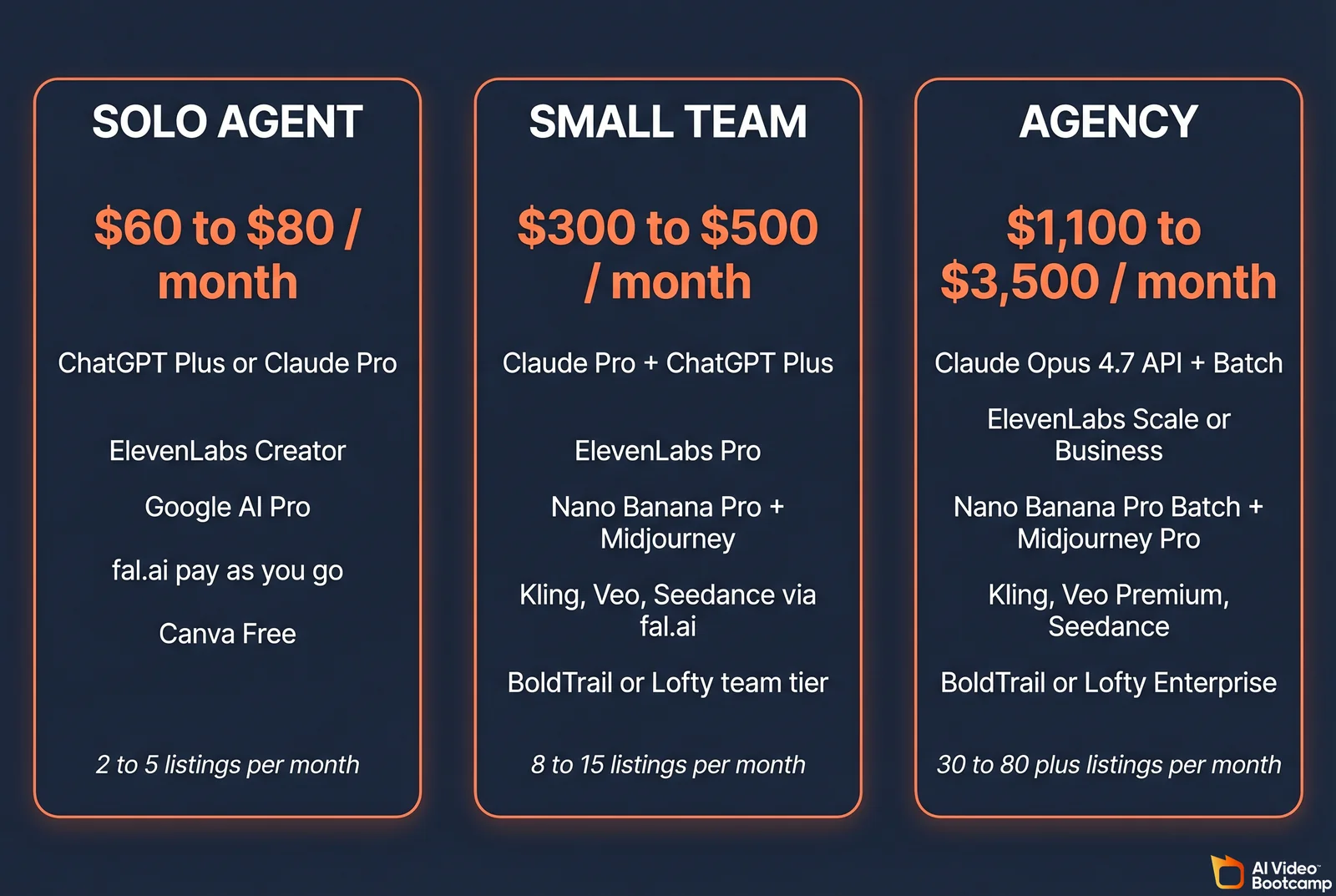
The solo agent stack covers content generation, basic image and video, voice cloning, and CRM-resident lead follow-ups for under $80 per month. Recommended: ChatGPT Plus or Claude Pro at $20/mo for reasoning and copy, ElevenLabs Creator at $22/mo for voice cloning, Canva Free for design and watermarking, Lofty CRM (custom solo pricing) for agentic follow-ups, and pay-as-you-go API access on fal.ai for video and image generation (typically $5 to $20 per month at solo volumes).
| Line item | Tool | Monthly cost |
|---|---|---|
| Reasoning + copy | Claude Pro or ChatGPT Plus | $20 |
| Voice cloning | ElevenLabs Creator | $22 |
| Image generation | Nano Banana Pro via Google AI Pro or fal.ai pay-as-you-go | $20 to $30 (mostly via Google AI Pro at €22.99/mo) |
| Video generation | Kling 3.0 / Veo 3.1 Lite via fal.ai pay-as-you-go | $5 to $15 (10 to 30 listing videos at solo volume) |
| Design + watermark | Canva | $0 (Free tier) |
| CRM | Lofty (solo tier) | varies; baseline included |
| Total | $67 to $87 |
Listings handled per month: 2 to 5. Cost per listing: roughly $14 to $44 (mostly fixed cost, so the per-listing cost falls fast as volume rises). Compare to a typical 2024 solo agent who spent $300 to $600 per listing on traditional staging, video production, and copywriting.
The Small Team Stack ($300 to $500 per month)
The small team stack scales the solo stack to 5 to 10 agents and adds team CRM, multi-agent voice management, and shared brand assets. Recommended additions: BoldTrail or Lofty team tier for routing, ElevenLabs Pro at $99/mo for shared voice library, Midjourney Standard at $30/mo for editorial-style imagery, and a higher-volume API budget on fal.ai.
| Line item | Tool | Monthly cost |
|---|---|---|
| Reasoning + copy | Claude Pro and ChatGPT Plus | $40 (both) |
| Voice cloning | ElevenLabs Pro | $99 |
| Image generation | Nano Banana Pro + Midjourney Standard | $50 to $80 |
| Video generation | Kling 3.0 / Veo 3.1 / Seedance 2.0 via fal.ai | $50 to $150 |
| Design + watermark | Canva Pro | $13 |
| CRM | BoldTrail or Lofty team tier | $50 to $150 (varies) |
| Total | $302 to $532 |
Listings handled per month: 8 to 15. Cost per listing: $20 to $66 (lower per-listing cost than solo because the fixed cost amortizes across more listings). Team leads typically run 8 to 12 listings per agent per quarter, so the per-listing arithmetic favors teams that do volume.
The Agency Stack ($800 to $2,000 per month)
The agency stack covers 20+ agents with full team CRM, legal review of AI outputs, ElevenLabs Scale or Business for high-volume voice, custom Claude agent orchestration via Anthropic’s Batch API, and dedicated compliance workflows. Recommended: BoldTrail Enterprise or Lofty Enterprise, ElevenLabs Scale ($299/mo) or Business ($1,320/mo) depending on volume, Salesforce Agentforce for agentic CRM if the brokerage already runs Salesforce, and a $300 to $600/mo API budget on Anthropic and fal.ai.
| Line item | Tool | Monthly cost |
|---|---|---|
| Reasoning + copy (API) | Claude Opus 4.7 + GPT-5.5 via API + Batch | $200 to $500 |
| Voice cloning | ElevenLabs Scale or Business | $299 to $1,320 |
| Image generation | Nano Banana Pro Batch + Midjourney Pro | $80 to $200 |
| Video generation | Kling, Veo Premium, Seedance via fal.ai | $200 to $500 |
| Design + watermark | Canva Teams | $35 |
| CRM | BoldTrail Enterprise or Lofty Enterprise | $300 to $1,000 |
| Total | $1,114 to $3,555 |
Listings handled per month: 30 to 80+. Cost per listing: $14 to $118 depending on listing tier and luxury volume. Agency cost per listing is comparable to a solo agent’s because the agency is paying for higher-volume tiers and team management overhead, not for fundamentally different AI capability.
Compliance Stack: One-Page Crosswalk
Every component of the AI marketing stack has a different compliance footprint. AI-staged photos trigger California AB 723 (criminal misdemeanor for willful undisclosed alteration), NAR Code of Ethics Article 12, every major MLS rule, and best-practice “Virtually Staged” watermark plus disclosure remark. AI video tours trigger AB 723 likely, NAR Article 12, FTC if synthetic performer is featured, and best-practice proactive disclosure ahead of MLS rules. AI voice cloning triggers FTC consent rules, New York’s June 1, 2026 synthetic performer rule, and NAR Article 12. AI listing copy triggers NAR Article 12 truth in advertising and Fair Housing Act language compliance.
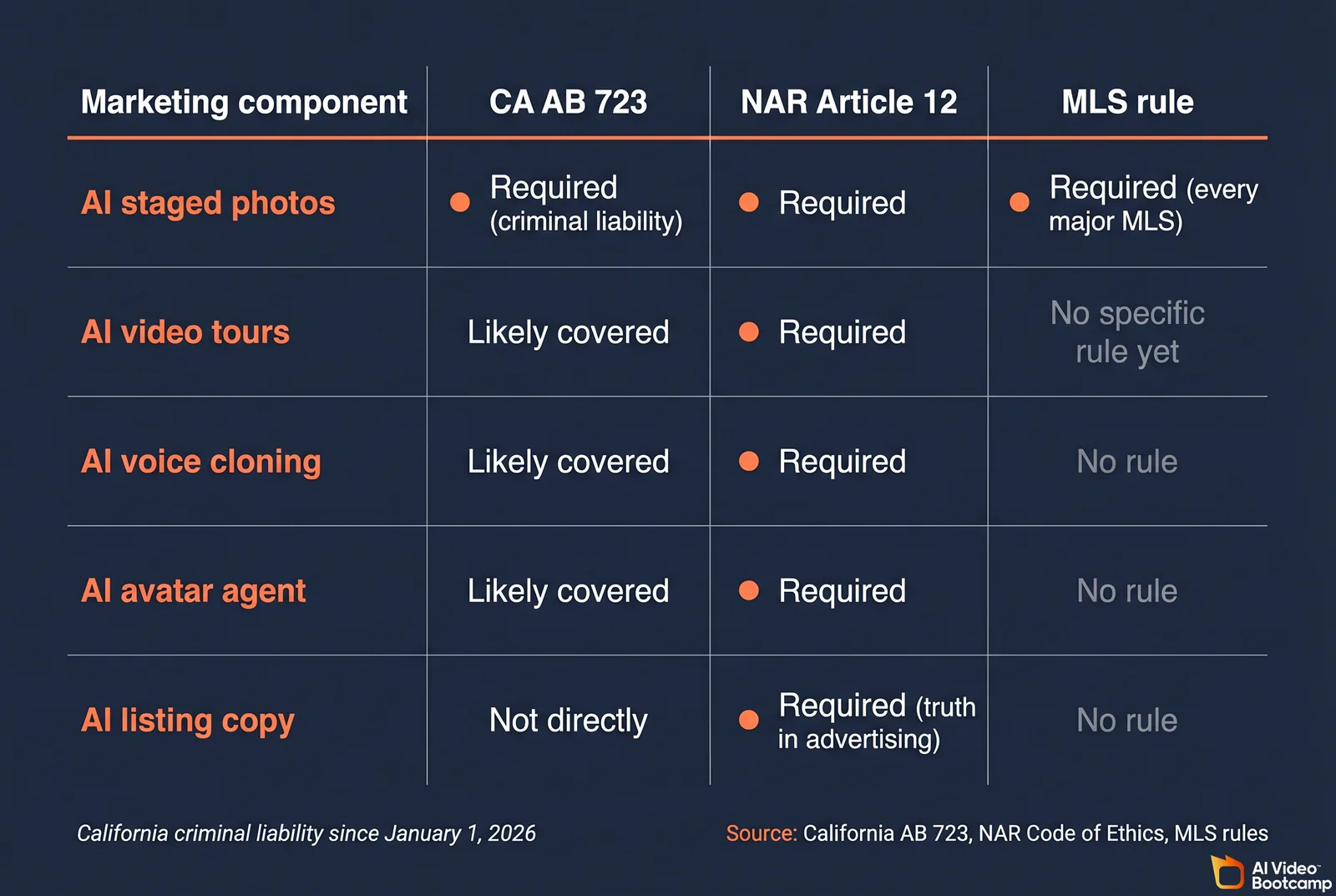
| Marketing component | CA AB 723 | NAR Article 12 | MLS rule | NY synthetic performer (June 1, 2026) | Best-practice disclosure |
|---|---|---|---|---|---|
| AI-staged photos | Required (criminal liability) | Required | Required (every major MLS) | N/A (still images) | “Virtually Staged” watermark + listing remark + originals available |
| AI video tours | Likely covered | Required | No specific rule yet | If features synthetic performer | ”Video created from listing photos using AI motion technology” in video and remarks |
| AI voice cloning | Likely covered | Required | No rule | Required if commercial ad | ”AI-generated voice” disclosure in audio and caption |
| AI avatar agent | Likely covered | Required | No rule | Required (synthetic performer) | “AI avatar” disclosure in caption and bio |
| AI listing copy | Not directly | Required (truth in advertising) | No rule | Not applicable | Internal QA against Fair Housing language; no public disclosure typically required |
State Law Sweep (April 2026)
| State | Law / Rule | Effective | Civil or Criminal |
|---|---|---|---|
| California | AB 723 | Jan 1, 2026 | Criminal misdemeanor (willful) + civil/MLS fines |
| New York | AI Disclosure Law (synthetic performer) | June 1, 2026 | Civil: $1,000 first / $5,000+ subsequent |
| Washington | HB 1170 (AI watermarking) | Feb 2027 | Civil |
| Colorado | SB24-205 (AI Act) | June 30, 2026 (delayed) | Civil |
| Texas | RAIGA + SB 1968 | Jan 1, 2026 | Civil; no AI-specific real estate rule |
| Florida | None identified | n/a | Broad AI governance interest only |
| Illinois | Multiple bills pending | Pending | Pending civil |
| Wisconsin | Analogous regulation | 2027 | Pending |
For the deep dive on AI disclosure compliance including C2PA, SynthID, and EU AI Act Article 50, see AI Disclosure Compliance 2026: C2PA and EU AI Act Guide.
For the deep dive on virtual staging compliance with AB 723 specifically, see AI Virtual Staging Real Estate Guide 2026.
ROI: What the Independent Data Says
Independent (non-vendor) data on AI in real estate documents 50 percent reduction in time-on-market for AI-staged listings, 73 percent faster listing go-live, 25 percent higher closing prices on AI-marketed listings, 9x conversion lift on five-minute lead response versus one-hour response, 171 percent average ROI on agentic AI deployments versus 60 percent for traditional automation, and 82 percent of agents using AI daily as of Q1 2026 (up from 68 percent in 2025 and roughly 15 percent in 2023).
The clearest signal: 82 percent daily AI adoption among real estate agents in Q1 2026, per the RPR survey reported by HousingWire in April 2026. That figure was 68 percent in the 2025 NAR survey and roughly 15 percent in 2023. The growth rate is the story: AI has gone from experiment to baseline in 24 months.
Top concerns from the same agent population: accuracy of AI outputs (63 percent), compliance and legal risk (49 percent), market data misinterpretation (47 percent), learning curve (30 percent), Fair Housing Act risk in AI-generated copy (28 percent). The compliance concern is the one that responds best to product design: a tool that surfaces disclosure templates by default earns trust faster than a tool that ships raw output.
On the deal side, the eight-agent residential firm case study cited earlier remains the cleanest single data point. Average response time dropped from four hours fifteen minutes to four minutes after the AI lead responder went live. Lead-to-appointment conversion rose from 31 percent to 46 percent. Total closed transactions rose 48 percent over nine months. The cost of the AI responder was a small fraction of the brokerage’s existing CRM spend.
On the enterprise side, average ROI on agentic AI deployments runs 171 percent versus 60 percent on traditional rule-based automation. In commercial real estate, IntellCRE saves an average $27,000 per user per year on underwriting and document processing.
What is missing from the public record: a verified 60 to 90 day case study of a single named agent or team adopting the full stack (image plus video plus voice plus copy) with quantified outcomes. AVB plans to publish that case study in v2 of this guide.
Common Mistakes to Avoid
- Buying a single all-in-one platform. No platform in 2026 does all four workflow layers at parity with a composed stack. Pick best-of-breed per layer.
- Stacking tools without workflow design. A stack without a workflow is just a subscription pile. Map the four workflow layers first, then assign tools to each.
- Ignoring compliance until an audit. AB 723 went live January 1, 2026. The cost of disclosure is zero. The cost of nondisclosure is a misdemeanor in California.
- Outsourcing prompting. The agent’s voice is the asset. Generic AI output is not. Invest the two hours required to learn structured prompting; the entire stack performs better afterward.
- Treating solo and agency identically. A solo agent’s compliance posture is different from an agency’s. So is the CRM choice, the voice cloning tier, and the legal review process. Do not copy an agency stack onto a solo budget.
- Underspending on data. PropStream and BatchData (or equivalents) are the cheapest hour of the workflow. Skipping them costs more in lost listings than they save.
- Skipping showing-prep disclosure. Always inform buyers before a tour that the photos and videos were AI-generated. Disappointment at the showing is the single biggest source of buyer complaints in 2026.
Frequently Asked Questions
What is the cheapest viable AI real estate marketing stack in 2026?
A solo agent can run the full four-layer stack for roughly $60 to $80 per month: Claude Pro or ChatGPT Plus at $20/mo for reasoning and copy, ElevenLabs Creator at $22/mo for voice cloning, Google AI Pro at €22.99/mo for Nano Banana Pro image generation, fal.ai pay-as-you-go video generation at $5 to $15 per month at solo volumes, and Canva Free for design. The True Models do the heavy lifting at API rates measured in cents per asset.
Is AI virtual staging legal for real estate listings in 2026?
Yes, with disclosure. California AB 723 (effective January 1, 2026) makes willful undisclosed AI alteration of listing photos a criminal misdemeanor and requires both a clear, conspicuous notice and access to the original unaltered image. NAR Code of Ethics Article 12 and Standard of Practice 12-10 require all REALTORS to clearly identify altered photos. Every major MLS requires a visible “Virtually Staged” watermark on the image itself, not just in the caption. See the AI Virtual Staging Real Estate Guide 2026 for full disclosure templates.
What is Claude Opus 4.7 and why does the 35 percent number matter?
Claude Opus 4.7 launched April 16, 2026, with the same nominal API pricing as Opus 4.6 ($5 per million input tokens, $25 per million output tokens). The catch: a redesigned tokenizer parses input differently and produces up to 35 percent more tokens for the same volume of input text. Effective cost on high-entropy tasks (contract analysis, multi-listing data ingest) is therefore roughly 35 percent higher than 4.6 even though the rate card did not move. Mitigations: Anthropic’s Batch API (50 percent discount on async workloads under 24 hours) and prompt caching (up to 90 percent discount on repeated cache reads).
Should I use a dedicated tool like Collov AI or DIY with Nano Banana Pro and GPT Image 2.0?
DIY with Nano Banana Pro and GPT Image 2.0 is more powerful and cheaper for any agent willing to spend two hours learning structured prompting. The room-by-room prompts in AI Virtual Staging Real Estate Guide 2026 make the learning curve explicit. Use a dedicated tool (Collov AI, Interior AI, REimagineHome) if you want maximum simplicity and are willing to pay for a UI on top of the same models the DIY path uses.
What is the bottleneck to AI adoption in real estate in 2026?
Cognitive load and prompting skill, not cost or tool availability. Zillow’s 2026 Agent Trends Survey found that the typical agent uses 2 to 4 software tools in a typical week and prioritizes “ease of use” above all other criteria when evaluating new tools. Compliance fear (49 percent of brokerage leaders cite legal/compliance as their top concern) and Fair Housing Act risk in AI-generated copy (28 percent) are the leading sources of caution. Both are addressable with workflow design and disclosure templates.
Will AI replace real estate agents?
No. The empirical 2026 data is unambiguous: AI compresses administrative, analytical, and marketing timelines so agents can spend more time on the relationship-driven and localized aspects of negotiation. The 8-agent firm case study showed a 48 percent increase in closed transactions in 9 months, not a 48 percent reduction in agents. The job is not disappearing. The job is changing into one where the agent operates a stack of AI tools while doing the human-only work of advising, negotiating, and closing.
Sources
- Zillow 2026 Agent Trends Survey
- California Assembly Bill 723 (AB 723), full bill text
- NAR Code of Ethics (Article 12 and Standard of Practice 12-10)
- Using AI to Enhance Listing Photos Can Be Legally Risky (NAR Magazine)
- NAR Profile of Home Staging
- California Department of Real Estate (DRE)
- FTC Endorsement Guides: What People Are Asking
- FTC Truth in Advertising authority
- Spotting Deepfakes — FTC Consumer Advice.
- Google Gemini API pricing (Nano Banana Pro)
- OpenAI GPT Image 2 model documentation
- ElevenLabs official pricing
- Anthropic Claude Opus 4.7 launch (GitHub Changelog, April 16, 2026)
- fal.ai Seedance 2.0
- fal.ai Hailuo 02
- Florida Realtors: The Next Era in Real Estate Marketing Is Here
- Denoising Diffusion Probabilistic Models (Ho et al., 2020), arXiv
- HousingWire: AI adoption reaches 82 percent among real estate agents (RPR survey)
- GPT Image 2.0 vs Nano Banana Pro: 10 Prompts Tested (AI Video Bootcamp)
- AI Virtual Staging Real Estate Guide 2026 (AI Video Bootcamp)
tate listings in 2026?”, “acceptedAnswer”: { “@type”: “Answer”, “text”: “Yes, with disclosure. California AB 723 (effective January 1, 2026) makes willful undisclosed AI alteration of listing photos a criminal misdemeanor and requires clear notice plus access to the original unaltered image. NAR Code of Ethics Article 12 and Standard of Practice 12-10 require all REALTORS to clearly identify altered photos. Every major MLS requires a visible Virtually Staged watermark on the image itself.” } }, { “@type”: “Question”, “name”: “What is Claude Opus 4.7 and why does the 35 percent number matter?”, “acceptedAnswer”: { “@type”: “Answer”, “text”: “Claude Opus 4.7 launched April 16, 2026, with the same nominal API pricing as Opus 4.6 ($5 per million input tokens, $25 per million output tokens). The redesigned tokenizer produces up to 35 percent more tokens for the same volume of input text, so effective cost on high-entropy tasks rose roughly 35 percent. Mitigations include Anthropic’s Batch API (50 percent discount on async under 24 hours) and prompt caching (up to 90 percent discount on repeated reads).” } }, { “@type”: “Question”, “name”: “Should I use a dedicated tool like Collov AI or DIY with Nano Banana Pro and GPT Image 2.0?”, “acceptedAnswer”: { “@type”: “Answer”, “text”: “DIY with Nano Banana Pro and GPT Image 2.0 is more powerful and cheaper for any agent willing to spend two hours learning structured prompting. Use a dedicated tool (Collov AI, Interior AI, REimagineHome) if you want maximum simplicity and are willing to pay for a UI on top of the same underlying models.” } }, { “@type”: “Question”, “name”: “What is the bottleneck to AI adoption in real estate in 2026?”, “acceptedAnswer”: { “@type”: “Answer”, “text”: “Cognitive load and prompting skill, not cost or tool availability. Zillow’s 2026 Agent Trends Survey found agents use 2 to 4 tools per week and prioritize ease of use above all other criteria. Compliance fear (49 percent of brokerage leaders) and Fair Housing Act risk (28 percent) are the leading sources of caution. Both are addressable with workflow design and disclosure templates.” } }, { “@type”: “Question”, “name”: “Will AI replace real estate agents?”, “acceptedAnswer”: { “@type”: “Answer”, “text”: “No. The 2026 data is unambiguous: AI compresses administrative, analytical, and marketing timelines so agents can spend more time on relationship-driven and localized aspects of negotiation. The 8-agent firm case study showed a 48 percent increase in closed transactions in 9 months, not a 48 percent reduction in agents. The job changes into one where the agent operates a stack of AI tools while doing the human work of advising, negotiating, and clos