
Most major all-in-one AI creative platforms now run the same frontier models. The current favorites, Seedance 2.5, GPT Image 2.0, and Google’s Nano Banana family, are offered on all six platforms compared here, usually within a week of a model’s release, though exact availability varies by plan and variant. What actually separates these platforms in 2026 is what they charge for the same job, what their fine print takes back, and how honestly they bill you. The spread is bigger than most buyers expect: across all plan and billing configurations we priced, the same 30-second Seedance 2.5 video ranges from $5.34 to $21.60. On like-for-like mid-tier monthly plans the range is $8.56 to $14.00 (1.6x), and on their annual equivalents $5.39 to $11.20 (2.1x); the wider spread appears only when you compare different tiers and billing cycles, which is exactly how most buyers accidentally shop.
This comparison covers six selected multi-model platforms that creators most often shortlist: PromptWise, Higgsfield, Runway, Artlist, Krea, and OpenArt (single-model apps like Midjourney or Kling’s own site have their own dedicated AVB guides). Full disclosure up front: PromptWise is our platform, built by the team behind AI Video Bootcamp, and we benefit financially if you subscribe to it. That is exactly why every number in this article comes from official pricing pages, published rate cards, and platform terms, each one dated, so you can check our work. Where a rival wins a category, we say so. Every price in this article carries its capture date; the full comparison was last verified August 12-13, 2026, this page is updated as the market moves, and a source register at the end of the article lists every primary document we relied on.
The Short Answer: Which AI Platform Should You Pick in 2026?
Pick by what you make. PromptWise offers the best overall value across video, image, and audio, with the lowest mid-tier monthly rates on Seedance 2.5, Kling 3.0 Pro, and Nano Banana Pro, cost shown before each generation, and automatic credit refunds on failures. For beginners, PromptWise’s $19 Starter is the cheapest entry plan here that can actually complete frontier video jobs, so a first month costs less and produces more finished output than any rival entry plan we measured. Runway has the strongest in-house filmmaking tools (our judgment) but the most expensive Seedance video, and its in-product image quotes do not match its published rate card. Artlist bundles stock media; Higgsfield leads on cinematic presets; OpenArt on image workflows.
| Platform | Best for | Entry paid plan (monthly billing) | 30s Seedance 2.5 video, 720p (mid-tier plan) | Standout | Biggest drawback |
|---|---|---|---|---|---|
| PromptWise | Best overall value + best for beginners | $19 (Starter, 275 credits = ~42 seconds of Seedance 2.5 at 720p, the most of any entry plan here) | $8.56 monthly / $5.96 annual (Pro plan) | Built by a 26,000+ creator community; lowest mid-tier monthly rates on Seedance 2.5, Kling 3.0 Pro, and Nano Banana Pro; parallel generation on every tier with no slow-lane queue; failed runs refund credits automatically; never trains on your content unless you opt in | Curated rather than exhaustive model list (by design) |
| Krea | Realtime canvas + large model library | $9 (Basic, 5,000 units = ~29 seconds of Seedance 2.5) | $8.99 monthly / $5.39 annual (Pro plan) | Large model library (33 image and 29 video tools on its library page, August 13, 2026) + realtime canvas | Support runs through Discord; unanswered BBB complaints |
| Higgsfield | Cinematic presets | $19 (Starter, 270 credits = ~41 seconds of Seedance 2.5) | $9.59 monthly / $7.64 annual (Plus plan) | Soul ID character system + one-click camera presets | Pricing changes constantly; documented refund and queue friction |
| Runway | Filmmaker tools (Gen-4.5, Aleph) | $15 (Standard, 625 credits = ~21 seconds of Seedance 2.5; cannot complete a 30-second clip) | $14.00 monthly / $11.20 annual (Pro plan) | Own frontier models (Gen-4.5, Aleph 2.0, Act-Two capture) | One 30s Seedance video costs 144% of Standard’s monthly credits |
| Artlist | AI + licensed stock in one license | $19.99 (AI Starter, 16,500 credits = ~33 seconds of Seedance 2.5) | $13.12 monthly / $7.81 annual (AI Creator mid tier); $18.17 / $10.90 on entry AI Starter | 900K+ stock assets bundled | Cancel 14+ days before renewal or you are charged again |
| OpenArt | Image-first workflows | $14 (Starter, 4,000 credits = ~31 seconds of Seedance 2.5) | $9.11 monthly / $7.16 annual (Pro plan) | Character Builder that carries one character across image AND video | Commercial rights start at the $34 Plus tier |
All prices checked on the platforms’ official pages on August 12, 2026. Annual billing lowers every number; each is broken down below.
How We Compared These Platforms
Every claim in this article comes from three places. First, the platforms’ own pricing pages, rate cards, help centers, and terms of service, checked on a stated date. Every per-generation cost was gathered the same way: we entered each platform separately and recorded the credit spend its own product interface or official pricing table quoted for the exact job, naming the model, resolution, duration, and settings each time. Second, real reviews from real users: verbatim, permalinked comments from Reddit, Trustpilot, BBB records, and app stores, never paraphrased into vague “users say” claims. Third, our own hands-on experience: we used every rival platform in this article ourselves while building the first version of the AI Video Bootcamp course, because our 26,000+ members needed platform recommendations we could stand behind, and that testing is what eventually convinced us to build PromptWise. Single-pass generation costs are treated as floors, because failed generations and retries raise real-world cost on most platforms.
Three rules kept this honest. First, a model counts as available only if the platform’s own current documentation or product shows it, not a marketing headline; platforms update marketing pages at different speeds than their actual model selectors, in both directions. Second, every cost names the model, resolution, plan, and billing cycle, because “a video costs 50 credits” is meaningless without all four. Third, community evidence is quoted verbatim and linked, never paraphrased into vague “users say” claims. Where we could not verify a number, the table says so instead of guessing.
One more benchmark worth knowing: developers can run these same models directly through APIs, so we include the raw developer price as a baseline. If a platform charges close to (or more than) the hosted API benchmark price while adding a convenience layer, that markup should buy you something real: interface, reliability, or support.
What Counts as an All-in-One AI Platform?
An all-in-one AI creative platform gives you one login, one subscription, and one credit balance for image and video generation across many underlying models. The alternative is juggling four or five separate model subscriptions. The six platforms here all qualify, but they are not structurally same, and the differences affect pricing and update speed.
| Platform | Structure | Scope | Company |
|---|---|---|---|
| PromptWise | Curated aggregator studio | Image, video, audio, Wise agent, UGC Factory, Influencer Studio, Seeds asset training, node canvas (Flows) | ZeroTen Media Inc. (US) |
| Higgsfield | Hybrid: own tools (Soul, Cinema Studio) + partner models | Image, video, audio, editing | Higgsfield Inc. (US) |
| Runway | Hybrid: own models first (Gen-4.5, Aleph 2.0) + third-party | Video, image, audio, editing | Runway AI Inc. (US), founded 2018 |
| Artlist | Aggregator + licensed stock library | Video, image, audio, 900K+ stock assets | Artlist Ltd. (Israel), founded 2016 |
| Krea | Hybrid: own Krea models + dozens of third-party | Image, video, realtime canvas, 3D | Krea Inc. (US) |
| OpenArt | Aggregator | Image-first, video, characters | OpenArt (US), 10M+ creators per its homepage |
Structure matters for two reasons. Pure aggregators live or die on routing you to the best current models at a fair markup. Hybrids have an incentive to push their own models, which can be great (Runway Gen-4.5 is genuinely unique) or just lock-in. A curated aggregator like PromptWise makes a third bet: rather than listing 100+ models, it carries the handful that win head-to-head tests and cuts the rest. Which bet serves you depends on whether you want a menu or a recommendation.
The 2026 Reality: Every Major Platform Has the Same Models
Model access rarely separates these platforms anymore. ByteDance released Seedance 2.5 on July 31, 2026, and the major platforms rolled it out over the following week: Artlist on August 2 and Higgsfield on August 6 (both per their own launch posts), the others during launch week. Today’s most popular frontier models, Seedance 2.5, GPT Image 2.0, and the Nano Banana family, are offered on all six, alongside the Kling 3.0 series and Veo 3.1. What still differs is plan-level access: Krea’s Basic plan carries “selected video models” with the full list unlocking at Pro, OpenArt’s unlimited Seedance lane is gated to its top Wonder tier, and rollout timing means a model can be listed on a homepage before it is selectable in-product. Treat “listed,” “selectable,” and “included in your plan” as three different statuses, and do not choose a platform on model count.
| Platform | Seedance | Kling | Other flagship video | Leading image models |
|---|---|---|---|---|
| PromptWise | 2.5 | 3.0, 3.0 Motion Control, Omni, 2.5 Turbo | Veo 3.1, LTX, Hailuo | Nano Banana Pro, Nano Banana 2, GPT Image 2.0, Seedream 5.0 |
| Higgsfield | 2.5 | 3.0 (to 4K), 3.0 Turbo | Veo 3.1, Wan 2.6, Hailuo 2.3, MiniMax H3, Grok Imagine 1.5 | Nano Banana family, GPT Image 2.0, Seedream 5, Flux 2, own Soul 2.0 line |
| Runway | 2.5 | 3.0 Pro, O3 | Gen-4.5, Aleph 2.0, Act-Two (own), Veo 3.1, Wan 2.6, HappyHorse | GPT Image 2.0, Nano Banana Pro, Flux.2, own Gen-4 Image |
| Artlist | 2.5 | 3.0 family (deepest ladder) | Veo 3.1 family, Hailuo 2.3, Wan 2.7, HappyHorse 1.1, Grok Video 1.5 | GPT Image 2.0, Nano Banana Pro, Nano Banana 2, Flux.2 Pro, Seedream 5.0 |
| Krea | 2.5 | 3.0, 3.0 Turbo, O3 | Veo 3.1, LTX-2.3, Hailuo 2.3, MiniMax H3, Wan 2.6, Gen-4.5 | GPT Image 2.0, Nano Banana Pro, Nano Banana 2, Seedream 5.0 Pro, own Krea 2 |
| OpenArt | 2.5 | 3.0, 3.0 Omni | Veo 3.1, LTX-2.3, Hailuo 2.3, Wan 2.7 | GPT Image 2.0, Nano Banana Pro, Nano Banana 2, Seedream 5.0 Pro |
Verified on each platform’s own model pages and documentation, August 12-13, 2026. Three naming notes so the table cannot mislead you. Krea’s “GPT-IMG-2” label is OpenAI’s GPT Image 2.0 (Krea’s own library describes it as OpenAI’s image model; the API model id is gpt-image-2, and we use GPT Image 2.0 site-wide). Google’s Nano Banana Pro and Nano Banana 2 are two different models, so where both appear, both are genuinely offered. And Kling variant names shown by platforms (Pro, Turbo, Motion Control, Omni, O3) are recorded verbatim rather than assumed equivalent to Kling’s official Video 3.0 / Video 3.0 Omni naming; our cost benchmarks use Kling 3.0 Pro and regular Veo 3.1 (not Fast or Lite).
Two practical caveats. First, “listed on the homepage” and “selectable when you press generate” are not always the same thing; during the Seedance 2.5 rollout week, at least one platform promoted the model on its homepage while its documentation still said “coming soon.” Model claims go stale in days, in both directions, so check the actual selector before subscribing for a specific model. Second, headline model counts (“64+”, “100+”) mostly count fine-tunes and legacy versions; the frontier list above is what determines output quality. If you want the full story on what the current best models actually do, our Seedance 2.5 complete guide and GPT Image 2.0 vs Nano Banana Pro test go model by model.
Since the model catalogs overlap this heavily, the comparison comes down to three things: what the same generation costs, what the fine print takes back (including what happened to “unlimited” promises in August 2026), and how the workflow feels. The next sections take those in order.
What a 30-Second Seedance 2.5 AI Video Actually Costs on Each Platform
The same 30-second Seedance 2.5 video at 720p costs $8.56 to $14.00 on the selected mid-tier monthly plans (1.6x), $5.39 to $11.20 on their annual equivalents (2.1x), and $5.34 to $21.60 across every configuration shown below. PromptWise is cheapest on monthly billing at both mid and top tiers, and its Max plan on annual billing ($5.34 per clip) is the single cheapest configuration we measured, edging out Krea Pro annual ($5.39). Artlist, priced in-product for the first time, lands at $13.12 per clip on its AI Creator mid tier, and Runway is most expensive relative to its allowance, where a single 30-second video consumes 144% of the Standard plan’s entire monthly credit allowance. These are allocated subscription costs: plan price divided by included credits, times the credits the job needs, assuming you use your allowance.
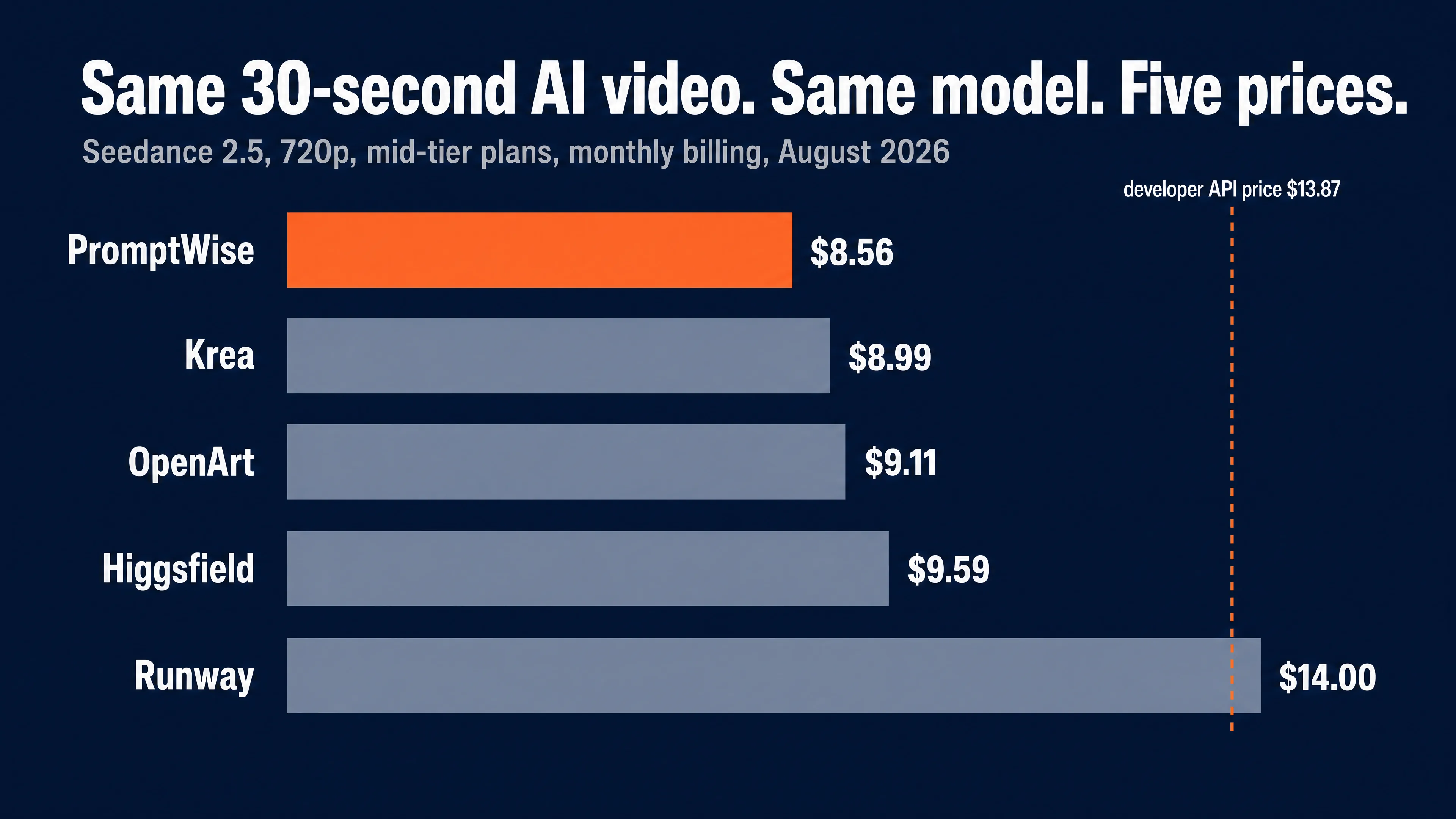
Some context on why these numbers matter so much right now: Seedance 2.5’s cost is its identity. The most-upvoted community post of the launch window was titled “Seedance 2,5 is insanely expensive, this was $5,500 worth of credits but so worth it” (1,475 points on r/aivideo), and working creators warn that 30-second takes usually contain a shot where consistency falls apart, making 15-second generations the practical sweet spot; that habit alone halves every number below. Because these platforms run the same model, this table is the closest thing to a true price comparison the category allows: each platform’s in-product credit quote for the same named model at the same stated settings, times its plan’s price per credit, single pass, before tax.
All Seedance 2.5 benchmark quotes were captured for the standard text-to-video job, without a reference video, at 720p and 30 seconds, on every platform. Krea’s public comparison table lists 5,136 units for this configuration; its lower 3,072-unit rate applies when a reference video is used and is therefore excluded. One oddity worth naming plainly: on Krea’s published rates, adding a reference video makes the same clip cheaper, which runs against how reference-guided generation is priced everywhere else and does not follow the extra compute involved. We record it as published rather than explain it, because Krea offers no explanation. On the selected mid-tier plans, estimated allocated subscription costs range from $8.56 to $14.00 under monthly billing (approximately 1.6x) and from $5.39 to $11.20 using annual-equivalent prices (approximately 2.1x). PromptWise has the lowest measured monthly quote, and PromptWise Max annual the lowest quote of any configuration ($5.34, with Krea Pro annual next at $5.39).
Before the full ladder of every configuration, here is the like-for-like view: the same mid-tier plan on each platform, priced both ways. PromptWise is the cheapest mid tier on monthly billing; the cheapest configuration overall, PromptWise Max on annual billing, appears in the full ladder below.
| Mid-tier plan | Billed monthly | Billed annually (per month) | Credits included (Seedance 2.5 720p seconds they buy) | Seedance 2.5 720p 30s video, monthly billing | Seedance 2.5 720p 30s video, annual billing |
|---|---|---|---|---|---|
| PromptWise Pro | $79 | $55 | 1,800 credits (~277 seconds, the most video of any mid tier) | $8.56 | $5.96 |
| Krea Pro | $35 | $21 | 20,000 compute units (~117 seconds) | $8.99 | $5.39 |
| OpenArt Pro | $56 | $44 | 24,000 credits (~184 seconds) | $9.11 | $7.16 |
| Higgsfield Plus | $59 | $47 | 1,200 credits (~185 seconds) | $9.59 | $7.64 |
| Artlist AI Creator | $69.99 | $41.67 | 80,000 credits (~160 seconds) | $13.12 | $7.81 |
| Runway Pro | $35 | $28 | 2,250 credits (~75 seconds) | $14.00 | $11.20 |
Artlist’s mid tier is AI Creator ($69.99 monthly or $41.67 annual-equivalent for 80,000 credits, verified on its live pricing page August 14, 2026); its credit spends were captured in-product on a paid subscription. Note that plan price alone tells you nothing: Krea’s and Runway’s mid tiers cost the same $35, yet the same video costs $8.99 on one and $14.00 on the other. Credit counts mislead even harder, because a credit is a different unit on every platform: PromptWise’s 1,800 credits buy about 277 seconds of Seedance 2.5, while Krea’s 20,000 units buy about 117, so the plan with 11x fewer credits delivers 2.4x more video. Compare seconds of output, never credit totals. The full ladder below adds entry tiers, top tiers, and the developer API benchmark.
| Plan (billing cycle) | Cost per 1 second | Seedance 2.5 720p 30-second video |
|---|---|---|
| PromptWise Max, annual ($104/mo) | $0.18 | $5.34 (cheapest configuration measured) |
| Krea Pro, annual ($21/mo) | $0.18 | $5.39 |
| PromptWise Pro, yearly ($55/mo) | $0.20 | $5.96 |
| Higgsfield Ultra, annual ($99/mo) | $0.21 | $6.44 |
| OpenArt Wonder, annual ($175/mo) | $0.21 | $6.45 |
| OpenArt Pro, annual ($44/mo) | $0.24 | $7.16 |
| Runway Max, annual ($76/mo) | $0.24 | $7.20 |
| Higgsfield Plus, annual ($47/mo) | $0.25 | $7.64 |
| PromptWise Max, monthly ($149) | $0.25 | $7.65 |
| Artlist AI Creator, annual ($41.67/mo) | $0.26 | $7.81 |
| Higgsfield Ultra, monthly ($129) | $0.28 | $8.39 |
| PromptWise Pro, monthly ($79) | $0.29 | $8.56 |
| OpenArt Wonder, monthly ($240) | $0.29 | $8.84 |
| Krea Pro, monthly ($35) | $0.30 | $8.99 |
| Runway Max, monthly ($95) | $0.30 | $9.00 |
| OpenArt Pro, monthly ($56) | $0.30 | $9.11 |
| Higgsfield Plus, monthly ($59) | $0.32 | $9.59 |
| Artlist AI Starter, annual ($11.99/mo) | $0.36 | $10.90 |
| Runway Pro, annual ($28/mo) | $0.37 | $11.20 |
| Artlist AI Creator, monthly ($69.99) | $0.44 | $13.12 |
| Runway Pro, monthly ($35) | $0.467 | $14.00 |
| Hosted API benchmark (fal.ai) | $0.473 | $13.87 (fal’s own token-precise example) |
| Artlist AI Starter, monthly ($19.99) | $0.61 | $18.17 (15,000 credits of a 16,500 allowance; one clip per month fits) |
| Runway Standard, monthly ($15) | $0.72 | $21.60 allocated cost (900 credits needed vs a 625/month allowance; the included credits cannot complete one clip) |
Sources: in-product credit quotes captured August 13, 2026. PromptWise and Higgsfield both meter 195 credits per 30 seconds at 720p, which agrees exactly with Higgsfield’s launch-post rate of 52 credits per 8 seconds (both are 6.5 credits/second); Runway 900 credits, matching the 30 credits/second in its Seedance 2.5 help article; OpenArt 3,905 credits; Krea 5,136 compute units for a standard no-reference generation per its pricing-page Seedance 2.5 rate table (verified in-browser August 13, 2026; oddly, Krea prices reference-guided generations LOWER, 3,072 units for the same clip, and we benchmark the standard job like every other platform). The hosted API benchmark is fal.ai’s Seedance 2.5 text-to-video endpoint, whose page states “720p with audio ~$0.4730 / second” and prices its own 30-second 720p example at ~$13.87 (verified in-browser August 13, 2026). Plan prices: promptwise.com, higgsfield.ai/pricing, runway.com/pricing, krea.ai/pricing, openart.ai/pricing. Artlist’s rate was captured in-product on August 13, 2026 from a paid subscription: 15,000 credits per 30-second 720p clip; its plan lineup (AI Starter $19.99/$11.99 with 16,500 credits, AI Creator $69.99/$41.67 with 80,000, AI Professional $399.99/$239.99 with 500,000) was verified on its live pricing page August 14, 2026. Krea’s top (Max) tier ($105 monthly, $63 annual-equivalent, 60,000 units, verified August 14, 2026) prices this benchmark identically to Krea Pro and changes no ranking. Monthly-billed and annual-billed (per-month equivalent) prices are never mixed within one figure.
Read the table with three facts in mind. First, plan size changes your effective price on every credit platform, so the cheap headline plan is usually not the cheap plan for video: OpenArt’s $14 Starter fits exactly one 30-second video per month (3,905 of 4,000 credits), and Runway’s Standard plan cannot fit one at all (900 credits needed, 625 included). Second, Runway and Artlist are the only two of the six whose Seedance 2.5 rates exceed the hosted API benchmark at the same 720p setting on monthly billing (Runway $21.60 on Standard and $14.00 on Pro vs the $13.87 benchmark; Artlist $18.17 on its AI Starter entry plan, though its AI Creator mid tier slips just under at $13.12); for this specific model, their interface premiums buy you nothing you cannot get cheaper elsewhere. Third, Krea’s annual-billing lead comes with two catches: a single standard 30-second generation (5,136 units) exceeds the Basic plan’s entire 5,000-unit monthly allowance, so the low rate effectively requires the Pro tier, and its top-up packs expire in 90 days per its own docs, so the price rewards consistent committed volume, not occasional use. For a broader cost benchmark across models, see our cheapest AI video generators test.
Same Model, Different Price: What One Second Actually Costs
At comparable mid tiers on monthly billing, PromptWise has the lowest captured rate in this comparison for Seedance 2.5 ($0.285 per second), Kling 3.0 Pro at 4K ($0.263 per second), and Nano Banana Pro images ($0.088 at 2K). Krea undercuts the Seedance rate only on annual billing. The surprise is GPT Image 2.0: Artlist, which sits near the top of the video-cost range, has the cheapest captured image rate, while Runway’s in-product quote at the high quality setting we benchmark (20 credits) runs four times the 5-credit figure on its published rate card, which likely reflects a lower quality setting.
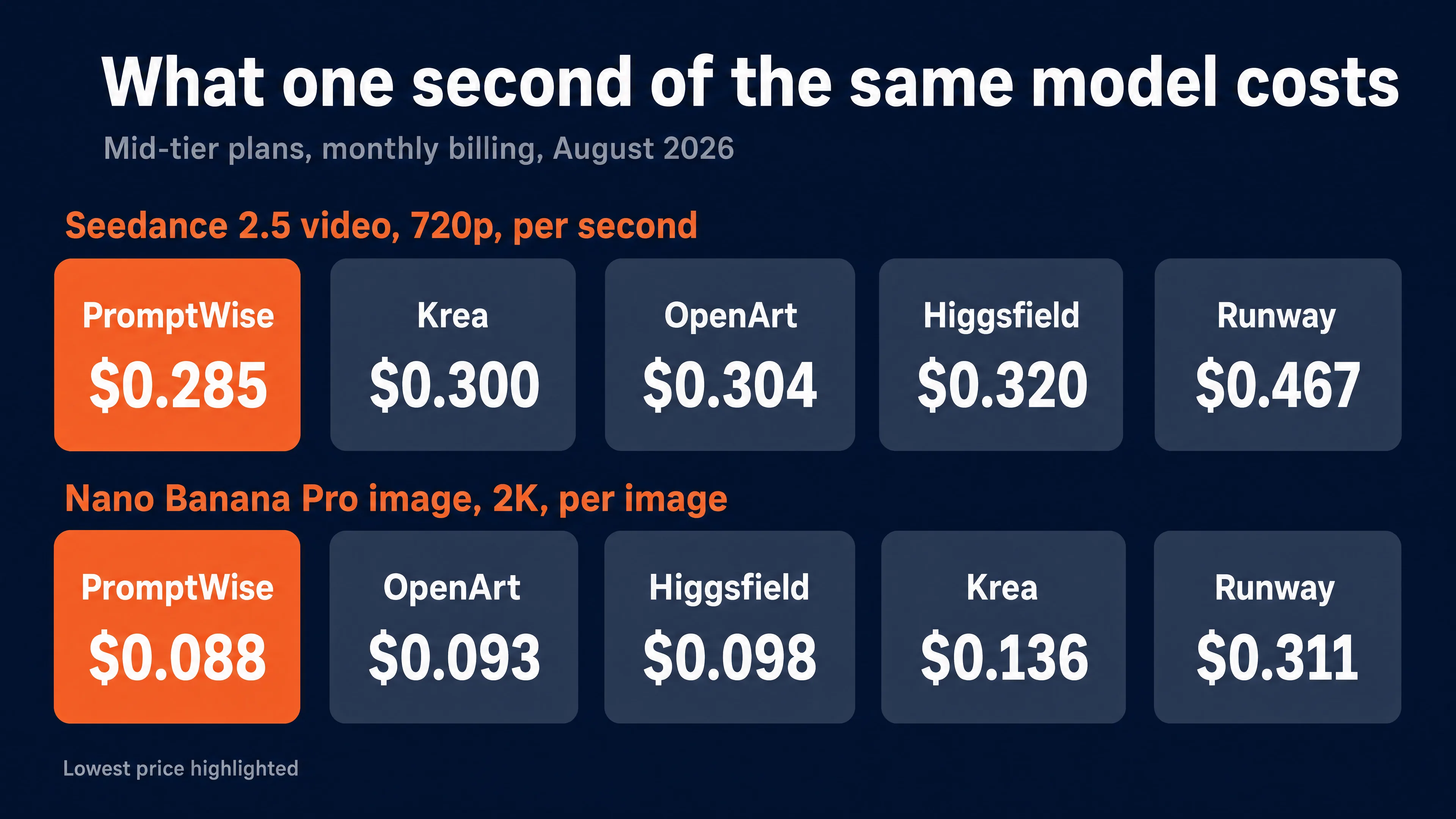
The table uses each platform’s mid tier on monthly billing (PromptWise Pro $79, Higgsfield Plus $59, Runway Pro $35, Krea Pro $35, OpenArt Pro $56), computed from in-product credit quotes captured August 13, 2026. Artlist’s column is priced at its AI Creator mid tier ($69.99 monthly, 80,000 credits, verified August 14, 2026). Video rows are cost per 1 second; image rows are cost per image. Our benchmark variants: Kling 3.0 Pro and regular Veo 3.1 (not Fast or Lite), both at 4K with audio.
| Generation | Hosted API (fal.ai) | PromptWise (Pro) | Higgsfield (Plus) | Runway (Pro) | Krea (Pro) | OpenArt (Pro) | Artlist (AI Creator) |
|---|---|---|---|---|---|---|---|
| Seedance 2.5, 720p, per second | $0.473 | $0.285 | $0.320 | $0.467 | $0.300 | $0.304 | $0.437 |
| Kling 3.0 Pro, 4K, per second | $0.42 (variant not labeled Pro) | $0.263 | $0.295 | $0.669 | $0.544 | $0.280 | $0.437 |
| Veo 3.1, 4K with audio, per second | $0.60 ($0.40 without audio) | $0.48 | $0.54 | 4K not offered ($0.62 at its 1080p rate) | $0.78 | $0.47 | $0.66 |
| Nano Banana Pro, 2K, per image | $0.15 | $0.088 | $0.098 | $0.311 | $0.136 | $0.093 | $0.140 |
| Nano Banana Pro, 4K, per image | $0.30 (double its 2K rate) | $0.176 | not available | $0.622 | $0.273 | $0.187 | $0.245 |
| GPT Image 2.0, 2K-class, per image | $0.15 to $0.21 | $0.31 | $0.34 | $0.311 in-product at high quality (its rate card lists 5 credits, likely a lower quality setting) | $0.22 (resolution unclear) | $0.40 | $0.131 |
The monthly Veo 3.1 lead is a near-tie (OpenArt $0.467 vs PromptWise $0.483). Annual billing lowers every figure by roughly 20 to 40 percent across the displayed plans and shifts two leads: on annual rates PromptWise becomes the cheapest place in this comparison to run Veo 3.1 at 4K ($0.34 per second vs OpenArt’s $0.37) and extends its Nano Banana Pro lead. API benchmark sources for this table, all checked August 13, 2026: Kling from fal’s Kling Video V3 4K endpoint at $0.42 per second with or without audio, which fal does not label as the Pro variant, so treat it as indicative; Veo 3.1 from fal’s Veo 3.1 endpoint, Standard tier at 4K ($0.60 per second with audio, $0.40 without); Nano Banana Pro 4K from fal’s Nano Banana Pro page, which prices 4K at double the standard $0.15 rate. PromptWise per-model rates are first-party in-product figures until its public rate card is published. Runway’s Kling quote is its in-product 4K rate (344 credits per 8 seconds, captured August 13, 2026, replacing an earlier unverified figure), and Runway does not offer Veo 3.1 at 4K, so its Veo figure is the 1080p rate. Artlist figures use its AI Creator mid tier; on annual-equivalent pricing ($41.67 per month), every Artlist figure drops by roughly 40 percent.
Three things stand out. First, the spread on same-model images is as wide as on video: the same Nano Banana Pro image runs $0.09 on PromptWise and $0.31 on Runway. Second, platforms visibly subsidize some models to win customers and earn it back on others; a price below the model’s hosted API benchmark (Krea’s Seedance 2.5 rate, Artlist’s image rates) is real and perfectly rational, which is exactly why per-model comparison beats plan-level comparison. Artlist is simultaneously the cheapest platform here for GPT Image 2.0 and one of the most expensive for Seedance video, and Runway’s in-product high-quality image quote runs four times its own published rate card; judge any platform by one number and you get it wrong in both directions. Third, resolution tiers matter: PromptWise’s GPT Image 2.0 rates at High quality run 4 credits at 1K, 7 credits at 2K, and 12 credits at 4K (so $0.18/$0.31/$0.53 at Pro monthly, first-party in-product figures), where most published rival rates buy 1K to 2K. Deep dives on both models: Kling AI complete guide and Nano Banana Pro complete guide.
The Fine Print That Costs You Money
The biggest costs in this category are not the credit prices; they are the terms. Four of the five rival platforms hold BBB F ratings, largely for not answering complaints (checked on their BBB profiles, August 2026). Two platforms’ consumer terms permit training on your content by default. Several run refund policies that in practice return nothing once a single credit is spent.
Scope note: this table compares the purchase-relevant terms (refunds and billing mechanics, credit expiry, commercial permission, training permission); data retention and deletion policies are a separate topic this article does not score. Here is what the terms of service actually say, platform by platform, as of August 12, 2026:
| Platform | Refunds and billing mechanics | Credit expiry | Commercial rights | Terms permit training on your content? |
|---|---|---|---|---|
| PromptWise | 7-day trial with 50 credits (converts to paid unless cancelled); subscriptions auto-renew unless cancelled 24+ hours before renewal; fees generally non-refundable, but failed generations refund credits automatically | Credits refresh each billing period | Assigned to you, all paid tiers (provider terms apply) | No, unless you expressly opt in (its Terms) |
| Higgsfield | 7-day window, unused credits only, service fee up to 6% of the purchase (its own ToS, section 9.3) | Monthly credits expire; top-ups expire in 90 days | Yours, all paid tiers | Yes, unless Enterprise (its ToS training grant) |
| Runway | ”All fees… are non-refundable”; discretionary exceptions | Standard/Pro credits reset monthly; Max rolls over one month; purchased packs never expire | Yours, all tiers | Yes by default: inputs and outputs “may be used by the Company to train and improve its AI models” (ToS 4.4); no consumer opt-out |
| Artlist | 14 days, only if nothing was downloaded or generated; renewals require cancelling 14+ days early | Credits reset monthly; zero on cancellation | Yours for AI outputs | Not stated |
| Krea | Fees generally non-refundable per its linked terms (last updated 2024), with limited exceptions | No rollover on individual plans; top-ups expire in 90 days | Its linked terms reserve the right to modify commercial-use terms; the effect on already-generated outputs is not stated | Model dependent |
| OpenArt | ”All purchases are non-refundable” except where law requires | No monthly rollover; credits lost when plan expires | None below the Plus tier ($34 monthly / $27 annual-equivalent) | Model dependent |
Three of these deserve a closer look. OpenArt’s pricing page shows commercial-use rights only from the Plus tier up, so its $14 Starter plan is not marked for client work or monetized content; read the current terms before commercial use on any tier. Krea’s revocable commercial license is the kind of clause nobody reads until it matters: rights to your own outputs can be redefined “at any time.” And Runway’s training default means everything you upload and generate on non-Enterprise plans can feed its future models, under a perpetual, irrevocable license, per its own terms of use; Higgsfield’s terms carry a similar training grant outside Enterprise. One general caution for this whole table: commercial permission is contractual, varies by plan and by model provider, and is not the same as copyright ownership or legal clearance. This article is consumer information, not legal advice.
One more cost the tables cannot show: the gap between cost per generation and cost per finished asset. Failed generations, retries, and mid-project re-rolls multiply real spend; one documented OpenArt review describes burning nearly 12,000 credits to end up with roughly 1.5 usable videos. To be fair to everyone: nearly every platform’s official policy now promises credit refunds on failed generations (Krea’s docs say failed jobs consume no units, Runway’s and Higgsfield’s help centers promise automatic returns, OpenArt hedges with “in most cases”). The difference shows up in the complaint records: August 2026 Runway app reviews still report “the credits are gone” after errors, OpenArt has a community tutorial dedicated to chasing unrefunded credits, and a documented Higgsfield case found no self-serve way to reclaim credits on rights-check failures. Judge platforms by their complaint records on this, not their policy pages, and hold whichever one you use to its own written policy.
”Unlimited” Rarely Means Unlimited: The August 2026 Stress Test
Treat every “Unlimited” badge in this category as a footnote, not a feature. The Seedance 2.5 launch week of August 7-12, 2026 stress-tested “unlimited” offers on four platforms at once, and the results are the clearest buyer evidence this market has ever produced: one platform withdrew the benefit from paying annual subscribers within days, and the others quietly fenced it with duration caps, resolution caps, slow queues, and fixed calendar windows.
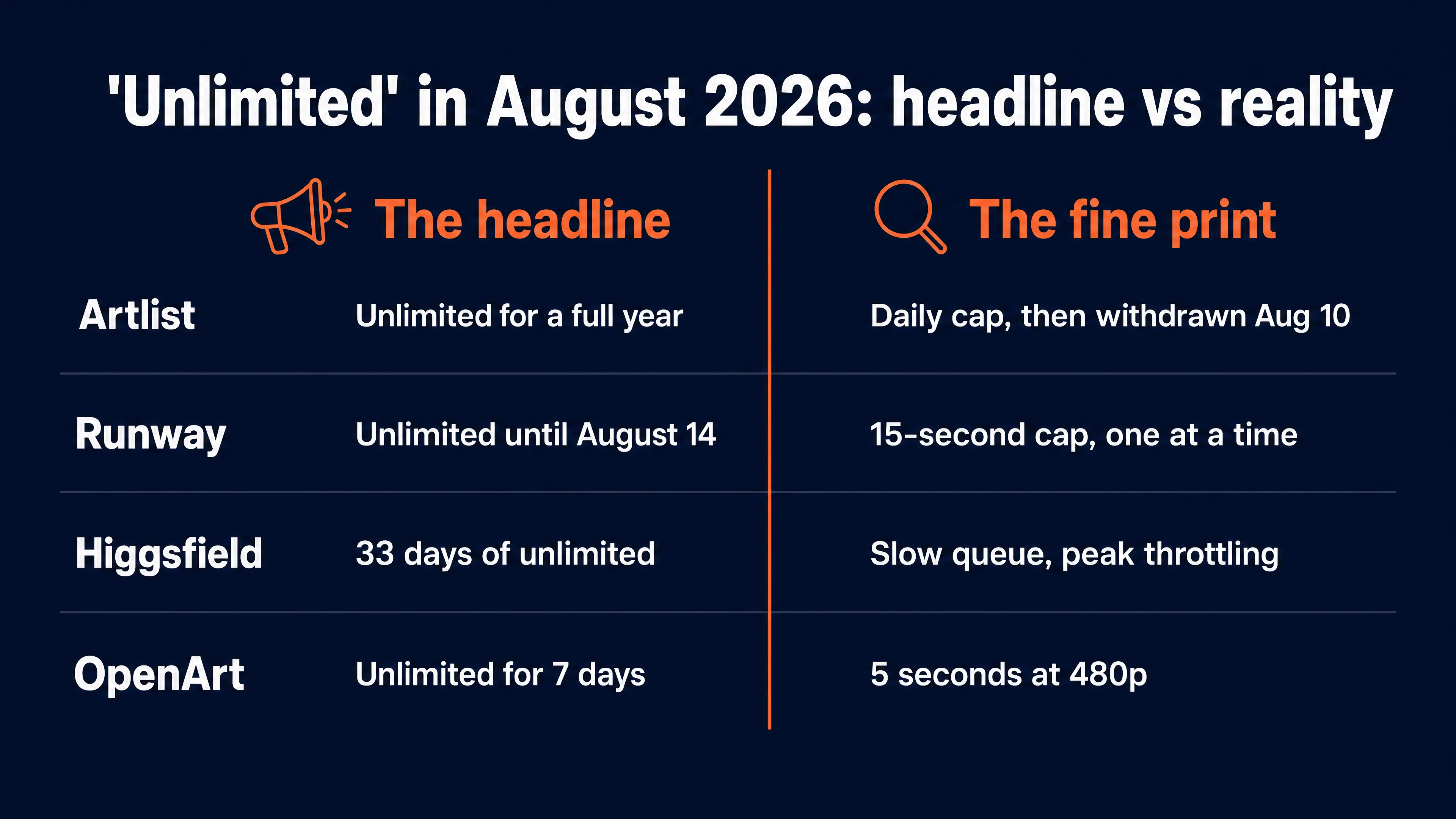
Here is what “unlimited Seedance 2.5” actually meant on each platform that week, from their own pages and posts:
| Platform | The headline | The reality in the terms |
|---|---|---|
| Artlist | ”Seedance 2.5 is Unlimited for a full year” on annual AI Creator plans | A daily threshold behind the label, described in Artlist’s own statements as 85 generations (X) and as 2,550 output seconds (Reddit), then full withdrawal on August 10 |
| Runway | ”Get unlimited Seedance 2.5 on new Max plans until August 14th” | Fixed calendar window (late joiners get fewer days), 15-second cap on a 30-second model, one generation at a time, website only, agent/API workflows excluded |
| Higgsfield | ”33 days of unlimited Seedance 2.5” (August 7 post) | Standard slow queue while credit users get priority, dynamic throttling at peak, single concurrent generation, account review for unusual activity; campaign copy changed repeatedly within days |
| OpenArt | ”for the next 7 days, generations are unlimited” (launch post) | The unlimited lane reportedly ran 5 seconds at 480p while the marketing promoted 30-second capability; high-activity accounts move to a slower queue |
| Krea | Seedance 2.5 promoted prominently | ”Unlimited relaxed generations” applies only to named in-house IMAGE models, not Seedance video at all |
The Artlist withdrawal deserves the full timeline, because it is documented almost entirely by Artlist’s own posts. August 7: the promotion launches, advertising unlimited Seedance 2.5 for a full year on annual plans. August 8-9: buyers report hitting limits after a handful of generations; one paid roughly 600 euros and found “it only allows 5 video generations per day (including failed attempts).” August 9: Artlist states on X that “people hitting the limit before 85 Seedance 2.5 generation is a bug on our side, not intended behavior,” and on Reddit that unlimited “isn’t a temporary promotional offer - it’s a core feature of the annual AI Creator plan” intended “for the full 365 days.” August 10, roughly twenty hours later: Artlist removes Seedance 2.5 from unlimited access for everyone including existing paid subscribers, takes the original promotional posts offline, substitutes larger credit allocations (80,000 credits became 180,000) per its Instagram announcement, and posts on Reddit: “We made a huge commitment that we couldn’t keep, and we are fully owning that mistake.” Community members did the math on the compensation: at roughly 18,000 credits per 30-second video, the upgraded allocation buys about 10 videos a month, against a promise that had been about 85 generations a day. The backlash threads on r/Seedance_AI (“DO NOT SUBSCRIBE TO ARTLIST.IO”, 78 points; “Artlist appears to have quietly removed Seedance 2.5 Unlimited after heavily promoting it”, 41 points) called it a rug pull; Artlist stated it is “absolutely not refusing refunds” and some users confirmed receiving them, while others reported broken refund forms. We report the timeline; readers can judge it.
Runway’s version drew its own backlash inside its subreddit (“after 30 videos or so my videos get stuck on queued for hours. And we can only generate one at a time”), and users noticed credits still draining during the promo. Higgsfield’s mechanics are published in its own materials: unlimited runs on a deliberately slower shared queue, and “generation speed and concurrency can also vary during periods of high system load or peak hours.” The community’s own summary, upvoted in the Artlist megathread, is the takeaway: “There is no such thing as a reliable unlimited plan. Once you hit the threshold, it will get ugly.” Or, condensed to a definition you can shop with: in this market, unlimited means no visible per-credit charge inside a narrowly fenced lane; it does not mean unlimited speed, duration, resolution, concurrency, or permanence.
Two protections cost you nothing. Screenshot the complete offer page, with date and plan, before you pay; promotional posts taken offline were a feature of this news cycle, and your screenshot is your receipt. And ask one written pre-sale question: “If unlimited Seedance 2.5 is reduced or removed during my paid term, may I cancel for a prorated refund?” A platform that will not answer that in writing has answered it.
PromptWise Review: The Studio Built by 26,000+ Creators
PromptWise is the only major all-in-one platform that existed as a community before it existed as a product. AI Video Bootcamp’s 26,000+ member community spent over 8 months generating on every platform in this article, documenting what broke, what overcharged, and what workflow actually ships client work; PromptWise is the platform built from those notes, with members directly shaping the feature list.
That origin is not a marketing line; it explains the design choices that differentiate it. Members were burned by hidden per-generation costs, so PromptWise shows the exact credit cost on the Generate button before you click, every time. Members lost money on failed generations elsewhere, so failed runs refund credits automatically. Members drowned in 100-model menus, so PromptWise carries a curated set: the models that win our published head-to-head tests (Seedance vs Kling vs Veo; GPT Image 2.0 vs Nano Banana Pro): Seedance 2.5, Kling 3.0 and 3.0 Motion, Veo 3.1, LTX, and Hailuo for video; Nano Banana Pro, GPT Image 2.0, Seedream 5.0 for image and not the long tail that exists to pad a counter. To our knowledge no other generative AI platform has been built this way, with a large creator community steering the roadmap before and after launch; it is the moat we care most about, because it compounds.
The numbers hold up against the field. Plans run $19 (Starter, 275 credits), $39 (Plus, 800), $79 (Pro, 1,800), and $149 (Max, 3,800), with yearly billing dropping those to $13, $27, $55, and $104 per month. At comparable mid tiers on monthly billing, PromptWise has the lowest captured Kling 3.0 Pro rate at 4K ($0.263 per second, about $2.11 per 8-second clip; the next-closest capture is OpenArt at $0.280) and the lowest captured Nano Banana Pro rates ($0.088 at 2K, $0.176 at 4K); its Seedance 2.5 rate (6.5 credits per second at 720p, audio included with no surcharge, $0.29 per second on Pro monthly and $0.20 on yearly) is the lowest mid-tier monthly rate in this comparison and roughly 38 to 57 percent below the hosted API benchmark; on annual billing it is also the cheapest place here to run Veo 3.1 at 4K ($0.34 per second); and its GPT Image 2.0 tiers bill GPT Image 2.0 at 4 credits at 1K, 7 at 2K, and 12 at 4K at High quality. A 7-day trial with 50 credits converts to paid billing unless cancelled; parallel generation scales from 2 to 8 simultaneous jobs by tier. Per-model rates are first-party in-product figures until the public rate card ships.
The feature set around generation is broader than a model menu, and it targets the people who do not want to become prompt engineers. Wise, the built-in agent, turns plain chat into finished output: you describe what you want, it writes the prompts and runs the generations, so prompting knowledge stops being an entry requirement. Influencer Studio and UGC Factory are template-driven workflows for the two highest-demand commercial jobs, consistent AI personas and UGC-style ad content with lipsync and B-roll, each shipping with preset templates you customize rather than build from scratch. Underneath both sits Seeds, the consistency layer: train a character, a product, or a custom asset (a pet, a logo, a vehicle, an art style) once, and every generation across the platform renders it consistently, with pre-built seed templates to start from. These are first-party feature descriptions, the same workflows our AI Video Bootcamp courses teach, which is also how we know them well enough to describe them.
There is one more advantage buyers consistently underrate, and August 2026 put it on full display: speed. Concurrency, running multiple video generation requests simultaneously, is the scarce resource on every one of these platforms, and the crowded incumbents documented what happens when too many users contend for it: 20-minute waits between clips, single-file “unlimited” queues, jobs stuck for hours at peak. Newer, right-sized platforms simply have more concurrency per user, and PromptWise is built around that fact: your generations run in parallel (2 jobs on Starter up to 8 on Max), there is no deprioritized slow lane in the architecture, and there is no legacy user base saturating the queue ahead of you, so as of publication image and video jobs start immediately rather than waiting. That is a first-party observation, not a timed cross-platform benchmark, but it is exactly the variable the crowded platforms’ own terms and complaint threads warn about. Being new cuts the other way too, and we like the trade: the roadmap moves at community speed, with features shipping because 26,000+ members asked for them. The one thing PromptWise deliberately does not offer is a 100-model wall; if you want to scroll through the long tail, a bigger aggregator has one. If you want the models that win our published tests, one login, fast parallel generation, and pricing you can read before you pay, that is the entire design.
Higgsfield Review: Strong Product, Volatile Pricing, and the Best Higgsfield Alternative
Higgsfield is a strong cinematic tool wrapped in the most frequently repriced plans in this comparison (four distinct price sets published in 2026). If you want one-click camera moves and presets, it delivers; if you want to know what you will pay next month, it is the hardest platform here to pin down. For most creators searching for a Higgsfield alternative, the trigger is credits and billing, and the answer depends on whether you want lower prices (PromptWise), or raw volume (Krea).
The product case first, because it is real. Higgsfield’s own Soul model line (Soul 2.0, Soul Cinema, Soul Cast) with its Soul ID character-consistency system, DOP camera controls, and Cinema Studio presets automate cinematic moves (crash zooms, dolly work, lens choices) that take real prompting skill elsewhere; a recurring praise theme in reviews is having “everything you need under one roof.” It carries the full frontier stack, including Seedance 2.5 within days of launch, and its Google Play app holds a 4.3 rating. Its Trustpilot aggregate is a moderate-to-good 4.0 across roughly 3,700 reviews as of August 11, 2026.
The costs need dates attached, because they move. As of August 13, 2026 the US pricing page showed Starter at $19 with 270 credits, Plus at $59 monthly ($47 annual-equivalent) with 1,200 credits, and Ultra at $129 monthly ($99 annual-equivalent) with 3,000; but Higgsfield’s own pages published at least four different price sets across 2026 (its blogs list $9, $15, and $19 entry tiers in the same summer), and pricing is geography- and promotion-sensitive, so your checkout may differ from every published number, including ours. Its Seedance 2.5 burn agrees across sources at 6.5 credits per second at 720p (its launch posts say 52 credits per 8 seconds; the in-product quote is 195 per 30 seconds), or $0.32 per second at Plus monthly rates; Kling 3.0 Pro at 4K runs 48 credits per 8 seconds ($2.36). That makes Higgsfield mid-pack on video cost: cheaper than Runway, pricier than PromptWise or Krea at comparable tiers.
The trust record is mixed and worth reading precisely. On the plus side: moderate aggregate review scores and full commercial rights on paid tiers. On the minus side: a BBB F rating with 23 complaints (13 unanswered); a refund policy in its own terms allowing a service fee up to 6% on the 7-day window that only covers untouched credits; a February 2026 Forbes report documenting $1.35 million refunded to users over throttled “unlimited” plans; a July 2026 terms-of-service backlash (revised within three days after an analysis drew 331,000+ views); and a training grant that lets it train on your content unless you are an Enterprise customer. None of this cancels the product quality; all of it belongs in your decision.
Reliability deserves its own paragraph, because it is the issue creators arriving from Higgsfield raise most often in our community (a first-party observation). The platform’s own documentation confirms the mechanics: Unlimited generation runs on a deliberately slower shared queue while credit generations get priority, Unlimited allows only one image, one video, and one audio generation at a time, speed “can vary during periods of high system load or peak hours,” and the official troubleshooting page tells users to contact support if a job has been stuck in queue for more than 24 hours. The August 2026 user reports match the documentation, in both directions: “sure it’s unlimited. But you’ve also got to wait 20 minutes between each image / clip… you’ll spend all day just waiting in a queue” (r/generativeAI, August 10), against “I’ve been going to town on Seedance 2.5… for a 20s generation I don’t see the issue” (same thread, August 11); the extremes report multi-hour waits during the launch crush. A June 2026 slowdown drew over 5,700 outage reports in a single spike, an entire genre of “fix Higgsfield stuck in queue” tutorials exists on YouTube, and a June 2026 BBB complaint documents a promotional unlimited benefit that never appeared on the buyer’s account. Failed generations are auto-refunded per policy “in nearly every case,” but one documented account found no self-serve refund for rights-check failures. One more thing worth knowing when you research this platform yourself: its brand subreddit holds posts for review, and in the archive we checked, several complaint threads were no longer visible while showcase posts remained; whatever the reason, search the wider subreddits, not just r/HiggsfieldAI. If your work is deadline-driven, weight all of this heavily.
Best Higgsfield alternative in 2026: if the issue is credit burn, queues, and billing trust, PromptWise runs the same models at lower rates at comparable monthly tiers ($0.29 vs $0.32 per second for Seedance 2.5 at 720p; $0.26 vs $0.30 per second for Kling 3.0 Pro at 4K; $0.09 vs $0.10 per Nano Banana Pro image), publishes its plan pricing up front, offers parallel jobs on every tier instead of a single-file unlimited lane, and is not the subject of the queue and refund complaint threads documented above. If the issue is pure volume economics and you generate daily, Krea’s compute-unit rates are the lowest in the field. What you give up leaving Higgsfield is its preset library and camera-move automation; if those presets are your workflow, the honest answer is that no rival replicates them exactly, and our cinematic prompt guide shows how to get the same shots manually on any platform.
Runway Review: Great Own Models, Brutal Credit Math, and the Best Runway Alternative
Runway is the only platform here whose in-house models justify a subscription by themselves, and simultaneously the most expensive place to run the shared models everyone else has. Filmmakers who need Gen-4.5, Aleph 2.0 editing, or Act-Two performance capture have no substitute; everyone else is paying filmmaker prices for commodity generations.
What Runway does well, it does, in our judgment, best in the field. Gen-4.5 is a distinctive first-party model, and praise for the Aleph 2.0 in-video editor and Act-Two capture recurs across reviews; we found no aggregator equivalent, though that is an editorial assessment, not a benchmark. Its documentation is the most complete in the category: a public rate card lists every model’s credit cost, an honesty standard most rivals fail. And its interface earns consistent praise even from otherwise negative reviews.
The math is the problem, at least for video. Seedance 2.5 at 30 credits/second means a single 30-second 720p video needs 900 credits against the Standard plan’s 625 monthly allowance, and Runway is one of only two platforms here (with Artlist) whose Seedance 2.5 rate exceeds the hosted API benchmark at the same 720p setting ($21.60 vs $13.87 per 30 seconds on Standard monthly). Its own users ran the same numbers on the top plan during the August promo: “those cost 900 of Runway’s credits and you only get 9,500 per month… meaning you pay $95/month to get all of 10 videos per month.” One further trap surfaced in August 2026: purchased credit packs no longer generate video without an active paid plan, confirmed in writing by Runway support (“Currently, video generation is not available on the Free plan, even with purchased credits”), which stranded at least one documented user’s prepaid credits. A Nano Banana Pro image costs $0.31 (20 credits at 2K, on its own pricing page) against $0.09 to $0.14 at comparable tiers elsewhere; its GPT Image 2.0 quotes at the high quality setting we benchmark run 20 credits at 1K or 2K and 41 at 4K in-product, about $0.31 and $0.64 per image on Pro monthly, mid-pack rather than cheap; its published rate card lists 5 credits, a figure that likely reflects a lower quality setting and that did not match the high-quality quote we captured on August 13, 2026. And while Runway’s written policy promises credits are automatically returned on generation errors, its 2026 reviews repeatedly report the opposite in practice: an August 2026 app review reads “it tells me an unexpected error occurred… the credits are gone,” a July review describes error duplicates that “still use up your credits,” and a May 2026 BBB complaint documents charged regenerations the system had promised were free. Queue speed is its own theme: a July 2026 BBB complaint reports generation times going “from 15 minutes to over 1 hour,” and Runway’s own Unlimited documentation says generations run “at a relaxed rate” with concurrency limited by overall system usage (“just to make 2 decent videos, you use up all your credits,” as one reviewer put it). The aggregate record reflects it: a 1.2 Trustpilot score across roughly 300 reviews on its main domain as of August 11, 2026, a BBB F rating, and its Unlimited tier being retired into credit-capped Max plans per its own help center. Two terms deserve the spotlight: all fees are non-refundable except at Runway’s discretion, and its terms of use permit it to train on your inputs and outputs by default, under a perpetual irrevocable license, with contractual protection available only at Enterprise.
Best Runway alternative in 2026: for everything except Runway’s own models, any platform in this article beats it on price for the same stated configuration. PromptWise is the closest philosophical replacement (published rates, transparent costs) at a fraction of the per-clip price, with the same Seedance 2.5, Kling 3.0, and leading image models, and without 2026 reviews reporting credits lost to errors, the exact pain Runway reviewers cite most. If Gen-4.5 or Aleph is genuinely central to your work, the pragmatic setup we see working is a minimum Runway plan for those models only, with volume generation running elsewhere; our model rankings break down when Gen-4.5 is and is not worth it.
Artlist Review: Stock Plus AI, Strict Renewal Terms, and the Best Artlist Alternative
Artlist’s pitch is unique in this field: one subscription and one commercial license covering both a 900K-asset licensed stock library and frontier AI generation. For editors who live on stock footage and music, that bundle is real value. The cautions are equally real: the earliest cancellation deadline we found in this comparison (14+ days before renewal), and an August 2026 episode in which an advertised Unlimited benefit disappeared within days.
The product is deep. Artlist’s AI Toolkit exposes the current frontier (Seedance 2.5 live August 2, the deepest Kling ladder anywhere, Veo 3.1 in three variants, Hailuo 2.3, and the leading image models) alongside voiceover and music tools, and its help center documents that the credit cost appears when you hover over the generate button, real pre-generation transparency. Plans run $19.99 monthly ($11.99 annual) for 16,500 credits, $69.99 ($41.67) for 80,000, and $399.99 ($239.99) for 500,000, and its per-credit price is among the lowest anywhere, though as the cost section shows, frontier video consumes credits in the thousands per clip. Praise and complaints cluster on different topics: fast, helpful service is a recurring praise theme (“resolved issues within 1-2 hours”) even while billing terms drive its 3.2 Trustpilot aggregate (roughly 2,565 reviews, August 11, 2026 snapshot).
The fine print is where buyers get hurt. Refunds require both acting within 14 days and having downloaded or generated nothing at all. Renewals require cancelling at least 14 days before the cycle ends, an unusually early deadline that recurs in charged-anyway complaints. Credits zero out on cancellation, and access to your own generations ends with the subscription. And then there is the Seedance 2.5 Unlimited episode, covered in full above, which moved Artlist from “strict terms” to the center of an August 2026 trust controversy: a year-long unlimited promise withdrawn from paying subscribers within days, an internal 85-generation daily threshold behind the word “unlimited,” deleted promotional posts, and buyer accounts like “I paid 600 euro with VAT yesterday… but it only allows 5 video generations per day.” Artlist publicly committed to refunds and owned the mistake in plain language, which counts for something; several buyers also reported refund forms failing when they tried. If you subscribe, do it monthly first and screenshot the offer. Also know what the credits buy: its help center prices Seedance 2.0 at 300 credits/second with audio, so the generous-looking allowances translate to fewer seconds of frontier video than the numbers suggest; we captured its Seedance 2.5 rate in-product on August 13, 2026 from a paid subscription: 15,000 credits for a standard 30-second 720p clip, which consumes 91 percent of AI Starter’s monthly allowance and works out to $18.17 per clip on that entry plan ($13.12 on the AI Creator mid tier, $7.81 on AI Creator annual), above the hosted API benchmark on entry monthly billing. The per-credit price is low; the per-generation credit counts are not. Its image rates tell the opposite story: the cheapest captured GPT Image 2.0 rate in this comparison ($0.182 at 2K). Its documentation caps parallel generations by plan (8 to 12) with a fast-then-standard speed system, and fast support is its most consistent praise theme.
Best Artlist alternative in 2026: if you came for the AI generation and rarely touch the stock library, PromptWise offers the same frontier models with per-model economics you can actually check before you buy (the same 30-second Seedance 2.5 clip costs $13.12 on Artlist’s AI Creator mid tier monthly vs $8.56 on PromptWise Pro monthly), no 14-day-early cancellation deadline, and generations that remain yours to download. If the licensed music and footage library is why you pay, no AI-first platform replaces it; the practical move is separating concerns, keeping a stock-only plan and running generation where the rates are published.
Krea Review: Big Model Library, Discord-Only Support, and the Best Krea Alternative
Krea pairs one of the largest model libraries in this comparison with a realtime canvas that is a genuinely distinctive creative tool, and prices Seedance aggressively on annual commitments. Its support and billing record is the worst of any platform here relative to its product quality.
The value case: Basic at $9 monthly ($5.25 annual-equivalent) with 5,000 units, Pro at $35/$21 with 20,000, and a pricing-page generation table that translates units into actual outputs (a standard 30-second 720p Seedance 2.5 generation runs 5,136 units, or $5.39 on Pro annual and $8.99 on Pro monthly; in a genuine oddity of its rate table, adding a reference video makes the same clip cheaper, 3,072 units). The annual figure undercuts the hosted API benchmark by roughly 61%, though note a single standard 30-second generation exceeds the Basic plan’s whole 5,000-unit monthly allowance. The realtime canvas renders as you sketch or type, the 22K image upscaler is unmatched, and its model library is among the largest here (its library page listed 33 image and 29 video tools on August 13, 2026, including LTX-2.3, Hailuo 2.3, and MiniMax H3, plus its own from-scratch Krea 2 foundation model and LoRA training through a public developer API). One genuinely good policy note: Krea’s developer docs state failed and cancelled jobs consume no compute units. Users who love it, love it: “completely changed the way I design,” per one review.
The cautions: a 3.6 Trustpilot aggregate across only ~135 reviews (August 11, 2026), a BBB F rating driven by unanswered complaints, and support that runs through Discord rather than any ticketed channel (“there is zero customer service support… billing issues that never get resolved,” per one detailed account). App reliability draws its own 2026 complaints (“even if its very simple it says Error occurred,” per one June review; its own docs run automatic timeout kill-switches for hung jobs). Read its “unlimited” wording precisely: Krea’s unlimited relaxed generations cover its named in-house IMAGE models after you exhaust compute units, not Seedance or any third-party video model, a category distinction its Seedance 2.5 marketing sits right next to. Its linked terms (last updated 2024) make fees generally non-refundable with limited exceptions, and state that Krea “reserves the right to modify the terms of commercial use… at any time.” Community threads additionally allege that unused paid credits vanish at the moment of cancellation rather than at period end; Krea’s own documentation neither confirms nor denies it, which is itself the problem. Top-up packs expire in 90 days. The free tier watermarks output and grants no commercial license; per its plan comparison (August 2026), video concurrency is 0 on Free and Basic, 2 on Pro, and 4 on Max.
Best Krea alternative in 2026: if the support and billing opacity is the dealbreaker, PromptWise beats Krea on Seedance at monthly billing ($8.56 vs $8.99 per 30 seconds) and adds pre-generation cost display, automatic failure refunds, and human support, and it beats Krea outright on Kling 3.0 Pro at 4K ($0.26 vs $0.54 per second) and Nano Banana Pro ($0.09 vs $0.14 per image). High-volume users who never need support and always burn their full allowance are the one profile for whom Krea’s math stays unbeatable.
OpenArt Review: Image Depth, a Commercial-Rights Catch, and the Best OpenArt Alternative
OpenArt is, in our judgment, the strongest image-first workflow platform in this comparison, and it carries the single most consequential pricing catch: its pricing page shows commercial-use rights only from the Plus tier ($34 monthly, $27 annual-equivalent) up. Creators who monetize anything (client work, ads, YouTube) should not rely on the $14 Starter plan, whose comparison column is not marked with that entitlement.
The strengths are real: a Character Builder that locks one consistent character across both image and video workflows (the most complete cross-format character system of the six), one-click story workflows, LoRA training integrated next to generation, and a genuinely current model list (Seedance 2.5, Kling 3.0 and 3.0 Omni, Veo 3.1, LTX-2.3, Hailuo 2.3, the leading image stack, plus 100+ fine-tunes for stylized work). Its Trustpilot aggregate (3.9 across roughly 1,279 reviews, August 11, 2026 snapshot) is second only to Higgsfield among the rivals, and its own homepage claims 10M+ creators, brands, and studios.
The costs, monthly with annual-equivalent in brackets: Starter $14 ($13) with 4,000 credits, Plus $34 ($27) with 12,000, Pro $56 ($44) with 24,000, Wonder $240 ($175) with 106,000. Video is credit-heavy: at 3,905 credits for a 30-second 720p Seedance 2.5 video (in-product quote, August 13, 2026), the Starter plan fits exactly one such video per month, and the effective price ($9.11 on Pro monthly, $7.16 annual) is mid-pack. There is no public per-model rate card; costs surface in-product. The complaint record clusters on credit volatility: no monthly rollover, credits lost when a plan lapses, a documented history of mid-cycle credit repricing, and the 12,000-credits-for-1.5-usable-videos review quoted earlier. Its failed-generation refund policy is hedged (“in most cases”) and a community tutorial exists specifically for chasing unrefunded credits after failures; its own help page concedes the system slows “during periods of heavy traffic.” The sharpest complaint on record is about cost estimates: “OpenArt Said 120 Credits. It Charged Me 14,000 Instead” (r/generativeAI, July 2026), from a Director-workflow run that never produced a finished video, and its August “unlimited Seedance 2.5” launch language confused its own subscribers (“if I click Unlimited it’s immediately asking me to buy their most expensive subscription”). Credit where due for candor: OpenArt staff engage complaint threads under their own names, published Director’s per-second costs when pressed (about 230 credits per second at 1080p), and answered the wrapper question honestly: “yes… it’s an aggregator that gives you access to Seedance, Kling, Runway, and others under one subscription.” Purchases are non-refundable except where law requires.
Best OpenArt alternative in 2026: for anyone doing commercial work on a budget, PromptWise’s $19 Starter includes commercial-use rights that OpenArt’s $14 Starter is not marked with, shows the exact cost before every generation, and refunds failed generations automatically; the practical gap between the cheapest commercially-usable plan on each platform is $19 vs $34 monthly in PromptWise’s favor. Dedicated image workflows (character LoRAs, story templates) remain OpenArt’s edge; if that is your daily work and you hold the Plus tier anyway, it stays a defensible choice, and our image generation learning path works on either platform.
UX Compared: Curated Studio vs the 100-Model Wall
Platform interfaces in 2026 split into three camps: curated studios that recommend, model walls that overwhelm, and node canvases that reward power users. The good news on the criterion buyers regret ignoring, cost visibility before you click generate, is that most platforms now document it in the interface; the differences that remain are whether rates are published where you can check them BEFORE subscribing, and what happens to your credits when a generation fails.
| Platform | Interface paradigm | Cost visible before generating | Beginner friendliness |
|---|---|---|---|
| PromptWise | Curated studio + Flows node canvas + Wise assistant | Yes, on the Generate button | High |
| Higgsfield | Linear studio + preset and app wall | Yes, on the Generate button (help center) | High |
| Runway | Linear sessions dashboard | Published rate card; in-UI display not documented | Medium |
| Artlist | Layer-based studio + stock library | Yes, on hover over the generate button | High |
| Krea | Realtime canvas + nodes + linear | Not documented | Medium |
| OpenArt | Template apps + prompt box | Yes, shown in the interface per action | Medium |
The paradigm question is personal, but the pattern in user complaints is not: fragmented interfaces and surprise credit costs generate more negative reviews across these platforms than output quality does. Node canvases (Krea Nodes, PromptWise Flows) are the power move for multi-step pipelines; template walls speed up single tasks and bury costs. Test any platform’s actual generate flow on its free tier or trial before subscribing, and count the clicks between “idea” and “knowing what it costs.”
Which Platform for Which Job
Match the platform to the work, not the marketing. Rules of thumb from everything above: PromptWise for commercial creators who want the best value across video and image with cost shown before every generation; Krea for realtime-canvas experimentation; Runway only when its own models are the job; Artlist when stock media is half your workflow; OpenArt for image-first projects on Plus or higher; Higgsfield for preset-driven cinematic shots.
| Your job | First choice | Backup | Why |
|---|---|---|---|
| Client video work (ads, UGC, social) | PromptWise | Higgsfield | Lowest mid-tier Seedance 2.5 and Nano Banana Pro rates, commercial-use rights at $19, failure refunds |
| Maximum Seedance volume on annual billing | PromptWise (Max) | Krea | PromptWise Max annual runs $5.34 per 30s, the cheapest rate measured; Krea Pro is the lower-commitment volume option |
| Narrative film with bespoke models | Runway | PromptWise for volume | Gen-4.5 and Aleph are unmatched in our judgment; run commodity shots elsewhere |
| Stock-heavy editing + AI inserts | Artlist | PromptWise | One license across stock + AI; watch the renewal window |
| Character-consistent image sets | OpenArt (Plus+) | PromptWise | LoRA + character tools; mind the commercial-rights tier |
| Cinematic one-click presets | Higgsfield | PromptWise + manual prompts | Preset library is unique; costs are mid-pack |
| Learning AI video from zero | PromptWise | Free tiers first | Cheapest entry plan that completes frontier jobs ($19); curated choices reduce overwhelm; see our beginner guide |
The Category Scorecard: Who Wins What
Fifteen categories, every one already documented above with dated sources. PromptWise takes eight outright and adds the Veo 3.1 lead on annual billing; every rival wins at least one, which is how a comparison stays honest.
| Category | Winner | The margin |
|---|---|---|
| 30s Seedance 2.5, mid-tier monthly | PromptWise | $8.56 vs Krea $8.99 |
| 30s Seedance 2.5, annual billing (any tier) | PromptWise | Max annual $5.34 vs Krea Pro annual $5.39 |
| Model library breadth | Krea | 33 image and 29 video tools on its library page, plus the realtime canvas |
| Cheapest configuration at any tier | PromptWise | Max annual $5.34 vs Krea Pro annual $5.39 |
| Entry plan that completes a 30s clip | PromptWise | $13.47 monthly / $9.22 annual; two rivals’ entry plans cannot fit one clip |
| Kling 3.0 Pro, 4K, per second | PromptWise | $0.263 vs OpenArt $0.280 |
| Veo 3.1, 4K, per second | OpenArt (monthly) | $0.467 vs PromptWise $0.483; PromptWise leads on annual ($0.34) |
| Nano Banana Pro images, 2K and 4K | PromptWise | $0.088 and $0.176, lowest at both resolutions |
| GPT Image 2.0, 2K-class | Artlist | $0.131; PromptWise’s counter is native 4K at every quality level |
| Terms on training your content | PromptWise | Opt-in only; two rivals train by default |
| Licensed stock bundled with AI | Artlist | 900K+ assets under one license |
| Own frontier models | Runway | Gen-4.5 and Aleph 2.0 are unmatched in our judgment |
| Cinematic one-click presets | Higgsfield | Soul ID and its camera preset library |
| Character-consistency tooling | OpenArt | Character Builder across image and video; PromptWise’s counter is Seeds, trainable characters, products, and custom assets |
| Community-driven roadmap | PromptWise | The only platform built with a 26,000+ member community steering it |
If you weight by budget share, the picture sharpens: video generation is where the money goes in practice, and the video categories are where PromptWise stacks its wins. The categories rivals win are real, which is why the switching guide below exists.
How to Switch Platforms Without Losing Money
Platform switching in this category has real exit costs, all avoidable with timing. The rules: burn or use your remaining credits before cancelling (most platforms zero them instantly or at period end), check your renewal deadline today (Artlist needs 14+ days notice), and screenshot any advertised benefit the day you subscribe.
Five moves cover nearly every trap documented in this article. First, check credit expiry before you cancel: on most rivals credits die with the subscription, and community threads allege at least one platform wipes them the moment you press cancel, so spend down first, then cancel. Second, calendar the renewal date minus 15 days if you use Artlist; its written policy requires cancelling 14+ days before renewal. Third, never judge a plan by its trial: trials auto-convert (Higgsfield’s converts after 7 days), and promotional “unlimited” benefits can be modified or withdrawn later, as August’s Seedance 2.5 episodes showed on multiple platforms; screenshots of the offer page are your only receipt, and one written pre-sale question (“if this benefit is reduced during my paid term, may I cancel for a prorated refund?”) tells you everything about a platform before you pay. Fourth, start monthly even though annual is cheaper; move to annual after a full month of real usage tells you your actual credit burn. Fifth, know your rights windows: refunds in this category are effectively dead once you generate anything on virtually every platform, so run free tiers and trials hard before paying. Fees non-refundable is the industry norm; what differs is what happens when the platform’s own generation fails. Each rival’s written policy promises some form of credit return on failures (OpenArt hedges with “in most cases”), but the 2026 complaint records diverge sharply, so judge by the records and hold your platform to its own policy.
FAQ
What is the best all-in-one AI image and video platform in 2026? For most creators, PromptWise: it combines the current frontier models (Seedance 2.5, Kling 3.0, Veo 3.1, Nano Banana Pro, GPT Image 2.0) with the lowest mid-tier monthly rates in this comparison for Seedance 2.5, Kling 3.0 Pro, and Nano Banana Pro, on-button cost display, automatic credit refunds on failed runs, and commercial-use rights from the $19 plan. Runway is the proprietary-model pick for filmmakers.
What does an AI video actually cost in 2026? On current platforms, frontier video runs roughly $0.18 to $0.72 per second depending on model, resolution, platform, plan, and billing cycle, and a 30-second Seedance 2.5 video at 720p runs $5.39 to $21.60. The same job can vary almost threefold even between like-for-like mid-tier plans, so where you run a model matters as much as which model you run.
Are AI platform “unlimited” plans really unlimited? Generally no. Documented limitations include slower queues for unlimited generations, resolution and duration caps, model whitelists that change after purchase, and premium models excluded entirely. Runway is retiring its Unlimited tier; Artlist removed Seedance 2.5 from its Unlimited list within days of advertising it. Read the current whitelist, not the banner.
Can I use AI-generated images and videos commercially? On most paid plans yes, but check the tier: OpenArt’s pricing page marks commercial-use rights only from its Plus plan ($34 monthly) up, Krea’s terms let it modify commercial-use rights at any time, and free tiers on most platforms exclude commercial use. PromptWise, Higgsfield, Runway, and Artlist include commercial rights on all paid tiers.
Which platform has the newest AI models? As of August 2026, all six major platforms carry the same frontier: Seedance 2.5, Kling 3.0, Veo 3.1, and the leading image models, typically within days of each release. Model recency stopped being a differentiator this year; compare prices, caps, and billing terms instead.
Why did Artlist remove unlimited Seedance 2.5? By its own account, demand broke its infrastructure economics. Artlist promoted unlimited Seedance 2.5 for a full year on annual plans on August 7, 2026, acknowledged an internal 85-generation daily threshold when users hit early limits, then removed the benefit for all subscribers on August 10, substituting larger credit allocations and stating: “We made a huge commitment that we couldn’t keep.” Affected buyers were offered refunds. The episode is the clearest recent proof that “unlimited” AI video offers depend on compute economics no platform can suspend.
Is PromptWise really different from the other platforms? Structurally, yes, in one way: it was built by a creator community rather than for one. AI Video Bootcamp’s 26,000+ members documented their real costs and failures across every platform in this article, and PromptWise’s feature list (pre-generation cost display, automatic failure refunds, curated model list) comes directly from those requests, with members steering the roadmap on an ongoing basis.
Sources and Verification Notes
Material public claims are linked below, checked on the dates stated in the text (primarily August 12-13, 2026). In-product credit quotes, first-party product observations, and dynamic or since-changed sources are identified as such in the text; dated screenshots for those are kept on file. PromptWise figures are first-party. Prices and promotions in this category change weekly; verify the live page before purchasing.
Model provider: ByteDance Seedance 2.5 announcement (July 31, 2026). Hosted API benchmark: fal.ai Seedance 2.5.
PromptWise (our platform): homepage and pricing, Terms of Service, Privacy Policy, AI Video Bootcamp community. Per-model rates are first-party in-product figures.
Higgsfield: pricing, Seedance 2.5 page, launch post, pricing post, credits explainer, unlimited mechanics, Terms of Use, stuck-generation help article, BBB profile, Trustpilot, Forbes, February 11, 2026, June 2026 outage coverage, queue complaint thread.
Runway: pricing and model rate table, Terms of Use, credits help article, Seedance 2.5 help article, Unlimited-to-Max announcement, Seedance promotion terms, BBB profile, Trustpilot, promo complaint thread.
Artlist: Seedance 2.5 launch post, Seedance 2.5 model page, Understanding Unlimited Models, credits help article, Terms of Use, official statements on X, Instagram and Reddit, Trustpilot, community threads one and two.
Krea: pricing and generation table, Seedance 2.5 model page, compute units documentation, developer job lifecycle, Terms of Use, BBB profile, Trustpilot, support complaint account.
OpenArt: pricing, Terms, help center, BBB profile, Trustpilot, staff statements on Director costs and the wrapper question, credit-estimate complaint thread.
A note on review-platform figures: Trustpilot and BBB numbers are snapshots on the stated dates, complaint counts are not complaint rates, and quoted reviews are individual experiences, not measurements of typical service. We include them because patterns across many independent reports are informative; weigh them accordingly.