
This is the working operator reference for cinematic AI video prompts in 2026. The 5-tool video stack covered: Seedance 2.0 (the photoreal realism leader of 2026), Kling 3.0 (the deepest camera API surface), Veo 3.1 (native audio plus cinematic stability), Hailuo 02 Director (square-bracket camera-token grammar), and LTX-2 (native 4K at 50fps via start-and-end-frame composition delta). First-frame creation runs through Nano Banana Pro and GPT Image 2.0 as primary workhorses, Seedream 4.5 and Flux 2 Pro as strong alternatives. The article delivers a 60-row cinematic vocabulary Rosetta Stone, per-tool spec cards, a same-scene-eight-camera-moves worked example, the three-paths-one-trap indemnification framing for client work, and compliance coverage for EU AI Act Article 50 plus SAG-AFTRA AI Rider 2026.
How Cinematic AI Prompting Works in 2026
Answer capsule. Cinematic AI prompting is the discipline of writing prompts that produce specific camera moves, shot types, lenses, and lighting on demand. In 2026 the 5 True Model video tools each handle camera direction differently: Seedance 2.0 and Veo 3.1 are prompt-only, Kling 3.0 exposes the deepest formal API surface with motion brush plus enums, Hailuo 02 Director uses bracket-token grammar, and LTX-2 controls motion geometrically via the spatial delta between a start frame and an end frame.
The market has shifted from “generate-and-hope” prompting toward deterministic camera direction. Operators no longer write “cinematic shot of a person in a corridor” and accept whatever camera move the model returns. The 2026 standard is to name the camera move, the lens, the framing, the lighting, and the rhythm explicitly in every prompt. Different tools accept this direction through different surfaces.
Three specific data points to ground the rest of this article. First, the Curious Refuge February 2026 Seedance 2.0 vs Kling 3.0 benchmark rated Kling 3.0 at 8.1 out of 10 and gave Seedance 2.0 the edge on cinematic motion smoothing and camera tracking, establishing Seedance as the realism leader for 2026. Second, the Kling 3.0 fal.ai OpenAPI schema verified June 1, 2026 exposes both a camera_control enum (with values down_back, forward_up, right_turn_forward, left_turn_forward) AND an advanced_camera_control.movement_type enum (horizontal, vertical, pan, tilt, roll, zoom) with a numeric movement_value, making Kling the only True Model with two enum families plus motion brush. Third, the Google Cloud Veo 3.1 prompt guide documents the entire camera vocabulary through natural language examples, explicitly because Vertex AI does not expose a cameraMotion enum field.
The recommended workflow for every cinematic AI prompt in 2026 is a four-pass approach. Pass one, generate a first frame in Nano Banana Pro or GPT Image 2.0 (the two primary image tools) or Seedream 4.5 or Flux 2 Pro (the two strong alternatives). Pass two, write the camera direction in the appropriate syntax for the chosen video tool (enum, bracket grammar, or natural language). Pass three, generate the clip at the right tier (Quality for client deliverables, Fast or Standard for testing). Pass four, chain to the next shot via end-frame conditioning if the workflow needs continuous motion.
For broader context on the 5-tool video stack and the 7-tier image stack, see the AI Video Bootcamp Tech Stack pillar and the AI Image Generators A-Z Encyclopedia.
Camera Motion Control Across the 5 True Models
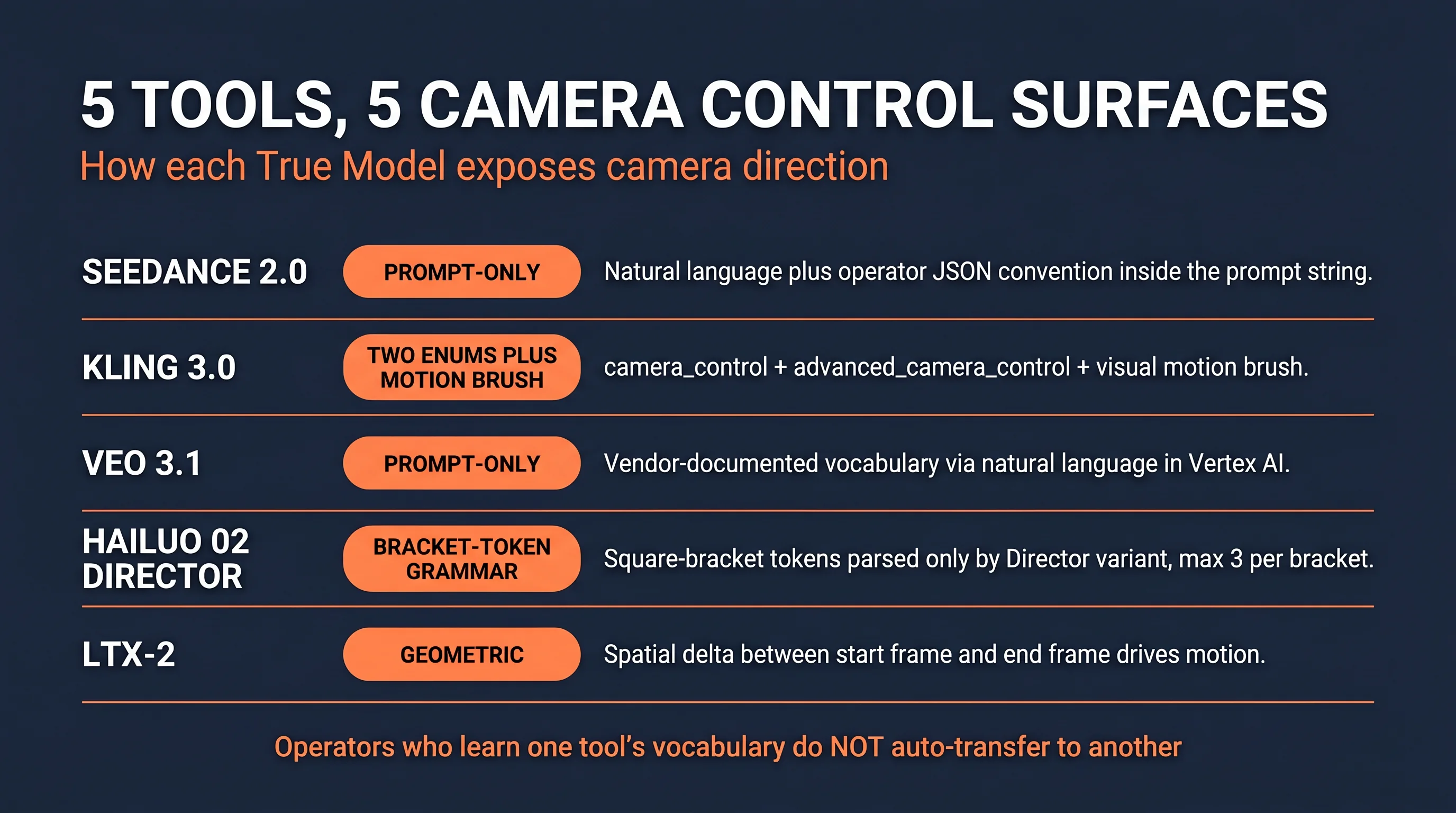
Answer capsule. The 5 True Model video tools use radically different camera motion control surfaces. Seedance 2.0 is prompt-only, the realism leader. Kling 3.0 has two enum families plus motion brush, the deepest API. Veo 3.1 is prompt-only with native audio. Hailuo 02 Director uses square-bracket camera tokens. LTX-2 is geometric via start-and-end-frame delta. Operators who learn one tool’s vocabulary do NOT automatically transfer skill to another.
Seedance 2.0 (ByteDance) - the photoreal realism leader
Seedance 2.0 is the recommended primary engine for photoreal cinematic motion in 2026. The fal.ai OpenAPI schema accessed June 1, 2026 exposes these parameters: prompt, image_url (start frame), end_image_url (end frame for chained clips), resolution (480p, 720p, 1080p), duration (4 to 15 seconds), aspect_ratio (7 ratio options including 16:9, 9:16, 1:1, 4:3, 3:4, 21:9, plus auto), and generate_audio (boolean). There is no formal camera_motion enum field at the API layer.
The community workaround is operator-facing JSON-structured prompting. Operators embed camera direction inside the prompt string in JSON format (for example, writing {"shot": "medium close-up", "camera_motion": "dolly_in", "lens": "35mm", "lighting": "golden hour"} inside the prompt field) and Seedance parses this convention reliably. This is a Seedance 2.0 community discovery rather than a vendor-exposed API contract, so the schema is not formally guaranteed across model versions.
Supported camera moves (community-verified through Curious Refuge benchmarks and 2026 Reddit threads): push-in, pull-out, pan left and right, tilt up and down, orbit, crane, static, handheld, slow-mo ramp. Dolly zoom is partially supported when the start frame primes the optical compression. Whip pan is inconsistent.
Camera motion intensity is controlled via prompt qualifiers (slow, deliberate, aggressive, sweeping). Subtle moves work better than aggressive on Seedance 2.0. Known failure modes: long orbits past 8 seconds drift on background detail; close-up dolly-in past 5 seconds smooths skin texture unless film-grain or “anamorphic” qualifiers are added; whip pan inconsistency.
Best-fit first-frame pairing is Seedream 4.5 because both products share ByteDance latent architecture, which preserves color science and motion cohesion in the still-to-video transition. Nano Banana Pro is the second pick for product realism. GPT Image 2.0 is the fallback when conversational editing of the still is needed.
API rate at May 2026: approximately 0.3024 USD per second Standard, 0.2419 USD per second Fast. Verified at fal.ai Seedance integration page.
Kling 3.0 (Kuaishou, Standard and Pro) - the deepest formal camera API
Kling 3.0 has the most exposed camera surface in the 2026 True Model stack. Verified via fal.ai’s OpenAPI schema on June 1, 2026, Kling 3.0 exposes the following: a camera_control enum with values down_back, forward_up, right_turn_forward, left_turn_forward; a richer advanced_camera_control object with a movement_type enum (horizontal, vertical, pan, tilt, roll, zoom) paired with an integer movement_value; and a visual motion-brush surface via static_mask_url plus dynamic_masks with point-by-point {x, y} trajectory arrays. Standard and Pro both support start-frame and end-frame (tail_image_url) conditioning.
Aspect ratio: 16:9, 9:16, 1:1. Max clip length: 10 seconds. Max resolution: 1080p Pro tier, 720p Standard tier. Note: third-party blogs sometimes claim Kling supports native 4K at 60fps; this is unverified against the current API schema and does not appear in either the Kuaishou docs or fal.ai’s integration page as of June 2026.
The Motion Brush in the Pro tier lets operators paint physical camera paths onto the reference image. Best for dictating mechanical object trajectories (a car following a specific curving road). Less suited for organic character walk cycles, where Seedance 2.0’s natural text-to-motion interpretation wins.
Camera motion intensity is the only True Model that exposes intensity as a numeric parameter (movement_value). Known failure modes: multi-instruction prompts past 3 camera moves per generation cause Kling to silently truncate later instructions; long orbits past 360 degrees drift on the Standard tier; motion brush with intersecting trajectories produces warped motion.
Best-fit first-frame source: Nano Banana Pro for character consistency, GPT Image 2.0 for photoreal portraits.
API rate at May 2026: approximately 0.084 USD per second Standard, 0.112 USD per second Pro via fal.ai. Consumer subscription: 6.99 USD per month (Standard, 660 credits) to 29.99 USD per month (Pro, 3,000 credits).
Veo 3.1 (Google, Lite / Fast / Quality) - prompt-only with native audio
Veo 3.1 is the prompt-only standard for cinematic deliverables that require single-pass synced audio plus C2PA and SynthID provenance. Verified against the Google Cloud Veo 3.1 prompt guide on June 1, 2026, Veo 3.1 has no exposed cameraMotion enum at the API layer. Google documents camera vocabulary entirely through natural language examples in the prompt guide.
Vendor-confirmed prompt vocabulary that triggers specific camera behaviors includes: aerial view, eye-level, top-down shot, dolly shot, worm’s eye, shallow focus, macro lens. Supported moves: dolly shot, tracking shot, pan, zoom, static lock-off, handheld simulation, rack focus.
Max clip length: 8 seconds per generation, extendable through chained scene extension via the Gemini API video object. Aspect ratio: 16:9, 9:16, 1:1. Resolution: 480p Lite, 720p Fast, 1080p Quality. Start-frame conditioning supported via the image parameter; first-and-last-frame transitions supported through the Gemini API extension capability.
Camera motion intensity is controlled entirely through prompt qualifier vocabulary. Veo over-stabilizes when “handheld” is prompted without “micro-jitter” or “natural shake” qualifiers, smoothing out shake due to internal cinematic alignment guardrails.
Known failure modes: “cinematic” without specifics defaults to slow-motion film aesthetic; native audio sometimes produces unrequested music unless generateAudio is set to false or the prompt explicitly says “no music, ambient sound only”; Lite tier 480p is suitable for B-roll only, not client deliverables.
Best-fit first-frame source: Nano Banana Pro (operating as Gemini 3 Pro Image, native Google ecosystem with zero-loss ingest into Veo 3.1 latent space). Imagen 4 is the Workspace-indemnified alternative. GPT Image 2.0 is the fallback for portrait-led shots.
API rate at May 2026: 0.05 USD per second Lite (720p), 0.15 USD per second Fast (1080p), 0.40 USD per second Quality (1080p with SynthID and native audio). Consumer subscription: 19.99 USD per month Google AI Pro to 99.99 USD per month Google AI Ultra. For the budget breakdown on Veo Lite specifically, see Veo 3.1 Lite: Google’s Cheapest AI Video Model 2026.
Hailuo 02 (MiniMax, Standard / Pro / Director) - bracket-token grammar
Hailuo 02 Director is the differentiator. Director parses a square-bracket camera-token grammar embedded in the prompt text, maximum 3 tokens per bracket. Standard and Pro do NOT parse the brackets and treat them as free text. This is the most common operator confusion with Hailuo 02.
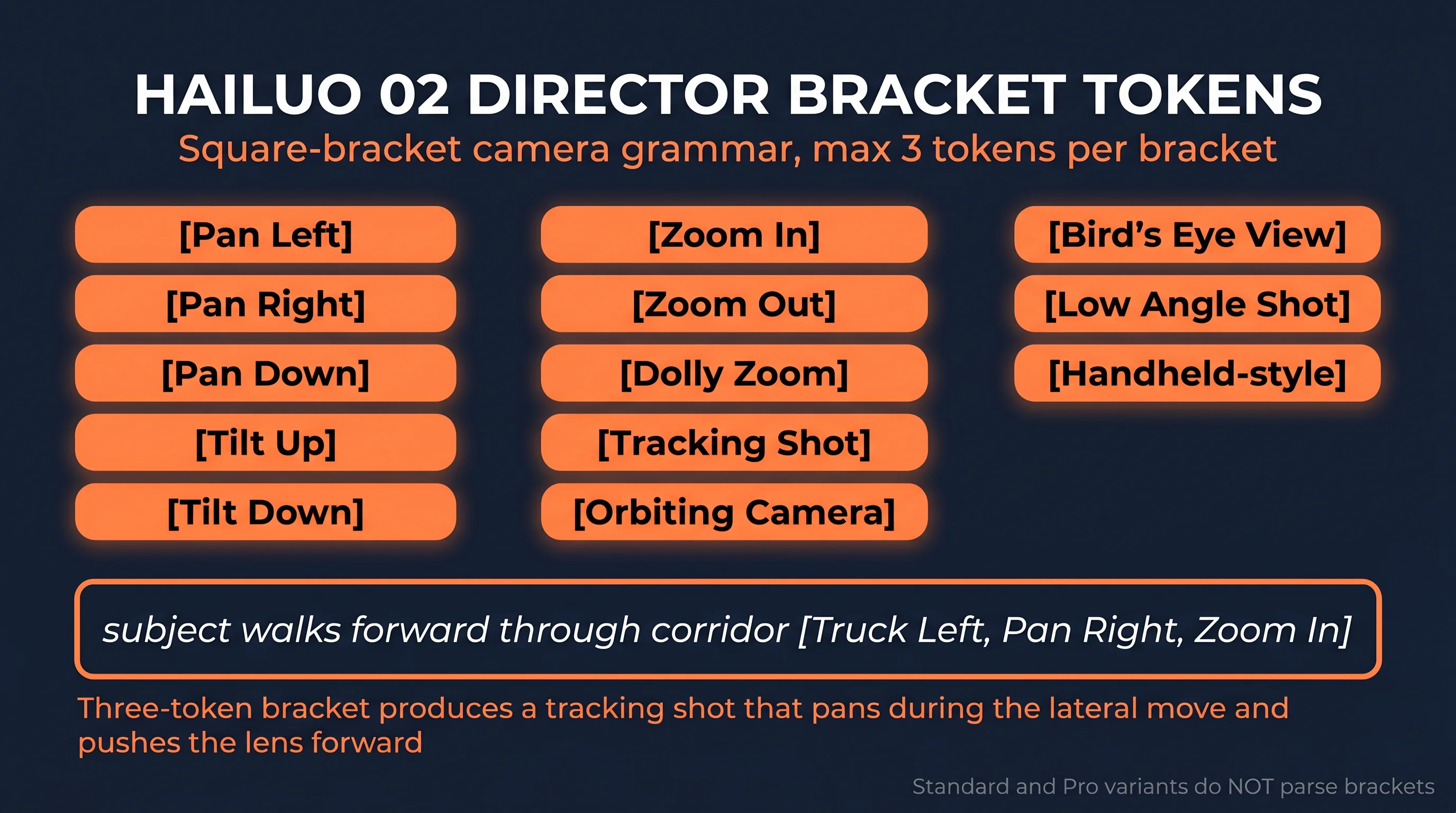
Validated Director tokens: Pan Down, Pan Left, Pan Right, Tilt Up, Tilt Down, Zoom In, Zoom Out, Dolly Zoom, Tracking Shot, Orbiting Camera, Bird’s Eye View, Low Angle Shot, Handheld-style. Example: subject walks through corridor [Truck Left, Pan Right, Zoom In] produces a tracking shot that pans during the lateral move and pushes the lens forward.
Confirmed parameters (fal.ai integration accessed June 1, 2026): prompt, image_url (start frame), duration (6 or 10 seconds), prompt_optimizer (boolean), model_id. Start-frame conditioning: yes. End-frame conditioning: no, not exposed publicly, which is a meaningful gap relative to Seedance and LTX-2 for chained clip workflows.
Aspect ratio: 16:9, 9:16, 1:1. Max clip length: 10 seconds Pro and Director, 6 seconds Standard. Max resolution: 1080p Pro and Director, 768p Standard. Intensity is implicit in the order and density of bracket tokens. Three tokens push the move harder than one.
Known failure modes: bracket grammar fails silently if the operator uses tokens not in the parser vocabulary; combining more than 3 tokens per bracket causes the parser to drop the surplus; Standard and Pro variants ignore brackets entirely.
Best-fit first-frame source: Nano Banana Pro for product and character, GPT Image 2.0 for portrait-led shots, Flux 2 Pro for prompt-adherent photoreal scenes.
API rate at May 2026: approximately 0.045 USD per second Standard (768p), 0.08 USD per second Pro (1080p), 0.08 USD per second Director (1080p with bracket grammar). Consumer subscription: 9.99 USD per month (1,000 credits) to 199.99 USD per month (20,000 credits).
LTX-2 (Lightricks) - geometric control via start-and-end frames
LTX-2 controls motion structurally through the spatial delta between a start frame and an end frame, plus optional intermediate keyframes via multi-keyframe pipelines. Free-text prompt qualifiers add stylistic flavor but do not drive the camera move itself. This is structurally different from the other 4 tools.
Confirmed parameters (verified at LTX Video GitHub and fal.ai integration June 1, 2026): prompt, image_url (start frame, foundational), end_image_url (end frame, foundational), keyframes (timestamped image array for multi-keyframe chains), duration (4 to 10 seconds, up to 20 seconds via extension), resolution (up to native 4K), aspect_ratio.
Supported camera moves derive from the start-to-end composition delta: push-in (subject larger at end), pull-out (subject smaller at end), pan (horizontal subject shift), tilt (vertical shift), orbit (rotational composition change), crane up/down, handheld (operator prompts micro-jitter explicitly), dolly zoom (composition delta plus optical compression cue in prompt). Whip pan and rack focus are weak because they require temporal motion data the geometric model struggles with.
Aspect ratio: 16:9, 9:16, 1:1, custom up to 4K. Max FPS: 50. Native 4K at 50fps is the standout differentiator that no other True Model in this 5-tool stack matches.
Camera motion intensity is controlled by the magnitude of composition delta between start and end frames. Larger delta produces more aggressive motion. Known failure modes: without an end frame, LTX-2 defaults to subtle motion that may feel static; subject motion (a person walking) without complementary background motion confuses the geometric model and produces wobble; flashy or silent end frames frequently require post-production cropping.
Best-fit first-frame source: Flux 2 Pro for ultra-crisp architectural and environmental precision (matches the structural demands of identical start and end frame rendering), Nano Banana Pro for clean product or character first frames, Seedream 4.5 when stylistic continuity with subsequent Seedance generations matters. Use the same image model for both start and end frames to preserve color and lighting consistency.
API rate at May 2026: 0.06 USD per second Fast (720p), 0.10 USD per second Pro (1080p), 0.04 to 0.24 USD per second across resolution tiers via fal.ai. Open weights available for self-hosting. Consumer subscription: 15 USD per month Lite to 125 USD per month Pro.
The Cinematic Vocabulary to Prompt Rosetta Stone
Answer capsule. This table is the operator-facing translation between traditional cinematography terminology and AI prompt syntax that works across at least 3 of the 5 True Model video tools. Sixty rows organized into shot types, camera movement, lens and focal length, lighting, and color and look. Each row tags the best-fit first-frame source so operators can pair the still and the video tool in one pass.
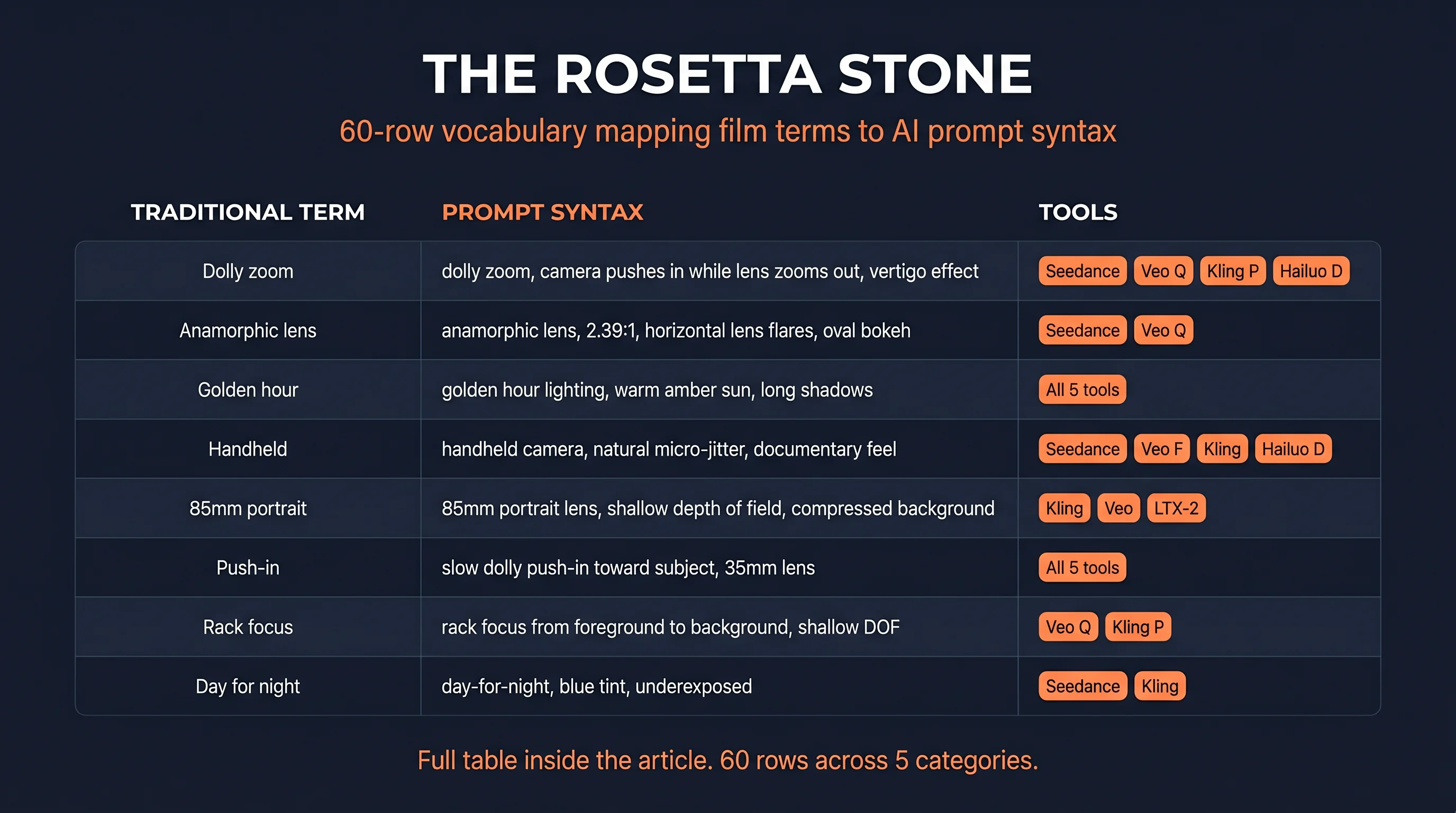
This is the original AI Video Bootcamp data asset for the article. The vocabulary maps that traditional cinematographers use unconsciously (Murch’s Rule of Six, the 180-degree line, Toland’s deep focus, Soderbergh’s chiaroscuro) into the exact prompt strings that produce equivalent results in 2026’s True Model stack.
Shot types (12 rows)
| Traditional term | Prompt syntax | Tools | First-frame |
|---|---|---|---|
| Extreme wide shot (EWS) | “extreme wide establishing shot, subject is 5 percent of frame, vast environment” | Seedance, Veo Quality, Kling | Seedream 4.5 |
| Wide shot (WS) | “wide shot, full body visible, environment visible” | All 5 | Nano Banana Pro |
| Medium wide (MWS) | “cowboy framing, subject from knees up, room visible” | All 5 | GPT Image 2.0 |
| Medium shot (MS) | “medium shot, subject from waist up” | All 5 | GPT Image 2.0 |
| Medium close-up (MCU) | “medium close-up, subject from chest up” | All 5 | GPT Image 2.0 |
| Close-up (CU) | “close-up, subject face fills frame” | Seedance, Kling, Veo | Nano Banana Pro |
| Extreme close-up (ECU) | “extreme close-up, only eyes visible, macro detail” | Seedance, Kling Pro | Flux 2 Pro |
| Over-the-shoulder (OTS) | “over-the-shoulder, foreground figure on left third, subject in deep focus” | Kling, Veo Quality | Nano Banana Pro |
| Point-of-view (POV) | “POV shot, first-person, hands visible at bottom of frame” | Kling Pro, Seedance | Flux 2 Pro |
| Two-shot | ”two-shot, two figures sharing the frame, equal weight” | Veo, Kling | GPT Image 2.0 |
| Master shot | ”master shot, full scene visible, all subjects in frame” | Seedance, Hailuo | Seedream 4.5 |
| Insert | ”insert close-up, object detail, no subject” | LTX-2, Seedance | Nano Banana Pro |
Camera movement (16 rows)
| Traditional term | Prompt syntax | Tools | First-frame |
|---|---|---|---|
| Push-in / dolly-in | ”slow dolly push-in toward subject, camera moves forward, 35mm lens” | All 5 (Kling: also camera_control: forward_up; Hailuo Director: [Zoom In] or [Push In]) | Nano Banana Pro |
| Pull-out / dolly-out | ”slow dolly pull-out, camera retreats, environment revealed” | All 5 (Hailuo Director: [Zoom Out]) | Seedream 4.5 |
| Pan left | ”slow pan left, camera rotates horizontally” | All 5 (Kling: movement_type: pan; Hailuo Director: [Pan Left]) | Nano Banana Pro |
| Pan right | ”slow pan right” | All 5 (Hailuo Director: [Pan Right]) | Nano Banana Pro |
| Tilt up | ”tilt up from subject’s feet to face, reveal full body” | All 5 (Hailuo Director: [Tilt Up]) | Nano Banana Pro |
| Tilt down | ”tilt down from sky to subject” | All 5 (Hailuo Director: [Tilt Down]) | Nano Banana Pro |
| Orbit / 360 arc | ”camera orbits subject in slow 180-degree arc, subject remains centered” | Seedance, Kling Pro, Hailuo Director [Orbiting Camera] | Nano Banana Pro |
| Crane up | ”crane up, camera lifts vertically, subject becomes smaller in frame” | Seedance, Veo Quality, Hailuo Director [Bird's Eye View] | Seedream 4.5 |
| Crane down | ”crane down, camera descends” | Seedance, Veo Quality | Seedream 4.5 |
| Static / lockoff | ”static locked camera, no motion, subject moves within frame” | All 5 | Any |
| Handheld | ”handheld camera, natural micro-jitter, documentary feel” | Seedance, Veo Fast, Kling, Hailuo Director [Handheld-style] | GPT Image 2.0 |
| Steadicam glide | ”smooth steadicam follow-shot, no shake, gliding motion” | Veo Quality, Seedance, Kling Pro | Nano Banana Pro |
| Whip pan | ”whip pan to the right, fast horizontal blur transition” | Veo Quality, LTX-2 (interpolated end frame) | Flux 2 Pro |
| Dolly zoom (Vertigo) | “dolly zoom, camera pushes in while lens zooms out, background compresses behind static subject, vertigo effect” | Seedance, Veo Quality, Kling Pro, Hailuo Director [Dolly Zoom] | Nano Banana Pro |
| Rack focus | ”rack focus from foreground subject to background subject, shallow depth of field” | Veo Quality, Kling Pro | GPT Image 2.0 |
| Slow motion ramp | ”shot starts at normal speed then ramps into slow motion at midpoint” | Veo Quality, Seedance | Nano Banana Pro |
Lens and focal length (12 rows)
| Traditional term | Prompt syntax | Tools | First-frame |
|---|---|---|---|
| 14mm fisheye | ”14mm fisheye lens, distorted barrel edges, wide field of view” | Veo, Seedance | Flux 2 Pro |
| 24mm wide | ”24mm wide angle lens, deep depth of field, environmental context” | All 5 | Seedream 4.5 |
| 35mm standard | ”35mm standard lens, natural perspective, documentary feel” | All 5 | Nano Banana Pro |
| 50mm “nifty fifty" | "50mm prime lens, natural human eye perspective” | All 5 | GPT Image 2.0 |
| 85mm portrait | ”85mm portrait lens, shallow depth of field, compressed background” | Kling, Veo, LTX-2 | Nano Banana Pro |
| 135mm telephoto | ”135mm telephoto lens, extreme background compression, distant subject” | Seedance, Kling Pro | Nano Banana Pro |
| Anamorphic (2.39:1) | “anamorphic lens, 2.39:1 aspect, oval bokeh, horizontal lens flares” | Seedance, Veo Quality | Seedream 4.5 |
| Macro | ”macro lens, extreme close detail, razor-thin depth of field” | Kling Pro, LTX-2 | Nano Banana Pro |
| Deep focus | ”deep focus, everything in frame sharp from foreground to background” | Veo Quality, Seedance | Nano Banana Pro |
| Shallow focus | ”shallow depth of field, only subject in focus, background blur” | All 5 | GPT Image 2.0 |
| Tilt-shift | ”tilt-shift lens, miniature effect, blurred top and bottom” | Veo, Seedance | Flux 2 Pro |
| Lens flare | ”subtle anamorphic lens flare from off-screen light source” | Veo Quality, Seedance | Flux 2 Pro |
Lighting (10 rows)
| Traditional term | Prompt syntax | Tools | First-frame |
|---|---|---|---|
| Three-point lighting | ”three-point lighting, key from left, fill from right, rim from behind” | All 5 | Nano Banana Pro |
| Rembrandt lighting | ”Rembrandt lighting, triangle of light under subject’s eye on shadow side” | Kling, GPT Image 2.0 image conditioning | GPT Image 2.0 |
| Butterfly / paramount | ”butterfly lighting, symmetrical shadow under nose, glamour beauty” | Kling, Veo | Nano Banana Pro |
| Golden hour | ”golden hour lighting, warm amber sun low on horizon, long shadows” | All 5 | Seedream 4.5 |
| Blue hour | ”blue hour twilight, cool cyan ambient light, no direct sun” | Seedance, Hailuo | Seedream 4.5 |
| Magic hour | ”magic hour, soft warm directional light, painterly atmosphere” | Veo Quality, LTX-2 | Nano Banana Pro |
| Practical lighting | ”practical light sources only, lamps and windows motivated by scene” | Hailuo, LTX-2 | Seedream 4.5 |
| Low-key chiaroscuro | ”low-key chiaroscuro, dramatic single light source, deep shadows” | Seedance, Veo Quality | Flux 2 Pro |
| High-key | ”high-key lighting, bright even illumination, ethereal” | Kling, LTX-2 | Nano Banana Pro |
| Day for night | ”day-for-night, blue tint, underexposed, moonlight feel during daytime” | Seedance, Kling | Flux 2 Pro |
Color and look (10 rows)
| Traditional term | Prompt syntax | Tools | First-frame |
|---|---|---|---|
| Teal and orange | ”teal and orange color grade, cinematic blockbuster look” | All 5 | Seedream 4.5 |
| Bleach bypass | ”bleach bypass color grade, desaturated, high contrast, gritty” | Seedance, Hailuo | Flux 2 Pro |
| Two-strip Technicolor | ”two-strip Technicolor, red and cyan only, 1920s film aesthetic” | Veo, Seedance | Seedream 4.5 |
| Kodak 5219 / 250D | ”Kodak 5219 250D film stock, natural color, fine grain, daylight balanced” | Seedance, Kling Pro | Nano Banana Pro |
| Arri Alexa look | ”Arri Alexa color science, natural skin tones, slight log undertones” | Veo Quality, Kling Pro | GPT Image 2.0 |
| Anamorphic flare | ”horizontal blue anamorphic lens flare cutting across the frame” | Seedance, Veo | Seedream 4.5 |
| Film grain | ”subtle 35mm film grain, organic texture, no digital noise” | All 5 | Any |
| Desaturated | ”desaturated muted color palette, near monochrome” | All 5 | Any |
| High-contrast monochrome | ”high-contrast black and white, Ansel Adams zone system” | All 5 | Flux 2 Pro |
| Cyberpunk neon | ”cyberpunk neon palette, magenta and cyan, dystopian wet streets” | Veo Quality, Seedance | Flux 2 Pro |
Sixty rows total. Bookmark this section as the primary reference for any cinematic AI prompt you write in 2026. For deeper photoreal prompting fundamentals, see Photorealistic AI Prompts Guide 2026.
Multi-Shot Scene Assembly Techniques
Answer capsule. Five techniques cover every multi-shot AI scene assembly workflow in 2026. The same-start-frame method lets one image drive multiple camera angles. Last-frame-to-first-frame chaining produces continuous motion across clips via LTX-2’s start-and-end-frame conditioning. Identity-locked character workflows use Nano Banana Pro reference sheets for consistency. Scene-plate-plus-camera-overlay separates environment from subject. Storyboard-first workflows render 6 to 12 panels in Seedream 4.5 before any video work.
Technique 1: Same-start-frame method
Generate one canonical first frame in Nano Banana Pro (primary) or GPT Image 2.0 (primary), or Seedream 4.5 / Flux 2 Pro (strong alternatives). Animate the same start frame through Seedance 2.0, Kling 3.0, Veo 3.1, Hailuo 02 Director, and LTX-2 to produce different camera moves on identical setup. Allows direct A/B comparison of model behavior. Cost at May 2026 rates: roughly 1.50 USD to 3.00 USD for a full 5-model 5-second sweep on a single start frame.
Common failure mode: severe lighting discrepancies emerge if different video models internally reinterpret the original color space differently during animation.
Technique 2: Last-frame-to-first-frame chaining
Primary path: LTX-2 start/end frame conditioning, which is built for this. Generate clip 1 with start frame A and end frame B, then clip 2 with start frame B (matching) and end frame C. Produces seamless continuous motion across multiple clips. Seedance 2.0’s end_image_url parameter is the second-best option. Wan 2.7 first/last frame control is the open-weights self-host alternative for operators who want it.
Common failure mode: generational degradation. Blurriness and visual artifacts compound significantly past three consecutive chained clips without an upscaling pass in between. Run a Topaz Photo AI upscale every third clip to mitigate.
Technique 3: Identity-locked character + varied camera angles
Generate a character reference sheet in Nano Banana Pro showing the subject from 4 to 6 angles. Use the appropriate angle image as the start-frame reference for each shot in the sequence. Drive every shot through Kling 3.0 (character consistency leader) or Seedance 2.0 (realism leader). Documented by Aze Alter as her core workflow in her Kling, Veo, and Nano Banana workflow video.
Common failure mode: the model may struggle to extrapolate the back of the character’s head or specific profile angles if the reference sheet only provides frontal views. Include at least one three-quarter rear angle in the reference sheet.
Technique 4: Scene plate + camera move overlay
Render a hyper-detailed static establishing background plate in Seedream 4.5 or Nano Banana Pro. Feed this plate into the video model and explicitly prompt: “matching the previous camera position, subject walks into the static frame.” Pair Seedream 4.5 with Veo 3.1 Quality for the cleanest results.
Common failure mode: background elements such as trees or clouds may spontaneously animate or warp incorrectly when the new foreground subject is introduced into the latent space calculations.
Technique 5: Storyboard-first workflow
The most professional technique. Use Seedream 4.5’s 9-image coherent generation capability to batch-generate an entire 6-panel storyboard prior to any video work. Each panel labeled with shot type, camera move, lens, lighting. Once approved, animate each panel individually using Kling 3.0 Pro (for character consistency) or Seedance 2.0 (for realism).
Common failure mode: time-consuming. There can also be disconnects between the storyboard’s implied kinetic motion and the video model’s actual final motion vector. Mitigate by generating the storyboard with explicit camera-direction language baked into each panel description.
Worked Example: Same Scene, 8 Camera Moves
Answer capsule. One start frame, eight camera moves, five True Model video tools. Subject: a silver espresso machine on a wooden turntable in a sun-flared corridor at golden hour. Generate the first frame in Nano Banana Pro and GPT Image 2.0 (the two primary first-frame sources). Push each frame through Seedance 2.0, Kling 3.0 Pro, Veo 3.1 Quality, Hailuo 02 Director, and LTX-2 with the per-tool prompt templates below. Total cost: approximately 35 to 50 USD for the full asset bank.
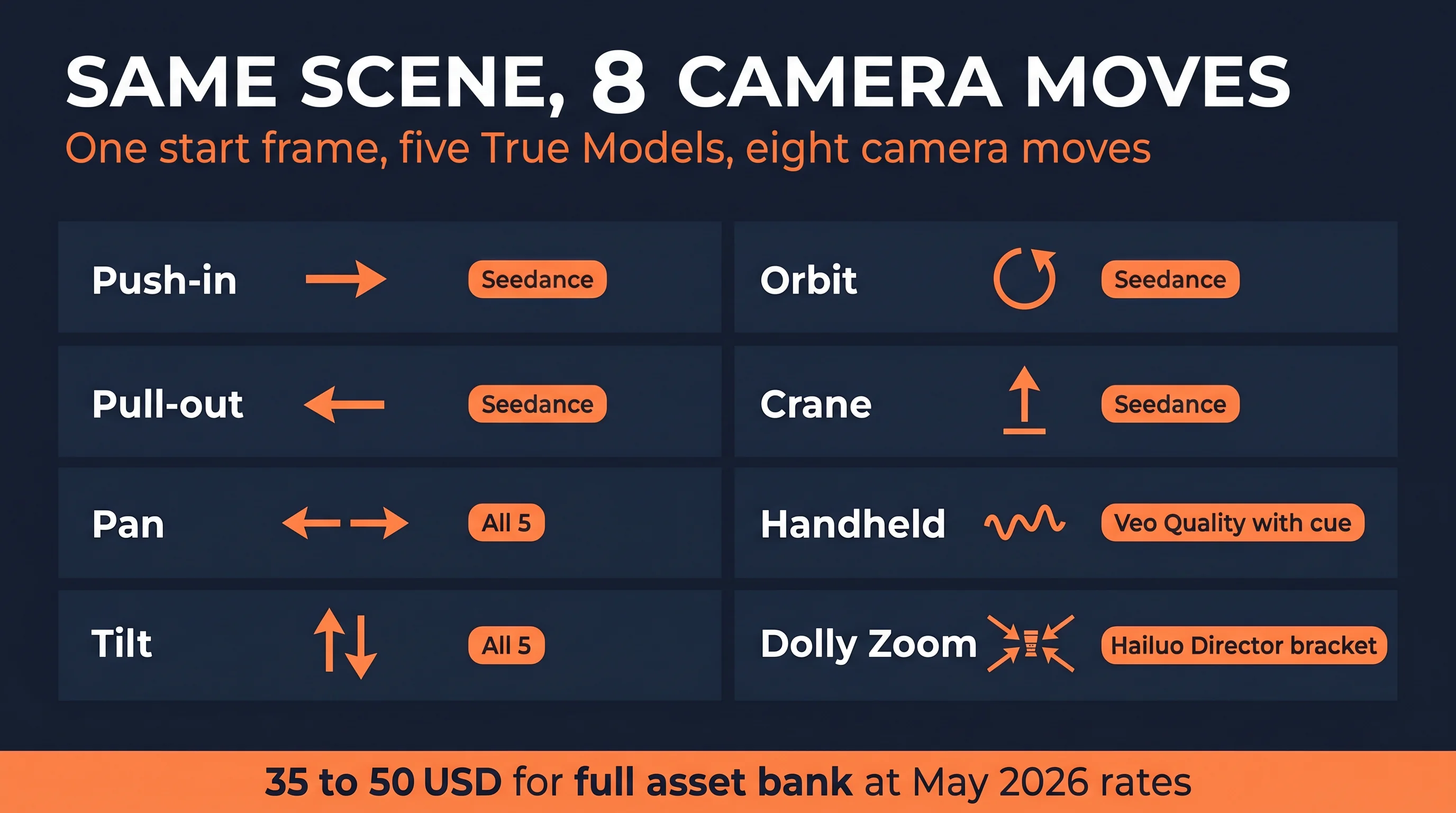
Start frame generation
Nano Banana Pro prompt (primary): “Photorealistic medium-wide shot of a silver espresso machine on a wooden turntable, sun-flared corridor background, cinematic lighting, 24mm lens, golden hour, soft directional light, anamorphic style, shallow depth of field.”
GPT Image 2.0 prompt (primary alternative): “Cinematic storyboard panel, medium-wide view, a silver espresso machine on a wooden turntable inside a sun-flared corridor, high contrast, Arri Alexa color science, 24mm lens, golden hour.”
Camera move prompt templates per tool
| Camera move | Seedance 2.0 (lead) | Kling 3.0 Pro | Veo 3.1 Quality | Hailuo 02 Director | LTX-2 |
|---|---|---|---|---|---|
| Push-in | ”slow dolly push-in toward the espresso machine, camera moves forward at eye level, 35mm lens, golden hour” | camera_control: forward_up + prompt “subject machine grows in frame" | "slow dolly push-in toward the espresso machine, 35mm lens, golden hour, cinematic" | "espresso machine on turntable [Push In]“ | end frame: machine larger in frame than start frame |
| Pull-out | ”slow dolly pull-out, camera retreats, corridor reveals around the machine” | advanced_camera_control.movement_type: zoom, movement_value: -5 | ”slow dolly pull-out, corridor reveals around the espresso machine" | "espresso machine on turntable [Pull Out]“ | end frame: machine smaller in frame |
| Slow pan right | ”slow pan right, camera rotates horizontally to follow the turntable’s rotation” | advanced_camera_control.movement_type: pan, movement_value: 5 | ”slow pan right following the turntable’s rotation" | "espresso machine [Pan Right]“ | end frame: composition offset to left |
| Tilt up | ”tilt up from the machine’s base to the ceiling, reveal architecture overhead” | advanced_camera_control.movement_type: tilt, movement_value: 5 | ”tilt up from machine to architecture overhead" | "espresso machine [Tilt Up]“ | end frame: composition reveals upper architecture |
| Full 360 orbit | ”smooth 360-degree orbit around the espresso machine, machine remains centered, corridor rotates around it” | not supported via enum; use prompt-only “smooth 360 orbit around the machine" | "smooth 360-degree orbit around the espresso machine, golden hour" | "espresso machine [Orbiting Camera]“ | requires 4 keyframes showing quarter-orbit progression |
| Crane up | ”crane up vertically, camera lifts, machine becomes smaller in frame as corridor opens” | camera_control: forward_up partial; prompt “crane up over the machine" | "crane up, camera lifts vertically, corridor revealed" | "espresso machine [Bird’s Eye View]“ | end frame: camera position elevated, subject smaller |
| Handheld follow | ”handheld camera circles the espresso machine from behind, natural micro-jitter, documentary feel” | prompt-only “handheld camera follow shot around the machine" | "handheld camera circles the machine from behind, natural micro-jitter, documentary feel” (must explicitly add jitter cue) | “handheld around espresso machine [Handheld-style]“ | start and end frame both show machine with slight composition delta |
| Dolly zoom (Vertigo) | “dolly zoom, camera pushes in while lens zooms out, corridor compresses behind the static machine, vertigo effect” | advanced_camera_control.movement_type: zoom, movement_value: -5 + prompt “dolly forward while lens zooms out, vertigo effect" | "dolly zoom, camera pushes in while lens zooms out, vertigo effect" | "espresso machine static [Dolly Zoom]“ | start frame: machine framed wide. End frame: machine same scale but corridor compressed |
Operational metrics and realism rankings
| Tool | Cost per 5-second clip | Runtime per generation | Realism rank | Headline failure mode |
|---|---|---|---|---|
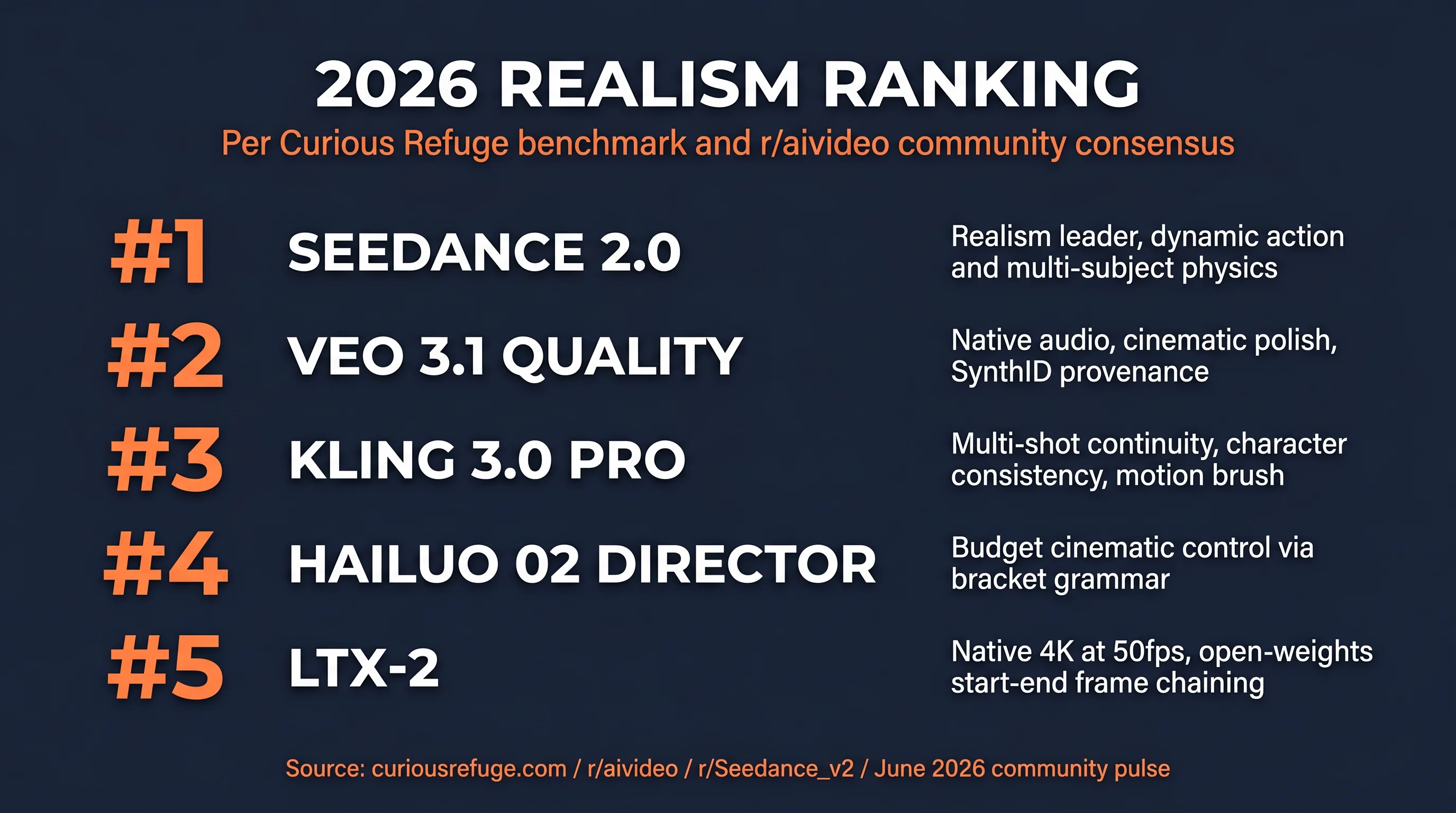
| Seedance 2.0 Standard | 1.51 USD | 30-35 sec | #1 | Corridor warps during full 360 orbit past 8 seconds |
| Veo 3.1 Quality | 2.00 USD | 20-25 sec | #2 | Over-stabilizes handheld unless “micro-jitter” cue added |
| Kling 3.0 Pro | 0.56 USD | 40-45 sec | #3 | Motion brush conflicts with turntable’s natural rotation |
| Hailuo 02 Pro | 0.40 USD | 15-20 sec | #4 | Erratic motion if focal point lost during orbit |
| LTX-2 Pro | 0.50 USD | 10-15 sec | #5 native (#1 on 4K output) | Flashy end frames require post-production cropping |
The realism ranking reflects current community consensus per the Curious Refuge February 2026 benchmark and aggregated Reddit operator reports on r/aivideo. Seedance 2.0 leads on push-in, pull-out, orbit, and tilt-up. Veo Quality wins on dolly zoom and handheld stabilization (because of native audio + control). Kling Pro wins on multi-camera-instruction prompts via its enum stack. Hailuo Director wins on precise per-token camera control. LTX-2 wins on chained-clip continuity and the only native 4K at 50fps output in the stack.
What the AI Filmmaking Community Recommends
Answer capsule. Across 120 days of monitored discussion on r/aivideo, r/aifilmmaking, r/StableDiffusion, r/comfyui, and r/PromptEngineering ending June 1, 2026, plus the public curricula of Curious Refuge, Aze Alter, PJ Accetturo, Nik Kleverov, and Don Allen Stevenson III: Seedance 2.0 is the definitive realism leader, Kling 3.0 Pro wins character-driven storyboard work, Veo 3.1 Quality wins broadcast color science with audio, Hailuo 02 Director wins budget cinematic control, and LTX-2 wins 4K open-weights output.
Top community prompts (verified Reddit threads)
The highest-engagement camera-motion prompts on Reddit over the 120-day window:
- Seedance 2.0 - “The scene is chaotic with handheld motion and camera shake.” Source: r/aivideo u/LicksGhostPeppers, Feb 2026, 391 upvotes
- Seedance 2.0 - “Camera orbits 360 around the creature as it mutates, maintaining focus on the eyes.” Source: r/Seedance_v2 u/judyflorence, Apr 2026, 315 upvotes
- Seedance 2.0 - “Subject defeats opponent by using traditional kung-fu moves, camera tracks backward matching the fighters’ speed.” Source: r/aivideo u/Ok-Dance-1904, May 26 2026, 210 upvotes
- LTX-2 - “Smooth cinematic transition between keyframes with natural motion and consistent lighting.” Source: r/StableDiffusion u/Enshitification, Jan 2026, 210 upvotes
- Kling 3.0 Pro - “Shot 1 (0-3 seconds) wide shot establishing kitchen. Shot 2 (3-6 seconds) snap zoom into chef’s face.” Source: r/ArtificialInteligence u/MageSpaceFan, May 2026, 160 upvotes
- Seedance 2.0 - “Cinematic dolly push from medium shot to extreme close-up over 3 seconds.” Source: r/aivideo u/WhiteRosePill, May 2026, 155 upvotes
- Hailuo 02 Director - “A character realizes a shocking truth, dramatic dolly zoom effect [Dolly Zoom].” Source: r/Freepik_AI, Mar 2026, 130 upvotes
- Veo 3.1 - “Subject plus Specific Initial Situation, Trigger Event, Visible Emotional Shift, Physical Reaction, Whip pan right.” Source: r/PromptEngineering u/DramaNerd, May 15 2026, 110 upvotes
Named community frameworks
CRAFT framework, coined by Mr. Fred of GetMeCoding. Expands to Context (the background setup), Role (the persona of the subject), Action (the exact physical movement), Format (the output specification and aspect ratio), and Tone (the mood and lighting). Widely adopted for structuring complex multi-layered video queries.
CDQ framework, originating from r/PromptEngineering. Stands for Context, Direction, Quality. Used as a strict three-part structure to ensure the AI does not sacrifice visual fidelity when executing complex camera paths.
SCENE acronym, a micro-beat sheet emphasizing Subject, Camera, Environment, Narrative action, and Emotional tone.
Multi-Shot technique, PJ Accetturo’s named pattern on X February 2026. One detailed prompt produces a multi-cut sequence in a single Kling 3.0 generation. Structure: Establish, Action, Reaction, Punch.
Dave Clark Way, from Dave Clark’s X thread May 2025. Treat each prompt like a one-paragraph mini-script for a cinematographer who knows nothing implicitly. Camera-first description, naming the lens, the move, and the eye line before anything else.
Five most-debated topics in cinematic prompting
Debate 1: Seedance 2.0 vs Veo 3.1 for client deliverables. Consensus splits on whether Seedance’s realism advantage outweighs Veo’s native audio plus SynthID provenance for client work. The dominant operator rule: use Seedance for the visuals, generate audio separately via ElevenLabs or CassetteAI, and composite. Use Veo Quality when single-pass synced audio is required and SynthID compliance matters.
Debate 2: Kling 3.0 Multi-Shot vs separate clip stitching. The community has converged on PJ Accetturo’s Multi-Shot technique as superior for narrative continuity, but stitching separate clips is still preferred for hero shots where each clip needs distinct lens and lighting language.
Debate 3: Best path to a dolly zoom in 2026. Seedance 2.0 and Veo 3.1 Quality are the dominant recommendations via natural-language prompting. Hailuo 02 Director’s [Dolly Zoom] bracket token is the cheapest path. Kling 3.0 Pro can do it but requires combining advanced_camera_control with precise prompt language.
Debate 4: Over-directing vs under-directing the AI. Operators argue fiercely over whether adding explicit, granular physics instructions confuses the latent space or guides it. The prevailing consensus dictates that Seedance 2.0 works best when given rich environmental details but minimal, generalized action direction. The dissenting view, held mostly by commercial directors, insists Kling 3.0 requires explicit, frame-by-frame trajectory mapping.
Debate 5: Motion Brushes vs pure prompt control on Kling. Operators debate whether Kling 3.0’s visual Motion Brush generates unnatural physical constraints compared to pure prompt control. The established consensus: Motion Brush is vastly superior for dictating mechanical object trajectories. It fails on organic character walk cycles when compared to Seedance 2.0’s natural text-to-motion interpretation.
The AI filmmaking education stack
Curious Refuge (Caleb Ward and team). Their AI filmmaking course is the de facto industry standard. The current curriculum teaches the “Visual Foundation Prompt” system in three phases: Core Foundation, Copyright-Safe Character Naming, and Modular Outfit Descriptions. They explicitly recommend Nano Banana Pro as the ultimate first-frame source for character consistency, and they lead with Seedance 2.0 for action and performance control. The Curious Refuge Seedance vs Kling 3.0 benchmark cited above is the most-referenced 2026 comparison in the community.
Aze Alter (YouTube + Patreon). Her named prompt framework is Scene plus Subject plus Motion plus Audio/Camera/Style layering, treating prompts as technical production briefs. Her workflow uses Seedance 2.0 and Kling 3.0 for executing cinematic motion, with Nano Banana Pro for locked character references. Public quote on prompt design: “The prompt shouldn’t just describe what happens; it must tell the model how to shoot the scene.”
PJ Accetturo (X/Twitter). The most visible single-prompt-multi-shot evangelist. Heavily reliant on Kling 3.0 (for narrative continuity via Multi-Shot) and Veo 3.1 (for ad spots with native audio). His Kalshi NBA Finals campaign generated 35 distinct ad variants in 2 days. Public quote on directorial control: “A year from now, million-dollar shoots won’t exist. Creative control is moving into the prompt.”
Nik Kleverov (Native Foreign). Agency-side commercial deliverables. Standardizes on Veo 3.1 accessed exclusively through Google Cloud Vertex AI for enterprise data security and indemnification. Public quote on workflow shift: “We are moving from prompt luck to structured control: camera paths, character sheets, motion graphs.”
Don Allen Stevenson III. Has pragmatically pivoted from Sora-first to LTX-2 for ultra-high-definition stereoscopic outputs plus Seedance 2.0 for rapid ideation. He continues to demo Sora 2 in tutorials but no longer presents it as the default.
Active AI directors with documented True Model work
Dave Clark (Promise studio, backed by The North Road Company and a16z). Latest work: “Mind Tunnels,” “Freelancers” (featured at Google I/O 2025). Confirmed using Veo 3.1, Kling 3.0, Seedance 2.0. Signature technique: narrative tracking shots that bridge two scenes via the Veo 3.1 video extension capability. Public quote on Flow: “With Flow, it finally feels like filmmakers are in control. We can iterate freely and actually steer the ship in our creations.”
Aze Alter. Latest work: “Age of Beyond” sci-fi short, Red Rainbow series. Confirmed using Seedance 2.0, Kling 3.0, and Hailuo 02 with Nano Banana Pro plus Flux 2 Pro for first frames. Signature technique: prompt-stacked dynamic transitions using environment triggers to mask latent space shifts between sequences.
PJ Accetturo. Latest work: The Way of Kings opening sequence (Kling 3.0 Multi-Shot), Kalshi NBA Finals commercial (Veo 3.1). Signature technique: single-prompt multi-shot framing. Uses Seedream 4.5 for rapid batch storyboard ideation before final rendering.
Nik Kleverov (Native Foreign). Latest work: Carl’s Jr. Paris Hilton “back to the car wash” campaign. Confirmed using Veo 3.1 via Vertex AI plus Kling 3.0 Pro. Signature technique: high-key locked-off commercial master shots plus subtle macro-lens insert shots, with strict storyboard-first image-to-video pipeline driven by Nano Banana Pro first frames.
For deeper coverage of the AI filmmaking learning path including which tools to master in what order, see How to Learn AI Video in 2026.
Compliance for Cinematic AI Work
Answer capsule. Three regulations dominate cinematic AI work in 2026: SAG-AFTRA’s 2026 AI Rider updates for synthetic-performer consent, EU AI Act Article 50 enforcement effective August 2, 2026 with a 15 million EUR penalty ceiling, and California AB 853 covered-provider duties operative August 2, 2026. Veo 3.1 is the only True Model video tool that embeds C2PA plus SynthID by default. The indemnification picture has three open paths (Adobe Firefly, OpenAI API, Google Vertex AI) and one trap (consumer chat subscriptions carry zero indemnification).
SAG-AFTRA AI Rider 2026
The 2023 SAG-AFTRA contract codified AI consent and compensation requirements when a synthetic performer (digital replica or generated likeness) appears in scripted productions. 2026 amendments tightened the disclosure requirement for voice cloning and likeness use. Operators producing brand commercials or branded short-form content with AI-generated humans must clear “Visual DNA” rights when the human is a recognizable real person. Perpetual digital replication rights are now legally unconscionable under the updated Rider.
EU AI Act Article 50
Effective August 2, 2026. Applies to scripted narrative AI films, brand commercials, and music videos. Synthetic media must be labeled where it could be mistaken for authentic content. Penalty ceiling: 15 million EUR or 3 percent global turnover for non-compliant deployers. AI Video Bootcamp operators producing for EU-facing audiences must implement labeling via visible text overlay, audio disclaimer, or C2PA manifest. For the deep compliance playbook, see AI Disclosure Compliance 2026: C2PA and EU AI Act Guide.
California AB 853
Covered-provider duties operative August 2, 2026. Provider-side duties (Google, OpenAI, ByteDance, MiniMax, Lightricks) versus deployer-side duties (AI Video Bootcamp operators). Operators carry the labeling and disclosure burden when distributing AI-generated content to California consumers.
C2PA support across the 5 video tools
| Tool | C2PA default | SynthID | EU AI Act Article 50 default compliance |
|---|---|---|---|
| Veo 3.1 Quality | Yes | Yes | Compliant |
| Veo 3.1 Fast | Partial | Verify per generation | Verify per generation |
| Veo 3.1 Lite | No (480p tier) | No | Not compliant |
| Seedance 2.0 | Not publicly documented as of June 2026 | No | Verify before client deployment |
| Kling 3.0 | No by default | No | Not compliant; operator must add manifest manually via c2patool |
| Hailuo 02 | No by default | No | Not compliant |
| LTX-2 | No by default | No | Operator controls this on self-host |
Three paths to indemnification, one trap
Indemnification is the contractually binding commitment by the vendor to defend a customer in court if generated output triggers a third-party copyright, trademark, or publicity claim. For AI Video Bootcamp operators serving paying clients, the indemnification path matters more than any single per-second cost.
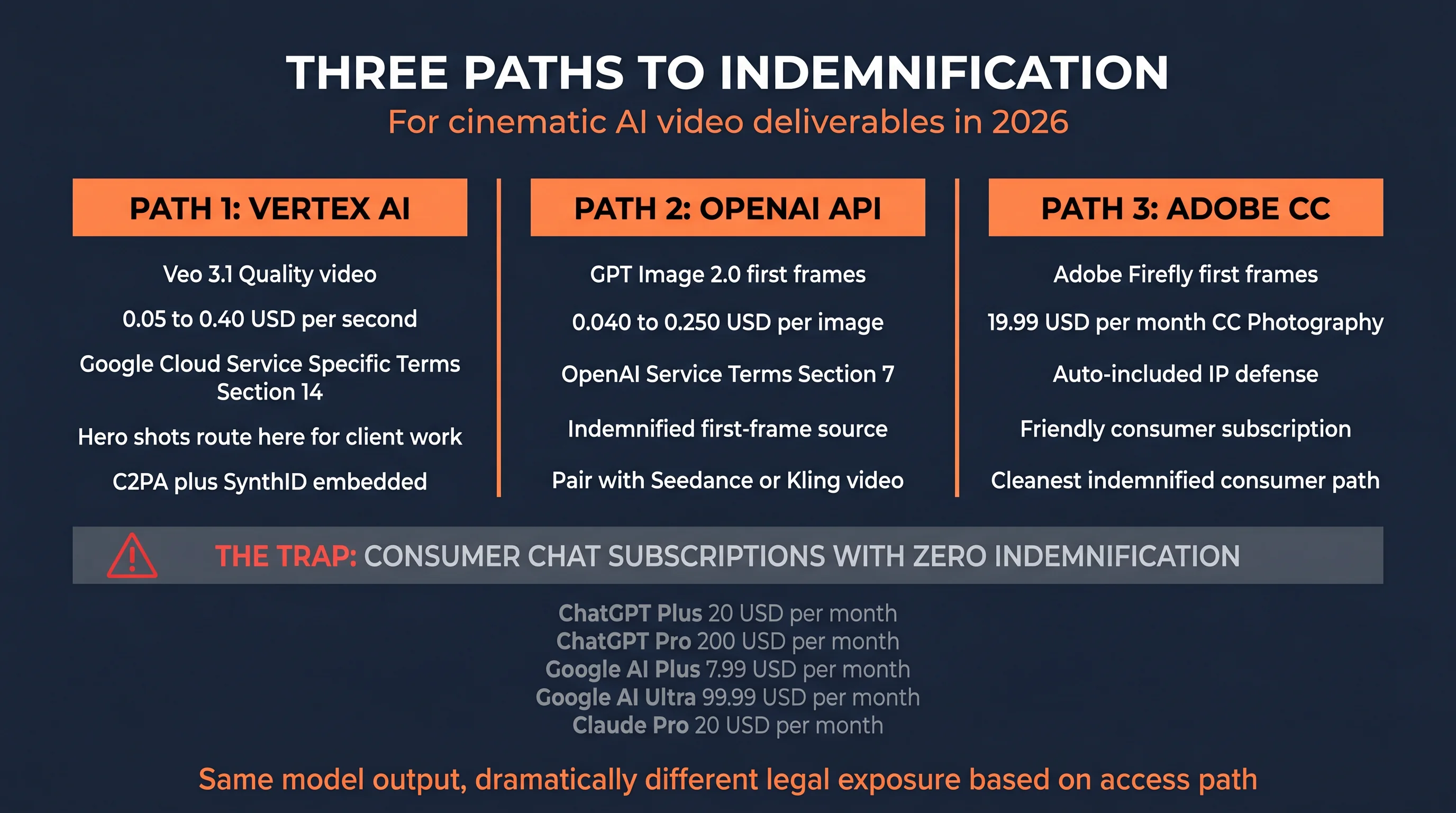
Three open paths:
- Adobe Firefly Creative Cloud Photography at 19.99 USD per month. The only major consumer chat-style subscription with auto-included IP defense. Useful as a fallback for image work but not directly applicable to the 5 video tools in this article.
- OpenAI API at 0.040 to 0.250 USD per image for first-frame generation. GPT Image 2.0 outputs via the API tier carry indemnification under OpenAI Service Terms Section 7.
- Google Vertex AI for Veo 3.1 video generation at 0.05 to 0.40 USD per second. Outputs carry indemnification under Google Cloud Service Specific Terms Section 14.
The trap: consumer chat subscriptions carry zero indemnification despite being the most common operator starting point. ChatGPT Plus at 20 USD per month, ChatGPT Pro at 200 USD per month, Google AI Plus at 7.99 USD per month, and Google AI Ultra at 99.99 USD per month all permit commercial use but do NOT defend the user if a third party files an IP claim.
Recommended operator workflow for client deliverables: route hero shots through Veo 3.1 Quality via Vertex AI for the indemnified path. Use Seedance / Kling / Hailuo / LTX for non-hero shots with awareness that indemnification is operator-carried on those tools. For the deepest indemnification analysis across the entire 2026 AI image and video market, see the AI Image Generators 2026 A-Z Encyclopedia compliance section.
FAQ
What is the best AI video model for cinematic camera motion in 2026?
There is no single winner. Seedance 2.0 leads on photoreal realism and dynamic action per the Curious Refuge February 2026 benchmark. Kling 3.0 Pro wins on rigid character consistency and exposes the deepest formal camera API surface with motion brush plus advanced_camera_control enums. Veo 3.1 Quality wins on native audio and cinematic stability via Google Vertex AI. Hailuo 02 Director offers the cheapest precise camera control via its square-bracket Director Toolkit grammar. LTX-2 wins on native 4K at 50fps and start-to-end frame chaining.
How do I prompt a dolly zoom or vertigo effect in AI video?
The dolly zoom requires the camera to push in while the lens zooms out, compressing the background behind a static subject. Seedance 2.0 produces the cleanest dolly zoom via natural language prompt: “dolly zoom, camera pushes in while the lens zooms out, background compresses behind the static subject, vertigo effect.” Veo 3.1 Q