
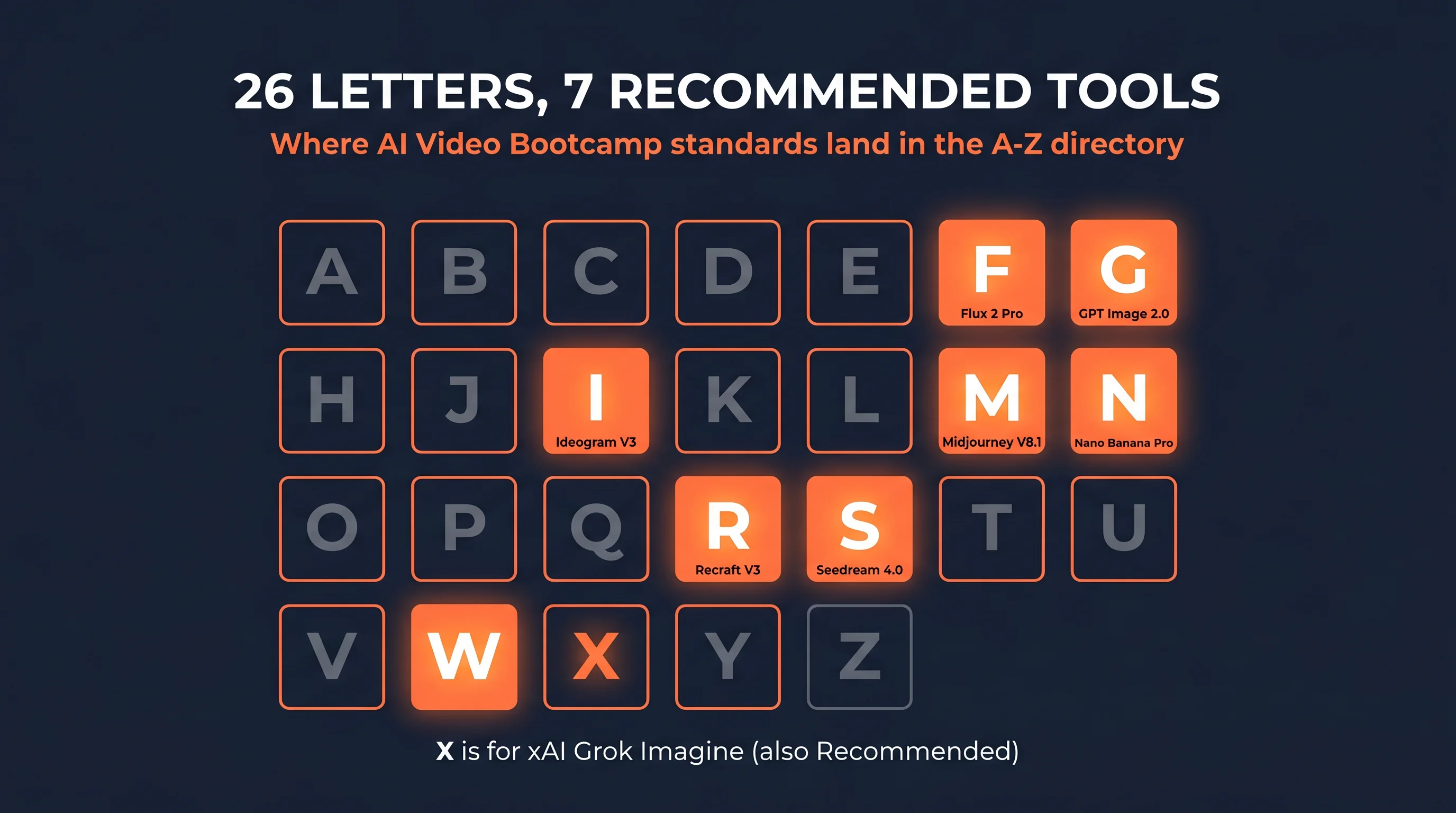
This is the definitive 2026 reference for every notable AI image generator and editor in the market. The full inventory tracks 108 active tools verified against vendor pricing pages between May 28 and June 1, 2026. Seven tools earn the AI Video Bootcamp Recommended badge for paying client work: GPT Image 2.0, Nano Banana Pro, Flux 2 Pro, Seedream 4.0, Midjourney V8.1, Recraft V3, and Ideogram V3. The single most underpublicized commercial finding in the entire market is that IP indemnification has three open paths and one big trap. The open paths are Adobe Firefly Creative Cloud at 19.99 USD per month, the OpenAI API at per-image pricing, and Google Vertex AI at per-image pricing. The trap is the default consumer chat subscription (ChatGPT Plus, ChatGPT Pro, Google AI Plus, Google AI Ultra), which carries zero indemnification despite being the most common starting point for AI Video Bootcamp members.
How to Use This Encyclopedia
Answer capsule. Each letter slot features the most prominent AI Video Bootcamp Recommended tool first, followed by notable non-recommended tools and a cross-letter pointer to the right alternative. Verification dates appear next to every pricing figure. The encyclopedia is updated monthly because the AI image market ships pricing changes weekly. Bookmark this URL and check the updated date in the header.
The encyclopedia uses four taxonomy tags applied to every entry. AI Video Bootcamp Recommended marks the seven tools the AI Video Bootcamp curriculum teaches and endorses for paying client work. Notable Non-Recommended marks legitimate tools (Adobe Firefly, Stability AI, Google Imagen 5, Claude Image Gen, Qwen-Image, Krea AI, Leonardo AI, Microsoft Designer) that AI Video Bootcamp covers factually but does not formally endorse in the curriculum. Legacy / Not Recommended marks tools (Higgsfield, Pika and others) that AI Video Bootcamp explicitly avoids, with a pivot to a True Model alternative on every mention. Niche / Vertical-Specific marks tools that serve narrow use cases (logo generators, architectural renderers, specific portrait apps).
The verification window is 60 days. Every pricing figure is verified against a primary vendor source dated within the last 60 days. The AI image market revises pricing weekly, so any pricing older than 60 days is presumed stale and re-verified during the monthly update cycle.
Best AI Image Generators in 2026 at a Glance
Answer capsule. Seven tools earn the AI Video Bootcamp Recommended badge in 2026: GPT Image 2.0 for photoreal portraits and conversational editing, Nano Banana Pro for product hero shots with logo persistence, Flux 2 Pro for prompt-adherent photorealism, Seedream 4.0 for batch multi-image generation, Midjourney V8.1 for aesthetic illustrative work, Recraft V3 for vector graphics and brand assets, and Ideogram V3 for text-heavy typography. Pricing ranges from 8 USD per month to 300 USD per month.
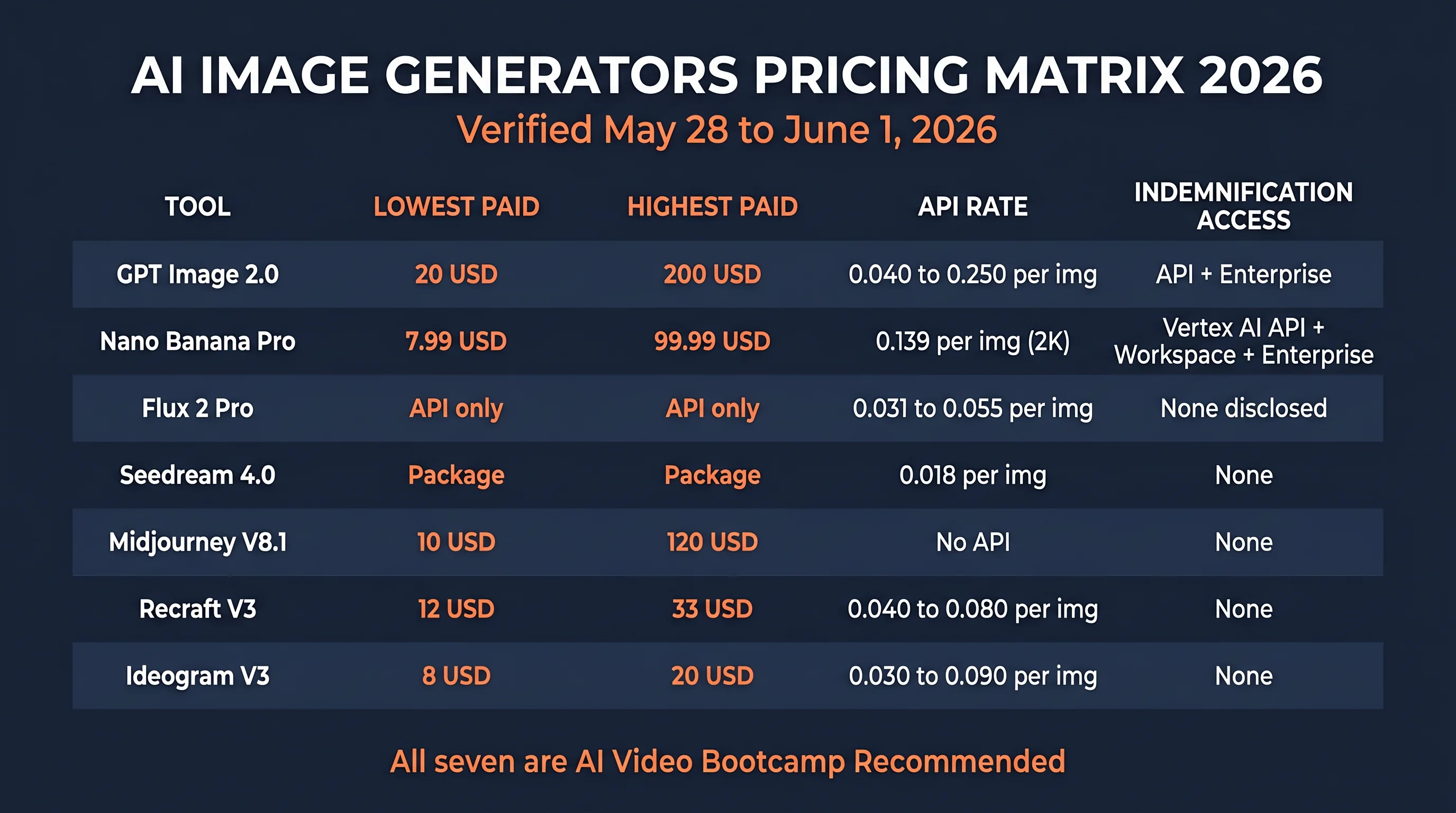
The master pricing table below covers the seven AI Video Bootcamp Recommended tools plus the most operationally important non-recommended tools. Every figure verified against the official vendor pricing page between May 28 and June 1, 2026.
| Tool | Vendor | Free tier | Lowest paid (USD/mo) | Highest paid (USD/mo) | API rate (USD/img) | Commercial | Indemnification |
|---|---|---|---|---|---|---|---|
| GPT Image 2.0 | OpenAI | Limited (ChatGPT free) | 20 (Plus) | 200 (Pro) | 0.040 to 0.250 | All paid | API + Enterprise only |
| Nano Banana Pro | 3/day in Gemini app | 7.99 (AI Plus) | 99.99 (AI Ultra) | 0.139 (2K), batch 50% off | All tiers | Vertex AI API + Workspace + Cloud Enterprise | |
| Nano Banana 2 | 3/day in Gemini app | Same as Pro tier ladder | Same | 0.039 (1K) | All tiers | Same as Pro | |
| Flux 2 Pro | Black Forest Labs | No | API only | API only | 0.031 via fal.ai, 0.055 via Replicate | API only | Not disclosed |
| Seedream 4.0 | ByteDance | Free trial | Package-based | Package-based | 0.018 | Paid | No |
| Midjourney V8.1 | Midjourney | No | 10 (Basic) | 120 (Mega) | No direct API | Paid only | No |
| Recraft V3 | Recraft AI | 30 generations/day | 12 (Basic) | 33 (Pro) | 0.040 (raster), 0.080 (vector) | All paid | No (reverse indemnity) |
| Ideogram V3 | Ideogram | Free tier | 8 (Basic) | 20 (Plus) | 0.030 (Turbo) to 0.090 (Quality) | All tiers | No |
| Adobe Firefly Image 5 | Adobe | Limited free | 19.99 (CC Photography) | 59.99 (CC All Apps) | Bundled with CC | Paid | Yes Creative Cloud + Enterprise |
| Imagen 5 | Via Google AI tiers | 7.99 (AI Plus) | 99.99 (AI Ultra) | 0.020 to 0.040 via Vertex AI | All tiers | Vertex AI API + Workspace + Cloud Enterprise | |
| Grok Imagine | xAI | 3/day via app | 8 (X Premium) | 300 (SuperGrok Heavy) | 0.020 to 0.070 | All paid | Enterprise only |
| Stable Diffusion 3.5 | Stability AI | Free open-weights | n/a (self-host) | n/a | ~0.045 via Replicate | Yes under $1M revenue | No |
| Claude Image Gen | Anthropic | Limited free | 20 (Claude Pro) | 200 (Claude Max) | Via Anthropic API | All paid | API + Enterprise only |
Three data points operators should internalize before picking a tool from this list. First, the cheapest reliable paid path to True Model image generation in 2026 is Ideogram V3 at 8 USD per month or Google AI Plus at 7.99 USD per month (which unlocks Nano Banana Pro). Second, the API price floor is 0.018 USD per image (Seedream 4.0) and the ceiling is 0.250 USD per image (GPT Image 2.0 quality tier), a 14x price differential within the True Model set. Third, indemnification has three open paths (Adobe Firefly Creative Cloud, OpenAI API, Google Vertex AI) and one trap (the default consumer chat subscription path), explained in the next section.
For the parallel video-tools breakdown of pricing, indemnification, and decision rules, see the Best AI Video Tools 2026 Tech Stack pillar. For the most up-to-date head-to-head image benchmark, see the GPT Image 2.0 vs Nano Banana Pro 10-prompt test.
Three Paths to Indemnification, One Big Trap
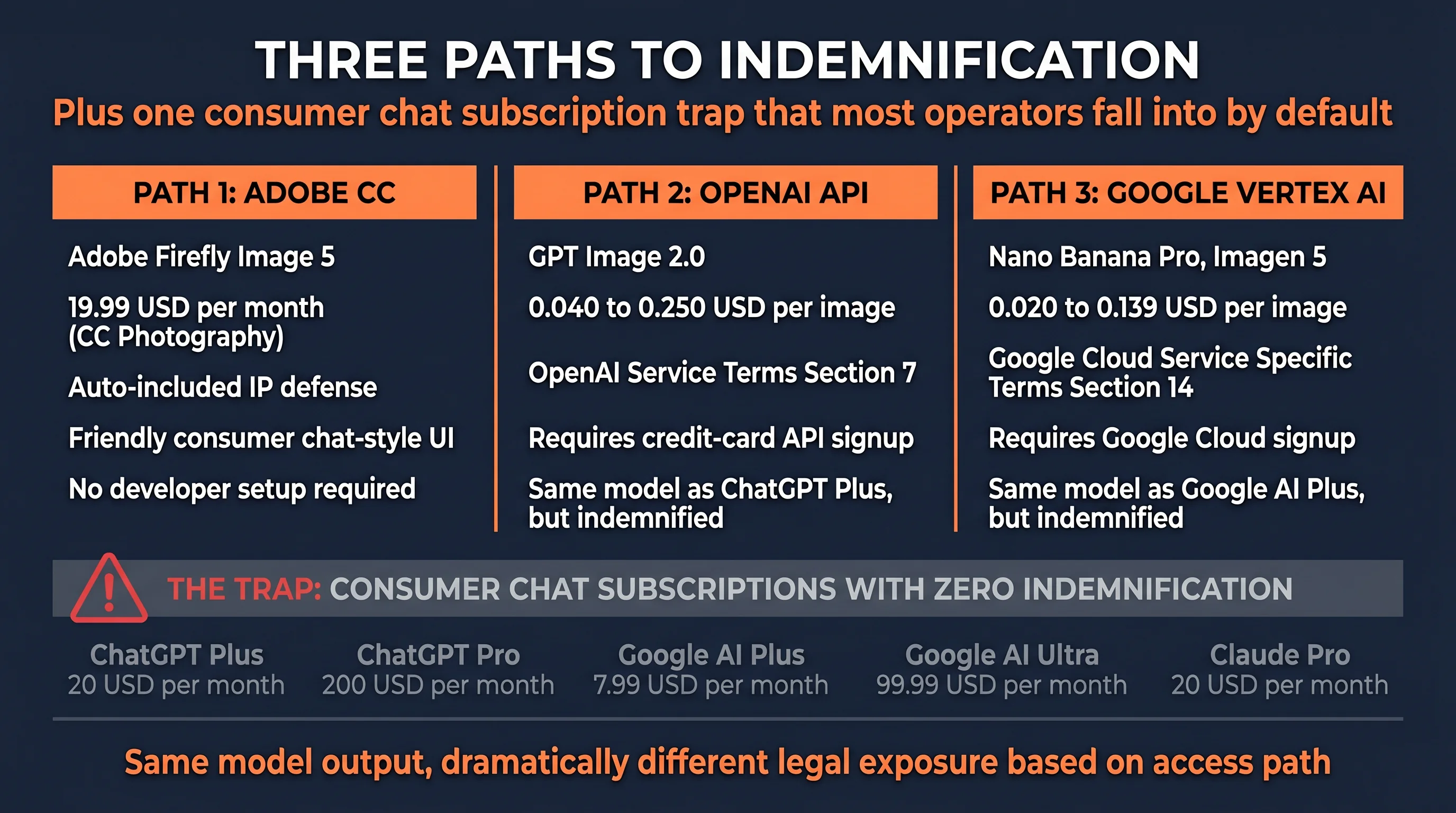
Answer capsule. IP indemnification is the single most underpublicized commercial finding in the 2026 AI image market, but the picture is more nuanced than “Adobe is the only path.” Three open paths get operators to indemnified outputs: Adobe Firefly Creative Cloud Photography at 19.99 USD per month (the only consumer chat-style subscription with auto-included IP defense), the OpenAI API at 0.040 to 0.250 USD per image, and Google Vertex AI at 0.020 to 0.040 USD per image. The trap is the default consumer chat subscription. ChatGPT Plus, ChatGPT Pro, Google AI Plus, and Google AI Ultra carry zero indemnification despite being the most common starting point.
This is the section that distinguishes the AI Video Bootcamp encyclopedia from every “best AI image generator” listicle on the SERP. Indemnification is not a marketing claim. It is a contractually binding commitment by the vendor to defend a customer in court if a generated output triggers a third-party copyright, trademark, or publicity claim. For AI Video Bootcamp members serving paying clients, the difference between “the tool I use defends me in court” and “the tool I use puts the risk on me personally” is the single most consequential commercial decision in the workflow.
The three open paths to indemnified outputs
| Path | Tool | Entry cost | Indemnified by | Best for |
|---|---|---|---|---|
| 1. Adobe Creative Cloud | Adobe Firefly Image 5 | 19.99 USD per month (CC Photography) | Adobe Terms of Use, all CC paid subscriptions | Operators who want a friendly consumer chat-style UI with auto-included IP defense, no developer setup |
| 2. OpenAI API | GPT Image 2.0 | 0.040 USD per image (low) to 0.250 USD per image (high) | OpenAI Service Terms Section 7 | Operators who want photoreal portraits and conversational editing quality at per-image pricing, willing to do credit-card API setup |
| 3. Google Vertex AI | Nano Banana Pro, Imagen 5 | 0.020 USD per image (Imagen Fast) to 0.139 USD per image (Nano Banana Pro 2K) | Google Cloud Service Specific Terms Section 14 | Operators who want product hero shots with logo persistence, willing to do Google Cloud signup |
The consumer chat subscription trap
Five subscription products that look like the right operator choice but carry zero indemnification:
| Subscription | Monthly cost | What it unlocks | Indemnification |
|---|---|---|---|
| ChatGPT Plus | 20 USD | GPT Image 2.0 in ChatGPT UI | None |
| ChatGPT Pro | 200 USD | GPT Image 2.0 plus other Pro features | None |
| Google AI Plus | 7.99 USD | Nano Banana Pro in Gemini app | None |
| Google AI Ultra | 99.99 USD | Nano Banana Pro plus Veo 3.1 in Gemini app | None |
| Claude Pro | 20 USD | Claude Image Gen in Claude UI | None |
This is the trap because the same model that is indemnified via the API or Vertex AI is NOT indemnified when accessed via the consumer chat subscription. An operator using GPT Image 2.0 via ChatGPT Plus and an operator using GPT Image 2.0 via the OpenAI API are using the same model, but only the API operator is defended in court if an output triggers a third-party claim.
The operator math behind the three paths
If a member generates 100 images per month for paying client work, the OpenAI API at the mid-quality 0.139 USD tier costs about 14 USD per month and includes indemnification, which is cheaper than ChatGPT Plus at 20 USD per month and indemnified. At 500 images per month, the API path costs about 70 USD per month, still cheaper than the indemnified Adobe Creative Cloud Photography subscription at 19.99 USD per month only if image generation is the only deliverable type. Adobe makes more economic sense the moment the operator also needs Photoshop, Lightroom, or InDesign for the same client work.
The full compliance matrix
| Tool | Commercial Use | Indemnification access tier | C2PA default | SynthID watermark | EU AI Act Art. 50 |
|---|---|---|---|---|---|
| Adobe Firefly Image 5 | Paid Creative Cloud | All Creative Cloud paid plans | Yes | No (uses C2PA only) | Compliant |
| GPT Image 2.0 | All paid tiers | API + Enterprise (NOT Plus/Pro) | Yes | Yes (added May 2026) | Compliant |
| Nano Banana Pro | All tiers | Vertex AI API + Workspace + Cloud Enterprise (NOT Google AI Plus/Ultra) | Yes | Yes (SynthID always-on) | Compliant |
| Imagen 5 | All tiers | Vertex AI API + Workspace + Cloud Enterprise | Yes | Yes (SynthID) | Compliant |
| Claude Image Gen | All paid tiers | API + Enterprise (NOT Claude Pro/Max) | Yes | No | Compliant |
| Microsoft Designer | Paid M365 | Microsoft 365 Enterprise only | Yes | No | Compliant |
| Magic Studio (Canva) | All tiers | Canva Shield (Enterprise 100+ seats) | Optional | No | Pending |
| Flux 2 Pro | API only | Not disclosed | Optional | No | Pending |
| Seedream 4.0 | Paid | No | Not disclosed | No | Unclear |
| Midjourney V8.1 | Paid only | No | No | No | Pending |
| Recraft V3 | All paid | No (reverse indemnity) | Optional | No | Pending |
| Ideogram V3 | All tiers | No | No | No | Pending |
| Grok Imagine | Paid | Enterprise only | No | No | Unclear |
| Stable Diffusion 3.5 | Under 1M USD rev | No | No | No | Operator responsibility |
Three specific operator findings
Finding 1: The ChatGPT Plus indemnification gap. OpenAI Service Terms Section 7 (verbatim, verified May 2026 against openai.com/policies/service-terms): “OpenAI will defend the customer from and against any actual or threatened third-party claim that the customer’s use or distribution of Output infringes a third party’s intellectual property right, and will indemnify the customer for amounts finally awarded by a court of competent jurisdiction.” This language applies to the OpenAI API (any developer with a credit card) and to ChatGPT Enterprise / Team plans. It does NOT apply to ChatGPT Plus or ChatGPT Pro consumer chat subscriptions. An AI Video Bootcamp member running paying client work through a personal ChatGPT Plus account is NOT covered. The fix is straightforward: migrate the same workflow to the OpenAI API and the same model output now carries indemnification.
Finding 2: The Google Vertex AI vs Gemini consumer split. Google Cloud Service Specific Terms Section 14 covers Vertex AI image generation outputs against third-party IP claims for any Google Cloud customer (any developer with a credit card on Google Cloud), plus Google Workspace and Google Cloud Enterprise customers. Consumer Gemini, Google AI Plus, and Google AI Ultra do NOT carry indemnification. The Nano Banana Pro consumer subscriber at 7.99 USD per month gets the same generation quality as the Vertex AI API caller, but no legal defense. The same fix applies: route through Vertex AI directly and the same model output now carries indemnification.
Finding 3: Adobe’s unique consumer-subscription indemnification. Adobe is the only major vendor whose consumer chat-style subscription (Creative Cloud Photography at 19.99 USD per month) auto-includes IP defense with no developer or API setup required. Adobe trains Firefly exclusively on licensed Adobe Stock, openly licensed work, and public-domain material, which lets them offer this without the same exposure as competitors trained on web-scraped data. For AI Video Bootcamp members who want a friendly consumer chat-style UI plus IP defense in one bundle, Adobe Creative Cloud is the only path that does not require migrating to an API.
For deeper AI Video Bootcamp coverage of the broader compliance landscape including C2PA, SynthID, and EU AI Act Article 50 timing, see AI Disclosure Compliance 2026: C2PA and EU AI Act Guide.
Active litigation status
Five tools have active litigation that AI Video Bootcamp members should track before deploying for client work. Midjourney V8.1 is co-defendant in Disney plus Universal Studios suit filed June 2025 (Case No. 2:25-cv-05275, C.D. Cal.), currently in active discovery. Stability AI faces the ongoing Andersen v. Stability et al. US class action, and the Getty Images UK case ruled mostly in favor of Stability in November 2025 on the central training-data infringement claim. OpenAI has the NYT and Authors Guild suits pending with image-side adjacent exposure. Runway is a co-defendant in Andersen v. Stability. Luma faces tangential pressure from RIAA-aligned music-label litigation.
When to Use Which Tool: Decision Matrices
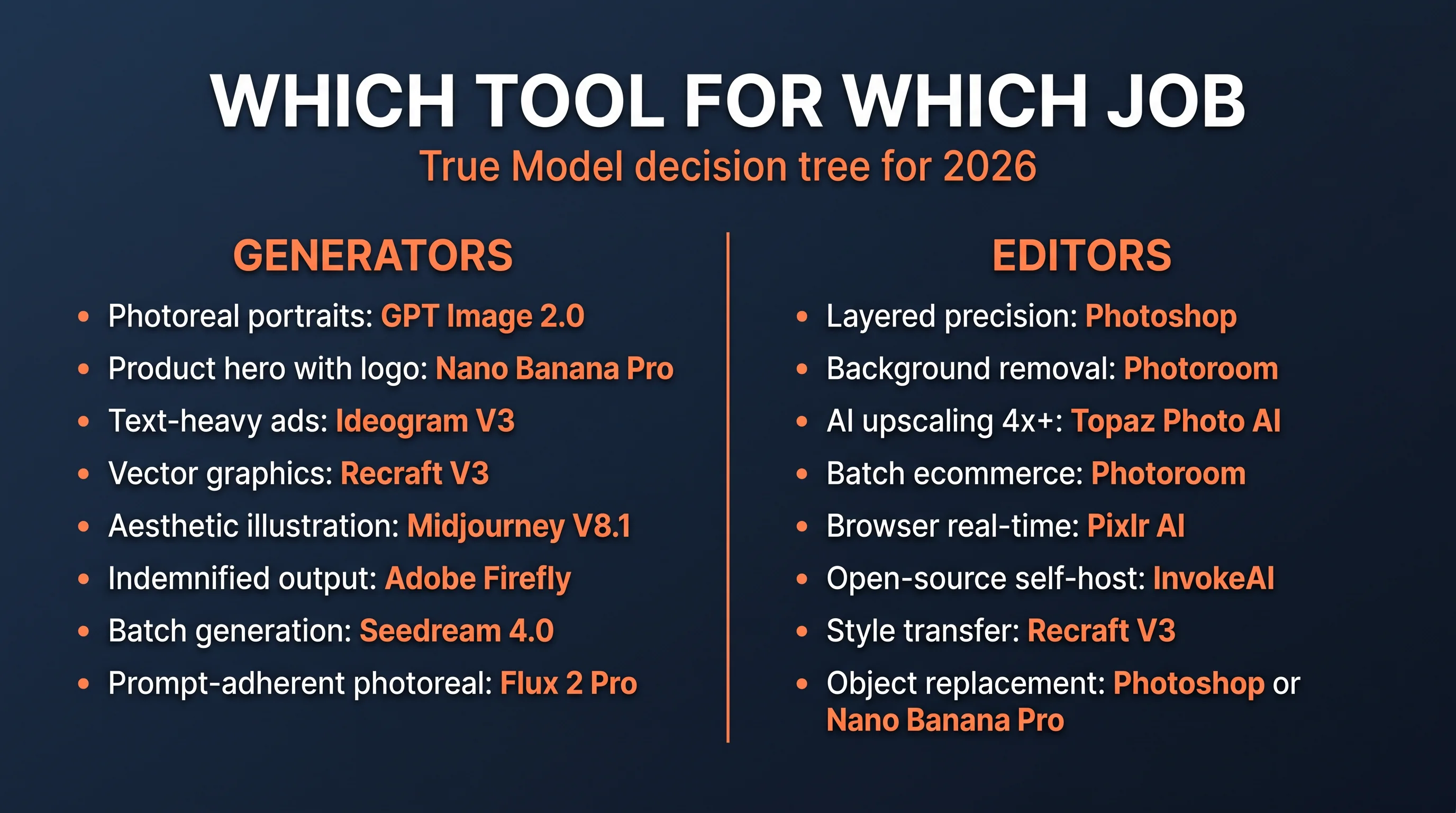
Answer capsule. For generators: use GPT Image 2.0 for photoreal portraits and conversational editing, Nano Banana Pro for product hero shots with logo persistence, Flux 2 Pro for prompt-adherent photorealism, Ideogram V3 for text-heavy ads, Recraft V3 for vector graphics, Midjourney V8.1 for aesthetic work, and Adobe Firefly when indemnification is non-negotiable. For editors: use Photoshop Generative Fill for layer-based precision, Photoroom for ecommerce batch editing, and Topaz Photo AI for AI upscaling above 4x.
Generators decision matrix
| Use case | First pick | Second pick | Third pick |
|---|---|---|---|
| Photoreal portraits | GPT Image 2.0 | Nano Banana Pro | Flux 2 Pro |
| Product hero with logo persistence | Nano Banana Pro | Flux 2 Pro | Seedream 4.0 |
| Text-heavy ads and typography | Ideogram V3 | Recraft V3 | GPT Image 2.0 |
| Illustrative artwork and aesthetic | Midjourney V8.1 | Flux 2 Pro | Seedream 4.0 |
| Vector graphics and SVG | Recraft V3 | Adobe Firefly Vector | (no third pick) |
| Brand-consistent multi-image batches | Recraft V3 | Nano Banana Pro | Seedream 4.0 |
| Non-Latin script accuracy | Nano Banana Pro | Qwen-Image 2.0 | GPT Image 2.0 |
| Public-figure-safe outputs (strict refusal) | Adobe Firefly | Imagen 5 | GPT Image 2.0 |
| Real-time iteration on canvas | Nano Banana Pro | Grok Imagine (mobile) | Krea AI (non-recommended) |
| Open weights and self-host | Flux 2 Dev | Stable Diffusion 3.5 | Qwen-Image 2.0 |
Editors decision matrix
| Use case | First pick | Second pick | Third pick |
|---|---|---|---|
| Precision inpainting with layers | Photoshop (Generative Fill) | Nano Banana Pro | GPT Image 2.0 |
| Background removal at scale | Photoroom | Remove.bg | Magic Studio (Canva) |
| AI upscaling 4x and above | Topaz Photo AI | Recraft V3 upscaling API | Upscayl (open-source) |
| Batch editing for ecommerce | Photoroom | Cutout.pro | Magic Studio |
| Style transfer | Recraft V3 | Magic Studio | Krea AI (non-recommended) |
| Object replacement | Photoshop | Nano Banana Pro | GPT Image 2.0 |
| Real-time browser editing | Photopea + AI plugins | Pixlr AI | Magic Studio |
| Lightroom workflow integration | Luminar Neo | Imagen AI (cataloguing) | Topaz Photo AI |
| Open-source self-host editor | InvokeAI | ComfyUI | Krita AI plugins |
The A-to-Z Directory
The 26-letter directory body. Each letter features the most prominent AI Video Bootcamp Recommended tool first, followed by other tools in that slot and a cross-letter pointer.
A is for Adobe Firefly Image 5
Featured tool: Adobe Firefly Image 5. Notable Non-Recommended (in the AI Video Bootcamp taxonomy because Firefly is not on the True Models list, but it earns special-case mention for its unique indemnification position). Released May 2026 as part of Adobe Creative Cloud. Pricing: 19.99 USD per month (CC Photography) to 59.99 USD per month (CC All Apps). The only major image tool that auto-includes IP indemnification in a consumer chat-style subscription with no API or developer setup required. Verdict: the right choice for AI Video Bootcamp members who want a friendly subscription UI plus IP defense in one bundle. Operators willing to do API setup can also get indemnification via the OpenAI API or Google Vertex AI at per-image pricing. Other tools in this slot: Affinity Photo 2 (Canva-acquired, free as of 2025, niche pro editor). Cross-letter pointer: if you want unconstrained artistic generation without corporate safety rails, try Midjourney V8.1 (M).
B is for Black Forest Labs (Flux)
Featured tool: Black Forest Labs lineup. Black Forest Labs ships the Flux 2 family which is covered in detail under F. Black Forest Labs closed a 300 million USD Series B at 3.25 billion USD valuation in December 2025, cementing the Stable Diffusion successor positioning. Other tools in this slot: Bing Image Creator (Microsoft, free, casual use), Brainpod AI (marketing aggregator, notable non-recommended), ByteDance Seedream lineage (covered under S). Cross-letter pointer: if you want the actual Flux model specs and pricing, go to F.
C is for Claude Image Gen
Featured tool: Claude Image Gen. Notable Non-Recommended. Anthropic launched conversational image generation inside Claude in March 2026. Pricing: included in Claude Pro at 20 USD per month, Claude Max at 200 USD per month. Strong on conversational ideation and integration with Anthropic’s broader chat workflow, weaker than GPT Image 2.0 or Nano Banana Pro on raw photoreal quality. Other tools in this slot: Canva AI Image (Magic Studio, notable non-recommended for collaborative team workflows), ComfyUI (open-source node-based pipeline, niche). Cross-letter pointer: if you want layered design assets that route to traditional design software, try Recraft V3 (R).
D is for DALL-E 3 (Legacy)
Featured note: DALL-E 3 deprecated May 12, 2026. OpenAI hard-deprecated DALL-E 3 in favor of GPT Image 2.0. Operators should migrate all legacy API workflows to GPT Image 2.0 for improved photorealism, text accuracy, and conversational editing. Cross-letter pointer: for the modern OpenAI image stack, go to G (GPT Image 2.0).
E is for ElevenLabs (Cross-Stack Audio Companion)
Featured note: ElevenLabs is the True Model audio companion to the image stack. Not an image tool, but every serious AI image plus video workflow uses ElevenLabs for voice generation, dialogue, and voice cloning. Creator tier at 22 USD per month covers most AI Video Bootcamp member workflows. Cross-letter pointer: for instrumental music to pair with ElevenLabs voice, use CassetteAI (covered in the AI Video Bootcamp Tech Stack pillar).
F is for Flux 2 Pro
Featured tool: Flux 2 Pro. AI Video Bootcamp Recommended. Released November 2025 by Black Forest Labs. API-only access, no consumer subscription tier. Pricing: 0.031 USD per image via fal.ai or 0.055 USD per image via Replicate, a 43 percent cost differential for the same model output. The cheaper fal.ai routing is the recommended path. Excellent prompt adherence, strong photorealism, permissive on logos and public figures (operator-side legal responsibility). C2PA optional, no SynthID, no IP indemnification. Verdict: the production-grade engine for operators who need prompt-faithful photoreal output at API scale. Other tools in this slot: Flux 2 Dev (open-weights, self-host with separate commercial license required above non-commercial use), Flux Schnell (Flux 1 lineage, free open-source fast tier), Freepik (now houses Magnific, platform aggregator), fal.ai (API middleware). Cross-letter pointer: if you want corporate IP indemnification on your generated outputs, three paths work: Adobe Firefly Creative Cloud (A), the OpenAI API (G), or Google Vertex AI (G/N).
G is for GPT Image 2.0
Featured tool: GPT Image 2.0. AI Video Bootcamp Recommended. Released April 2026 by OpenAI as the successor to DALL-E 3. Pricing: 20 USD per month (ChatGPT Plus) to 200 USD per month (ChatGPT Pro). API rate 0.040 USD per image (low quality) to 0.250 USD per image (high quality). Excellent photorealism, excellent text rendering, strict refusal on real public figures and trademarks. C2PA embedded by default, plus SynthID added May 2026 when OpenAI joined the C2PA steering committee. Critical operator point: API and Enterprise tiers carry IP indemnification, ChatGPT Plus and Pro consumer tiers do NOT. Verdict: the daily workhorse for AI Video Bootcamp members building practical business assets, provided the operator manages the model’s warm default aesthetic with explicit negative prompting. Other tools in this slot: Grok Imagine (xAI, AI Video Bootcamp Recommended, covered under X), Gemini Omni (Google omnimodal, AI Video Bootcamp Recommended, image generation as part of video pipeline), Google Imagen 5 (notable non-recommended, photorealistic search-grade output via Vertex AI). For the deepest head-to-head image-quality comparison between GPT Image 2.0 and Nano Banana Pro across 10 prompts, see the GPT Image 2.0 vs Nano Banana Pro 10 Prompts Tested article. Cross-letter pointer: if you want vector graphics that route to design software, try Recraft V3 (R).
H is for Hailuo 02
Featured tool: Hailuo 02. AI Video Bootcamp Recommended. MiniMax product, primarily a video model but generates cinematic stills as part of the image-to-video pipeline. Pricing: 9.99 USD per month (1,000 credits) to 199.99 USD per month (20,000 credits). Strong for cinematic motion and stills, native audio support on video output, no indemnification. Other tools in this slot: Higgsfield. Legacy / not recommended by AI Video Bootcamp. Operators requiring cinematic stills with logo persistence should pivot to Nano Banana Pro (N). Operators requiring cinematic video should pivot to Veo 3.1 (V) or Kling 3.0 (K).
I is for Ideogram V3
Featured tool: Ideogram V3. AI Video Bootcamp Recommended. Released March 2025 by Ideogram. Pricing: free tier with standard limits, 8 USD per month (Basic) to 20 USD per month (Plus). API rate 0.030 USD per image (Turbo) to 0.090 USD per image (Quality). Industry-leading text rendering accuracy at approximately 95 percent across complex multi-line layouts, the only major model that handles dense typography natively without post-generation Photoshop correction. C2PA embedded by default, no SynthID, no IP indemnification. Permissive trademark and public-figure policy (operator legal responsibility). Verdict: the mandatory tool for AI Video Bootcamp members generating social media graphics, t-shirt designs, posters, and marketing assets where readable typography is the load-bearing requirement. Other tools in this slot: Imagen 5 (Google, notable non-recommended, photoreal generation via Vertex AI), Imagen 4 (older Google tier), InvokeAI (open-source self-host editor canvas). Cross-letter pointer: if you want raw photorealism without text-heavy requirements, try Nano Banana Pro (N).
J is for Janus Pro
Featured tool: Janus Pro. Niche / Vertical-Specific. Open-weights architectural model from DeepSeek. Active in the research community but not a production tool for AI Video Bootcamp members. Cross-letter pointer: for production-ready open-weights workflows, try Flux 2 Dev (F) or Stable Diffusion 3.5 (S).
K is for Kling 3.0
Featured tool: Kling 3.0. AI Video Bootcamp Recommended. Kuaishou product, primarily a video model but uses image conditioning extensively for image-to-video workflows. Pricing: 6.99 USD per month (Standard, 660 credits) to 29.99 USD per month (Pro, 3,000 credits). API rate 0.084 USD per second (Standard) to 0.112 USD per second (Pro) via fal.ai. Strong for image-to-video bridging where the start frame is a photoreal still. Permissive policies. Verdict: the workhorse for AI Video Bootcamp members converting still images into vertical short-form video. Other tools in this slot: Krea AI (notable non-recommended, real-time canvas with 64+ model bundle), Krita AI plugins (open-source). Cross-letter pointer: for the still-image step that feeds Kling 3.0, use Nano Banana Pro (N).
L is for LTX-2
Featured tool: LTX-2. AI Video Bootcamp Recommended. Lightricks product, video model with image-conditioning start-frame support. Pricing: 15 USD per month (Lite, 8K credits) to 125 USD per month (Pro, 110K credits). API rate 0.06 USD per second (Fast) to 0.10 USD per second (Pro). Native 4K at 50 fps. Cheap per-second rate makes it the budget-arbitrage choice for B-roll generation. Other tools in this slot: Looka (logo generation, niche), Leonardo AI (Canva-acquired, notable non-recommended, LoRA marketplace and game art), Lexica Aperture (searchable gallery niche). Luma. Legacy / not recommended by AI Video Bootcamp. Operators requiring cinematic stills with strict physical accuracy should pivot to Nano Banana Pro (N) or for video to Veo 3.1 (V).
M is for Midjourney V8.1
Featured tool: Midjourney V8.1. AI Video Bootcamp Recommended. Released May 2026 by Midjourney as the next-generation aesthetic engine. Pricing: 10 USD per month (Basic), 30 USD per month (Standard), 60 USD per month (Pro), 120 USD per month (Mega). No official API (operators automate via unofficial wrappers or manual generation). Aesthetic excellence on illustrative artwork, mood boards, concept art, painterly composition. Permissive policies. No C2PA, no SynthID, no indemnification, active litigation from Disney + Universal Studios (Case 2:25-cv-05275, C.D. Cal.). Operator-known weakness: V7 had poor text rendering; V8.1 improved to fair. Verdict: the unrivaled engine for aesthetic exploration when typography is not required and when the deliverable is not headed into legal review. Operators concerned about Disney litigation should consider Adobe Firefly or Flux 2 Pro alternatives for client work. Other tools in this slot: Microsoft Designer (M365-bundled, notable non-recommended), Magnific (acquired by Freepik April 2026, now part of Freepik bundled offering), Meta AI (social-integrated, notable non-recommended). For the deepest AI Video Bootcamp Midjourney coverage, see the Midjourney Complete Guide 2026. Cross-letter pointer: if you want an API for automated generation, try Flux 2 Pro (F).
N is for Nano Banana Pro
Featured tool: Nano Banana Pro. AI Video Bootcamp Recommended. Google product (Gemini 3 Pro Image), released November 2025. Pricing: free 3 generations per day via the Gemini app, 7.99 USD per month (Google AI Plus) to 99.99 USD per month (Google AI Ultra). API rate 0.139 USD per 2K image with a 50 percent batch discount when using the Nano Banana Batch API (effective rate 0.069 USD per 2K image). Industry-leading multi-image fusion, character consistency, and product logo persistence. C2PA and SynthID embedded by default at pixel level. EU AI Act Article 50 compliant by default. Workspace and Cloud Enterprise tiers carry indemnification; consumer Gemini and Google AI Pro do NOT. Operator-known weakness: tends to over-smooth skin textures unless explicitly prompted for film grain. Verdict: the dominant model for product photography, character consistency across multi-image batches, and any deliverable requiring SynthID provenance signal. Other tools in this slot: Nano Banana 2 (cheaper sibling at 0.039 USD per 1K image), NightCafe (notable non-recommended aggregator), NovelAI (niche anime). For the deepest AI Video Bootcamp Nano Banana Pro coverage, see the Nano Banana Pro Complete Guide 2026. Cross-letter pointer: if you want vector graphics with brand consistency, try Recraft V3 (R).
O is for OpenAI Pipeline (Topic Entry)
Featured topic: OpenAI’s ecosystem dominance is the strategic story of 2026 image generation. OpenAI’s continued lead in conversational AI image work relies entirely on embedding image generation directly into the existing ChatGPT chat workflow rather than forcing users into separate image platforms. The April 2026 launch of GPT Image 2.0 inside ChatGPT, combined with the May 2026 SynthID + C2PA dual-signature compliance posture, gives OpenAI the strongest combined “ease of use plus compliance” position in the market. Cross-letter pointer: for the actual OpenAI image model and spec card, go to G (GPT Image 2.0).
P is for Photoshop Generative Fill
Featured tool: Photoshop with Generative Fill. Notable Non-Recommended (in the AI Video Bootcamp taxonomy because Photoshop sits outside the True Models list but earns special-case coverage as the industry-standard layered editor). Powered by Adobe Firefly model. Pricing: 19.99 USD per month (CC Photography) to 59.99 USD per month (CC All Apps). The only AI image editor with full layer-based precision editing, professional masking, and indemnified outputs inherited from Firefly. Verdict: the mandatory editor for AI Video Bootcamp members doing layered composite work on client deliverables. Other tools in this slot: Photoroom (ecommerce batch editor, 12.99 USD per month, no indemnification but strong on bulk product editing), Pixelmator Pro (Apple-acquired, macOS native), Pixlr AI (browser editor with generative fill). Pika. Legacy / not recommended by AI Video Bootcamp. Operators requiring stylized visual generation should pivot to Midjourney V8.1 (M). Pixverse. Legacy / not recommended by AI Video Bootcamp. Operators requiring anime or stylized casual visuals should pivot to NovelAI (N) for anime specifically.
Q is for Qwen-Image 2.0
Featured tool: Qwen-Image 2.0. Notable Non-Recommended. Alibaba product, released February 2026 under Apache 2.0 open-weights license. Took the AI Arena #1 spot for text-to-image on February 10, 2026 and held it. Free via providers, 0.025 USD per image typical hosted rate. Strongest non-Latin script rendering (Chinese, Japanese, Korean) in the open-weights segment. Verdict: the leading open-weights challenger to Flux 2 Dev for AI Video Bootcamp members building self-hosted pipelines. Other tools in this slot: Qwen-Image-2512 (sibling open-source variant). Cross-letter pointer: for the most production-grade open-weights tool, try Flux 2 Dev (F).
R is for Recraft V3
Featured tool: Recraft V3. AI Video Bootcamp Recommended. Released May 7, 2026 by Recraft AI. Pricing: free tier (30 generations per day), 12 USD per month (Basic) to 33 USD per month (Pro). API rate 0.040 USD per raster image or 0.080 USD per vector SVG. The only major True Model that outputs true scalable SVG vectors natively. Excellent text rendering, permissive policies, C2PA optional, no indemnification (with a reverse-indemnity clause that pushes Article 50 responsibility to the user, AI Video Bootcamp members must read this clause before client deployment). Verdict: the mandatory tool for AI Video Bootcamp members producing logos, brand icons, SVG illustrations, and print-ready vector assets. Other tools in this slot: Recraft V4 Pro (newer raster sibling), Replicate (API middleware aggregator), Reve Image (penny-per-image budget niche). Runway. Legacy / not recommended by AI Video Bootcamp. Operators requiring cinematic video generation should pivot to Veo 3.1 (V) or Kling 3.0 (K). Operators requiring image-only generation should pivot to Flux 2 Pro (F).
S is for Seedream 4.0
Featured tool: Seedream 4.0. AI Video Bootcamp Recommended. Released September 2025 by ByteDance with the 4.5 variant released March 2026 and a 5.0 variant reportedly in February 2026 (verify against the live ByteDance Seed pricing page before client deployment). Pricing: free trial, package-based subscription pricing, 0.018 USD per image API rate (4.0) or 0.030 USD per image (4.5). Strongest batch generation in the True Model set, capable of nine coherent storyboard images simultaneously. Good text rendering, inconsistent policies, C2PA embedded by default, no indemnification. Verdict: the fastest path for AI Video Bootcamp members generating multi-image variations, paid-ad creative at batch scale, or coherent storyboard sequences.
Sibling spotlight: Seedance 2.0. Seedance 2.0 is the AI Video Bootcamp Recommended ByteDance video sibling and currently the #1 video model for photoreal realism in 2026, ranked above Veo 3.1 Quality and Kling 3.0 Pro on community realism benchmarks. The Seedream + Seedance combination is the only ByteDance image-and-video pair where both siblings are top-tier in their category, making it the most cohesive single-vendor stack for operators producing photoreal still and motion deliverables together. For the full Seedance video specs, pricing, and head-to-head ranking, see the Best AI Video Tools 2026 Tech Stack pillar.
Other tools in this slot: Stable Diffusion 3.5 (Stability AI, notable non-recommended open-weights), Sora (OpenAI, notable non-recommended video model with image generation), SDXL (Stability AI, legacy open-weights). Cross-letter pointer: if you want precision typographic control on single images, try Ideogram V3 (I).
T is for Topaz Photo AI
Featured tool: Topaz Photo AI. Notable Non-Recommended (in the AI Video Bootcamp taxonomy because Topaz is a specialized editor outside the True Models list). The industry-standard AI upscaler. Pricing: historically 199 USD one-time perpetual license, transitioning to Topaz Studio subscription with perpetual licenses ending October 3, 2026. Strongest 4x-and-above upscaling output in the market, plus AI noise reduction and sharpening. Verdict: the mandatory tool for AI Video Bootcamp members preparing print-ready or 4K-deliverable assets from lower-resolution AI generations. Other tools in this slot: TESS AI (team collaboration, notable non-recommended platform). Cross-letter pointer: for AI generators that natively output 4K and reduce the upscaling step, try GPT Image 2.0 (G) Pro tier or Nano Banana Pro (N).
U is for Upscalers (Topic Entry)
Featured topic: Upscaling is a distinct workflow step. Operators should pair aesthetic generation tools (Midjourney V8.1) with dedicated upscalers (Topaz Photo AI, Magnific now Freepik, Recraft V3 upscaling API, Upscayl free open-source). The native resolution of most True Model generators is 2K to 4K; for print or large-format display, dedicated upscaling adds the final 4x to 8x. Cross-letter pointer: for the primary upscaler, see T (Topaz Photo AI).
V is for Veo 3.1
Featured tool: Veo 3.1. AI Video Bootcamp Recommended. Google’s premier video model with image-frame conditioning. Pricing: 19.99 USD per month (Google AI Pro) to 99.99 USD per month (Google AI Ultra). API rate 0.05 USD per second (Lite) to 0.40 USD per second (Quality) via Vertex AI. SynthID always-on. C2PA support. Workspace + Cloud Enterprise indemnification. Verdict: the cinematic standard for AI Video Bootcamp members producing 1080p polished client deliverables. Other tools in this slot: Veras (architectural rendering niche from EvolveLAB). For the detailed Veo 3.1 Lite pricing breakdown, see Veo 3.1 Lite: Google’s Cheapest AI Video Model 2026.
W is for Wan 2.7
Featured tool: Wan 2.7. AI Video Bootcamp Recommended. Alibaba product released April 2026. First and last frame control plus 9-grid image input for storyboard work. Open-weights with commercial license. Other tools in this slot: Writesonic AI (notable non-recommended marketing-bundled image gen). Cross-letter pointer: for the closely related open-weights image-only tool, try Qwen-Image 2.0 (Q).
X is for xAI Grok Imagine
Featured tool: Grok Imagine. AI Video Bootcamp Recommended. Released May 2026 by xAI. Pricing: free 3 per day via the Grok app, 8 USD per month (X Premium) to 300 USD per month (SuperGrok Heavy). SuperGrok at 30 USD per month is the recommended standalone path. API rate 0.020 USD to 0.070 USD per image, plus 0.05 to 0.07 USD per second of video. The only top-tier image plus video model with first-party publishing into a 600 million plus MAU social network in the same app session, ships prompt-to-published-X-post in 90 to 180 seconds for video. No C2PA or SynthID embedded by default, no indemnification on consumer tiers (Enterprise Customer Agreement does indemnify). The exact safety filter refusal text on flagged prompts is “Image is moderated.” For the complete AI Video Bootcamp Grok Imagine pillar, see Grok Imagine Complete Guide 2026. Cross-letter pointer: if you want SynthID provenance on outputs, try GPT Image 2.0 (G) or Nano Banana Pro (N).
Y is for Y-Axis Outpainting (Topic Entry)
Featured topic: Y-axis outpainting extends an image vertically beyond its original canvas. The True Models with the strongest outpainting capability are Nano Banana Pro (Y) and Adobe Firefly Image 5 (A). Both preserve the original geometry and lighting in the extended canvas, which Midjourney V8.1 struggles to do without seam artifacts. Cross-letter pointer: for the cleanest outpainting workflow, use Nano Banana Pro (N) or Adobe Firefly (A).
Z is for Zero-Shot Generation (Topic Entry)
Featured topic: Zero-shot generation is the ultimate test of an AI image model’s world knowledge. Zero-shot refers to the ability to generate highly specific complex scenes from a single text prompt without reference images, LoRA fine-tuning, or workflow chaining. Flux 2 Pro currently leads the True Model set in zero-shot prompt adherence and structural accuracy. Cross-letter pointer: for the primary zero-shot champion, go to F (Flux 2 Pro).
What the Community Actually Recommends in 2026
Answer capsule. Across 90 days of monitored discussion on r/midjourney, r/StableDiffusion, r/comfyui, r/openai, r/Bard, and X creator community, five tools gained the most mindshare: Nano Banana Pro, Flux 2 Pro, Seedream 4.0/4.5, Qwen-Image 2.0, and Recraft V3. Five tools lost mindshare: Midjourney V8 Alpha (aesthetic regression backlash), DALL-E 3 (deprecated May 12, 2026), Stability AI (license restructure controversy), Higgsfield (trust erosion over unlimited-tier dark pattern), and Pika image generation.
The dominant operator debates
Five tool comparisons dominate community discussion in 2026. Each represents a real fork in the AI Video Bootcamp member’s decision tree.
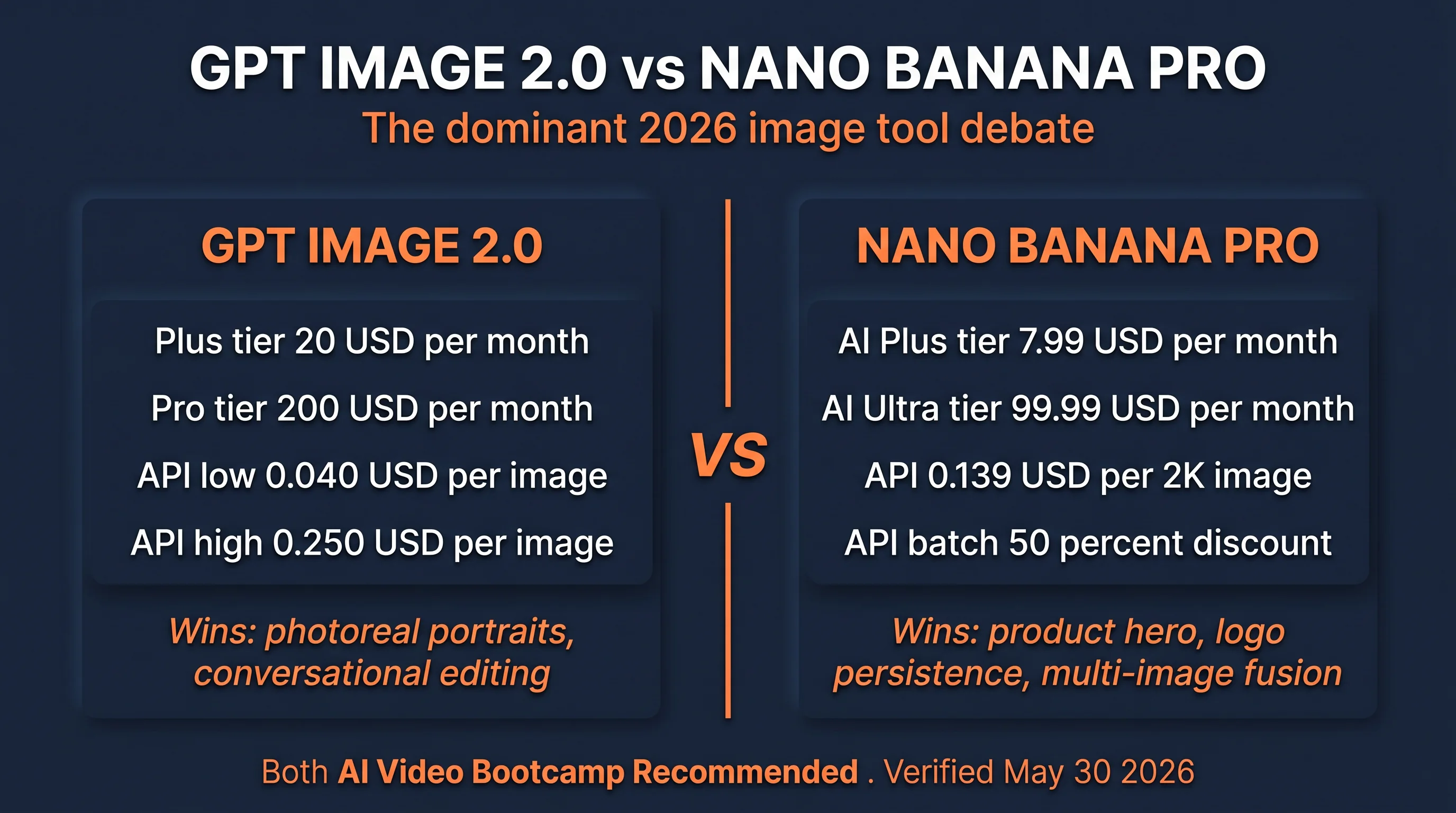
Debate 1: Nano Banana Pro vs GPT Image 2.0. The dominant 2026 image-tool debate. Nano Banana Pro wins multi-image fusion and product logo persistence. GPT Image 2.0 wins photoreal portraits and conversational editing. For the full head-to-head with rendered images, see the GPT Image 2.0 vs Nano Banana Pro 10 Prompts Tested article.
Debate 2: Midjourney V8.1 vs Flux 2 Pro. Aesthetic versus prompt adherence. Midjourney V8.1 wins style and painterly composition. Flux 2 Pro wins literal prompt following and photorealism. The community split is roughly 60/40 in favor of Flux 2 Pro for client work and Midjourney V8.1 for personal aesthetic exploration.
Debate 3: Nano Banana Pro vs Seedream 4.0. Quality versus batch economics. Nano Banana Pro wins per-image fidelity. Seedream 4.0 wins cost at scale (0.018 USD per image vs 0.139 USD per image, a roughly 8x cost differential). For variation testing at scale, the community recommends Seedream 4.0. For final client deliverables, Nano Banana Pro.
Debate 4: Ideogram V3 vs GPT Image 2.0 on text. Typography head-to-head. Ideogram V3 wins dense typographic layouts at small point sizes. GPT Image 2.0 wins integrated text within complex compositions. Operators producing t-shirt designs and social media posters favor Ideogram. Operators producing marketing layouts with both visual and text elements favor GPT Image 2.0.
Debate 5: Open weights, Flux 2 Dev vs Stable Diffusion 3.5 vs Qwen-Image 2.0. The open-weights succession story. Flux 2 Dev now dominates the open-weights community over SD 3.5 by community-LoRA adoption count. Qwen-Image 2.0 is the rising contender with its Apache 2.0 license driving rapid open-source ecosystem adoption.
Major 2026 market events
Five events shaped the 2026 AI image market and AI Video Bootcamp members should know them. DALL-E 3 hard-deprecated May 12, 2026, forcing migration to GPT Image 2.0. Magnific.ai absorbed into Freepik April 28, 2026 at reported 230 million USD ARR. Black Forest Labs closed a 300 million USD Series B at 3.25 billion USD valuation in December 2025. OpenAI joined the C2PA steering committee in May 2026 and added SynthID alongside C2PA. Qwen-Image 2.0 took the AI Arena #1 spot February 10, 2026 and held it through May.
Vendor Consolidation Map
Answer capsule. The 2025-2026 consolidation cycle grouped True Model AI image tools under eight major parent companies. Google operates four overlapping image surfaces (Imagen 5, Nano Banana Pro, Nano Banana 2, Gemini Omni image). OpenAI consolidated DALL-E 3 into GPT Image 2.0. ByteDance owns Seedream 4.0/4.5 plus Seedance 2.0. Black Forest Labs ships the entire Flux 2 family. Adobe stands alone with Firefly Image 5. Midjourney, Recraft, and Ideogram remain fiercely independent.
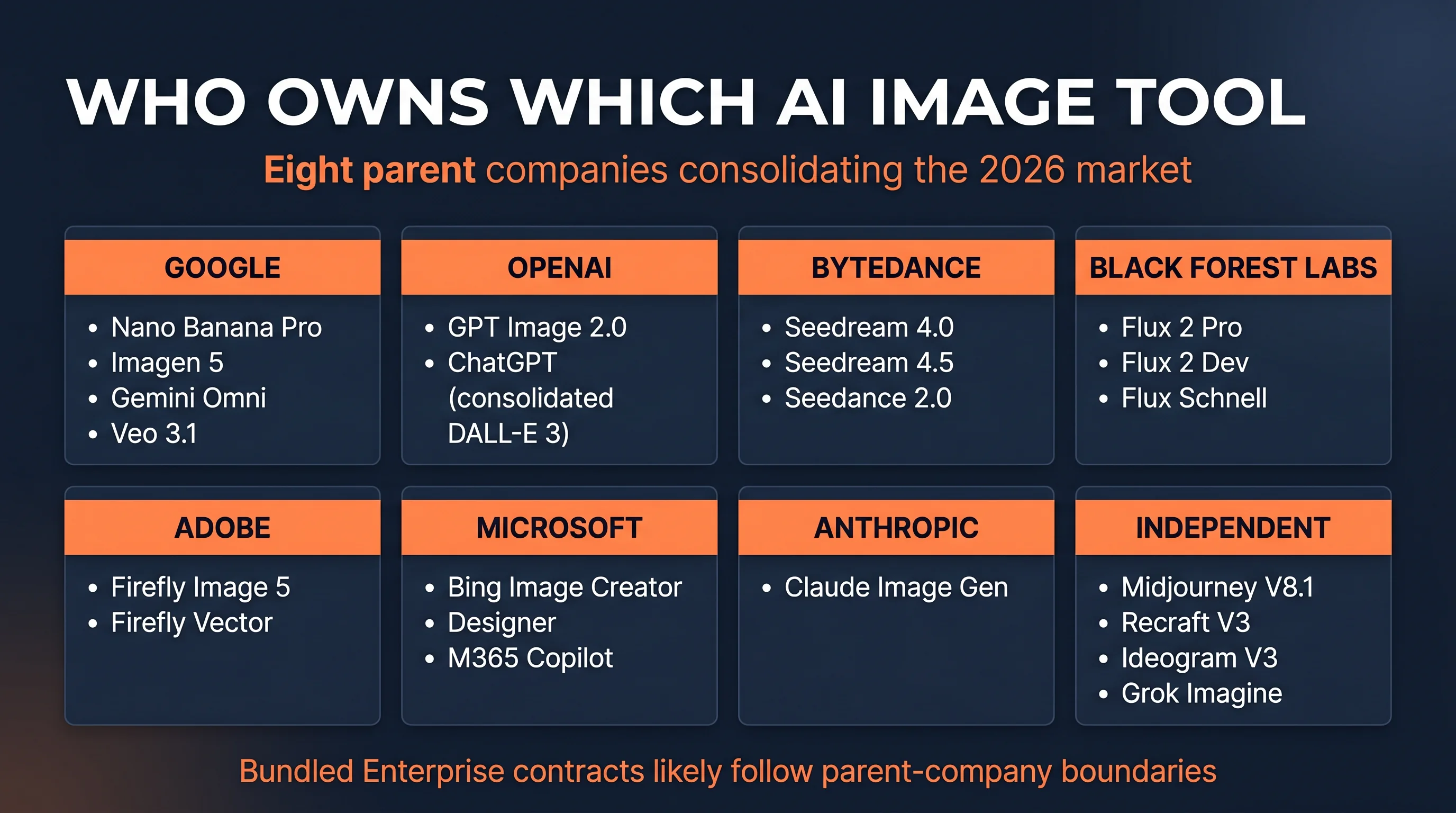
The vendor consolidation map helps AI Video Bootcamp members anticipate which tools will get bundled into Enterprise contracts together, where API pricing is likely aligned across siblings, and which independent vendors are most at acquisition risk.
| Parent company | Tool roster | Strategic positioning |
|---|---|---|
| Google (Alphabet) | Nano Banana Pro, Nano Banana 2, Gemini Omni image, Imagen 5, Veo 3.1 | Enterprise volume via Vertex AI, aggressive Workspace bundling, indemnification gated at Workspace tier |
| OpenAI | GPT Image 2.0 (consolidated from DALL-E 3) | Default conversational ecosystem, installed user base, API + Enterprise indemnification |
| ByteDance | Seedream 4.0, Seedream 4.5, Seedance 2.0 | Ultra-fast MoE architecture, batch processing, social media scale economics |
| Black Forest Labs | Flux 2 Pro, Flux 2 Dev, Flux 2 Max, Flux Schnell | Open-weights and API-first, prompt adherence, photorealism standard |
| xAI | Grok Imagine | Fast and aggressive pricing, X-native distribution, less restrictive moderation |
| Adobe | Firefly Image 5, Firefly Vector | Brand-safe commercial, full IP indemnification at paid tier, ecosystem integration |
| Microsoft | Bing Image Creator, Microsoft Designer, M365 Copilot image | OpenAI infrastructure under the hood, M365 Enterprise bundling |
| Anthropic | Claude Image Gen | Conversational ideation, integration with Claude chat workflows |
| MiniMax | Hailuo 02 (image + video) | Cinematic motion, native audio, budget tier |
| Kuaishou | Kling 3.0 | Image-to-video bridging, character consistency |
| Alibaba | Wan 2.7, Qwen-Image 2.0 | Open-weights challenger, regional Chinese market |
| Lightricks | LTX-2 | 4K native, 50 fps, budget per-second arbitrage |
| Stability AI | Stable Diffusion 3.5, SDXL | Open-weights legacy, community license restructure 2025 |
| Midjourney Inc | Midjourney V8.1 | Fiercely independent, Discord and web native, aesthetic superiority |
| Recraft | Recraft V3, Recraft V4 Pro | Vector and brand asset specialist |
| Ideogram | Ideogram V3 | Typography specialist |
| Canva | Magic Studio, Leonardo AI (acquired), Affinity (acquired) | Browser-native, team collaboration, design-bundled |
| Freepik | Magnific (acquired April 2026), Freepik AI | Stock asset integration, AI upscaling |
Three strategic takeaways for AI Video Bootcamp members planning a 2026 image stack. First, Google’s four-surface consolidation means operators using any Google image tool should evaluate the bundled Google Workspace upgrade path for indemnification. Second, Adobe’s standalone position with Firefly Image 5 means it will not get absorbed into a competitor’s ecosystem, making it the most stable long-term indemnification bet. Third, the independent specialists (Midjourney, Recraft, Ideogram) are the most likely 2027 acquisition targets given current market trajectory.
FAQ
What is the best AI image generator in 2026?
No single tool wins every use case. For paying client work that needs IP indemnification, three paths work: Adobe Firefly Creative Cloud, the OpenAI API, or Google Vertex AI. For photoreal portraits, GPT Image 2.0 wins. For product hero shots with logo persistence, Nano Banana Pro wins. For text-heavy ads and typography, Ideogram V3 wins. For aesthetic illustrative work, Midjourney V8.1 wins. The AI Video Bootcamp Recommended badge marks the seven tools the curriculum teaches: GPT Image 2.0, Nano Banana Pro, Flux 2 Pro, Seedream 4.0, Midjourney V8.1, Recraft V3, and Ideogram V3.
How much does GPT Image 2.0 cost compared to Nano Banana Pro?
GPT Image 2.0 access starts at 20 USD per month via ChatGPT Plus and scales to 200 USD per month via ChatGPT Pro. The API rate is 0.040 USD per image at the low quality tier and 0.250 USD per image at the high quality tier. Nano Banana Pro access starts at 7.99 USD per month via Google AI Plus and scales to 99.99 USD per month via Google AI Ultra. The API rate is 0.139 USD per 2K image with a 50 percent batch discount. Nano Banana 2 is the cheaper sibling at 0.039 USD per 1K image.
Are AI image generators free to use commercially?
It depends on the tool and tier. Most paid tiers permit commercial use, but indemnification is the question that matters for client work. Three paths get you indemnified outputs: Adobe Firefly Creative Cloud Photography at 19.99 USD per month, the OpenAI API at 0.040 to 0.250 USD per image, or Google Vertex AI at 0.020 to 0.040 USD per image. The trap is the default consumer chat subscription. ChatGPT Plus, ChatGPT Pro, Google AI Plus, and Google AI Ultra all permit commercial use but do NOT defend the user if a third party files an IP claim. Operators serving paying clients should pick one of the three indemnified paths above.
Which AI image generators are EU AI Act Article 50 compliant?
Adobe Firefly, OpenAI GPT Image 2.0 (with C2PA plus SynthID since May 2026), all Google image surfaces (Nano Banana Pro, Imagen 5, Gemini Omni), and Microsoft Designer ship compliant by default. Midjourney does not. Self-hosted Flux 2 Dev and Stable Diffusion shift the marking burden to the operator. Article 50 enforces August 2, 2026 with a 15 million EUR or 3 percent global turnover penalty ceiling for non-compliant deployers.
Which AI image tools have active lawsuits against them in 2026?
Midjourney V8.1 is in active litigation from Disney and Universal Studios (Case No. 2:25-cv-05275, C.D. Cal.). Stability AI faced the Andersen US class action and the Getty UK case (mostly defeated November 2025). OpenAI has the NYT and Authors Guild suits with image-side adjacent exposure. Runway is a co-defendant in Andersen v. Stability. Operators using these tools for client work should track litigation outcomes before signing deliverables.
Last reviewed by the AI Video Bootcamp editorial team on 2026-06-01. Pricing verified against official vendor documentation between May 28 and June 1, 2026. Update cadence: monthly. The AI image market ships pricing changes weekly. Pricing older than 60 days should be re-verified against the live vendor pricing page before quoting clients.