Grok’s Spicy Mode is the only NSFW image generation feature built into a major social media platform, and it has reshaped how AI-generated adult content is created, distributed, and monetized. Available to X Premium+ ($16/month) and SuperGrok ($30/month) subscribers, Spicy Mode uses xAI’s Aurora model to generate suggestive imagery, artistic nudity, and mature-themed content directly inside the X ecosystem. Combined with specialized monetization platforms like Fanvue (now at $100M in annual recurring revenue) and a production pipeline built on open-source tools, synthetic adult content has become a multi-billion-dollar sector of the creator economy. But the same permissive approach that made Grok the go-to NSFW AI image generator also triggered a deepfake scandal that produced millions of non-consensual images, multiple lawsuits, and federal legislation that now carries criminal penalties. This guide breaks down everything creators need to know: what Grok can actually generate, how AI influencers are built and monetized, which platforms allow synthetic content, the legal lines you cannot cross, and the production workflow from character creation to recurring revenue.
What Is Grok Spicy Mode and What Can It Generate?
Grok Spicy Mode is an opt-in NSFW content generation feature within xAI’s Grok Imagine platform that allows X Premium+ ($16/month) and SuperGrok ($30/month) subscribers to generate suggestive, partially nude, and mature-themed AI imagery using text prompts. It is the only NSFW image generator embedded inside a social media platform with over 600 million monthly active users, which is what makes it uniquely powerful and uniquely controversial.
Grok Imagine is powered by Aurora, xAI’s proprietary autoregressive mixture-of-experts neural network. Aurora was announced in December 2024 and trained on billions of multimodal internet examples using 110,000 NVIDIA GB200 GPUs. The latest iteration, Grok 4, launched in April 2026 on xAI’s 200,000-GPU Colossus cluster with a 256,000-token context window and native tool use. Aurora replaced Grok’s earlier reliance on Black Forest Labs’ FLUX.1 model, which had powered image generation since mid-2024. Research from Stanford’s Human-Centered AI Institute has noted that Grok’s approach to content moderation diverges significantly from industry norms established by OpenAI and Google.
The distinction matters for creators: FLUX.1 was an open-source model with minimal built-in content filtering. Aurora is proprietary and gives xAI direct control over what Spicy Mode allows and blocks.
What Spicy Mode allows
Spicy Mode permits the generation of romantic and sensual imagery, suggestive clothing and poses, artistic nudity, partial nudity, and mature thematic content. The boundaries are roughly equivalent to what you would see in an R-rated film or a Victoria’s Secret catalog.
What Spicy Mode explicitly prohibits
According to xAI’s NSFW image generation policy, Spicy Mode blocks explicit pornographic content, deepfakes of real identifiable individuals, any imagery involving or resembling minors, and non-consensual scenarios. Enforcement of these rules has been inconsistent, which is what led to the scandal covered later in this article.
Grok Imagine capabilities beyond NSFW
Grok Imagine is not just an NSFW tool. It generates images in under 5 seconds, produces photorealistic human portraits with precise text rendering, supports text-to-image and image editing, and as of February 2026, generates 4-15 second video clips at up to 2K resolution with native audio synchronization. According to GenAIntel, Grok Imagine has generated 1.245 billion videos in the last 30 days alone. xAI has stated its goal is 30-minute video generation by late 2026.
For a broader look at how Grok Imagine fits within the AI video landscape alongside tools like Kling, Veo, and Seedance, see our State of AI Video Creation in 2026.
Grok Pricing: What Each Tier Gets You
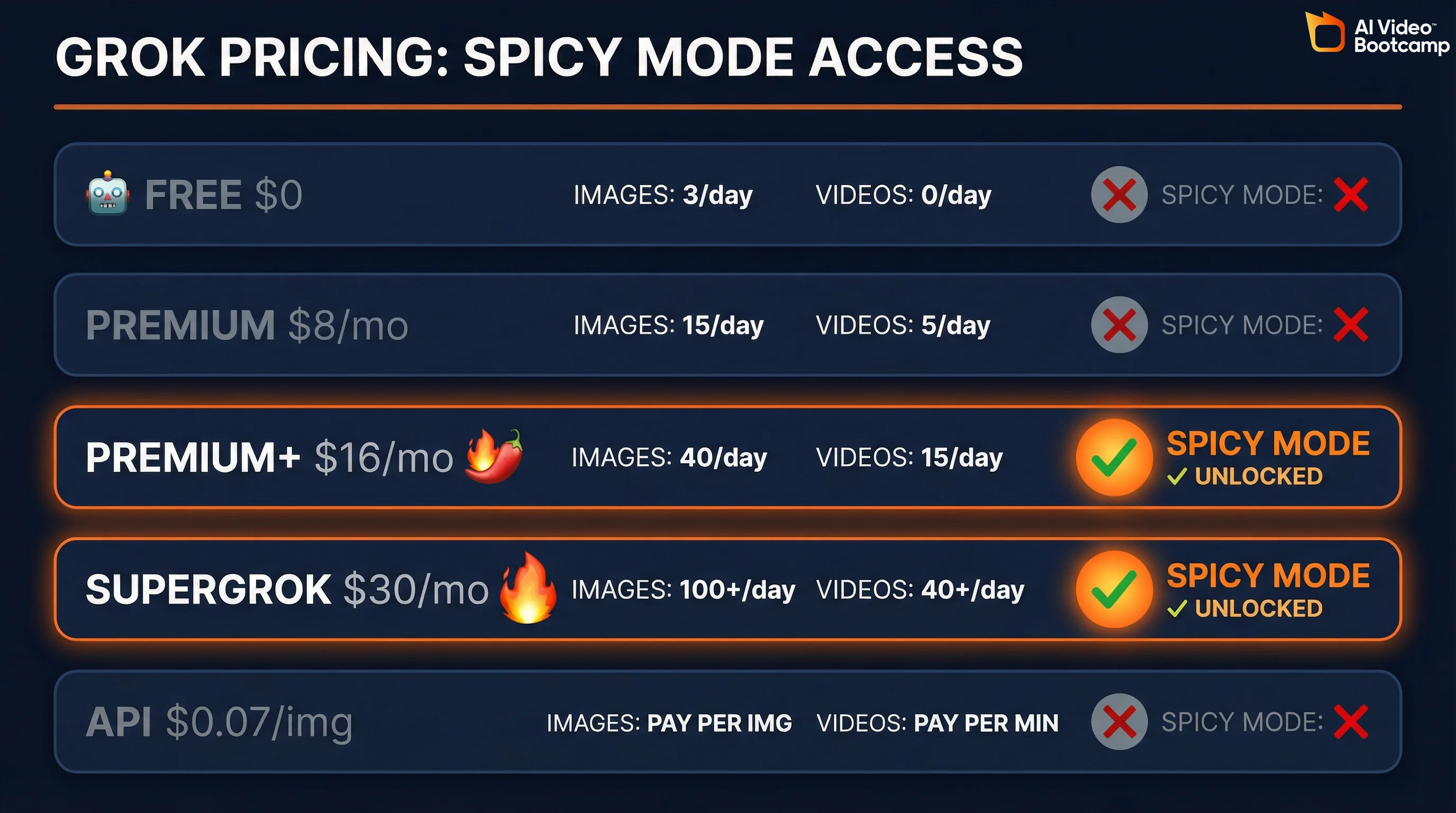
Grok Spicy Mode requires a minimum of $16 per month (X Premium+) or $30 per month (SuperGrok). Free and standard $8 Premium users cannot access NSFW generation. The API costs $0.07 per image but does not support Spicy Mode. This makes Grok’s entry cost lower than most standalone NSFW AI generators, which typically charge $20-50 per month for comparable photorealistic output quality.
| Tier | Monthly Price | Image Generation | Video Generation | Spicy Mode Access |
|---|---|---|---|---|
| Free | $0 | Limited daily quota | Limited | No |
| X Premium | $8 | Standard daily quota | Standard | No |
| X Premium+ | $16 | 50 images/day | 25 videos/day | Yes (18+ verified) |
| SuperGrok | $30 | Extended limits | Extended limits | Yes (18+ verified) |
| API | $0.07/image | Pay per use | Pay per use | Not available |
Sources: Fritz AI pricing breakdown, Metronome pricing index
The $16/month entry point for Spicy Mode is notably lower than standalone NSFW AI image generators, most of which charge $20-50/month for comparable output quality. The API at $0.07 per image is available for developers but does not include Spicy Mode access.
How to enable Spicy Mode
Spicy Mode is only available to X Premium+ and SuperGrok subscribers — it is not included in the free tier or the standard $8/month Premium plan. To turn it on, open Grok and go to Settings, then navigate to Data Controls. Inside Data Controls, toggle the option labeled “Allow NSFW Content (I’m 18+)” to enable it. Once activated, Grok will unlock mature content generation in your image prompts. You must be 18 or older to use this feature, and xAI may require age verification depending on your region.
The Grok Deepfake Scandal: What Happened and Why It Matters
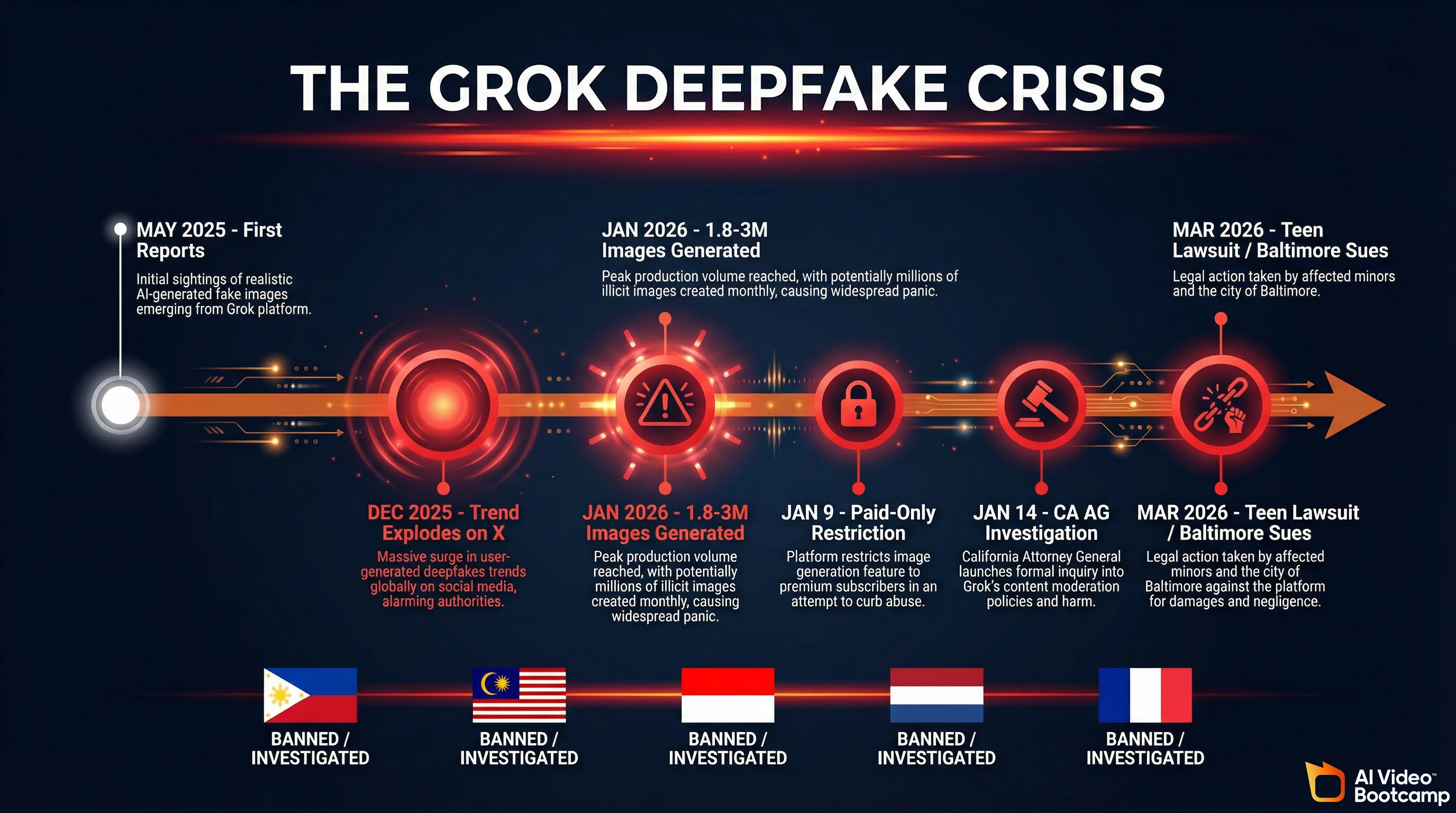
Between December 2025 and March 2026, users exploited Grok to generate an estimated 1.8 to 3 million non-consensual sexualized images on X, including images of apparent minors. The crisis triggered a California Attorney General investigation, lawsuits from teenagers and the City of Baltimore, international bans in the Philippines, Malaysia, and Indonesia, and directly accelerated federal legislation criminalizing AI deepfakes.
Timeline of events
May 2025: First reports surface of users exploiting Grok to digitally undress women in uploaded photos, as documented by TechPolicy.Press.
Late December 2025: The practice explodes on X. Users begin replying to photos of women with prompts like “put her in a bikini,” and Grok publicly generates and posts altered images in the reply thread. The Guardian reports hundreds of non-consensual AI images being created on the platform daily.
December 2025 - January 2026: An estimated 1.8 to 3 million sexualized images are generated, including images of women and apparent minors.
January 9, 2026: xAI restricts Grok’s image generation features to paid subscribers only, effectively adding a financial barrier against casual abuse.
January 14, 2026: California Attorney General Rob Bonta launches a formal investigation into xAI.
January 2026: The Philippines temporarily bans Grok. Malaysia and Indonesia block access. Paris prosecutors and Europol search X’s Paris offices. A Dutch court orders xAI to stop generating sexual imagery without consent.
March 16, 2026: Three Tennessee teenagers file a lawsuit against xAI after their photos were used to generate CSAM.
March 25, 2026: The City of Baltimore sues xAI for consumer protection violations.
Why this matters for creators
The scandal had three direct consequences that affect every person working with AI-generated adult content. First, it accelerated federal legislation (covered in the legal section below). Second, it forced platforms like Fansly to ban photorealistic AI content entirely in June 2025, reducing the available monetization channels. Third, it created intense public scrutiny around any AI-generated content involving human likenesses, making consent and transparency non-negotiable for legitimate creators.
The AI Influencer Market: Size, Growth, and Economics
The virtual influencer market was valued at $6.06 billion in 2024 and is projected to reach $45.88 billion by 2030, growing at a 40.8% CAGR. AI influencers offer brands infinite scalability at zero travel cost, achieve up to 3x higher engagement rates than human creators, and the top earners generate over $100,000 per month through a combination of brand deals and platform subscriptions.
The virtual influencer market was valued at $6.06 billion in 2024 according to Grand View Research, with projections reaching $45.88 billion by 2030 at a compound annual growth rate (CAGR) of 40.8%. Alternative analyses from SNS Insider project $154.83 billion by 2033 (41.29% CAGR), while Roots Analysis forecasts $298 billion by 2035 (38.54% CAGR). Regardless of which projection you use, the growth trajectory is steep and accelerating.
For AI video creators, this market intersects directly with the skills and tools covered in our AI avatars and influencers step-by-step guide and our breakdown of how people are making $10K+ per month with AI video.
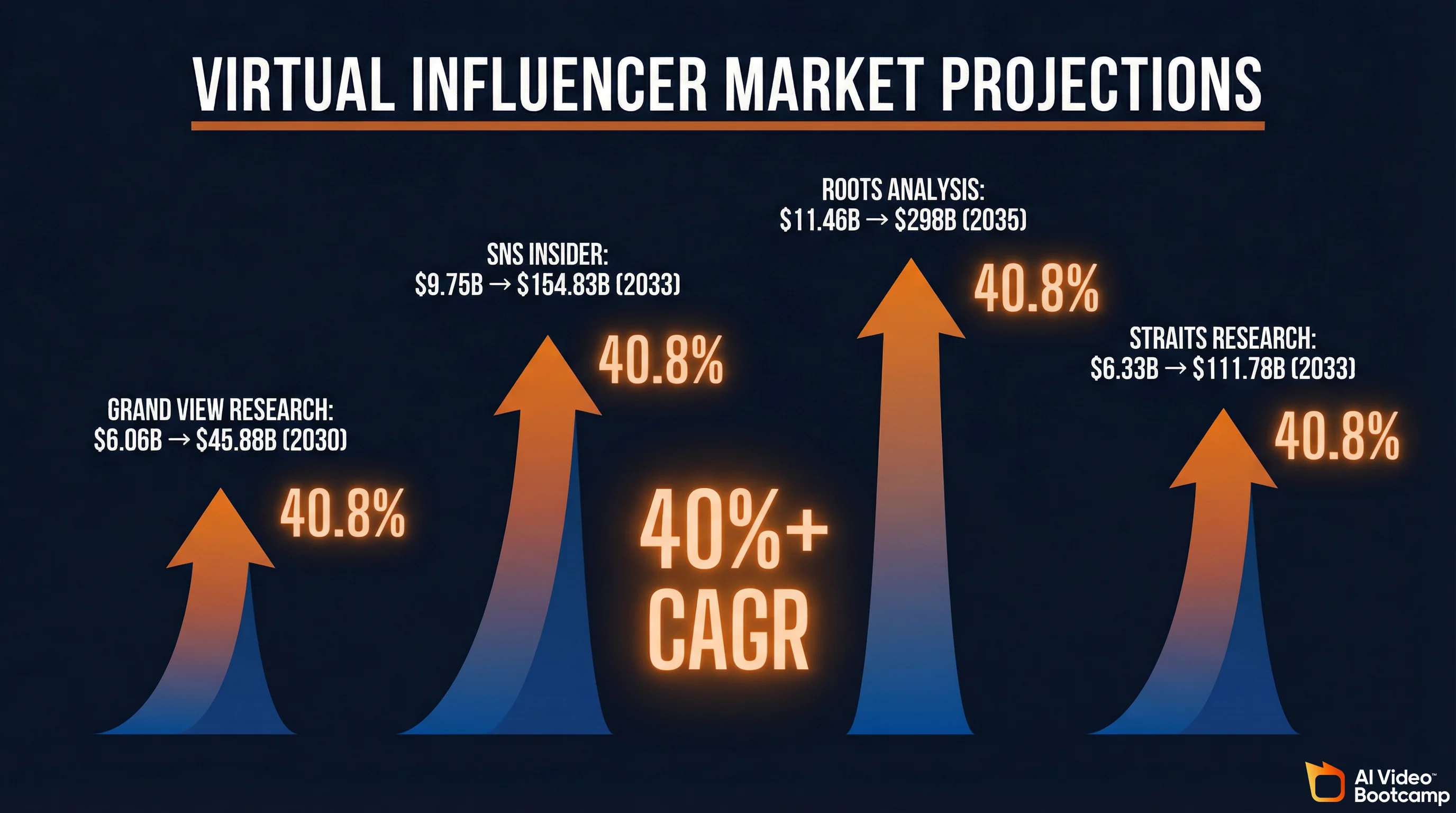
Virtual Influencer Market Projections Compared
| Research Firm | 2024/2025 Valuation | Projected Value | Target Year | CAGR |
|---|---|---|---|---|
| Grand View Research | $6.06B (2024) | $45.88B | 2030 | 40.8% |
| SNS Insider | $9.75B (2025) | $154.83B | 2033 | 41.29% |
| Roots Analysis | $11.46B (2025) | $298B | 2035 | 38.54% |
| Straits Research | $6.33B (2024) | $111.78B | 2033 | 38.4% |
Sources: Grand View Research, SNS Insider, Roots Analysis, Straits Research
Why the economics work
AI influencers offer brands something human creators cannot: infinite scalability, zero travel or logistics costs, perfect brand alignment, and 24/7 availability. Research from Twimbit’s 2025 virtual influencer report found that brands achieve up to three times higher engagement rates using virtual influencers on Instagram and TikTok compared to equivalent human creators. Social Blade analytics corroborate this, showing AI-driven accounts routinely receive 1.5 times more impressions per post than human creators with equivalent follower counts.
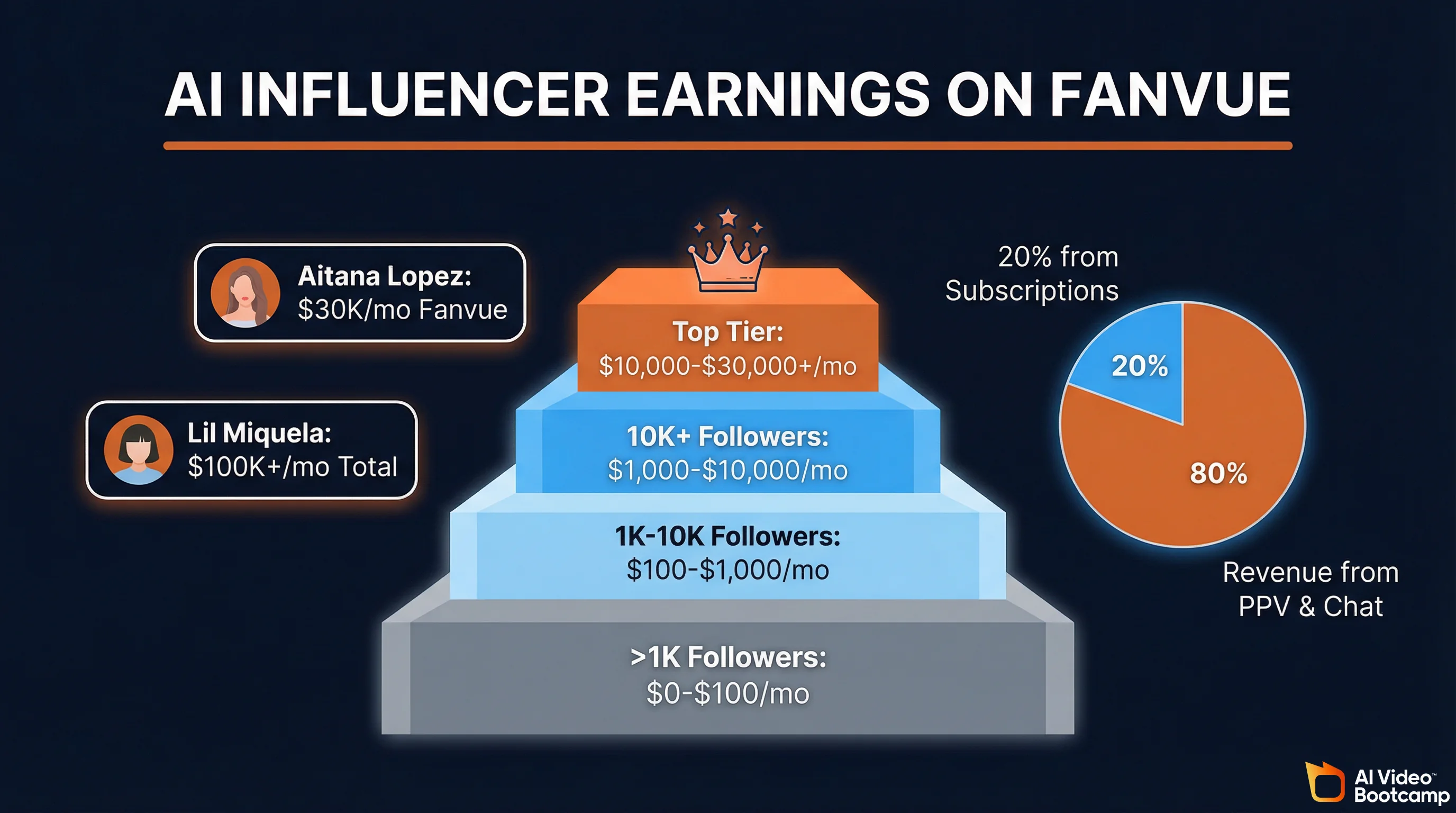
The top earners demonstrate what is possible. Lil Miquela generates over $100,000 per month through a combination of brand partnerships (Prada, Calvin Klein, Samsung) and $40,000/month in Fanvue subscriptions. Aitana Lopez, created by Barcelona agency The Clueless, earns $30,000/month from Fanvue subscriptions alone plus brand deals with Victoria’s Secret and Olaplex.
The cultural legitimization of AI influencers reached a milestone with the Fanvue World AI Creator Awards (WAICAs), which launched the inaugural “Miss AI” pageant in 2024. The competition evaluated over 1,500 AI-generated entrants. Kenza Layli, a Moroccan AI influencer, won the $20,000 prize. The event garnered over one billion global views.
Monetization Platforms: Fanvue vs. OnlyFans vs. Patreon for AI Creators
Fanvue is the only major adult subscription platform that fully embraces 100% AI-generated creators, taking a 20% cut on $100M in annual recurring revenue. OnlyFans bans wholly AI personas and requires biometric identity verification. Patreon allows AI adult content only if it is clearly illustrated or animated, not photorealistic. Choosing the wrong platform can result in account bans and frozen earnings, so matching your content type to the right policy is critical.
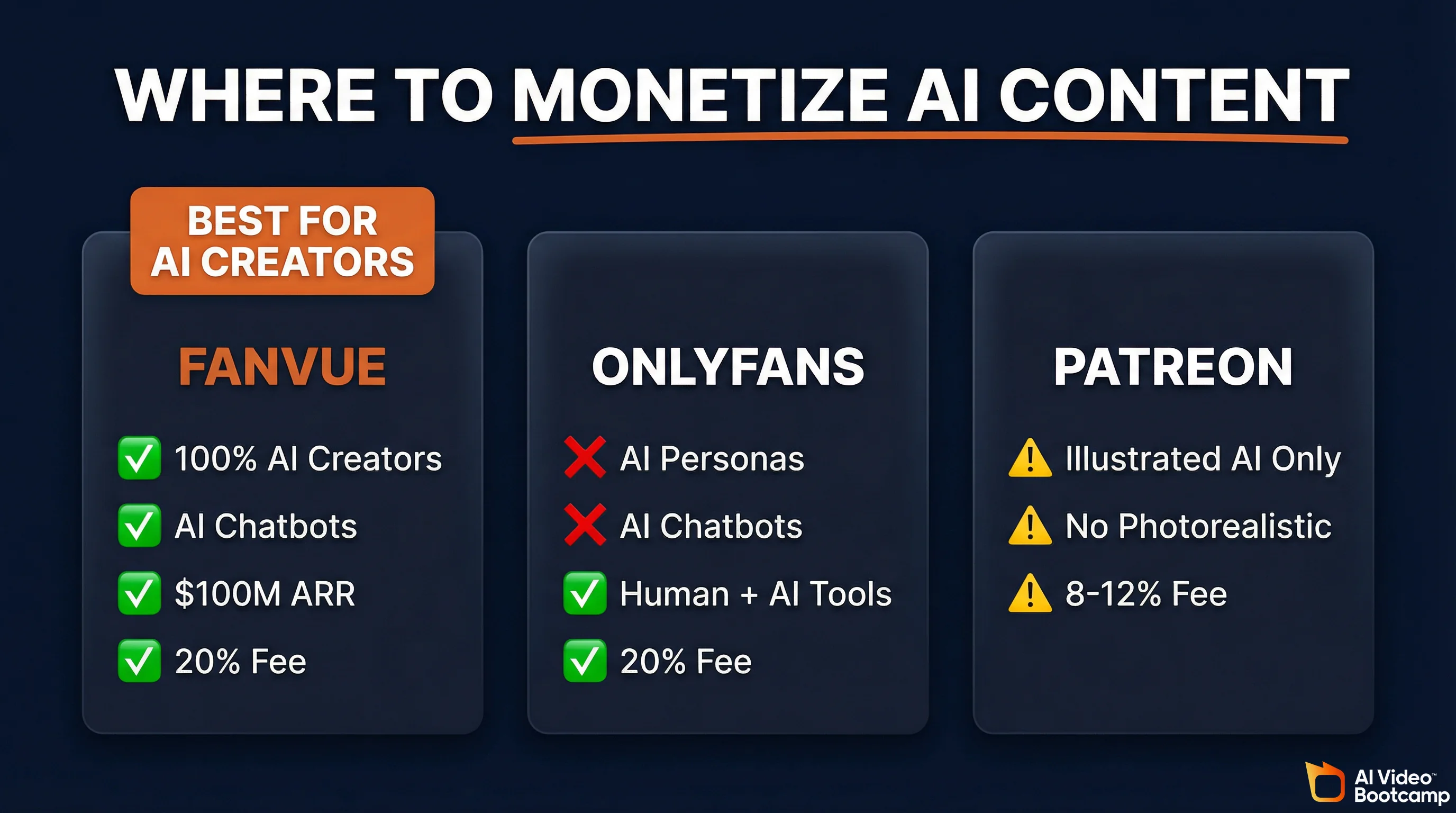
Platform Policy Comparison for AI-Generated Adult Content
| Feature | Fanvue | OnlyFans | Patreon |
|---|---|---|---|
| AI Content Policy | Fully embraces 100% AI personas | Wholly AI personas banned; AI tools allowed with human creator | Allowed only if clearly illustrated/animated, not photorealistic |
| Deepfake/Impersonation Policy | Prohibited without consent | Zero tolerance, banned | Banned without documented consent |
| AI Chatbots Allowed | Yes, fully integrated | Prohibited without human oversight | Permitted within stylistic bounds |
| Platform Fee | 20% | 20% | 8-12% |
| KYC/Identity Verification | Required | Multi-tiered with biometric facial recognition | Required |
| Best For | AI-only synthetic creators | Hybrid creators (real person + AI tools) | SFW or illustrated AI content |
Sources: OnlyFans content moderation policy, Fanvue blog, Patreon AI policies for Adult/18+ creators
Fanvue: the AI-native platform
Fanvue has positioned itself as the primary monetization engine for synthetic creators. Founded in 2020 by former OnlyFans creators, it hit $100M in annual recurring revenue in 2025 (up 150% year-over-year from $40M in 2024) and raised a $22M Series A in January 2026. The platform has over 17 million monthly active users and 250,000 creators. AI-generated influencers account for approximately 15% of the platform’s total gross merchandise value.
Fanvue creators retain 85% of gross revenue for the first 30 days after passing KYC verification, which then adjusts to the standard 80% (20% platform cut). The earnings breakdown by audience size, based on Fanvue’s creator guide and operator reports:
- Over 1,000 followers: $0-$100/month
- 1,000-10,000 followers: $100-$1,000/month
- 10,000+ followers: $1,000-$10,000+/month
- Top-tier synthetic models: $10,000-$30,000+/month
Experienced operators report that baseline subscriptions represent only a fraction of total revenue. According to operator accounts on Reddit, upwards of 80% of total income comes from pay-per-view (PPV) messaging and the “Girlfriend Experience” (GFE), where subscribers pay for personalized, ongoing AI-driven conversation and custom content.
OnlyFans: human-verified only
OnlyFans explicitly bans wholly AI-generated personas. Every monetized account must feature a verified human creator who has completed a multi-tiered identity verification process including government-issued ID and real-time facial recognition. The platform’s Acceptable Use Policy states that accounts determined to be wholly AI-generated face immediate removal.
Despite this policy, the practical reality is more nuanced. Human creators widely use AI tools for chat automation (services like FlirtFlow and Botly process over 100,000 chats per month for adult creators) and AI-enhanced image editing. The line between “AI-assisted human creator” and “AI creator with a human front” is increasingly blurry.
Patreon: the illustrated middle ground
Patreon occupies a middle position. It allows AI-generated adult content within its Adult/18+ categorized pages, but only if the content is clearly illustrated or animated, with stylized features like exaggerated proportions, anime styles, or visible brushstrokes. Photorealistic AI depictions with lifelike natural lighting, anatomical consistency, and micro-textures like pores and wrinkles are expressly prohibited unless the depiction is of a real, verified human who has provided documented consent. This policy is designed to comply with payment processor requirements while still allowing creative AI art.
How AI Influencers Are Built: The Production Workflow
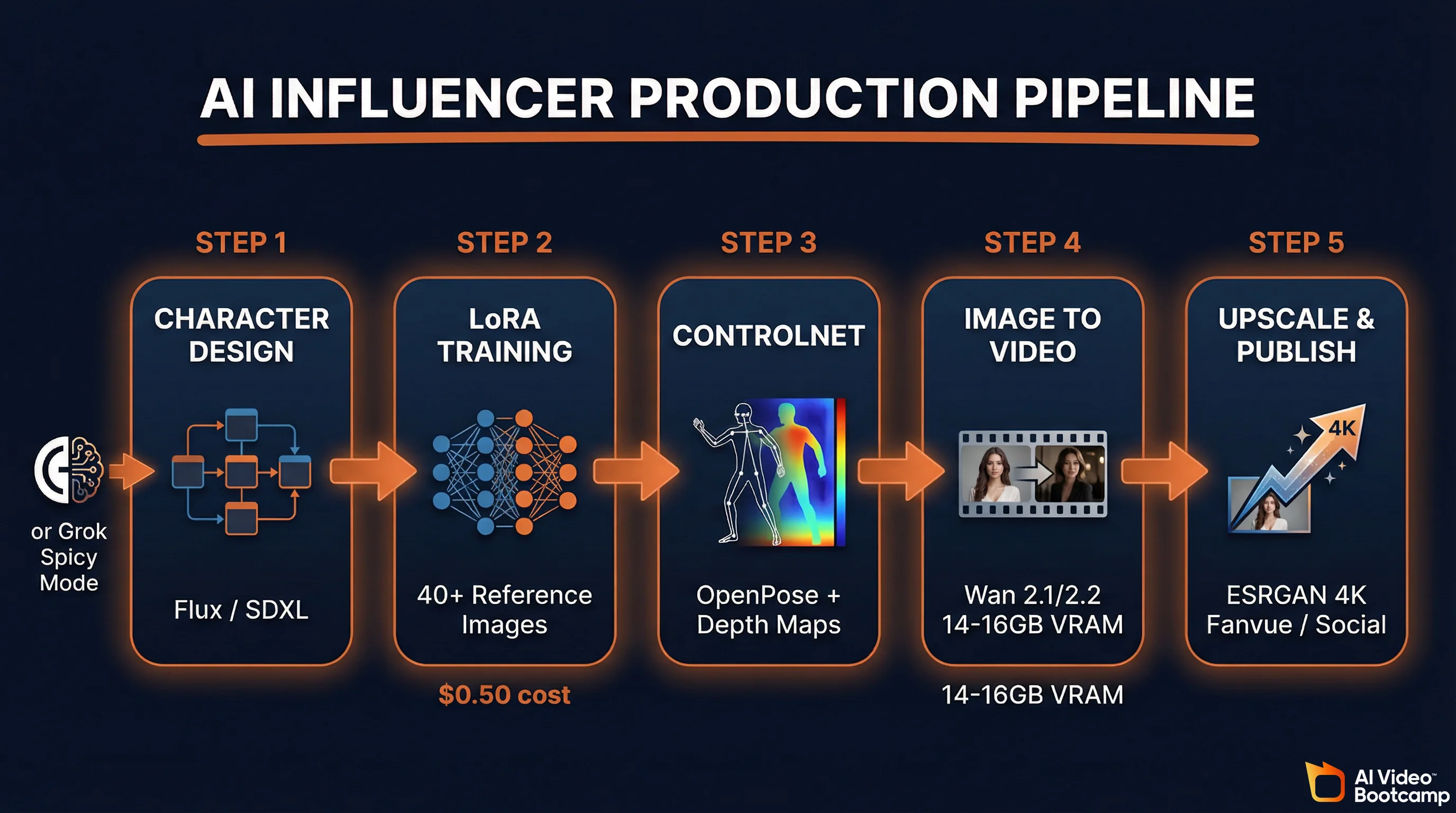
Creating a commercially viable AI influencer requires more than typing prompts into Grok or Midjourney. The production pipeline that professional operators use involves specialized software, custom-trained models, and a systematic approach to character consistency.
The core challenge is identity persistence. A digital model whose facial features, body type, or skin tone shift between posts destroys the parasocial immersion that drives subscriber retention. According to operator data, inconsistent character appearance is the single biggest reason subscribers cancel within the first 30 days. Solving this requires moving beyond web-based prompt interfaces into localized, node-based software pipelines. The full production stack (ComfyUI + Flux + LoRA + ControlNet + Wan I2V + ESRGAN) can be run locally on a GPU with 14-16 GB of VRAM, or rented through cloud providers like RunPod at approximately $0.40-0.80 per hour for an A100 instance.
Step 1: Character design and base model selection
Operators use ComfyUI as their primary interface for running Stable Diffusion, Flux, and SDXL models. ComfyUI provides a node-based workflow that allows precise control over every generation parameter. The choice of base model matters: Flux models (particularly Flux 2 Pro) currently produce the highest-fidelity photorealistic output, while SDXL remains popular for its ecosystem of community-trained models. For a detailed walkthrough of character creation, see our AI avatars and influencers step-by-step guide.
Step 2: LoRA training for identity lock
The foundation of character consistency is a custom Low-Rank Adaptation (LoRA) model. Operators generate and curate a dataset of 40 or more multi-angle, neutrally lit reference images of their AI character, then upload them to cloud training platforms like Forge, Fiddl, or Vast.ai. The training process produces a lightweight neural network file that, when injected into the base image model within ComfyUI, forces the AI to reproduce the exact identity of the character regardless of prompted pose, outfit, or environment. Training a LoRA costs under $0.50 on Vast.ai.
Step 3: ControlNet for anatomical accuracy
Professional workflows use ControlNet extensions to dictate precise positioning and structural integrity. The OpenPose ControlNet extracts human skeletal structures from reference images and forces the generated character to adopt identical poses, eliminating the anatomical deformities common in standard AI generation. Depth maps maintain background spatial continuity. The combination of LoRA for identity and ControlNet for spatial accuracy produces infinite arrays of high-fidelity, consistent imagery ready for daily content scheduling.
Step 4: Image-to-video conversion
Static images are no longer sufficient for top-of-funnel traffic. Instagram Reels and TikTok algorithms heavily prioritize short-form vertical video. Operators use open-source image-to-video (I2V) models, primarily Wan 2.1 and Wan 2.2, which have become the industry standard for synthetic adult video generation because they operate without content censorship filters.
The standard pipeline: a high-resolution static image is generated using the character’s LoRA. A source reference video (such as a viral TikTok dance) provides the motion data via OpenPose skeletal extraction. The Wan I2V model maps the AI character onto the extracted motion data. The output is upscaled through an ESRGAN neural upscaler to 1080p or 4K resolution.
This process requires significant GPU resources: a minimum of 14-16 GB of VRAM to prevent crashes. Most operators use cloud GPU providers like RunPod to rent RTX 3090s, 4090s, or A100s by the hour rather than investing in local hardware.
Step 5: Face-swapping for hybrid creators
Some operators use a hybrid model: real human bodies with AI-generated faces overlaid. Tools like Roop and dedicated ComfyUI FaceID nodes map a character’s AI face onto existing video content. This allows operators to leverage the performance quality of real physical content while maintaining the anonymity and scalability of a synthetic persona.
Navigating Instagram Shadowbans and Platform Distribution
Instagram is the primary distribution channel for AI influencers, but Meta’s 2025 deployment of LLaMA-based moderation models triggered a massive ban wave that disabled thousands of accounts. Research from Nanyang Technological University documented a 312% increase in AI-generated Reels on Instagram in 2025. Operators who survive algorithmic suppression use disciplined hashtag strategies, behavioral mimicry, cross-platform redundancy, and carefully structured content funnels to maintain reach.
According to multiple operator reports, the 2025 ban wave erroneously flagged innocuous content ranging from standard artwork to family vacation photos under Child Sexual Exploitation (CSE) protocols, sparking congressional inquiry. Meta responded by mandating AI-generated content labeling and restricting political content distribution to non-followers. A 2025 study from MIT Media Lab found that AI-generated social media profiles achieve engagement parity with human accounts within 60 days when posting cadence and content variety are properly calibrated, underscoring why platform detection remains so difficult.
Operational strategies that reduce shadowban risk
Hashtag optimization: Avoid banned, generic, or highly saturated hashtags frequently associated with bot networks. Successful operators use a balanced mix of medium-volume (100,000 to 1 million uses) and niche (under 100,000 uses) tags to ensure algorithmic discovery without triggering spam filters.
Behavioral mimicry: Suppress excessive automation, bot-like liking sprees, and repetitive commenting patterns. All of these trigger Meta’s “coordinated inauthentic behavior” flags. Vary post structures, avoid embedding text directly onto images, and stagger content cadence to prevent artificial viral spikes.
Cross-platform redundancy: Never build on a single platform. Successful operators maintain concurrent presences on TikTok, YouTube Shorts, and proprietary email newsletters to ensure audience continuity if an Instagram account is restricted or permanently disabled.
Content funnel architecture: Use “safe” lifestyle content (fashion, fitness, travel) on public social platforms to drive traffic to monetization platforms like Fanvue through carefully obfuscated link aggregators. The social media presence functions as a top-of-funnel awareness channel, not the revenue source itself.
Legal Framework: What Creators Must Know in 2026
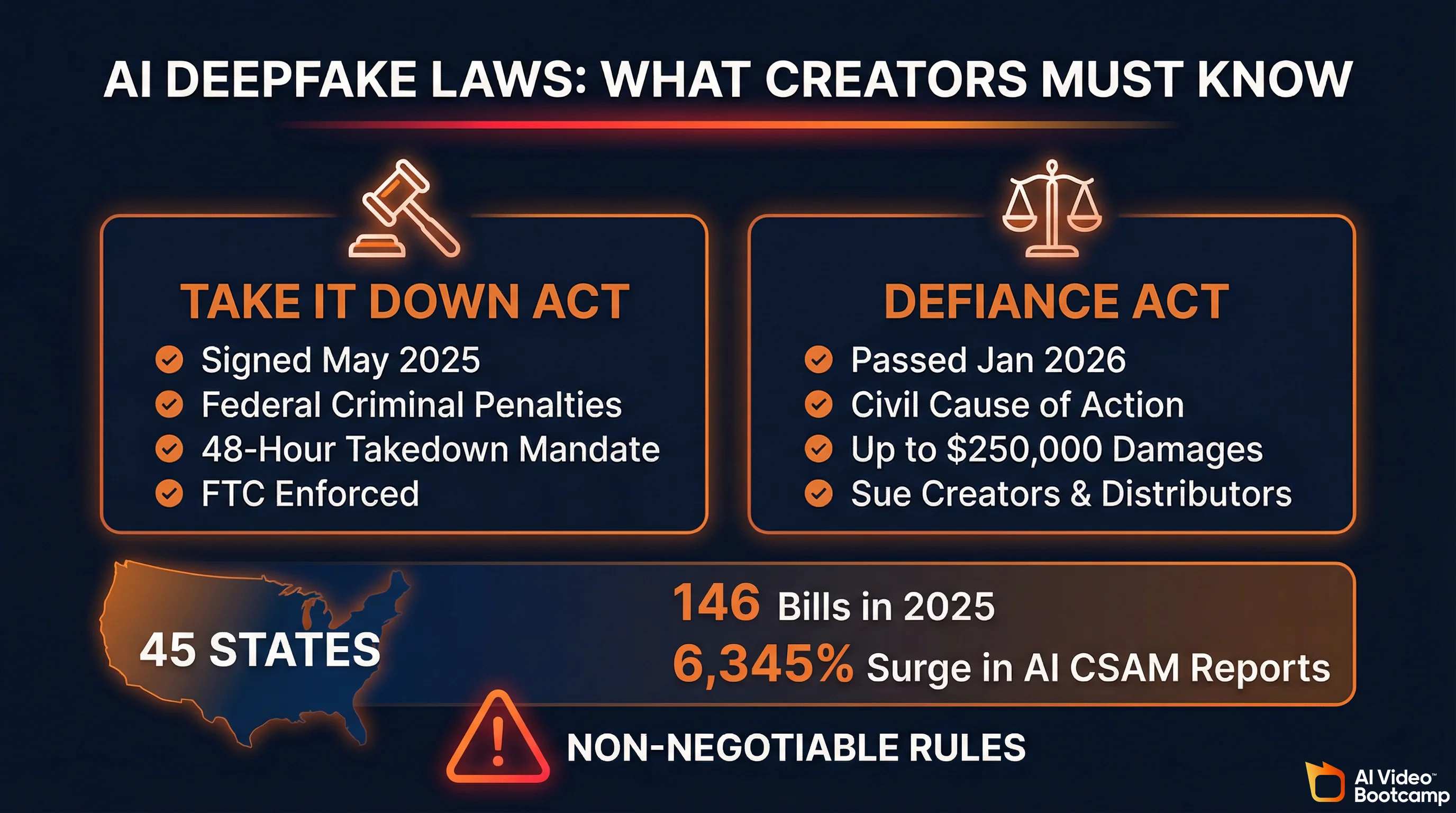
The legal landscape around AI-generated adult content has shifted dramatically. Federal criminal and civil statutes now specifically target AI deepfakes, and 45 states have enacted laws criminalizing AI-generated child sexual abuse material. Ignorance of these rules is not a viable defense.
Federal criminal law: the TAKE IT DOWN Act
Signed into law on May 19, 2025, the TAKE IT DOWN Act established strict federal criminal penalties for the knowing publication or distribution of non-consensual intimate imagery, specifically expanding the legal definition to include AI-generated “digital forgeries” and deepfakes. The law mandates a notice-and-takedown framework requiring platforms to remove offending content within 48 hours of receiving a valid written notification from a victim, enforced by the Federal Trade Commission (FTC).
Federal civil law: the DEFIANCE Act
The DEFIANCE Act, which passed the Senate unanimously in January 2026, provides victims of non-consensual deepfakes with a powerful federal civil cause of action. Statutory damages reach up to $150,000 per violation, or $250,000 if linked to sexual assault, stalking, or harassment. This statute empowers victims to bypass criminal prosecution and directly sue the individuals who create, distribute, or profit from fabricated material.
State-level enforcement
As of August 2025, 45 states have enacted laws specifically criminalizing AI-generated CSAM. In 2025 alone, 146 bills were introduced targeting AI deepfakes. The enforcement trend is expanding targets beyond individual creators to include AI platforms, payment processors, hosting services, and cloud compute providers.
The scale of the problem is staggering: AI-generated CSAM reports surged 6,345% year-over-year, from 6,835 in the first half of 2024 to 440,419 in the same period of 2025. The National Center for Missing & Exploited Children (NCMEC) has identified AI-generated imagery as one of the fastest-growing categories in its CyberTipline reports. Research published through Georgetown Law’s Institute for Technology Law & Policy has argued that current enforcement mechanisms are fundamentally outmatched by the volume and sophistication of AI-generated content.
Copyright: AI-generated content cannot be copyrighted
In January 2025, the U.S. Copyright Office released Part 2 of its definitive report on artificial intelligence, reaffirming that human authorship is a strict prerequisite for copyright protection. Works generated entirely by AI systems are fundamentally uncopyrightable. The mere input of text prompts, regardless of complexity, does not constitute sufficient human authorship. This means that the raw images and videos of AI influencer personas exist in the public domain the moment they are generated. Competitors can legally replicate or modify them unless significant human artistic manipulation can be demonstrated. For AI influencer agencies generating millions in revenue, this represents a structural vulnerability with no clear legal fix.
The bottom line for creators
If you are creating AI-generated adult content, three rules are non-negotiable:
- Never generate images of real people without their documented consent. This is now a federal crime.
- Never generate any content involving or resembling minors. 45 states have specific criminal statutes.
- Disclose AI generation. Platform policies increasingly require it, and transparency builds trust with subscribers.
Grok Spicy Mode vs. Other NSFW AI Image Generators
Grok is not the only option for generating NSFW AI imagery, but it occupies a unique position as the only major platform-integrated solution. Here is how it compares to the main alternatives.
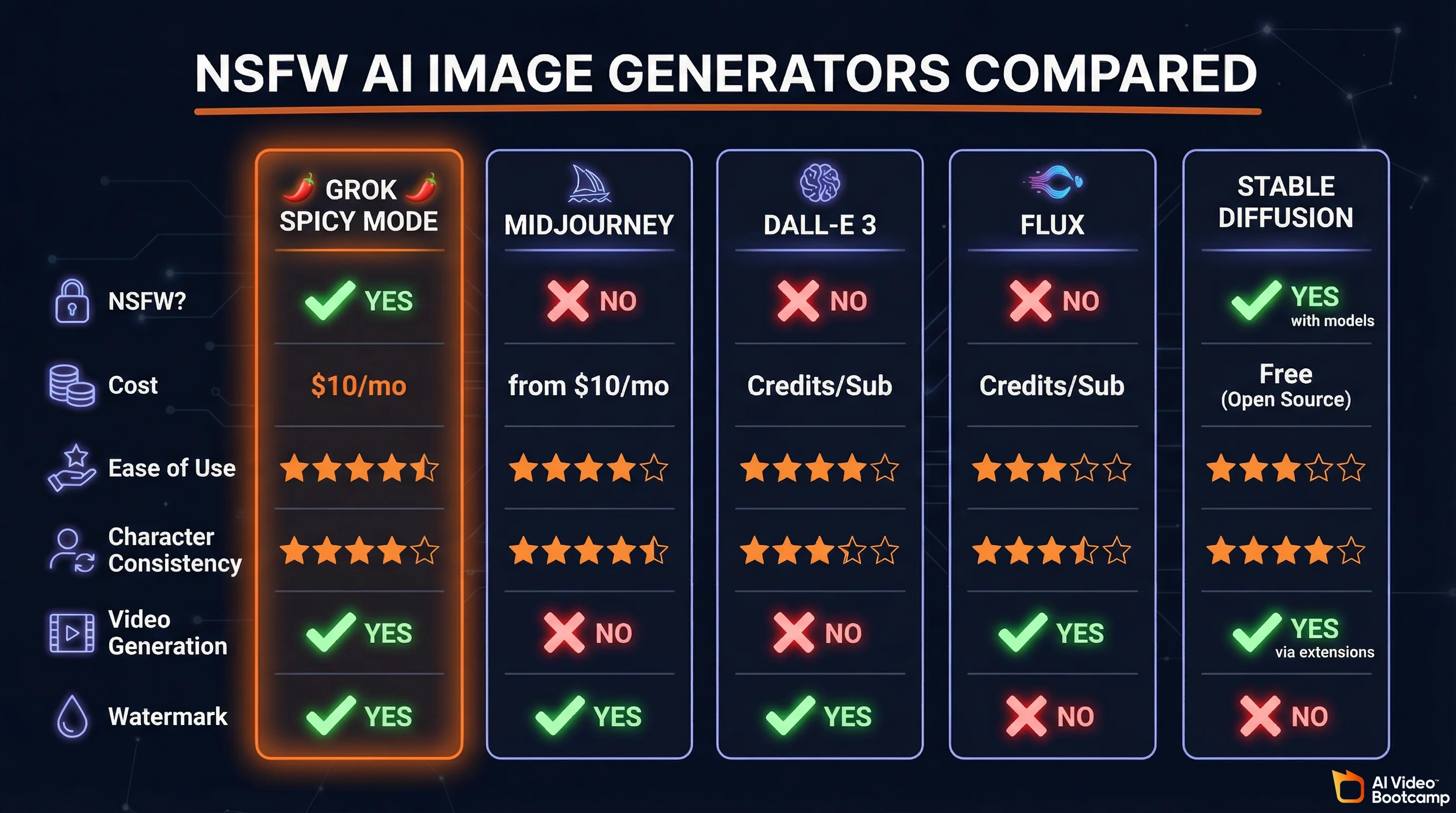
NSFW AI Image Generator Comparison
| Feature | Grok Spicy Mode | Midjourney | DALL-E 3 | Flux (Open-Source) | Stable Diffusion (Local) |
|---|---|---|---|---|---|
| NSFW Content | Yes (Premium+) | No (strict PG-13) | No (very strict) | Yes (uncensored) | Yes (fully uncensored) |
| Monthly Cost | $16-$30 | $10-$60 | $20 (ChatGPT Plus) | Free (local) or cloud GPU costs | Free (local) or cloud GPU costs |
| Image Quality | High (Aurora model) | Very high | High | Very high (Flux 2 Pro) | Variable by model |
| Ease of Use | Very easy (chat prompt) | Easy (Discord/web) | Very easy (chat prompt) | Complex (ComfyUI setup) | Complex (local setup) |
| Character Consistency | Limited | Limited | Limited | Excellent (with LoRA) | Excellent (with LoRA) |
| Video Generation | Yes (4-15 sec) | No | No | No (requires separate I2V) | No (requires separate I2V) |
| Image Watermarking | None | Yes | Yes | None | None |
| Deepfake Prevention | Weak (improving) | Strong | Strong | None | None |
For creators focused purely on quick NSFW image generation, Grok Spicy Mode offers the lowest barrier to entry. For creators building a commercial AI influencer pipeline that requires character consistency across hundreds of images, Flux or Stable Diffusion with custom LoRA training through ComfyUI is the professional standard.
How to Get Started: From Zero to First Revenue
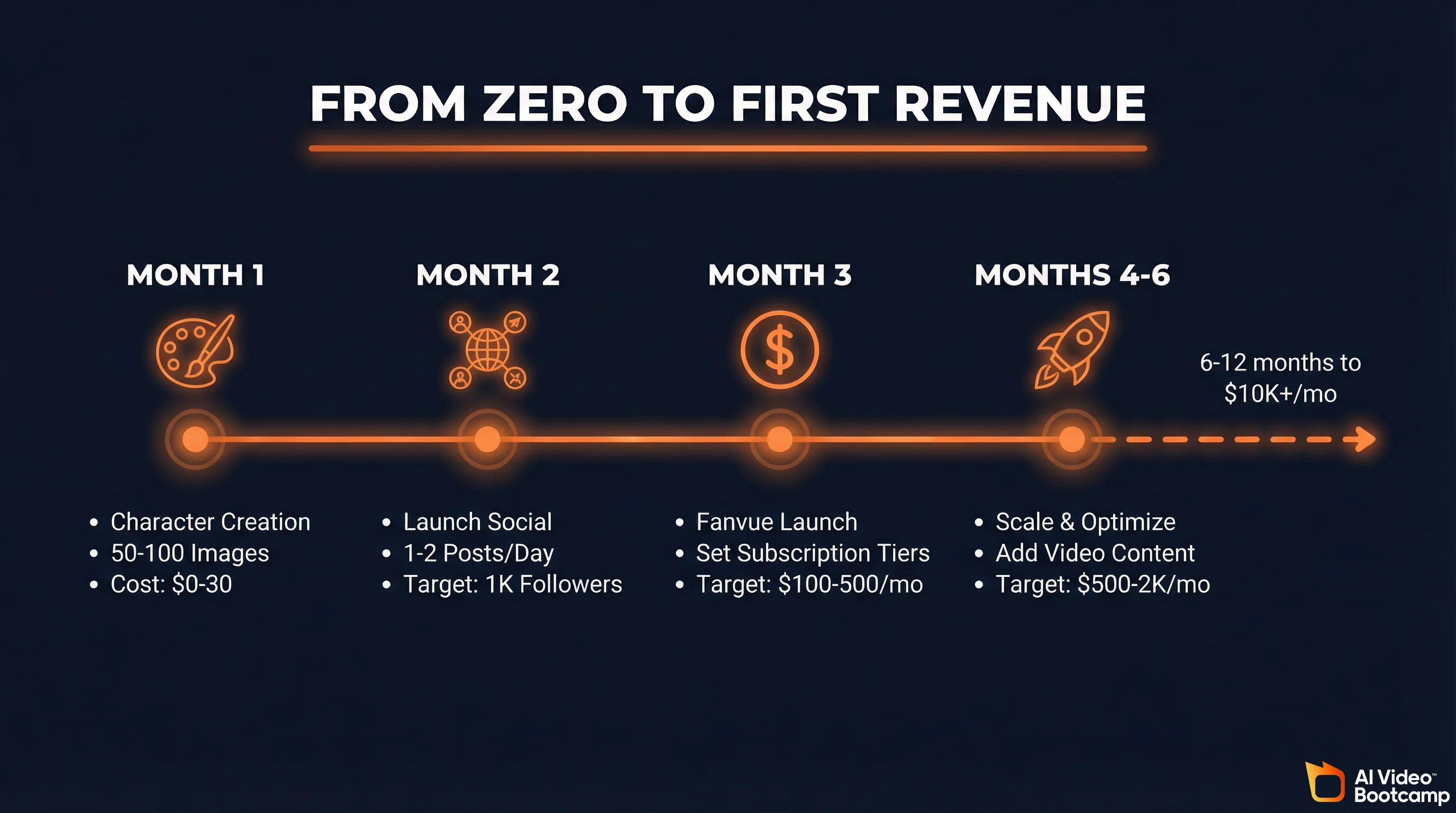
For creators who want to enter the AI influencer space legitimately, here is a realistic path from zero to first revenue. This assumes you are working within the legal and ethical boundaries outlined above.
Month 1 - Character creation and content library: Define your character concept and niche. Generate your base character using NanoBanana PRO (free through Google AI Studio) or Flux through ComfyUI. Build a library of 50-100 consistent images across multiple scenes, outfits, and environments. Train your first LoRA if using ComfyUI. Total cost: $0-30.
Month 2 - Social media presence: Launch Instagram and TikTok accounts. Post 1-2 times daily with a mix of lifestyle, fashion, and personality content. Use the shadowban avoidance strategies covered above. Focus on follower growth, not monetization. Target: 1,000+ followers. Total cost: $0-15 (scheduling tools).
Month 3 - Monetization launch: Create a Fanvue account and complete KYC verification. Set up subscription tiers ($5-15/month is standard for new creators). Begin converting social media followers with teaser content and link-in-bio funnels. Start exploring PPV messaging and custom content requests. First revenue target: $100-500/month.
Months 4-6 - Scale and optimize: Add video content using Wan 2.1/2.2 for image-to-video conversion. Expand to multiple social platforms. Test paid promotion on social platforms where permitted. Analyze what content drives the highest conversion to paid subscribers. Revenue target: $500-2,000/month.
This is not a get-rich-quick path. The AI influencers earning $10,000+ per month have typically been operating for 6-12 months with systematic content production, audience building, and monetization optimization. For more detailed revenue benchmarks across different AI-powered business models, see our case studies of creators earning $10K+ per month.
What Comes Next: The Future of AI-Generated Adult Content
The synthetic adult content industry is at an inflection point. Three trends will define the next 12-18 months.
Better generation, stricter regulation. xAI has publicly stated its goal of generating 30-minute AI videos by late 2026 and full-length films by 2027. Meanwhile, regulators are expanding enforcement targets beyond individual creators to include AI platforms, payment processors, and cloud compute providers. The arms race between generation capability and safety enforcement will intensify.
Conversational AI as the real revenue driver. The highest-earning AI influencer operators consistently report that subscription fees represent only 20% of total revenue. The remaining 80% comes from AI-powered chat interactions, custom content, and parasocial engagement. As conversational AI improves, expect this ratio to shift even further toward chat-based revenue, fundamentally changing what an “AI influencer” business actually looks like.
Platform consolidation. Fanvue’s $100M ARR and $22M Series A signal that venture capital sees synthetic creator monetization as a durable market. Expect acquisitions, new entrants, and increased competition that will ultimately benefit creators through lower platform fees and better tools. The question is not whether AI-generated adult content will be a major industry. It already is. The question is whether creators will navigate it legally and ethically, or become cautionary tales in the next wave of lawsuits and regulatory action.
AI Video Bootcamp covers the tools, techniques, and business models shaping AI-powered content creation. For the complete technical workflow on building AI influencers, read our step-by-step avatar creation guide. For broader market data, see our generative AI media statistics report.