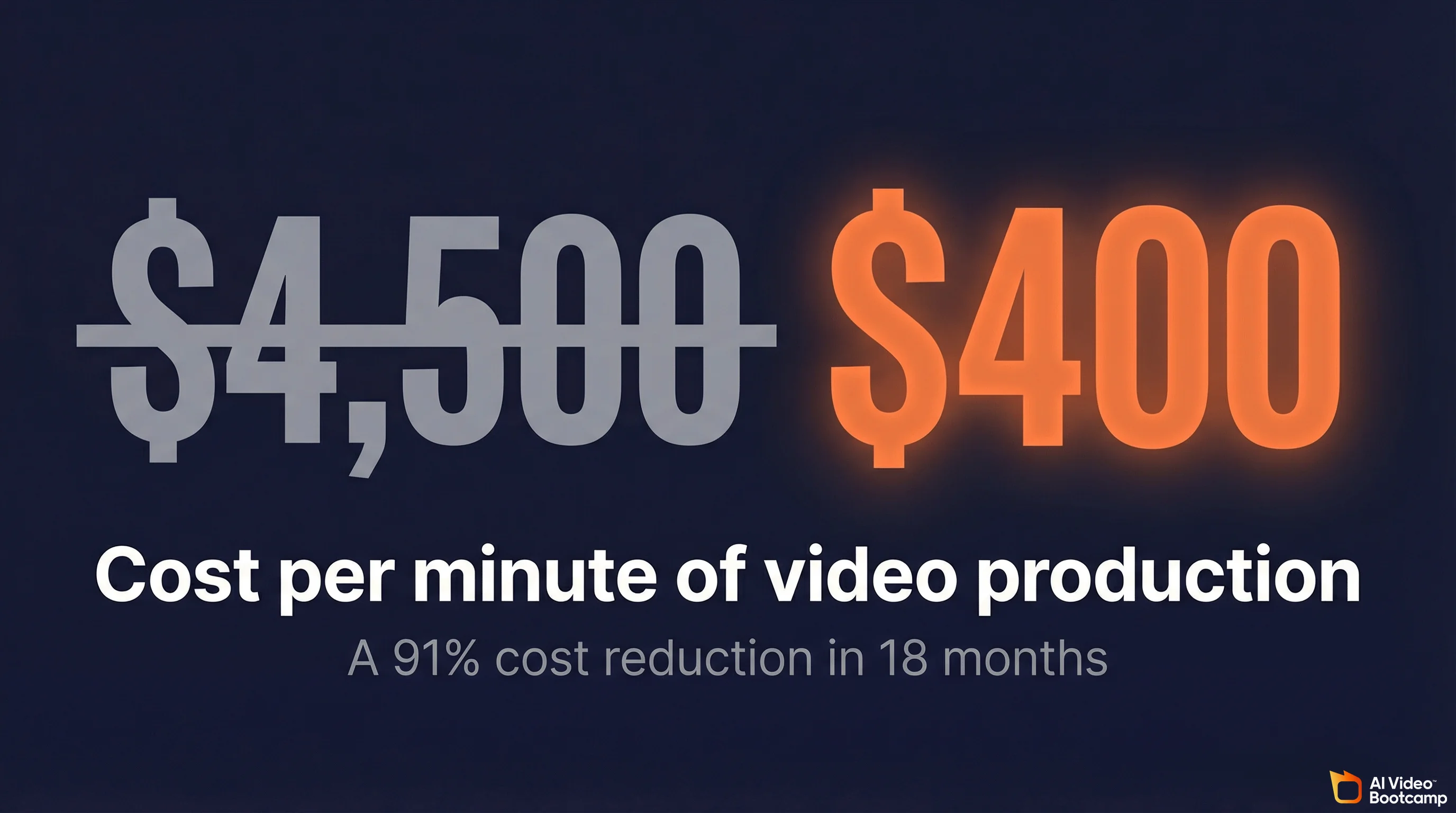
AI video generation reached production quality in 2025, with native 4K resolution, synchronized dialogue, and 120-second single-pass clips now standard across leading platforms. Production costs dropped 91%, from $4,500 per minute to roughly $400 per minute, and the average 60-second marketing video that took 13 days to produce now takes 27 minutes. This article breaks down every major trend in AI video creation, with sourced data from Gartner, PwC, Grand View Research, TechCrunch, Nature, and company filings.
Table of Contents
- The Generation Quality Leap: From Novelty to Production-Ready
- The Tool Landscape: Who’s Winning, Who’s Gone, and Who’s Emerging
- AI Video Tool Comparison Table (April 2026)
- The Audio Revolution: AI Voice and Sound Crossed the Uncanny Valley
- The Creator Workflow Transformation
- The Rise of the Faceless Creator
- Enterprise Adoption: From Experiment to Essential
- The Economics: What AI Video Actually Costs Now
- What’s Coming in 2027: Multimodal, Agentic, and Real-Time
- Frequently Asked Questions
The Generation Quality Leap
AI video generation crossed the production-ready quality threshold in 2025. Native 4K resolution, video lengths up to 120 seconds, reliable temporal consistency, and synchronized audio from a single text prompt are now available across multiple platforms. This section covers the four technical breakthroughs that made it happen.
Resolution hit 4K. Google’s Veo 3.1, released in October 2025, became the first mainstream model to support native 4K generation at 3840x2160 pixels. This is not upscaled 720p. It is native 4K with fine-grained texture and depth that upscaling cannot replicate. Luma’s Ray3.14 update in January 2026 followed with native 1080p at 4x the speed and 3x lower cost than its predecessor.
Video length expanded dramatically. In 2024, the standard AI video clip was 4 to 10 seconds. By early 2026, Kling 2.0 can generate up to 120 seconds in a single pass. Most platforms now generate 15 to 45 second clips as standard, and Alibaba’s Wan 3.0 (targeting mid-2026) aims for 30+ seconds at 4K with a 60-billion parameter model.
Temporal consistency became reliable. The shift from pure diffusion models to hybrid architectures with explicit state representations solved the biggest complaint about early AI video: characters that morphed between frames, backgrounds that shifted, and physics that defied reality. Visual consistency now outperforms creativity as the competitive differentiator. Coherence is table stakes.
Native audio generation arrived. This is the breakthrough that changed everything. Google’s Veo 3 introduced joint audio-visual generation, where the model processes visual patches and temporal audio information simultaneously during diffusion. It produces video with synchronized dialogue, ambient sound, and sound effects from a single text prompt. Lip-sync accuracy is within 120 milliseconds. ByteDance’s Seedance 2.0 and Kling 2.6 quickly followed with their own audio-visual models.
The Tool Landscape
The AI video market consolidated in early 2026 after OpenAI’s Sora shutdown. As of April 2026, the market has organized into four tiers: quality-first (Runway), cost-efficiency (Kling), ecosystem-integration (Google Veo), and multimodal-first (Seedance), with open-source models (Wan, Genmo Mochi) forming a fifth tier.
The Leaders
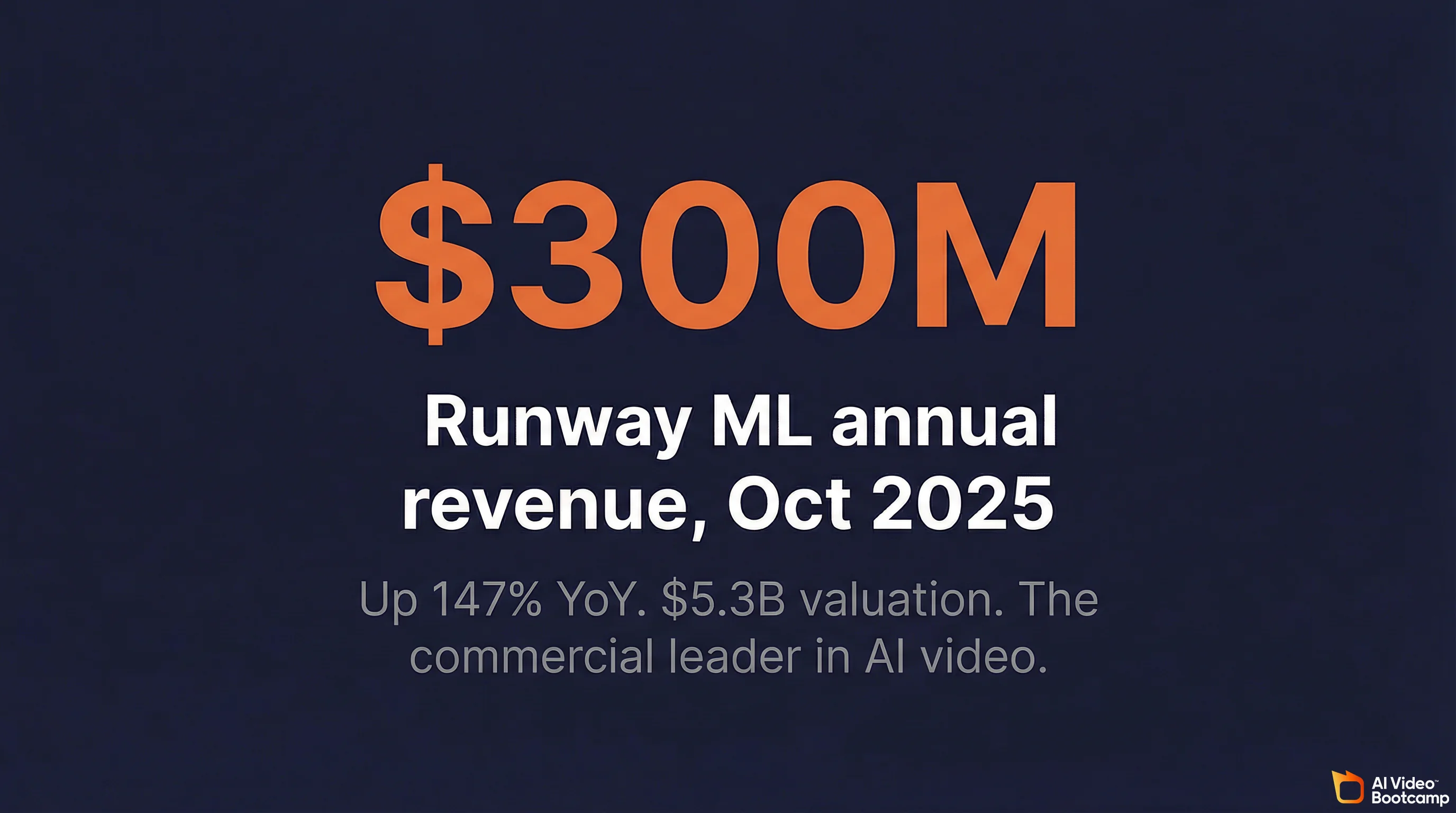
Runway is the commercial leader in AI video. Runway ML hit $300 million in revenue in October 2025, up 147% year over year. It raised $315 million in Series E funding at a $5.3 billion valuation in February 2026, bringing total funding to $860 million across 7 rounds. Gen-4 (April 2025) brought consistent character generation, native 4K output, and enhanced spatial understanding. Gen-4 Turbo halved generation costs at 5 credits per second. Pricing ranges from $12 per month (Standard, roughly 52 seconds of Gen-4 video) to $76 per month (Unlimited in Relaxed Mode).
Google Veo 3 / 3.1 redefined what is possible by being the first model to generate video with native synchronized audio in a single pass: dialogue, sound effects, and ambient noise. Veo 3.1 added true 4K resolution and richer audio with stronger prompt adherence. Testing shows Veo 3.1 follows cinematographic instructions accurately 85 to 90% of the time. The upcoming Veo 3.2 reportedly introduces character locking and a physics-simulation engine codenamed “Artemis.”
Seedance 2.0 (ByteDance) launched March 24, 2026, and immediately made waves. It is a unified multimodal architecture that accepts text, images, audio, and video as inputs simultaneously, supporting up to 9 reference images, 3 video clips, and 3 audio clips in a single pass. It generates 15-second clips at 1080p with native multilingual dialogue. On Artificial Analysis benchmarks, Seedance 2.0 achieved an Elo rating of 1,269, beating Veo 3, Sora 2, and Runway Gen-4.5. It is available globally through Dreamina and is being integrated into CapCut.
The Contenders
Kling AI went from budget option to serious contender. Kling 2.5 Turbo (September 2025) delivered 60% faster generation and 62% lower cost. Kling 2.6 (December 2025) added simultaneous audio-visual generation with synchronized voiceovers and dialogue. Kling 2.0 holds the record for the longest single-pass generation at 120 seconds.
Pika Labs grew to 11+ million total users, with 500,000 active creators generating millions of videos weekly. Pika 2.2 introduced “Pikaframes,” a keyframe transition technology enabling smoother scene transitions. Financial projections estimate $130 million+ in revenue for 2026, up from $50 million in 2024. Meta held acquisition discussions with Pika in July 2025.
Luma Dream Machine captured 15 to 20% of the AI video market by late 2025, positioned between Pika’s accessibility and Runway’s professional tools. Ray3.14 brought native 1080p, 4K 60fps output, and Character Seed technology for identity consistency across clips.
Alibaba Wan 2.6 is notable for its open-source approach (Apache 2.0 license). It is the first model to offer reference-to-video (upload a character video with appearance and voice) and multi-person dialogue with intelligent multi-shot storytelling. Over 600 million videos have been generated using Wan models by end of 2025. Wan 3.0 targeting mid-2026 aims for 4K, 30+ seconds continuous generation, and 2 to 5 minute automated narratives.
The Exit
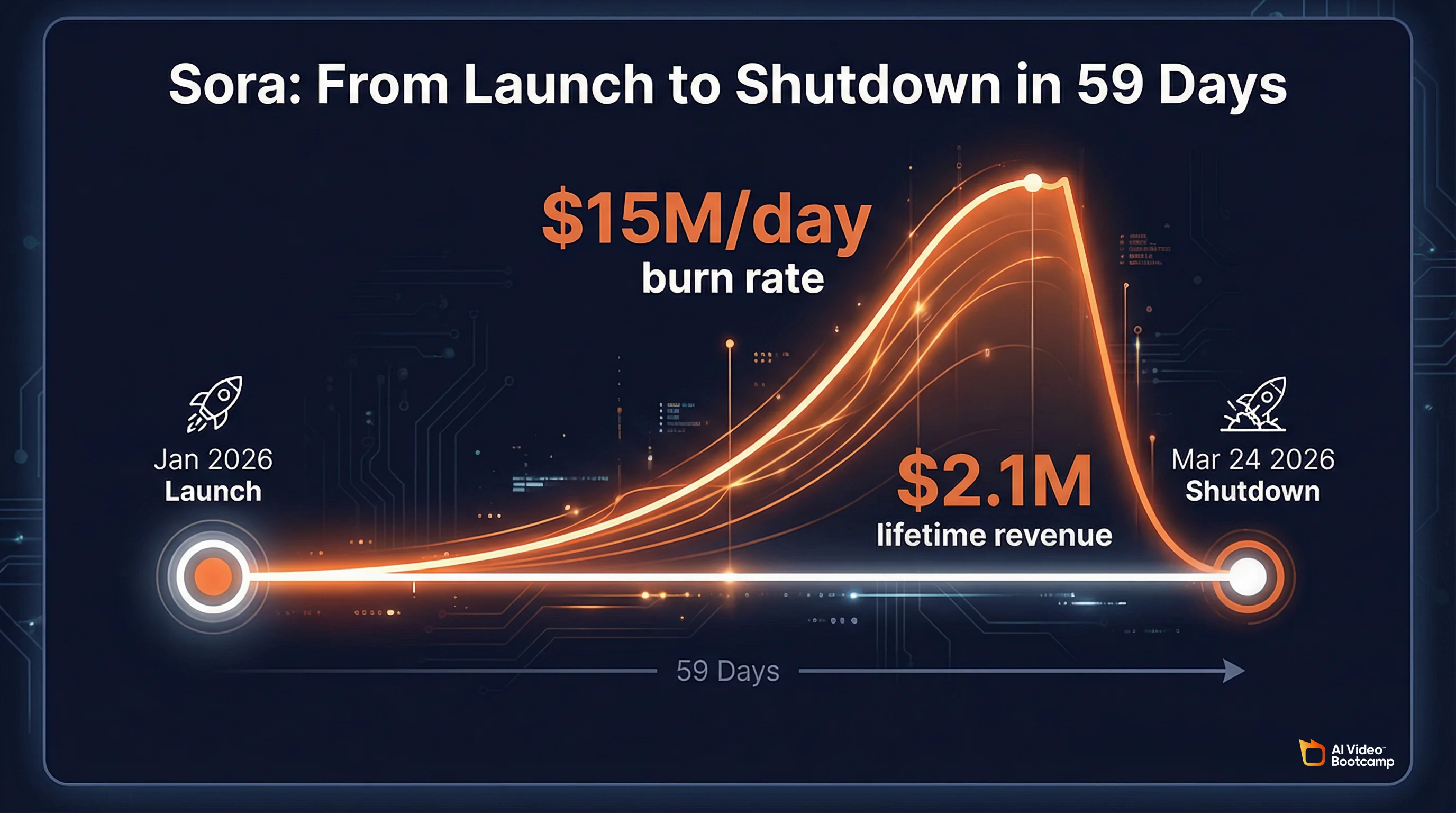
OpenAI shut down Sora on March 24, 2026. Sora 2 had launched to Plus ($20/month) and Pro ($200/month) subscribers in January 2026, generating 15 to 25 second videos with native audio. But the economics did not work. The platform was reportedly burning $15 million per day in inference costs against $2.1 million in total lifetime revenue. Sora’s exit removed an underpriced, VC-subsidized competitor and accelerated market consolidation around platforms with sustainable business models.
The Editing Revolution
AI is not just generating video from scratch. It is transforming every step of the editing workflow.
Adobe Premiere Pro (January 2026 update) added AI object masking with single-click tracking, Generative Extend (seamlessly add frames to clips in 4K), Media Intelligence (search through visuals and transcripts across thousands of shots in seconds), caption translation in 27+ languages, and a tracking engine that is 20x faster than its predecessor.
DaVinci Resolve 20 introduced AI IntelliScript (create timelines from text), AI Multicam SmartSwitch (automatic camera angle selection based on speaker detection), AI Audio Assistant (intelligent audio mixing), and IntelliTrack AI (object tracking without keyframes). The free version includes most AI tools; Studio costs $295 one-time.
Descript pioneered text-based video editing (edit video like a document), one-click filler word removal, voice cloning with Overdub, and in December 2025 added video translation with lip-sync matching. It now integrates Kling O1 for high-resolution video generation up to 10 seconds.
CapCut expanded with Script-to-Video (input text, get assembled draft), Smart Cutout 3.0 (background removal in 8 seconds), Audio Restore Pro (separate speech, music, ambient noise), and now integrates ByteDance’s Seedance 2.0 for AI video generation directly in the editor.
AI Video Tool Comparison Table (April 2026)
Below is AI Video Bootcamp’s original comparison of the leading AI video generation platforms, based on publicly available specs, pricing pages, and benchmark data as of April 2026.
| Platform | Max Length | Max Resolution | Native Audio | Pricing (per month) | Best For |
|---|---|---|---|---|---|
| Runway Gen-4 | 10-15 sec | 4K | No (separate) | $12 - $76 | Professional quality, character consistency |
| Google Veo 3.1 | 8 sec | 4K (native) | Yes (dialogue + SFX) | Google ecosystem | Synchronized audio-visual, prompt accuracy |
| Seedance 2.0 | 15 sec | 1080p | Yes (multilingual) | Free (limited time) | Multimodal inputs, benchmark performance |
| Kling 2.6 | 120 sec | 1080p | Yes (voiceover + SFX) | Tiered plans | Long clips, cost-efficiency |
| Pika 2.2 | 10 sec | 1080p | No | Entry-level tiers | Accessibility, fast social content |
| Luma Ray3.14 | 5 sec (native) | 4K 60fps | No | Tiered plans | Photorealism, character identity |
| Alibaba Wan 2.6 | 15 sec | 1080p | Yes (dialogue) | Open source (free) | Multi-character narratives, open access |
| Adobe Firefly Video | Varies | 1080p (4K coming) | No (separate tools) | Creative Cloud sub | Enterprise, commercial safety |
Data compiled by AI Video Bootcamp from official documentation, pricing pages, and third-party benchmarks. Specs change frequently; check official sources for the latest. For the latest AI media market data, see our Generative AI Media Statistics 2026 report.
The Audio Revolution
AI voice synthesis became indistinguishable from human speech in 2025, with listeners unable to identify AI-generated voices better than chance. Combined with native audio-visual generation from models like Veo 3 and voiceover costs dropping 95%+, audio went from the weakest link to the strongest enabler in the AI video pipeline.
AI Voices Became Indistinguishable From Human
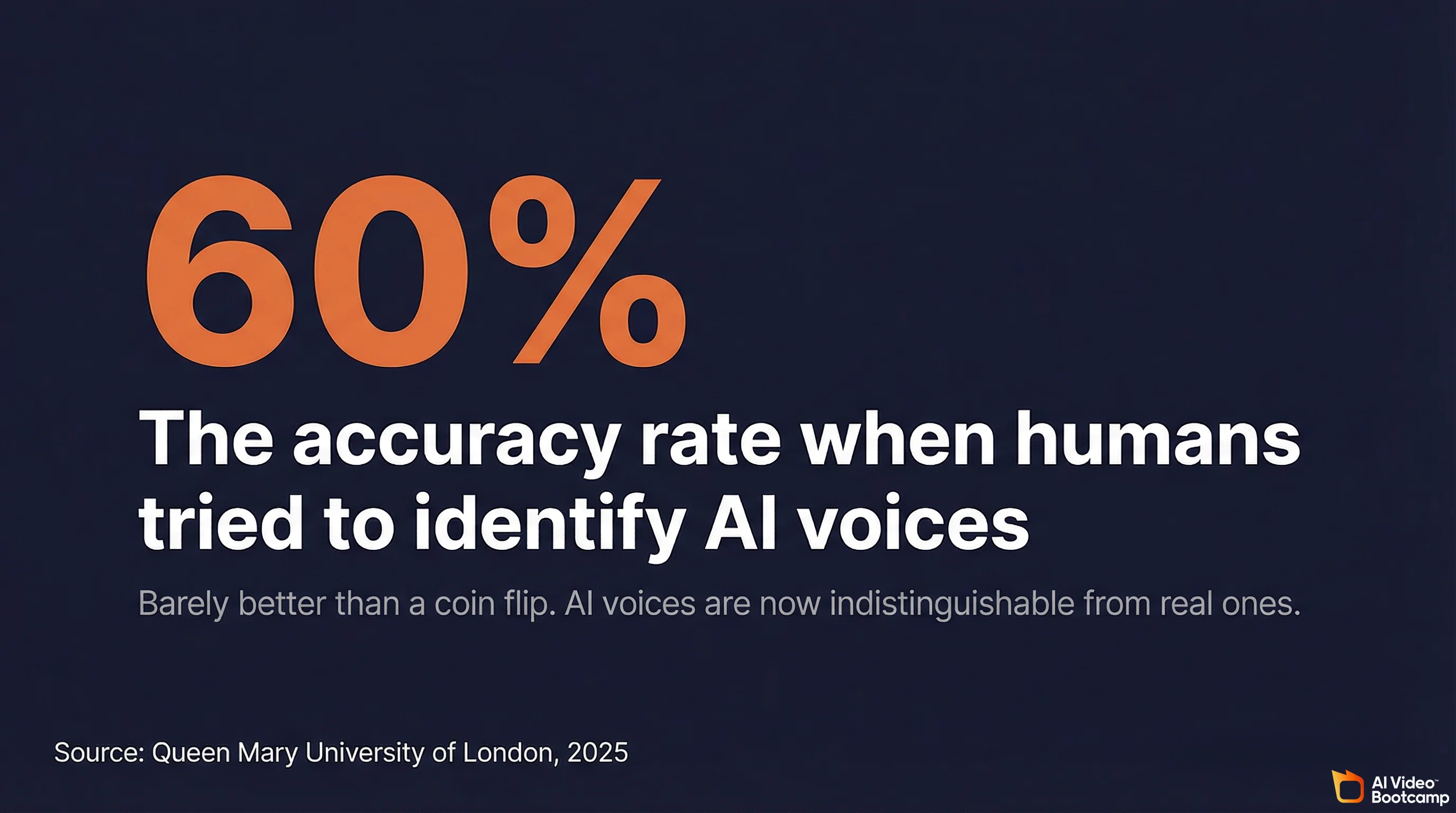
A September 2025 study from Queen Mary University of London delivered a definitive finding: AI-generated voices are now indistinguishable from real human voices. Participants perceived AI-cloned voice identity as the same as the real counterpart approximately 80% of the time, and correctly identified voices as AI-generated only about 60% of the time, barely better than a coin flip.
A separate study published in Nature Scientific Reports found that AI-generated voices are judged as more dominant than human voices, and some are perceived as more trustworthy. The remaining differentiation comes from prosodic variation, the subtle shifts in tone that AI still handles less naturally than humans in emotionally complex deliveries.
ElevenLabs Set the Standard
ElevenLabs’ Eleven v3, released in June 2025 and moved to general availability in March 2026, supports 70+ languages with multi-speaker dialogue, audio tags like [excited], [whispers], and [sighs] for directing vocal actions, and text-to-dialogue that weaves multiple voices with matching prosody. The company closed 2025 with $330 million in ARR and raised $500 million at an $11 billion valuation in February 2026.
ElevenLabs also launched Eleven Music in August 2025, the first AI music generator explicitly cleared for YouTube monetization without copyright strikes, thanks to commercial licensing through Merlin Network and Kobalt partnerships.
The Cost Collapse in Voiceover
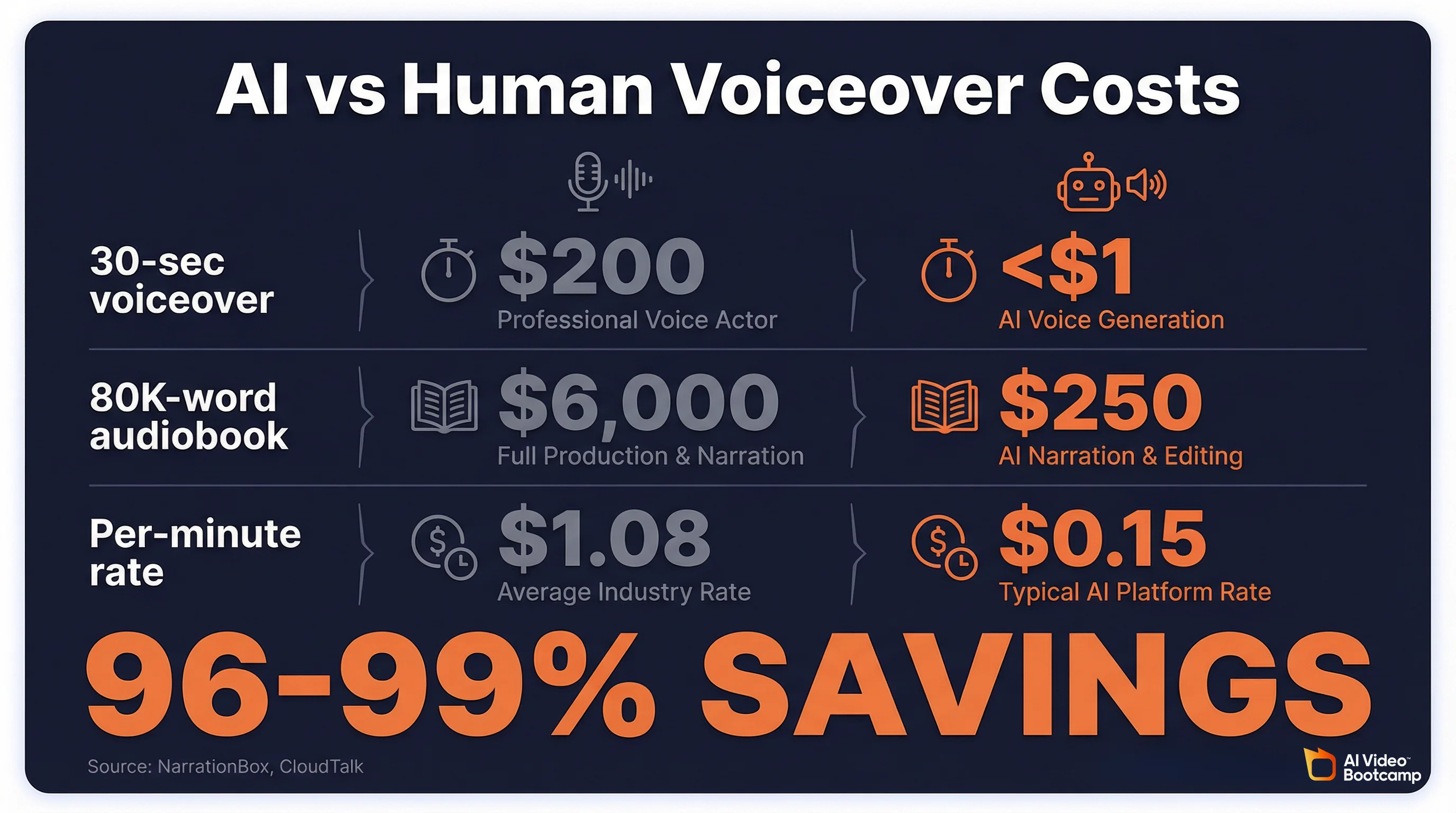
The voiceover pricing shift is one of the starkest economic transformations in all of AI. Here are the numbers:
| Use Case | Human Cost | AI Cost | Savings |
|---|---|---|---|
| 30-second voiceover | $50 - $200 | Less than $1 | 99%+ |
| 80,000-word audiobook (8-9 hours) | $2,400 - $6,000 (4-6 weeks) | $40 - $250 (under 1 hour) | 96-98% |
| Per-minute voiceover rate | $0.42 - $1.08 | $0.08 - $0.15 | 81-86% |
Sources: NarrationBox, CloudTalk
AI dubbing for video localization can now cut costs by up to 90% and reduce production times from months to days, with platforms like ElevenLabs, Perso AI, and Maestra offering 125+ language coverage with voice cloning that preserves the original speaker’s tone and rhythm.
For a complete breakdown of AI audio and music generation market data, see our Generative AI Media Statistics 2026 report.
Creator Adoption of AI Voice
An estimated 80%+ of the voiceover market is shifting to AI. Among content creators specifically, 47% of documentary-style content on streaming platforms now uses AI voice narration. A University of British Columbia study found that AI voice adoption increased TikTok creator video production by 21.8%, with the biggest gains among less experienced creators.
The Creator Workflow Transformation
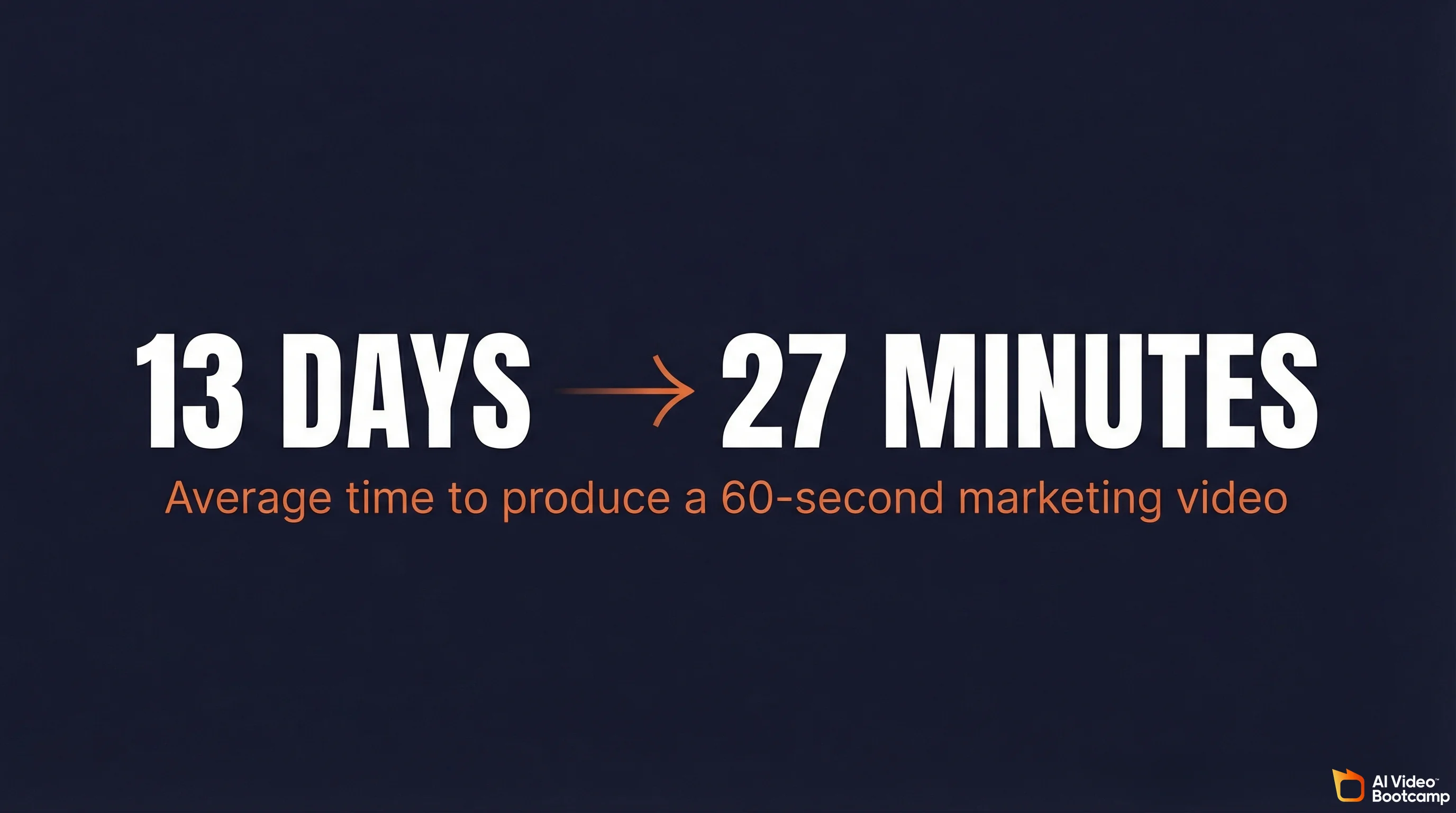
AI video tools compressed production timelines by 80 to 97%, with 81% of marketers reporting at least 3 hours saved per project and the average 60-second marketing video dropping from 13 days to 27 minutes. Solo creators are now producing 5 to 10x more video than their 2024 counterparts.
The Numbers
81% of marketers report saving substantial time with AI in video production, with most saving at least 3 hours on creation and editing tasks. 69% of content creators say AI editing tools help them post videos 2x as often, with 54% reporting faster workflows. A 10-minute educational video that traditionally took 3 to 4 hours now takes 30 to 45 minutes with AI tools, an 80 to 85% time reduction. Real estate property tour videos were cut from 2 to 3 hours to 20 minutes. The average time to produce a 60-second marketing video dropped from 13 days to 27 minutes.
The One-Person Studio Is Real
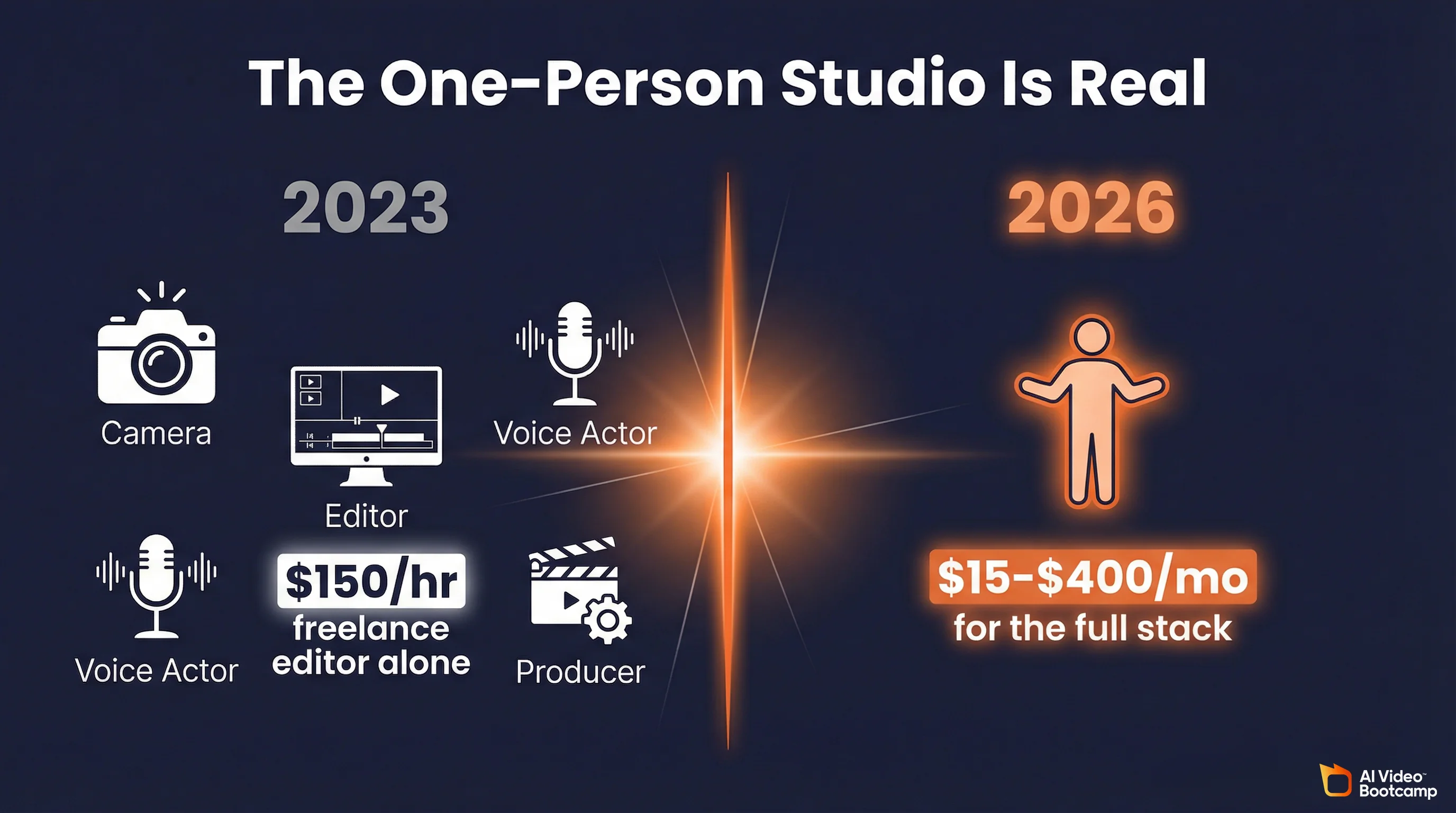
Solo creators using AI are now producing 5 to 10x more video than their 2024 counterparts. The entry point for a full AI video production pipeline starts at roughly $15 per month (CapCut or LTX Studio Lite), with mid-tier setups at $50 to $100 per month combining a generation tool (Runway or Kling), an editing platform (Descript or CapCut), and a voice tool (ElevenLabs).
Some extreme examples include teams of 4 people operating 300-video monthly production pipelines and individual creators producing post-ready videos in under 15 minutes. The production capacity bottleneck has shifted from technical execution to creative strategy.
AI Thumbnails and Content Optimization
67% of creators have adopted AI-powered thumbnail generators, which boost click-through rates by 154 to 234% on average. AI thumbnail A/B testing predicts winning variants with up to 89% accuracy and reduces design time by 74%. YouTube’s native “Test & Compare” feature, rolled out in 2025, allows upload of up to 3 thumbnails per video with automatic traffic split testing.
Short-Form Content Automation
An entire category of tools now exists to extract short-form clips from long-form video for TikTok, Instagram Reels, and YouTube Shorts. Tools like Opus Clip, Reap, CapCut, and Submagic handle clip identification, trimming, captioning, reframing, and platform-specific optimization automatically. The key insight that separates good creators from mediocre ones: each platform (TikTok, Reels, Shorts) has distinct algorithms and audience behaviors. Successful repurposing requires platform-native optimization, not just cutting the same clip three ways.
The Rise of the Faceless Creator
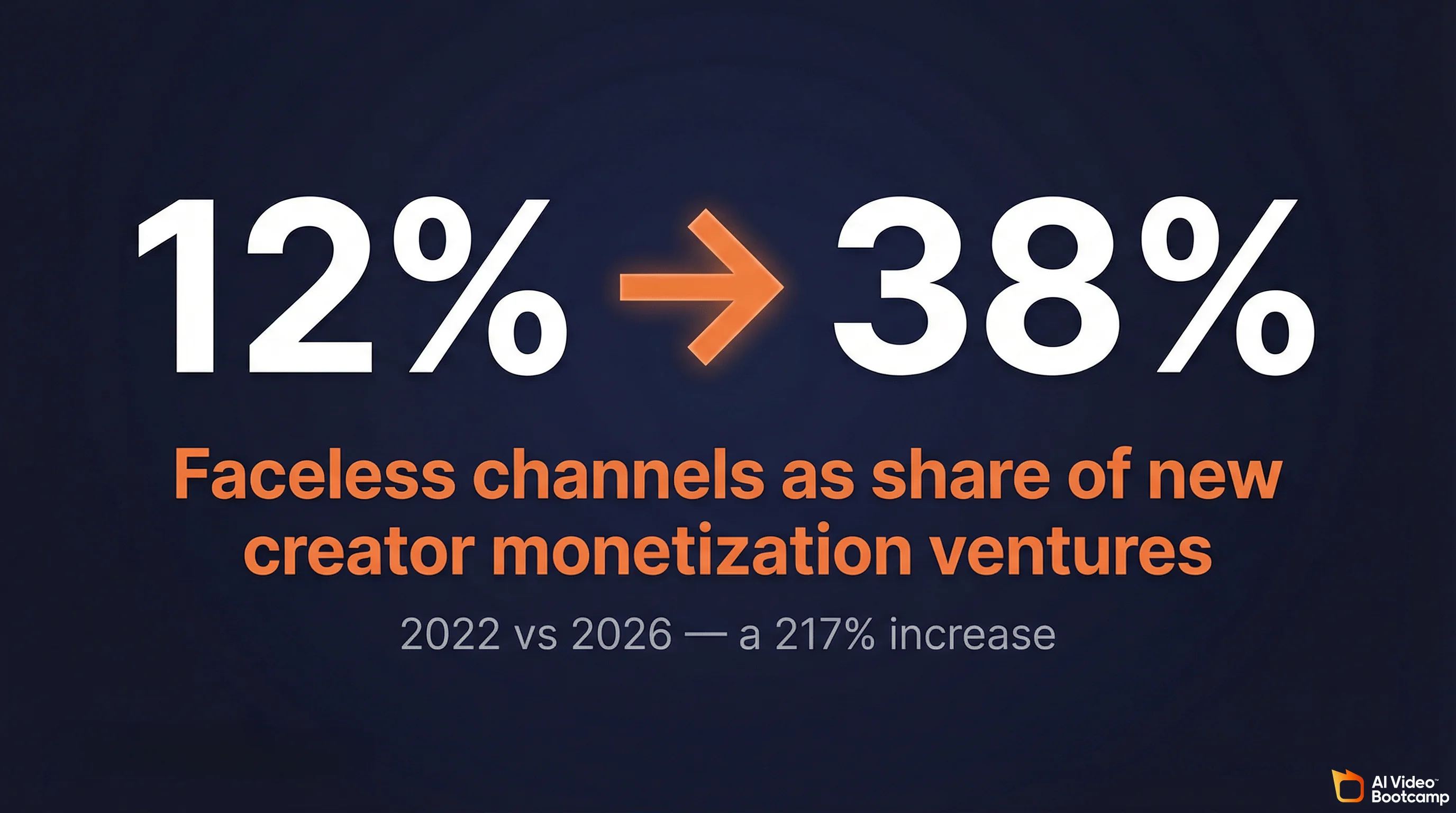
Faceless YouTube and TikTok channels, where creators never appear on camera, now represent 38% of all new creator monetization ventures, up from 12% in 2022. This 217% increase is directly enabled by AI video tools that combine AI-generated visuals, synthetic voiceover, and automated editing.
The economics are compelling. Top faceless channels include BRIGHT SIDE (45 million subscribers, $23,000 to $75,000 monthly revenue) and Daily Dose of Internet (20 million subscribers, $140,000 to $400,000 in monthly ad revenue). These channels demonstrate that massive audiences can be built entirely without on-camera talent.
What is driving this trend: 72% of Gen Z viewers prioritize content quality over creator visibility, and 86% of consumers perceive faceless content as more authentic because it focuses on the message rather than the messenger.
The monetization timeline for new faceless channels typically follows a predictable curve: 6 to 12 months to reach YouTube’s monetization threshold, with payouts scaling from $50 to $500 per month initially to $500 to $5,000 per month by months 12 to 18. With AI tools reducing per-video costs by 80 to 95%, the economics work even at modest view counts.
This trend is directly enabled by AI video tools. The combination of AI-generated visuals, synthetic voiceover, automated editing, and AI thumbnail optimization means a single person can operate a faceless channel that produces daily content. That would have required a small production team 18 months ago.
AI Video Bootcamp covers faceless channel creation strategies in depth in our AI Video Creation Course. For the full creator economy data, see our Generative AI Media Statistics 2026 report.
Enterprise Adoption
78% of marketing teams now use AI-generated video in at least one campaign per quarter (up from 30% in early 2024), 79% of eCommerce brands use AI video for product showcases, and 68% of businesses use AI video for employee onboarding. Enterprise spending on AI video platforms grew 127% year over year in 2025.
Advertising and Brand Marketing
86% of ad buyers are using or planning to use generative AI to build AI video ads in 2026. Real campaigns tell the story. Coca-Cola generated 70,000+ AI clips for its “Holidays Are Coming” 2025 campaign using GPT-5, assembling the campaign in under a month, as part of a $1.1 billion AI commitment across marketing, product development, and supply chain. Nike’s “Never Done Evolving” campaign reconstructed 130,000 full tennis matches between two AI-generated versions of Serena Williams.
The results are measurable: AI-generated videos posted on Facebook and Instagram receive 32% more user interactions compared to traditional videos. Brands using AI video report 33% higher viewer retention and 20% better conversion rates. LinkedIn saw a 310% increase in AI-generated video content shared in 2025.
E-Commerce
79% of eCommerce brands use AI-generated videos to showcase products, and AI-generated product demonstration videos boost conversion rates by an average of 40%. E-commerce brands using AI video saw product listing engagement increase by 156%. Dynamic creative optimization (automatically swapping product images, copy, and video based on viewer behavior) is now used by 82% of advertisers.
Corporate Training
68% of businesses use AI video for internal communications and employee onboarding. A global retailer producing 50,000+ new hire onboarding videos annually reduced costs from $2.1 million to $430,000, a 79% reduction, while increasing content freshness from quarterly to monthly updates. AI now translates training videos in real-time while preserving the speaker’s voice and tone.
Film and Pre-Production
Hollywood remains cautious. Less than 3% of major US/EU studio production budgets go directly to AI tools. But 7% of operational spending is shifting to generative-AI-enabled workflows for pre-visualization, concept art, storyboarding, and localization. Filmmakers can now preview scene layouts, camera angles, tone, and lighting styles instantly, replacing static storyboards with dynamic visuals. Expensive concept art phases that took weeks are shrinking to hours.
The Stock Footage Disruption
The traditional stock footage model is under existential pressure. A marketing agency spending $6,000 per month on stock licensing can achieve comparable output for $400 in AI generation credits. Getty Images reported record revenue of $981.3 million in 2025 and responded by merging with Shutterstock and pivoting to AI licensing partnerships with Nvidia, Runway, Perplexity, and Picsart. But Getty also issued a “going concern” warning in March 2026 due to merger debt and the accelerating irrelevance of traditional stock models.
The Economics
AI video generation costs dropped approximately 60% since early 2025, with the average cost per second falling from $0.25 to $0.40 down to $0.10 to $0.15. Total production cost reductions range from 70 to 99% depending on project complexity. A solo creator can now run a full production operation for $15 to $400 per month.
AI vs. Traditional Video Production Costs
| Production Type | AI Cost | Traditional Cost | Savings |
|---|---|---|---|
| Per minute (generation) | $0.50 - $30 | $1,000 - $5,000 (freelance) | 94-99% |
| Per minute (agency-level) | $0.50 - $30 | $15,000 - $50,000+ | 99%+ |
| 10-video social campaign | ~$89 | $100,000+ (agency) | 99.9% |
| Single marketing video | Under $800 | $5,500 (avg. agency) | 85% |
| 60-second marketing video timeline | 27 minutes | 13 days | 99.9% (time) |
Sources: vidBoard.ai, MindStudio, Vivideo
Platform Pricing (April 2026)
Runway: $12/month (Standard, ~52 seconds of Gen-4 video) to $76/month (Unlimited in Relaxed Mode). Gen-4 costs 10 to 12 credits per second; Gen-4 Turbo costs 5 credits per second.
Kling: Tiered subscription with professional mode and 1080p output. 62% cost reduction with Kling 2.5 Turbo vs. earlier versions.
Pika: Consumer-friendly pricing starting at entry-level tiers with Discord and web access. 11+ million total users.
Adobe Firefly: Unlimited AI image and video generation for paid Creative Cloud subscribers. Monthly credit limits were removed in 2026.
The Full-Stack Creator Budget
A solo creator can now run a fully AI-powered video production operation at three tiers:
Entry level ($15 to $30 per month): CapCut Pro + free tier generation tools. Suitable for short-form social content and faceless channels.
Mid-tier ($50 to $150 per month): Runway Standard + ElevenLabs Creator + editing tool. Enough for a YouTube channel publishing 2 to 3 videos per week.
Professional ($200 to $400 per month): Runway Pro/Unlimited + ElevenLabs Pro + Adobe Creative Cloud. Full production capability comparable to a small studio.
Compare this to 2023, when hiring a freelance video editor alone cost $50 to $150 per hour. A single project’s editing budget now covers an entire month of AI-powered production tools.
AI Video Bootcamp teaches the complete AI video production stack from entry to professional level. See our course curriculum for details.
What’s Coming in 2027
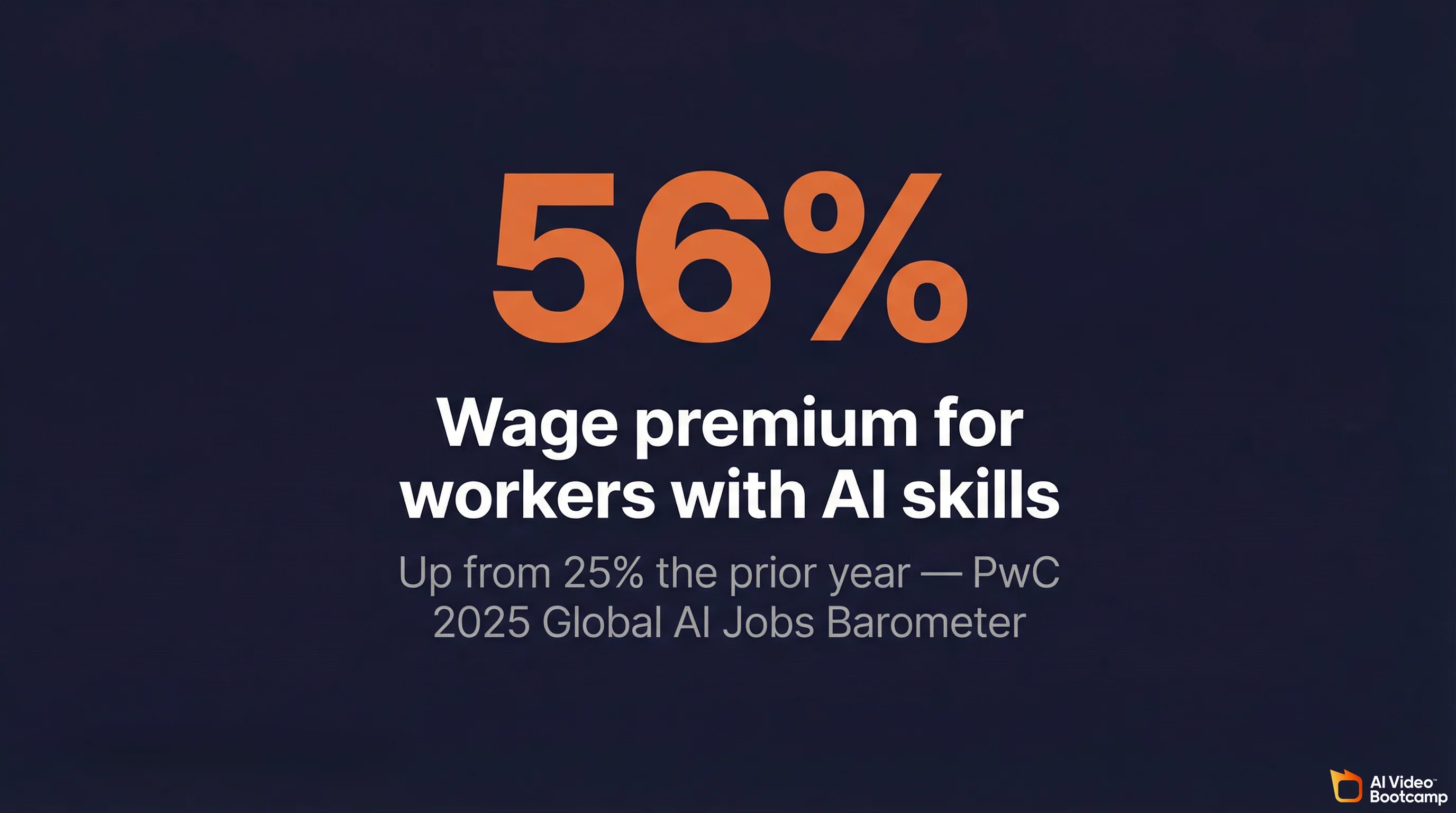
By 2027, 40% of generative AI solutions will be multimodal (up from 1% in 2023), more than 50% of enterprise GenAI models will be industry-specific, and workers with AI skills will continue commanding a 56%+ wage premium. The AI video market is on track to reach $3.44 billion by 2033.
Multimodal Convergence
40% of generative AI solutions will be multimodal (text, image, audio, and video) by 2027, up from 1% in 2023, according to Gartner. The silos between image, video, and audio generation tools are collapsing. We are already seeing this with Seedance 2.0 (accepts text, images, audio, and video simultaneously), Veo 3 (joint audio-visual generation), and ElevenLabs’ expansion into image, video, and music from its voice-first origins.
By 2027, the dominant creative tools will not be “image generators” or “video generators.” They will be unified creative platforms where you describe what you want and the system chooses the right modality. Creators who understand all three modalities (visual, video, and audio) will have a significant competitive advantage.
Multi-Minute Coherent Narratives
Alibaba’s Wan 3.0 roadmap targets 2 to 5 minute automated multi-shot narratives with consistent characters by mid-2026, using a 60-billion parameter model. If achieved, this would represent the shift from “AI generates clips” to “AI generates scenes.” Combined with tools like LTX Studio that handle scripting, storyboarding, and final delivery, the path to fully AI-generated short films is becoming visible.
Real-Time and Interactive Generation
Generation speeds are dropping from minutes to seconds, enabling interactive creative workflows. Rather than typing a prompt and waiting, creators will manipulate AI video in real-time, adjusting camera angles, lighting, and character actions through direct-manipulation interfaces comparable to video game engines or CAD software. Early versions of this are already visible in Runway’s director mode and Pika’s Pikaframes.
Industry-Specific Models
By 2027, more than 50% of GenAI models used by enterprises will be specific to an industry or business function, up from approximately 1% in 2023, according to Gartner. For video specifically, this means specialized models optimized for advertising (quick iteration, brand consistency), real estate (property tours, virtual staging), education (instructional video, adaptive learning), and entertainment (pre-visualization, VFX).
The Skill Premium Keeps Growing
Workers with AI skills already earn a 56% wage premium over peers without them, according to PwC, up from 25% the prior year. GenAI course enrollments surged 195% year-over-year on Coursera, with 12 enrollments per minute in 2025 (up from 1 per minute in 2023). The global AI talent shortage stands at a 3.2:1 demand-to-supply ratio.
For video creators specifically, the implication is clear: mastering AI video tools is not a nice-to-have. It is becoming a baseline professional requirement. The creators and professionals who build these skills now are entering a market with far more demand than supply.
Key Takeaways
The quality question is settled. AI video crossed the production-ready threshold in 2025. Native 4K, synchronized audio, 120-second clips, and reliable character consistency mean the question is no longer “is AI video good enough?” but “how do I use it effectively?”
Audio was the real breakthrough. Veo 3’s joint audio-visual generation, ElevenLabs’ indistinguishable voice synthesis, and the 95%+ cost reduction in voiceover changed AI video from a visual novelty to a complete production pipeline. The Queen Mary University finding that AI voices are indistinguishable from real ones at 80% accuracy is the data point that matters most for creators.
The economics are irresistible. From $4,500 per minute (traditional) to $400 per minute (AI) in production costs. From 13 days to 27 minutes for a marketing video. From $6,000 per month in stock licensing to $400 in AI credits. These are not marginal improvements. They are order-of-magnitude shifts restructuring entire industries.
The winner’s playbook is clear. The market has consolidated: Runway leads on quality and revenue, Kling on cost-efficiency, Google Veo on ecosystem integration, Seedance on multimodal capabilities, and the open-source tier (Wan, Genmo Mochi) on accessibility. Sora’s exit proved that even the biggest name in AI can fail in video if the unit economics do not work. The winners are platforms with focused value propositions and sustainable pricing, and the creators who learn to use them skillfully.
Frequently Asked Questions
What is the best AI video generator in 2026?
Runway Gen-4 is the current commercial leader with $300 million in revenue and a $5.3 billion valuation, offering the strongest combination of quality, character consistency, and professional features. However, “best” depends on use case: Google Veo 3 leads on native audio-visual generation, Kling 2.6 offers the longest clips (120 seconds) at the lowest cost, Seedance 2.0 leads on multimodal input support and benchmark scores, and Alibaba Wan 2.6 is the top open-source option. See our comparison table above for a detailed side-by-side breakdown.
How much does AI video production cost compared to traditional video?
AI video production costs $0.50 to $30 per minute, compared to $1,000 to $5,000 per minute for traditional freelance production and $15,000 to $50,000+ per minute for agency work. This represents a 91 to 99%+ cost reduction. A complete solo creator setup runs $15 to $400 per month. The average 60-second marketing video now takes 27 minutes to produce instead of 13 days.
What happened to OpenAI Sora?
OpenAI shut down Sora on March 24, 2026. Sora 2 had launched in January 2026 with 15 to 25 second video generation and native audio, but the platform was reportedly burning $15 million per day in inference costs while generating only $2.1 million in total lifetime revenue. The shutdown accelerated market consolidation around Runway, Kling, Google Veo, and Seedance.
Can AI voices replace human voiceover artists?
A September 2025 study from Queen Mary University of London found that AI-generated voices are indistinguishable from real human voices, with listeners correctly identifying AI voices only 60% of the time (barely above chance). AI voiceover costs less than $1 for a 30-second clip versus $50 to $200 for a human voice actor, a 99%+ cost reduction. However, human voice actors still hold an edge in emotional complexity and prosodic variation for premium content.
Are AI-generated videos good enough for professional use?
Yes. AI video crossed the production-ready quality threshold in 2025. Native 4K generation is available on Google Veo 3.1 and Luma Ray3.14. Temporal consistency is reliable across leading platforms. Native synchronized audio (dialogue, sound effects, ambient noise) is available on Veo 3, Seedance 2.0, and Kling 2.6. A marketing agency case study showed that in blind tests, clients could not consistently distinguish AI-generated from traditionally produced videos, and both performed similarly in engagement metrics.
Sources
[1] AI MagicX, “4K AI Video Generation 2026: Broadcast Quality”
[2] GoEnhance, “Luma AI Review 2026”; Magic Hour, “Luma Dream Machine Pricing 2026”
[3] AI Tool Analysis, “Kling AI Complete Guide 2026”
[4] Alibaba Cloud Blog, “Alibaba Unveils Wan 2.6 Series”; Latenode, “Alibaba Releases Wan 2.1”
[5] Higgsfield AI, “Visual Consistency Performance 2026”; arXiv, “Spatiotemporal Consistency Survey” (2502.17863)
[6] Google DeepMind, “Veo”; MindStudio, “What Is Google Veo 3”
[7] Skywork AI, “How to Prompt Lip-Synced Dialogue in Google Veo 3”
[8] BuildFastWithAI, “Seedance 2.0 ByteDance AI Video 2026”; TechCrunch, “ByteDance’s Seedance 2.0 Comes to CapCut” (March 2026)
[9] Getlatka, “Runway ML Revenue and Customers 2025”; Skywork AI, “RunwayML Review 2025”
[10] TechCrunch, “AI Video Startup Runway Raises $315M at $5.3B Valuation” (February 2026)
[11] AI Tool Land, “Google Veo 3 Review”; Veo3AI, “Veo 3 Text-to-Video Guide 2026”
[12] TechCrunch, “ByteDance’s Seedance 2.0 Comes to CapCut” (March 2026)
[13] Fueler, “Pika Labs 2026 Growth Statistics”; VentureBeat, “Pika 2.0 Launches” (2025)
[14] Nerd Level Tech, “OpenAI Sora Shutdown: AI’s Most Expensive Failure”
[15] VentureBeat, “Sora 2 Announcement”; GlbGPT, “Sora 2 Pricing Guide 2026”
[16] Adobe Blog, “New AI-Powered Video Editing Tools in Premiere” (January 2026)
[17] Maurizio Mercorella, “DaVinci Resolve 20: New AI Tools & Features”
[18] Fritz AI, “Descript AI Review 2025”; VidMeToo, “Descript Review 2026”
[19] CapCut, “Latest 2025 CapCut Features”; StarryAI, “CapCut: Smarter Video Editing with AI”
[20] Queen Mary University of London, “AI-Generated Voices Now Indistinguishable from Real Human Voices” (September 2025); Singularity Hub coverage
[21] Nature Scientific Reports, “AI Voice Perception Study” (2025)
[22] ElevenLabs Blog, “Eleven v3”; “ElevenLabs Raises $500M Series D at $11B Valuation”
[23] CNBC, “Nvidia-Backed AI Startup ElevenLabs Hits $11 Billion Valuation” (February 2026)
[24] Humai Blog, “AI Music Creation: Suno vs Udio vs ElevenLabs Music”
[25] NarrationBox, “AI Voice vs Human Narrator Cost: 80K Words”
[26] CloudTalk, “How Much Does Voice AI Cost?”
[27] RWS, “AI Dubbing in 2026”; Vocal Media, “Top 7 AI Dubbing Solutions for Video Localization”
[28] AgentVoice, “AI Voice in 2025: Mapping a $45 Billion Market Shift”
[29] Zebracat, “AI Video Creation Statistics”
[30] Clipwise, “Automated Video Creation: Save 10+ Hours Per Week with AI Tools”
[31] vidBoard.ai, “How AI Can Save You 80% of Your Video Production Time”
[32] Vivideo, “75 AI Video Statistics Every Marketer Needs to Know in 2026”
[33] Zapier, “The 18 Best AI Video Generators in 2026”
[34] Clippie AI, “AI Video Creation Trends 2025-2026”
[35] Opus Pro, “10 Best YouTube Thumbnail A/B Testing Tools”
[36] Reap, “Top 5 AI Clipping Tools 2025”; Trend Watchers, “What Is Short Form Content Automation Software”; ALM Corp, “How to Dominate TikTok, Reels & YouTube Shorts in 2026”
[37] AutoFaceless, “Faceless Content Creator Statistics 2026”
[38] Awisee, “Top 9 Most Successful Faceless YouTube Channels in 2026”
[39] IAB, “2025 Digital Video Ad Spend & Strategy Full Report”
[40] Hyperight, “Coca-Cola’s 2025 AI Ad”; MarketingTechNews, “Coca-Cola Expands AI Use”
[41] T2C Online, “AI in Advertising: How Nike and Coca-Cola Are Redefining Marketing”
[42] TrueFan AI, “AI Video Production Cost Guide”
[43] StackAdapt, “Dynamic Creative Optimization”; ALM Corp, “OpenAI State of Enterprise AI Report 2025”
[44] D-ID Blog, “5 Ways AI Can Transform Corporate Training Videos”
[45] Deloitte, “TMT Predictions: Hollywood Cautious of GenAI Adoption”
[46] Cliprise, “Death of Stock Footage: AI Impact on Media Industry”
[47] Getty Images Newsroom, “Getty Images and Perplexity Multi-Year Partnership” (October 2025)
[48] YOPRST, “How Much Does an AI Video Cost in 2026”
[49] Adobe Blog, “Create with Unlimited Generations in Adobe Firefly” (February 2026)
[50] vidBoard.ai, “AI Video Generation vs Traditional Production: Cost Breakdown”; Magic Hour, “Video Production Costs: Traditional vs AI”
[51] MindStudio Blog, “Marketing Agency Scaled Video Production 10x with AI”
[52] Gartner, “Gartner Predicts 40% of Generative AI Solutions Will Be Multimodal By 2027” (September 2024)
[53] Gartner, “3 Bold and Actionable Predictions for the Future of GenAI”
[54] PwC, “2025 Global AI Jobs Barometer”
[55] Coursera, “Job Skills Report 2026”; “2026’s Fastest-Growing Skills and Top Learning Trends”
© 2026 AI Video Bootcamp. All claims sourced from publicly available reports, company announcements, academic research, and industry data. If you cite this article, please link back to the original.