
A restaurant owner does not need another folder of lovely clips with no plan for using them. Give them a smaller decision: four finished videos next month, each with a clear job, an agreed deadline and a price they can understand.
That is the service worth building. AI can help you produce the visuals. Your value is choosing what to show, keeping the food honest and delivering something the owner can actually post.
I’d start with one paid video before proposing a monthly package. You need to find out whether the restaurant has the budget, whether it supplies usable material and how much work its approvals create. None of that becomes clear from generating a beautiful bowl of pasta.
Give the package a shape someone can buy
Here is a starting offer you can adapt: four vertical videos per month, each six to fifteen seconds long, with four cover images and four suggested captions. Include a short planning call and one consolidated round of changes. Agree on the intended channels before quoting.
The restaurant supplies approved photographs or footage, its logo, current menu information and any offer conditions. You turn those inputs into a small, coherent set of posts. The owner approves the finished files before use.
Keep on-site filming, posting, community management and paid advertising outside that price unless you have explicitly included them. Four videos a month is a content package, not an entire social media service. Extra formats, new concepts after approval and extra revision rounds need their own scope.
I’d give the four videos different jobs. The first makes a signature dish look worth ordering. The second gives people a truthful reason to visit on a quieter evening. The third introduces something real about the place, such as a chef’s process or its room, using approved footage. The fourth supports a seasonal dish or takeaway option that is actually available.
That gives you a monthly conversation with the owner: what should customers notice, and what should they do next? It is more useful than asking which AI effect they would like this time.
Make one sample that explains the offer
The example here uses Willow & Sumac, a fictional restaurant created for this article. The pasta, room and brand are generated. This is a portfolio concept, not a client campaign or evidence of sales.
Its message is deliberately small: “MIDWEEK, MADE BETTER.” The action is “Book your table.” There is no invented discount, customer review or claim that tables are selling out. The bowl does the appetising work; the words give the image a purpose.
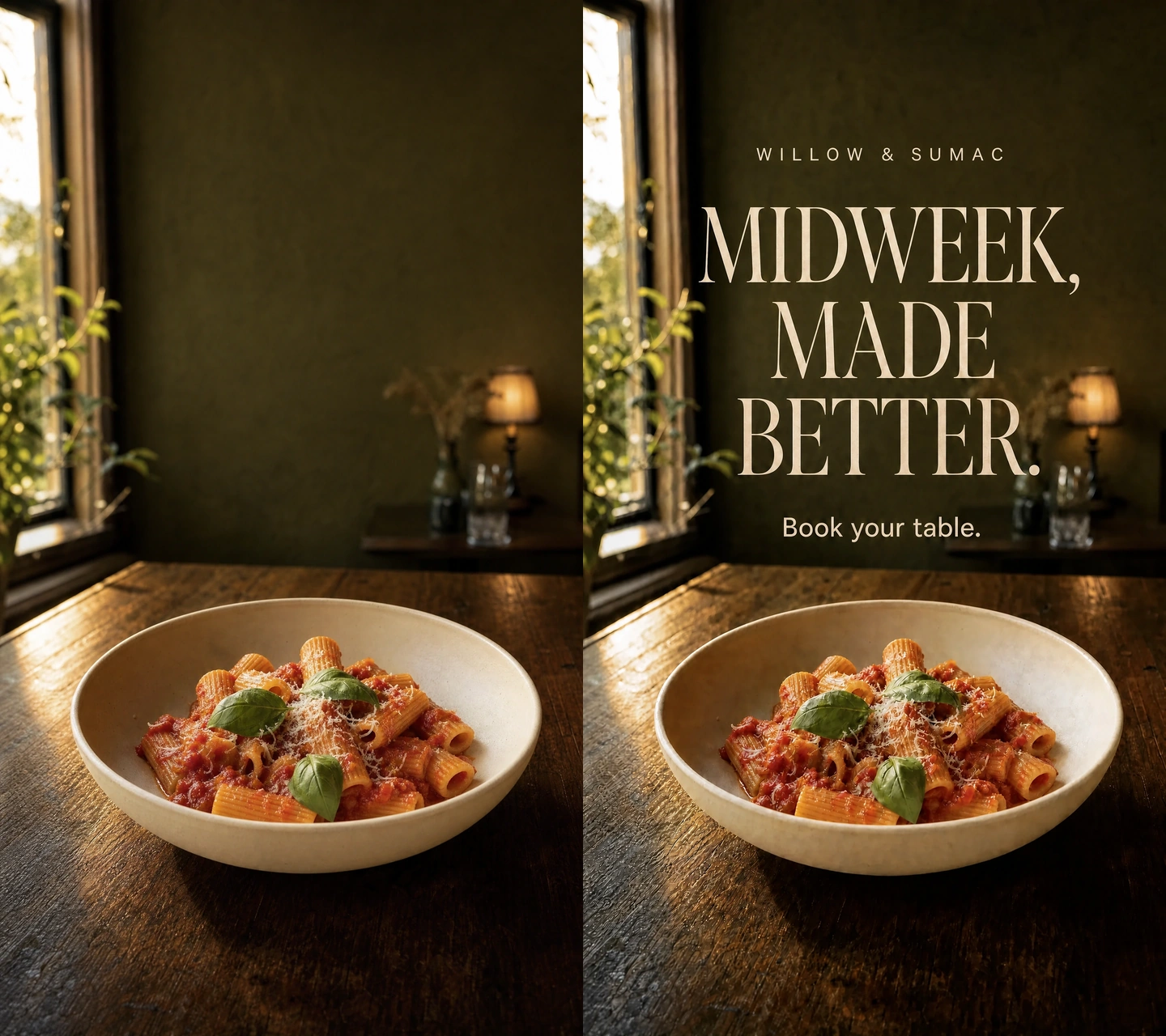
A fictional Willow & Sumac example: clean food reference on the left, finished campaign still on the right. Both images were generated with GPT Image 2 through PromptWise; they do not depict a real restaurant or its food.
The still was created in PromptWise, AI Video Bootcamp’s own studio, with GPT Image 2. A clean vertical food image came first, with the bowl low in the frame and dark space above it. That space gave the headline somewhere to go without covering the food. A reference-based generation produced the campaign layout and its lettering; the video uses separately editable text layers.
Notice the limit of that example. A plausible generated pasta dish is fine for a clearly labelled fictional portfolio. For a real restaurant, begin with its actual approved dish photograph. You are being paid to represent what it sells, not quietly improve the portion, replace ingredients or invent a prettier dining room.
Before generating anything for a client, compare the reference with the menu and ask the owner to approve it. Which garnish belongs there? Is that the bowl customers receive? Is the dish available during the period the video will run? These are small questions with expensive consequences if you skip them.
For composition practice, AI Video Bootcamp’s AI image prompt cheat sheet gives you a place to work on framing and light before a client’s deadline is involved.
Build the motion around one believable change
For a food clip, I’d begin with a restrained camera move. A slow approach to the plate gives you something to watch without asking the model to invent a hand, a fork and a complicated bite at the same time.
Use the approved clean image as the starting frame. Keep the camera direction, lighting and ending specific. Here is a reusable motion brief for the fictional pasta example:
“One continuous five-second shot. Slowly push towards the bowl, keeping its shape, portion and ingredients consistent. Preserve the window light from the left and the existing background. Settle into a steady final frame for the last second. No hands, new ingredients, scene changes or generated lettering.”
This is a direction to the model, not a guarantee that it will obey. Inspect the whole result. Look for a changing rim, drifting garnish, a portion that grows or a camera move that turns into a different shot. If it changes what the restaurant serves, reject it rather than hoping nobody notices.
A five-second generated shot is one ingredient in the proposed six-to-fifteen-second delivery. You can add a short opening or closing card in the edit, but do not stretch a weak shot just to fill time. Put the restaurant name, message and booking instruction on editable text layers when you need precise control.
TikTok’s ad creative guidance recommends vertical 9:16 video, at least 720P and space for the interface around important details. Those are useful production checks, not a promise that your post will perform. Check the final export in its intended placement, especially the booking instruction near the bottom.
If writing motion directions is still the difficult part, start with AI Video Bootcamp’s guide to AI video prompts. If you are new to the whole process, its guide to learning AI video is a better first stop than promising a client a monthly delivery.
For this example, Kling 3.0 Pro in PromptWise generated a silent five-second shot. The first attempt added more steam than the brief called for. A second pass removed it. The finished edit adds fixed campaign lettering and a two-second final hold, making a roughly seven-second sample. It demonstrates the proposed format, not results for a paying restaurant.
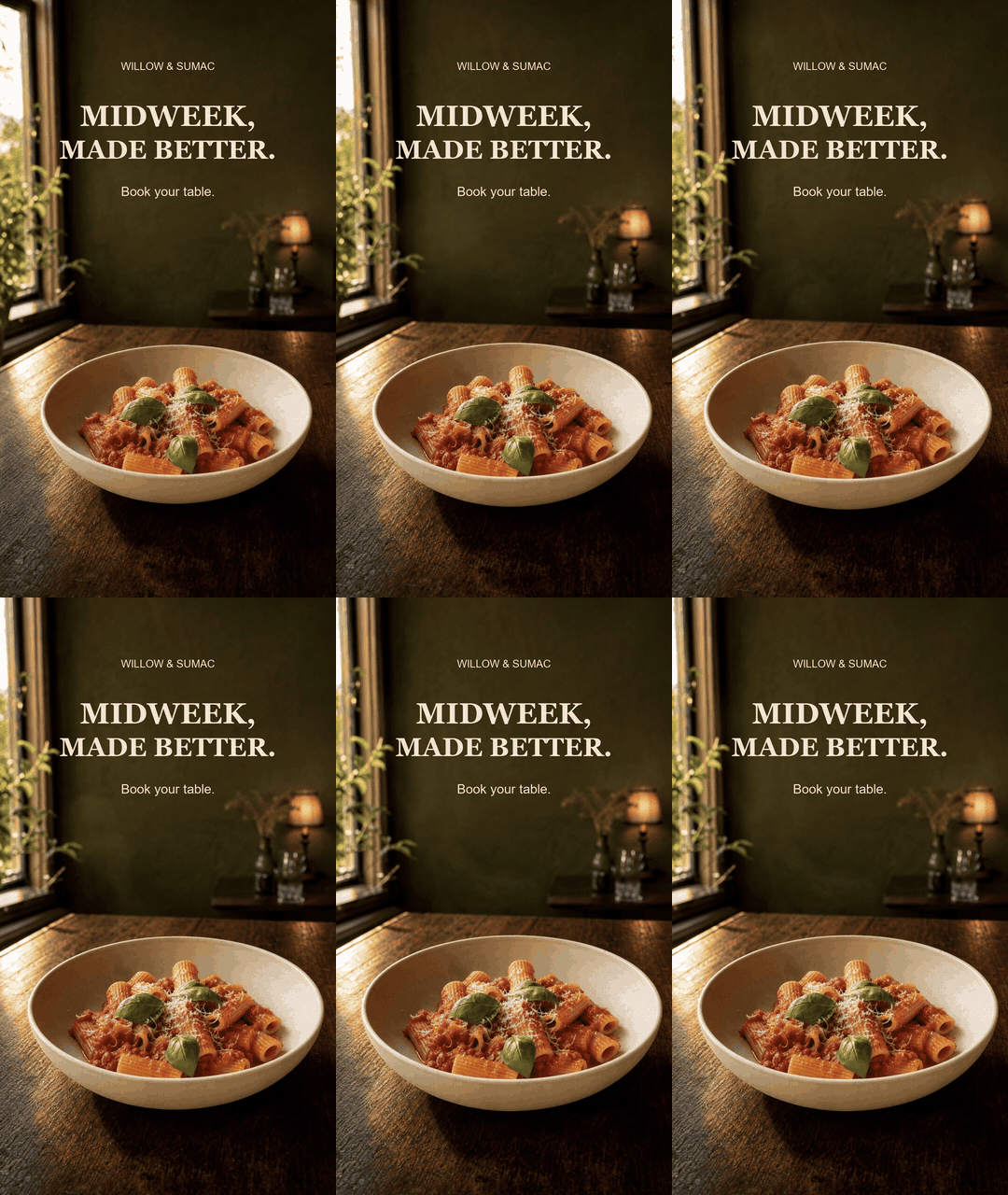
Web preview: a silent 360 x 640 animated GIF of the complete seven-second edit. It repeats after the final hold; the restart is not a seamless loop.
AI-generated fictional Willow & Sumac campaign. A five-second Kling 3.0 Pro shot made through PromptWise, edited with fixed campaign copy and a two-second hold. Silent; no real restaurant or campaign performance is represented.
Price the work you will actually do
Do not take the number below as a market rate. It is an illustrative calculation to help you see where a package can go wrong.
Suppose you quote $600 for the month. You allow ten hours of your time at $35 per hour, which comes to $350, plus a $50 allocation for software and generation. That gives you a $400 allowance and leaves $200 before taxes, other overhead and fees. The $50 is an example budget, not a measured PromptWise bill.
Now let approvals, regeneration and extra edits push the job to sixteen hours. At the same hourly allowance, labour becomes $560. Add the $50 software allocation and you reach $610. Your $600 fee is already $10 short before those other costs.
The important number is the time the client actually requires. Track the pilot from the first planning message to the final export, including failed generations, revisions and administration. Then quote the monthly work from that evidence and the scope you can sustain. A fee that covers your costs still needs a buyer willing to pay it.
Restaurant budgets deserve that caution. The National Restaurant Association’s 2025 Restaurant Operations Data Abstract covered more than 900 US operators. Salaries, wages and benefits were a median 36.5% of 2024 sales among its full-service respondents. That cost context does not tell you what an individual restaurant can spend on marketing.
Our AI video career guide goes further: it advises against choosing restaurants as your primary niche because of competition and thin margins per hour. I’d look for a business that already treats marketing as a real expense and has a specific use for the content. If the owner wants guaranteed bookings for a tiny fee, the offer is probably a poor fit.
Get the monthly handover agreed before the first edit
Ask for one folder with the approved menu, photographs, logo, booking or ordering destination, and the exact terms of any promotion. Get permission to use the supplied material and any identifiable people. Confirm the tool and asset licences cover the intended commercial use; do not assume that access to a file is permission to advertise with it.
Agree on one person who approves the work and one place where feedback is collected. Set an input deadline and an approval deadline. If the restaurant changes the dish or offer after approval, treat that as a scope change rather than pretending the original brief never existed.
For delivery, I’d provide clearly named final videos, the four covers and the captions in a simple document. Include silent masters if music will be added later. State whether editable project files are included, which channels the work is prepared for and how long you will keep the source files.
Music needs its own check. TikTok’s Commercial Music Library offers business-use options with placement and region filters. Do not assume a track cleared there can also go into an Instagram ad. Clear the actual use on each destination, or deliver without music until the client has the appropriate licence.
The US Federal Trade Commission’s basic advertising guidance explains that claims must be truthful and nondeceptive. Apply that discipline to the visuals too: no invented customers, fake chef endorsements or food the restaurant cannot serve. The owner should verify the message and the final depiction before either goes live. Agree who applies the required AI disclosures when posting. TikTok requires labelling for realistic AI-generated images, audio or video; use its platform label and a clear caption. Check the current rules for each destination and market before delivery.
Find the first buyer without making ten free campaigns
Start with a shortlist of ten local restaurants you could reasonably serve. Look at their public posts and menu. You want enough real material to work with, a clear way to contact the decision-maker and an identifiable content need. An inactive account alone does not tell you that the owner has money or interest.
Use the fictional sample to show what you mean. Ask permission to send it, rather than making an unsolicited advert with the restaurant’s logo and pretending it commissioned you. If you visit in person, choose a quiet time rather than interrupting service.
Here is a message you can adapt after checking the details:
“Hi [name], I noticed [specific, true detail about the restaurant]. I make short videos built around a restaurant’s actual food and offers. May I send you a fictional sample showing the format? If it fits what you need, I can quote one paid pilot video using your approved photos before we discuss a monthly package.”
Keep that first offer small enough to understand. Agree on the pilot’s deliverable, fee, deadline and included revision before starting. Price it from your work and costs; do not promise that one clip will pay for itself. Agree any deposit, payment dates and the client’s permitted uses in writing before production starts.
If the pilot goes well, show the owner the four proposed jobs for the following month. You now have something concrete to discuss, including how approvals worked and what the production time really was. A successful delivery is useful evidence. It is still not proof that a recurring service will be profitable.
Make the renewal conversation about something useful
Erica Hays, a content marketer at DoorDash, writes: “Stop counting likes, start counting orders.” DoorDash sells ordering tools, so it has a commercial interest in that advice.
I would take that as a question for the brief, not a licence to claim every extra order. Is this month’s aim booking-page visits, takeaway enquiries or an offer people can redeem? Agree on one useful action and a way to observe it with the access the restaurant already has. For an existing promotion, that might mean counting redemptions of its agreed offer code, while recognising that people can encounter the offer elsewhere too.
At the end of the month, review those actions alongside the content, the time you spent and the owner’s experience of approving it. Bookings can change for reasons beyond your videos. Be honest about what you can connect to the work and what you cannot.
The next step is small: write the four-video offer on one page, make one clearly labelled sample and find one suitable person to show it to. The monthly package becomes credible when you can explain the work, deliver it accurately and charge enough to keep doing it.
Sources and visual credits
TikTok: performance-ad creative guidance
TikTok: Commercial Music Library
FTC: Advertising and Marketing Basics
National Restaurant Association: labour-cost survey context
Erica Hays, DoorDash: Online Marketing for Restaurants
TikTok: labels for realistic AI-generated content
Visuals are original AI-generated illustrations for this article. Fictional brand and campaign; no real client, endorsement or earnings claim. Source image and campaign still: GPT Image 2. Motion: Kling 3.0 Pro. Generation through PromptWise; final video typography and hold added in editing.
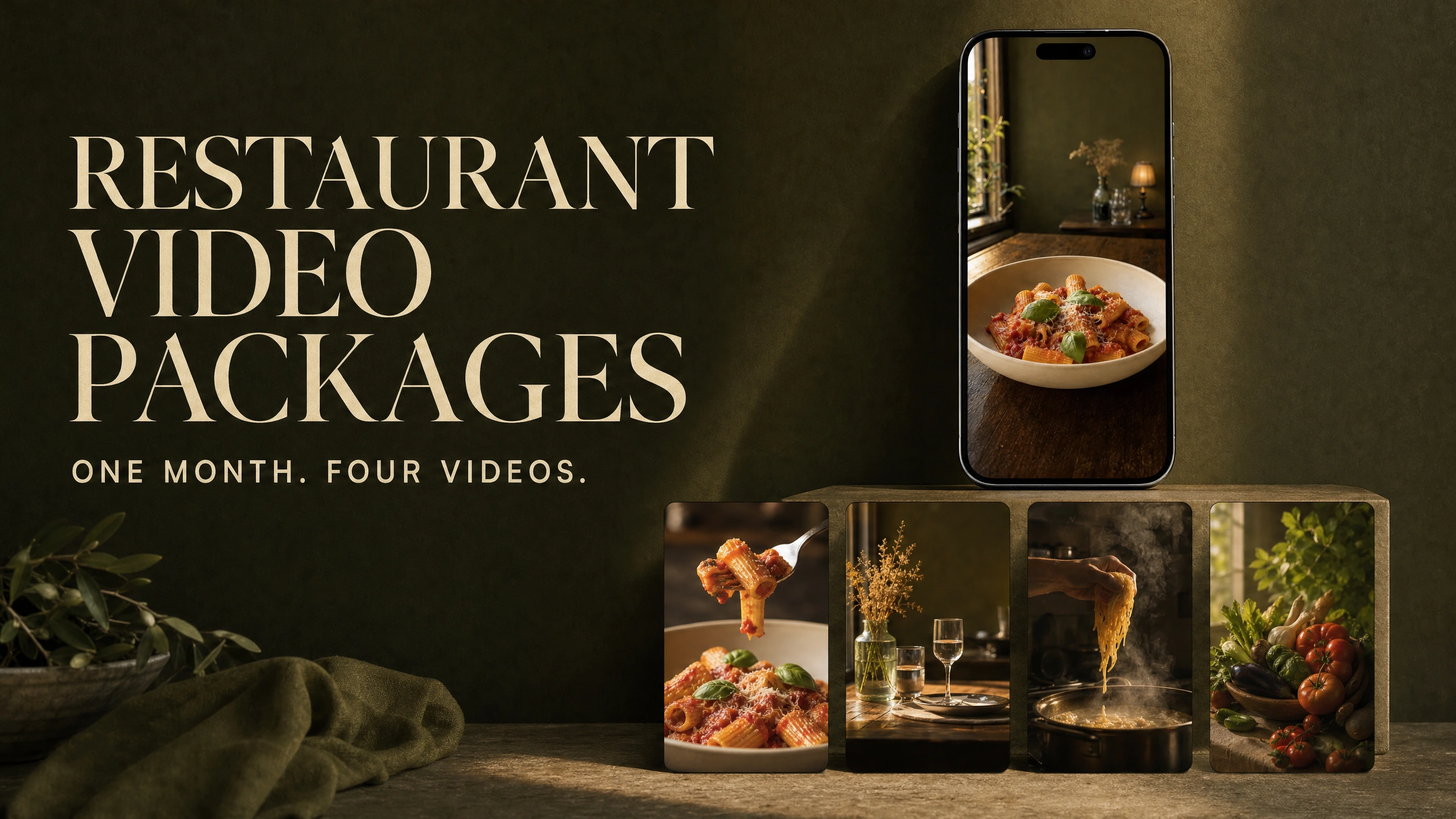
Cover: GPT Image 2 through PromptWise; an AI-generated illustration of a restaurant-video package, not a real client campaign.