
What Operators Actually Make in AI Video Today
An in-house generative AI creative director at a brand or studio earns $75,000 to $185,000 base in Year 1 and $110,000 to $310,000 total compensation by Year 3. A project-based freelancer can clear $30,000 to $65,000 in Year 1 and $80,000 to $260,000 by Year 3, with a hard personal-capacity ceiling around $300,000 to $400,000. An agency owner runs a 6 to 12 month build window with negative-to-low margin, then breaks into $100,000 to $250,000 Year 1 net, scaling to $500,000 to $1,500,000+ net by Year 3. PJ Accetturo of Genre.ai has publicly disclosed charging $100,000 per 30-second commercial. Yonatan Dor of The Dor Brothers has charged €200,000 (roughly $235,000) per spot and crossed $1 million in annual revenue by mid-2025. The compute cost to produce a 60-second commercial with Veo 3.1 audio enabled on fal.ai sits at $72. The fully-loaded production cost including labor and revision contingency is $229.80. The arbitrage gap is the article.
Why Most AI Video Pricing Advice Is Wrong
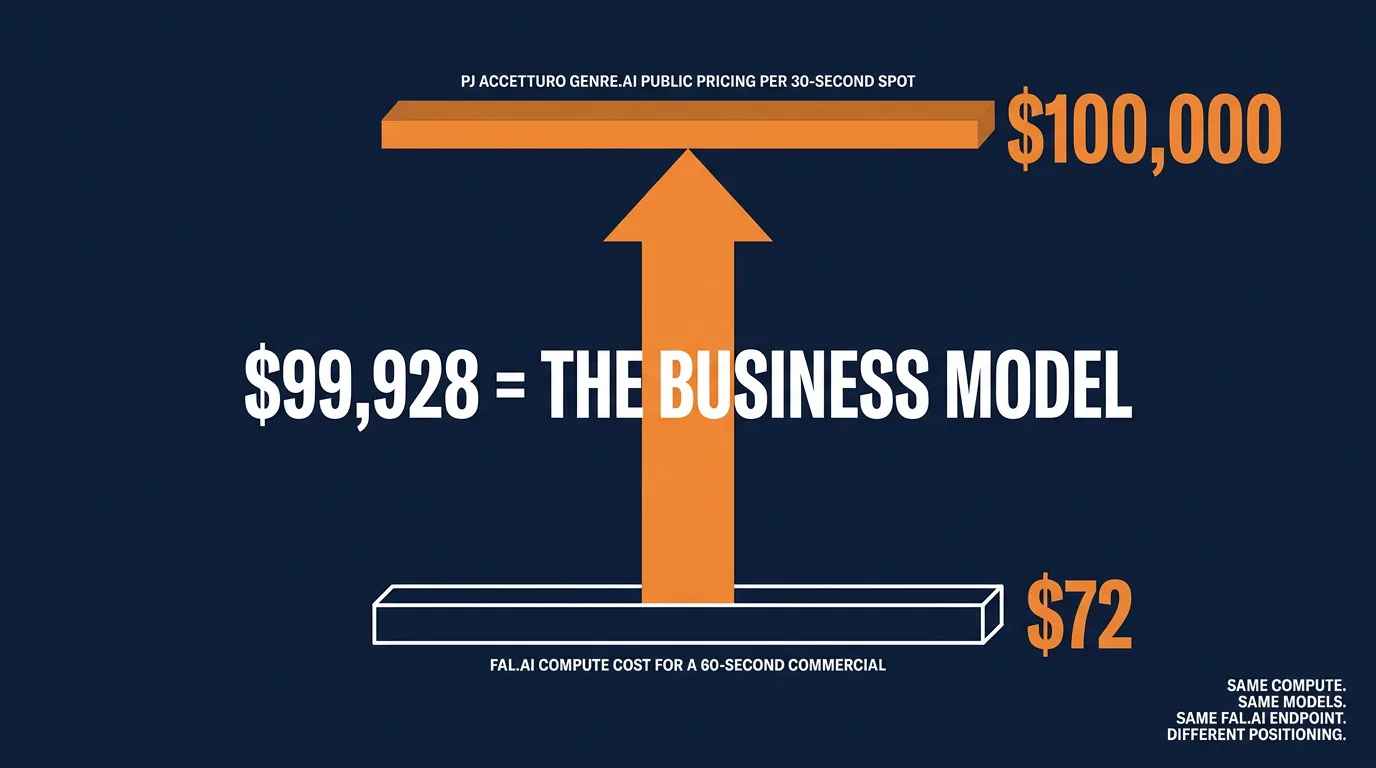
Most published pricing guides for AI video work miss the load-bearing fact: profitability is not a function of generation speed. It is a function of fixed-fee arbitrage against legacy production cost. Upwork freelancers selling raw AI video clips at $15 to $50 per hour are competing on commodity output. Yonatan Dor and PJ Accetturo are selling the same underlying generation through the same fal.ai compute endpoints and charging six figures per spot. The compute cost difference is zero. The price difference is $99,000+. That gap is the entire business model.
The Three Career Models (Pick One Before You Read Anything Else)
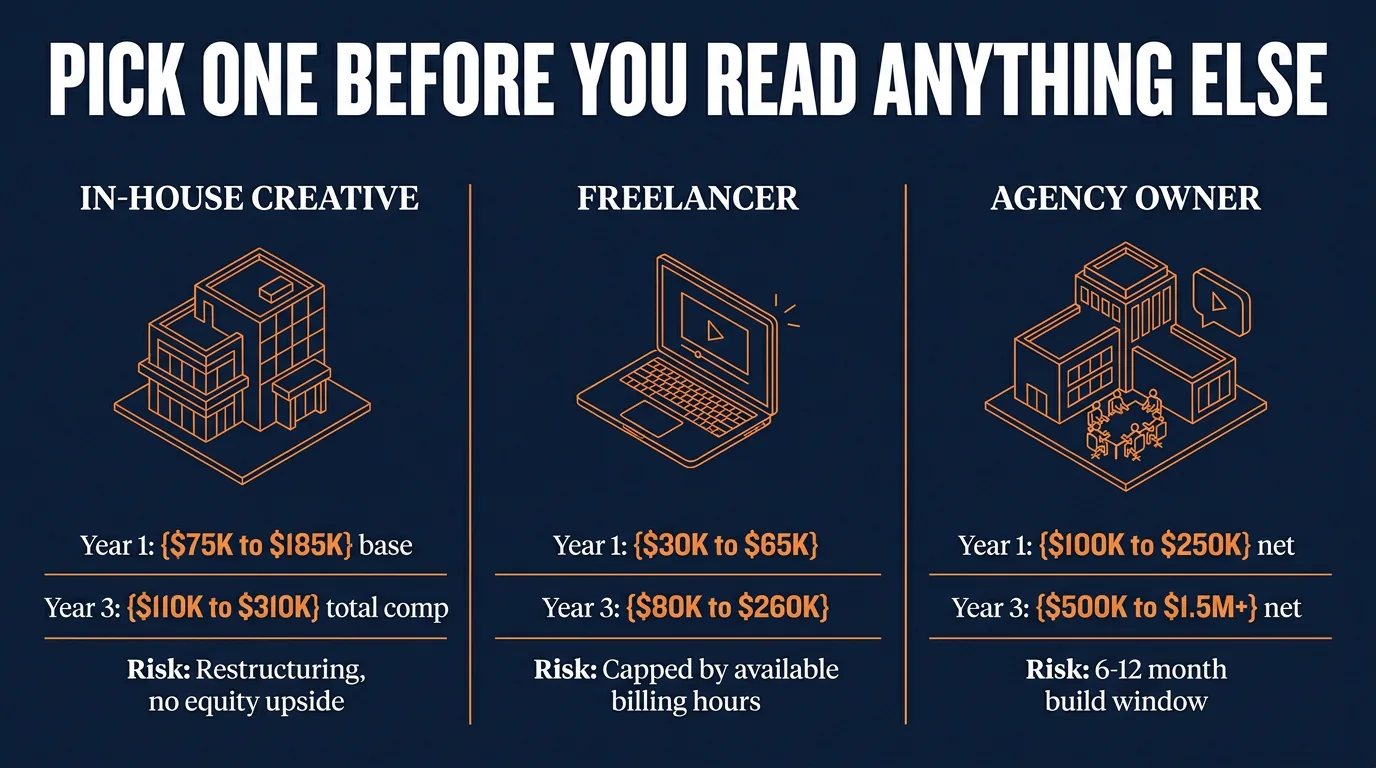
The generative AI video sector supports three operational paths that demand different decisions on capital, time, and risk. Pick the path that matches your current capital position and 5-year horizon before reading the rest of the guide. Every section below changes meaning depending on which path you are on.
| Career Path | Time to First Revenue | Starting Capital | Year 1 Income | Year 3 Income | Primary Risk |
|---|---|---|---|---|---|
| In-House Creative | 4 to 12 weeks | $0 (employer-funded) | $75,000 to $185,000 base | $110,000 to $310,000 total comp | Restructuring; no equity upside |
| Project-Based Freelancer | 1 to 4 weeks | Under $500 | $30,000 to $65,000 | $80,000 to $260,000 | Income capped by available billing hours |
| Full-Service Agency Owner | 3 to 6 months | $5,000 to $15,000 | $100,000 to $250,000 net (often Year 1 negative until month 7+) | $500,000 to $1,500,000+ net | High operational overhead; long enterprise sales cycles |
The in-house path is the most predictable. Major brands, e-commerce conglomerates, and traditional production studios are hiring dedicated generative content directors with job titles like AI Creative Director, Generative AI Producer, AI Video Editor, and Head of AI Storytelling. NYC and San Francisco senior roles exceed $185,000 base. Equity at startups, RSUs at established brands. Trade-off: capped upside, no creative autonomy, IP belongs to the employer.
The project-based freelance path is the most flexible. Solo operator selling generative AI services project-by-project or through small retainers. Defining sentence: “I am the deliverable.” The capacity wall hits around 30 to 40 billable hours per week, which caps senior freelancers at roughly $300,000 to $400,000 in personal annual revenue. Above that, the path forces a hire decision and crosses into the agency model.
The full-service agency owner path has the largest upside and the largest Year 1 risk. Founders run a 6 to 12 month negative-margin window during build-out. Year 3 outcomes range from $500,000 to $1,500,000+ in net to the founder. Top-of-band cases like Romain Torres at Arcads reached $10 million ARR with 5 employees by late 2025, triple-verified via GetLatka, the $16M seed announcement, and Eurazeo press coverage. The model scales with system maturity, not personal hours.
If you are 0 to 2 years into your AI video career and the cash flow uncertainty of solo work feels uncomfortable, take the in-house path. Build skills inside someone else’s operation, then jump to freelance with proof of work in your portfolio. If you have 6 months of expenses in savings and at least one client lined up, start as a freelancer. If you already have $25,000 to $80,000 of Year 1 burn capital, a clear repeatable service, and willingness to hire and delegate, start as an agency owner. Most operators should not attempt the agency path in Year 1.
What Real Operators Charge: Four Named Disclosures
Public revenue or pricing disclosures from four operators currently shipping work. Each is verified against at least one primary source. Use these as ceiling and floor anchors when you price your own work.
PJ Accetturo (@PJaccetturo) runs Genre.ai. He publicly disclosed in a Semafor interview that his AI agency delivered a broadcast-quality commercial for prediction-market platform Kalshi that traditionally would have cost hundreds of thousands of dollars. Using Google Veo 3 via API, he executed the project in two days. Compute costs in the low thousands. He has stated commercials in the $100,000 per 30-second ad band.
Yonatan Dor (@TheDorBrothers) runs The Dor Brothers, the viral AI ad agency behind a series of breakthrough subversive brand campaigns. Cross-verified by Semafor and San Juan Daily Star: the agency surpassed $1 million in revenue by mid-2025, with individual spots in the €200,000 (roughly $235,000) per project range. Pricing reflects a guaranteed business outcome plus risk absorption, not raw output.
Dave Clark (@Diesol) operates as an elite freelance director. He secured a verified $500,000 prize for an AI-generated commercial in the Grok Imagine Super Bowl contest, documented in PR Newswire coverage of Promise Studios. Flag: the $500,000 number is a single outlier event, not a baseline. It demonstrates the ceiling rather than the median.
Brett Malinowski (@TheBrettWay) is a 22-year-old AI commercial director monetizing the creator-educator model. He documented live $10,000+ project sprints in public, where he builds AI ad assets in single sessions, cross-verified via Podwise transcript and his YouTube channel. Specific demonstration of the meta-layer monetization path: build live, sell access, repeat.
Two important interpretation rules. These are top-decile outcomes from operators with significant personal brand leverage. Median outcomes are roughly one order of magnitude smaller. A typical solo freelancer crosses $65,000 in Year 1. A typical agency founder clears $90,000 net in Year 1 after team comp and tools.
The compute cost for the underlying generations is roughly identical across operators. PJ Accetturo’s $100,000 per 30-second ad costs the same to produce on fal.ai as a $300 Upwork freelancer’s 30-second ad. The $99,700 price difference is the premium the market pays for operational reliability, brand trust, legal compliance, and creative direction. This is the entire arbitrage.
The Production Cost Receipts
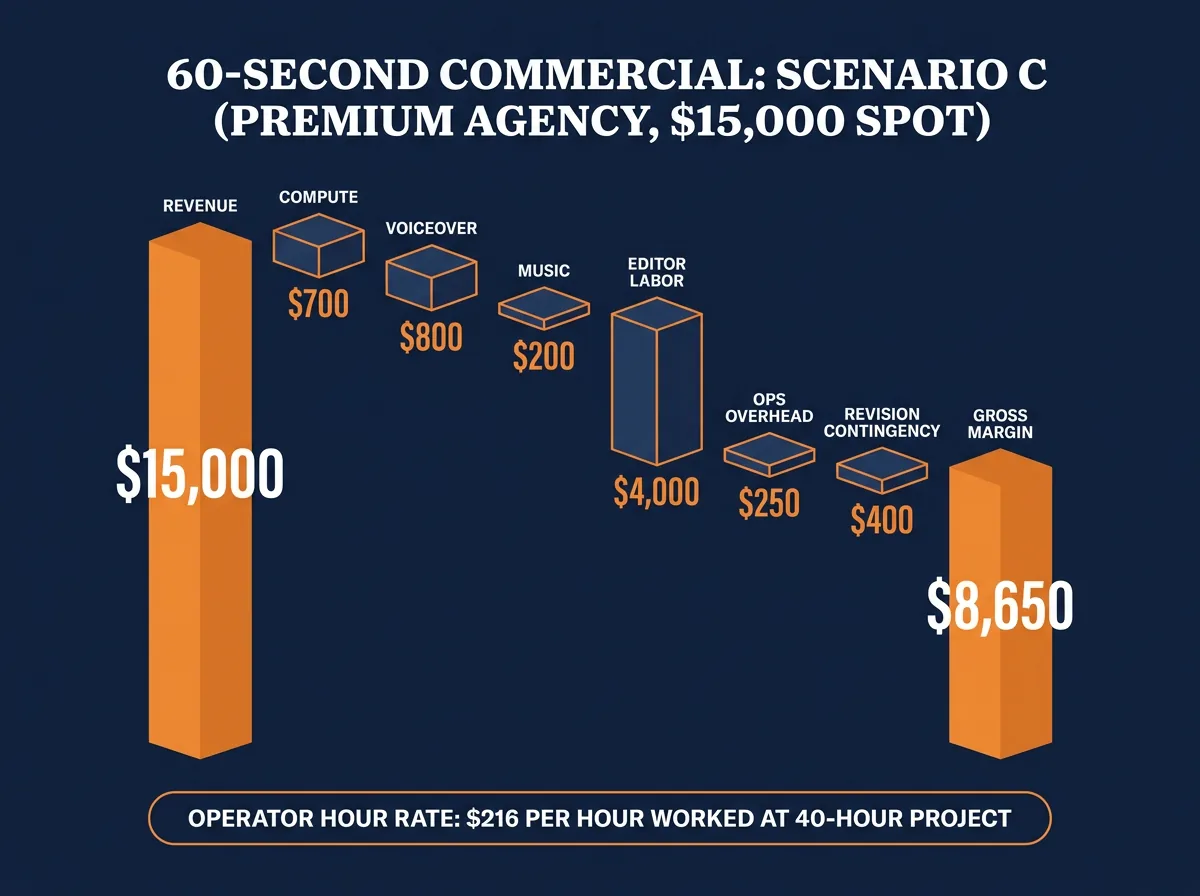
Every operator should know exactly what one 60-second commercial costs to produce. Pricing without this number is guesswork. Margin without this number is fiction. Here is the full stack at fal.ai canonical pricing as of 2026-06-09.
Per-second compute costs on the True Models stack (fal.ai canonical pricing, verified 2026-06-09)
| Model | Rate | Use case |
|---|---|---|
| Veo 3.1 (no audio) | $0.20/sec | Hero shots, brand-grade commercials |
| Veo 3.1 (with audio) | $0.40/sec | Audio-native sync, talking-head spots |
| Veo 3.1 Lite | $0.05/sec at 720p | Drafts, ideation, beginner iteration |
| Kling 3.0 Turbo | $0.07/sec | Character-consistent motion, mid-fidelity |
| Kling 3.0 Master | $0.28/sec | Premium photoreal motion |
| Seedance 2.0 (1080p) | ~$0.30/sec | Photoreal product video, stylized variants |
| Seedance 2.0 (720p) | ~$0.15/sec | Volume ad creative |
| LTX-2.3 Fast | $0.04/sec | Budget volume, open-weight self-host alternative |
| Wan 2.7 | $0.05/sec | Open-weight stack alternative |
| Hailuo | ~$0.045/sec | Stylized brand work |
Per-image compute costs on the True Models stack
| Model | Rate | Use case |
|---|---|---|
| Nano Banana Pro (Google Vertex AI) | $0.134 per 2K image / $0.24 per 4K | Photoreal hero stills, product shots |
| GPT Image 2.0 (OpenAI API) | $0.04 standard / $0.08 high-res | Multi-region campaign stills, paragraph-length text-in-image |
| Seedream 4.0 (fal.ai) | ~$0.04 per image | Stylized brand imagery |
| Ideogram 4.0 (fal.ai) | $0.03 Turbo / $0.06 Balanced / $0.10 Quality per MP | Typography-heavy ad cards, logos, signage |
| Recraft V3 (fal.ai) | $0.04 per image | Vector and design work |
| Flux 2 Pro (fal.ai) | $0.03/MP | Photoreal hero stills |
Voice and music on the stack
| Tool | Rate | Use case |
|---|---|---|
| ElevenLabs Pro (voice) | $99/mo allocation, ~$0.30/min effective | Voice cloning, multilingual voiceover |
| ElevenLabs free / TTS | $0 with watermarked output | Beginner DIY voiceover for low-stakes drafts |
| Stable Audio 3.0 (commercial) | $11.99/mo Creator tier | Music licensing for client work |
| Stable Audio 3.0 (free tier) | $0 with watermarked output | Draft track ideation |
The fully-loaded 60-second deliverable
| Cost Line Item | Specification | Cost |
|---|---|---|
| Video compute | Veo 3.1 with audio at 3x discarded-takes ratio | $72.00 |
| Image assets | Recraft V3 or Ideogram 4.0 (20 images to find 5 keepers) | $0.80 |
| Voiceover | ElevenLabs Pro allocation | $1.20 |
| Music licensing | Stable Audio 3.0 commercial allocation | $2.50 |
| Editing labor | 2 hours at $50/hr internal rate | $100.00 |
| Ops overhead | CRM, storage, project management allocation | $15.00 |
| Revision contingency | 20% buffer | $38.30 |
| Total cost to produce | Fully loaded per 60-second deliverable | $229.80 |
The counterintuitive finding
Editor labor at $50 per hour internal rate eats $100 of the $229.80 stack. Compute eats $72. Everything else combined is $58. Editor time, not compute, dominates production cost. This contradicts the cultural narrative that “AI does the work.” Operators who attack editor time first (template project files, batched rendering, AI-assisted captioning, AI-assisted color grading) drop per-deliverable cost faster than operators chasing cheaper compute models.
The iteration count variance: what beginners need to understand
The single most underdocumented variable in AI video unit economics is generation count. A skilled operator who knows prompt engineering, model selection, and reference-frame discipline can produce a usable 60-second commercial from 20 to 30 generated clips. A beginner attempting the same brief might need 200 to 300 generated clips to land equivalent output. The 10x variance in iteration count drives the same 10x variance in compute spend.
This is the education arbitrage. Two operators paying the same per-second rate on fal.ai end up with wildly different per-deliverable costs depending on whether they iterate efficiently. The AI Video Bootcamp curriculum is built around shortening this iteration cycle: teaching operators which Veo 3.1, Kling 3.0, Seedance 2.0, or LTX-2.3 endpoint to use for which shot type, how to write prompts that hit on the first or second generation rather than the twentieth, and how to combine Nano Banana Pro, Ideogram 4.0, and Seedream 4.0 for the still-image layer of the workflow.
The same logic applies to voice and editing. Operators starting out without budget for a hired voiceover actor or paid editor can ship deliverables using ElevenLabs free-tier text-to-speech and edit in CapCut. The AVB curriculum covers both the TTS workflow and the CapCut editing pipeline so beginners are not blocked by tool spend.
Three real cost scenarios
Scenario A: Beginner solo operator, $300 to $500 productized social ad (DIY voiceover and editing)
- Compute: $50 to $150 (40 to 100 Veo 3.1 Lite clips at $0.05/sec plus 10 to 20 Kling 3.0 Turbo clips, more iterations because skill is still developing)
- Voiceover: $0 using ElevenLabs free TTS or recording your own voice on a phone
- Music: $0 with Stable Audio 3.0 free tier (watermarked but usable for low-stakes drafts) or $1 prorated from Stable Audio Creator subscription
- Editor labor: 4 to 8 hours self-editing in CapCut at $0 cash outlay
- Ops overhead: $5
- Revision contingency: $30
- Out-of-pocket cost: $86 to $186 | Cash margin: $114 to $414 | Time investment: ~8 hours per deliverable
The beginner profile sacrifices time to save cash. This scenario covers the operator’s first 5 to 20 paid projects while skills compound.
Scenario B: Mid-tier freelancer with hired help, $4,500 branded short-form ad
- Compute: $250 to $500 (50 to 100 clips, mix of Veo 3.1 with audio at $0.40/sec for hero, Kling 3.0 Turbo for motion, Seedance 2.0 for stylized variants, plus Ideogram 4.0 stills for ad cards)
- Voiceover: $200 to $400 (hired voice actor or ElevenLabs Pro allocation for voice cloning)
- Music: $3 (Stable Audio 3.0 Creator subscription allocation)
- Editor labor: 12 to 18 hours at $75 internal blended rate = $900 to $1,350
- Ops overhead: $30
- Revision contingency: $250
- Total cost: $1,633 to $2,533 | Gross margin: $1,967 to $2,867 (44 to 64 percent) | Margin per hour worked: $164 to $239
The mid-tier operator has learned which prompts work, which models match which shot types, and how to lock storyboards before high-resolution compute runs.
Scenario C: Senior agency commercial, $15,000 to $20,000 for a 60 to 90 second spot
This is the verified high-end commercial pricing band documented across public agency disclosures.
- Compute: $400 to $700 (200 to 300 clips for hero-grade commercials, premium Veo 3.1 with audio plus Seedance 2.0 1080p plus Kling 3.0 Master plus Nano Banana Pro 4K stills plus Ideogram 4.0 Quality typography)
- Voiceover: $400 to $800 (professional voice actor or multilingual ElevenLabs Pro)
- Music: $99 to $200 (custom Stable Audio 3.0 composition or licensed track)
- Editor labor: 25 to 40 hours at $100/hr senior rate = $2,500 to $4,000
- Ops overhead: $250
- Revision contingency: $400
- Out-of-pocket cost (compute + voice + music + ops + revisions): ~$1,000 | Plus senior labor: $3,500 to $5,400 fully loaded | Gross margin at $15,000 spot: $9,600 to $11,500 (64 to 77 percent) | Gross margin at $20,000 spot: $14,600 to $16,500 (73 to 82 percent)
The strategic implication: chase higher-ticket commercial work where the skill-driven iteration efficiency compounds margin. The same operator who can drop iteration count from 250 to 50 on the senior commercial captures an extra $300 to $500 per project in compute savings alone, plus dramatically less revision time. The senior commercial has 4x to 6x the margin per hour worked of the entry social ad.
Service-Level Pricing Matrix
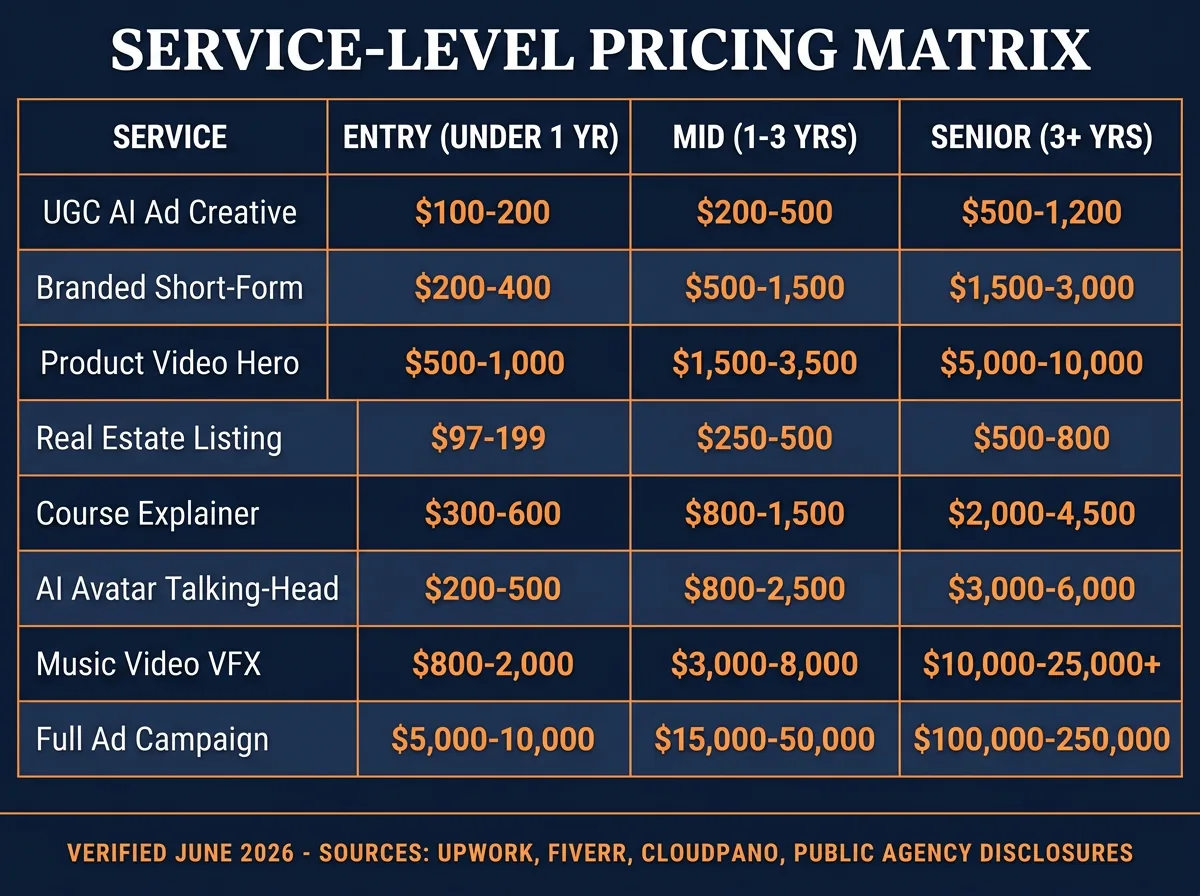
Eight common AI video service types, three experience tiers, three pricing structures. Rates verified against Upwork live postings, Fiverr top-rated sellers, public agency websites, and CloudPano AI video pricing guide.
| Service Type | Entry (< 1 yr) | Mid (1-3 yrs) | Senior (3+ yrs) | Pricing Model |
|---|---|---|---|---|
| UGC AI Ad Creative | $100 to $200 | $200 to $500 | $500 to $1,200 | Project freelance |
| Branded Short-Form | $200 to $400 | $500 to $1,500 | $1,500 to $3,000 | Agency retainer/month |
| Product Video (Hero) | $500 to $1,000 | $1,500 to $3,500 | $5,000 to $10,000 | Productized fixed package |
| Real Estate Listing | $97 to $199 | $250 to $500 | $500 to $800 | Productized fixed package |
| Course Explainer | $300 to $600 | $800 to $1,500 | $2,000 to $4,500 | Project freelance |
| AI Avatar Talking-Head | $200 to $500 | $800 to $2,500 | $3,000 to $6,000 | Agency retainer/month |
| Music Video and VFX | $800 to $2,000 | $3,000 to $8,000 | $10,000 to $25,000+ | Project freelance |
| Full Ad Campaign | $5,000 to $10,000 | $15,000 to $50,000 | $100,000 to $250,000 | Agency retainer/month |
Two pricing models to know before you quote anything: commodity pricing (rate per hour, per second, or per deliverable on Upwork or Fiverr) and value-based pricing (a fixed fee anchored against the client’s business outcome). The Upwork freelancer charging $15 per hour for AI video and the agency charging $100,000 for a 30-second commercial are using the same compute. The difference is one is commodity-priced and the other is value-priced. The next two sections show how to make the switch.
How to Land Your First $5,000 Client: The 12-Step Playbook
This section is the practical answer to the most-asked question in every AI video community. The playbook draws from documented sequences used by Justin Welsh (LinkedIn solopreneur, $5M ARR), Codie Sanchez (Contrarian Thinking, Main Street Millionaire), and Sam Parr (The Hustle, Hampton). Adapted for AI video operators.
Step 1: Pick exactly one vertical. Not “I do AI video.” Specifically “I do AI ad creative for medical aesthetic clinics in [your city].” Niching down is the single highest-leverage move per Sahil Bloom’s Inverted Sales Funnel framework: audience-built leads convert at 10x the rate of cold outreach.
Step 2: Build three worked-example reels for that vertical. Two paths. Path one: generate them yourself on fal.ai using the True Models stack to Veo 3.1 for hero shots, Kling 3.0 Turbo for character-consistent motion, Seedance 2.0 for stylized variants, Nano Banana Pro for product stills, and Ideogram 4.0 for typography or ad-card overlays. Compute for three 6-second worked-example reels runs roughly $15 to $30 across the stack at draft tier. Path two: run the same stack on PromptWise, AVB’s own studio, and skip the six separate vendor billing accounts. It carries Nano Banana Pro, GPT Image 2.0, Seedance 2.5, Kling 3.0 and Veo 3.1 behind one login, with consistent characters across every scene and the exact credit cost shown on the Generate button before you click. Plans start at $19 a month. We built it, so treat that as a disclosure, not a review. Either path, these reels are your proof of work. No client cares about your portfolio of generic AI clips. Every client cares about clips that look like the work you would produce for them specifically.
Step 3: Build a 20-name target list. Use Apollo.io or Hunter.io to find decision-makers (owner, marketing director, head of growth) at 20 businesses in your niche. Spend two hours on this. The 20 names are your pipeline.
Step 4: Send the Justin Welsh value-first DM. Welsh’s documented format runs 15 to 20 percent reply rates compared to 1 to 3 percent for traditional cold pitches:
Hey [Name],

Saw your [specific post / specific campaign / specific product launch].
Mocked up a 6-second AI ad concept for [Their Product] in the time
it took to drink coffee.

Want me to send it over? No pitch, just curious if it's useful.

[Your Name]
The mechanic: you have already done the work. The cost to you is $0.50 in fal.ai compute and 10 minutes of time. The asymmetry is decisive because AI video is uniquely suited to value-first outreach. The deliverable IS the marketing.
Step 5: Send the mockup. Reply rate is around 15 to 20 percent on Step 4. When they say yes, deliver the 6-second clip within 24 hours. Do not pitch. Just send the clip with one line: “Made it for you. Use it if you want.”
Step 6: Follow up exactly once if no response. Steli Efti’s 3-line follow-up format:
Hey [Name], following up on the clip.

If this isn't a fit, no worries. If it is, what's the next step?

[Your Name]
Step 7: Get the call. When they engage, propose a 20-minute call to “scope what they actually need.” Do not quote a price in the email. Per Blair Enns’ Four Conversations framework from Win Without Pitching, the price conversation is conversation 3 or 4, not conversation 1.
Step 8: Run Chris Voss mirroring on the discovery call. Voss’ Never Split the Difference mirror technique: repeat the last 3 to 5 words the client said back to them as a question. They keep talking. You learn the actual problem. Most operators rush to pitch. Mirror instead. The client will tell you exactly what they want to buy.
Step 9: Frame the scope around their business outcome, not your deliverable. Per Donald Miller’s StoryBrand framework, position the client as the hero and yourself as the guide. The client does not want “an AI video.” They want “more booked consultations” or “a 15 percent lift in ad conversion.” Quote against that outcome.
Step 10: Pitch the Hormozi Grand Slam Offer. Alex Hormozi’s $100M Offers structure: a high-value outcome plus a guarantee that no traditional video shop can match. Sample:
“Here is what I deliver. Five 30-second AI ad variants tested against your existing creative over 14 days. If the AI variants do not lift your CTR by at least 20 percent, you do not pay. If they do, my fee is $5,000.”
Why this works for AI video specifically: your compute cost is under $200 across all five variants. You can absorb a money-back guarantee no human production crew can match. The guarantee is the close.
Step 11: Lock the deal with 50 percent upfront. Standard for service work. Covers your compute costs and signals client commitment. Do not start work without it.
Step 12: Over-deliver on the first project. Deliver one extra variant for free. Send a personal thank-you note. Ask for a referral and a testimonial 14 days after final delivery. Per Codie Sanchez’s Contrarian Thinking framework, the second project from the same client closes at 60 to 80 percent versus 1 to 3 percent for cold leads. Retention is the entire business.
Cold Email Templates That Get Replies
Four documented templates from named operators. Each cites a specific source. Reply rates listed where the source disclosed them.
Template 1: Steli Efti 3-Line Cold Email (Close blog)
Original use case: B2B SaaS sales outreach. Documented reply rate: 8 to 12 percent across industries.
Subject: [their company name] x [your specialty]

Hey [Name],

Are you the right person to talk to about AI video for [their company]?

If not, can you point me in the right direction?

[Your Name]
The whole mechanic: 3 lines, asks nothing of consequence, and uses the social pressure of being pointed to the right contact rather than ignored. Often forwards itself internally.
Template 2: Justin Welsh Value-First Cold DM (Saturday Solopreneur)
Original use case: solopreneur audience growth. Documented reply rate: 15 to 20 percent.
[Name],

Watched your [specific post / video / launch]. Worth all 4 minutes.

The angle on [specific point they made] is exactly what most [vertical]
brands miss. Built a 6-second proof-of-concept around that idea for
[their product / brand]. Cost me $0.50 to make.

Want me to send it over?

[Your name]
[Your handle]
The mechanic: specificity proves you watched. The proof-of-concept proves you can do the work. The price reveal ($0.50) proves the arbitrage opportunity. No pitch in the message. The pitch happens after they say yes.
Template 3: Alex Hormozi Reverse-Pitch Cold Email ($100M Offers, Chapter 13)
Source: acquisition.com and the $100M Offers book. Original use case: lead generation for service business. Documented sub-niche reply rates: 20 to 35 percent.
[Name],

I'll make this short. I help [vertical] businesses [outcome] using AI video
that takes 48 hours to ship and costs 90 percent less than traditional shoots.

If that's worth a 20-minute call, here is my calendar: [link]

If it's not, no hard feelings, ignore this.

[Your Name]
The mechanic: leads with outcome and time advantage, not features. Reverse-pitches by giving the recipient permission to ignore, which paradoxically increases reply rate. Hormozi-documented effect across hundreds of campaigns.
Template 4: Cole Schafer Personality-Driven (Honey Copy / Sticky Notes)
Original use case: high-ticket creative services. Documented effect: not numerical but qualitative: “the only cold emails my clients actually read.”
[Name],

I've been watching [specific thing they made] for the past 20 minutes
instead of working on a paying client's project. That should tell you
something about the work.

Here's a 6-second concept I made for [their thing] in the same time
window. Not a pitch. Just a thank-you for making the thing.

Reply if useful. Disappear if not.

[Your name]
The mechanic: personality and admission of being a fan, with deliverable attached. Schafer’s signature voice is the proof point.
The First 90 Days: A Day-by-Day Cadence
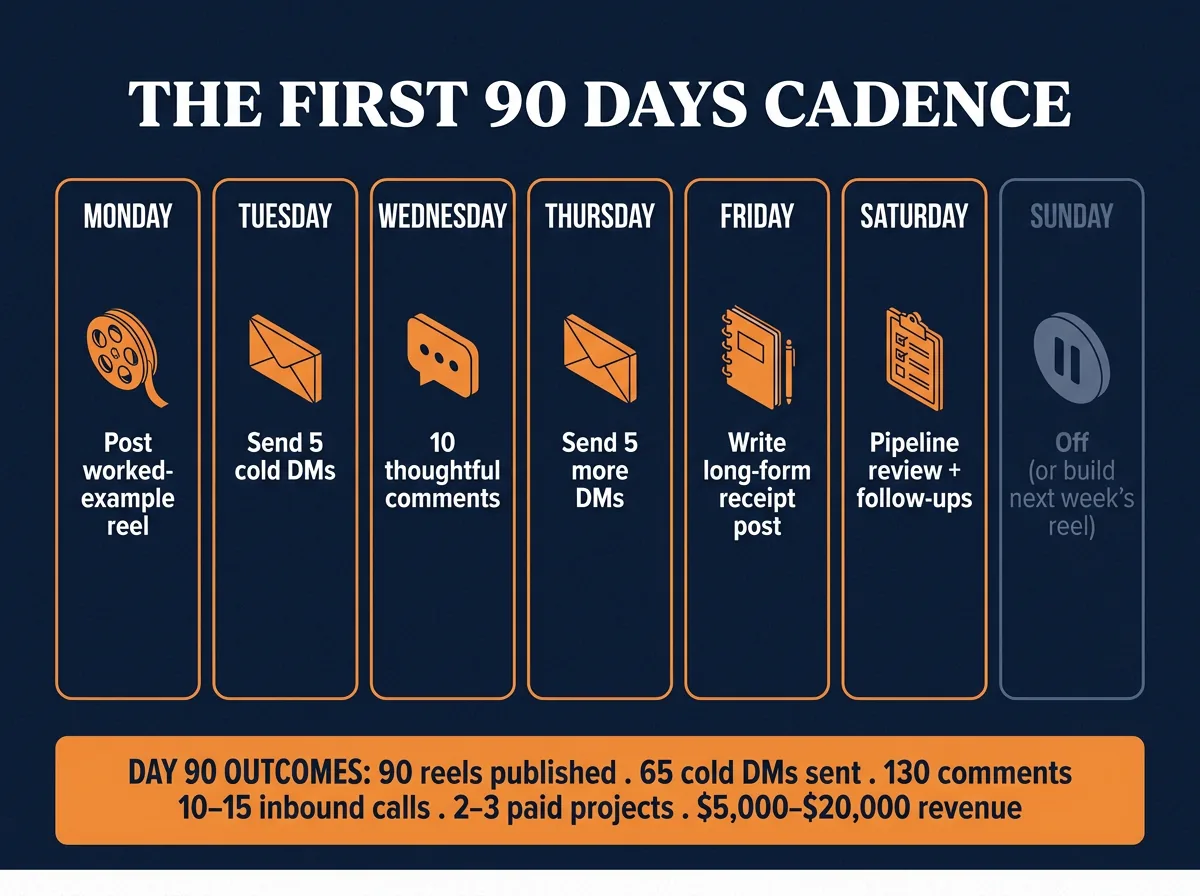
Adapted from Justin Welsh’s LinkedIn Operating System (sold 25,000+ copies as of mid-2026) and Sahil Bloom’s solopreneur framework. The cadence below is what a Day 1 freelance AI video operator does for 90 consecutive days to land first 3 clients.
Monday: Post one worked-example reel on LinkedIn and X. Generated yourself. Vertical-specific. Caption explains the prompt + cost + time.
Tuesday: Send 5 cold DMs using Template 2 (Welsh value-first). Track in a Google Sheet with date, recipient, response.
Wednesday: Comment thoughtfully on 10 posts from decision-makers in your target vertical. Not “great post.” Specific takes that demonstrate domain knowledge. This is your inbound flywheel.
Thursday: Send 5 more cold DMs. Different value-first template, same scoring sheet.
Friday: Write one long-form post (LinkedIn or X thread) breaking down the production cost of a project you would have delivered this week. Show the fal.ai bill. Show the time. Show the deliverable. Receipts are the marketing.
Saturday: Review the week’s pipeline. Follow up once on every DM that did not respond, using Steli Efti’s 3-line follow-up. Update your Apollo target list with 5 new names.
Sunday: Off. Or use the day to build one new worked-example reel for next week’s content cycle.
Outcomes by Day 90 from this cadence (validated against Welsh’s documented LinkedIn Operating System outcomes for solopreneurs, adapted for AI video):
- 90 worked-example reels published
- 65 cold DMs sent (5 weekly x 13 weeks)
- 130 thoughtful comments on decision-maker posts
- Approximately 10 to 15 inbound calls scheduled
- 2 to 3 paid projects closed at the entry to mid tier
- $5,000 to $20,000 in revenue from Day 1 to Day 90
Day 90 is also the trigger to start raising rates, covered in the next section.
When and How to Raise Your Rates
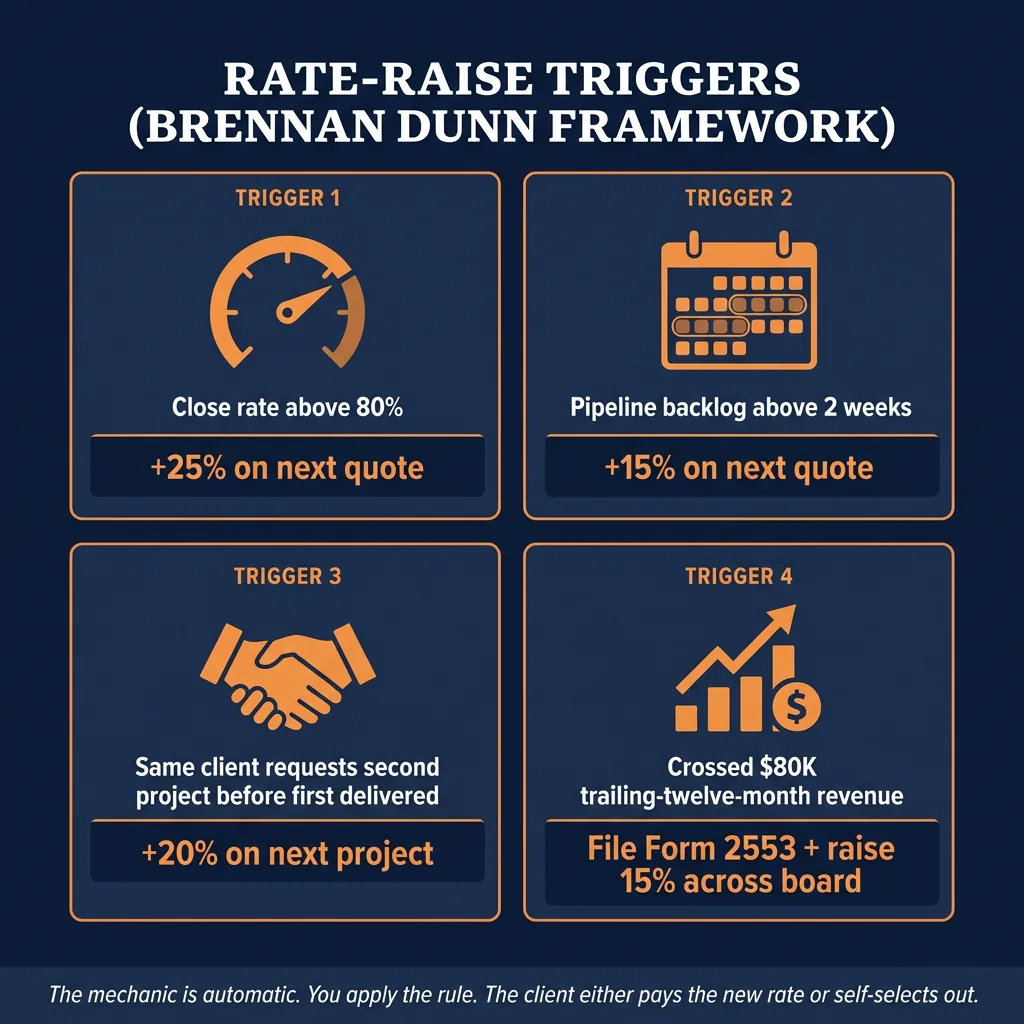
Adapted from Brennan Dunn’s Double Your Freelancing Rate framework (documented across 50,000+ freelancers since 2014).
Trigger 1: Your close rate exceeds 80 percent. Every deal you quote is closing. This means you are leaving money on the table. Action: raise rates by 25 percent on the next quote.
Trigger 2: Your pipeline backlog exceeds 2 weeks. Clients are waiting to start work. The market is telling you supply is constrained. Action: raise rates by 15 percent on the next quote.
Trigger 3: A client requested a second project before the first is delivered. They are buying the relationship, not the deliverable. Action: raise rates by 20 percent on the second project and forward.
Trigger 4: You crossed $80,000 in trailing-twelve-month revenue. Your business has stabilized. Action: file Form 2553 with the IRS for S-corp election to capture self-employment tax savings, then raise rates by 15 percent across the board.
The mechanic is automatic. You do not negotiate against yourself by asking “is this rate fair?” You apply trigger-based rules. When the rule fires, you raise. The client either pays the new rate or self-selects out, freeing capacity for the next inbound lead at the higher rate.
The Blair Enns counter-mechanic from Win Without Pitching: the highest-leverage rate raise is in the discovery conversation, not the quote conversation. When the client asks “what does this cost?” Enns frames the answer around the value created, not the deliverable produced. Sample pivot:
Client: “What does a 30-second ad cost?”
You: “That depends on what business outcome you are buying. If you are trying to lift CTR by 20 percent across your existing creative inventory, that is a different scope than producing a single hero asset. What is the actual outcome you need from this project?”
The client now has to tell you the outcome value. You quote against that outcome. The conversation never returns to per-asset pricing.
The Five Contract Clauses Every AI Video Operator Needs
Drop-in language adapted from named contract templates. Have a lawyer review before signing anything.
Clause 1: Revision Limit (Bonsai standard)
“Client is entitled to two (2) rounds of revisions on each deliverable, included in the project fee. Additional revisions are billed at $150 per revision hour. Significant scope changes initiated after the initial brief approval will be treated as a separate engagement and require a new written quote before work commences.”
Clause 2: IP Assignment (AIGA Standard Form of Agreement, 2022 update)
“Upon receipt of full payment, Contractor assigns to Client all rights, title, and interest in and to the final stitched video deliverable. Contractor retains ownership of all underlying prompts, prompt libraries, workflows, and intermediate generation files. Client receives a perpetual royalty-free license to use the final deliverable for its intended purpose. This Agreement does not transfer ownership of any third-party AI model weights, generation systems, or proprietary tools used in production.”
Clause 3: Training Data Warranty Disclaimer (adapted from Hashicorp / GitHub Open Source indemnification disclaimers)
“Contractor warrants the original creative direction, editing, and assembly of the deliverable. Contractor makes no warranty regarding the training data of any third-party generative AI model used in production, including but not limited to models offered by Google, OpenAI, ByteDance, Black Forest Labs, Ideogram AI, Stability AI, or ElevenLabs. Client acknowledges that Contractor’s liability for third-party intellectual property claims arising from AI-generated content is limited to a refund of fees paid for the affected deliverable. Client is responsible for verifying the suitability of the deliverable for its intended use, including any required EU AI Act Article 50 disclosure or California AI Transparency Act compliance.”
Clause 4: Kill Fee (Andy Clarke’s Contract Killer language)
“If Client cancels the project after work has commenced but before final delivery, Client agrees to pay a kill fee equal to thirty percent (30%) of the total project fee, plus reimbursement of all compute and third-party tool costs incurred up to the date of cancellation. If Client cancels after final delivery is in progress, the full project fee is due.”
Clause 5: Late Payment Penalty (LegalSifter / LawDepot standard)
“Invoices are due net fifteen (15) days from issuance. A late payment fee of one and one-half percent (1.5%) per month accrues on any balance unpaid after the due date. Contractor reserves the right to suspend all in-progress work and withhold delivery of unfinished assets until the account is current.”
Tool Stack Economics at Three Volume Tiers
Per-deliverable cost falls as volume rises because tool subscriptions are largely fixed-cost. The Brennan Dunn trigger to upgrade tiers fires when fixed-cost amortization across your monthly volume drops the per-deliverable cost below your blended labor cost.
| Volume Tier | Output Target | fal.ai Compute | ElevenLabs | Software Subs | Per Deliverable |
|---|---|---|---|---|---|
| Occasional | 5 videos/month | $100 | $5 (Starter) | $150 | $51.00 |
| Steady | 50 videos/month | $1,000 | $99 (Pro) | $200 | $25.98 |
| High-Volume | 500 videos/month | $8,500 | $330 (Scale) | $500 | $18.66 |
The silent cost spike that ruins inexperienced operators: compute overrun on revision cycles. A project budgeted at $20 in fal.ai compute can suddenly spike to $150 when the client requests a wardrobe color change that requires regenerating the entire sequence 20 times. The mitigation is operational: lock the script and storyboard approval in writing before any high-resolution video generation runs. Use Veo 3.1 Lite at $0.05 per second for all draft work. Only upgrade to Veo 3.1 with audio at $0.40 per second after client storyboard signoff.
Secondary silent cost spike: ElevenLabs voice clone character overage on revision cycles. Each revision take consumes approximately 700 characters of voice clone allocation. Four takes across 50 deliverables per month equals 280,000 character overage on a 100,000-character Creator plan, forcing a Pro upgrade plus overage fees that can add $200 to $400 in a single billing cycle.
Niche Selection: Pick One Vertical
Eight client verticals ranked by combined willingness-to-pay, sales cycle length, referral velocity, and saturation risk.
| Vertical | Typical Project Value | Sales Cycle | Primary Lead Source | Saturation Risk |
|---|---|---|---|---|
| Medical Aesthetics | $3,000 to $8,000 | 2 to 4 weeks | Cold email, trade shows | Green |
| Legal | $5,000 to $15,000 | 4 to 12 weeks | Referrals, SEO | Green |
| B2B SaaS | $4,000 to $10,000 | 4 to 8 weeks | LinkedIn outreach | Yellow |
| E-commerce DTC | $1,500 to $5,000 | 1 to 3 weeks | Inbound content, X | Yellow |
| Course Creators | $1,000 to $3,000 | 2 to 4 weeks | Skool communities | Yellow |
| Real Estate | $200 to $600 | 1 to 2 weeks | Brokerage partnerships | Red |
| Restaurants | $300 to $800 | 1 to 3 weeks | Local walk-ins, Instagram | Red |
| Music Artists | $500 to $2,500 | 2 to 6 weeks | Instagram, TikTok | Red |
If starting today, prioritize Medical Aesthetics and Legal. Both verticals suffer from stale, expensive video marketing options. Law firms possess significant discretionary marketing budgets and extraordinary customer lifetime values but struggle to produce compelling localized commercial assets. An operator using Veo 3.1 or Hailuo can generate cinematic narrative ads for personal injury firms at a fraction of the traditional TV-shoot cost. Medical aesthetics clinics need brand-safe video content but physical clinical shoots are disruptive and run afoul of patient privacy concerns. AI-generated lifestyle B-roll using Flux 2 Pro or Nano Banana Pro circumvents that friction. For the medical aesthetics vertical specifically, the AVB Medical Spa Marketing 2026 AI Video + Image Playbook documents the full compliance-safe workflow.
Verticals to avoid as primary: Music Artists, Restaurants, Real Estate. Combined red WTP and red saturation make margin per hour worked extremely thin.
Ten Failure Modes That Kill Operator Margin
Documented across r/freelance, r/aivideo, r/sweatystartup, r/Entrepreneur, and named operator post-mortems.
1. Underpricing the deliverable. Operators charge based on how fast the AI generated the clip rather than the value of the final asset. New operators undercharge by 40 to 70 percent in their first six months. Fix: always price against the traditional production cost anchor, not the API compute cost.
2. Unlimited revisions. Offering boundless edits results in runaway compute on fal.ai. Fix: cap revisions at two rounds in the contract. Bill $150 per hour for additional revisions.
3. Scope creep without re-quoting. Clients ask for “just one more video” or a Spanish version. Fix: mandate script and audio lock before any frames are generated. Treat scope changes as new engagements with new quotes.
4. Compute cost surprises. Generating 1080p Veo 3.1 with audio repeatedly to fix a minor artifact. Fix: generate all drafts in 720p with Veo 3.1 Lite at $0.05 per second. Only upgrade to high-resolution compute after client storyboard signoff.
5. Missing C2PA disclosure on EU/CA delivery. Delivering AI video to EU or California audiences without embedded content credentials exposes the client to compliance penalties. Fix: audit your export pipelines to ensure editing software does not strip content credentials.
6. Client IP confusion. Failing to clarify that the agency relies on third-party foundation models for base generation. Fix: include the AI tool disclosure and training data warranty clauses from Section “Contract Clauses” above.
7. Net 60+ payment terms with no deposit. Client disappears after final delivery. Fix: 50 percent deposit before work begins, balance due before final file release. Late payment penalty in writing.
8. Under-capitalized scaling. Hiring a contractor before MRR can support 3 months of their pay. Fix: hire only when you have 4 to 6 months of contractor cost in the bank.
9. Tool stack lock-in. Building proprietary workflows on a single platform that changes pricing or deprecates a feature. Fix: maintain workflow portability across 2 to 3 alternative tools per category.
10. The demo trap. Doing 5 to 10 hours of unpaid spec work that never converts. Fix: charge a paid trial project at 30 to 50 percent of full rate. Free spec work is for portfolio building, not sales.
PJ Accetturo of Genre.ai captured the structural failure pattern in a Semafor interview: clients want “all the storyboarding, and it’s like they have to ruin everything that’s good about AI by forcing an older way of making things.” The mismatch between rigid legacy planning and chaotic generative exploration is where most projects bleed profitability. The fix is operational: set the expectation in the contract that the AI workflow is iterative and the storyboard exists as a directional artifact, not a frame-locked deliverable.
The Freelance-to-Agency Transition
The transition fires when monthly recurring revenue crosses $15,000 to $20,000 (annualized $180,000 to $240,000) and the founder is mathematically maxing out available edit time. Below this threshold, agency overhead (contractor labor, expanded toolchain, contracts, incorporation) eats the margin gain. Above this threshold, the founder is leaving 20 to 40 percent of revenue on the table by lacking delivery capacity.
The first system to formalize before any hire: the prompt engineering library. Centralize successful generation strings, negative prompt exclusion lists, and brand-specific style codes for each retainer client. This is the single most leveraged systematization move because it transfers tacit knowledge from the founder’s head into a reusable asset.
The first external hire should never be a salesperson. The first hire is an operational project manager or a junior video editor who can take raw AI outputs and stitch them together. This extracts the founder from the timeline, freeing capacity for creative direction and enterprise sales. Once the editor hire stabilizes, the second hire is an account manager. Sales is the third hire, not the first.
The S-corp election threshold also fires at this exact revenue band. At $80,000 to $100,000 in net income, filing Form 2553 with the IRS for S-corp election captures self-employment tax savings via a structured salary plus distribution split that pays for itself in tax savings within the first year. The legal entity restructuring and team scaling happen together.
Legal Compliance: The August 2026 Deadlines
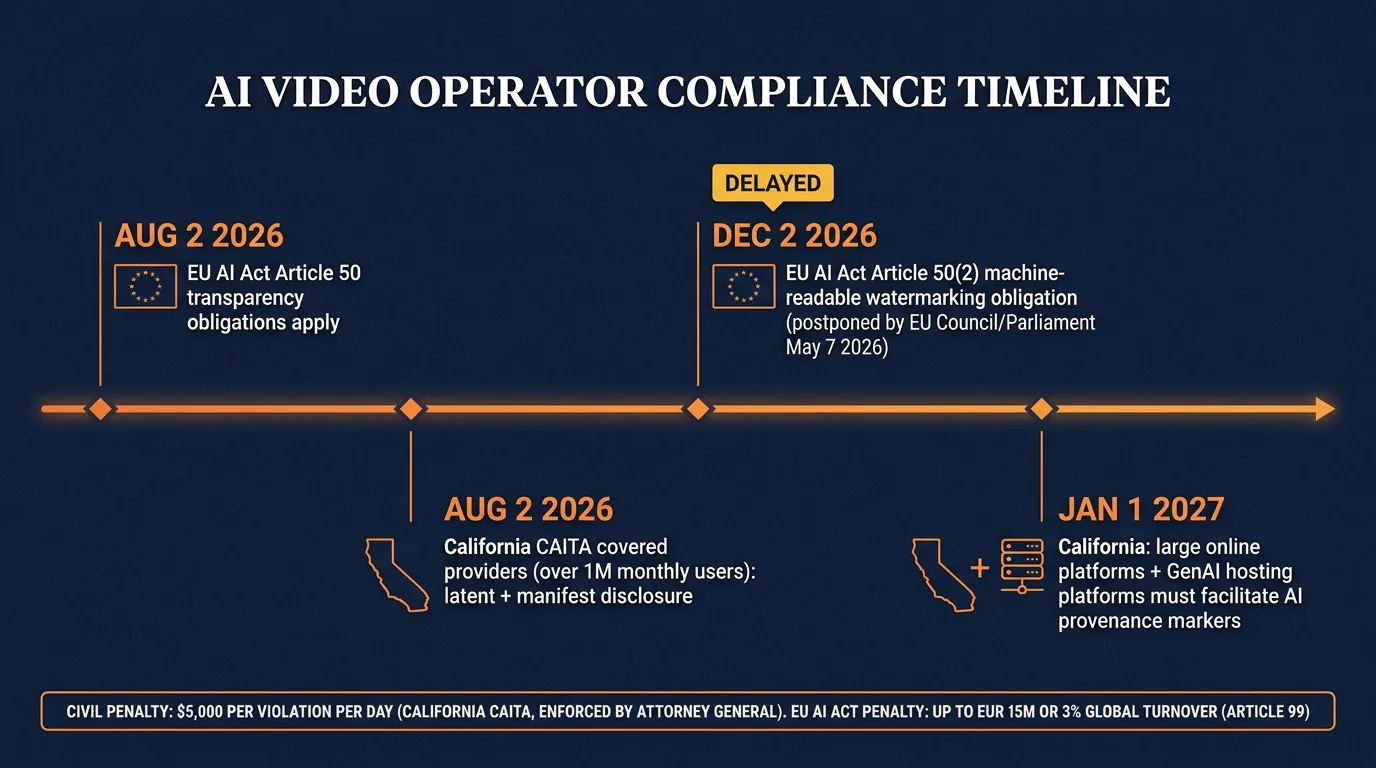
This section corrects a widely-circulated misunderstanding about the 2026 AI compliance dates. The dates below are verified against the actual statute text, Troutman Privacy analysis, and Pillsbury Law analysis as of June 9, 2026.
EU AI Act Article 50. The transparency obligations under Article 50(1), (3), and (4) apply on August 2, 2026 to any business making AI-generated synthetic content available to EU viewers. The watermarking obligation under Article 50(2) for providers of synthetic content systems was postponed by the EU Council and Parliament agreement of May 7, 2026 to December 2, 2026. Many published guides still cite August 2, 2026 for the watermarking specifically. That date is no longer correct. Article 50 penalties are governed by Article 99 of the AI Act and can reach up to EUR 15 million or 3 percent of worldwide annual turnover, whichever is higher.
California AI Transparency Act (CAITA). Original SB 942 (signed September 19, 2024) was amended by AB 853 (signed October 13, 2025). The CAITA obligations now phase in across three dates:
- August 2, 2026: covered providers (GenAI systems with over 1,000,000 monthly visitors or users publicly accessible in California) must include latent and manifest disclosures in image, video, or audio output, plus offer a free public AI detection tool.
- January 1, 2027: large online platforms (over 2 million unique monthly users) and GenAI hosting platforms must facilitate the inclusion of AI provenance markers and refuse to host non-compliant generation systems.
- January 1, 2028: capture device manufacturers must support content authenticity.
CAITA’s civil penalty is $5,000 per violation per day, plus attorney’s fees and costs, enforced by the California Attorney General. AB 853 did not remove “text” from CAITA’s substantive provisions: the original SB 942 enactment already limited CAITA to image, video, and audio content.
The C2PA framing operators must use. Neither the EU AI Act nor California CAITA explicitly mandates C2PA Content Credentials. C2PA is the leading interoperable standard that satisfies the machine-readable provenance requirement in both jurisdictions, but the statutes are technology-neutral. Operators should embed C2PA via c2patool or the Adobe Content Authenticity SDK because it is the dominant interoperable standard, not because it is legally required by name.
The operator obligation in practice. For any AI video deliverable shipped to a client serving EU or California audiences:
- Embed C2PA Content Credentials in the file before delivery
- Include a visible “AI-generated” disclosure adjacent to published content
- Document the access path used (fal.ai, ideogram.ai subscription, Ideogram API, ElevenLabs Pro, HeyGen Avatar IV)
- Verify your editing software does not strip Content Credentials on export
- Include the Compliance Cooperation clause (see Contract Clauses section) requiring the client to preserve embedded metadata in distribution
US Business Structure Decision Matrix
| Revenue Range | Structure | Primary Benefit |
|---|---|---|
| $0 to $40,000 | Sole Proprietor (Schedule C) | Zero setup friction. Ideal for testing initial market viability. |
| $40,000 to $80,000 | LLC (default taxation) | Legal liability shielding from client lawsuits over IP claims. |
| $80,000+ net income | LLC with S-corp election (Form 2553) | Significant reduction in self-employment taxes via structured salary plus distribution split. |
| Raising venture capital | C-corp | Allows for issuing structured equity to institutional investors and employees. |
The $80,000 to $150,000 solo revenue band is simultaneously the S-corp election threshold AND the freelance-to-agency transition point. This is not a coincidence. At this revenue level, the math of both shifts in the operator’s favor. Restructure the entity and scale the team at the same time.
The Cloud-Managed Path: PromptWise
For operators who want commercial-licensed AI video output without managing six separate vendor billing accounts, voice clone overages, or downstream compliance plumbing, the natural fit is a managed orchestration platform that handles routing, licensing, and compliance disclosure by default. PromptWise is AVB’s own all-in-one AI creative studio, live now from $19 a month.
The platform is built around what working AI video operators told us they actually need:
- Consistent characters across every scene of a multi-clip commercial, solving the single biggest workflow blocker on Veo 3.1, Kling 3.0, and Seedance 2.0 pipelines today.
- Current-generation models as standard, with Seedance 2.5, Kling 3.0, Veo 3.1, Nano Banana Pro and GPT Image 2.0 available as soon as they are production-ready, so you are never generating a version behind.
- Flows purpose-built for ads and commercials, not generic video generation. UGC ad flow, 30-second hero flow, 90-second commercial flow, product video flow, real estate listing flow, treatment-menu flow.
- A single studio interface that routes a single project brief across the True Models stack: Veo 3.1 for hero shots, Kling 3.0 for character-consistent motion, Seedance 2.0 for stylized variants, ElevenLabs for voiceover, Stable Audio 3.0 for music, Ideogram 4.0 and Nano Banana Pro for hero stills. One billing account replaces six.
- C2PA Content Credentials embedded by default on output so EU AI Act Article 50 and California CAITA compliance happen automatically rather than as a downstream chore.
Your generations run in parallel, 2 jobs on Starter up to 8 on Max, with no deprioritized slow lane. That is the variable that actually decides whether you hit a client deadline. Current plans and credit rates are on the PromptWise pricing page.
FAQ
How much does it actually cost to produce a 60-second AI video? Excluding human labor, a 60-second commercial costs roughly $72 in raw compute when using Veo 3.1 with audio enabled on fal.ai, plus $0.80 for image assets, $1.20 for ElevenLabs voiceover, and $2.50 for music licensing. Fully loaded with 2 hours of editing at $50 per hour, ops overhead, and 20 percent revision contingency, the total cost-to-produce is $229.80.
Is an AI video career path sustainable in 2026? Yes, provided you focus on selling business outcomes (patient acquisition, e-commerce conversions, qualified leads) rather than selling raw access to AI generation, which is commoditizing fast. The arbitrage between $72 in fal.ai compute and $100,000 per spot (PJ Accetturo’s documented pricing) is the entire business.
What is the best pricing model for AI video services? Avoid hourly billing. Use value-based fixed-fee pricing anchored against the client’s business outcome. The Blair Enns framework from Win Without Pitching forces the price conversation to round 3 or 4 of client discovery, not round 1. Operators who quote in email 1 leave 40 to 70 percent of margin on the table.
How do I prevent compute cost overruns? Lock the written script and AI-generated storyboards in client signoff before any high-resolution video compute runs. Generate all draft work in 720p with Veo 3.1 Lite at $0.05 per second. Only upgrade to Veo 3.1 with audio at $0.40 per second after storyboard approval. The single biggest silent cost spike is regenerating sequences during revision cycles.
What are the August 2026 legal risks? EU AI Act Article 50 transparency obligations apply on August 2, 2026 to any business making AI-generated synthetic content available to EU viewers. The watermarking obligation under Article 50(2) was postponed to December 2, 2026 by the EU Council/Parliament agreement of May 7, 2026. California CAITA covered-provider obligations also apply August 2, 2026. Civil penalty is $5,000 per violation per day enforced by the California AG. Embed C2PA Content Credentials before every delivery and audit your editing pipelines to preserve metadata.
Do I need an LLC to start freelance AI video work? You can start as a sole proprietor (Schedule C) to validate market viability. Transition to an LLC once revenue crosses $40,000 to shield personal assets from client lawsuits over IP claims. At $80,000+ net income, file Form 2553 with the IRS for S-corp election to capture self-employment tax savings.
Which service type has the highest margin per hour? AI avatar talking-head videos at $400 to $500 per hour worked. HeyGen Avatar IV at $4 per minute API floor eliminates voiceover and most b-roll, dropping per-deliverable cost while preserving premium pricing for enterprise corporate communications. Second highest: full ad campaigns at $1,000 to $1,500 per senior hour because clients pay for risk absorption and strategic trust, not compute.
How much do in-house AI video creators make? ZipRecruiter aggregated data puts the US median for “AI video creator” titles at $75,498. The actual band based on LinkedIn job postings May to June 2026: $58,000 to $87,500 base for entry-level roles, $145,000 to $220,000 for senior Generative AI Producer roles in NYC and San Francisco, $185,000 to $310,000+ for Head of AI Storytelling roles with equity at well-funded startups.
Can I charge a monthly retainer for AI video work? Yes. Industry standard for branded short-form: 4 to 10 videos per month for a flat $1,500 to $5,000 fee. Higher tiers run $8,000 to $25,000 per month for full-service multi-asset retainers. The retainer model is universally favored over project-by-project billing because it stabilizes operator cash flow and shifts client psychology from price-shopping to relationship management.
Do clients care if the video is made with AI? In high-conversion niches (DTC e-commerce, local services, lead generation), clients care only about return on ad spend. In prestige branding (luxury, hospitality, enterprise B2B), clients expect significant cost savings over traditional production but require visible quality parity. Industries that filter heavily for “no AI” tend to be the ones AI video can disrupt fastest because