
Medical spa marketing in 2026 is the highest-margin, fastest-growing, and most visually-driven small-to-medium business vertical in US healthcare, with 10,488 registered locations in 2023 projected to exceed 12,500 by end of 2026 per the American Med Spa Association, 15 percent annual growth, and average single-location revenue of 1.98 million USD. This guide gives marketing directors and creative directors the operator-grade AI video and image production stack: which True Models to use for which med spa format, exactly what each workflow costs in AI compute (typically under 20 USD per finished deliverable versus the 5,400 USD average monthly agency retainer it replaces), how to navigate the HIPAA, FDA, state Board of Medical Examiners, and FTC Endorsement Guides compliance overlay that distinguishes legal marketing from class-action exposure, and ten image prompts you can generate today to bootstrap your first AI content campaign.
The New Economics of Medical Spa Marketing in 2026
Answer capsule. The US medical spa industry generates over 17 billion USD annually with an average single-location practice doing 1.98 million USD in revenue, 20 to 25 percent EBITDA margins (40 percent for top quartile), and 7 to 15 percent of gross revenue allocated to marketing. The dominant 2026 structural shift: 87 percent of practices made significant marketing changes in early 2026 but only 7 percent effectively leverage short-form video platforms like TikTok, creating a wide performance gap between practices investing in modern AI content production and those still relying on legacy agency retainers.
Industry data verified per the American Med Spa Association State of the Industry report:
- Locations: 10,488 in 2023, projected 12,500+ by end of 2026, growing 15 percent annually
- Revenue: Average single-location 1.98 million USD; 73 percent of revenue from repeat patients
- EBITDA margins: 20 to 25 percent typical, scaling to 40 percent for top quartile practices
- Marketing spend: 7 percent of gross revenue average; 10 to 15 percent for growth-mode practices
- Treatment revenue mix: Injectables (Botox, Dysport, fillers) lead, followed by laser treatments, body contouring, retail skincare (40 to 60 percent gross margin)
- Marketing director compensation: 77,000 to 117,000 USD annual base (40 to 50 percent below cross-industry marketing director benchmarks of 195,000 USD, per Glassdoor 2026 data), explaining why many practices reach for agency retainers instead of in-house hires
For private equity buyers and multi-location operators, EBITDA acquisition multiples vary sharply by clinic size per Covenant Health Advisors 2026 Med Spa Market Outlook:
| Revenue Band | Typical EBITDA | Acquisition Multiple |
|---|---|---|
| Under 4M USD | Sub-1M USD | 3.0x to 6.0x EBITDA |
| 4M to 20M USD | 1M to 4M USD | 5.0x to 8.0x EBITDA |
| 20M+ USD | Multi-million | 7.0x to 12.0x EBITDA |
This means marketing directors at PE-backed multi-location chains are not just measured on cost per booked consultation. They are measured on whether content production efficiency moves the multiple at exit. AI compute compression of creative costs from 6,000 to 8,000 USD per month down to 150 to 300 USD per month directly improves the EBITDA line that drives the multiple.
The wedge story for 2026: per the AmSpa Marketing Investment Gap report, 87 percent of practices reported making significant marketing changes in early 2026 to adapt to new digital realities, but only 7 percent effectively leverage short-form video platforms like TikTok. The performance gap between practices using AI content production and those still on legacy agency models is widening every quarter.
The Synthetic Patient Wedge: Why Real Patient Photos Are the Wrong Default in 2026
Answer capsule. The single most consequential editorial decision for medical spa marketing in 2026 is whether to use real patient before-and-after photos or AI-generated synthetic patient images. Fully synthetic patient images created from text-to-image prompts only, with no real patient as conditioning input, are NOT Protected Health Information under HIPAA Safe Harbor (45 CFR 164.514) and carry zero PHI risk. Real patient photos used in marketing require explicit 45 CFR 164.508 authorization, are permanently irrevocable once published, and remain exposed to revocation requests for the lifetime of the patient. The default choice for new med spa content in 2026 is synthetic.
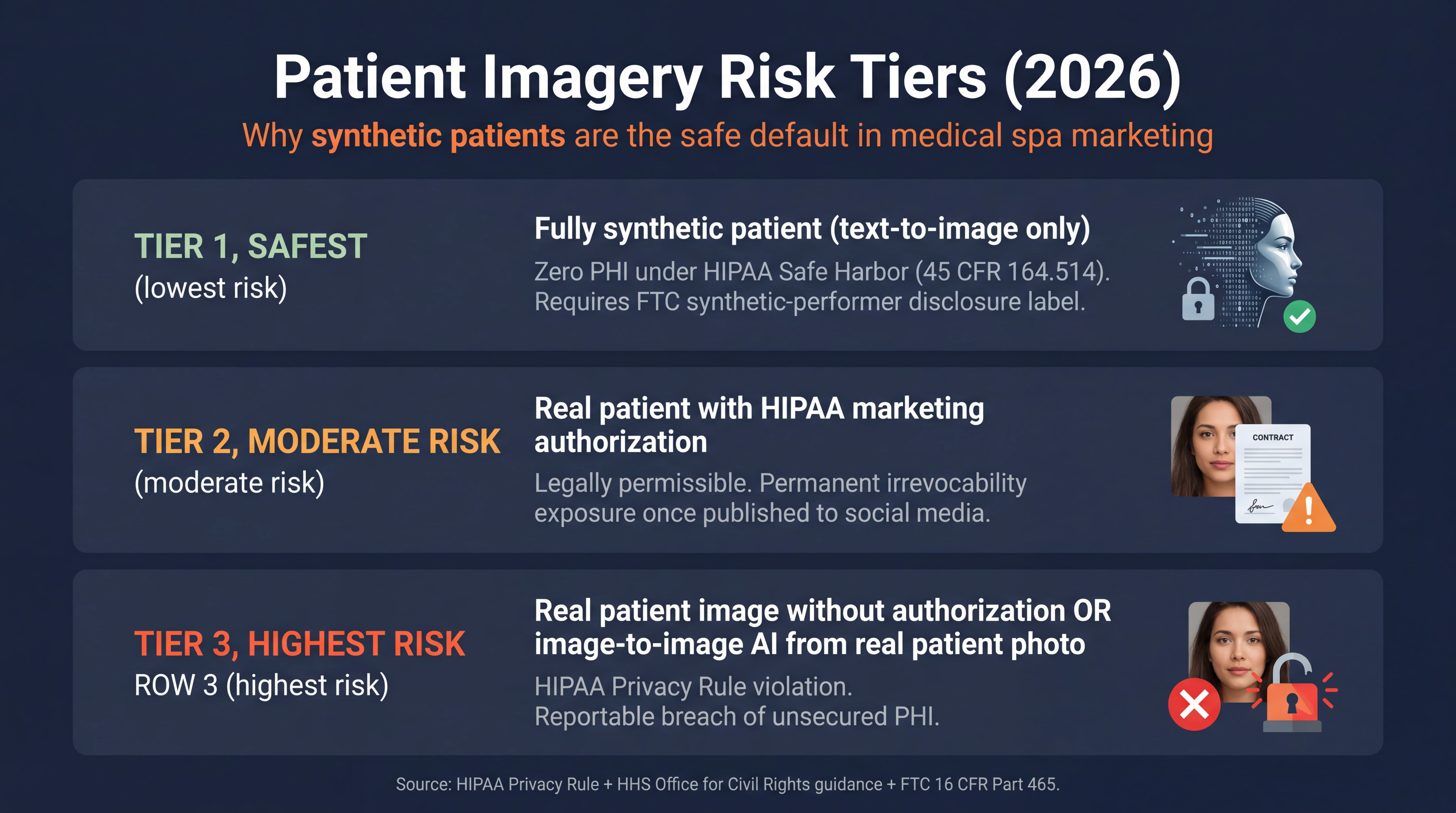
The load-bearing AVB editorial position: medical spas should generate before-and-after illustrative content using fully synthetic patients from text-to-image prompts, with a visible on-image disclosure label such as “AI-generated illustration. Not an actual patient. Individual results vary.”
Three categories of patient imagery in 2026 marketing, ranked safest to riskiest:
- Fully synthetic patient (text-to-image only): zero PHI under HIPAA Safe Harbor. Requires FTC synthetic-performer disclosure label per 16 CFR Part 465. This is the safe default.
- Real patient image with full HIPAA marketing authorization: legally permissible but operationally complex. The authorization must explicitly describe why the photo is being taken, who it will be shared with, and acknowledge the patient’s right to revoke. Once published to social media, the image cannot be fully retracted, creating permanent revocation exposure.
- Real patient image without explicit authorization, including image-to-image AI style transfer using real patient photos as conditioning input: direct HIPAA Privacy Rule violation. The image-to-image route through an unvetted cloud AI service without a signed Business Associate Agreement (BAA) is a reportable breach of unsecured PHI per HHS Office for Civil Rights guidance.
The FTC penalty for passing AI-generated synthetic patients off as real testimonials reaches 53,088 USD per violation (2026 inflation-adjusted) under FTC 16 CFR Part 465 (Trade Regulation Rule on Consumer Reviews and Testimonials) combined with the May 2026 Endorsement Guides commentary on synthetic testimonials.
The third-rail trap most legacy med spa marketing agencies miss: image-to-image style transfer using a real patient photo as the conditioning input does NOT make the output “synthetic.” It is a derivative work that remains PHI under HIPAA. Only text-to-image generation with no real patient reference qualifies as fully synthetic under HIPAA Safe Harbor.
For the broader 2026 AI content compliance picture across all verticals, see the AI Disclosure Compliance 2026 pillar.
The Medical Spa AI Tool Stack: Video + Image Unified
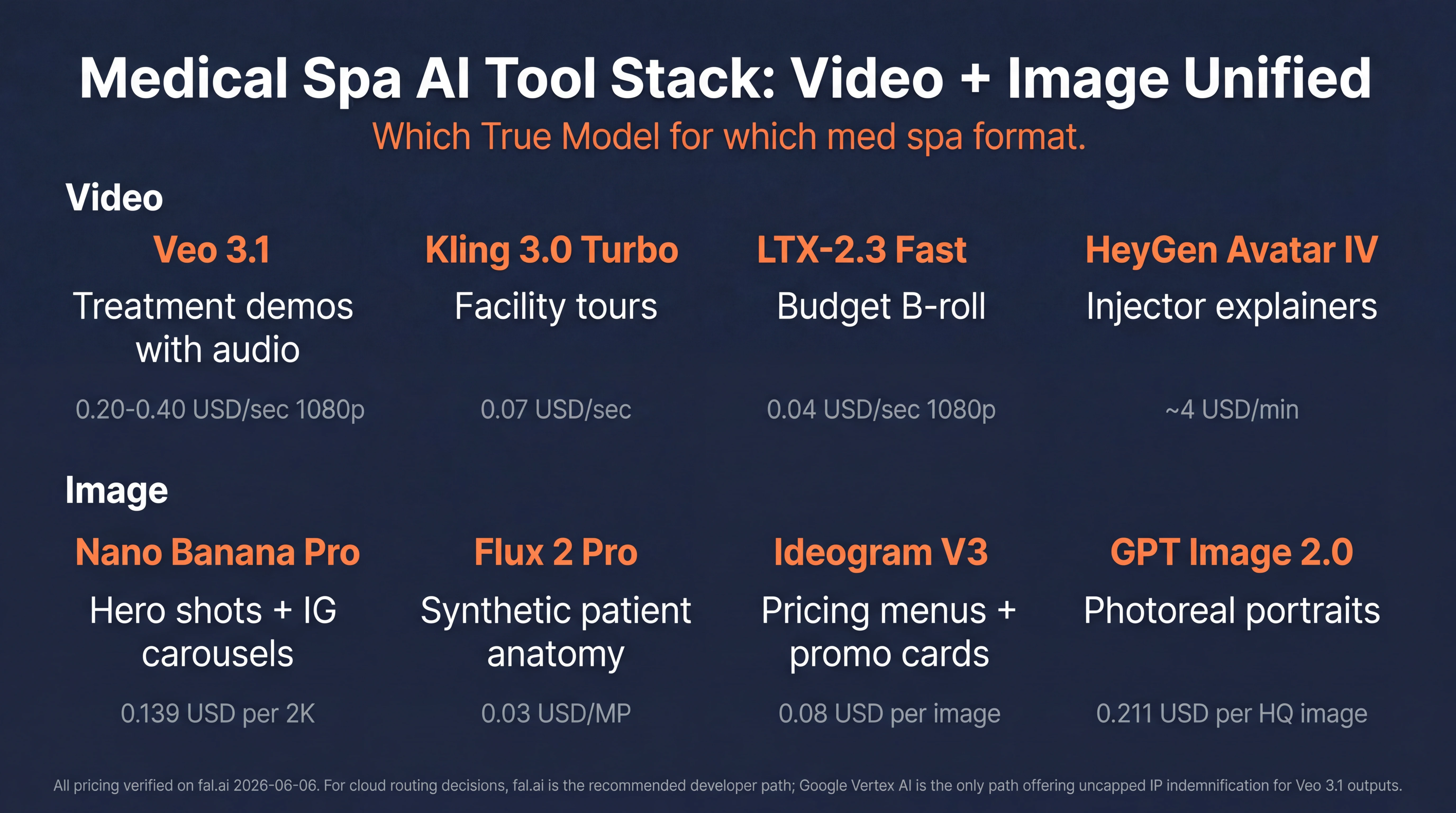
Answer capsule. Med spa marketing requires both AI video and AI image generation because the format mix (Instagram carousels, treatment promo Reels, before-after stills, facility tours, paid social ads) spans both modalities. The recommended True Models stack for 2026: Veo 3.1 for high-fidelity treatment demos with native audio, Kling 3.0 Turbo for cinematic facility tours, LTX-2.3 Fast for budget B-roll, Seedance 2.0 for fast-cut social ads, HeyGen Avatar IV for injector-presenter explainers. Image: Nano Banana Pro for product hero shots and IG carousels, Flux 2 Pro for synthetic patient anatomy, Ideogram V3 for typography-heavy promo cards.
Video tools by use case
| Use case | Recommended tool | fal.ai pricing (2026-06-06) | Native audio |
|---|---|---|---|
| Treatment demo macro shots, dialogue scenes | Veo 3.1 | 0.40 USD/sec 1080p with audio, 0.20 USD/sec without | Yes (48 kHz dialogue) |
| Cinematic facility tour | Kling 3.0 Turbo | 0.07 USD/sec | Native |
| Budget B-roll, ambient establishing shots | LTX-2.3 Fast | 0.04 USD/sec 1080p | 24 kHz stereo |
| Fast-cut social promo (TikTok, Reels) | Seedance 2.0 Pro | 0.682 USD/sec 1080p | Dual-branch |
| Injector-presenter explainer video | HeyGen Avatar IV | approx. 4 USD per minute | Lip-synced |
| Cheapest open-weights option | Wan 2.7 | 0.04-0.10 USD/sec partner clouds | Post-composited |
Veo 3.1 pricing verified live on fal.ai/models/fal-ai/veo3.1: “For every second of video you generate you will be charged $0.20 without audio or $0.40 with audio for 720p or 1080p. At 4k, you will be charged $0.40 per second without audio, or $0.60 with.” For med spa B-roll where dialogue is rarely needed and the soundtrack is music or voiceover added in post, the no-audio Veo tier cuts the cost by 50 percent versus the with-audio default most operators use by mistake.
For the LTX-2.3 deep dive including the asymmetric dual-stream architecture (14B video + 5B audio) and the three product tiers (Fast, Pro, Quality), see the LTX-2 Complete Guide 2026. For the Seedance 2.0 omni-reference capability (12 simultaneous reference files including 9 images, 3 videos, 3 audio) and the full pricing matrix, see the Seedance 2.0 Complete Guide. For the broader True Models lineup beyond med spa applications, see the Best AI Video Tools 2026 Tech Stack pillar.
Image tools by use case
| Use case | Recommended tool | Pricing |
|---|---|---|
| Product hero shots, IG carousel consistency, brand logo persistence | Nano Banana Pro | 0.139 USD per 2K image via Vertex AI |
| Synthetic patient anatomy (skin, faces, before/after) | Flux 2 Pro | 0.03 USD per megapixel via fal.ai |
| Photoreal portraits, conversational refinement | GPT Image 2.0 | 0.211 USD per high-quality 1024x1024 |
| Typography-heavy pricing menus, promo cards | Ideogram V3 | approx. 0.08 USD per image |
| Vector-grade promotional creative | Recraft V3 | approx. 0.05 USD per image |
| Batch generation for 50+ ad variations | Seedream 4.0 | 0.018 USD per image via fal.ai |
| Cinematic interior architecture | Flux 2 Pro | 0.03 USD per megapixel |
| Aesthetic stylized brand illustration | Midjourney V8.1 | included in Basic plan from 10 USD/mo |
Nano Banana Pro is the all-around winner for med spa work across 6 of 8 image formats because of its multi-image consistency feature (lock the same injector face or treatment room across an entire Instagram carousel without LoRA training) and brand logo persistence (render your branded serum bottle or branded skincare line with the logo intact across angles). Flux 2 Pro takes the lead specifically for synthetic patient anatomy because of its high realism on skin texture, pores, fine lines, and natural lighting. For deeper image tool coverage including all 108 generators and editors, see the AI Image Generators A-Z Encyclopedia. For the Nano Banana Pro deep dive, see the Nano Banana Pro Complete Guide 2026.
Pricing and Cost Math: AI Compute vs Traditional Agency
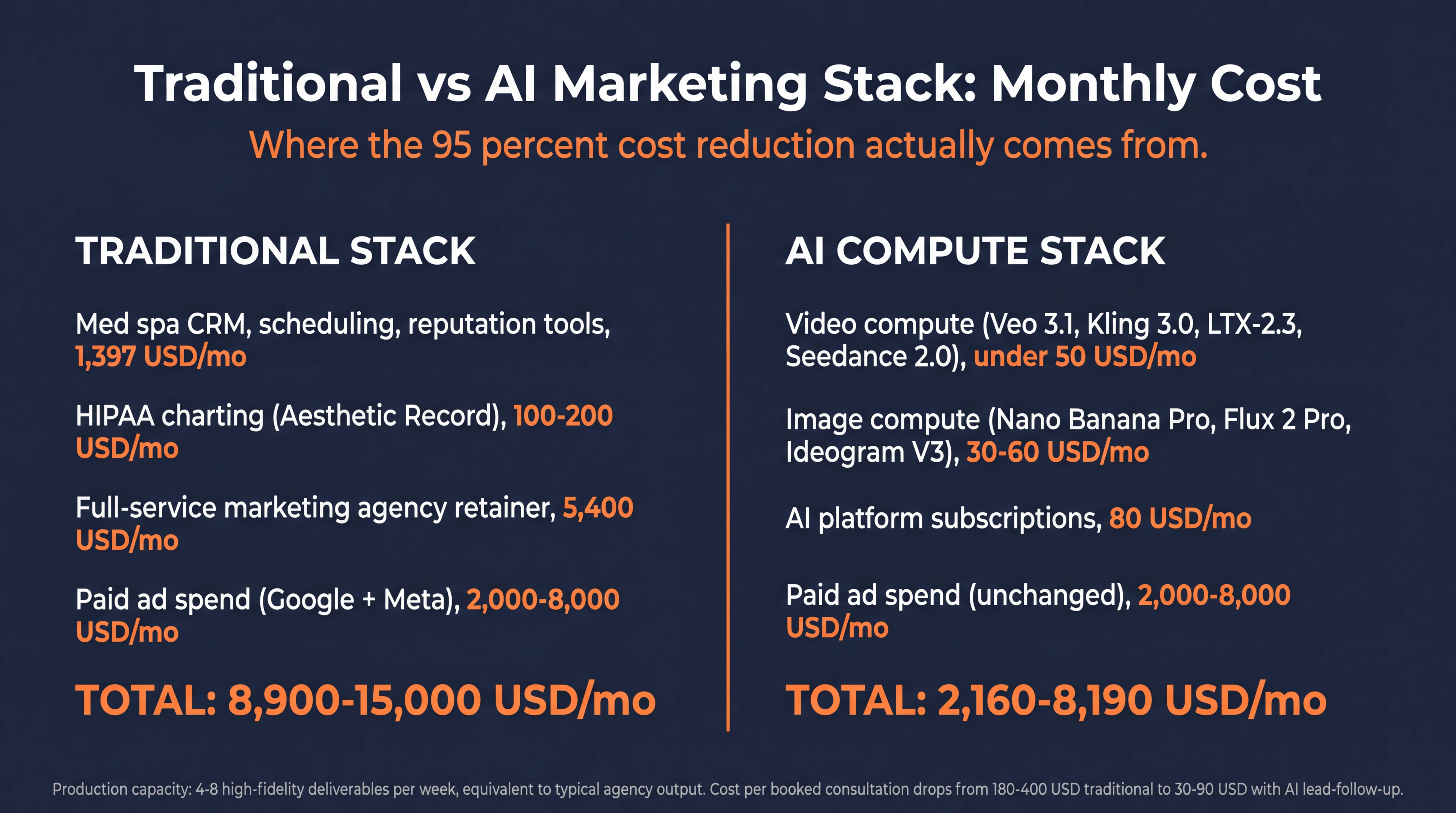
Answer capsule. Traditional med spa marketing stack runs 6,000 to 8,000 USD per month (CRM at 1,397 USD, agency retainer averaging 5,400 USD, plus 2,000 to 8,000 USD in ad spend). The equivalent AI compute stack producing 4 to 8 deliverables per week using True Models runs 150 to 300 USD per month. Cost per booked consultation drops from 180 to 400 USD traditional to 30 to 90 USD with AI lead-follow-up automation. The structural shift is collapsing the creative production line item from 5 to 15 percent of marketing budget to under 2 percent, freeing capital for paid media efficiency.
Traditional stack monthly costs
Per PatientNow industry benchmarks and Optimal.dev med spa marketing analysis:
- Med spa technology stack (CRM, scheduling, reputation management, email): approximately 1,397 USD per month
- Specialized HIPAA-compliant charting (Aesthetic Record, Boulevard): 15.00 to 19.00 USD per user per month, plus 399 USD onboarding
- Full-service marketing agency retainer: 5,400 USD per month average; high-end metro agencies charge 2,500 USD baseline management fee plus retainer
- Ad spend (Google + Meta): 2,000 to 8,000 USD per month
- Total monthly: 6,000 to 8,000 USD before a single dollar in ads
AI compute stack monthly costs
For a clinic producing approximately 20 high-end marketing videos per month (averaging 10 seconds each) plus 30 to 40 still images per month using the True Models stack:
- Video compute (mix of Veo 3.1, Kling 3.0, LTX-2.3, Seedance 2.0): less than 50.00 USD per month in raw API costs
- Image compute (Nano Banana Pro, Flux 2 Pro, Ideogram V3): 30 to 60 USD per month
- AI platform subscriptions (Midjourney 10 USD, HeyGen 30 USD, ChatGPT Plus 20 USD, Gemini Advanced 20 USD): roughly 80 USD per month
- Total monthly: 150 to 300 USD per month
The 95 percent cost reduction is real and verifiable on a per-deliverable basis. A 60-second social campaign requiring six 10-second clips costs approximately 2.40 USD on LTX-2.3 Fast or 3.60 USD on LTX-2.3 Pro versus 24.00 USD on Veo 3.1 with audio versus 4,000 to 8,000 USD on a traditional video production day-rate.
Cost per booked consultation
The operationally critical KPI for medical spa marketing directors is cost per booked consultation. Industry benchmarks:
- Traditional manual workflow: 180 to 400 USD per booked consultation
- AI-driven workflow with sub-60-second lead response: 30 to 90 USD per booked consultation
The driver: per the Optimal.dev med spa AI transition guide, average manual lead response time is 4.2 hours. AI agents shrink this to under 60 seconds. 78 percent of potential patients abandon a clinic conversation after 30 minutes of communication silence. Recovering that 78 percent at scale moves the cost per booked consultation by 3 to 5x.
Seven Compliance-Safe Production Workflows
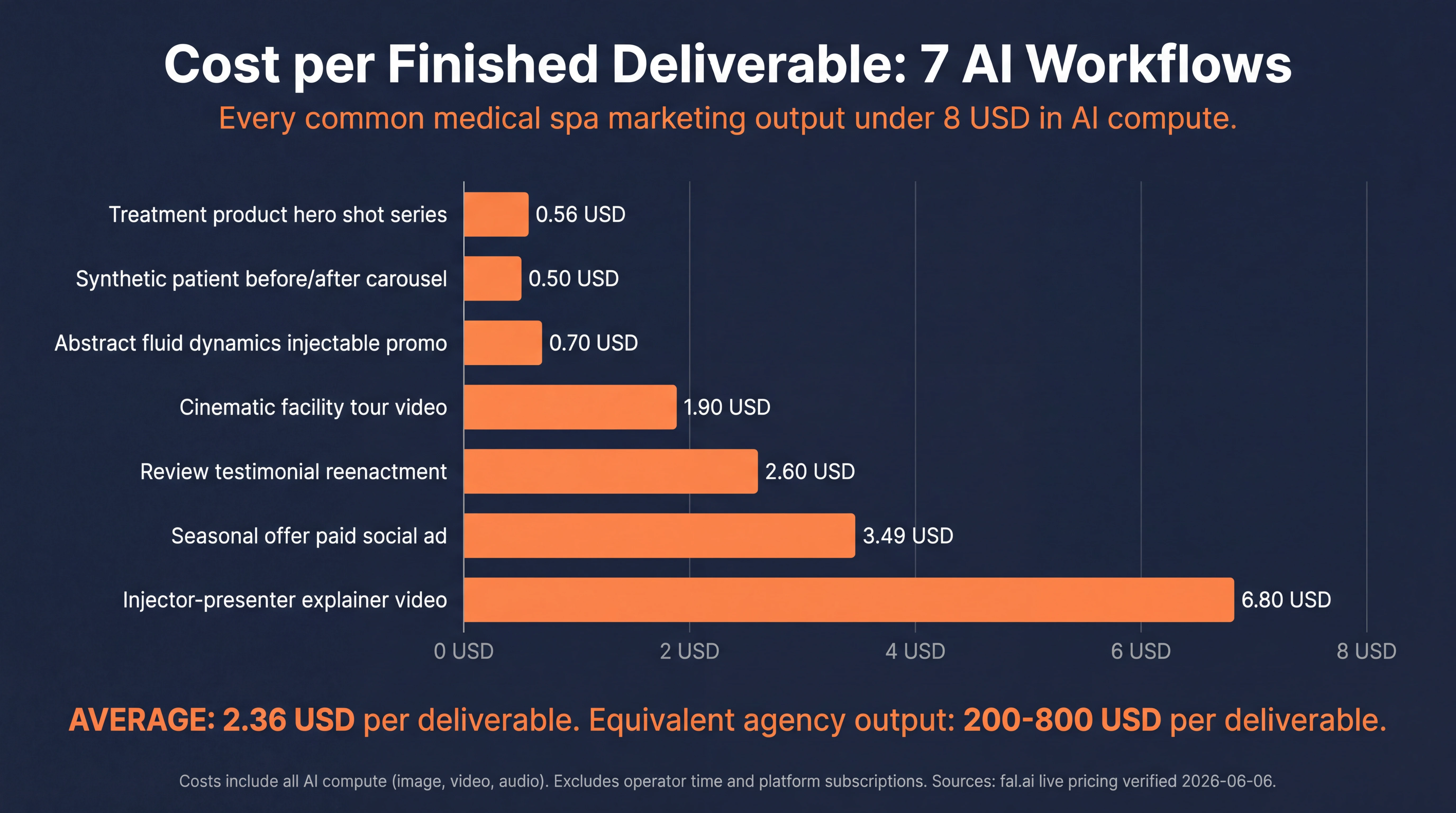
Answer capsule. Seven worked workflows combining AI image and video tools with cost math under 8 USD per finished deliverable. Each workflow includes the marketing objective, format and platform, full tool stack, step-by-step production sequence, AI compute cost itemized, and the specific compliance flag that applies.
Workflow 1: Synthetic Patient Before-and-After Carousel
- Objective: Illustrate dermal filler or neurotoxin treatment outcomes without HIPAA exposure
- Format: Instagram carousel, 5 slides at 1080x1350 portrait
- Tool stack: Flux 2 Pro (image) + Canva (design overlay)
- Sequence: Prompt Flux 2 Pro for synthetic baseline patient with specific aging markers (deep nasolabial folds, glabella 11-lines, crow’s feet). Use image-to-image with same synthetic patient as reference to generate the “after” frame with reduced markers. Composite both into Canva slides with mandatory “AI-Generated Synthetic Patient Illustration. Not an actual patient.” overlay. Add state-board-required medical director attribution.
- Cost: 5 Flux 2 Pro images at approximately 0.10 USD each = 0.50 USD per carousel set
- Compliance flag: FTC 16 CFR Part 465 and May 2026 Endorsement Guides update require visible on-image disclosure label. Up to 53,088 USD per violation if presented as real patient testimonial.
Workflow 2: Injector-Presenter Patient Education Video
- Objective: Scale post-care education without removing clinical staff from revenue-generating appointments
- Format: YouTube Shorts, Instagram Reels (60-90 seconds)
- Tool stack: HeyGen Avatar IV (presenter video) + LTX-2.3 Fast (B-roll)
- Sequence: Record baseline 30-second avatar reference of your real injector. Script post-care instructions reviewed by your medical director. Generate the avatar speaking the script via HeyGen. Generate 3 to 4 abstract B-roll clips using LTX-2.3 Fast (laser glides, skincare bottle close-ups, ambient spa environments). Edit in CapCut Pro with brand graphics.
- Cost: HeyGen 90-second video at approximately 6.00 USD + 5 seconds of LTX-2.3 Fast B-roll at 0.04 USD/sec x 4 clips = 0.80 USD. Total: 6.80 USD per video.
- Compliance flag: Script must not guarantee clinical results per FDA Title 21 efficacy rules. State board attribution required for the supervising physician name.
Workflow 3: Cinematic Facility Tour
- Objective: Upgrade phone photos into cinematic Google Business Profile video tour
- Format: Google Business Profile video, website header
- Tool stack: Nano Banana Pro (image upscale) + Kling 3.0 Turbo (motion) + ElevenLabs (voiceover)
- Sequence: Capture phone photos of clinic interior. Enhance through Nano Banana Pro for lighting and resolution. Feed enhanced stills into Kling 3.0 Turbo for smooth dolly-in and tracking motion. Add ElevenLabs welcoming voiceover. Layer ambient spa music from Stable Audio 3.
- Cost: Nano Banana Pro 4 images at 0.139 USD = 0.56 USD. Kling 3.0 Turbo 12 seconds at 0.07 USD/sec = 0.84 USD. ElevenLabs 30-second voiceover approximately 0.50 USD. Total: 1.90 USD per tour video.
Workflow 4: Seasonal Offer Paid Social Advertisement
- Objective: Drive direct response conversions for holiday aesthetic packages
- Format: Meta and TikTok paid ads (15-30 seconds, 9:16 vertical)
- Tool stack: Midjourney V8.1 (image) + Seedance 2.0 (motion) + Ideogram V3 (text overlay)
- Sequence: Generate luxury floral and product flat-lay in Midjourney V8.1. Import into Seedance 2.0 for subtle animated motion. Generate text-only overlay in Ideogram V3 for treatment package, pricing, and consultation requirement disclaimer. Composite in CapCut.
- Cost: Midjourney included in 10 USD subscription. Seedance 2.0 Pro 5 seconds at 0.682 USD/sec = 3.41 USD. Ideogram V3 single overlay 0.08 USD. Total: 3.49 USD per ad.
- Compliance flag: Offers must include fine print regarding medical consultation requirement and treatment-specific contraindications.
Workflow 5: Treatment Product Hero Shot Series
- Objective: Create high-resolution web banners and Google Business Profile photos for service pages
- Format: 1920x1080 web header, 1080x1080 GBP photos
- Tool stack: Nano Banana Pro only
- Sequence: Prompt Nano Banana Pro for pristine clinical setup with unbranded medical vials and syringes on sterile stainless tray under dramatic studio lighting. Generate 4 variations to populate web service page gallery.
- Cost: 4 images at 0.139 USD each = 0.56 USD per series.
- Compliance flag: Prompts must explicitly avoid generating exact replicas of trademarked prescription drug labels (Botox, Juvederm, Dysport) to prevent FDA misbranding and trademark enforcement.
Workflow 6: Abstract Fluid Dynamics for Injectable Promotion
- Objective: Visually represent hyaluronic acid hydration without showing needles (which trigger platform censorship)
- Format: TikTok video (15-30 seconds)
- Tool stack: Kling 3.0 Turbo only
- Sequence: Generate hyper-realistic simulation of crystal-clear water merging with viscous gel. Loop seamlessly. Add Stable Audio 3 ambient soundtrack in post.
- Cost: 10 seconds Kling 3.0 Turbo at 0.07 USD/sec = 0.70 USD per clip.
Workflow 7: Review Testimonial Reenactment (Compliance-Heavy)
- Objective: Bring written Google or Yelp reviews to life using synthetic patient performers
- Format: Paid social video, 30-60 seconds
- Tool stack: Flux 2 Pro (synthetic portrait) + ElevenLabs (voiceover) + HeyGen Avatar IV (animation)
- Sequence: Generate diverse synthetic patient portraits in Flux 2 Pro. Generate conversational voiceover of actual anonymized review text in ElevenLabs. Use HeyGen to animate the Flux 2 Pro portrait speaking the audio. Add persistent “Synthetic Performer. Actor portrayal.” overlay throughout the entire video.
- Cost: Flux 2 Pro 0.10 USD + ElevenLabs 0.50 USD + HeyGen 30-second avatar 2.00 USD = 2.60 USD per reenactment.
- Compliance flag: Extremely high. Must comply with FTC Endorsement Guides synthetic testimonial rules AND New York S.8420-A synthetic performer disclosure (effective June 9, 2026). The video must prominently feature persistent “Synthetic Performer” overlay throughout, not just at beginning and end. The underlying clinical encounter being referenced still requires HIPAA marketing authorization from the original real reviewer (see Compliance section below for the double-bind).
Worked Examples: 10 Medical Spa Images You Can Generate Today
Answer capsule. Ten image generation examples spanning the most common medical spa marketing formats. Each example includes the use case, recommended True Model tool, exact prompt (copy-paste ready), step-by-step instructions, cost, and compliance flag. Total compute cost for all 10 examples: approximately 2.35 USD if first-attempt, budget 15 to 25 USD if regenerating 5 to 8 variations per example.
Example 1: Treatment Hero Shot (Botox Vial Product Photography)
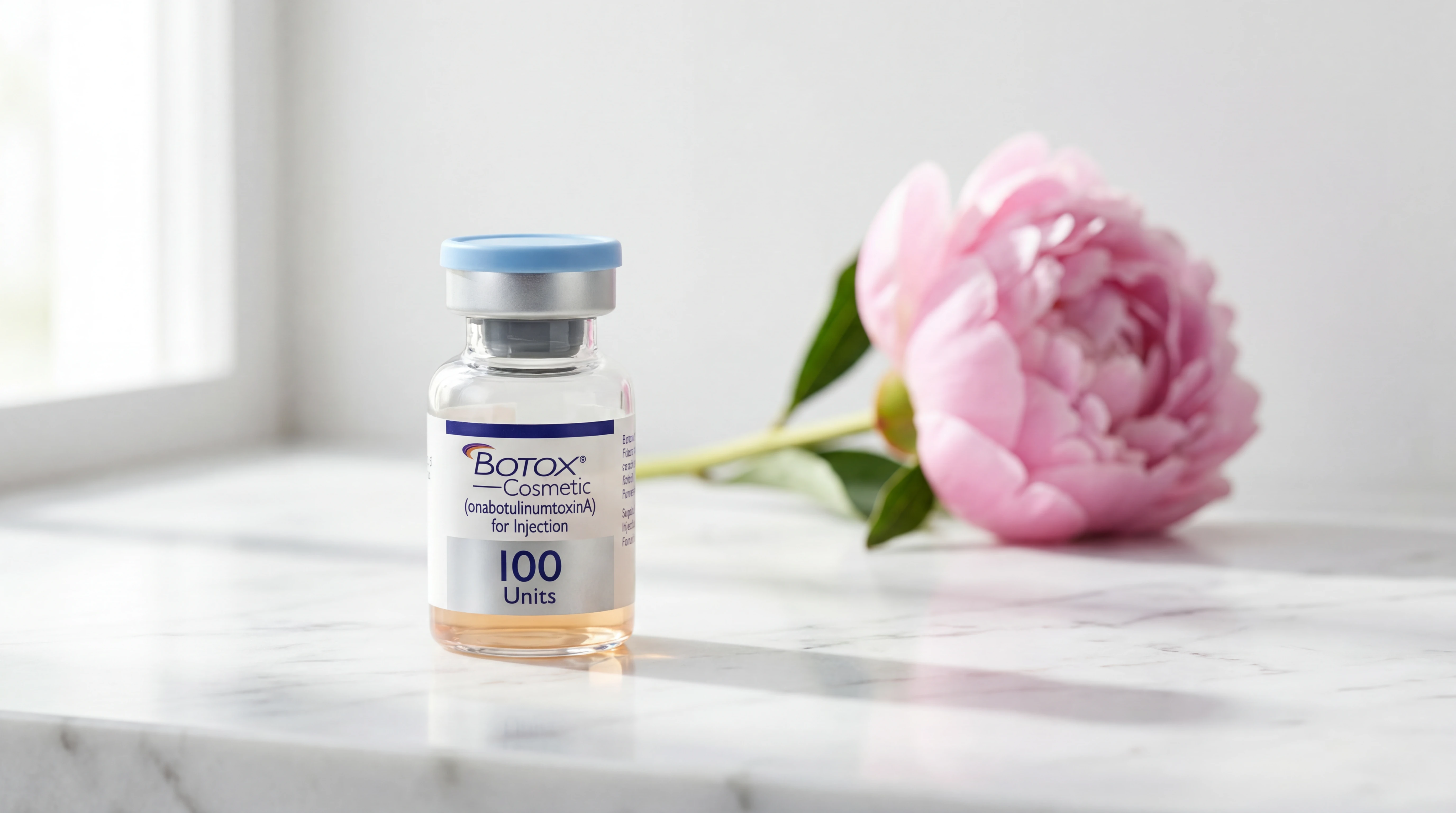
Concept image.
Use case: Web service page hero, paid social creative, Google Business Profile photo. Tool: Nano Banana Pro at gemini.google.com or fal.ai/models/fal-ai/nano-banana-pro. Cost: 0.139 USD per 2K image.
Hyperrealistic luxury product photography of a single 100-unit Botox Cosmetic vial standing upright on white Carrara marble countertop with subtle grey veining. Vial features visible Allergan branding, clear glass body, light blue rubber stopper, silver crimped cap, clinical typography on the label, soft amber liquid inside. Behind the vial on a clean white background, a single fresh-cut pink peony stem leans slightly. Soft daylight from a north-facing window creates gentle highlights and natural shadows. Shot on 85mm f/2.8, depth of field places the vial in razor-sharp focus and the peony slightly soft. Color palette: warm whites, pale pink, brushed silver. Aspect ratio 16:9. No text overlay. No watermark. Editorial luxury beauty magazine aesthetic.Brand customization: Swap “Botox Cosmetic” + “Allergan” for your actual injectable (Dysport from Galderma, Xeomin from Merz, etc.). If you do not want specific brand vials, change to “unbranded clinical injectable vial” and add your med spa logo via Canva composite.
Example 2: Synthetic Patient Before/After Illustration (Forehead Botox)
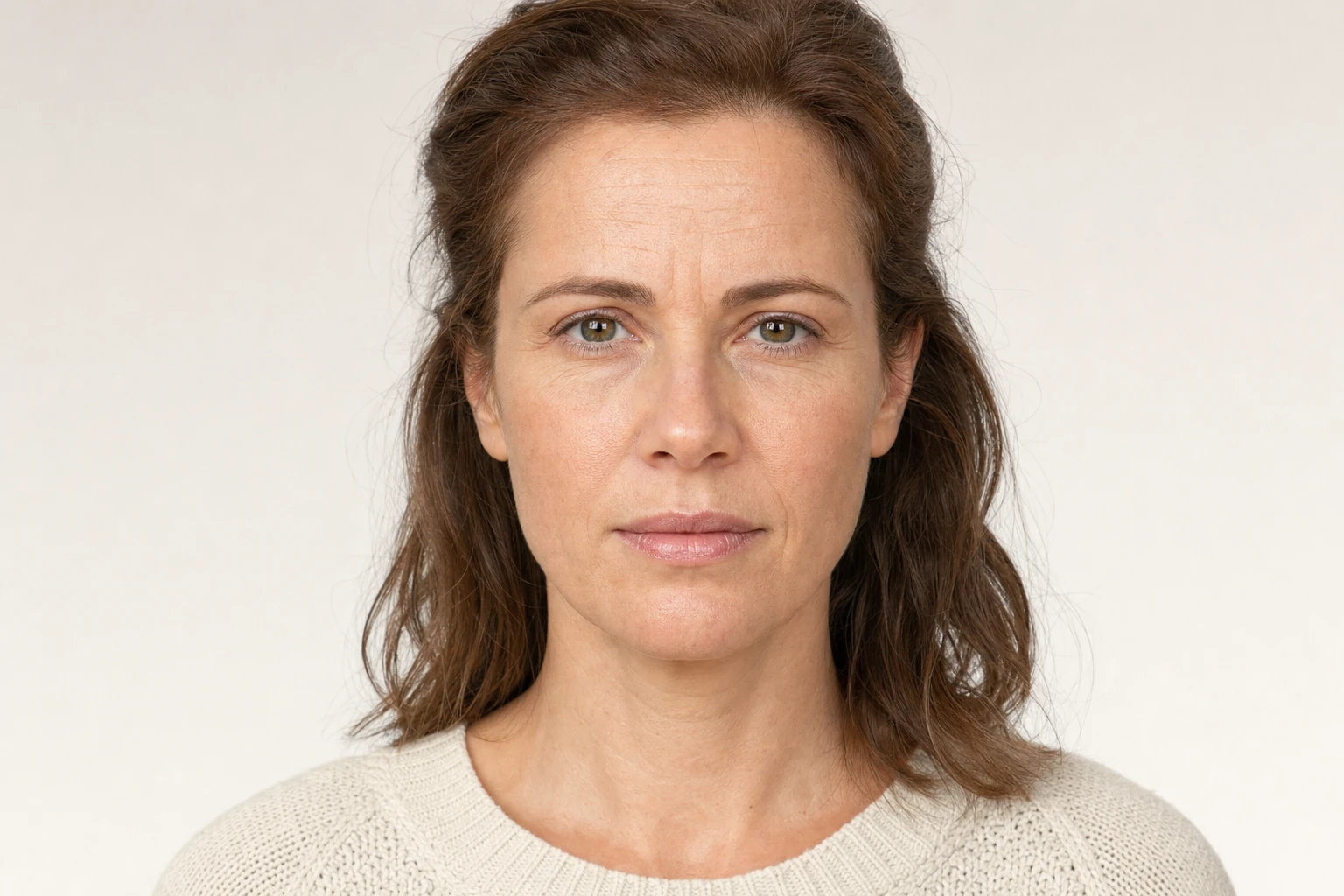
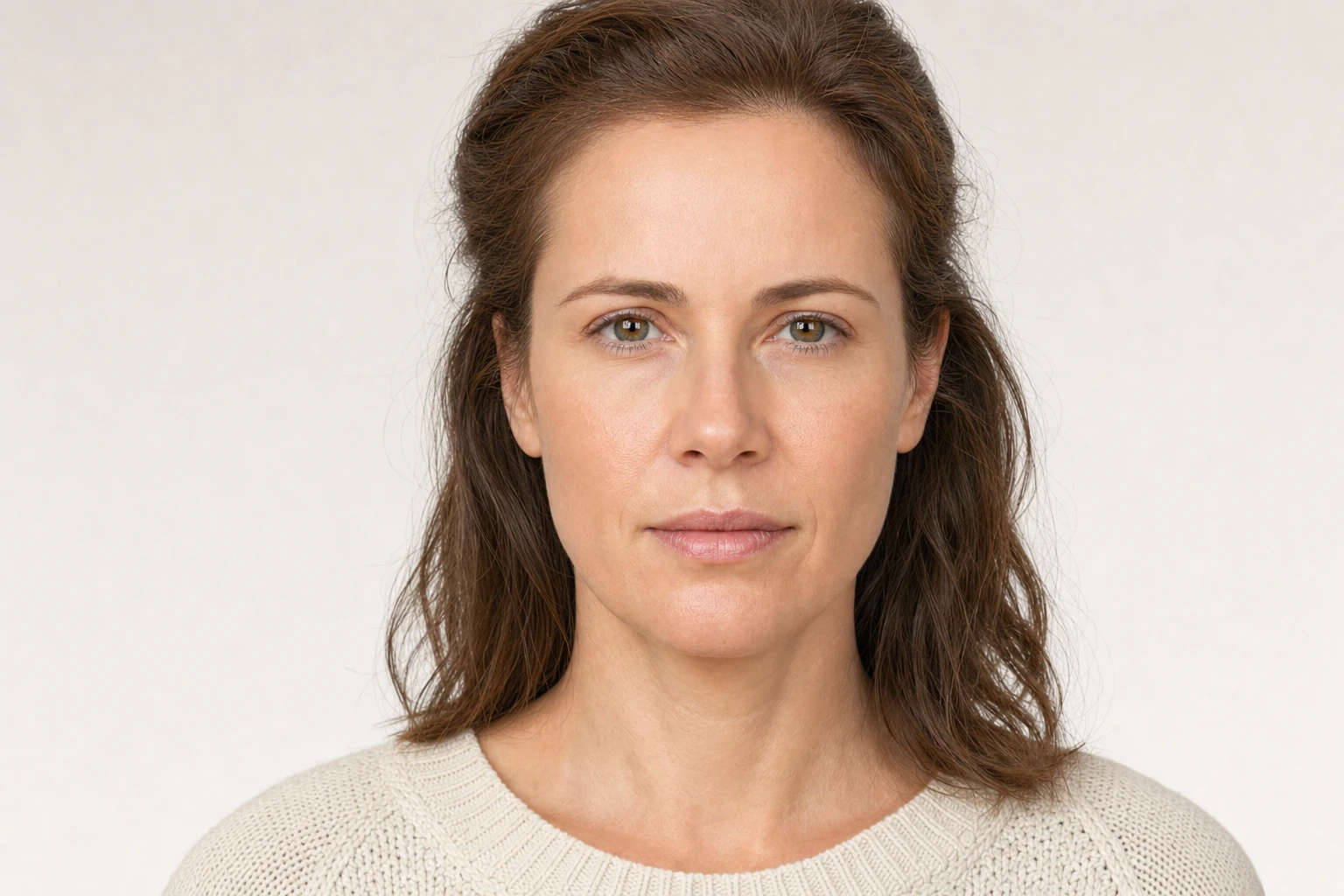
Use case: Educational web page, Instagram carousel slide, internal training. NOT for testimonial use. Tool: Nano Banana Pro for multi-image consistency. Cost: 0.278 USD total for 2 images.
Generate the BEFORE first, then use Nano Banana Pro’s multi-image reference to lock the same synthetic person for the AFTER frame.
Prompt A (BEFORE):
Photorealistic clinical portrait of a synthetic woman, late 30s, neutral expression, natural shoulder-length warm brown hair pulled back loosely, no makeup except subtle clear lip balm, wearing a soft cream knit sweater. Camera: 85mm lens at f/4, eye-level, evenly lit by a soft northwest window for natural shadow falloff. Visible horizontal lines across the forehead between the brows and 11-lines at glabella, faint crow's feet near outer eye corners. Background: clean off-white studio backdrop. The face is a composite, not based on any real person.Prompt B (AFTER, using BEFORE as multi-image reference):
Same woman as reference, same hair, same sweater, same lighting, same camera angle, same neutral expression. The forehead is now smooth and even, the 11-lines at the glabella are gone, the crow's feet near the outer eye corners are softened but the eyes still crinkle naturally when she smiles. Skin texture remains realistic and natural, not waxy or over-smoothed. The face remains a composite, not based on any real person.Compliance flag (CRITICAL): Per FTC 16 CFR Part 465 and the May 2026 Endorsement Guides update, the mandatory disclosure text “AI-generated illustration. Not an actual patient. Individual results vary.” MUST appear visibly on the image itself, not just in the caption. The synthetic patient should also not be a lookalike of any real patient at your practice.
Example 3: Injector Staff Portrait
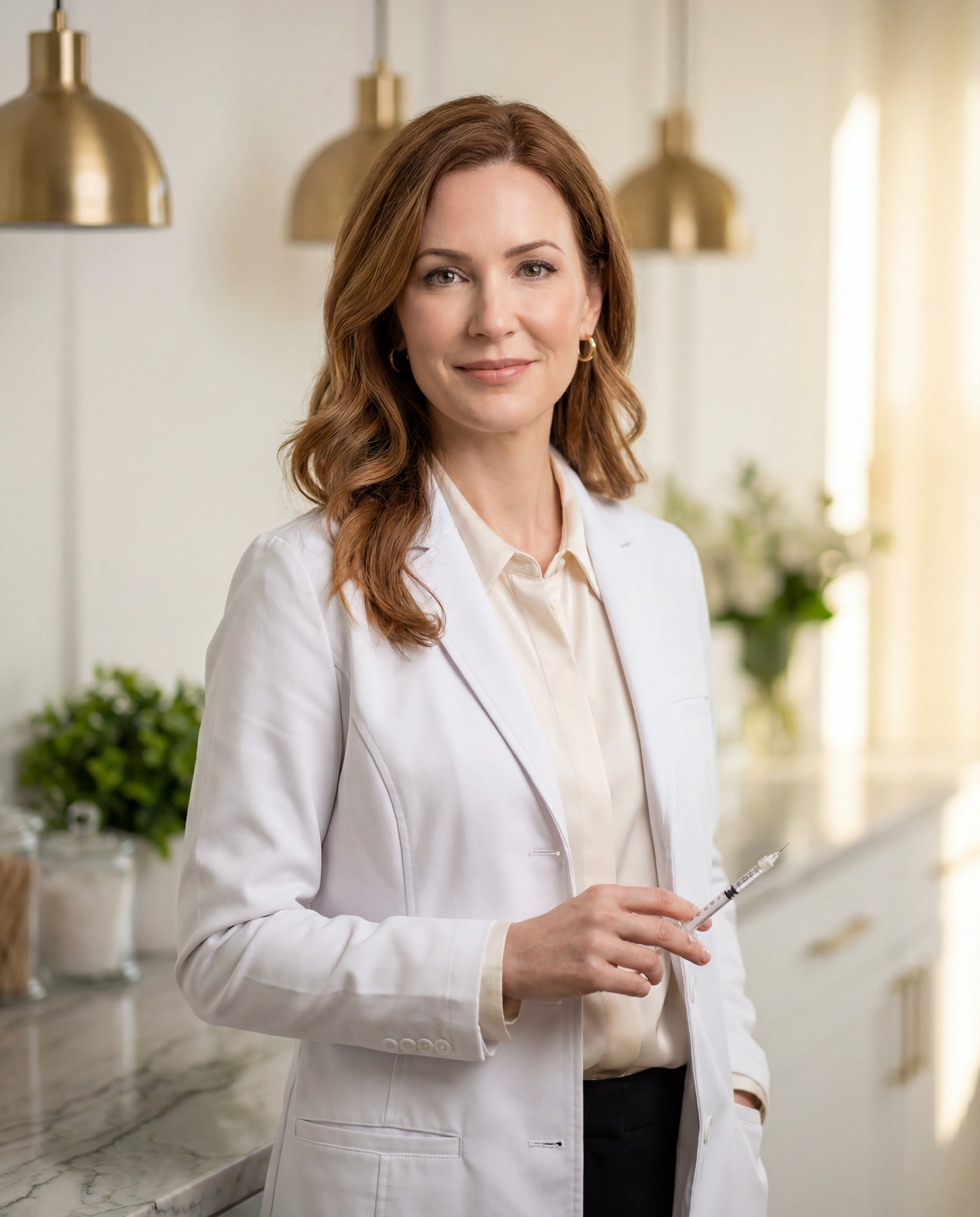
Use case: Team page, About Us, LinkedIn, Google Business Profile staff photos. Tool: GPT Image 2.0 at chat.openai.com. Cost: 0.211 USD per high-quality 1024x1024.
Professional editorial portrait of a nurse practitioner injector, woman in her early 40s, warm intelligent smile, natural makeup, shoulder-length auburn hair styled in soft waves, wearing a tailored medical white lab coat over a soft cream silk blouse, simple gold hoop earrings, holding a non-branded clinical sterile syringe loosely in her right hand at waist level. Standing in a softly out-of-focus med spa treatment room with clean white walls, brushed gold pendant lighting overhead, hint of marble counter behind her. Eye-level shot at 85mm f/2.0, eye contact with camera. Color grading: warm editorial beauty magazine, natural skin tones, soft golden window light from screen-right. The face is a composite, not based on any real person. Aspect ratio 4:5.Compliance flag: Do NOT use an AI-generated synthetic injector as if they were your real injector. State medical boards in CA, NY, FL, TX consider this deceptive advertising under state UDAP law. Use AI portraits for editorial illustrations, educational characters, or placeholders before real team photos are taken.
Example 4: Facility Interior Shot
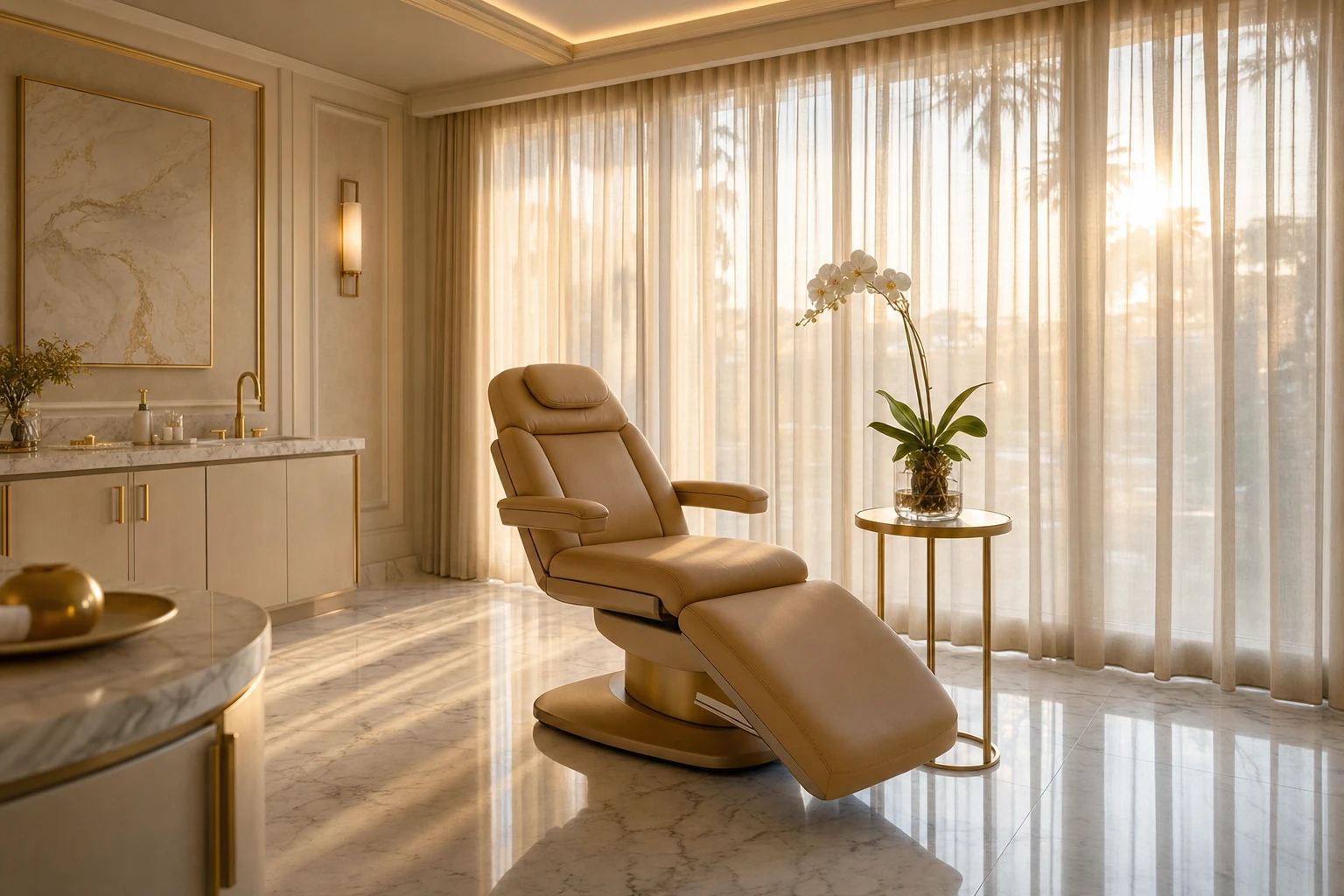
Use case: Web home page hero, GBP interior photos, paid social backgrounds. Tool: Flux 2 Pro at fal.ai/models/fal-ai/flux-2-flex. Cost: approximately 0.06 USD per 1920x1080.
Cinematic interior photography of a luxury medical spa treatment room at golden hour. White Carrara marble floor with subtle grey veining, warm cream walls with brushed gold sconces, a single contoured treatment chair upholstered in soft camel leather positioned slightly off-center. Floor-to-ceiling sheer linen curtains diffuse warm afternoon light streaming through tall windows. A small brass side table holds a single white orchid stem in a clear vase. Subtle gold and white accents throughout. Soft shadows, naturalistic depth, no people in frame, no medical equipment visible. Shot wide on 24mm lens at f/4, depth of field places the chair in sharp focus with the windows softly diffused. Aspect ratio 16:9.Example 5: Treatment Menu Pricing Card
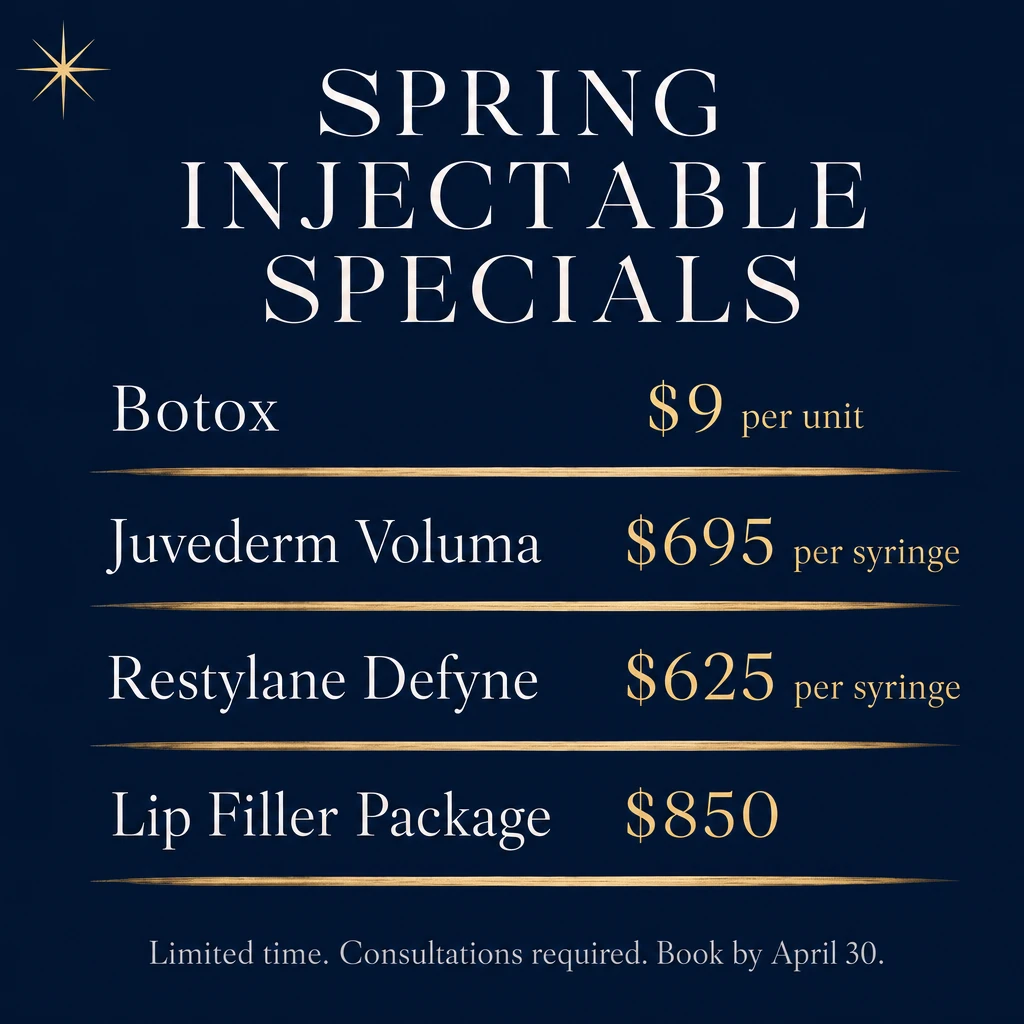
Use case: Instagram carousel slide, web pricing page, printed flyer. Tool: Ideogram V3 at ideogram.ai. Cost: approximately 0.08 USD per image.
Elegant medical spa pricing menu graphic on dark navy background. Top half: in clean white serif typography (Cormorant Garamond style), the words "SPRING INJECTABLE SPECIALS" centered. Below in horizontal rows, each row a different treatment with price in pale gold:
"Botox  $9 per unit"
"Juvederm Voluma  $695 per syringe"
"Restylane Defyne  $625 per syringe"
"Lip Filler Package  $850"
Bottom: small text in light gray "Limited time. Consultations required. Book by April 30."
Soft brushed gold horizontal divider lines between each treatment row. A single small minimalist gold star icon decoration in the top-left corner. Crisp readable typography throughout. No watermarks. No overlapping text. Aspect ratio 1:1.
Compliance flag: Medical advertising. Pricing must be accurate. State medical boards in CA, NY, FL require “from” or “starting at” language if prices vary. Add small disclaimer: “Pricing per unit/syringe. Final cost depends on units used during consultation. Limit one offer per patient.”
Example 6: Seasonal Promo Offer (Mother’s Day Spa Package Ad)
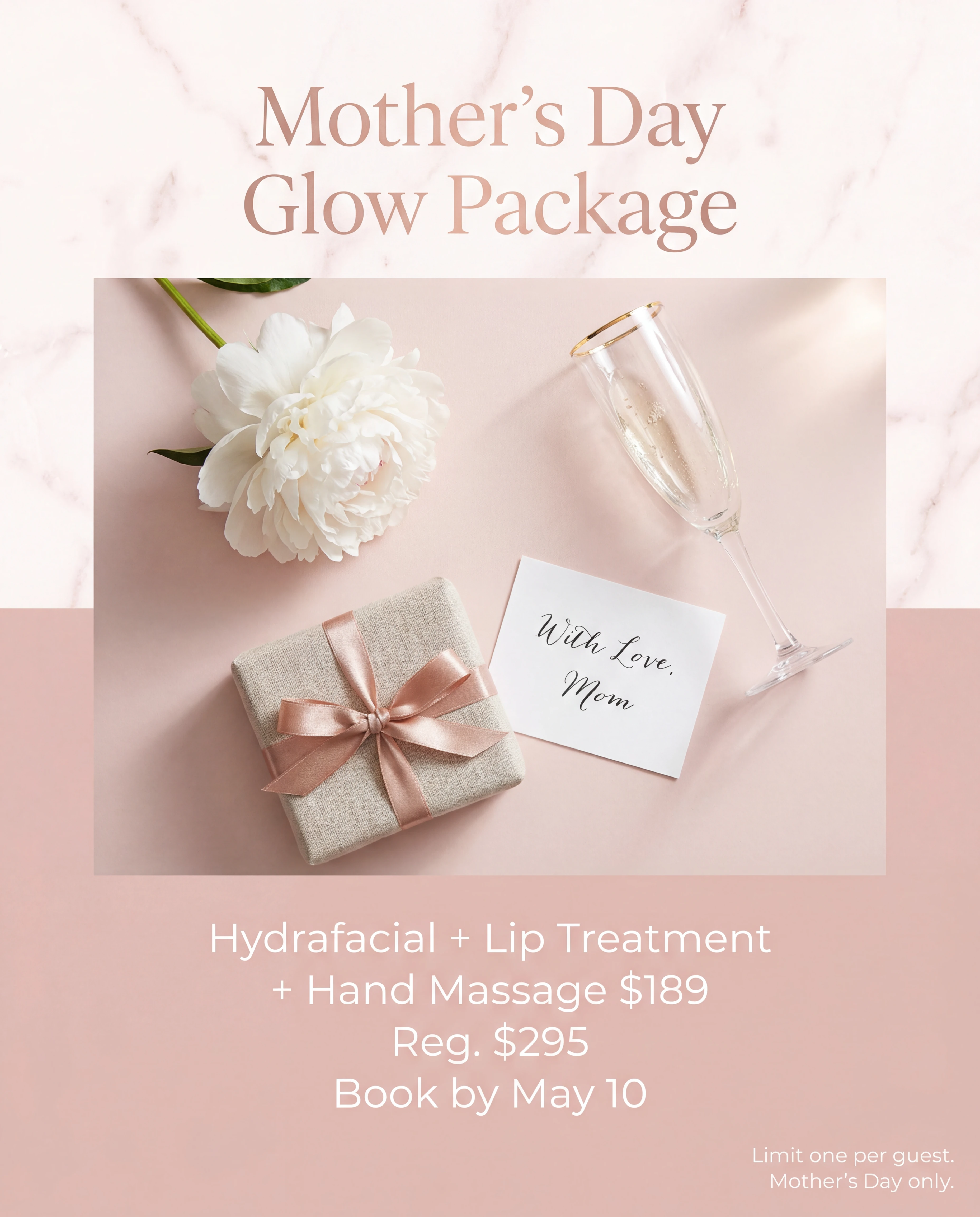
Use case: Paid social ad for Meta and TikTok, email banner, web promotional banner. Tool: Recraft V3 at recraft.ai. Cost: approximately 0.05 USD per image.
Elegant Mother's Day spa promotion ad creative on a soft blush pink background with subtle marble texture. Top text in pale rose gold serif typography: "Mother's Day Glow Package." Center: a flat-lay overhead shot of a single fresh white peony bloom, a small linen-wrapped gift box tied with rose gold ribbon, a delicate gold-rimmed champagne flute, and a small handwritten white note card. Below the flat-lay, the offer text in white sans-serif: "Hydrafacial + Lip Treatment + Hand Massage $189 Reg. $295 Book by May 10." Bottom right corner: small text "Limit one per guest. Mother's Day only." Soft natural light from upper right, gentle shadows, editorial magazine layout. No watermarks. Aspect ratio 4:5.Example 7: Instagram Carousel Set (5 Themed Slides)
Use case: Instagram carousel post, “5 things to know before your first Botox appointment” educational content. Tool: Nano Banana Pro with multi-image reference. Cost: 5 images at 0.139 USD = 0.70 USD total.
Generate Slide 1 (cover) first, then use multi-image reference to maintain visual consistency across slides 2-5.
Slide 1 (cover):
Editorial illustration cover slide on soft blush pink background with subtle marble texture. Center: a simple line-art illustration of a woman's profile silhouette in pale rose gold, looking forward with subtle confidence. Top text in elegant white serif: "5 things to know before your first Botox appointment." Bottom right small text in pale gray: "Swipe ->". Minimal design, generous white space, magazine cover aesthetic. Aspect ratio 4:5.Slide 2 (using slide 1 as reference):
Slide 2 of 5 in the same editorial series, same blush pink marble background, same rose gold line-art illustration aesthetic. Top: "1. It is NOT supposed to look frozen." Below: a small line-art illustration of two facial expressions side by side. Generous breathing room. Bottom right small "1/5". Aspect ratio 4:5.Continue this pattern for slides 3, 4, 5 with topics: “2. Results show up in 7 to 14 days,” “3. You can absolutely exercise the same day,” “4. The consultation matters more than the price per unit,” “5. Your first treatment will probably need adjustment at 2 weeks (and that is normal).”
Example 8: Treatment Product Hero with Branded Packaging
Concept image.
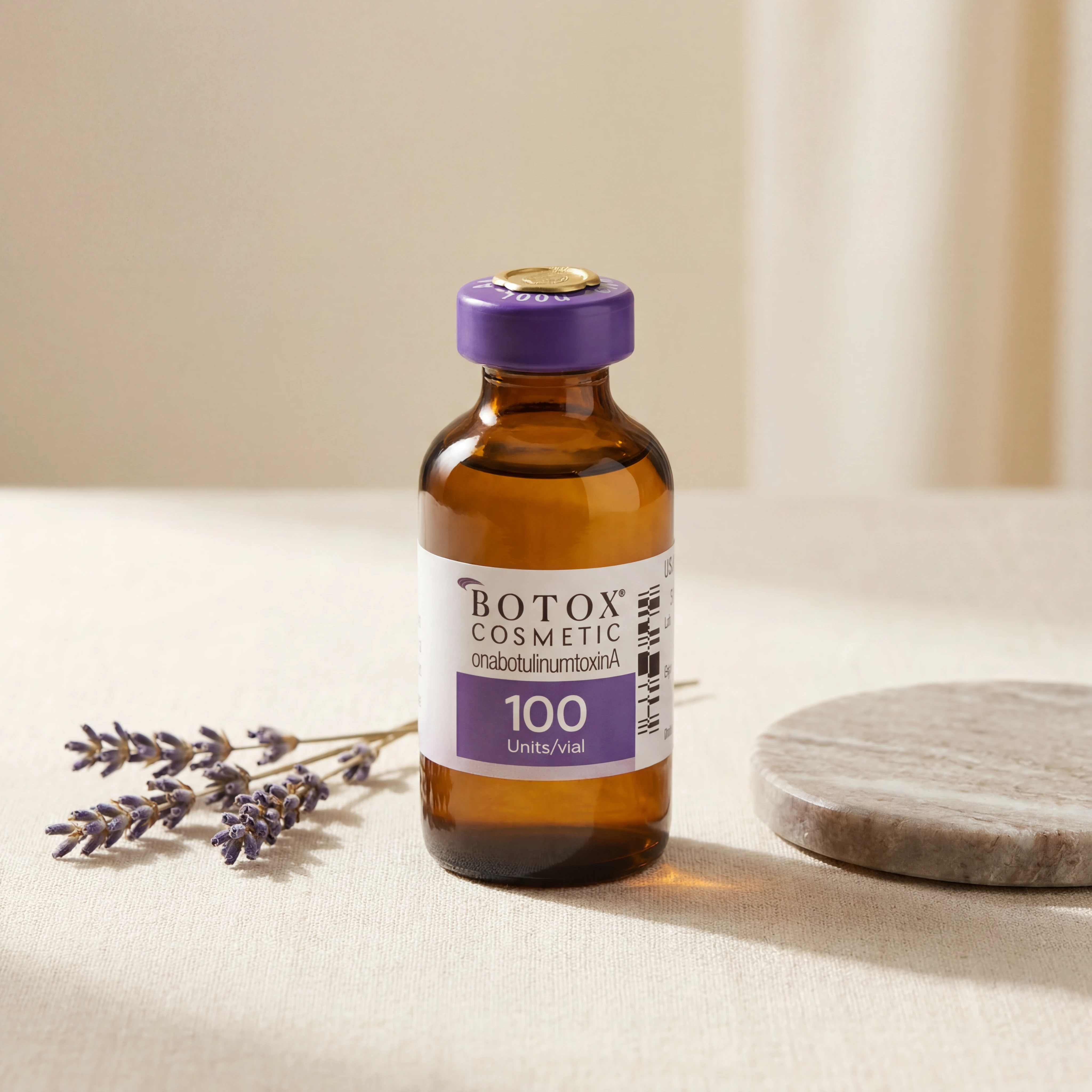
Use case: Retail product page hero, e-commerce listing, Google Shopping product image. Tool: Nano Banana Pro for brand logo persistence. Cost: approximately 0.56 USD for 4-image series.
Hyperrealistic luxury skincare product photography. A single 50ml glass amber serum bottle stands upright at center on warm cream linen surface. The bottle features a clean modern label with the brand name in elegant serif typography, a fine ingredient line in small sans-serif below, and a small gold foil seal on the cap. To the left of the bottle, a small fresh sprig of dried lavender. To the right, a single round flat marble coaster in warm grey. Background: softly out-of-focus warm cream studio wall with diffused natural window light from screen-right creating gentle shadows. Color palette: amber, cream, warm grey, soft gold accent. Shot on 100mm macro lens at f/5.6. Aspect ratio 1:1. Editorial luxury skincare brand aesthetic.Upload a reference photo of your actual branded packaging or logo to lock brand consistency across all 4 angles.
Example 9: Educational Anatomical Illustration (Anatomical Maps)
Two production-quality anatomical illustration variants generated by AVB for this article using GPT Image 2.0:
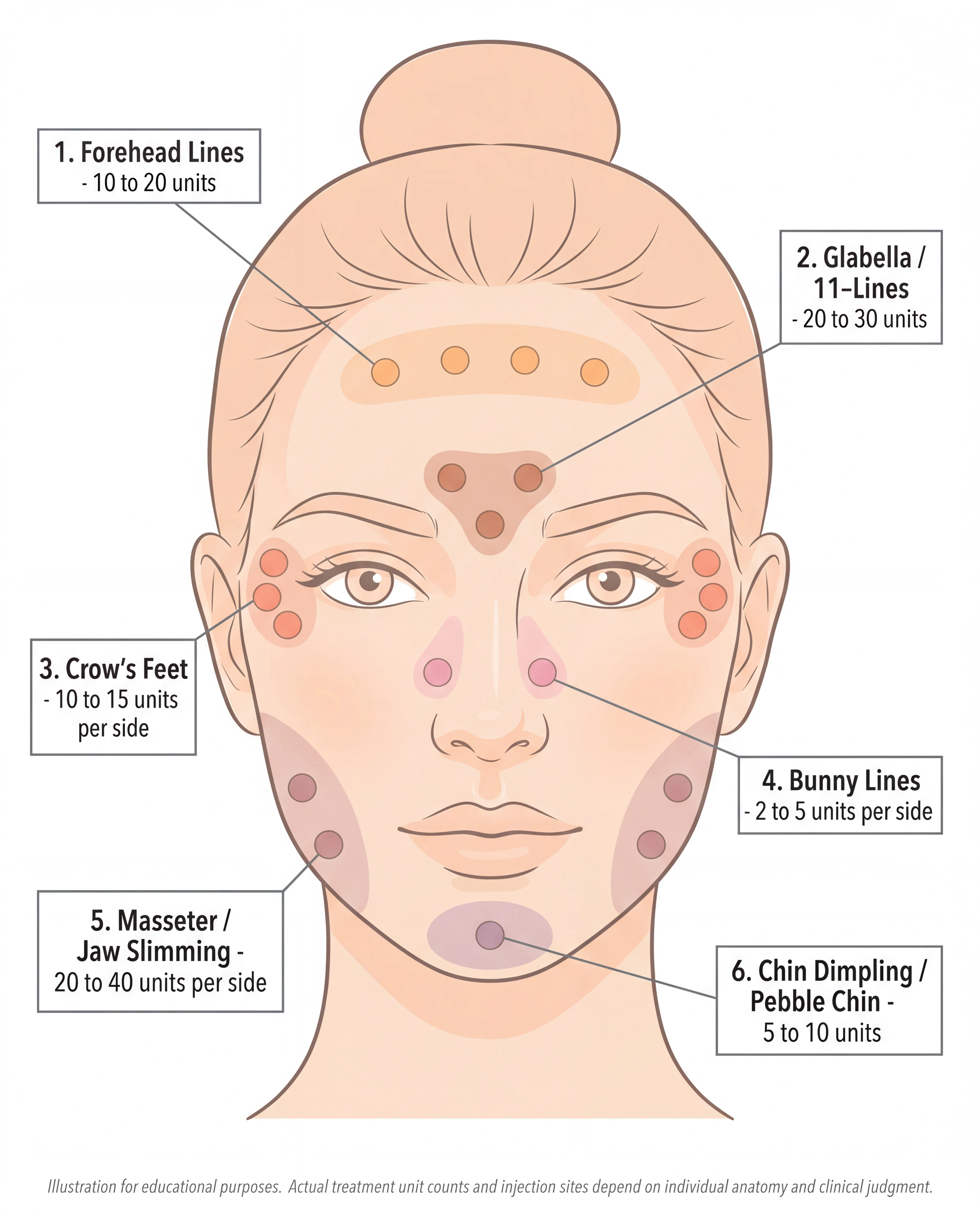
The Botox injection point map above shows the 6 most-treated areas with typical unit ranges, designed for in-clinic consultation visuals and Instagram educational carousels. The unit counts shown are typical ranges per FDA labeling for Botox Cosmetic; actual treatment counts and injection sites depend on individual anatomy and clinical judgment.
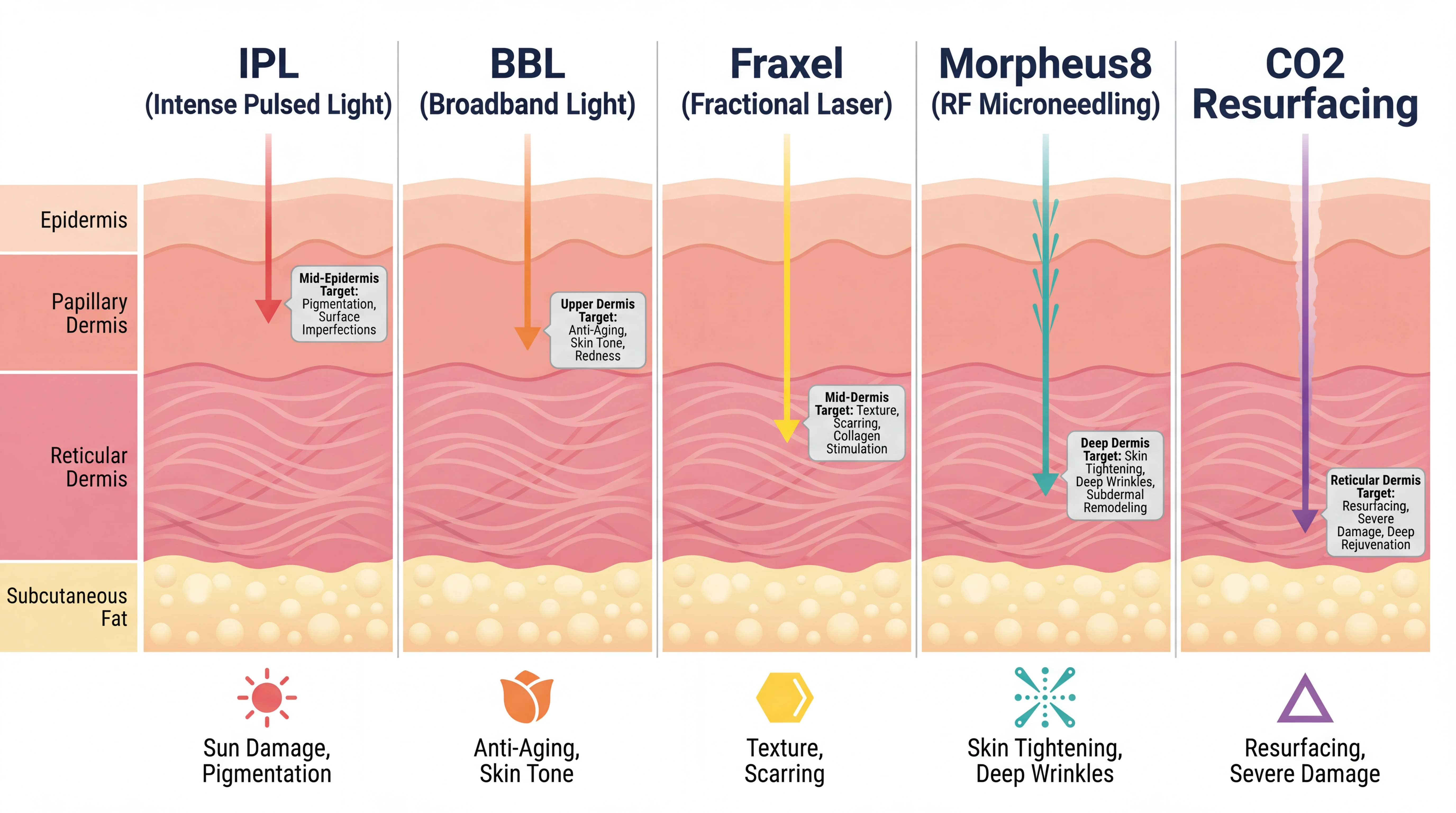
The laser and energy device comparison above is the single most operator-relevant educational asset for med spas offering 3 or more energy-based treatments. It converts confused consultations into informed treatment selection by visually showing what each technology actually targets at the dermal level.
Use case: Educational web page, iPad consultation deck, social educational content. Tool: GPT Image 2.0 or Midjourney V8.1. Cost: 0.211 USD GPT Image 2.0 or included in Midjourney subscription.
Clean medical illustration showing a cross-section side-profile of a human cheek and mid-face area, depicting subcutaneous tissue layers labeled with simple thin gray lines and clean modern sans-serif callouts: "Epidermis," "Dermis," "Subcutaneous Fat," "Periosteum," "Bone." A small dermal filler injection syringe with a fine 27-gauge cannula tip is shown entering at the malar fat pad with a clear directional arrow. Color palette: anatomical illustration warm peach skin tones, cool gray for bone, soft pink for tissue layers, clinical white background. Illustration style: modern editorial medical textbook. Aspect ratio 16:9.Example 10: Google Business Profile Cover Image (Facility Exterior, Golden Hour)
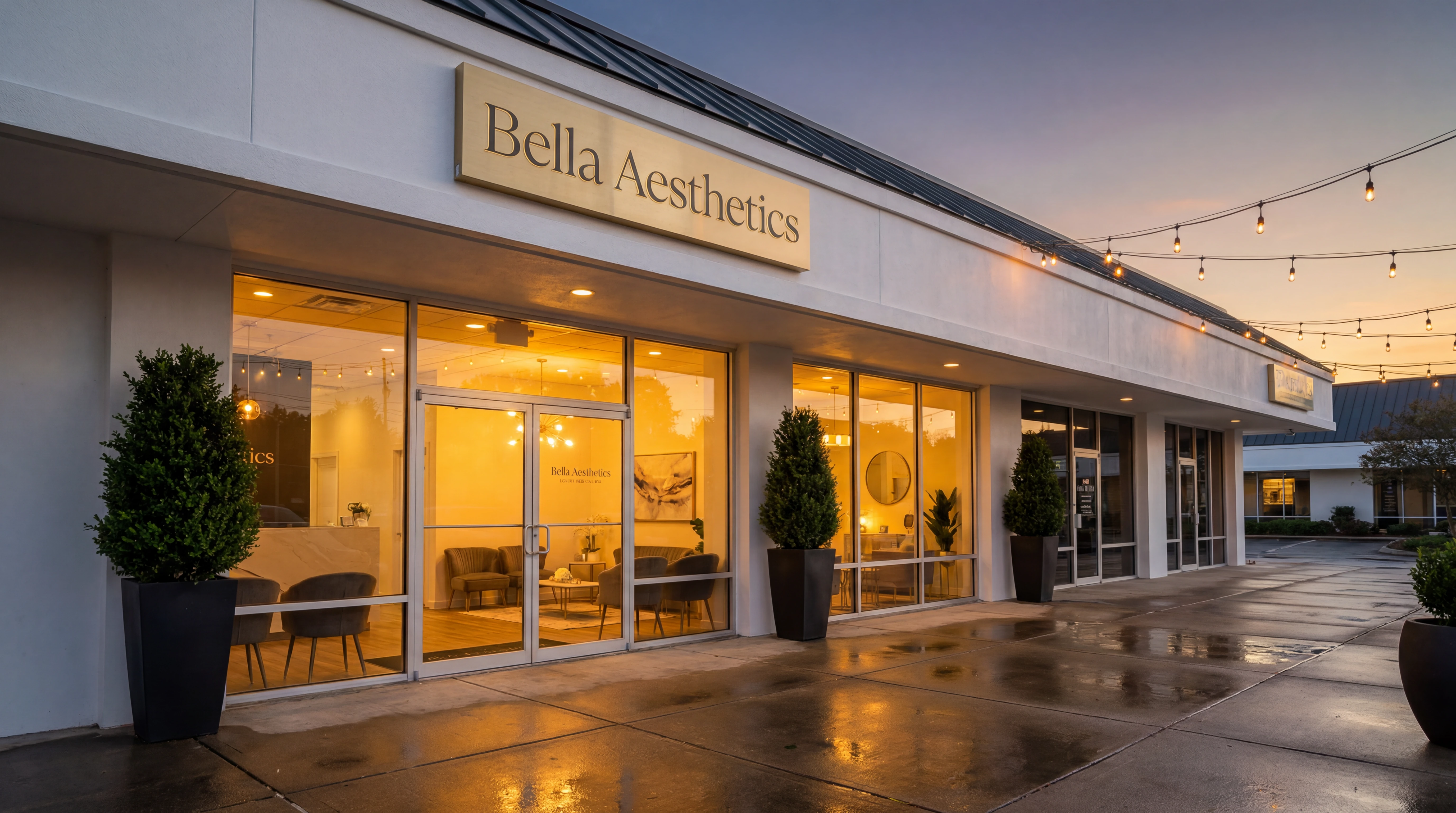
Use case: Google Business Profile cover, web Find Us page, Yelp business header. Tool: Flux 2 Pro. Cost: approximately 0.06 USD per 1920x1080.
Cinematic exterior storefront photography of a luxury medical spa at golden hour, just after sunset. A clean modern white facade with large glass windows reveals warm tungsten light from the interior, a single illuminated sign in elegant brushed gold typography reads "[your med spa name]" above the entrance. Tall potted boxwood trees flank the doorway. The sidewalk is clean and slightly wet from a recent shower, creating subtle reflections of the warm interior light. Soft golden sky transitioning to dusky blue overhead. No people in frame. Wide-angle 24mm lens at f/5.6, eye-level shot. Color palette: warm gold interior, cool blue twilight sky, deep green boxwood, white facade. Aspect ratio 16:9.Compliance flag: If the image is implied as your actual location, accuracy matters under state UDAP law. For Google Business Profile, Google policy requires that the photo represent your actual business. Safer to use AI exteriors for “Coming Soon” pages or generic blog hero images, not as your actual GBP cover if the building does not match reality.
Total cost across all 10 examples
| Example | Tool | Cost |
|---|---|---|
| 1. Botox vial hero | Nano Banana Pro | 0.14 USD |
| 2. Synthetic before/after | Nano Banana Pro | 0.28 USD |
| 3. Injector portrait | GPT Image 2.0 | 0.21 USD |
| 4. Facility interior | Flux 2 Pro | 0.06 USD |
| 5. Pricing menu card | Ideogram V3 | 0.08 USD |
| 6. Mother’s Day promo | Recraft V3 | 0.05 USD |
| 7. IG carousel (5 slides) | Nano Banana Pro | 0.70 USD |
| 8. Product hero (4 angles) | Nano Banana Pro | 0.56 USD |
| 9. Anatomical illustration | GPT Image 2.0 | 0.21 USD |
| 10. GBP exterior | Flux 2 Pro | 0.06 USD |
| Total | 2.35 USD |
Budget 15 to 25 USD if you plan to regenerate 5 to 8 variations per example to find the best output. Total production time estimate for all 10: 2 to 3 hours of focused work.
HIPAA Compliance for AI-Generated Content
Answer capsule. Medical spas become HIPAA covered entities the moment they run one electronic insurance transaction (billing Botox for migraine, TMJ, or hyperhidrosis is the classic trigger). Once HIPAA applies, every aesthetic patient photo in the EMR becomes Protected Health Information requiring 45 CFR 164.508 authorization. Fully synthetic patient images generated from text-to-image prompts only are NOT PHI under HIPAA Safe Harbor (45 CFR 164.514) and carry zero PHI risk. Image-to-image AI style transfer using real patient photos as conditioning input IS PHI and requires BAA-covered AI vendor plus full marketing authorization.
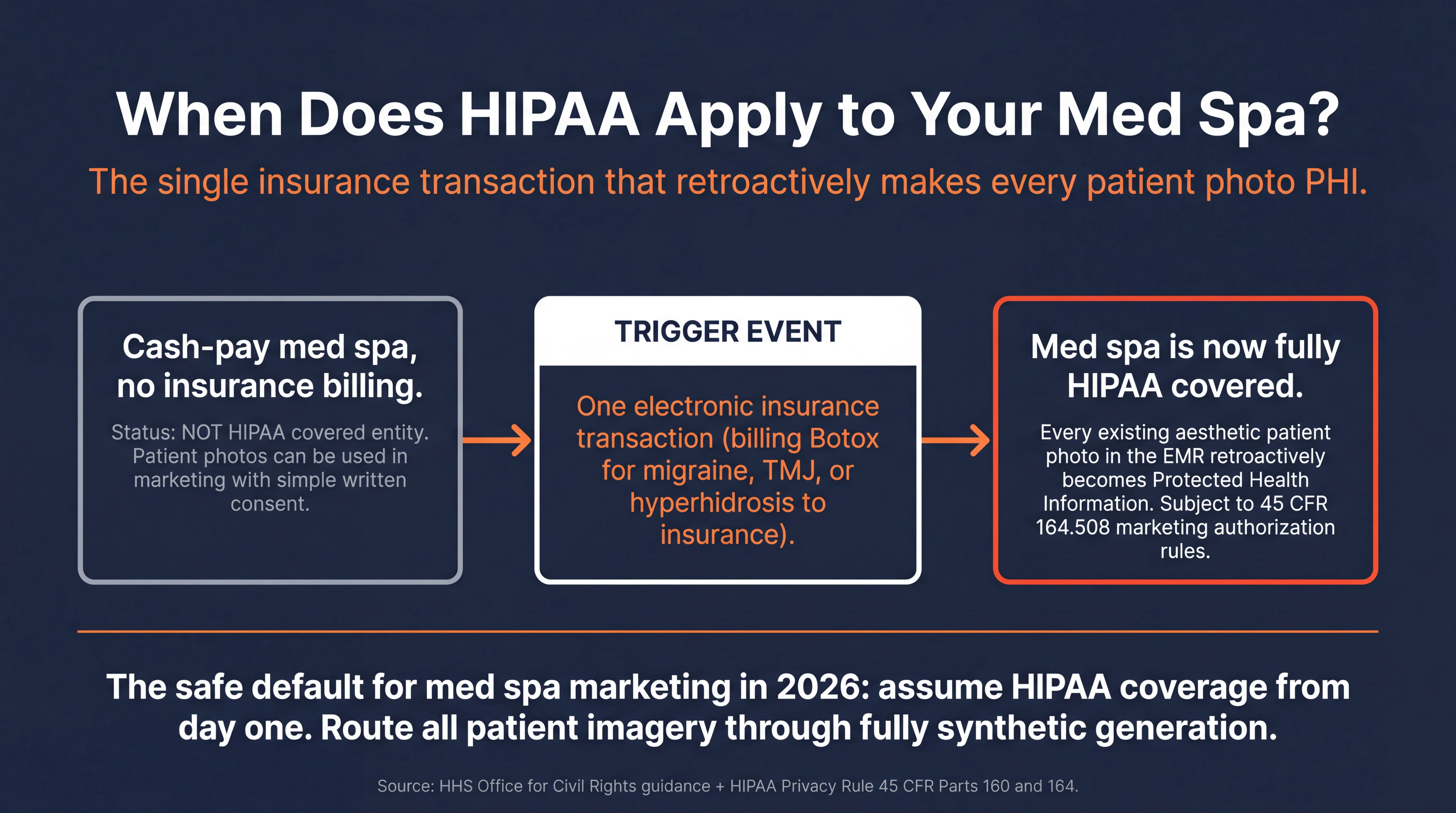
The covered-entity status flip is the most operator-relevant HIPAA gotcha most cash-pay med spas miss. The moment your clinic processes a single insurance claim electronically (even if 99 percent of revenue is cash), all your existing aesthetic patient records become subject to the full HIPAA regime retroactively. The safe-default assumption for marketing purposes in 2026: behave as if HIPAA always applies.
Real patient photos in marketing: the authorization regime
Per HIPAA Journal photography rules guidance, clinical photographs encompassing full-face images, distinctive injuries, tattoos, or unique identifying features constitute PHI. To legally publish a real patient before-and-after photo, the clinic requires written authorization that:
- Explicitly explains why the photo is being taken
- States exactly who it will be shared with
- Acknowledges the patient’s legal right to revoke authorization at any time
- Acknowledges that revocation does not retroactively unpublish content already shared
The permanent-irrevocability trap: once published to social media, the image cannot be fully retracted. Patients who revoke authorization months or years later create operational exposure that cannot be eliminated, only mitigated through best-effort takedown across platforms.
Synthetic patient images: the HIPAA Safe Harbor framework
Fully synthetic patient images generated entirely via text-to-image prompts (no real patient as conditioning input) do not represent any actual, living human being. Per HIPAA Safe Harbor at 45 CFR 164.514, the image contains zero PHI and falls completely outside HIPAA jurisdiction.
The image-to-image trap: using a real patient photo as the conditioning reference for an AI-generated “similar” synthetic image does NOT make the output non-PHI. It is a derivative work that remains PHI because the underlying reference was PHI. Only text-only prompting with no patient reference qualifies as Safe Harbor synthetic.
Workflow safety ranking
- Safest: Fully synthetic patient generation via text-to-image only. Zero HIPAA risk.
- Moderate risk: Real patient images with explicit, ironclad marketing-specific authorization, signed BAA with the AI vendor, and post-deletion monitoring across all platforms.
- Highest risk: Real patient image-to-image AI generation without authorization, OR using unvetted cloud AI services without a BAA.
BAA requirements for cloud AI services
When using cloud AI services that process any patient identifiable information, a signed Business Associate Agreement is mandatory. Google Vertex AI, OpenAI Enterprise, and Microsoft Azure AI offer BAA-covered enterprise tiers. Consumer chat interfaces (ChatGPT Plus, Gemini Advanced standard, Midjourney Discord bot) do NOT come with BAAs and must NOT be used for any workflow involving real patient data.
FDA Title 21 Medical Device Claim Compliance
Answer capsule. Medical spas marketing FDA-cleared devices (CoolSculpting, Ultherapy, Morpheus8, BBL, Fraxel) must NOT describe them as “FDA approved.” The distinction is enforced. CoolSculpting, Ultherapy, Morpheus8, BBL, and Fraxel are 510(k)-cleared, not approved. Botox (BLA 103000), Juvederm, Restylane, and Sculptra are PMA-approved drugs and CAN be described as FDA approved. Writing “FDA approved” for a cleared-only device is a misbrand-class misstatement that has driven class actions against device makers and exposes the practice to FTC and state UDAP claims.
The other critical operator-facing rule: off-label promotion. While licensed physicians may administer FDA-approved products for off-label uses based on clinical judgment, medical spas are strictly prohibited from advertising or promoting off-label uses to the public. AI-generated content showing a dermal filler in an unapproved anatomical region triggers immediate FDA scrutiny.
Per Section 502(bb) of the FD&C Act, a compounded drug is legally misbranded if its advertising or promotion is false or misleading in any particular. This applies to compounded semaglutide for weight loss (Wegovy alternatives), compounded peptides, and compounded BPC-157. AI-generated marketing claims must accurately reflect the legal status of the compounded product, including the fact that compounded versions are NOT FDA-approved.
AI-specific FDA risk: generating a synthetic patient outcome that depicts an unrealistic, physically impossible result from a medical device qualifies as deceptive advertising under FDA regulations. The synthetic image must depict outcomes within the range of clinically proven results achievable by the specific device being promoted.
Recent FDA enforcement examples documented in the FDA Office of Compliance Annual Report: warning letters to med spas overstating cosmetic device efficacy, multiple enforcement actions against compounding pharmacies marketing compounded semaglutide as FDA-approved.
State Board of Medical Examiners and State AI Disclosure Laws
Answer capsule. California has the strictest cumulative enforcement environment for medical spa AI marketing in 2026. The stack of B&P Code 651 plus B&P 17500 (Unfair Competition Law) plus AB 853 (effective August 2, 2026) plus CAITA (5,000 USD per day per violation) creates compounding exposure. New York is a close second via S.8420-A (synthetic performer disclosure effective June 9, 2026). Texas, Florida, and Illinois enforce strict Corporate Practice of Medicine doctrine requiring physician ownership for “medspa” branding.
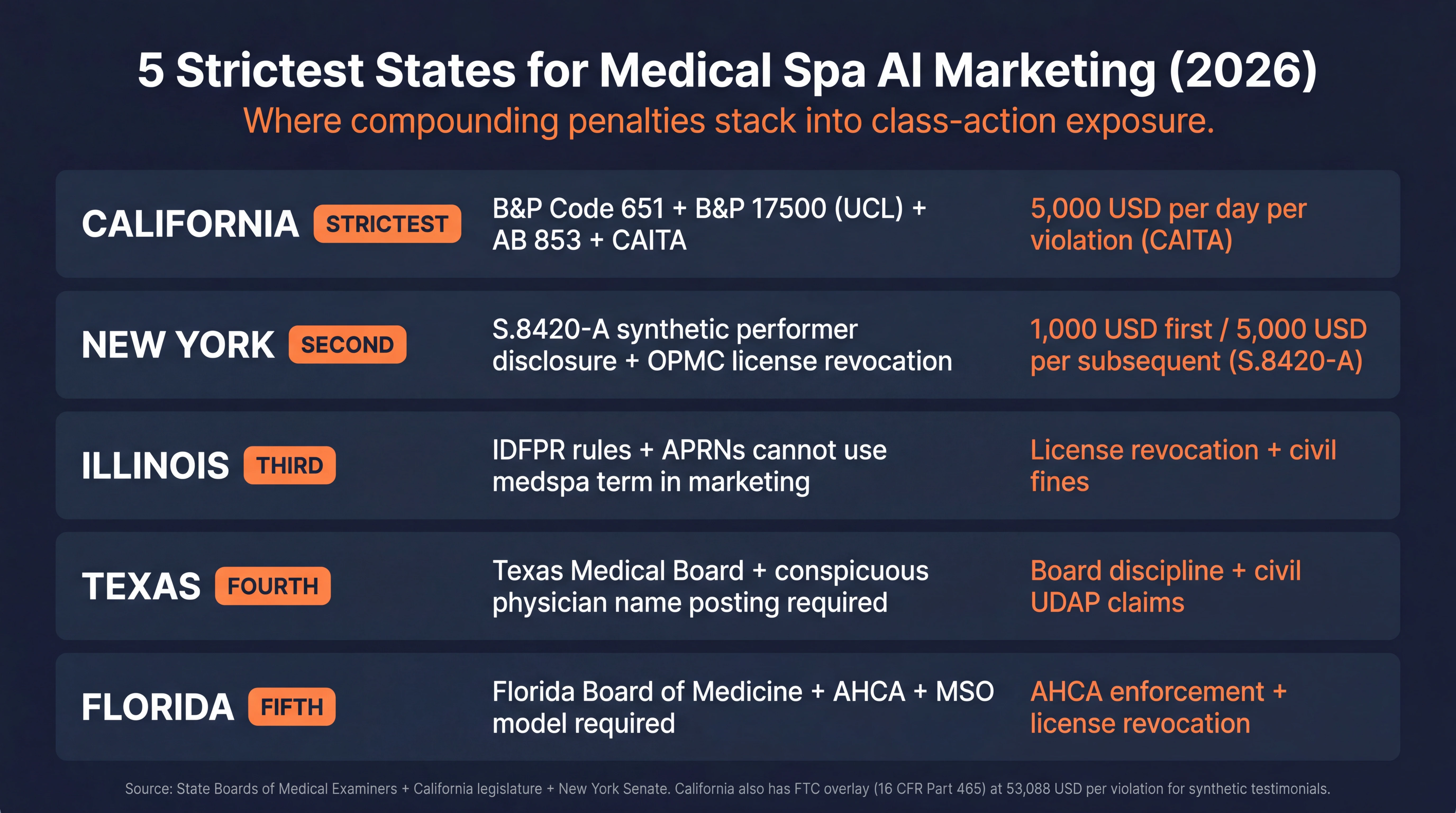
5-state deep dive on advertising and AI integration
| State | Governing Body | CPOM Enforced | Key AI-Relevant Rules |
|---|---|---|---|
| California | Medical Board of California | Yes (strict) | Fictitious name permits required for marketing names. Advertising must clearly identify supervising physician or Medical Director. AB 853 effective August 2, 2026 requires C2PA metadata embedding. CAITA penalties 5,000 USD per day per violation. B&P 651 + 17500 (UCL) stack. |
| Texas | Texas Medical Board | Yes | Any facility providing delegated acts must conspicuously post name and license number of delegating physician in all public areas. Advertising must disclose medical directorship per Texas Medical Liability Trust guidance. Delegation does not transfer liability. |
| Florida | Florida Board of Medicine | Yes | Follows CPOM restricting non-physicians from owning medical practices. Most non-physician ventures utilize MSO model. Regulated and enforced by Agency for Health Care Administration (AHCA). |
| Illinois | IL Dept of Financial & Professional Regulation (IDFPR) | Yes | Only physician-owned entities can advertise as a “medspa.” APRNs with full practice authority cannot legally use the term “medical spa” in marketing per Goldberg Law Group analysis. |
| New York | NY State Office of the Professions | Yes | CPOM actively enforced. Advertising bound by S.8420-A synthetic performer law. Specific medical board AI guidelines beyond MSO requirements pending. |
Three load-bearing state AI disclosure laws
-
New York S.8420-A (GBL section 396-b): Effective June 9, 2026. Requires conspicuous disclosure of any “synthetic performer” in advertisements directed at New York audiences. A synthetic performer is defined broadly as any digitally created asset mimicking a human performer created via generative AI or any software algorithm. Even traditional visual effects are covered. Penalties: 1,000 USD first violation, 5,000 USD per subsequent violation. Per Cooley analysis.
-
Colorado SB24-205: Effective June 30, 2026. Targets high-risk AI systems making consequential decisions in healthcare and employment. Deployers (medical practices) must conduct annual impact assessments and provide detailed patient notifications if an AI system makes adverse decisions regarding their care.
-
California AB 853: Effective August 2, 2026 (delayed from earlier effective date). Expands the California AI Transparency Act to require GenAI platforms and capture device manufacturers to embed latent disclosures (C2PA metadata) indicating if content was AI-generated. Online platforms must maintain detection interfaces. Stacked with CAITA penalties of 5,000 USD per day per violation.
For the broader 2026 AI disclosure compliance picture (covering EU AI Act Article 50, C2PA Content Credentials, SynthID, and platform-specific policies), see the AI Disclosure Compliance 2026 pillar.
Federal layer: FTC Endorsement Guides + 16 CFR Part 465
The FTC updated its AI endorsement guidance in May 2026 to explicitly target synthetic influencers and AI-generated testimonials. Under the FTC Act, endorsements must reflect the honest, actual opinions of real people who have genuinely experienced the product. Using AI to generate a synthetic patient review, deploying an automated review aggregator script, or fabricating a before-and-after testimonial constitutes a deceptive practice.
In early 2026, the FTC issued active warning letters directly targeting AI review practices in the cosmetic and aesthetic sectors. The maximum civil penalty under 16 CFR Part 465 (Trade Regulation Rule on Consumer Reviews and Testimonials, effective October 21, 2024) is 53,088 USD per violation (2026 inflation-adjusted).
Platform-level AI content policies (2026)
- YouTube: Effective May 27, 2026, YouTube automatically applies highly visible AI labels to photorealistic altered content. The label sits directly below the video player for long-form, as an overlay inside the frame for Shorts. Videos carrying C2PA metadata receive this label permanently with no creator override possible.
- Google Ads / Google Shopping: Effective March 5, 2026, Google requires the
ai_generatedattribute in the Merchant Center product feed for any product image primarily generated by AI. Failure to apply this label results in immediate ad disapproval on the first offense. Intentional metadata stripping (removing C2PA or EXIF data) leads to immediate, unappealable account suspension. - Meta: Labels organic AI-generated content based on industry-shared signals (C2PA) and self-disclosure. Standard “AI info” labels moved to the post menu for lightly modified tools.
- TikTok: 94.7 percent Content Integrity Engine accuracy. 4-strike escalation pattern for unlabeled AI content.
Lead Generation Channels and Funnel Mechanics
Answer capsule. Med spas acquire patients primarily through local search intent (Google Business Profile, Google Ads) and social proof (Meta Ads, organic Instagram, referrals). The most operationally critical 2026 finding: average manual lead response time is 4.2 hours; AI agents shrink this to under 60 seconds. 78 percent of potential patients abandon a clinic conversation after 30 minutes of silence. Deploying AI lead-follow-up drops cost per booked consultation from 180-400 USD traditional to 30-90 USD with AI.
Channel performance benchmarks (2026)
Per Creekside Marketing Pros med spa benchmarks and PatientNow lead generation analysis:
| Channel | Typical CPC/CPM | Conversion Rate | Cost per Lead |
|---|---|---|---|
| Google Ads | 5-30 USD CPC | 6-14 percent | 40-180 USD |
| Meta Ads (Instagram + Facebook) | 12.50 USD industry benchmark | Varies | 5-15 USD per conversion in optimized campaigns |
| Google Business Profile (organic) | Free | High intent | Cost varies by SEO investment |
| Organic Instagram | Free | Varies | Cost is content production time |
| Email automation | Low | 37 percent of email-generated sales from automated sequences | Near zero per email |
| Referrals | Free | Highest intent | Cost is patient experience investment |
A standard funnel breakdown: spending 3,500 USD on Google Ads to acquire an 8-patient cohort drives a 4.6x annualized ROI, assuming 159 USD cost per lead and 35 percent consultation close rate.
The AI lead-follow-up wedge: manual lead response averages 4.2 hours per PatientNow industry data. AI agents respond in under 60 seconds. 78 percent of potential patients abandon after 30 minutes of communication silence. Recovering that 78 percent at scale is the single biggest operational improvement available to med spa marketing directors in 2026.
Named Operator Case Studies
Answer capsule. Four named medical spa operators publicly using AI in production marketing as of 2026. Ever/Body (NYC/DC multi-location) runs disclosed AI motion graphics for educational B-roll while keeping real patient footage for hero shots. Clique Med Spa (operator John Santarpia) transitioned from agency retainers to in-house AI, cutting marketing costs to one-third. Xyonix AI Assistant is an early-stage startup deploying AI iPhone app for nurse practitioners. Portrait Care operates as an MSO providing compliance infrastructure for independent med spas in strict CPOM states.
Ever/Body (multi-location, NYC and DC)
Ever/Body is the lead reference for the compliance-first AI integration pattern. The practice publicly runs disclosed AI motion graphics and AI-animated treatment explainer Reels while reserving AI strictly for educational B-roll and keeping real patient footage exclusively for hero shots. The model: AI for the contexts that do not require real patient testimony, real patient footage for everything that does. This is the operational pattern the AVB curriculum advocates.
Clique Med Spa (operator John Santarpia)
Per a Clique Med Spa case study published on YouTube, operator John Santarpia transitioned away from traditional expensive marketing agency retainers to an in-house AI-driven marketing program. By deploying text-to-pay links and an AI lead follow-up system, the clinic reduced its marketing costs to one-third of the traditional agency rate while simultaneously increasing conversion control. The Clique pattern is the clearest documented agency-replacement transition in the industry.
Xyonix AI Assistant
Xyonix deployed an AI iPhone application designed specifically for med spa nurse practitioners. The AI categorizes facial features and assesses treatments, tracking temporal visual changes to evaluate injector performance and product efficacy. The Xyonix case demonstrates that AI in med spas is not only about content production; AI agents inside the clinical workflow are now a real operational layer.
Portrait Care
Portrait Care operates as a Management Services Organization (MSO) platform providing software and compliance infrastructure to independent medical spas. This allows clinics to navigate strict state laws (Illinois and Texas CPOM rules) while managing growth without massive agency retainers. Portrait Care is the model for med spa owners who want compliance-as-a-service without building it in-house.
Community sentiment
Conversations across operator communities (r/medspaowners subreddit, AmSpa member forums, Aesthetic Practice Owners Facebook Group) indicate intense frustration with high-cost, low-yield traditional agency models. The AI lead-response speed improvement (4.2 hours to under 60 seconds) is the single most-praised AI capability. The community simultaneously exhibits strong resistance to low-effort, purely synthetic social media posts. Algorithm updates and patient trust favor authentic, educational content over generic AI filler. Cold outreach using low-effort AI is largely ignored.
Cloud-Managed Tool Choice and Where PromptWise Fits
Answer capsule. Most medical spa marketing directors and creative directors will run their AI content production through cloud-managed platforms rather than self-hosting models. The default developer path is fal.ai for video and image API access. LTX Studio is the consumer subscription option for non-technical operators. Lightricks direct API offers the only documented (capped) IP indemnification path among non-Veo True Models. PromptWise is AI Video Bootcamp’s own managed studio for AI image, video and sound, live now from $19 a month and built around the curriculum AVB teaches.
Cloud platform decision matrix
| Platform | Target User | Pricing Model | Indemnification |
|---|---|---|---|
| fal.ai | Developer | Per second or per megapixel | None (pass-through inference) |
| Replicate | Developer | Per video-second | None |
| OpenAI API | Developer | Per token or per image | Yes (under Service Terms Section 7) |
| Google Vertex AI | Enterprise | Per second or per image | Yes (uncapped under Cloud Service Specific Terms Section 14) |
| LTX Studio | Non-technical creator | Monthly credit subscription (12-100 USD) | None on consumer plans |
| Lightricks direct API | Enterprise buyer | Sales-gated per-second | Yes, capped at lower of annual fees or 1M USD |
| HeyGen Avatar IV | Mid-market | Monthly subscription with per-minute charges | Gated above Team tier |
For client deliverables requiring uncapped indemnification, route through Google Vertex AI (Veo 3.1, Gemini Omni, Imagen 5). For everything else, fal.ai is the recommended developer path.
AI Video Bootcamp’s own studio, PromptWise, is built for this shape of work. Seeds lets you train one synthetic patient once and hold that face consistent across every before-and-after set, every treatment explainer and every ad variant, which is the hard part of compliance-safe med spa creative. It carries Veo 3.1, Kling 3.0, Seedance 2.5, Hailuo, Nano Banana Pro, GPT Image 2.0 and Flux.2 Pro under one login, from $19 a month, with no ComfyUI setup and no per-vendor API keys across fal.ai, Replicate, OpenAI API, Vertex AI and the Lightricks direct API. We built it, so weigh that accordingly.
FAQ
What is the safest way for a medical spa to use AI-generated before-and-after images?
Generate fully synthetic patients from text-to-image prompts only (Flux 2 Pro for anatomy, Nano Banana Pro for product context). Synthetic images created from text prompts with no real patient as conditioning input are NOT Protected Health Information under HIPAA Safe Harbor (45 CFR 164.514) and carry zero PHI risk. The image must include a visible on-image disclosure label such as “AI-generated illustration. Not an actual patient. Individual results vary.” to comply with FTC 16 CFR Part 465 and the May 2026 Endorsement Guides update on synthetic testimonials. Real patient photos used as image-to-image conditioning input ARE PHI and require full 45 CFR 164.508 authorization.
How much does AI video and image production cost compared to a traditional medical spa marketing agency?
Traditional med spa marketing stack totals approximately 6,000 to 8,000 USD monthly before a single dollar of ads. AI compute stack producing 4 to 8 deliverables per week using True Models runs 150 to 300 USD monthly. Cost per booked consultation drops from 180 to 400 USD traditional to 30 to 90 USD with AI lead-follow-up automation that responds in under 60 seconds rather than the 4.2 hour manual average.
Which True Model AI tools are best for medical spa marketing?
Video: Veo 3.1 for high-fidelity treatment demos with native audio. Kling 3.0 Turbo for facility tours. LTX-2.3 Fast for budget B-roll. Seedance 2.0 for fast-cut social ads. HeyGen Avatar IV for injector-presenter explainer videos. Image: Nano Banana Pro for product hero shots and Instagram carousel consistency. Flux 2 Pro for synthetic patient anatomy. GPT Image 2.0 for typography-heavy work. Ideogram V3 for text-rendered pricing menus. Recraft V3 for vector-grade promo creatives.
Does my medical spa need HIPAA compliance if we’re cash-pay only?
A med spa goes from “not HIPAA covered” to “fully HIPAA covered” the moment it runs one electronic insurance transaction. Billing Botox for migraine, TMJ, or hyperhidrosis to insurance is the classic trigger. Once HIPAA applies, every aesthetic patient photo in the EMR retroactively becomes Protected Health Information subject to 45 CFR 164.508 authorization rules. Most cash-pay-feeling practices do not realize this status flip has occurred. The safest workflow assumes HIPAA coverage from day one and routes all marketing imagery through fully synthetic generation.
What state AI disclosure laws apply to medical spa marketing in 2026?
Three load-bearing state laws. New York S.8420-A (GBL section 396-b) effective June 9, 2026 requires conspicuous disclosure of any “synthetic performer” with penalties of 1,000 USD first offense and 5,000 USD per subsequent violation. Colorado SB24-205 effective June 30, 2026 targets high-risk AI systems in healthcare. California AB 853 effective August 2, 2026 requires embedded C2PA metadata, stacked with CAITA penalties of 5,000 USD per day per violation. California has the strictest cumulative enforcement.
Last reviewed by Mateo Starcevic Filipovic on June 8, 2026. For structurally similar vertical playbooks, see the Law Firm Marketing 2026 AI Video Playbook and the Home Services Marketing 2026 AI Video Playbook. For the full 2026 AI tool stack across all verticals, see the Best AI Video Tools 2026 Tech Stack and the AI Image Generators A-Z Encyclopedia. For the broader AI disclosure compliance framework, see the AI Disclosure Compliance 2026 pillar. New to AI Video Bootcamp? Start with What is AI Video Bootcamp.