
Why Law Firm Marketing Is the Highest-CPC AI Video Vertical in 2026
Answer capsule. Legal services is the highest-leverage AI video niche AVB operators can target in 2026. Only 30 percent of US law firms produce video today, leaving a 70 percent gap. Attorneys pay $114 to $600 per lead in personal injury and family law, making a $1,500 to $15,000 monthly retainer easily defensible. Solo and small firms (56 percent of the market combined) are the realistic first-client targets.
Market sizing: 1.3 million attorneys and 450,000 firms
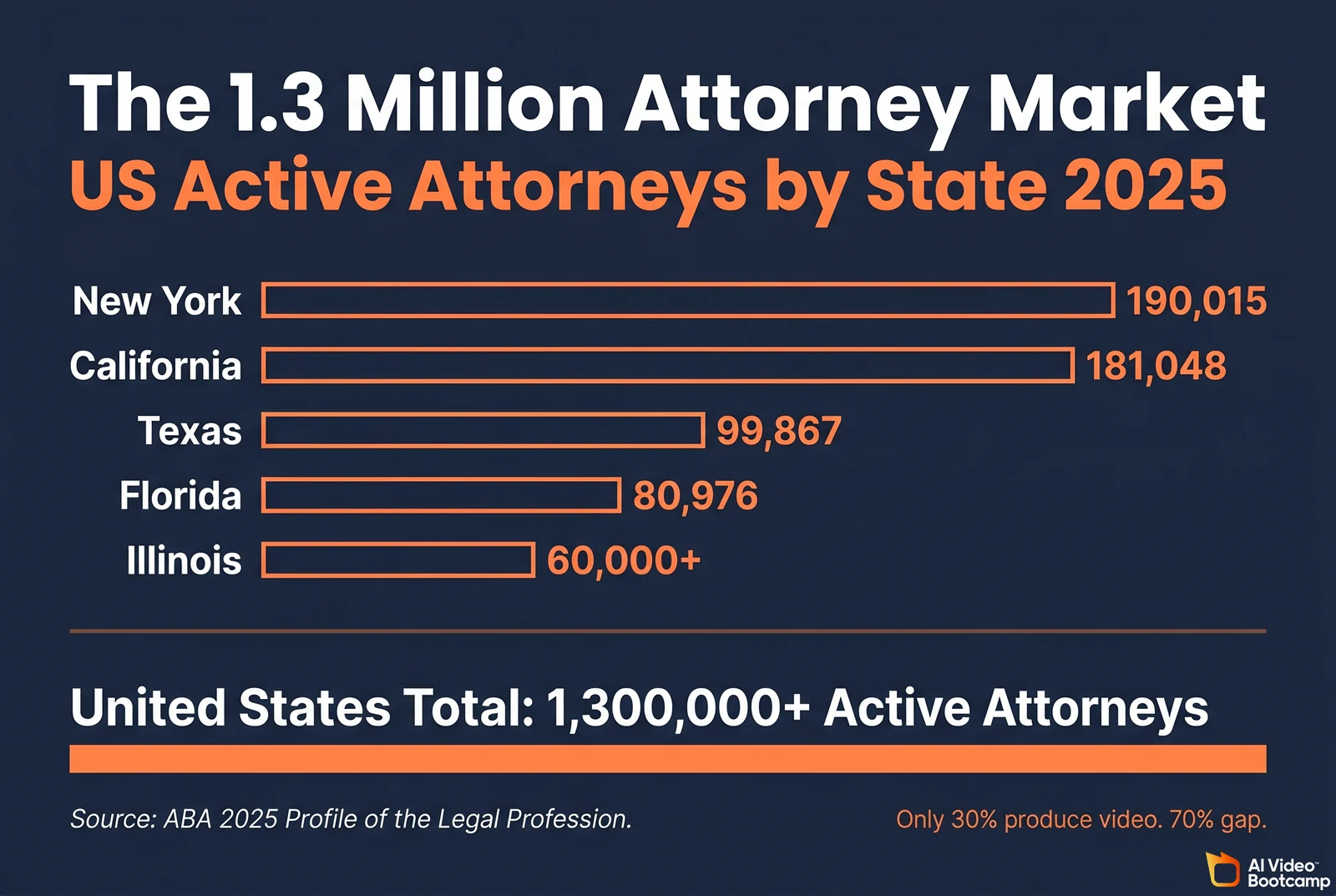
The US legal market grew 1.38 percent into 2025 to 2026 per the ABA 2025 Profile of the Legal Profession, bringing active resident attorney population over 1.3 million. The geographic distribution favors high-population states that align directly with high-volume AI video opportunity:
| State | Active attorneys (2025) | Primary source |
|---|---|---|
| New York | 190,015 | ABA 2025 NLPS |
| California | 181,048 | ABA 2025 NLPS |
| Texas | 99,867 | ABA 2025 NLPS |
| Florida | 80,976 | ABA 2025 NLPS |
| Illinois | 60,000+ | ABA 2025 NLPS |
The firm-size distribution shapes the sales approach. Per ABA data cross-referenced with the Colorado Office of Attorney Regulation Counsel 2024 Annual Report, approximately 29 percent of private practitioners operate as solo practitioners, while 27 percent belong to small firms of 2 to 10 attorneys. Combined, more than half the legal market consists of small businesses where the principal attorney is directly responsible for marketing budget decisions. These solo and small-firm operators are the ideal targets for solo AI video freelancers.
Marketing budgets and ROI on digital channels
Law firm marketing spend continues to climb. The US Small Business Administration recommends law firms allocate 7 to 8 percent of gross revenue to marketing, though legal management consultants typically observe established firms spending between 2 and 5 percent (Clio Blog Marketing Budget Guide). The Clio 2025 Legal Trends Report documents that solo firms utilizing digital client intake tools reported 53 percent higher revenue, while small firms experienced a 28 percent increase (Clio 2025 Legal Trends).
Customer Acquisition Cost by practice area (the math that makes AI video retainers obvious)
Pareto Legal’s 2026 benchmark documents highly stratified CAC across legal practice areas:
| Practice area | Typical CPL range | Average CPL | Competition level |
|---|---|---|---|
| Personal injury | $150 to $500+ | $284 | Highest |
| Family law | $75 to $300 | $112 | High |
| Criminal defense | $50 to $200 | $130 | Moderate (urgent buyer intent) |
| Estate planning | $50 to $150 | $58 | Lower (procrastination buying) |
| Immigration | $40 to $80 | $42 | Lower |
A personal injury firm paying $284 per lead with average PI case values between $24,000 and $1.2 million can defend a $5,000 monthly AI video retainer trivially. The math: a 15 percent CPL reduction saves $42 per lead. At 50 leads per month, that yields $2,100 in monthly CPL savings. Add lead-volume lift from new video content surfacing in AI Overview citations, and the retainer pays for itself many times over.
The legal AI wave context
May 2026 is unusually fertile for legal AI content. OpenAI announced “Codex for Legal” on May 18, 2026 per Artificial Lawyer coverage. Anthropic shipped Claude for Legal plug-ins in April 2026 with the Freshfields deal. The California State Bar Generative AI Practical Guidance was updated May 14, 2026. The New York State Bar Association published its Task Force on Artificial Intelligence report in 2024. These announcements make “AI for lawyers” top-of-mind for attorneys but nobody is yet running the angle of “AI VIDEO for lawyers” at depth. That is AVB’s wedge.
For the broader monetization framework see our Making $10K per month with AI video guide.
The Legal Advertising Ethics Framework Every AI Video Operator Must Know
Answer capsule. Legal advertising is the most heavily regulated vertical AVB has ever covered. ABA Model Rules 7.1, 7.2, and 7.3 form the baseline. Each of the 50 state bars adopts their own version with modifications. The five strictest state bars are California, New York, Florida, Texas, and Illinois. Get the ethics wrong and you expose your attorney client to bar discipline, fines, and possible disbarment, plus your own E&O liability. The single highest-stakes editorial call: never produce AI-generated client testimonials in any state, regardless of where the attorney practices.
ABA Model Rules baseline (not directly enforceable, but adopted by every state)
The American Bar Association publishes Model Rules of Professional Conduct that are not directly enforceable until adopted by individual state bars. Three rules govern AI video content:
ABA Model Rule 7.1 (Communications Concerning a Lawyer’s Services). A lawyer shall not make false or misleading communication. A communication is false or misleading if it contains a material misrepresentation of fact or law, or omits a fact necessary to make the statement not materially misleading. Hyper-realistic AI generations that imply false firm size, fabricate past success, or use generative environments to deceive the public explicitly violate this rule.
ABA Model Rule 7.2 (Specific Rules). Governs required disclosures, the ban on claiming to be a specialist without official board certification, and strict rules on paid endorsements and compensation for recommendations.
ABA Model Rule 7.3 (Solicitation of Clients). Explicitly restricts real-time electronic solicitation and imposes strict post-accident waiting periods for personal injury advertising.
The 5 strictest state bar rules
California
The California State Bar Generative AI Practical Guidance was updated May 14, 2026 with a new comment to Rule 1.1 on competence: attorneys “must independently review, verify, and exercise professional judgment regarding any output generated by the technology” per California Bar reporting. A proposed amendment to Rule 1.4 requires lawyers to disclose AI use if it materially affects representation. Deploying autonomous agentic AI systems that transmit external communications without human review is strictly prohibited. AVB operators must build a mandatory human-attorney review step into every video production pipeline before publication.
New York
New York Senate Bill S.8420-A, effective June 9, 2026, enacted the AI Transparency in Advertising Act. The law requires conspicuous disclosure when advertisements feature an AI-generated synthetic performer and applies to any advertisement distributed to New York audiences, regardless of where the operator or law firm is located. Civil penalties: $1,000 first violation, $5,000 subsequent. The NY State Bar Association Task Force on AI also emphasizes duty of confidentiality and over-reliance risk.
Florida
Florida Rule 4-7.13 governs deceptive and inherently misleading advertisements. Testimonials are subject to a five-condition test: cannot be written by the lawyer, must reflect actual experience of the person giving it, cannot imply prospective clients will achieve the same results, must include disclaimers if past results are mentioned, and the speaker must be identifiable. Because AI avatars cannot have “actual experiences,” AI-generated client testimonials are per-se inherently misleading and completely banned in Florida.
Texas
Texas enforces aggressive mandatory review procedures. Under Texas Rule 7.04, attorneys must file copies of advertisements with the Advertising Review Committee of the State Bar of Texas no later than 10 days after dissemination. This requires the lawyer advertising application plus a $100 filing fee. Failure to file non-exempt ads results in a $250 fine plus the review fee. If an AVB operator produces a batch of 10 Meta ad variations, the attorney client must navigate the filing process for these. This creates an add-on revenue line for AVB operators: Texas filing-as-a-service at $150 to $250 per filing covers the state’s $100 fee plus operator margin.
Illinois
The Illinois Attorney Registration and Disciplinary Commission (ARDC) published sweeping AI guidance spanning 2024 to 2025. The ARDC requires law firms to treat AI tools with the same supervisory duty applied to non-lawyer assistants. The ARDC provides a Notice of AI Practices template for client transparency. AVB operators in Illinois should help attorney clients update engagement letters to reflect use of AI marketing vendors.
50-state quick-reference table (top 10 states)
| State | Explicit AI guidance? | Testimonial rules | Outcomes disclaimer? | PI solicitation wait | Pre-approval |
|---|---|---|---|---|---|
| California | Yes (May 2026) | Restricted | Yes | 30 days | No |
| New York | Yes (SB S.8420-A June 2026) | Restricted | Yes | 30 days | No |
| Florida | Yes | Banned if AI | Yes | 30 days | Yes if not exempt |
| Texas | No | Allowed w/ rules | Yes | 30 days | Mandatory filing within 10 days |
| Illinois | Yes (ARDC 2024) | Restricted | Yes | 30 days | No |
| Pennsylvania | No | Allowed w/ rules | Yes | 15 days | No |
| Ohio | No | Allowed w/ rules | Yes | 30 days | No |
| Georgia | No | Restricted | Yes | 30 days | No |
| Michigan | No | Allowed w/ rules | Yes | 30 days | No |
| New Jersey | Yes | Heavily restricted | Yes | 30 days | No |
For the broader compliance framework see our AI Disclosure Compliance 2026: C2PA and EU AI Act guide.
The Owner-Avatar Versus Synthetic-Performer Decision (Load-Bearing Legal Section)
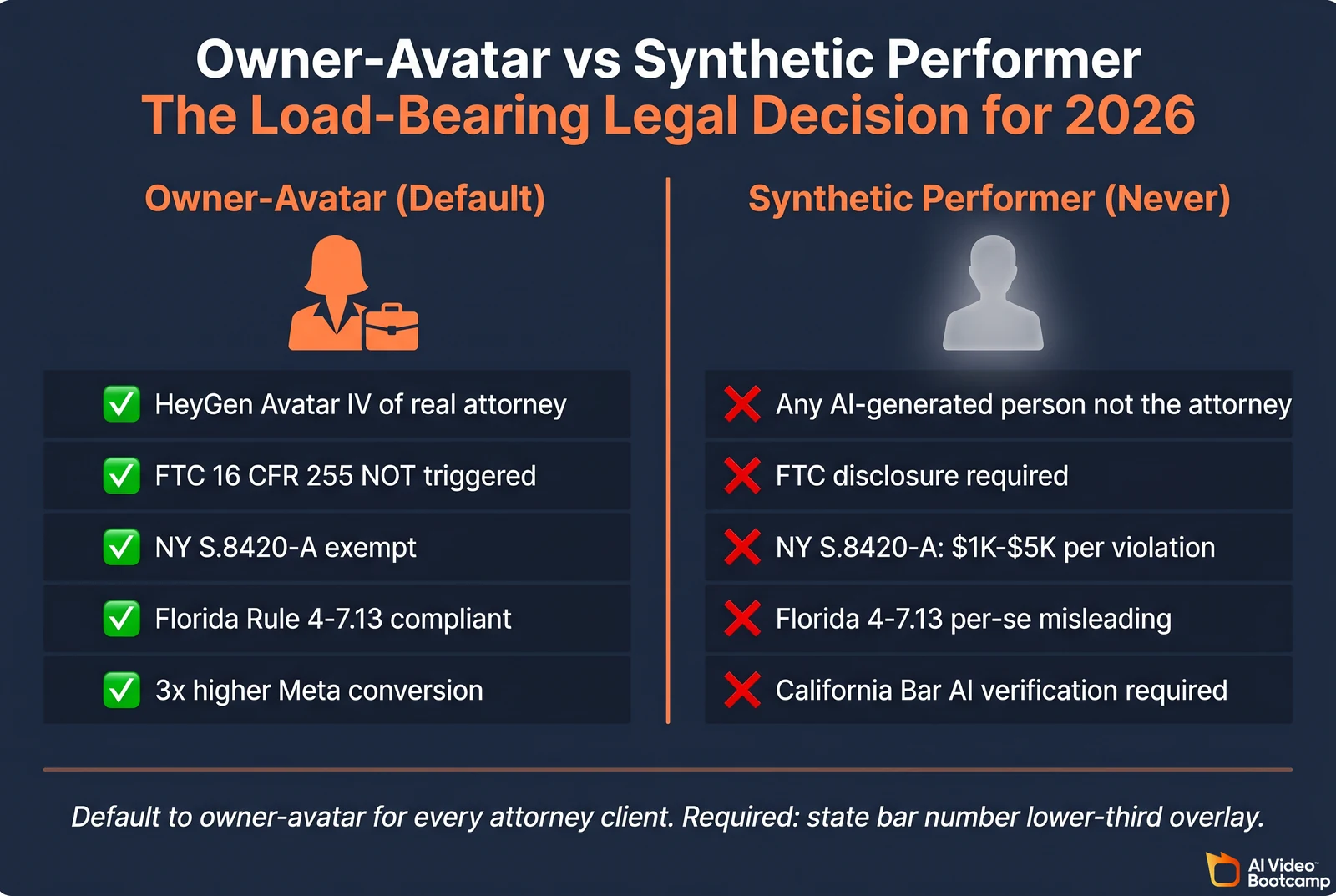
Answer capsule. The single most consequential decision for every AI video operator serving lawyers is whether to use an owner-avatar (HeyGen Avatar IV trained on the actual attorney with recorded consent) or a synthetic performer (any AI-generated human not depicting the actual attorney). Owner-avatar workflows are generally permitted across all 50 states with proper disclosure and the attorney state bar number overlay. Synthetic-performer workflows trigger New York S.8420-A penalties, FTC 16 CFR 255 endorsement disclosure, California State Bar AI guidance review, and Florida Rule 4-7.13 per-se inherently misleading findings. Default to owner-avatar for every attorney client.
Why owner-avatar is the default
Owner-avatar workflow (HeyGen Avatar IV trained on the actual attorney with recorded HeyGen consent video and separate AI Avatar and Voice Likeness Release):
- Generally permitted across all 50 states with proper disclosure
- Required state bar number in lower-third overlay (state-specific rules vary)
- Not a synthetic performer trigger under New York S.8420-A
- Treated as authentic attorney communication under ABA Model Rule 7.1
- Conversion lift: documented 3x higher Meta engagement vs synthetic avatars in trade-services testing
Synthetic-performer workflow (any AI-generated human not depicting the actual attorney, including stock HeyGen avatars, Veo 3.1 or Kling 3.0 generated humans, fake clients, fake associates):
- NY S.8420-A applies: $1,000 first violation, $5,000 subsequent (effective June 9, 2026)
- California State Bar AI Practical Guidance covered-provider duties activate
- FTC 16 CFR 255 endorsement disclosure required
- Florida Rule 4-7.13 makes AI testimonials per-se inherently misleading
- Strong recommendation: AVB operators should NEVER produce AI synthetic-performer content for legal clients
The state attorney bar number overlay (the legal-vertical equivalent of contractor license overlay)
Every video deliverable for an attorney client must display the attorney’s state bar number in the lower-third where state rules require attorney identification. This is the legal analog to the state contractor license overlay we documented in our Home Services Marketing 2026 AI Video Playbook.
States with explicit attorney identification requirements include California, New York, Florida, Texas, and Illinois. Bake the bar number overlay into the CapCut Pro project template at the start of every engagement.
The 6 Compliance-Safe AI Video Workflows That Win Cases
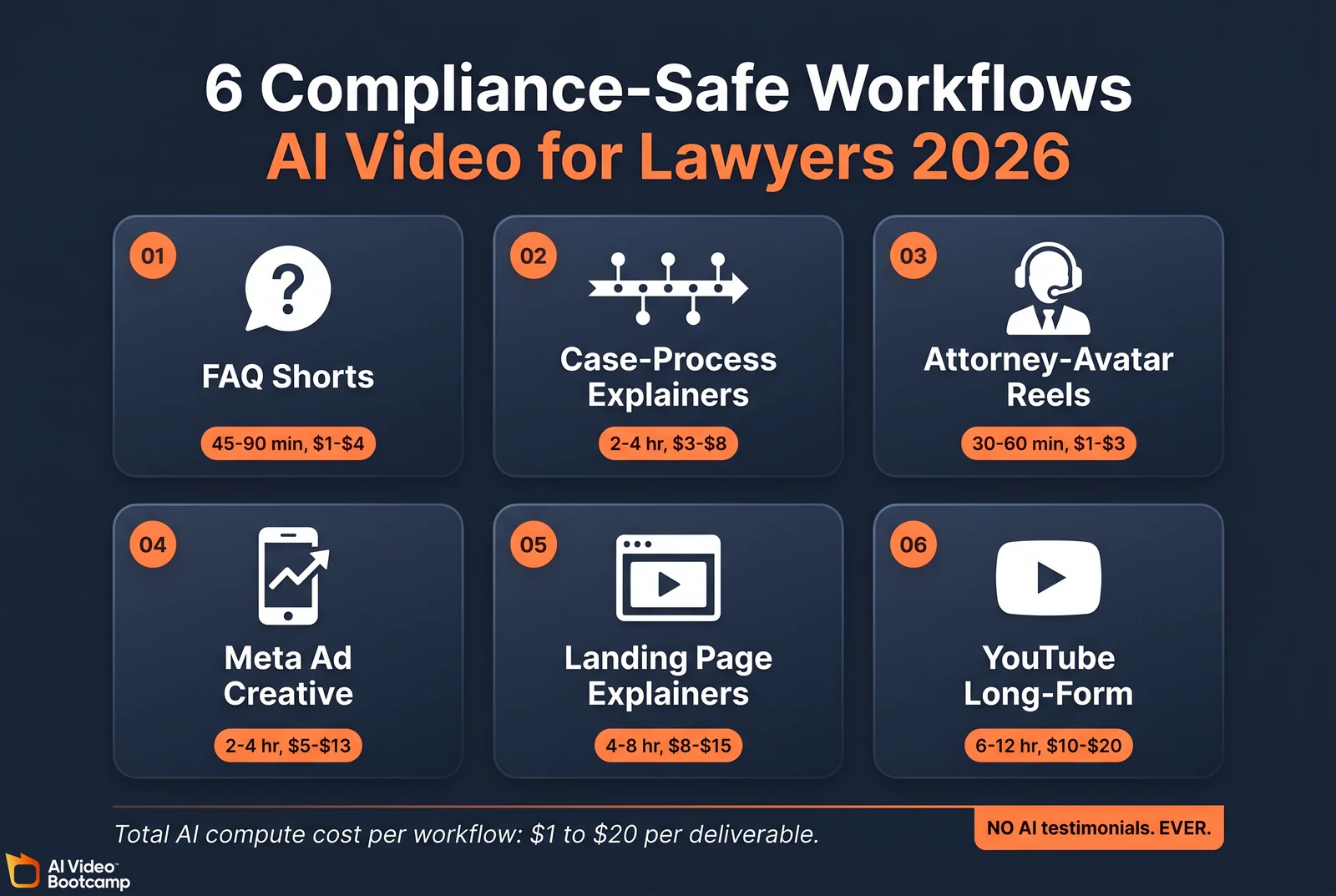
Answer capsule. Six workflows generate measurable lift for legal clients in 2026: AI-narrated practice-area FAQ Shorts, AI-illustrated case-process explainers (the compliance-safe alternative to testimonials), attorney-avatar intake reels with state bar number overlay, AI ad creative for Meta and Google in high-CPC practice areas, practice-area landing-page explainer videos, and YouTube long-form for AI Overview citations. All six execute on the AI Video Bootcamp tool stack at AI compute costs ranging from $1 to $13 per deliverable. The single biggest editorial call: replace all AI testimonial workflows with case-process explainers.
Workflow 1: AI-narrated practice-area FAQ Shorts
Capture top-of-funnel legal search intent. Queries like “What is a deposition?” or “How long do I have to file a personal injury claim in California?” dominate local search volume.
Pipeline:
- Script via Gemini Omni or Claude with neutral informative tone, state-specific statute references
- Diagram thumbnails via GPT Image 2.0 (text-accurate)
- Motion via Seedance 2.0 Fast (superior logo persistence, $0.2419/sec)
- Voiceover via ElevenLabs Creator tier ($0.36 per minute of audio)
- Vertical assembly with dynamic captions in CapCut Pro
Time per deliverable: 45 to 90 minutes AI compute cost: $1 to $4 per Short Platforms: YouTube Shorts, Instagram Reels, TikTok Primary KPI: Local search impressions, short-form view velocity, GBP click-throughs Compliance constraint: Every script must explicitly state the video provides general legal information, not formal legal advice to a specific viewer. Required disclaimer in description and lower-third. Verified operator: IFTS Design uses this exact content marketing model to scale law firm visibility without requiring the attorney to draft scripts or appear on camera (source).
Workflow 2: AI-illustrated case-process explainers (the compliance-safe alternative to testimonials)
Many secondary marketing sources recommend AI-generated client testimonials. AVB operators must completely avoid AI testimonials. Florida Rule 4-7.13 makes them per-se inherently misleading. The compliance-safe alternative is the case-process explainer: videos like “The 5 stages of a personal injury case from accident to settlement” that provide the same trust-building utility as testimonials without the ethical liability.
Pipeline:
- Illustrated branded scenes via Nano Banana Pro (abstract enough to avoid promising specific outcomes)
- Cinematic motion via Kling 3.0 Standard ($0.084/sec, workhorse pricing)
- Narration via ElevenLabs
- Assembly in CapCut Pro
Time per deliverable: 2 to 4 hours AI compute cost: $3 to $8 per explainer Platforms: Firm website landing pages, Meta ad campaigns Primary KPI: Landing-page dwell time, bounce rate reduction Compliance constraint: Avoid any implied guarantee of results or timelines. Mandatory “case timelines vary” disclaimer. Documented lift: Consultwebs documents that integrating high-quality video content into a firm’s digital strategy can reduce cost per lead by 52 percent (agency-cited result, individual firms vary widely).
Workflow 3: Attorney-avatar intake reels
Trust is the highest-converting metric in legal marketing. When a distressed client submits an intake form at 2:00 AM after a DUI arrest, an immediate personalized video response from the lead attorney dramatically increases retainer conversion.
Pipeline:
- HeyGen Avatar IV trained on the actual attorney with recorded HeyGen consent video plus separate AI Avatar and Voice Likeness Release
- ElevenLabs voice clone of the actual attorney
- Permanent lower-third overlay with state bar number and principal office address (Texas requirement, recommended in all states)
- CapCut Pro assembly
Time per deliverable (after one-time avatar training): 30 to 60 minutes per reel AI compute cost: $0.30 to $0.60 per minute of generation on HeyGen Creator tier ($29/month for 15 minutes of generation), or $0.30/min on HeyGen Team tier ($178/month for ~600 minutes) Platforms: Automated SMS follow-ups, email intake sequences, direct social DMs Primary KPI: Intake-form to signed-client conversion rate Compliance constraint: State bar number lower-third overlay mandatory in Texas, recommended in all states. Owner-avatar (actual attorney) is generally permitted; synthetic stock avatars trigger NY S.8420-A and FTC rules.
Workflow 4: AI ad creative for Meta and Google lead generation
In high-CPC environments like personal injury ($284 CPL) and family law ($112 CPL), testing dozens of visual variations is mandatory to lower cost per lead. Generative AI lets operators produce hyper-specific visual hooks that stop the scroll.
Pipeline:
- Bulk visual variations via Flux 2 Pro through fal.ai API ($0.031 per megapixel)
- Dynamic motion via Kling 3.0 Standard ($0.084/sec)
- HeyGen Avatar IV trust framing in final seconds
- Variation packaging in CapCut Pro across 9:16, 1:1, 4:5 aspect ratios
Time per deliverable (batch of 10 ads): 2 to 4 hours AI compute cost: $5 to $13 per batch of 10 variations Platforms: Facebook Ads, Instagram Reels Ads, Google Display Network, Google Search Ads Primary KPI: Cost per lead reduction, qualified lead volume Compliance constraint: Strict adherence to post-accident solicitation rules (Florida 30 days, others vary). Ad creative must remain general to practice area rather than targeting specific recent local tragedies. Must NOT guarantee outcomes. Required disclosures: firm name, geographic limitation, attorney identification.
Workflow 5: Practice-area landing-page explainer videos
Embedding 2 to 3 minute long-form videos on practice-area pages dramatically increases organic visibility. Video pages outrank text-only pages on legal SEO.
Pipeline:
- Text-accurate branded composites via Nano Banana Pro
- B-roll sequences via Kling 3.0 (courthouses, legal documents, professional handshakes)
- Voiceover via ElevenLabs Creator
- Professional long-form editing and color grading in DaVinci Resolve Studio
Time per deliverable: 4 to 8 hours per long-form video AI compute cost: $8 to $15 per video Platforms: Embedded directly on practice-area service pages, firm website Primary KPI: Organic traffic uplift, time-on-page metrics Compliance constraint: Avoid words like “expert” or “specialist” unless the attorney holds formal board certification in that specific state, as strictly enforced by the Florida Bar. Closed captions are an accessibility requirement under ABA accessibility guidance.
Workflow 6: YouTube long-form for AI Overview citations
As search behavior shifts, approximately 20 percent of AI Overview search results pull directly from YouTube citations (per industry SEO analyses). Deep-dive videos ranging from 10 to 15 minutes capture this emerging semantic search traffic.
Pipeline:
- Cinematic hero shots via Google Veo 3.1 Lite ($0.05/sec, 720p) for legal environments
- Secondary motion graphics via Kling 3.0
- High-CTR thumbnails via GPT Image 2.0
- Final multi-track assembly in DaVinci Resolve Studio
Time per deliverable: 6 to 12 hours AI compute cost: $10 to $20 per long-form video Platforms: YouTube (primary, drives AI Overview citations and branded search lift) Primary KPI: AI Overview citation rate, branded search lift, organic search placement Compliance constraint: Comprehensive geographical disclaimers noting the specific jurisdictions where the firm is licensed to practice, avoiding unauthorized practice of law violations across state lines.
For deeper workflow detail on the AI video ad creative layer see our AI video ads complete guide 2026.
The AI Video Bootcamp Tool Stack for Legal Work
Answer capsule. The AI Video Bootcamp tool stack for legal work uses only direct-to-foundation-model tools. Total solo-operator monthly subscription cost runs $180 to $400 for the foundation model layer plus $100 to $300 for operations tools. Critical tier upgrades: HeyGen Team tier ($178/mo) over Creator tier ($29/mo) for legal operators serving more than two attorney clients because of avatar credit consumption. For the full learning path on these tools see our How to learn AI video and image creation in 2026 guide.
Image generation models for legal work
| Tool | Best for | Solo cost | Notes |
|---|---|---|---|
| Nano Banana Pro | Illustrated branded scenes, text-accurate composites | $19.99/mo Google AI Plus | Workhorse for case-process explainers |
| GPT Image 2.0 | Text-accurate diagram thumbnails, complex text overlays | Included in ChatGPT Plus $20/mo | Best for FAQ Short thumbnails |
| Seedream 4.0 | Reference-image-driven brand consistency | $19/mo | Critical for multi-asset firm brand |
| Flux 2 Pro | Bulk variation generation via API | $0.031/megapixel via fal.ai | Powers Workflow 4 batch ad creative |
| Midjourney v7 | Stylized hero imagery, mood references | $30/mo Standard | Reference-grade mood boards |
| Ideogram V3 | Typography-heavy graphics, legal terminology overlays | Pay-per-use API | Strong text rendering for legal terms |
| Recraft V3 | Vector-style legal graphics, infographic explainers | Pay-per-use API | Editorial design polish |
For deep guide on Nano Banana Pro see our Nano Banana Pro complete guide 2026.
Video generation models for legal work
| Tool | Best for | Solo cost | Notes |
|---|---|---|---|
| Kling 3.0 Standard | High-volume motion across all workflows | $37/mo Pro plan | Workhorse for product motion and lifestyle reels |
| Google Veo 3.1 Lite | Cinematic hero shots with native audio | $0.05/sec pay-per-use (720p) | Best for long-form YouTube hero pieces |
| Seedance 2.0 Fast | Logo persistence across cuts | $19.90/mo Basic (150 credits) | Critical when firm brand must not drift |
| Gemini Omni | Physics-accurate world-model simulations, conversational editing | Free via Gemini app for Plus/Pro/Ultra subscribers | Use for case-scene reconstructions with hypothetical-scenario disclaimers |
| Hailuo 02 | High quality at budget-friendly tier | $9.99 to $94.99/mo tiered | Alternative for Workflow 5 |
| LTX Video | Ultra-low-cost batch volume | $0.02 per generation | Cheapest viable model for repetitive content |
| Wan 2.7 | Open-source motion alternative | Apache 2.0 license, $0.10/sec API | Open-weight alternative |
For deeper comparison see our Seedance vs Kling vs Veo 2026 guide and Kling AI complete guide. For Gemini Omni capabilities released at Google I/O 2026 see our Gemini Omni guide.
Avatar, voice, and editing
| Tool | Best for | Solo cost |
|---|---|---|
| HeyGen Avatar IV (Creator tier) | Owner-avatar talking-head content, single client | $29/mo (15 minutes generation) |
| HeyGen Team tier | Multi-client legal operator (2+ attorney clients) | $178/mo (~600 minutes, shared assets) |
| ElevenLabs Creator | Voiceovers, attorney voice cloning with consent | $22/mo (121K credits) |
| CapCut Pro | Short-form assembly with burned-in captions and state bar number overlay | $10/mo |
| DaVinci Resolve Studio | Long-form color grading and multi-track edits | $295 one-time |
The HeyGen tier upgrade math (operator warning)
HeyGen Avatar IV burns avatar credits fast. The Creator tier ($29/month) includes only 15 minutes of generation. For a legal operator running attorney-avatar intake reels for two attorney clients at 2-3 minutes per reel, two reels per month each, you exhaust the 15-minute allowance in eight reels. Upgrade to HeyGen Team tier ($178/month) at the second attorney client, not the third. Operators new to legal vertical routinely undercharge for HeyGen-driven workflows and subsidize client output from their own pocket.
Pricing Benchmarks for Legal AI Video Retainers
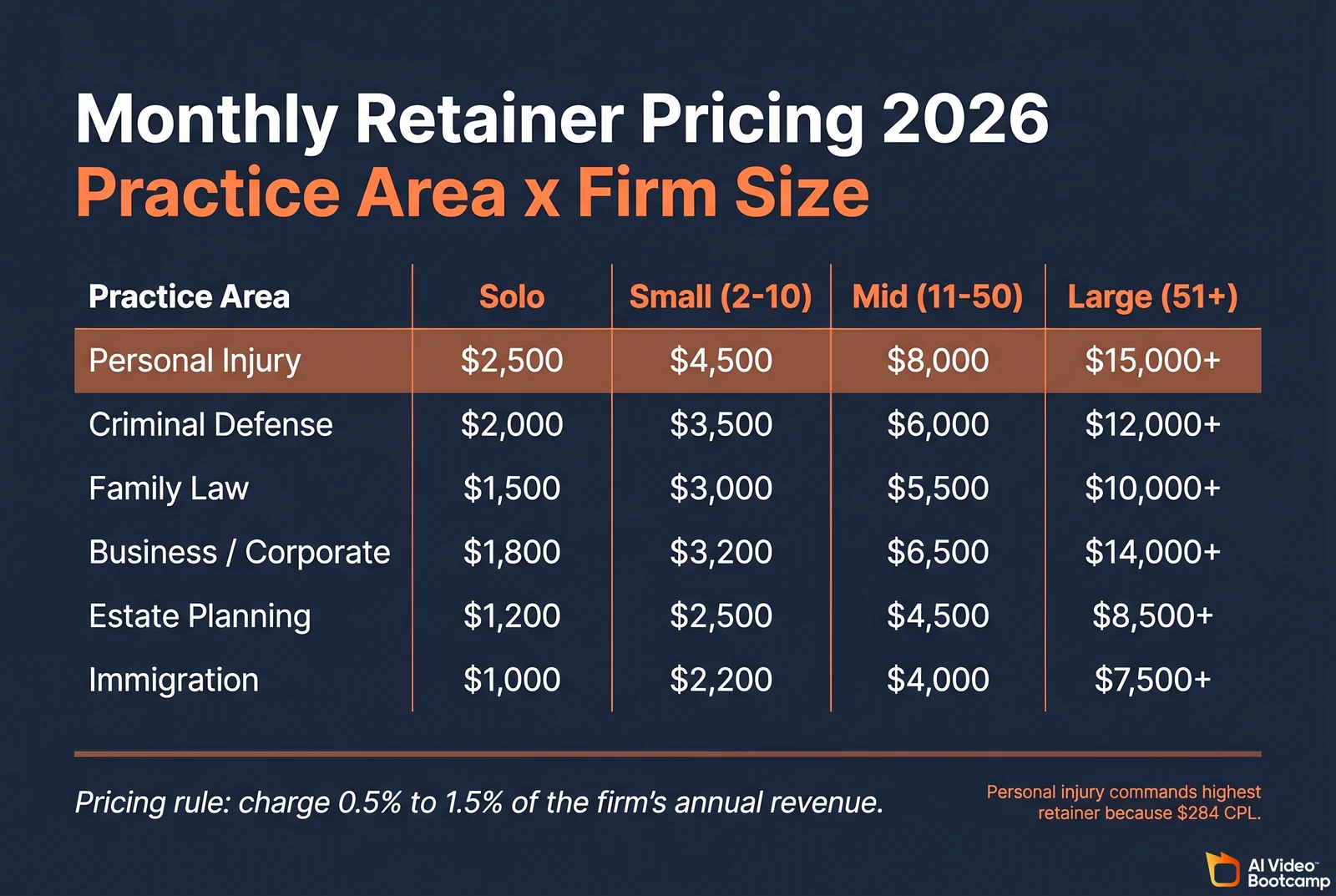
Answer capsule. Per-deliverable pricing for legal AI video runs $400 to $3,000 depending on workflow and practice area. Monthly retainers run $1,000 to $15,000+ depending on practice area and firm size. The cleanest pricing heuristic is to charge 0.5 to 1.5 percent of the firm’s annual revenue, adjusted upward for high-competition practice areas (personal injury 1 to 1.5 percent, criminal defense 0.5 to 1 percent, estate planning 0.3 to 0.8 percent). A $500,000 PI firm pays $5,000 to $7,500 per month. A $1.5M PI firm pays $15,000 to $22,500 per month. Setup fees of $1,500 to $3,000 cover legal-vertical premium for brand foundation, attorney consent capture, and HeyGen avatar training.
Per-deliverable pricing benchmark
| Deliverable | Personal Injury & Criminal | Family & Business | Estate & Immigration |
|---|---|---|---|
| AI-Narrated FAQ Shorts (batch of 5) | $800 | $650 | $500 |
| AI-Illustrated Case Explainer (1 min) | $1,200 | $900 | $750 |
| Attorney-Avatar Intake Reel | $600 | $500 | $400 |
| AI Ad Creative Batch (10 variations) | $1,500 | $1,200 | $900 |
| Landing-Page Explainer (2-3 min) | $2,500 | $2,000 | $1,500 |
| YouTube Long-Form Deep Dive (10-15 min) | $3,000 | $2,200 | $1,800 |
Monthly retainer pricing by practice area and firm size
| Practice area | Solo practitioner | Small firm (2-10) | Mid-size (11-50) | Large firm (51+) |
|---|---|---|---|---|
| Personal injury | $2,500/mo | $4,500/mo | $8,000/mo | $15,000+/mo |
| Criminal defense | $2,000/mo | $3,500/mo | $6,000/mo | $12,000+/mo |
| Family law | $1,500/mo | $3,000/mo | $5,500/mo | $10,000+/mo |
| Business / corporate | $1,800/mo | $3,200/mo | $6,500/mo | $14,000+/mo |
| Estate planning | $1,200/mo | $2,500/mo | $4,500/mo | $8,500+/mo |
| Immigration | $1,000/mo | $2,200/mo | $4,000/mo | $7,500+/mo |
The 0.5 to 1.5 percent of firm revenue rule (verified for legal)
The pricing heuristic that works across trades, home services, and now legal:
- Personal injury and family law: Upper end (1 to 1.5 percent of revenue)
- Estate planning and corporate law: Lower end (0.3 to 0.8 percent)
- Criminal defense and immigration: Middle (0.5 to 1 percent)
A solo PI attorney doing $500,000 in annual fees pays $5,000 to $7,500 per month. A small firm doing $2.5M pays $12,500 to $37,500 per month. A mid-size firm doing $10M pays $50,000 to $150,000 per month.
Setup fees (legal vertical premium)
Setup fees run higher than other verticals because of compliance overhead:
- Brand foundation document ($800 to $2,000): exact hex codes, firm voice and tone, state bar number, required disclosure templates per state, attorney consent capture
- Intake form and portal setup ($500 to $1,000): structured intake form, branded client portal, document retention compliance
- Content audit and competitor benchmark ($800 to $1,500): document where competing firms rank, practice-area content gaps, recommended cadence
- Custom HeyGen avatar training ($500 to $1,200): consent video capture, model training, voice clone, asset library
Typical bundled legal setup fee: $1,500 to $3,000.
Texas filing-as-a-service add-on revenue line
Texas is the only major state with mandatory advertising filing ($100 per ad within 10 days). AVB operators serving Texas attorney clients can offer Texas filing-as-a-service at $150 to $250 per filing, covering the $100 state bar filing fee plus operator margin. For an attorney client running monthly Meta ad creative batches, this becomes a recurring add-on revenue line of $300 to $500 per month.
How to Land Your First Attorney Client
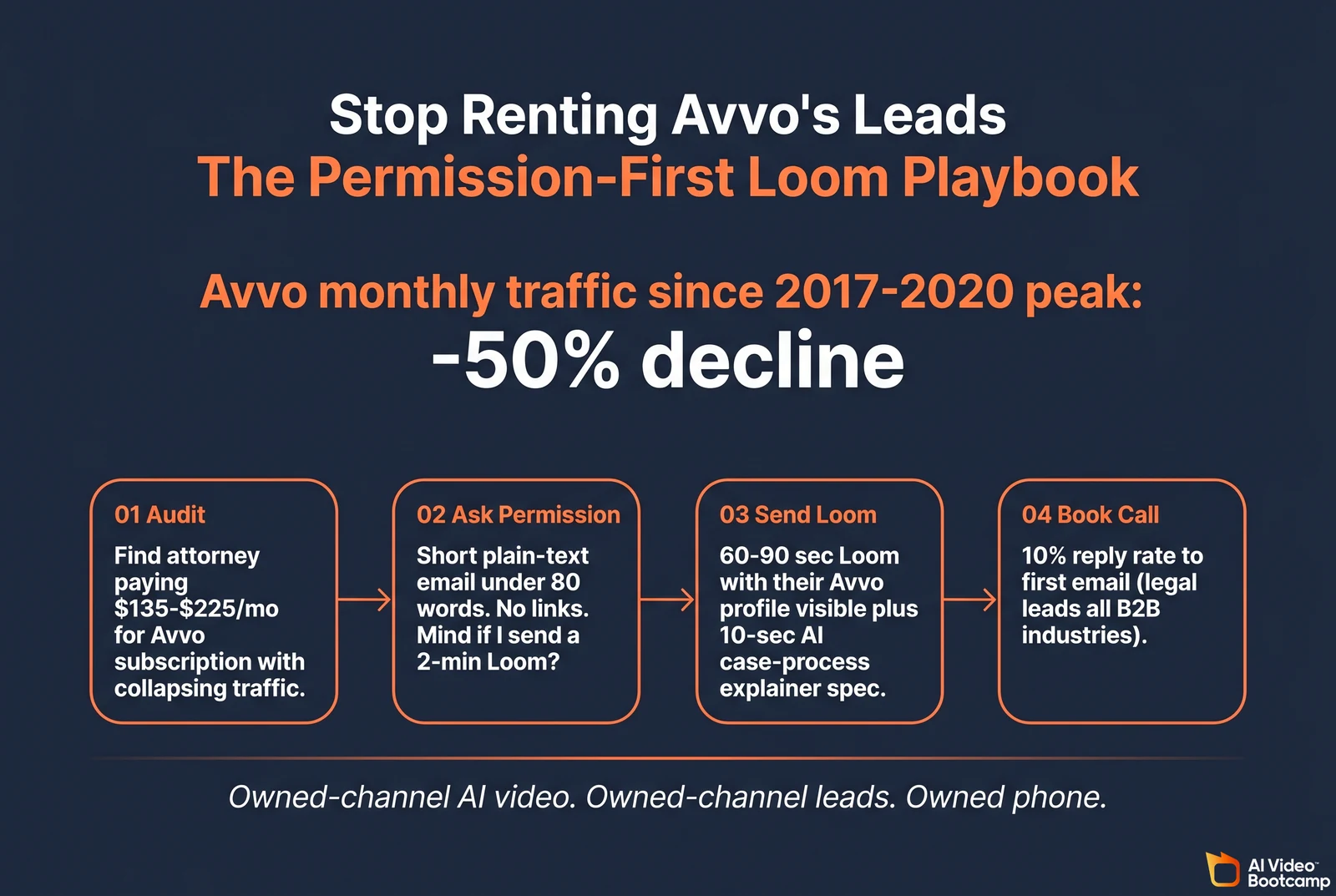
Answer capsule. The highest-converting cold-outbound tactic for legal AI video in 2026 is the Permission-First Loom Playbook combined with the Avvo platform fatigue wedge. Avvo monthly traffic dropped roughly 50 percent from its 2017-2020 peak per Mockingbird Marketing analysis, and Avvo Legal Services was discontinued after intense ethical scrutiny. Attorneys are paying $135 to $225 per month for Avvo Premium, Advanced, or Elite subscriptions on a directory with collapsing traffic. The pitch wedge writes itself.
The Avvo wedge
Avvo was the premier legal directory for 15 years. As of May 2026:
- Monthly traffic down roughly 50 percent from 2017-2020 peak (Mockingbird Marketing analysis)
- Avvo Legal Services discontinued after 8+ state bar ethics opinions
- Justia now outranks Avvo on most state + practice-area queries
- Current subscriptions: Premium $100/mo, Advanced $135/mo, Elite $225/mo
The pitch positions AI video as the path to owned-channel lead generation:
“I noticed you’re paying $135 to $225 per month for Avvo Elite, but Avvo’s organic search traffic has dropped 50 percent since 2020 and many practice-area searches now show zero Avvo results. I help attorneys ship owned-channel AI video (Google Business Profile, YouTube AI Overview citations, Meta lead-gen) that drives leads directly to your phone instead of feeding Avvo. Mind if I send a 2-minute Loom showing how it would work for [Firm Name]?”
The Permission-First Loom Playbook adapted for attorneys
Email 1 (plain text, under 80 words, no links):
Subject: Quick AI video idea for [Firm Name]

Hi [Attorney First Name],

I audited [Firm Name]'s Avvo profile and noticed [specific gap: no video posts, weak Google Business Profile, no practice-area FAQ content].

I help attorneys ship AI-generated video (practice-area FAQ Shorts, case-process explainers, owner-avatar intake reels) that complies with [state bar] advertising rules and drives qualified leads.

Recorded a 2-minute Loom showing exactly what I'd do for your firm. Mind if I send it over?

[Your first name]
Email 2 (sent only after “yes” reply):
Subject: Re: Quick AI video idea for [Firm Name]

Here you go: [60-90 second Loom link]

Walks through 3 things I'd change and shows a 10-second AI-illustrated case-process explainer I made for your specific practice area.

If it lands, happy to chat. If not, hope the ideas are useful either way.

[Your first name]
Documented reply rates for legal cold email run approximately 10 percent (highest of any B2B industry per industry benchmarks). The Permission-First two-email approach with Loom delivery converts at 15 to 25 percent.
10 lead-gen channels ranked by ease
| Rank | Channel | Why it works |
|---|---|---|
| 1 | Avvo Profile Audit + Permission-First Loom | Combines the platform fatigue wedge with the proven outbound script |
| 2 | LinkedIn warm-first outreach | Attorneys are heavy LinkedIn users; warm InMail 18-25 percent reply rate |
| 3 | Cold email | Legal services lead all B2B in cold email at ~10 percent reply |
| 4 | State bar association member directories | All 50 state bars publish directories; filter by location, practice area, admission date |
| 5 | Justia and FindLaw partner ecosystems | Justia dominant over Avvo for organic; explore partner programs |
| 6 | Existing-client referrals | Attorneys refer cases across practice areas; 10 percent referral commission baked into retainer |
| 7 | Local bar association CLE events | Continuing Legal Education events draw attorneys; some open to vendors |
| 8 | Mockingbird Marketing community + podcasts | Active legal marketing community |
| 9 | State bar annual conventions | Premium booth pricing $5K-$25K+; secure 1 large-firm retainer to recoup |
| 10 | Google Business Profile audits as wedge service | Free starter offering; attorneys love seeing competitor GBPs |
Practice-Area Deep Dive: 7 Niches Inside Legal
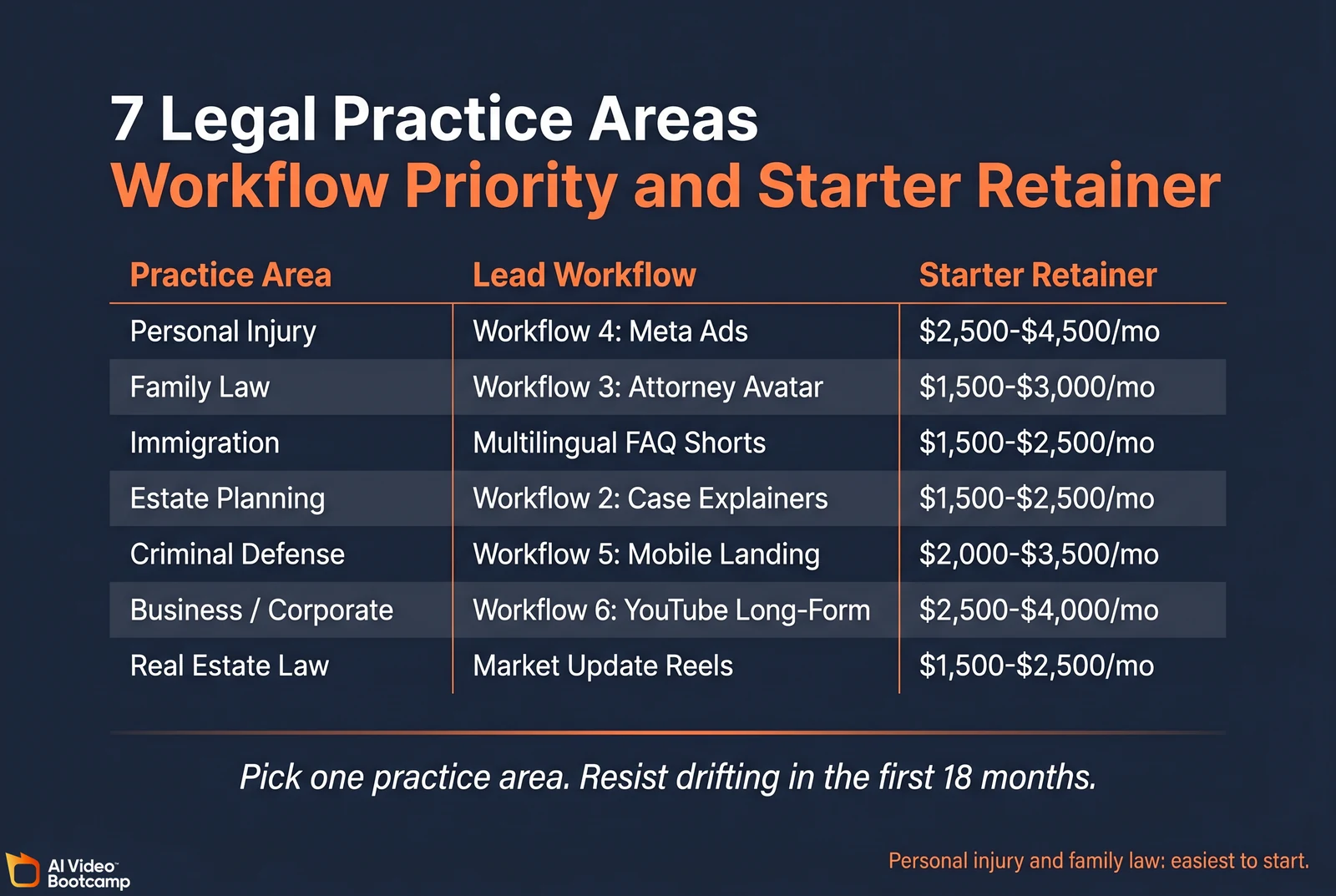
Answer capsule. Each legal practice area has distinct economics that determine workflow priority, starter retainer, and the under-served opportunity an AVB operator can claim. Personal injury commands the highest retainer at $2,500 to $4,500 starter. Family law has the strongest emotional buying intent. Immigration unlocks the multilingual workflow advantage (Spanish, Mandarin, Tagalog via ElevenLabs voice cloning). Criminal defense requires the fastest-loading mobile landing-page videos for late-night panic-driven buyers. Business and corporate has the longest sales cycle but the highest LTV.
1. Personal injury
- Buyer profile: Individuals recently suffering physical trauma and financial distress
- Unique pain point: Extreme market saturation, $284 average CPL, clicks for “compensation lawyer” exceeding $100 in major metros
- AI video priority: Workflow 4 (Meta ad creative via Flux 2 Pro + Kling 3.0)
- Starter retainer: $2,500 to $4,500
- Compliance constraint: 30-day post-accident solicitation waiting period in most states; no guarantee of financial outcomes
2. Family law
- Buyer profile: Spouses navigating divorce, custody battles, asset division
- Unique pain point: Clients are highly suspicious, require empathy and trust before reaching out; $112 average CPL with $35 keyword CPC
- AI video priority: Workflow 3 (attorney-avatar intake reels with reassuring tone)
- Starter retainer: $1,500 to $3,000
- Compliance constraint: Protect privacy of minors; AI-illustrated scenarios must be heavily abstracted
3. Immigration law
- Buyer profile: Families and individuals navigating federal bureaucracy, often facing language barriers
- Unique pain point: Explaining dense federal requirements to non-English speakers; $42 average CPL
- AI video priority: Multilingual FAQ Shorts using ElevenLabs voice cloning to dub attorney avatar into Spanish, Mandarin, Tagalog (unique vertical advantage)
- Starter retainer: $1,500 to $2,500
- Compliance constraint: Federal practice rules allow cross-state representation, but geographical claims in video must remain accurate
4. Estate planning
- Buyer profile: Aging Baby Boomers executing wealth transfers, young families establishing protective trusts
- Unique pain point: Procrastination; clients know they need a will but delay endlessly; $58 average CPL
- AI video priority: Workflow 2 (case-process explainers via Nano Banana Pro that visualize the probate court nightmare scenario, incentivizing immediate action)
- Starter retainer: $1,500 to $2,500
- Compliance constraint: Financial thresholds and tax law references in generative scripts must reflect current reality
5. Criminal defense
- Buyer profile: Individuals facing imminent loss of freedom, often searching frantically after hours from mobile devices
- Unique pain point: Urgent panic-driven buying mode after-hours mobile searches; speed-to-respond is the primary conversion driver
- AI video priority: Workflow 5 (fast-loading mobile-optimized landing-page explainer videos at top of mobile site to capture late-night traffic)
- Starter retainer: $2,000 to $3,500
- Compliance constraint: AI video must not dilute the attorney’s authentic trial record. Authentic attorney expertise is critical for criminal defense rankings.
6. Business and corporate law
- Buyer profile: Founders, corporate officers, entrepreneurs seeking contract review, M&A guidance, litigation defense
- Unique pain point: Exceptionally long sales cycles; deep networking required; highest LTV of any practice area
- AI video priority: Workflow 6 (high-end YouTube long-form deep dives discussing complex legal precedents, designed for Google AI Overview citation)
- Starter retainer: $2,500 to $4,000
- Compliance constraint: Avoid disclosure of proprietary business methodologies during generative case studies or hypotheticals
7. Real estate law
- Buyer profile: Commercial developers, property managers, high-net-worth residential buyers navigating zoning or contract disputes
- Unique pain point: Cross-pollination with broker and title company vendor networks; content must appeal to B2B referral sources
- AI video priority: Market update reels and contract pitfall explainers
- Starter retainer: $1,500 to $2,500
- Compliance constraint: Adhere to both state bar advertising rules and real estate commission advertising guidelines simultaneously
- Cross-pollination opportunity: Pair this client with our AI Real Estate Marketing Stack 2026 playbook for the broader vertical opportunity
Legal Compliance Must-Haves: 5 Things Every Contract Must Include
Answer capsule. Five clauses every AVB operator’s contract with an attorney client must include after May 2026: indemnification stating attorney is final reviewing authority and solely liable for state bar compliance, document retention archive obligations (2 to 4 years per most state bars), E&O insurance coverage ($1M baseline, $2M for operators with 3+ legal clients), attorney consent capture for HeyGen Avatar IV with separate signed AI Avatar and Voice Likeness Release, and platform AI disclosure liability allocation (attorney handles platform-specific deployment disclosures, operator delivers assets with proper metadata).
1. Indemnification clause (the most important)
The contract must clearly state that the attorney is the final reviewing authority and is solely liable for ensuring the marketing material complies with their specific state bar rules before publication. Sample language: “Client is the licensed legal professional and is the sole authority on compliance with state bar advertising rules in their licensed jurisdictions. Client retains final review and approval authority on all delivered materials prior to public dissemination.”
2. Document retention archive
State bars often require attorneys to retain copies of all advertisements for 2 to 4 years. AVB operators should provide a centralized secure archive of all delivered video files. Use Frame.io or branded Notion portal with version history.
3. E&O insurance
- Baseline: $1M aggregate from Hiscox, Next Insurance, or Thimble ($50 to $150/month)
- Operators with 3+ legal clients: Upgrade to $2M aggregate ($150 to $300/month)
- Media liability rider: Additional $30 to $80/month for AI-generated content disputes
- Confirm in writing that the law firm client’s General Liability policy includes advertising injury coverage
4. HeyGen Avatar IV consent + AI Avatar and Voice Likeness Release
Two separate documents required:
- HeyGen mandatory consent video (captured through the HeyGen Avatar IV training flow)
- AVB operator’s separate AI Avatar and Voice Likeness Release signed by the attorney, granting commercial use rights and indemnification
5. Platform AI disclosure allocation
Standard language: “AVB operator delivers AI-generated video assets with appropriate metadata and provenance markers (C2PA where supported). Attorney client is responsible for deploying these assets with platform-specific disclosure tags (Meta C2PA, TikTok AI Disclosure, YouTube AI dropdown) and for ensuring state bar-required overlay disclosures are present in the final published version.”
Common Failure Modes That Kill Legal AI Video Operators
Answer capsule. Seven failure patterns kill AI video operators in their first 12 months serving attorney clients: producing AI synthetic testimonials (instant Florida Rule 4-7.13 violation), missing the state bar number overlay, undercharging at compute cost markup, HeyGen credit margin trap on Creator tier, choosing the wrong workflow for the practice area, attempting to render legal advice instead of general information in FAQ Shorts, and missing the post-accident solicitation waiting period in personal injury Meta ads. The most expensive compliance failure is the AI testimonial. The most expensive operational failure is undercharging.
-
Producing AI synthetic testimonials in any state. Florida Rule 4-7.13 makes them per-se inherently misleading. Other state bars are tightening. Strongest recommendation: never produce them regardless of where the attorney practices.
-
Missing the state bar number overlay. Texas requires it; California, New York, Florida, Illinois recommend it; most states require attorney identification in advertising. Bake the lower-third overlay into the CapCut Pro project template.
-
Undercharging at compute cost plus 50 percent. Floor at 5x compute cost. Apply the 0.5 to 1.5 percent of firm revenue rule. Legal vertical commands premium pricing because of compliance overhead.
-
HeyGen Avatar IV credit margin trap. Creator tier ($29/month, 15 minutes) exhausts in eight intake reels at 2 minutes each. Upgrade to Team tier ($178/month, ~600 minutes) at the second attorney client.
-
Wrong workflow for the practice area. Generic FAQ Shorts for an estate planning client waste budget. Use the workflow-to-vertical matrix in Section 8. PI wants Workflow 4 Meta ads. Family law wants Workflow 3 owner-avatar reels. Criminal defense wants Workflow 5 mobile-fast landing-page videos.
-
Crossing the general-information line into legal advice in FAQ Shorts. Script writes “If you were in a car accident, you should…” instead of “California’s statute of limitations for personal injury claims is two years from the date of injury.” The first is legal advice (compliance violation). The second is general information (compliant).
-
Missing post-accident solicitation waiting period. Florida requires 30 days. Other states vary (Pennsylvania 15 days). Meta lead-gen ad creative must remain general to practice area, not targeting specific recent local tragedies.
How to Scale a Legal AI Video Practice to $10K MRR
Answer capsule. A solo AVB operator can scale to $10,000 monthly recurring revenue serving legal clients in 8 to 14 months through three discrete phases: first paid attorney client by week 8 via the Avvo-wedge Permission-First Loom Playbook, $4,000 to $6,000 MRR by month 6 via 2 to 3 attorney retainer clients at $2,000 to $3,000 each, then $10,000 MRR by month 12 to 14 via 4 to 6 attorney clients with one premium retainer ($5,000+) anchoring the book.
Phase 1: Land the first attorney client (weeks 1 to 8)
- Pick one practice area. Personal injury or family law are the easiest to start (highest CPL pain point, clearest workflow priority, single-decision-maker dynamics at solo or small firms).
- Build a 3-piece spec portfolio in 14 days. One AI-narrated FAQ Short for the practice area, one AI-illustrated case-process explainer, one attorney-avatar intake reel demo (use a willing local attorney you know, or arrange a paid one-hour HeyGen Avatar IV consent capture session).
- Ship 10 to 15 Permission-First Loom emails per day using the Avvo-wedge script. Target solo attorneys in your local metro area with weak Google Business Profile presence.
- Convert at $1,500 to $2,500 starter retainer. The first attorney client is the case study material for the next 10.
Phase 2: Scale to $4,000 to $6,000 MRR (months 2 to 6)
- Run the case study formula every 60 days. Document the firm name, problem, intervention, metric (CPL reduction or lead-volume lift), screenshot, and attorney quote. Publish on LinkedIn long-post, X thread, 90-second video walkthrough, and dedicated case study landing page.
- Bake referral incentives into every retainer. 10 percent of first 3 months of any referred client paid to the referring attorney. The legal community is tightly networked.
- Add a complementary practice area. PI + family law pair well. Estate planning + business law pair well. Don’t take immigration unless you have multilingual capacity.
- Raise prices on new clients at the 3-month mark. Grandfather existing attorney clients at original rates for at least one quarter.
Phase 3: Hit $10K MRR by month 12 to 14
- Stabilize at 4 to 6 attorney clients across 2 to 3 practice areas. Solo capacity caps around 6 to 8 legal clients depending on workflow mix and Texas filing volume.
- Convert one client to a premium tier ($5,000+/mo). A mid-size PI or business law firm with $1.5M+ revenue justifies premium retainer per the 0.5 to 1.5 percent rule.
- Make the first contract hire only after crossing $250K annualized revenue. Same rule as Home Services and Agency playbooks. Hire hourly via Upwork for fulfillment.
The complete operator scaling framework from solo through Phase 3 is in our Making $10K per month with AI video guide.
Sources
Primary research, government, and academic:
- ABA 2025 Profile of the Legal Profession
- ABA TechReport 2023: Websites & Marketing
- BLS OEWS NAICS 5411 Lawyers
- California State Bar Generative AI Practical Guidance
- New York Senate Bill S.8420-A
- Texas Disciplinary Rules of Professional Conduct
- Illinois ARDC Artificial Intelligence Guidance
- FTC DoNotPay Settlement
- FTC Operation AI Comply
- FTC Advertisement Endorsements (16 CFR 255)
- EU AI Act Article 50
Industry analysis and benchmarks:
- Clio 2025 Legal Trends Report (Solo and Small)
- Clio Marketing Budget Guide
- Pareto Legal Google Ads Practice-Area Math
- Mockingbird Marketing
- Consultwebs Video Marketing for Law Firms
- Justia Lawyer Marketing
- Custom Legal Marketing Law Firm SEO
- Lowenstein on NY S.8420-A
- LawNext on California AI Verification Rule
- Artificial Lawyer: OpenAI Codex for Legal
Tool documentation:
- Kling AI membership plans
- Seedance pricing
- HeyGen pricing
- ElevenLabs pricing
- Flux 2 Pro on fal.ai
- Google Veo 3.1 pricing
- Stability AI Community License
Lead-gen and outreach:
- State Bar of Texas Advertising Review
- Cleverly Cold Email Benchmarks by Industry
- MyCase Best Legal Directories 2025
- Lawyerist Podcast
- Justia
Related AI Video Bootcamp blog reading:
- What is AI Video Bootcamp?
- How to learn AI video and image creation in 2026
- Making $10K per month with AI video
- Home Services Marketing 2026 AI Video Playbook
- AI Video for E-commerce 2026: The DTC Playbook
- AI Real Estate Marketing Stack 2026
- Stable Audio 3.0 Complete Guide: AI Music 2026
- AI Video Ads Complete Guide 2026
- Nano Banana Pro Complete Guide 2026
- Kling AI Complete Guide
- Seedance vs Kling vs Veo 2026
- Gemini Omni Google AI Video Model 2026
- AI Disclosure Compliance 2026: C2PA and EU AI Act
This guide was compiled from primary research papers, the ABA Profile of the Legal Profession, state bar association documentation (California, New York, Florida, Texas, Illinois), FTC enforcement filings (DoNotPay, TruHeight, Rytr, Operation AI Comply), the Clio 2025 Legal Trends Report, Pareto Legal 2026 CAC benchmark, Mockingbird Marketing legal-marketing analysis, official tool documentation from Kling, Veo, Seedance, Gemini, Nano Banana Pro, Flux 2 Pro, HeyGen, and ElevenLabs, and AI Video Bootcamp operator community interviews documented during May 2026. All pricing and benchmark figures are current as of May 22, 2026. Readers should verify current state bar rules and tool pricing directly with each provider before deploying client campaigns.