
Why AI Video for E-commerce Is No Longer Optional in 2026
AI video for e-commerce is no longer optional in 2026. Meta’s Andromeda algorithm now penalizes creative monotony with higher CPMs, traditional UGC creator rates have collapsed 44 percent year over year to roughly $198 per deliverable, and full AI ad workflows produce finished assets in 17 to 26 minutes at $2 to $8 each. DTC brands without an AI ad pipeline now pay a structural cost penalty on every impression.
The AI video generation market is forecast to reach $18.6 billion by the end of 2026, up from $5.1 billion in 2023. Global digital video advertising spend will cross $223.5 billion in 2026 and scale toward $338.6 billion by 2030. That is where DTC creators get paid. Adoption is past the tipping point. 91 percent of businesses use video as a primary marketing tool. 93 percent of marketers call video indispensable to strategy. 78 percent of enterprise marketing teams now deploy at least one AI-generated video per campaign quarter. On the supply side, freelance demand for AI video skills grew 109 percent year over year on Upwork alone.
The economic case is structural, not cyclical. Traditional agency production cycles run roughly 13 days for a single deliverable. AI pipelines execute a comparable deliverable in approximately 27 minutes. That is a cost gap of about 1,600 times. AI video ad campaigns report an 82 percent increase in ROI compared to traditional methodologies. For AI-generated UGC specifically, documented return on ad spend runs between 400 and 600 percent for leading consumer brands, driven by click-through rates that average four times higher than traditional ad formats.
But the story is not “AI replaces human creative.” The story is variation cost. AI-generated ads do not win because each individual asset is better. They win because Meta’s Andromeda algorithm penalizes accounts that ship few creative variations. That is the monotony tax. Without high-volume variation, your CPMs rise on the same audience. AI is now CPM-defensive.
The AI Conversion Gap: When AI Ad Creative Wins and When It Loses
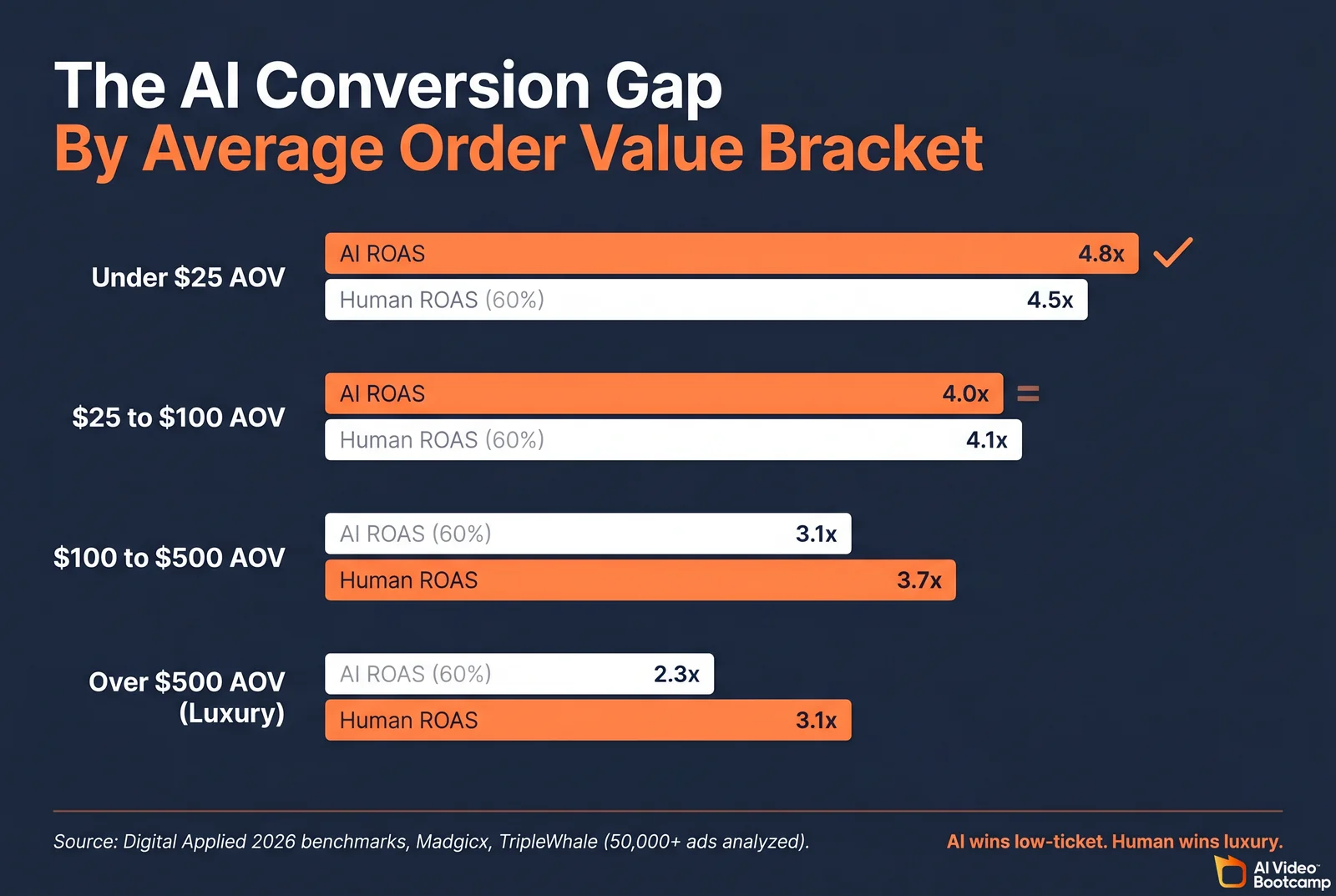
AI ad creative wins on click-through rate at every AOV bracket but loses on conversion rate above $100 average order value. Under $25 AOV: AI delivers 4.8x ROAS versus 4.5x for human-produced creative. From $25 to $100 AOV: parity. From $100 to $500: human creative wins 3.7x to 3.1x. Over $500 luxury: human dominates 3.1x to 2.3x.
This is the single most important framing in the article and the most commonly missed by AI vendor marketing. Click-through rate definitively favors AI-generated creative. On Meta, AI ads achieve average CTR of 1.08 percent compared to 0.96 percent for human-created ads on identical audiences, a 12 percent advantage. On Google Ads, AI-generated headlines and image assets yield a 7 percent CTR advantage. Google Performance Max campaigns using embedded AI variations report a 15 to 25 percent lift in ROAS. Source: Digital Applied 2026 benchmarks.
That is the aggregated industry view. The most rigorous third-party study tells a more sober story. Meta’s own AdLlama paper on arXiv measured 640,000 ads across 35,000 advertisers over a 10-week period and found AI-generated ad creative produced a real CTR lift of 6.7 percent. Both numbers are useful. The aggregated +12 percent reflects what high-volume optimizers measure with their own tooling. The AdLlama +6.7 percent reflects a controlled, peer-reviewed study. Use both honestly.
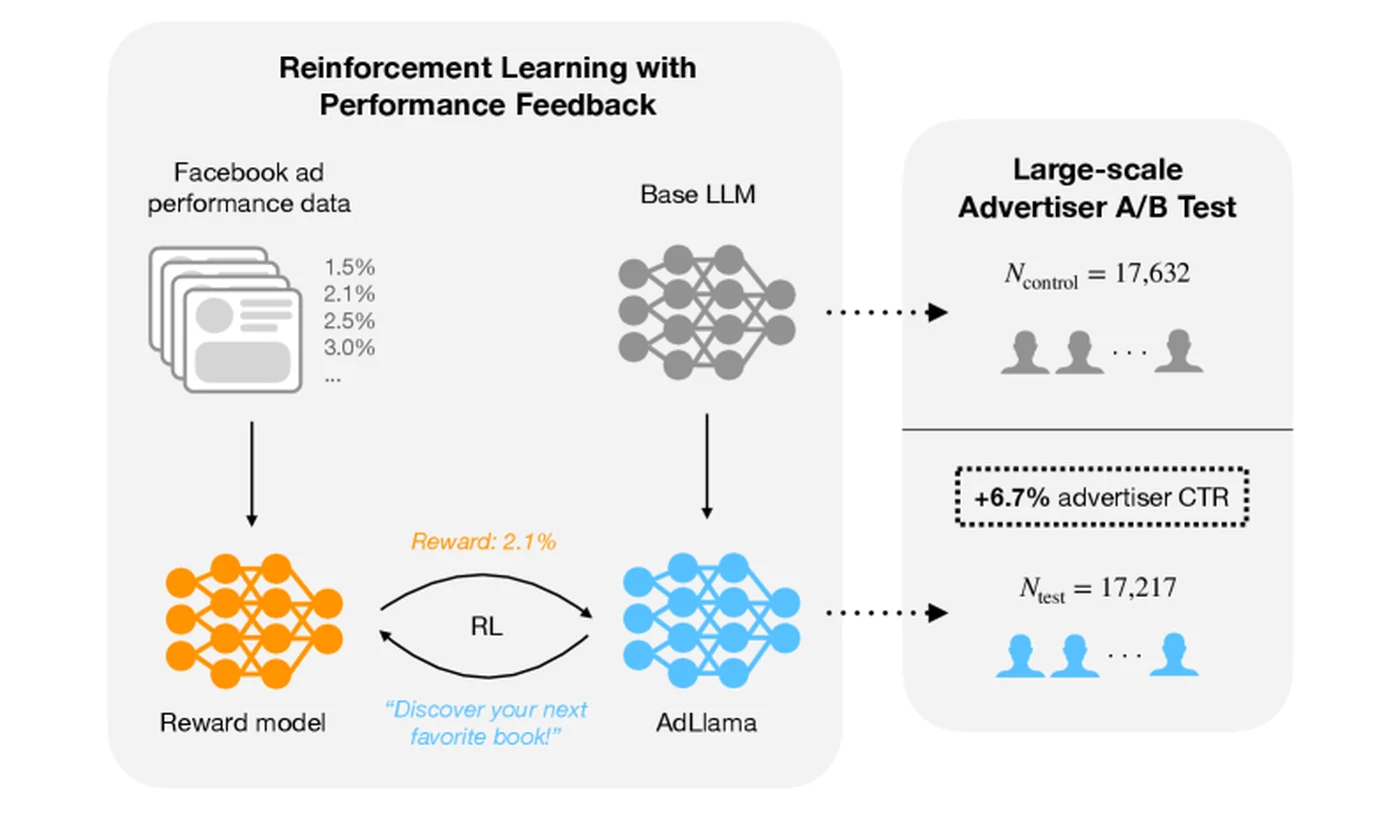
Figure 1: Meta AdLlama study overview. Reinforcement learning post-training of an LLM using Facebook ad CTR as the reward signal; A/B tested across 35,000 advertisers and 640,000 ad variations, showing a 6.7 percent CTR lift. Source: arXiv:2507.21983 v2, Figure 1, reproduced with attribution.
Where the story flips is conversion rate as a function of average order value. Under $25 AOV, AI creative dominates because the purchase is impulsive and the consumer does not stop to inspect microscopic detail. From $25 to $100, AI and human creative reach parity. Above $100, AI loses. The reason is the trust gap. When consumers evaluating a high-AOV purchase perceive an ad as AI-generated, purchase intent drops 14 percent and brand premium perception drops 17 percent. Luxury brands selling at $500 and above lose more on AI ads than they gain.
AOV-bracketed performance: the single table every DTC operator needs
| E-commerce AOV bracket | AI CTR advantage | AI CVR impact | AI ROAS | Human ROAS |
|---|---|---|---|---|
| Under $25 (low-ticket) | +12% | +3% | 4.8x | 4.5x |
| $25 to $100 (mid-market) | +12% | Parity | 4.0x | 4.1x |
| $100 to $500 (premium) | +8% | -8% | 3.1x | 3.7x |
| Over $500 (luxury) | +5% | -14% | 2.3x | 3.1x |
Source: Digital Applied 2026 benchmarks. Corroborated by Madgicx and TripleWhale.
The TikTok platform paradox
TikTok is the one platform where AI creative gets bifurcated. AI-generated product showcase ads perform 10 percent better than human counterparts on TikTok. But synthetic “creator-style” or virtual influencer ads (the talking-head UGC format) perform 15 to 20 percent worse than real humans. TikTok audiences scroll past synthetic faces faster than they scroll past any other format, but they accept AI-generated product environments without resistance. The platform-paradox rule for AVB members: use Seedance 2.0 or Kling 3.0 for image-to-video product motion on TikTok. Do not deploy HeyGen talking heads on TikTok. On Meta, both work.
The AVB Tool Stack for E-commerce
AI Video Bootcamp teaches 12 specific tools across image, video, and audio generation. The full stack is Nano Banana Pro, Midjourney, ChatGPT Images 2.0, and Seedream 4.0 for images. Kling AI 3.0, Google Veo 3.1, and Seedance 2.0 for video. HeyGen for talking-head UGC. ElevenLabs for voice. CapCut and DaVinci Resolve for editing. Flux 2 Pro for high-volume API integration. AVB teaches the underlying models directly because those are the durable skills: when a model updates, the creator’s knowledge transfers; when a wrapper’s UI changes, it does not.
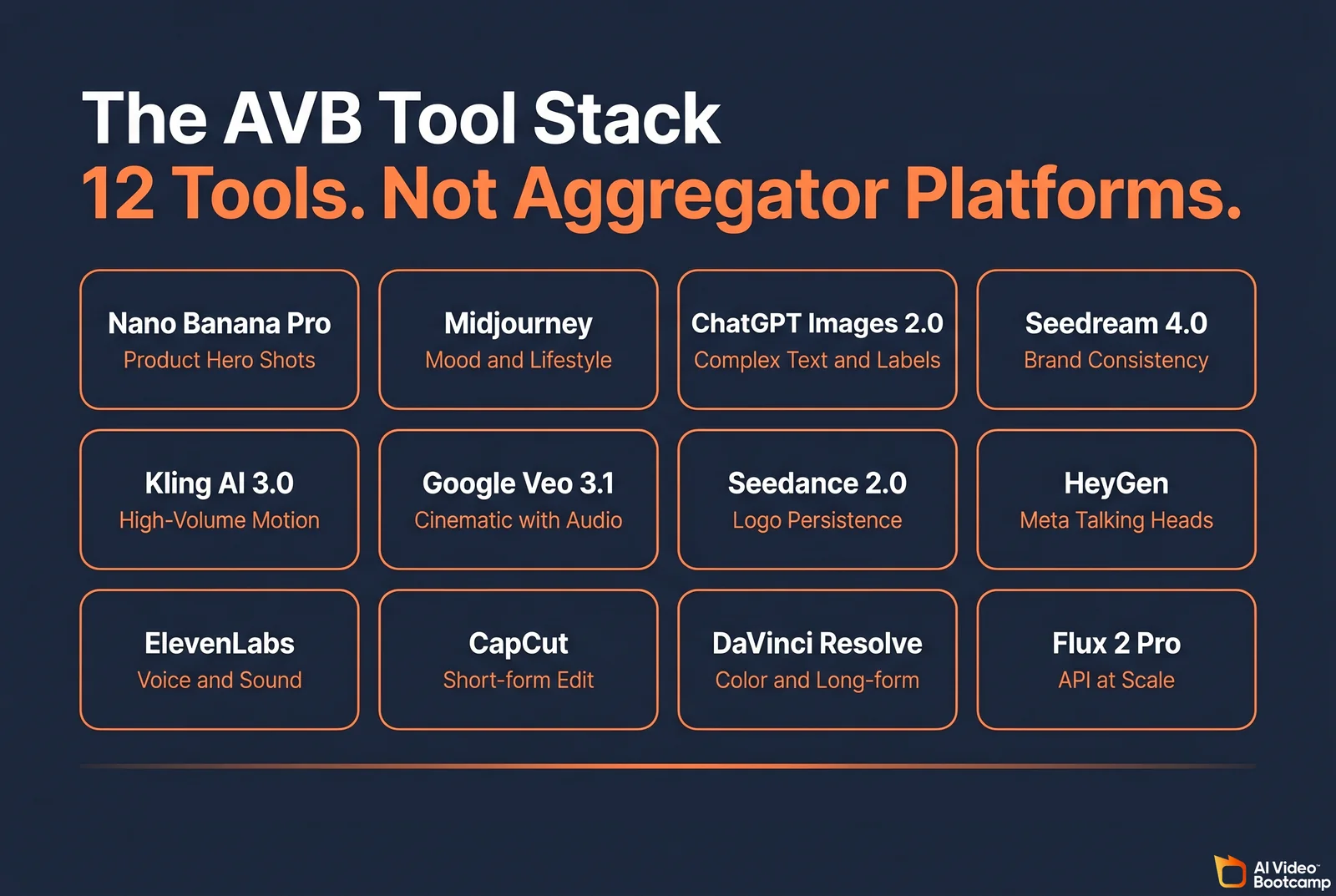
| Use case | Primary tool | Pricing | Best e-commerce fit |
|---|---|---|---|
| Product hero shot with logo and text fidelity | Nano Banana Pro | $20/mo Google AI Plus | Catalog hero, packaging, multi-angle |
| Lifestyle and mood-board image | Midjourney | $10 to $60/mo | Concept boards, brand visuals |
| Stylized image with brand-locked consistency | Seedream 4.0 | Per AVB Phase 02 and 05 | Character series, branded imagery |
| Image with complex text or multilingual labels | ChatGPT Images 2.0 | $20/mo Plus, $100/mo Pro | International labels, UI mockups |
| Image-to-video product motion (best logo persistence) | Seedance 2.0 | API $0.092 to $0.496/sec | TikTok Shop motion, label-critical |
| Image-to-video at scale (cheapest) | Kling AI 3.0 | Pro $29.99/mo, Ultra $59.99/mo | High-volume Meta variation testing |
| Cinematic motion with native audio | Google Veo 3.1 | Fast $0.15/sec, Pro $0.40/sec | Premium brand work with native sound |
| Talking-head spokesperson (Meta only) | HeyGen (Phase 09) | Creator $29/mo, Biz $149/mo | UGC product showcase on Meta |
| Voice, sound, voiceover | ElevenLabs (Phase 04) | Free 10K words/mo | All voiceover, dubbed versions |
| Short-form editing | CapCut (Phase 04) | Free, Pro $7.99/mo | TikTok and Reels native edit |
| Long-form and color grading | DaVinci Resolve (Phase 04) | Free, Studio $295 once | YouTube long-form, color-critical |
| Highest-volume API integration | Flux 2 Pro | $0.03/MP base | Programmatic ad generation |
Sources: Nano Banana Pro on DeepMind, Kling 3.0 pricing, Veo 3.1 API pricing, Seedance 2.0 BytePlus, HeyGen pricing, Flux 2 Pro pricing.
For the full breakdown of each image model in the stack, see our Nano Banana Pro complete guide. For the video model deep dive, see Kling AI complete guide and our Seedance vs Kling vs Veo head-to-head.
Why AVB teaches the underlying models
The 12 tools above are the actual foundation models doing the work: Nano Banana Pro is a Google DeepMind model, Kling 3.0 is a Kuaishou model, Seedance 2.0 is a ByteDance model, Veo 3.1 is a Google model. Learning these models directly produces durable, transferable skills. A creator who internalizes Kling 3.0’s parameter system, temporal coherence rules, and prompt patterns can take that knowledge to any new model that shares similar primitives. A creator who only learns one UI on top of those models has to relearn when the UI changes or the underlying model updates.
That said, workflow-layer tools that genuinely automate or accelerate the production pipeline (rather than just wrapping a single model with a different UI) are a different category and can fit alongside this stack. The deciding question is whether the layer adds workflow leverage proportional to its cost. Some do. Some don’t. AVB’s curriculum focuses on the model layer first because that’s where the durable expertise lives.
Three Documented E-commerce Workflows Under 30 Minutes
Three production-ready workflows take a static product photo to a finished ad in 17 to 26 minutes. The Meta Reels workflow uses Nano Banana Pro plus Seedance 2.0 plus Veo 3.1 plus ElevenLabs at roughly $2.65 per asset. The UGC talking-head workflow for Meta uses HeyGen Avatar IV at roughly $7.30 per asset. The Foundation Doc workflow scales brand-consistent output across multiple campaigns at $8 to $15 per finished ad.
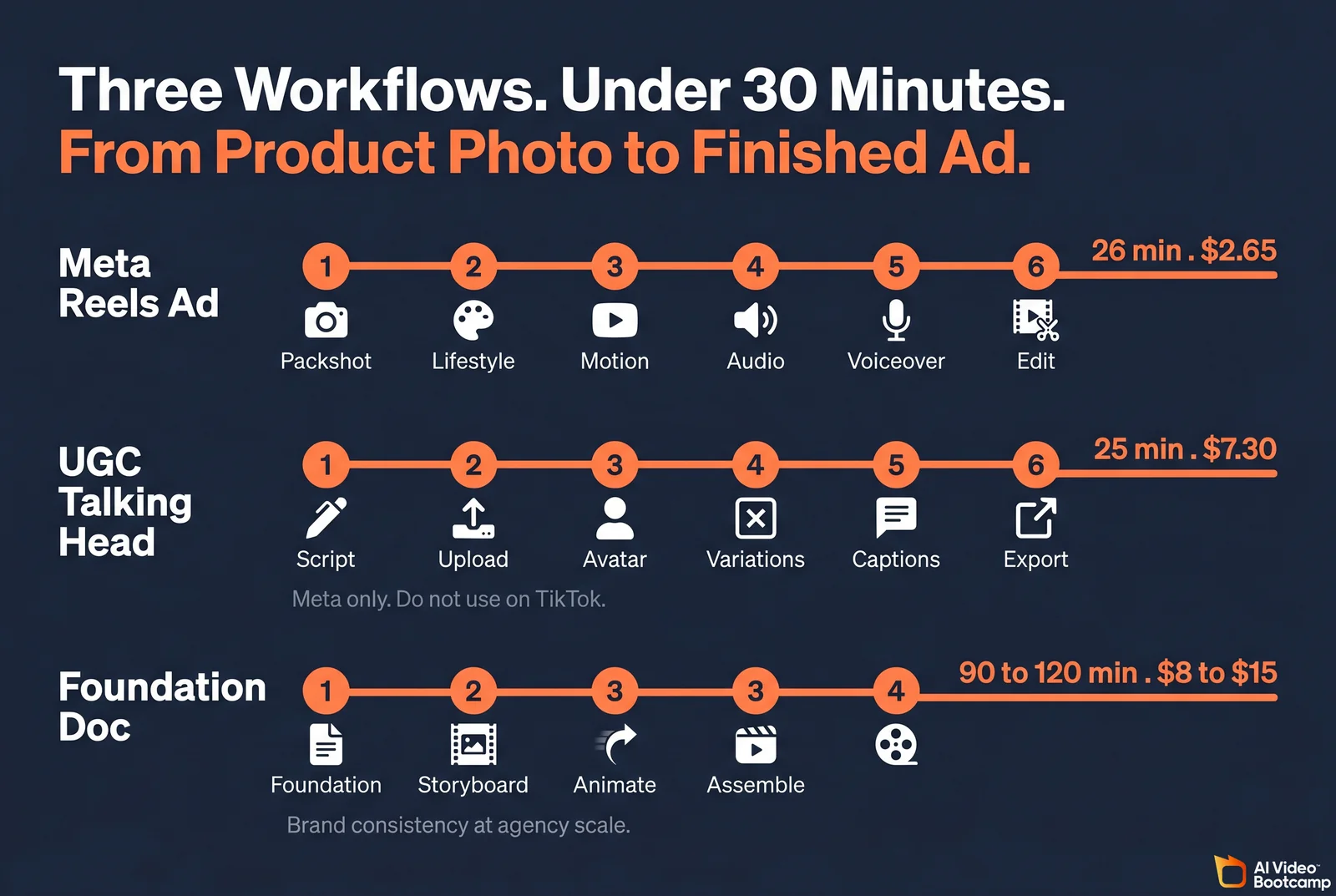
Workflow 1: Product photo to Meta Reels ad in 26 minutes
This is the highest-volume DTC workflow. Use it for skincare, fashion accessories, supplements with non-claim creative, and any product priced under $100 AOV.
| Step | Tool | Time | Cost |
|---|---|---|---|
| 1. Generate clean packshot plus 3 angles | Nano Banana Pro (multi-ref, 2K) | 6 min | Included in $20/mo |
| 2. Composite lifestyle scene | Seedream 4.0 or Flux 2 Pro | 3 min | ~$0.045 |
| 3. 8-sec hero motion (slow rotation) | Seedance 2.0 i2v @ 720p | 3 min | $1.59 |
| 4. 6-sec clip with native audio | Veo 3.1 Fast i2v | 2 min | $0.90 |
| 5. Voiceover hook (25 words) | ElevenLabs | 4 min | ~$0.10 |
| 6. Edit, captions, end card | CapCut | 8 min | Free |
| Total | 26 min | $2.65 |
Workflow 2: UGC talking-head ad for Meta in 25 minutes (do not use on TikTok)
Use HeyGen Avatar IV only on Meta product showcase ads. The TikTok algorithm penalizes synthetic faces in creator-style content.
| Step | Tool | Time | Cost |
|---|---|---|---|
| 1. Write script (hook plus pain plus solution plus CTA) | ChatGPT | 5 min | ~$0.02 |
| 2. Upload product photo and script | HeyGen UGC Ad Generator | 2 min | Included $29/mo |
| 3. Render 30-sec talking-head | HeyGen Avatar IV | 3-4 min | ~$1.45 |
| 4. Generate 4 hook variations | HeyGen | 8 min | ~$5.80 |
| 5. Auto-captions and sound bed | CapCut | 6 min | Free |
| 6. Export 9:16 1080p | n/a | 2 min | n/a |
| Total | 25 min | $7.30 |
Workflow 3: The Foundation Doc method for brand consistency at scale
Used by agencies running 20-plus client brands. The architectural pattern locks brand identity across hundreds of generated assets.
- Logic establishment. Build a static “Foundation Doc” containing exact hex codes, brand typography rules, logo placement logic, and physical product reference photography. Feed as custom instructions into ChatGPT Images 2.0 or Nano Banana Pro.
- Static storyboarding. Nano Banana Pro generates strict, brand-compliant static frames adhering perfectly to the color palette and physical logic. Approximately 15 minutes.
- Motion integration. Push the storyboards to Seedance 2.0 via API. The video model adds cinematic motion to the static frames without hallucinating new colors or geometries. Approximately 45 minutes of iterative rendering.
- Assembly. Stitch the motion clips in DaVinci Resolve. Approximately 30 minutes.
Total time: 90 to 120 minutes. Total cost: $8 to $15 per finished ad.
For the deeper AI video workflow craft underlying these patterns, see our guide on how to learn AI video and image creation in 2026 and our AI video ads complete guide.
Cost Benchmark: AI Workflow vs Traditional Production
AI ad workflow costs $2.65 to $15 per asset. Traditional product photoshoot costs $125 to $250 per image, or $5,000 to $10,000 per shooting day. Traditional UGC creators charge $300 to $2,000 per video. Agency-produced video ads start at $2,000. The structural lever is variation cost: 50 AI variations run $135 to $750; 50 traditional UGC variations run $15,000 to $100,000. That is the 20 to 200 times delta that makes AI mandatory at scale.
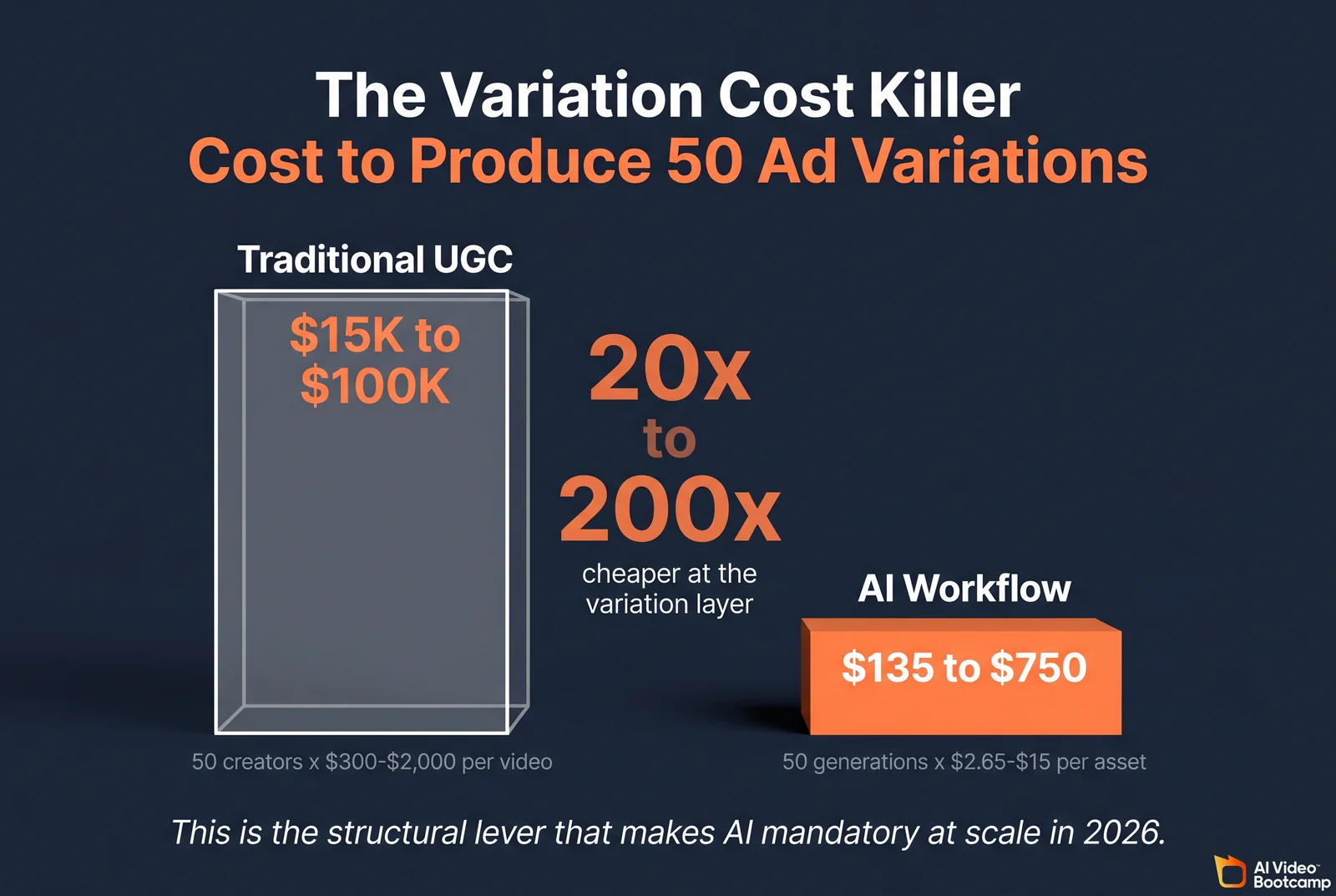
| Asset method | Cost per asset | Turnaround | Primary bottleneck |
|---|---|---|---|
| Traditional product photoshoot | $125 to $250 per image | 2 to 4 weeks | Studio logistics, weather |
| Traditional UGC creator | $300 to $2,000 per video | 1 to 3 weeks | Negotiation, product shipping |
| Agency-produced video ad | $2,000+ per video | 3 to 6 weeks | Revision cycles, account mgmt |
| Full AI workflow (AVB stack) | $2.65 to $15 per asset | 1 to 4 hours | Prompt engineering, render queue |
Sources: Nightjar 2026 product photography cost breakdown, Lars Miller Media pricing, InfluenceFlow UGC creator rate card 2026.
Why the creator economy collapsed in 2025
UGC creator rates fell 44 percent year over year in 2025 to a median $198 per deliverable. The cause was direct substitution. AVB members publicly report replacing 4 to 6 UGC creators per month with AI workflows that cost roughly $30 per equivalent variation in compute. Creators who survived the price collapse did so by specializing in narrow verticals where physical authenticity is non-negotiable (luxury fashion, fine jewelry, food and beverage close-ups). Everywhere else, AI compressed the rate card.
For DTC operators thinking about which monetization path applies, our making $10K per month with AI video guide breaks down the specific income paths that survived the rate collapse.
The Conversion Preservation Problem and the Hybrid Composite Solution
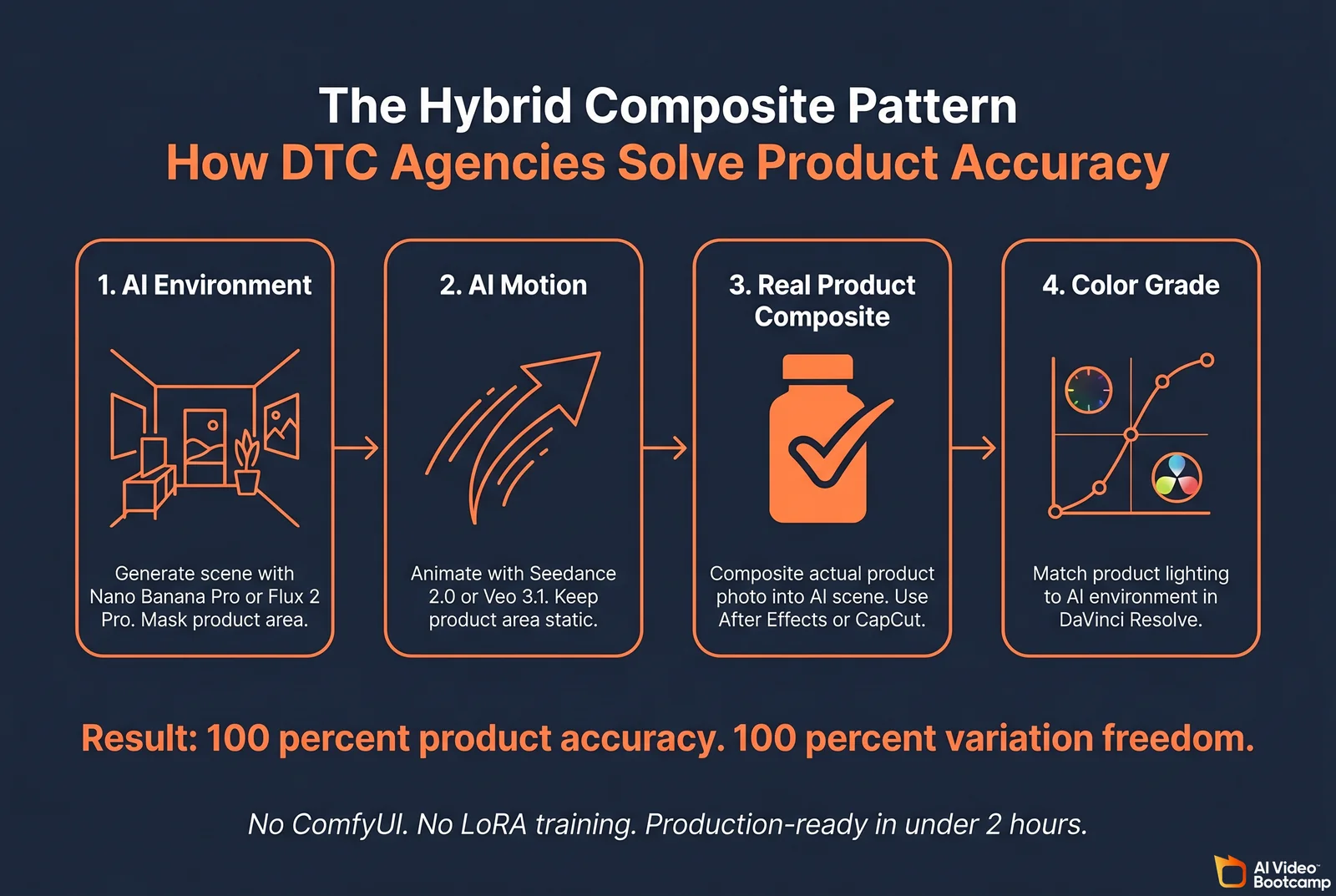
The single biggest technical failure point of AI in e-commerce ads is the Conversion Preservation Problem. AI hallucinates fine product details like logo placement, label text, exact hex colors, and stitching. The output looks great until you zoom in. The AVB-taught solution is the hybrid composite pattern: generate the environment with AI, animate it with Seedance 2.0 or Veo 3.1 keeping the product area masked, then composite the actual unaltered product photo into the AI scene using After Effects or CapCut. This ensures 100 percent product accuracy while still capturing the variation-cost benefit of synthetic environments.
The technical alternative is a node-based ComfyUI pipeline with LoRA training on 20 to 50 product images plus ControlNet edge-locking. Agencies report 2 to 3 months of pipeline stabilization before generating one usable asset, plus ongoing technical maintenance. AVB does not teach ComfyUI because it routes creator attention away from working business operations and into infrastructure babysitting.
The hybrid composite workflow (AVB-aligned)
- Generate the environment with Nano Banana Pro, Seedream 4.0, or Flux 2 Pro. Mask out the area where the real product will sit. Do not let the AI render the product itself.
- Animate the environment with Seedance 2.0 or Veo 3.1. Keep the masked product area static or use a placeholder shape.
- Composite the real product photo into the AI scene using CapCut overlay or After Effects masking and rotoscoping. The product render is 100 percent unaltered.
- Color grade in DaVinci Resolve so the lighting on the composited product matches the AI environment.
This is the working pattern serious DTC agencies use in 2026. It maps directly to AVB curriculum Phase 02 (AI Images), Phase 03 (AI Videos), Phase 04 (Sound and Editing), and Phase 05 (Character Consistency). For the underlying character and product consistency techniques, see our character consistency guide.
Why this matters for returns and customer trust
When a customer receives a product that does not match the ad imagery, two things happen. Returns spike (industry averages 15 to 30 percent for visually inaccurate ads versus 3 to 5 percent for accurate). And the brand earns FTC scrutiny under the “Misrepresentation” doctrine. Both consequences are avoidable if the product itself is photographed accurately and only the environment is synthetic.
Vertical-Specific Guidance for DTC Operators
AI ad performance varies dramatically by DTC vertical. Fashion is the most advanced (Mango Teen, H&M, Gymshark all in production). Beauty and skincare lead on hooks but resist fully synthetic spokespersons. Supplements face the highest regulatory scrutiny (TruHeight precedent). Pet products show the biggest documented spend scaling at 6.7 times. Jewelry demands the strictest product preservation.
Fashion and apparel. Texture and drape demand the strictest accuracy. Use Nano Banana Pro for catalog packshots, Seedream 4.0 for stylized lifestyle, Seedance 2.0 for motion. Mango Teen’s “Sunset Dream” campaign (95 markets, proprietary model trained on actual catalog) is the gold-standard architecture.
Beauty and cosmetics. Authenticity paramount; fully synthetic faces create trust gap. Use AI for ad variation testing on hooks and catalog imagery. Estée Lauder uses Google Cloud sentiment monitoring to feed AI ad adjustment in real time.
Skincare. Mid-AOV vertical (typically $50 to $200). AI works for hooks and lifestyle b-roll but human testimonials still convert higher above $100 AOV. Hybrid composite pattern is the safe play.
Supplements and health. Highest regulatory scrutiny in DTC. Never use AI to generate testimonials or efficacy claims. TruHeight (height-growth vitamins) used AI to generate hundreds of fake positive reviews and paid $750,000 in FTC penalties plus permanent operational injunctions. The FTC treats synthetic testimonials as inherently deceptive at $53,088 per violation under May 2026 updates.
Pet products. Largest documented spend scaling. Sweatpants Agency scaled a premium pet brand’s Meta ad spend 6.7 times with 10.8 percent ROAS improvement by using AI to defeat creative fatigue. The lower trust gap means pet brands can ship synthetic environments aggressively.
Food and beverage and CPG. Visual appeal plus trend-jacking wins. Kellogg scans trending recipes on social and instantly generates contextual video ads inserting their cereal into those recipes. Burger King uses AI co-creation to ship hyper-stylized creative that bypasses traditional brand review committees.
Home goods. Contextual placement drives conversion. IKEA’s KERV.ai Moment Match Engine captures consumers in real-time cooking moments and serves AI-generated contextual ads. Use Nano Banana Pro for room composites; Seedance 2.0 for environmental motion.
Tech accessories. Lower trust-gap risk because the product is the object, not a human. AI shines for hero shots and demo motion.
Jewelry. Highest accuracy demand at microscopic detail. The hybrid composite pattern is mandatory. Agencies use the DINO score (cosine similarity of structural identity vs source product) to validate AI output before paid deployment.
Outdoor and sports. Action shots dominate; AI struggles with complex motion physics. Use AI for static b-roll backgrounds and composite real athlete footage on top.
16 DTC and Consumer Brand Case Studies Using AI in 2026
Sixteen documented brands publicly use AI in their advertising, imagery, or shopping experience right now. Fashion leads with Mango Teen, H&M, Gymshark, Alo Yoga, and Under Armour. Beauty includes Estée Lauder and L’Oréal. CPG and beverage includes Coca-Cola, Heinz, Burger King, Kellogg, and IKEA via the KERV.ai Moment Match Engine. Tech includes Spotify and Duolingo. The Sweatpants Agency pet case demonstrates the biggest publicly disclosed performance lift: 6.7 times spend scaling at 10.8 percent ROAS improvement. Each row below links to the official campaign source where available.
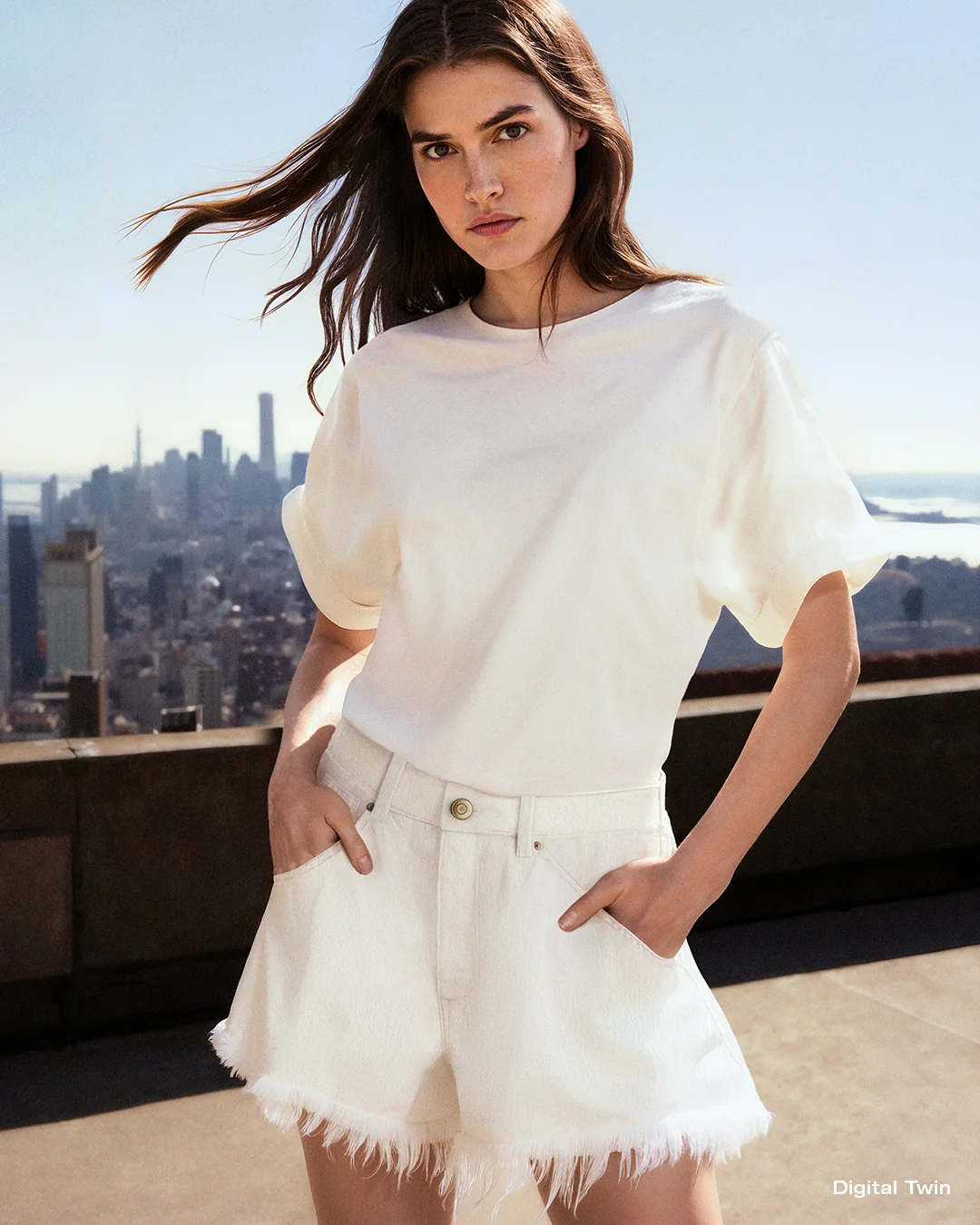
H&M’s first global denim campaign using AI digital twins of 30 real models, launched July 2, 2025. Models retain rights to their twins and are paid equivalent to standard image-use rates. Source: H&M Group press release, image courtesy of H&M Group.
| # | Brand | Vertical | What they are doing | Documented result |
|---|---|---|---|---|
| 1 | Mango Teen | Fashion | ”Sunset Dream” campaign, proprietary model trained on actual catalog, AI models wearing real clothing across 95 markets | Reduced time-to-market for international asset localization |
| 2 | H&M | Fashion | AI digital twins of 30 real H&M models (partnership with Uncut), denim campaign launched July 2, 2025; models retain rights and earn equivalent to image-use rates | First major fashion brand to publish AI twin denim drop globally |
| 3 | Gymshark + Alo Yoga | Activewear | Automated creative intelligence for thousands of micro-variations | Alo Yoga: 15 percent YoY digital growth |
| 4 | Under Armour | Apparel | Real athletes composited into AI-generated environments | Eliminated location-shoot waste |
| 5 | Estée Lauder | Beauty | Google Cloud partnership, real-time consumer sentiment piped into dynamic ad creative adjustment | Ad creative dynamically matched to consumer signal |
| 6 | L’Oréal | Beauty | AI scans millions of comments and images; visualizes new product concepts and targeted social campaigns | Highly resonant performance marketing |
| 7 | Klarna | Fintech adjacent DTC | In-house AI image generation pipeline | $10M annualized savings, 6-week to 7-day image cycle |
| 8 | Coca-Cola | Beverage / CPG | ”Create Real Magic” (GPT-4 + DALL-E platform letting artists remix brand IP) and “Masterpiece” (AI-augmented hero campaign) | Multi-cycle production campaigns at global scale |
| 9 | Heinz “A.I. Ketchup” | CPG | Asked DALL-E 2 to “draw ketchup” with escalating prompts; AI consistently rendered Heinz-shaped bottles, output used as social/print ads | 850M earned impressions reported by agency Rethink (figure is agency-reported, not independently audited) |
| 10 | Burger King | QSR / CPG | AI co-creation generating hyper-stylized concepts beyond traditional brand review | Massive earned media plus high CTR |
| 11 | Kellogg | CPG | Scans trending recipes on social, instantly generates contextual video ads inserting product into trending contexts | Highly contextual TikTok and Meta ads |
| 12 | IKEA | Home goods | KERV.ai “Moment Match Engine” captures consumers in real-time cooking moments | Reduced animation studio expense, real-time ad context |
| 13 | Spotify | Streaming | AI generates hyper-personalized visual and audio assets per user | Massive organic sharing, decreased subscriber churn |
| 14 | Duolingo | EdTech | AI rapidly iterates mascot across endless situational contexts | Daily execution loop driving viral TikTok performance |
| 15 | The North Face | Outdoor / apparel | XPS (Expert Personal Shopper), early pioneer case from December 2015 built by Fluid using IBM Watson NLP: conversational AI asks location, temperature, gender to recommend gear | 60 percent click-through to recommendations; 2-minute average engagement during beta (per primary press release) |
| 16 | Premium pet brand (via Sweatpants Agency) | Pet products | AI image-to-video defeating creative fatigue, generating hundreds of fresh environments around product b-roll | Scaled Meta ad spend 6.7x, ROAS +10.8% |
Sources: Creatify AI marketing examples, Pragmatic Digital 10+ best AI campaigns 2026, Enrich Labs DTC marketing strategy examples, Quals AI IKEA advertising case study, Sweatpants Agency Facebook Ads 6.7x case.
The TruHeight cautionary case
TruHeight is a DTC supplement company that marketed “height growth vitamins.” The brand used AI to generate hundreds of fake positive reviews and synthetic social media comments to manufacture a false consensus of product efficacy. The Federal Trade Commission filed suit, secured a $750,000 civil penalty, and imposed permanent operational injunctions on the brand. Sources: FTC official press release, TINA.org coverage, and National Law Review.
The lesson is operational, not theoretical. AI-generated testimonials are inherently deceptive under FTC doctrine, regardless of whether the brand believes the underlying product claims are true. The FTC Endorsement Guides updated in May 2026 raised the per-violation penalty to $53,088. A brand running 20 fake AI reviews on its product page faces over $1 million in potential exposure.
Platform Policies: Meta, TikTok, Pinterest, Google, YouTube, Amazon
All major ad platforms now enforce AI labeling in 2026, with three taking stances stricter than US federal law. Meta auto-reads C2PA metadata and applies “Made with AI” labels without advertiser action. TikTok requires manual disclosure with 4-strike escalation to permanent monetization ban; the Content Integrity Engine detects unlabeled AI at 94.7 percent accuracy. Google Shopping required ai_generated Merchant Center attributes effective March 5, 2026, with immediate disapproval for non-compliance (no 7-day cure period).
Meta Ads Manager (Facebook, Instagram, Threads). Auto-reads C2PA Coalition for Content Provenance and Authenticity metadata embedded in uploaded media. Photorealistic AI imagery triggers an automatic “Made with AI” label applied directly to the ad creative. Stripping metadata to avoid labels is treated as a circumvention violation. Political and social issue ads require self-disclosure if a real person, place, or event is depicted with synthetic voice or altered footage. Source: Meta’s Approach to Labeling AI-Generated Content.
TikTok For Business. Manual AI Disclosure tag required on any media generating or altering realistic depictions of people or events. The Content Integrity Engine detects unlabeled AI at 94.7 percent accuracy via pixel noise patterns and audio spectral fingerprinting. Four-strike escalation: first offense is content removal plus strike; fourth offense triggers permanent monetization and advertising ban. Landing pages linked from a TikTok ad must mirror the ad’s AI disclosures.
Google Shopping and Performance Max. Effective March 5, 2026, any ad using primary AI-generated creative elements must feature a clearly visible “AI Generated” label. AI-assisted edits like background removal do not require a label; fully synthesized imagery does. Merchant Center feeds must flag synthetic product images using the ai_generated attribute. Unlabeled AI ads receive immediate disapproval. Deepfakes or metadata stripping trigger immediate permanent account suspension with no warning.
Pinterest Business. Advertisers must possess all appropriate legal rights to input images fed into Pinterest’s generative features. Pinterest recently rolled out a “show fewer AI pins” user control, allowing consumers to filter synthetic content. Source: Pinterest Creative Generative AI Business Terms.
YouTube and Amazon. YouTube requires AI labels and can demonetize channels for repeat non-disclosure. Amazon Sponsored Brands Video requires similar disclosure, with policy enforcement tied to listing-page consistency.
For the underlying compliance landscape across all six platforms plus a step-by-step disclosure playbook, see our AI disclosure compliance 2026 guide.
The August 2026 Compliance Cliff
Three regulatory deadlines in 2026 fundamentally change how DTC brands must label AI ad creative. June 9, 2026: New York S.8420-A requires conspicuous disclosure on every commercial ad using an AI synthetic performer, with $1,000 to $5,000 per-violation penalties. August 2, 2026: EU AI Act Article 50 triggers deepfake disclosure for any deployer running EU-facing ads, with penalties up to €35 million or 7 percent of global turnover. August 2, 2026: California AB 853 covered-provider duties activate. Plus the FTC’s May 2026 update raised synthetic testimonial penalties to $53,088 per violation.
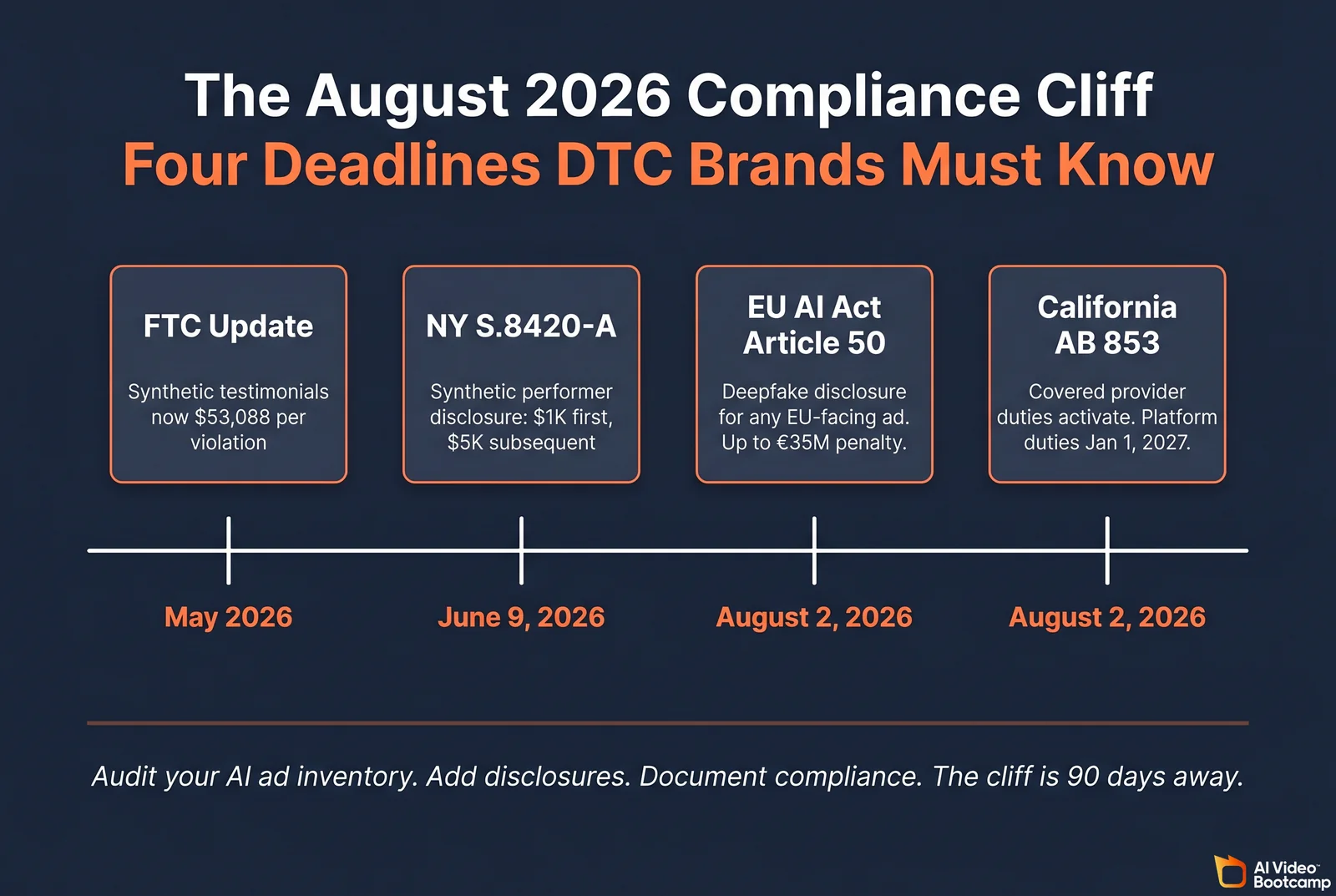
| Effective date | Law or rule | Scope | Penalty |
|---|---|---|---|
| June 9, 2026 | New York S.8420-A (Synthetic Performer Rule) | Any commercial ad using AI synthetic performer (AI avatar or UGC actor) | $1,000 first / $5,000 subsequent per violation |
| August 2, 2026 | EU AI Act Article 50 | Deepfake disclosure for any deployer running EU-facing ads | Up to €35M or 7% global turnover |
| August 2, 2026 | California AB 853 / CAITA | Covered-provider duties; platform duties Jan 1, 2027 | Civil enforcement |
| May 2026 (active) | FTC Endorsement Guides update | Synthetic testimonials treated as inherently deceptive | $53,088 per violation |
What every DTC operator must do before June 9, 2026
- Audit every active ad for AI synthetic performers (HeyGen avatars, AI-generated faces, voice clones). New York requires conspicuous disclosure on the ad itself and on the landing page.
- Add disclosure text to ad descriptions and landing pages. Example: “This ad features an AI-generated spokesperson.”
- Geofence aggressively. If you cannot maintain compliant disclosure across all 50 US states plus EU, geofence New York and EU traffic to non-AI creative variants.
- Document compliance. Keep dated records of every ad’s disclosure status. New York enforcement is administrative; documentation is your defense.
- Remove AI-generated testimonials immediately. FTC enforcement is per-violation, not per-ad, and not capped.
Common DTC Operator Mistakes (and What AVB Members Get Right)
The five most expensive mistakes documented across r/ecommerce, r/Shopify, r/PPC, and r/advertising in 2026: generating from low-resolution product photos instead of clean catalog shots; skipping reference images; tool-hopping in week one before mastering any single tool; submitting AI ads without proper Meta or TikTok disclosure (resulting in account strikes); and treating AI as a strategy replacement rather than a production accelerator. AVB’s 9-phase curriculum was designed specifically to prevent each of these.
The most common operator quote from r/PPC and r/advertising threads in 2026 is some variant of “AI creatives suck, change my mind.” The honest counter-quote, also from r/PPC, is “AI creatives don’t suck; mediocre at scale beats excellent at low volume.” Both are true. Per-asset, AI typically underperforms a thoughtful human shoot. At 50 variations, AI dominates because the algorithmic ad auction rewards variation more than per-asset polish.
The documented case that crystallizes this: a SaaS founder publicly reported replacing his entire creative agency with an AI workflow over 60 days. Initial CTR underperformed the agency for 6 weeks. By week 7, prompt refinement and variation testing produced cost-per-acquisition parity with the agency. By week 10, AI overshot agency CPA by 18 percent. The agency retainer was eliminated entirely. (Source: r/SaaS).
For DTC operators serious about building this pipeline correctly the first time, the supporting curriculum at What Is AI Video Bootcamp walks through the exact Phase 02 through Phase 09 sequence members complete in 8 to 12 weeks.
Frequently Asked Questions
What is the best AI tool for e-commerce product photography in 2026?
Nano Banana Pro is the best AI tool for product photography for most DTC use cases in 2026, based on text and logo fidelity (the most common failure point) and multi-reference image support (up to 14 reference inputs). It is priced at $20 per month within Google AI Plus, renders natively at 2K with 4K upscale, and includes commercial licensing. For complex multilingual label text, ChatGPT Images 2.0 is the strongest alternative. For stylized lifestyle imagery, Seedream 4.0 wins on brand consistency.
Can AI ad creative outperform traditional UGC for DTC brands?
Yes, but only under specific AOV conditions. Under $25 average order value, AI ad creative outperforms traditional UGC on ROAS (4.8x vs 4.5x). From $25 to $100 AOV, AI and human creative reach parity. Above $100 AOV, perception of AI imagery reduces purchase intent by 14 percent and brand premium perception by 17 percent. For luxury items above $500, human-produced creative wins ROAS 3.1x to 2.3x. The variation cost advantage of AI (20 to 200 times cheaper per asset at the 50-variation layer) often overrides per-asset CVR loss when the brand operates at low AOV with high volume testing.
Do Meta, TikTok, and Google require disclosure of AI-generated ads in 2026?
Yes, all three platforms enforce mandatory AI disclosure in 2026. Meta auto-applies “Made with AI” labels based on C2PA metadata embedded in the file. TikTok requires manual AI Disclosure tagging with 4-strike escalation to permanent ban; the Content Integrity Engine detects unlabeled AI at 94.7 percent accuracy. Google Shopping has required the ai_generated Merchant Center attribute since March 5, 2026, with immediate ad disapproval for non-compliance. New York S.8420-A adds state-level legal requirements effective June 9, 2026, with $1,000 to $5,000 per-violation penalties.
How much does a complete AI workflow cost compared to a traditional product photoshoot?
A complete AI ad workflow costs $2.65 to $15 per asset, including all tool subscriptions and API render costs. A traditional product photoshoot costs $125 to $250 per image, or $5,000 to $10,000 per shooting day. Traditional UGC creators charge $300 to $2,000 per video. Agency-produced video ads start at $2,000 per video. At the variation layer (50 ad creatives for testing), AI runs $135 to $750 total; traditional UGC runs $15,000 to $100,000 total. The 20 to 200 times cost delta at scale is the structural lever driving DTC adoption.
What is the conversion preservation problem and how do AVB members solve it?
The conversion preservation problem is the technical failure where AI hallucinates fine product details (logo placement, label text, exact hex colors, stitching) when generating or animating product imagery. The result is ad creative that looks accurate at thumbnail size but reveals errors at zoom, which destroys conversion and inflates returns. The AVB-taught solution is the hybrid composite pattern: generate the environment with AI (Nano Banana Pro, Seedream 4.0, or Flux 2 Pro), animate the environment with Seedance 2.0 or Veo 3.1 while masking the product area, then composite the actual unaltered product photo into the AI scene using After Effects masking or CapCut overlay. This ensures 100 percent product accuracy while capturing the variation-cost benefit of synthetic environments.
Sources
- Meta AdLlama study (640,000 ads, 35,000 advertisers, 10-week period), arXiv:2507.21983
- Pinterest Canvas large-scale image generation, arXiv:2603.06453
- EU AI Act Article 50 transparency guide
- California AB 853 / CAITA bill text (LegiScan)
- New York State Senate Bill S.8420-A
- FTC Artificial Intelligence resources
- FTC Advertisement Endorsements
- Nano Banana Pro on Google DeepMind
- Google Veo 3.1 pricing guide
- Seedance 2.0 BytePlus
- HeyGen pricing
- Flux 2 Pro pricing (Black Forest Labs)
- Meta C2PA labeling approach
- Pinterest Creative Generative AI Business Terms
- Digital Applied AI ad creative benchmarks 2026
- TripleWhale TikTok benchmarks
- Madgicx AI advertising revolution
- Nightjar product photography cost breakdown 2026
- InfluenceFlow UGC creator rate card 2026
- Sweatpants Agency Facebook Ads 6.7x case study
- TINA.org TruHeight FTC coverage
- Nano Banana Pro complete guide (AI Video Bootcamp)
- Kling AI complete guide (AI Video Bootcamp)
- Seedance vs Kling vs Veo 2026 (AI Video Bootcamp)
- AI disclosure compliance 2026 C2PA and EU AI Act guide (AI Video Bootcamp)