
What This Article Delivers (Answer Capsule)
Seedance 2.0 Mini launched June 15, 2026 at exactly 50% of the flagship Seedance 2.0 list price on BytePlus ModelArk ($3.5 per million tokens text-to-video versus $7.0). Mini keeps the full multimodal reference suite (image, video, audio) plus native synchronized audio output. The trade-off is a 720p ceiling with no 1080p. ByteDance now ships a three-tier Seedance 2.0 family that all coexist: Standard, Fast, Mini. Mini is testable today on the BytePlus AI Playground with a concurrency cap of 1. General API access opens June 22, 2026. Best fit: high-volume A/B testing, vertical social formats, drafts, and any workflow where 720p is sufficient.
What ByteDance Just Shipped
Seedance 2.0 Mini went live on June 15, 2026 at 07:41 UTC, surfacing first on BytePlus (the ByteDance enterprise cloud) and on the Dreamina consumer editor inside CapCut. The canonical model slug is dreamina-seedance-2-0-mini-260615, where 260615 is the YYMMDD release stamp. The family pattern: dreamina-seedance-2-0-260128 for Standard (released January 28, 2026), dreamina-seedance-2-0-fast-260128 for Fast, plus the new Mini slug.
Mini is a third coexisting tier inside the Dreamina Seedance 2.0 series, not a Fast replacement. All three tiers run in parallel on ModelArk and inside Dreamina. The BytePlus announcement framed Mini as “a faster, more accessible way to create videos from image, video, and audio references” priced at “about 50% of Seedance 2.0’s list price.” That framing is confirmed on the published ModelArk pricing page.
Mini inherits the same prompt grammar, reference syntax, and dual-branch audio-video architecture as the flagship. The Seedance 2.0 complete guide covers the omni-reference system, the JSON-inside-prompt convention, and benchmark wins against Veo 3.1 and Kling 3.0 Master. The two architectural differences on Mini are the resolution ceiling and a slightly trimmed reference slot count on Dreamina. The 23,000-creator AI Video Bootcamp community is testing Mini today via the BytePlus playground.
The 50% Pricing Math, Confirmed
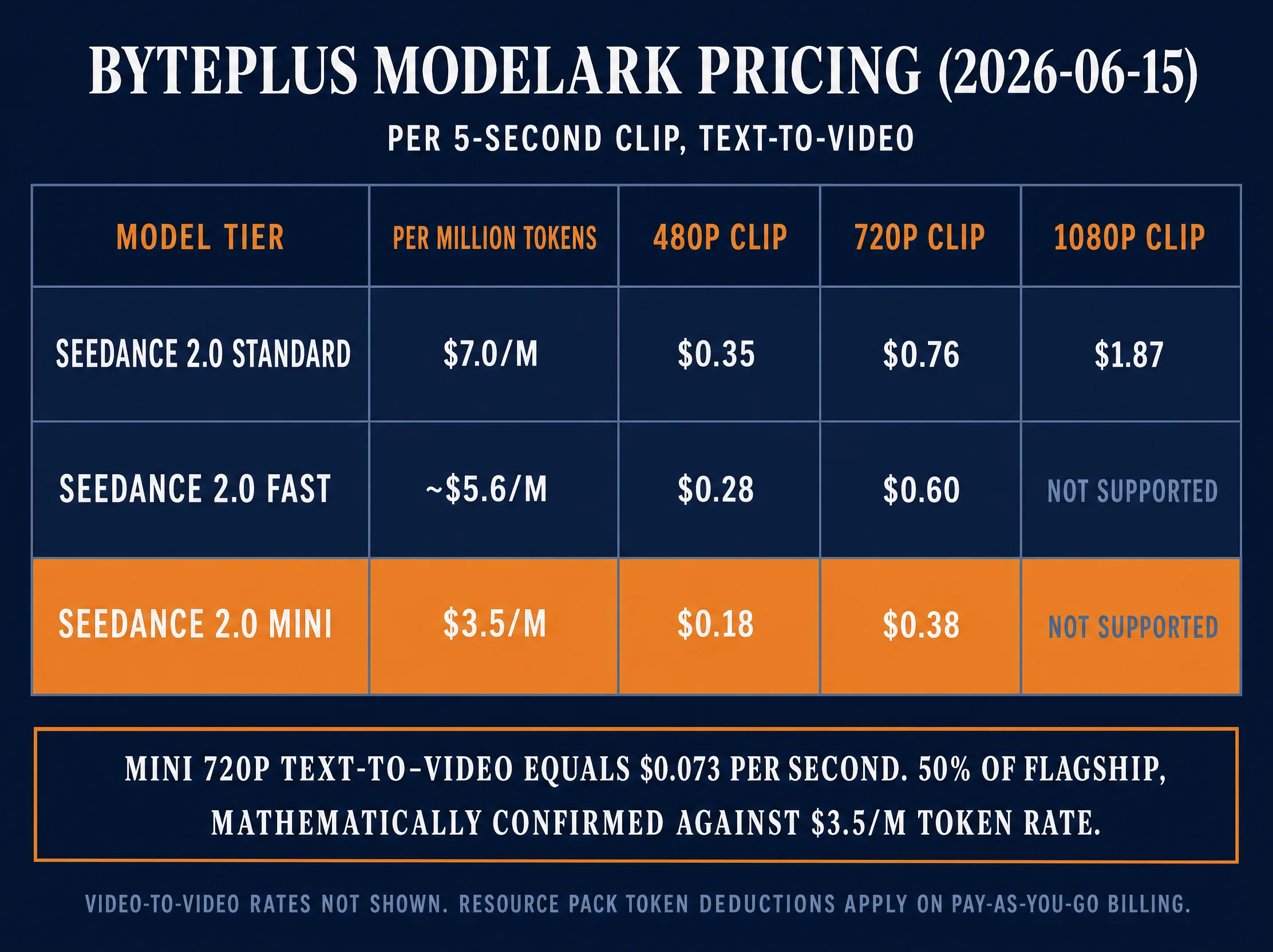
The 50% claim maps directly onto the published BytePlus ModelArk pricing table.
| Tier | Text-to-video (480p/720p) | Video-to-video | 1080p? |
|---|---|---|---|
| Seedance 2.0 Standard | $7.0 per million tokens | $4.3 per million tokens | Yes |
| Seedance 2.0 Fast | ~20% below flagship | ~20% below flagship | No |
| Seedance 2.0 Mini | $3.5 per million tokens | $2.1 per million tokens | No |
Mini’s $3.5 rate is exactly half of the $7.0 Standard rate; video-to-video is 51% off. BytePlus uses per-token billing: tokens = ((input_duration + output_duration) × width × height × frame_rate) / 1024. Applied to a 5-second 720p clip at 24 fps:
| Resolution | Mini text-to-video per 5-sec clip | Mini video-to-video per 5-sec clip |
|---|---|---|
| 480p | $0.18 | $0.19 to $0.42 |
| 720p | $0.38 | $0.41 to $0.91 |
| 1080p | Not supported | Not supported |
The widely-cited “$0.073 per second” figure comes from applying the $3.5 rate to the formula at 720p / 24 fps. For context, the AI Video Bootcamp canonical reference is fal.ai, where Seedance 2.0 Standard lists at $0.3034 per second at 720p. fal.ai is a routing intermediary with its own markup; the BytePlus direct rate runs lower. When fal.ai lists Mini, expect a per-second rate above $0.073. The two surfaces are not directly comparable.
Two billing mechanics matter. Resource packs sell in 1M, 10M, and 100M token increments with 90-day validity; prepaid tokens deduct before pay-as-you-go. Text-to-video at 480p and 720p uses a 1.6279x token deduction ratio against prepaid packs (compensating for higher zero-shot compute cost). On Dreamina, Mini runs ~180 credits per generation versus 255 for the flagship; a 720p 5-second clip is about 60 credits.
The Three-Tier Family (Standard + Fast + Mini)
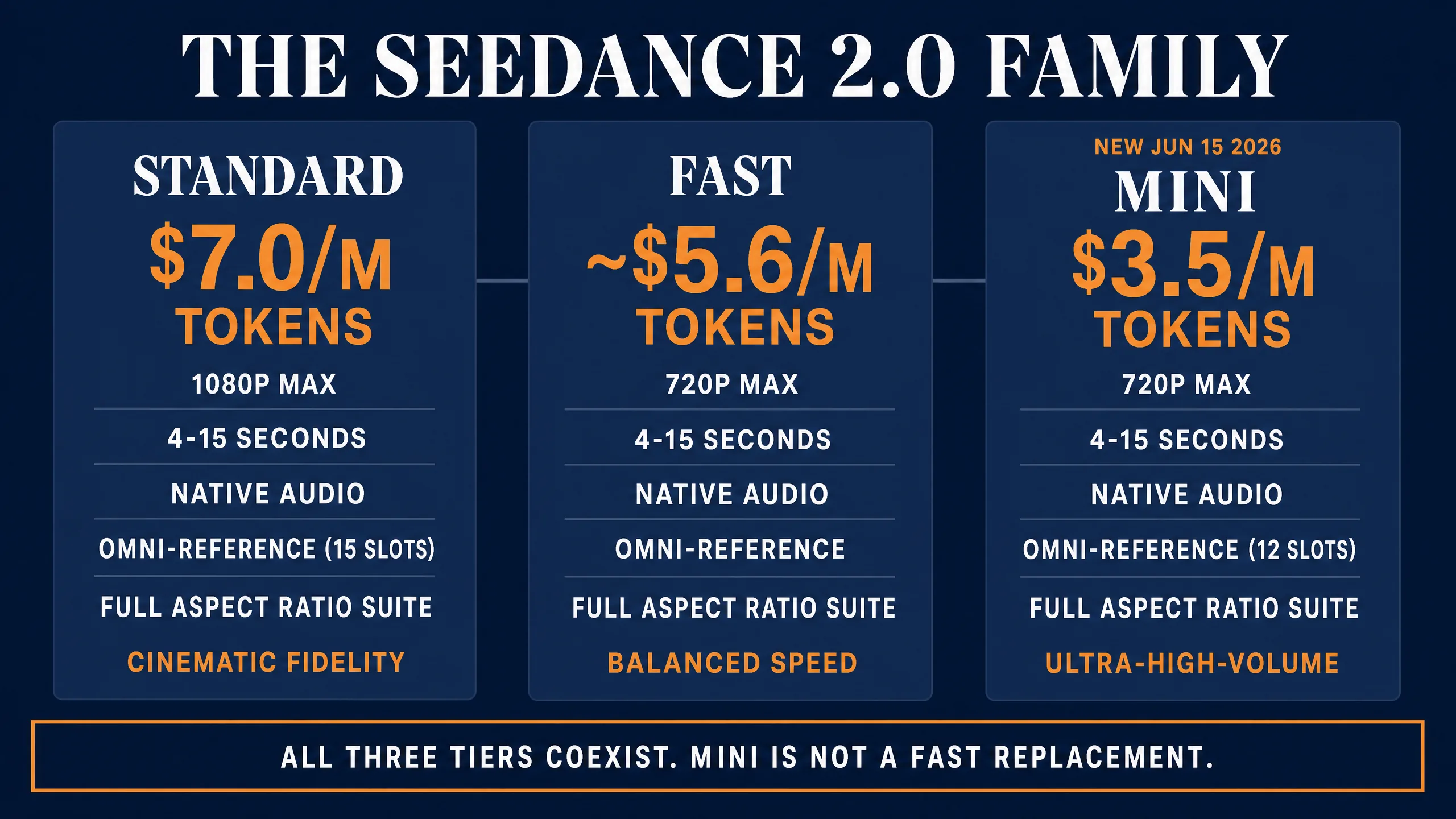
ByteDance kept all three Seedance 2.0 tiers running. Mini is not a Fast deprecation, and Fast is not being absorbed.
Standard (dreamina-seedance-2-0-260128) is the cinematic flagship. Full 1080p via upscale, premium fidelity, strongest performance on complex physics and multi-subject scenes. $7.0 per million tokens. For hero shots and final client deliverables.
Fast (dreamina-seedance-2-0-fast-260128) runs ~20% below Standard. No 1080p. Optimized for low-latency inference at near-flagship quality. For operators with established Fast API integrations.
Mini (dreamina-seedance-2-0-mini-260615) is the ultra-high-volume option. 50% of Standard. No 1080p. Same omni-reference and native audio as the flagship, lower compute ceiling. For A/B testing, drafts, storyboards, and vertical social.
A typical workflow now: Mini for 20 to 40 draft variations during brainstorm, Fast for 4 to 6 refined versions in review, Standard for the 1 to 2 final hero shots. The three-tier family lets operators compose that pipeline inside one model family with shared prompt grammar, instead of bridging across vendors mid-project.
Specs vs Flagship: What Mini Keeps and What It Cuts
| Spec | Flagship | Mini |
|---|---|---|
| Resolution | 480p, 720p, 1080p via upscale | 480p and 720p only |
| Clip duration | 4 to 15 seconds | 4 to 15 seconds |
| Aspect ratios | 21:9, 16:9, 4:3, 1:1, 3:4, 9:16 | Same |
| Output format | mp4 | mp4 |
| Native synchronized audio | Yes | Yes ("generate_audio": "true") |
| Multimodal references | Image + video + audio | Image + video + audio |
| Dreamina reference slots | 15 (9 img + 3 video + 3 audio) | 12 (6 img + 3 video + 3 audio) |
| ModelArk API hard slot limit | Documented | TBD until June 22 |
| Trial concurrency | Standard commercial | 1 at a time (June 15 to 22) |
| IP indemnification | None | None |
| Price (text-to-video) | $7.0 per million tokens | $3.5 per million tokens |
The two consequential cuts are 1080p removal and the slot trim on Dreamina. If a deliverable needs 1080p native, Mini is not the tool. The ModelArk API hard slot limit for Mini is not yet codified; treat the ceiling as TBD until general access opens June 22. Everything else carries over: full aspect ratio suite, 4 to 15 second duration, mp4 output, and native synchronized audio. Most budget-tier models drop native audio or stitch it in post; Mini ships synchronized audio at generation time through the same dual-branch architecture as the flagship.
Multimodal References and Native Audio Synthesis
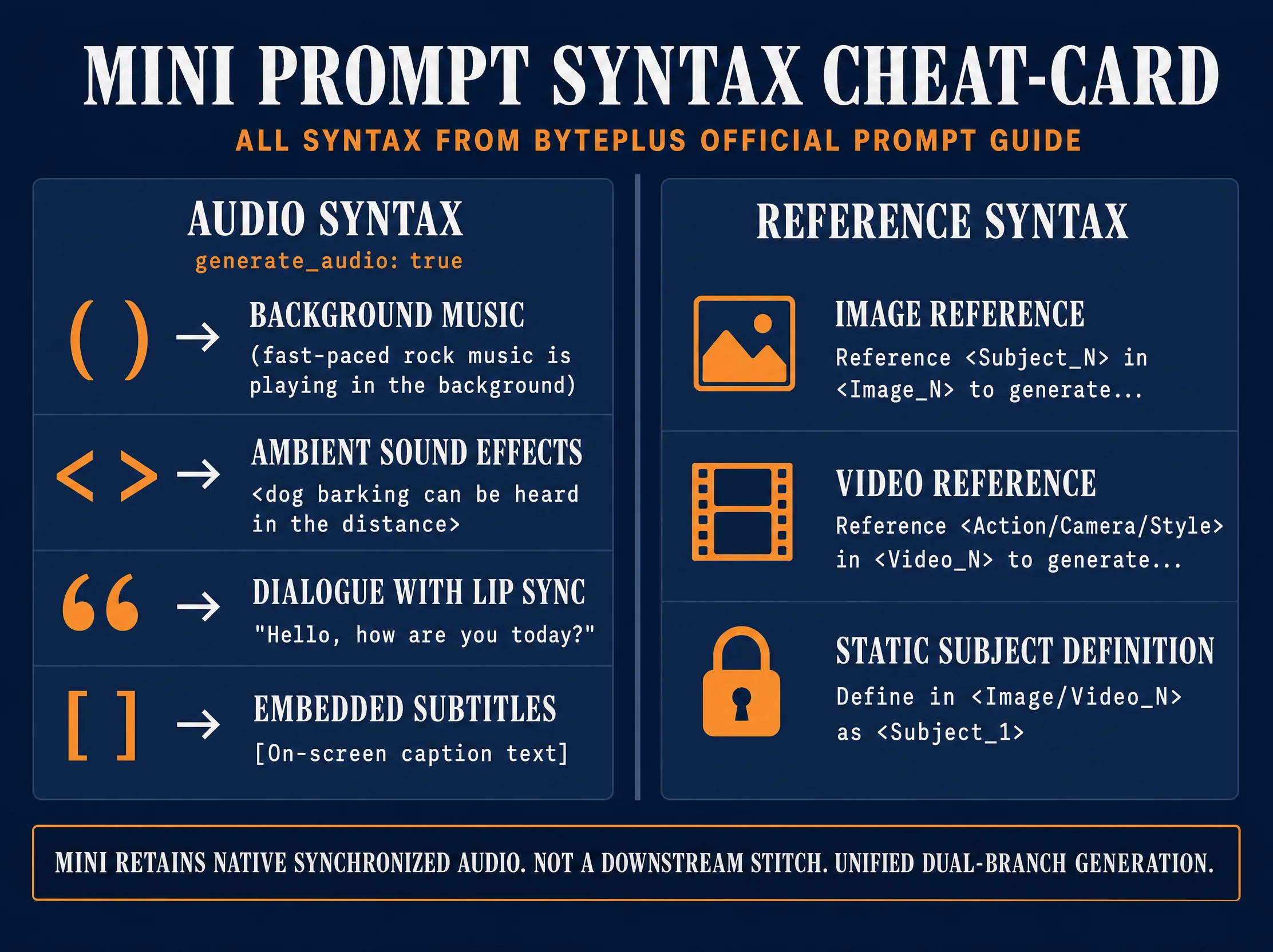
Mini inherits the full omni-reference architecture. Operators inject reference images, video clips, and audio into the same prompt and get a single coherent output. Images anchor subject identity, video clips anchor action and camera motion, audio anchors the music or ambient bed.
The BytePlus prompt guide documents three reference syntax patterns:
- Image:
Reference <Subject_N> in <Image_N> to generate... - Video:
Reference <Action/Camera_movement/Style> in <Video_N> to generate... - Static subject definition:
Define in <Image/Video_N> as <Subject_1>
For native audio output, Mini uses four bracket symbols inside the prompt:
()for background music. Example:(fast-paced rock music is playing in the background)<>for ambient and physics-based sound effects. Example:<dog barking can be heard in the distance>""for character dialogue with strict lip-sync. Example:"Hello, how are you today?"【】for embedded text subtitles burned into the frame
The API parameter is "generate_audio": "true". Set false for silent mp4 at the same per-token rate.
ByteDance documents an emotion-as-physical-action convention. Instead of “a sad woman,” name actions: “her shoulders slump, she looks down at her hands, a single tear traces her cheek.” Instead of “a nervous man,” “his fingers drum against the desk, his eyes dart toward the door.” This produces measurably stronger emotional adherence than abstract emotion words.
Mini is one of the few budget-tier video models in the 2026 stack retaining native synchronized audio at generation time, not a downstream stitch.
How to Access Mini Today (and the US Gotcha)
Four access surfaces exist as of June 16, 2026. Three are live, one is pending.
1. BytePlus AI Playground (live). Direct link: https://ai.byteplus.com/en/playground/media?mode=vision&modelId=dreamina-seedance-2-0-mini-260615&tab=GenVideo. The cleanest evaluation path. Trial concurrency cap of 1 means sequential evaluation only.
2. BytePlus ModelArk API (pricing live, general access June 22). The pricing page lists the Mini SKU at $3.5 per million tokens. Trial window June 15 to June 22 (UTC+8) with concurrency cap of 1. General API access with standard commercial rate limits opens June 22, 2026. That is the date Mini becomes operationally viable for production client work.
3. Dreamina inside CapCut (live). ~180 credits per generation, about 60 credits for a 720p 5-second clip. No enterprise account needed. The path of least friction for solo creators.
4. fal.ai and Replicate (not yet listed). Neither lists Mini as of June 16. fal.ai is the AI Video Bootcamp canonical pricing reference, so a fal.ai endpoint matters for operators routing through fal.ai for billing consolidation. Expect a markup over the BytePlus direct rate when listings publish.
One operational gotcha: BytePlus Video Generation Model Services are not available in the United States. The geographic exclusion is documented in the BytePlus Specific Terms. US operators serving paying clients must route through fal.ai or Replicate once those Mini endpoints publish. Until then, US commercial workflows do not have a clean access path.
Licensing, IP Risk, and the Anti-Compete Clause
The licensing picture for Mini is identical to the flagship and consequential for any paid client work.
IP indemnification: none. The BytePlus Specific Terms for Video Generation Model Services require the customer to indemnify BytePlus, not the other way around. If a generated clip triggers a copyright claim, the customer carries the risk. This is the inverse of Adobe Firefly Enterprise, where Adobe indemnifies the customer. The AI image prompt cheat-sheet covers the broader indemnification matrix.
Anti-compete. Customers cannot use Mini outputs to train competing AI video models or fine-tune competing services.
Other terms. No reverse engineering. No bypassing content safety filters. License is non-exclusive, non-transferable, non-sublicensable, revocable. Output ownership goes to the customer subject to the terms above. Revocability matters: BytePlus retains the right to terminate access for violations.
For US operators serving paying clients, direct BytePlus access is not the path. Route through fal.ai when its Mini endpoint goes live, and check fal.ai’s own terms for indemnification stance on routed Seedance outputs.
What Early Operators Are Saying
Field testing on Mini started inside Dreamina within hours of launch. The most useful early read came from JSFILMZ, who ran Mini and the flagship through head-to-head tests on identical prompts.
The pattern: flagship Seedance 2.0 wins clearly on cinematic quality, complex physics, dark or low-light scenes, and prompt adherence on high-action sequences with multiple moving subjects. Mini holds its ground on standard well-lit aesthetic tasks, single-subject portraits, product reveals, and vertical social formats. The harder the lighting, the wider the quality gap.
One workflow flag: Mini exhibits noticeably stricter content and safety filtering than the flagship. Prompts that pass the flagship’s filter sometimes trip Mini’s safety layer. Operators doing edgy creative work or prompts involving nuanced depictions of conflict or intimacy should test Mini first. If the prompt is borderline, the flagship is the safer bet.
Arena benchmarks are on pause until June 22. The trial concurrency cap of 1 blocks the volume that VBench, LMSys Video Arena, and Artificial Analysis Video Arena need for statistically meaningful scoring. Expect placements after June 22.
Mini vs Veo 3.1 Lite vs Kling 3.0 Turbo vs LTX-2.3 Fast vs Hailuo
The 2026 budget tier got crowded fast.
- Seedance 2.0 Mini ($0.073/sec at 720p, ModelArk direct): 720p ceiling, native audio, full omni-reference suite, Dreamina + CapCut consumer surface. Strict content filter.
- Veo 3.1 Lite ($0.05/sec at 720p, fal.ai): Google’s budget tier. Strong cinematic editorial quality, native audio, strong on camera direction prompts.
- Kling 3.0 Turbo ($0.07/sec, fal.ai): Character-consistent motion at mid-fidelity, strong on single-subject portraits and dialogue scenes.
- LTX-2.3 Fast ($0.04/sec at 1080p, fal.ai): The only budget-tier model shipping 1080p. Open weights, native synchronized audio, lowest per-second price in the tier.
- Hailuo (~$0.045/sec, fal.ai): The cheapest budget option. Weaker prompt adherence, acceptable for high-volume social formats.
Each model has a niche. Mini’s wedge is native audio plus the full omni-reference suite plus the Dreamina and CapCut consumer surface for non-API users. LTX-2.3 Fast remains the pick when 1080p is required at budget pricing. Veo 3.1 Lite remains the pick when editorial cinematic polish at 720p is the requirement. For broader 2026 stack decision rules, see the best AI video tools 2026 tech stack pillar.
When to Use Mini (and When to Pay for the Flagship)
Use Mini when: 720p is sufficient. Vertical social formats (TikTok, Reels, Shorts). Drafts and storyboards. A/B variants where the goal is 20+ versions of the same beat. Reaction shots and product reveals with simple camera motion and well-controlled lighting.
Use Fast when: Higher fidelity than Mini is needed but budget is still cost-sensitive on 720p, and an established Fast API integration is in place.
Use Standard (flagship) when: 1080p native is required. Cinematic quality matters for hero shots and premium client deliverables. The shot involves complex physics, dark scenes, multi-subject choreography, or prompt-critical camera motion.
Avoid Mini for: Final hero shots destined for broadcast or print. Prompts that flirt with Mini’s stricter content filter. Anything requiring 1080p native output.
What’s Still Unknown (and When We’ll Know)
- ModelArk API hard slot limit on Mini multimodal references. Dreamina shows 12 slots; the API ceiling is not yet codified. Expected at June 22 general access.
- Native C2PA and SynthID watermarking in Mini API output. BytePlus offers post-processing watermarking through its VOD service at the CDN layer (PNG overlay, MOV bug, dynamic text), but native C2PA or SynthID at generation point is unconfirmed. This matters for the EU AI Act Article 50(2) machine-readable watermarking obligation effective December 2, 2026. Full compliance picture in the AI disclosure compliance pillar.
- VBench, LMSys, and Artificial Analysis Video Arena placement. Trial concurrency cap of 1 blocks aggregator volume. Expected after June 22.
- fal.ai and Replicate pricing markup. Neither lists Mini as of June 16. Markup expected when listings publish.
- Benchmark numbers vs Veo 3.1 Lite head-to-head. Field reads are the best signal until June 22.
This article will be updated after June 22 when those unknowns resolve.
FAQ
What is Seedance 2.0 Mini and how is it different from the flagship? Mini is the budget tier of ByteDance’s Seedance 2.0 family, launched June 15, 2026 at 50% of the flagship list price on BytePlus ModelArk. Mini keeps the full omni-reference suite, native synchronized audio, and the same prompt grammar. Trade-offs: 720p ceiling, trimmed Dreamina reference slots (12 vs 15), and stricter content filtering.
How much does Seedance 2.0 Mini cost per second? $3.5 per million tokens text-to-video on ModelArk direct, roughly $0.073 per second at 720p / 24 fps. A 5-second 720p clip costs about $0.38 text-to-video. Dreamina is ~180 credits per generation, about 60 credits for a 720p 5-second clip. fal.ai and Replicate will publish at a markup once endpoints go live.
Can I use Seedance 2.0 Mini for commercial work? Yes, with caveats. License is non-exclusive, non-transferable, non-sublicensable, revocable. No IP indemnification: the customer must indemnify BytePlus. No using Mini outputs to train competing models. US operators cannot access BytePlus directly; US workflows must route through fal.ai or Replicate once endpoints publish.
Why is Mini limited to 720p? The 720p ceiling is the compute trade-off that funds the 50% price cut. Operators needing 1080p native should use Seedance 2.0 Standard or LTX-2.3 Fast.
Is Mini available in the United States? Direct BytePlus access is not available in the United States. US operators must route through fal.ai or Replicate once those Mini endpoints publish.
When does general API access open? June 22, 2026 (UTC+8). Until then, Mini runs in a trial window with a hard concurrency cap of 1.
Does Mini support native audio output?
Yes, via the same dual-branch transformer architecture as the flagship. API parameter: "generate_audio": "true".
How do I prompt Mini to add background music and lip-synced dialogue?
Use four bracket symbols: () for background music, <> for ambient sound effects, "" for character dialogue with strict lip-sync, and 【】 for embedded text subtitles.
The Verdict
Mini is the right pick for roughly 60 to 70% of operator workflows: drafts, A/B tests, vertical social, storyboards, reaction shots, product reveals where 720p is sufficient and unit economics matter. Reserve the flagship for premium 1080p, complex physics, dark scenes, and final hero shots.
The 50% pricing is not marketing language. It is mathematically confirmed against ModelArk’s published per-million-token rate. Mini retains the full omni-reference suite and native synchronized audio, which is the architectural reason it lands as a serious budget option rather than a stripped-down lite model.
The US territorial exclusion plus zero IP indemnification means US operators serving paying clients should treat fal.ai (when its Mini endpoint goes live) as the practical access path. Mini is now part of the AI Video Bootcamp recommended toolkit alongside the flagship. This article will be updated after June 22 when the benchmark unknowns resolve.