
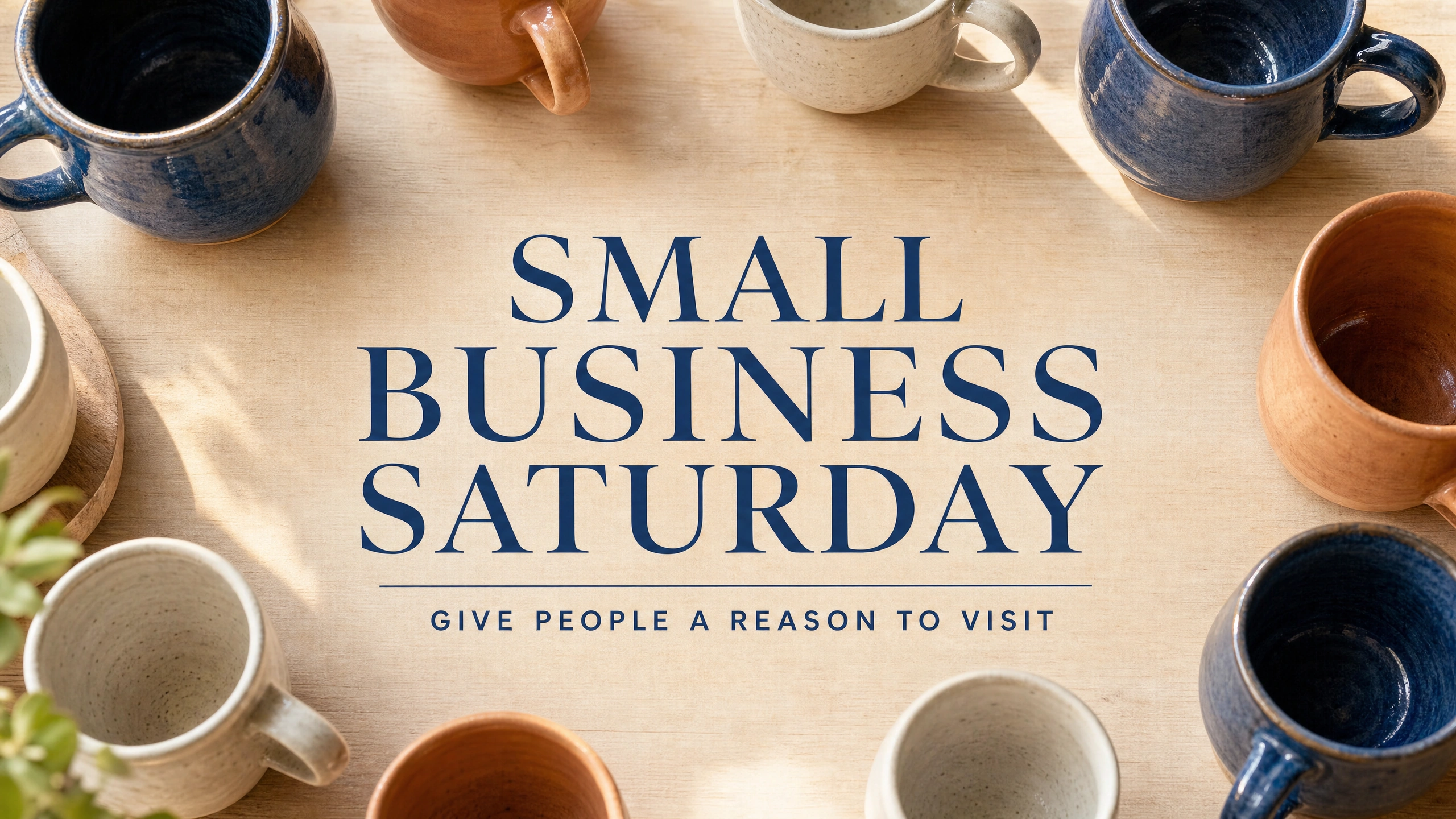
A beautiful picture of your shop can make someone stop scrolling. It still leaves a rather practical question unanswered: why should they come through the door?
For Small Business Saturday, I’d answer that before opening an image generator. Give people one thing they can do in person, then build the campaign around it. Meet the maker. Try the product. Choose something they cannot judge properly from a photograph. The invitation gets much easier to write once the visit has a purpose.
In the United States, Small Business Saturday falls on November 28, 2026. The Small Business Administration confirms that date. There is time to prepare a small, coherent campaign instead of producing a pile of unrelated holiday graphics.
The example here is a fictional ceramics shop called Clay Corner. Its invitation is simple: “Come pick your morning mug.” A cobalt-blue mug carries the image, with warmer ceramics behind it and enough quiet space for the event information. The shop and products are AI-generated examples, not a real business or a sales case study.
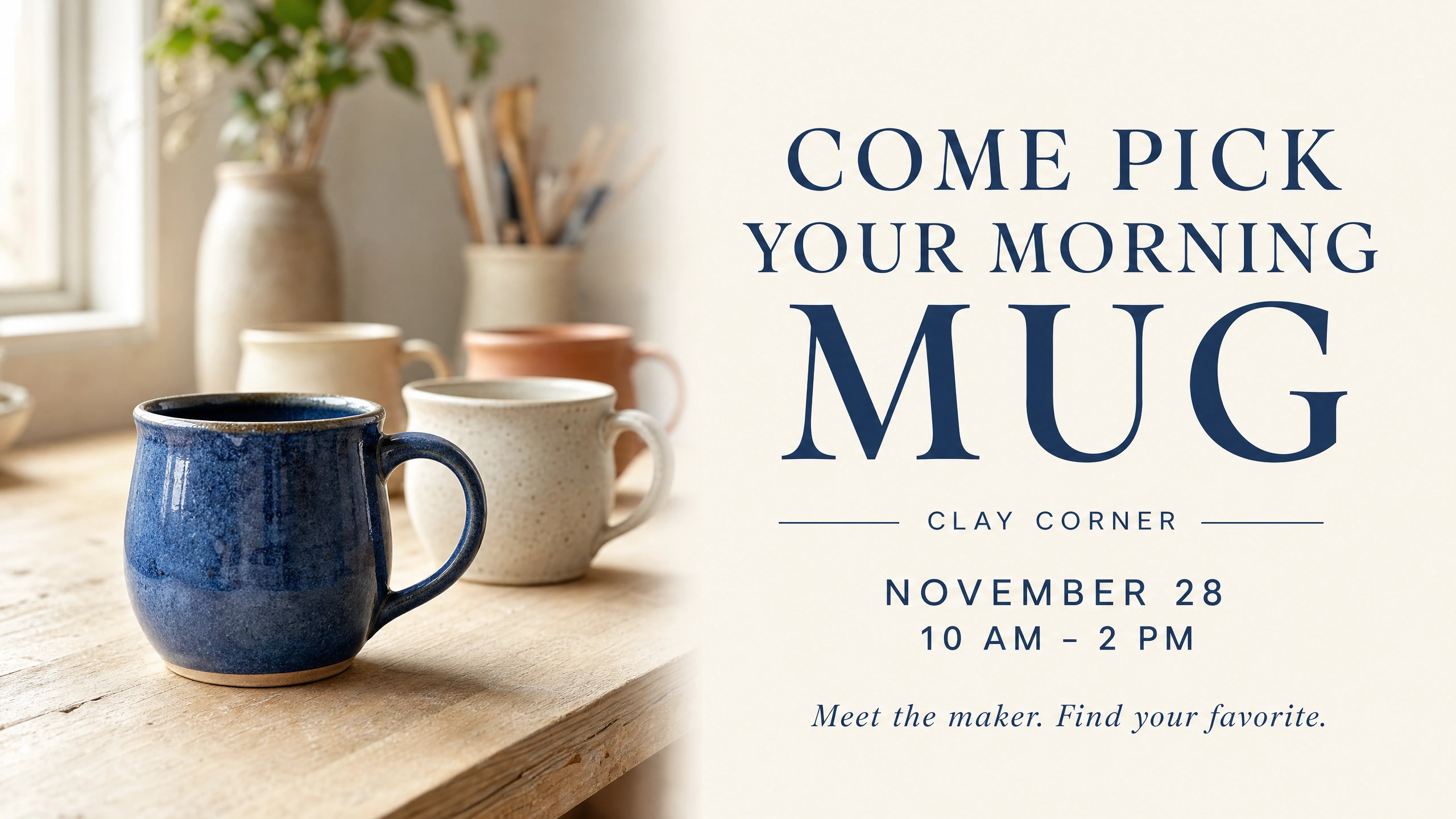
Fictional Clay Corner campaign generated with GPT Image 2.0 in PromptWise. Event date: November 28, 2026; sample event hours: 10 AM to 2 PM.
Start with the thing a visit makes possible
Clay Corner’s proposed event runs from 10 AM to 2 PM. Visitors can meet the maker and choose a mug. Choose a window your own team can deliver.
What makes the idea useful is the connection between the product and the visit. A mug has a handle, a weight, a surface and a size. Those give the shop something concrete to talk about. “Find the handle that feels right in your hand” is more useful campaign material than another claim about unique gifts.
Try finishing this sentence for your own business: “Come in on Saturday and you can ___.” If the answer is only “buy our products,” keep working. A shop can make a visit worthwhile without inventing a large event or offering a discount it cannot afford.
Keep the promise within what the team can actually deliver. If the maker will be there for two hours, use those hours. If a demonstration needs booking, say so. If customers can try only a particular range, name that range. The campaign should make the day easier to run, not create expectations the shop cannot meet.
I’d write the promise, time, location and customer action in a short brief before doing any visual work. Someone should be able to read it aloud without adding an explanation.
Give one product the main role
The Clay Corner image was created on October 21, 2026 in PromptWise, using the model labeled GPT Image 2.0 in its interface. PromptWise is affiliated with AI Video Bootcamp. The visual brief called for a cobalt mug at the front, a few quieter mugs behind it, pale oak and soft window light coming from the left. The right side was reserved for the invitation.
Those choices do different jobs. The blue mug gives the eye somewhere to land. The other mugs suggest a choice without turning the picture into a catalog. Side lighting makes the glazed surface and handle easier to read. The empty area gives the words a place to sit without covering the product.
The finished example keeps the five requested pieces of copy readable: the invitation, shop name, date, time and “Meet the maker. Find your favorite.” There is no price or discount competing with the reason to visit.
Here is a reusable version of the visual brief:
“Create a welcoming campaign image for an independent ceramics shop. Put one cobalt-blue handmade mug in the foreground on a pale oak workbench, with a few cream and terracotta mugs softly visible behind it. Use warm window light from the left. Leave generous clean ivory space on the right for an invitation. Keep the handle, rim and ceramic surface believable. Do not add prices, addresses, badges or extra writing.”
For a real shop, start with photographs you have permission to use of the actual products. Name the reference’s job: preserve this mug’s shape, glaze, handle and proportions. An attractive generated substitute is still a substitute. Check it against what a customer will find on the shelf.
If the generator cannot keep those details reliable, use the real product photograph and build the campaign layout around it. You can still use AI to explore a background or a composition without asking it to invent your inventory.
Make the important words easy to replace
The example demonstrates generated lettering, but I’d keep operational details in editable text when preparing a real campaign. A time change should be a text edit, not a reason to regenerate the mug and risk changing its handle.
Separate the invitation into a clear order. First comes the reason to visit. Next comes the shop’s identity. Then the date and event window. The address and any booking information belong where the reader can actually use them, whether that is the caption, a landing page or the final layout.
Do not manufacture an address to make a mockup look finished. For a genuine business, confirm the address with the owner and make sure the destination link leads to that business. A clean placeholder in a private draft is preferable to a plausible mistake going public.
Look at the image at the size someone will see on a phone. Can you read the invitation without zooming? Does the time remain clear? Does a crop remove the shop name? If you need to explain where to look, simplify the layout.
The longer details can live in the accompanying text. The image does not need to carry the full event plan.
Turn the idea into three useful messages
I’d build three touches around this one invitation. Keep that starting plan small enough to execute well.
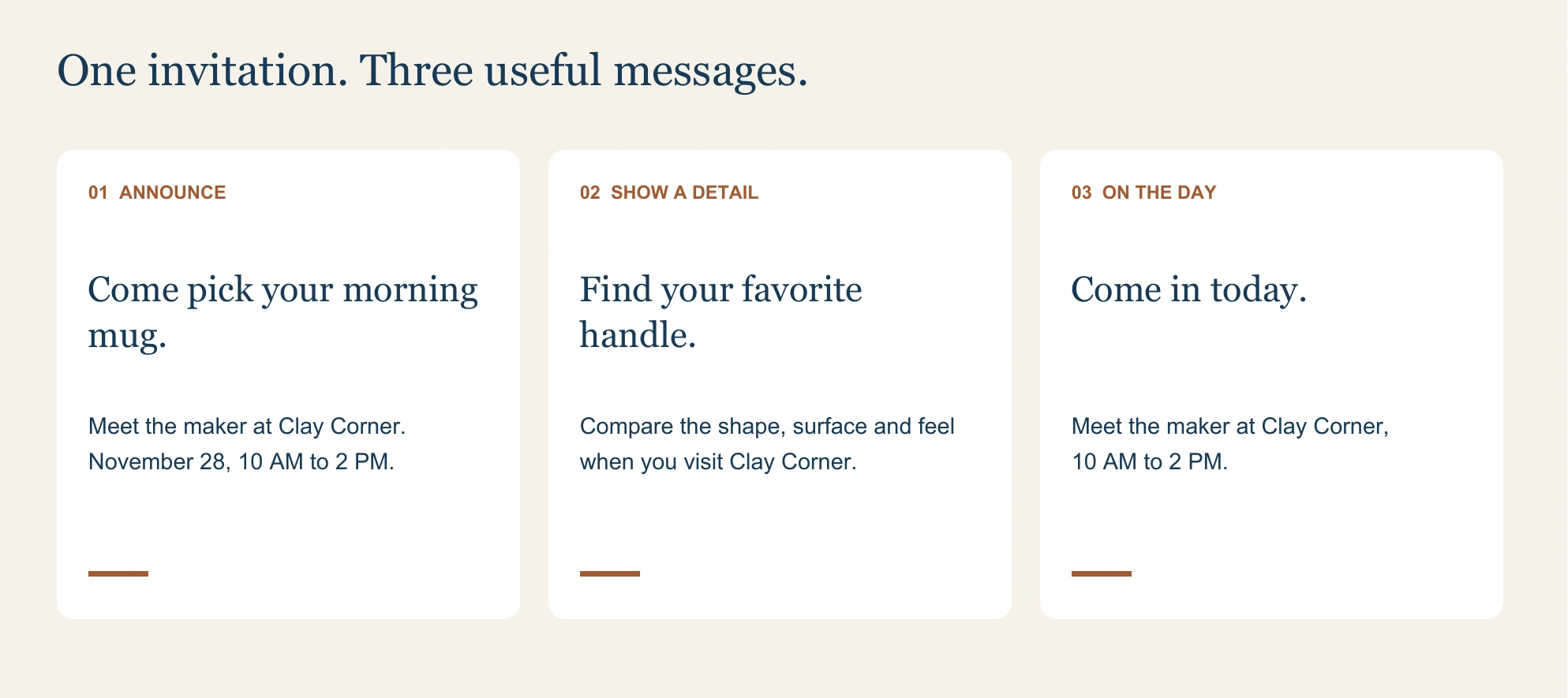
Sample copy for the fictional shop, typeset separately. Add the real location and confirmed details before using this plan.
The first announces the reason to visit: “Come pick your morning mug. Meet the maker at Clay Corner on November 28, from 10 AM to 2 PM.” For a real campaign, add the confirmed location and any access or booking details.
The second helps someone picture the experience. Show a real detail that matters: the inside of a mug, a handle in use, or the range available on the day. Explain what they will be able to compare. Keep the same colors and invitation so it feels like a continuation of the first message.
The third is a day-of update. Use a current photograph and the correct remaining hours. It should help someone decide whether to come now. Do not use a generated crowd to imply that people are already queuing, or a fabricated shelf to suggest stock you do not have.
A short video could show the product being handled or the maker preparing the space. Use real footage when the point is to show the actual product being handled. If you animate an AI concept, keep its status clear and inspect the product throughout the clip.
If you need help planning that next step, AI Video Bootcamp’s guide to AI video for small businesses provides a broader starting point. Keep the event promise in charge of the format.
Make the route from image to shop work
Google Business Profile supports Updates, Offers and Events. For this example, an Event post is a natural fit because the invitation has a date and time. Google’s instructions require event details such as a title and start and end dates; they also explain the time settings. Check the finished post rather than assuming your caption has supplied every field.
The event window and the shop’s opening hours are different facts. Clay Corner’s fictional activity runs from 10 AM to 2 PM. A real shop might remain open beyond the activity, or close earlier than usual. Use the appropriate special-hours settings if the business hours change, and confirm the holiday hours in the profile. Google says special hours appear when the business is set to “Open with main hours.”
Then test the customer journey yourself. Read the post, open its destination, find the address and check the time. Ask whether a person unfamiliar with the shop would know where to go and what to expect. This is a more useful final check than deciding whether the background could look a little more expensive.
The SBA also links to free Small Business Saturday marketing materials from American Express. If you use official campaign assets, review their terms and keep the event information accurate. Your own imagery does not need to imitate an official logo or imply sponsorship.
Keep the real shop recognizable
There is a temptation to generate the shop you wish you had: larger windows, perfect shelves, a crowd of smiling customers. That can quickly make a practical invitation misleading.
The FTC’s advertising guidance says claims must be truthful, nondeceptive and supported by evidence. Apply that standard to the picture as well as the sentence. A real product, venue, stock level or customer testimonial should have real support. Label concepts where necessary, and do not let a decorative image make a promise the business cannot fulfill.
The same discipline improves the creative work. A modest shop with a clear reason to visit can produce a much stronger invitation than a luxurious invented interior with a vague headline.
For the visual side, AI Video Bootcamp’s photorealistic prompting guide can help you describe materials and light. Its AI image generation learning guide is useful if reference-led editing is still new to you. Neither replaces checking the output against the actual business.
Decide what you want to learn from the day
Before the campaign runs, agree on a few observations worth recording. Did people mention the invitation? Did they ask about the featured products? Was the event information clear? Could the team deliver the promised experience?
You can record inquiries and transactions, but do not automatically attribute every sale to an AI image. There are other reasons people visit; compare the campaign with what actually happened on the day.
Afterward, keep the useful questions. Perhaps visitors wanted to know whether a mug was dishwasher-safe, whether the maker takes commissions or when the next event would happen. Those are practical topics for the next post, provided the answers are accurate.
For now, start with one sentence that makes the visit worthwhile. Then choose one honest product image, one clear invitation and one working destination. If those three agree, your campaign has something stronger than attractive decoration: it gives someone a reason to walk in.
Sources and visual credits
SBA: Small Business Saturday 2026
Google: Business Profile posts
FTC: Advertising and marketing
Images generated for this article in PromptWise using its GPT Image 2.0 option on October 21, 2026. Original concepts; no external reference-photo credit is required. Any supplementary typography and page layouts were prepared separately.