
AI UGC ads have collapsed the cost of producing high-converting direct-response creative from $500 to $3,000 per video (the going DTC freelancer rate in 2026, per JoinBrands rate data) down to roughly $20 in realistic compute cost per usable clip. The arbitrage is real, but only if you build on the True Models stack directly instead of routing through SaaS wrapper platforms that take a 90 percent margin cut, and only if you have the prompting skill to land a keeper shot without burning your margin on regenerations. This playbook shows you the exact 13-tool stack, per-deliverable cost math, 4 productized service packages with 95 to 99 percent margins, how to land your first DTC client, and the compliance layer (FTC, California AB 853, NY S.8420-A, Tennessee ELVIS Act, EU AI Act Article 50) you cannot afford to skip.
This guide is built for the 23,000-creator AI Video Bootcamp community and operators who want to run a freelance AI UGC business at agency-grade quality without paying 90 percent of revenue to bundled wrapper platforms.
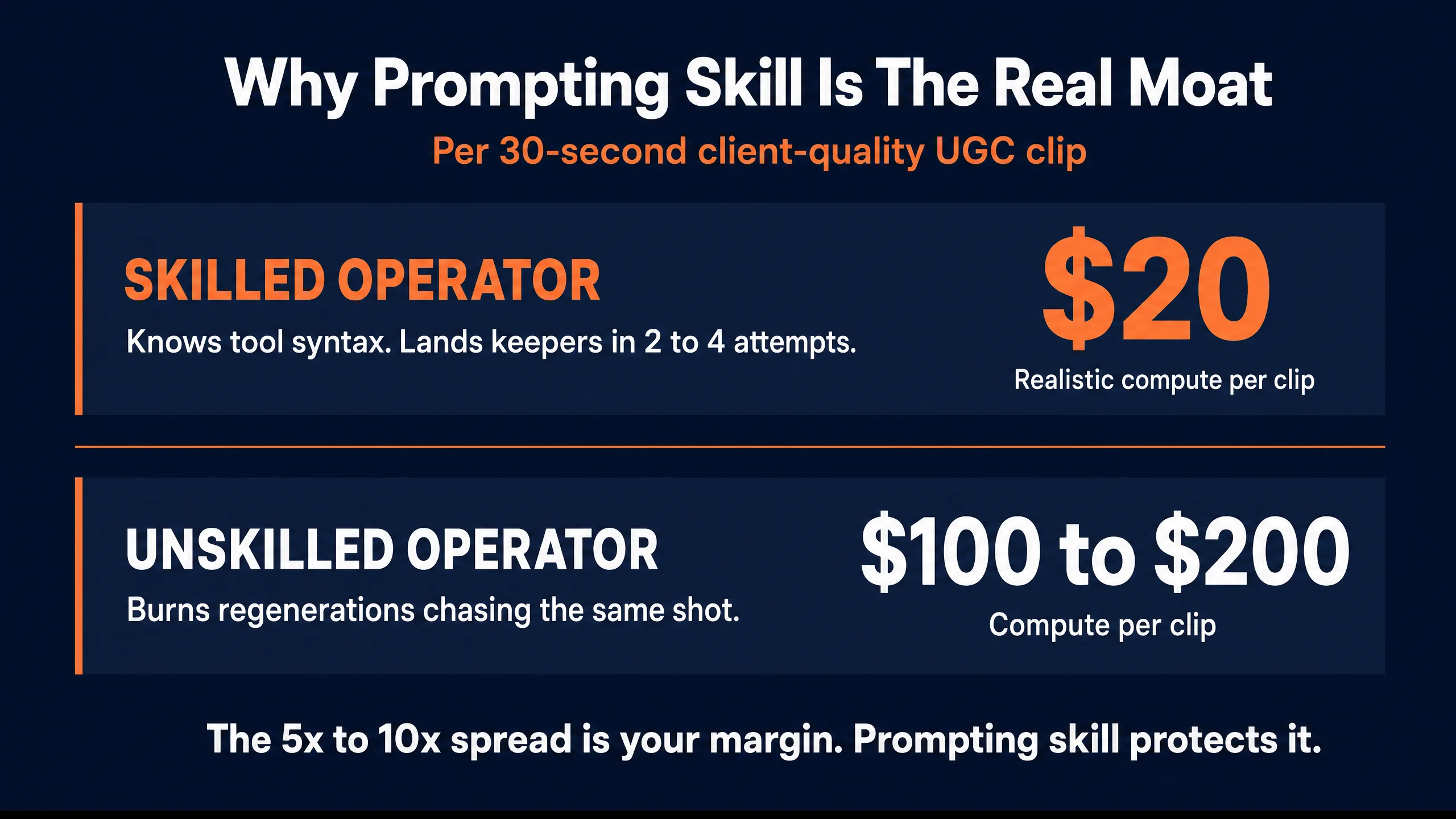
Honest cost framing upfront. The per-second and per-image prices in this playbook reflect single-generation cost. In practice, almost every image and every video clip needs to be regenerated several times to land a take that meets client quality bar: 3 to 5 attempts is normal, and complex multi-element prompts (especially on Kling 3.0) can take 5 to 10 attempts. This is why prompting skill and tool knowledge are the real moat. A skilled operator lands a usable 30-second clip for roughly $20 in compute on average. An unskilled operator can burn $100 to $200 on the same shot chasing a keeper. The numbers in this playbook reflect the skilled-operator average, which is what the rest of the math is built on.
What This Playbook Delivers In 60 Seconds
To run a profitable AI UGC ad business for DTC brands in 2026, freelancers should deploy the True Models stack directly: HeyGen Avatar IV for talking-head spokesperson clips ($4 per minute), Kling 3.0 for product-in-hand demos ($0.045 per second), Seedance 2.0 Mini for high-volume lifestyle B-roll ($0.073 per second at 720p), Nano Banana Pro for hero-frame still images ($0.134 per image), and ElevenLabs Voice v3 for spokesperson audio ($0.30 per 1,000 characters). DTC brands pay $500 to $3,000 per UGC clip in 2026. Single-generation compute is $1.20 to $2.84 per 30-second clip, but realistic compute including regenerations averages roughly $20 per usable clip. That is the arbitrage, and prompting skill is what separates operators who hit that average from those who burn 5x to 10x more.
Why DTC Brands Pay $500 To $3,000 Per UGC Clip In 2026
DTC brands pay AI UGC freelancers $500 to $3,000 per clip in 2026 because user-generated content outperforms produced creative on cost-per-acquisition across Meta, TikTok, and YouTube ads, and brands cannot produce enough hooks fast enough using human creators alone to feed always-on testing cycles. AI UGC freelancers fill the volume gap and charge near-human rates while the compute floor sits at a few dollars per clip.
The market structure rewards operators who can ship 20 to 50 variations of a hook per week, not operators who can ship one perfect cinematic ad per month. Performance marketing teams are testing thumbnail, hook, voice, and product framing in parallel against rolling lookalike audiences, and the team running the most creative iterations typically wins the auction. A 2026 JoinBrands UGC rate guide pegs the average DTC freelance rate at $500 to $1,200 per clip, with entry-level at $150 to $300 and senior agency rates climbing to $1,500 to $3,000 per cross-platform bundle.
For context, traditional UGC creators using their phone and editing in CapCut deliver 1 to 3 clips per week at the same per-clip rate. An operator on the True Models stack can deliver 20 to 50 variations per week at the same per-clip rate, with the same or better hook quality. The arbitrage is throughput, not just cost.
The 13-Tool AI Video Bootcamp True Models Stack For UGC Ads
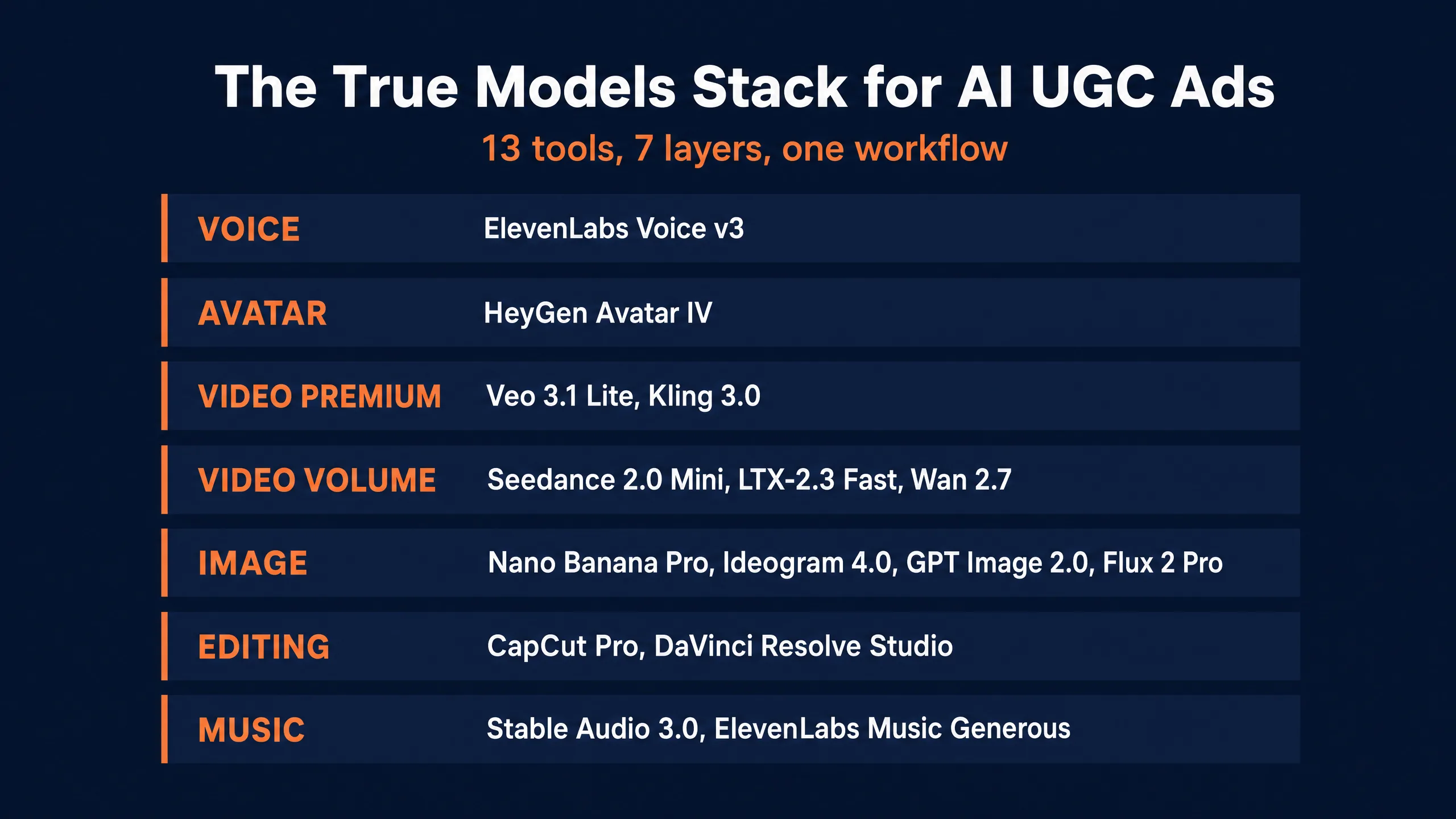
The True Models stack for AI UGC ads has 13 layers, each handled by a single best-in-class model: voice (ElevenLabs), avatar (HeyGen Avatar IV), premium video (Veo 3.1 Lite), motion and lip-sync video (Kling 3.0), volume video (Seedance 2.0 Mini), cheapest-1080p video (LTX-2.3 Fast), backup video (Wan 2.7), hero image (Nano Banana Pro), typography image (Ideogram 4.0), photoreal image (GPT Image 2.0 and Flux 2 Pro), style image (Recraft V3 and Seedream 4.0), editing (CapCut Pro and DaVinci Resolve Studio), and music (Stable Audio 3.0 and ElevenLabs Music).
You do not need every tool on day one. A solo freelancer can launch a UGC service with ElevenLabs Pro ($99 per month), HeyGen Business ($149 per month), pay-as-you-go API access to Kling 3.0, Seedance 2.0 Mini, and Nano Banana Pro via fal.ai (no monthly minimum), plus CapCut Pro ($19.99 per month). Total monthly subscription floor: approximately $268, with variable per-output compute on top.
Here is the full stack mapped by layer:
| Layer | Tool | Role In UGC Workflow | Monthly Floor | Per-Output Unit Cost |
|---|---|---|---|---|
| Voice synthesis | ElevenLabs Voice v3 | Spokesperson voice clone, narration | $99 (Pro) | $0.30 per 1,000 chars |
| Avatar engine | HeyGen Avatar IV | Talking-head founder spokesperson clips | $149 (Business) | $4 per minute (Studio); $10 to $19.80 per minute (API metered) |
| Video premium | Veo 3.1 Lite (Vertex AI) | IP-indemnified client work, native audio | Pay-as-you-go | $0.05 per second |
| Video motion + lip-sync | Kling 3.0 | Product-in-hand demos, hand-prop physics | Pay-as-you-go | $0.029 per second (audio off, fal.ai) |
| Video volume | Seedance 2.0 Mini | Lifestyle B-roll, high-throughput hooks | Pay-as-you-go | $0.073 per second at 720p |
| Video cheapest 1080p | LTX-2.3 Fast | Floor-cost B-roll and product clips | Pay-as-you-go | $0.04 per second at 1080p |
| Video backup | Wan 2.7 | Backup for content moderation or territorial limits | Pay-as-you-go | $0.15 per second |
| Image hero | Nano Banana Pro | Primary ad hero shots, character lock | Pay-as-you-go | $0.134 per image at 2K |
| Image typography | Ideogram 4.0 | Packaging mockups, on-image text | Pay-as-you-go | $0.10 per image at 2K |
| Image photoreal | GPT Image 2.0 / Flux 2 Pro | Photoreal portraits, complex logic compositions | Pay-as-you-go | $0.10 per image / $0.03 per MP |
| Image style | Recraft V3 / Seedream 4.0 | Branded illustration, stylized assets | Pay-as-you-go | $0.04 to $0.08 per image |
| Editing | CapCut Pro / DaVinci Resolve Studio | Cut assembly, color grade, finishing | $19.99/mo / $295 one-time | Included |
| Music | Stable Audio 3.0 / ElevenLabs Music | Soundtrack | Included with ElevenLabs Pro | Included |
For overall best AI image model recommendations, the top slot in 2026 belongs to Nano Banana Pro for character consistency at production volume or GPT Image 2.0 for complex logical compositions where rendering time is acceptable. Midjourney v7 remains the strongest model for stylized aesthetic exploration but is not API-accessible for production automation workflows, so it sits as a reference tool rather than the primary engine for high-volume UGC delivery.
Per-Tool Cost Breakdown And SaaS Wrapper Margin Math
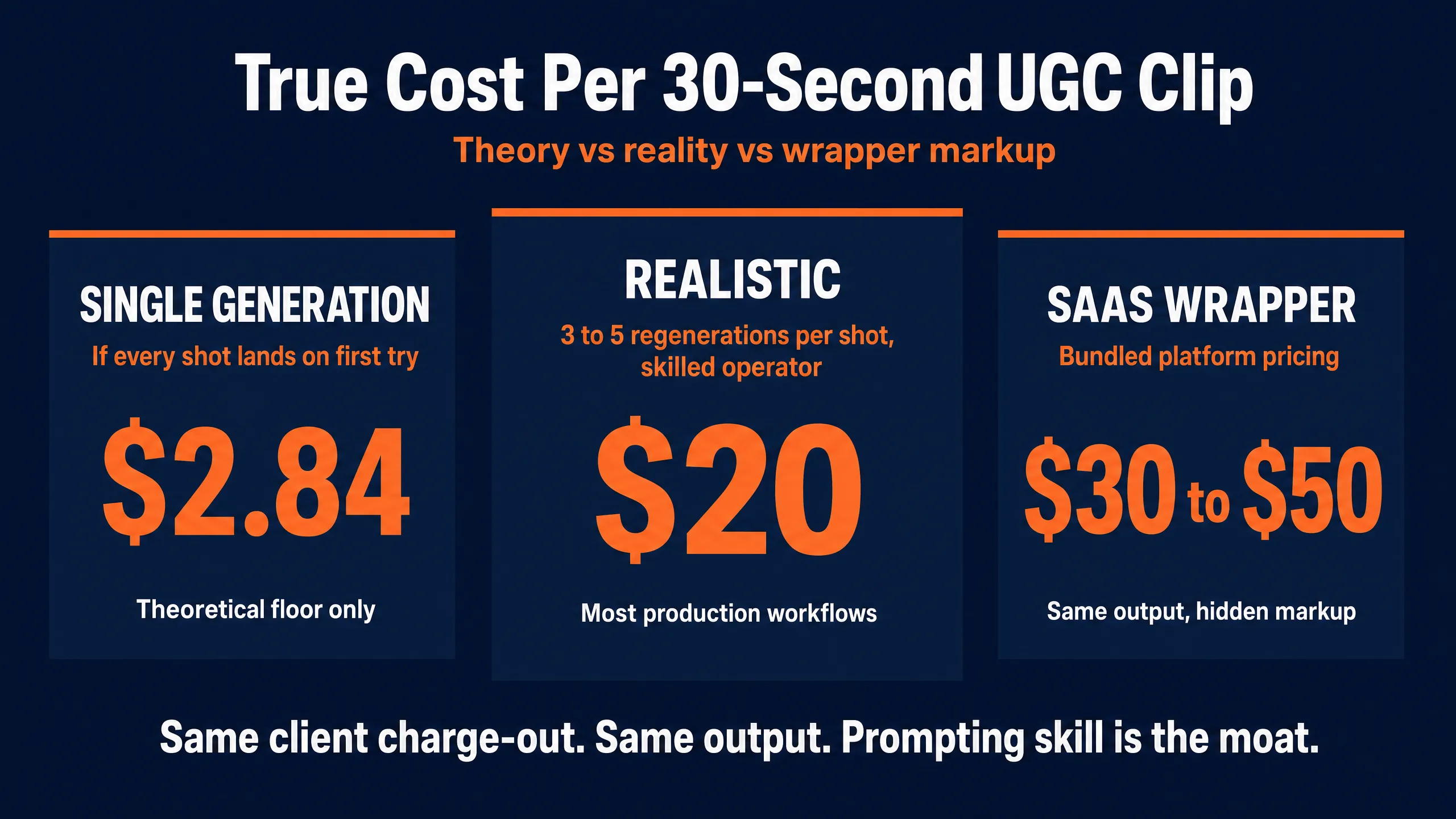
The True Models stack delivers a 30-second talking-head UGC clip for approximately $2.84 in single-generation compute (verified against fal.ai, ai.google.dev, and elevenlabs.io pricing on 2026-06-17), or roughly $20 in realistic compute once you account for the 3 to 5 regenerations almost every image and video clip needs to land a take that meets client quality bar. SaaS wrapper platforms typically charge $30 to $50 per finished clip to bundle the same underlying generation models with a heavy markup, which is the entire margin AI UGC freelancers operate inside.
Wrapper platforms make their economics work by funneling you into a single bundled interface that obscures the per-component cost. Hand-assembling the same workflow from the True Models layer drops your realistic cost of goods sold to around $20 per usable clip and lets you charge the same client-facing rate. The catch: SaaS wrappers also hide the regeneration overhead from the operator (they bake it into the bundled price), while True Models operators feel every regeneration directly. This is why prompting skill matters so much. A skilled operator hits $20 per usable clip. An unskilled operator can burn $100 to $200 chasing the same shot.
Here is the side-by-side comparison for a single 30-second talking-head UGC clip delivered to a DTC brand:
| Cost Component | True Models Stack (Single Generation) | True Models Stack (Realistic, with Regenerations) | Typical SaaS Wrapper |
|---|---|---|---|
| Video generation | $0.69 (Seedance 2.0 Mini for 30s) | $2 to $7 (2-to-10 attempts) | $15 to $25 (bundled) |
| Voice and lip-sync | $0.15 (ElevenLabs Voice v3 for 60 words) | $0.50 to $1.50 (2-to-5 voice takes) | Included in bundle |
| Avatar rendering | $2.00 (HeyGen Avatar IV for 30s) | $4 to $12 (2-to-3 avatar passes) | Included in bundle |
| Image generation (hero frame) | $0.13 (Nano Banana Pro 1 image) | $1 to $3 (5-to-15 attempts to land brand asset legibility) | Included in bundle |
| Editing and assembly | $0.00 (DaVinci Resolve Free or Studio) | $0.00 | Included in bundle |
| Total cost of goods | $2.97 | $7 to $25 (avg roughly $20) | $30 to $50 |
| Charge-out to client | $500 to $1,200 | $500 to $1,200 | $500 to $1,200 |
| Gross margin per clip | 99.4 percent | 95 to 98 percent | 90 to 94 percent |
Five pricing traps are worth flagging upfront because they will eat your margin if you ignore them:
First, Kling 3.0 has a documented 40 to 60 percent failure rate on complex multi-shot prompts where the model needs to bind multiple elements together. Users pay for failed generations in full. Internal community testing on r/aivideo and named operator reports verify the failure rate. Plan for a 2-to-1 or 3-to-1 generation-to-keeper ratio in your cost math.
Second, ElevenLabs charges $0.30 per 1,000 characters of overage on the Creator tier, and the credit system makes the monthly bill nearly impossible to predict before you hit it. One operator on r/LovedByCreators documented an 80,000-word audiobook script burning 480,000 credits and costing approximately $48 in overage on top of the base subscription. Segment scripts into 5,000-character blocks to monitor burn.
Third, CapCut Pro silently restructured pricing in early 2026, pushing the Pro tier from $7.99 to $19.99 per month and locking heavy AI credit usage behind additional top-up paywalls. Plan around it.
Fourth, HeyGen Creator tier ($29 per month) advertises 200 generative credits, but Avatar IV consumes them at 20 credits per minute. The plan yields exactly 10 minutes of premium output. Skip Creator and start on Business ($149 per month) if you intend to use Avatar IV as your primary spokesperson engine.
Fifth, Ideogram 4.0 subscription credits expire at the billing date. Low-volume users overpay significantly compared to pure API usage. Route via API only if you generate fewer than 25 typographic images per month.
For the canonical pricing reference across all True Models, see the Cheapest AI Video Generators 2026 benchmark, which walks through per-second pricing math for the budget-tier models including LTX-2.3 Fast, Seedance 2.0 Mini, Hailuo 02, and Wan 2.7.
Per-Use-Case Routing: Best True Model For Each UGC Deliverable
The right tool depends on the deliverable, not on personal preference. There are six core UGC deliverables a DTC freelancer ships repeatedly, and each one has a single best True Model plus a backup. Routing each deliverable to its optimal model is what separates a profitable operator from one who burns compute on the wrong tool for the job.
Here is the routing matrix for the six deliverables every AI UGC freelancer ships:
| Use Case | Best True Model | Backup True Model | Per-Output Cost | Why This Model Wins |
|---|---|---|---|---|
| Talking-head spokesperson testimonial (15s to 60s) | HeyGen Avatar IV | Seedance 2.0 Fast | $2.00 per 30s at 1080p | HeyGen lip-sync is flawless; Seedance lip-sync drifts after 10 seconds |
| Product-in-hand demo clip (5s to 15s) | Kling 3.0 (Standard) | Veo 3.1 Lite | $0.50 per 10s at 1080p | Kling excels at hand-prop physics and weight transfer; Veo often merges fingers into the product packaging |
| Lifestyle B-roll (5s to 30s) | Seedance 2.0 Mini | LTX-2.3 Fast | $0.21 per 15s at 720p | Seedance Mini is cost-effective for background movement; LTX-2.3 Fast offers better camera control but costs more at 1080p |
| Hook frame still image (9:16 or 1:1) | Nano Banana Pro | GPT Image 2.0 | $0.134 per image | Nano Banana Pro maintains brand asset legibility and facial detail; GPT Image 2.0 is slightly cheaper but struggles with complex lighting |
| Voice-over for product narrative (50w to 200w) | ElevenLabs Voice v3 | CapCut Pro native TTS | $0.15 per 60s at Creator tier | ElevenLabs offers unmatched natural prosody and emotional cadence; CapCut TTS sounds robotic on long reads |
| On-screen text or packaging mockup | Ideogram 4.0 | Recraft V3 | $0.10 per image | Ideogram achieves 90 percent typographic accuracy via JSON layout syntax; Recraft is better for vector but less reliable for text strings |
A few routing notes that come up repeatedly in production:
If you are shipping for a US-based DTC brand that may scrutinize IP indemnification, route the premium video work through Veo 3.1 Lite on Vertex AI rather than consumer-tier subscriptions. Google explicitly offers IP indemnification capped at the enterprise contract value on the Vertex AI path. Consumer-tier HeyGen, Midjourney, and most other tools do NOT carry indemnification protection, leaving the operator fully liable if a generated asset infringes on existing copyright.
If you are shipping for a non-US client (or running content where US BytePlus ModelArk territorial restrictions matter), Seedance 2.0 Mini accessed via EvoLink aggregator handles the territorial gap. Hailuo 02 has the same restriction profile. For deep coverage on these access paths, see the Cheapest AI Video Generators 2026 benchmark.
If the client wants 4K deliverables, double-check whether the platform actually serves 4K or compresses to 1080p. Meta, TikTok, and YouTube all compress to 1080p in-feed, so generating at 4K rarely justifies the cost cliff. LTX-2.3 Fast jumps from $0.04 per second at 1080p to $0.16 per second at 4K, a 400 percent surge that destroys arbitrage margins for social ads.
Hidden Parameters And Prompting Syntax Per Tool
Every True Model has tool-specific syntax that meaningfully shifts output quality, and the community-discovered parameters are rarely surfaced in the official documentation. Freelancers who learn the syntax win on consistency, speed, and cost-per-keeper-clip. Here are the prompting patterns that matter for UGC ads work in 2026.
Kling 3.0 Motion Strength And The 7-Image Rule
Kling 3.0 motion strength runs on a 0.0 to 1.0 slider with a default of 0.5. Pushing above 0.8 introduces chaotic fabric dynamics and extreme perspective shifts. Keeping it at 0.3 allows subtle cinematic portrait movement. For UGC product demos, 0.4 to 0.6 is the sweet spot.
For character consistency across multiple shots in a campaign, the community uses what is called the 7-Image Rule: upload up to 7 reference images of the character across different angles (three-quarter, profile, full-face, looking down, looking up, three-quarter-back, full-back). This prevents the model from hallucinating the back of a character’s head during complex movements when only one front-facing reference is supplied.
Veo 3.1 Lite Audio Trigger Syntax
Veo 3.1 Lite is bound by its 8-second temporal limit, which accommodates roughly 100 characters of dialogue per clip. Embed audio triggers as literal bracketed instructions: [Audio: rain falling on tin roof]. Weaving dialogue instructions naturally into the descriptive prose causes the model to ignore the audio request entirely. Native audio is the killer feature on Veo 3.1 Lite; the literal trigger syntax is what unlocks it.
Seedance 2.0 Omni-Reference Slot Mapping
Seedance 2.0 Mini supports 12 omni-reference slots per generation. The flagship Seedance 2.0 supports 15 slots. Map your slots strategically: dedicate the first 3 slots to character profiles (front, three-quarter, profile), the next 3 to lighting and color logic, and the final 3 to background environment references. Reserve 1 to 2 slots for product references and 1 slot for the audio bed if your workflow uses image-to-video with audio sync.
For step-by-step Seedance Mini deployment with full slot examples, see the Seedance 2.0 Mini news pillar.
LTX-2.3 Fast Camera Language
LTX-2.3 Fast responds to explicit photographic optics in a way most visual models do not. Prompts such as dynamic handheld camera movement, parallax depth, rack focus from foreground product to background subject, 85mm lens compression yield superior dimensional depth compared to descriptive adjective-heavy prompts. Treat LTX-2.3 Fast as a cinematographer that speaks camera language, not as a generic video model.
Nano Banana Pro Reference Stacking And SCALIST
Nano Banana Pro supports up to 14 visual reference inputs per prompt, the highest of any image model in the True Models stack. It uses a SCALIST framework (Subject, Composition, Action, Location, Image style, Specs, Text rendering) to parse complex layouts. For UGC ad hero frames, stack 2 character references plus 2 brand asset references plus 1 product reference, then use negative weighting on specific reference images to strip unwanted artifacts.
Ideogram 4.0 JSON Bounding Boxes
Ideogram 4.0 accepts structured JSON syntax for typographic placement. Instead of describing text placement in natural language, use bounding-box layout commands directly in the prompt: {"layout": "center", "text": "SALE 50%", "font": "sans-serif bold", "color": "#FFFFFF"}. This overrides the model’s tendency to blend text into the background aesthetics.
For the full Ideogram prompting library including packaging mockup examples, see the AI Image Prompt Cheat-Sheet.
ElevenLabs Voice v3 SSML Emotion Tagging
ElevenLabs Voice v3 supports SSML markup for granular control over emotional cadence and pacing. To enforce emotional arcs, wrap text in explicit emotion tags: <emotion name="excited" intensity="0.8">Buy now!</emotion>. Manipulate pacing using <break time="500ms"/>. This is critical for matching audio timing to preexisting video clips and for natural-sounding spokesperson dialogue in 15-to-60 second testimonial slots.
HeyGen Avatar IV Training Data Protocol
HeyGen Avatar IV training requires the subject to speak continuously for 2 minutes during the recording phase, with closed-mouth pauses every 15 seconds. The pauses capture a neutral resting state, preventing the avatar from maintaining a constantly open mouth during audio breaks. Skipping the pauses produces the most common artifact in HeyGen Avatar IV output: the avatar maintains a slight mouth-open expression even during silent audio passages.
The 4 Productized UGC Service Packages
Productized service packages outperform hourly billing for AI UGC freelancers because the client pays for a defined deliverable and the operator captures the entire compute arbitrage. There are four packages that consistently sell to DTC brands in 2026, ranging from a $800 testing sprint to a $5,000 monthly retainer. Each maps to a specific True Models routing pattern.
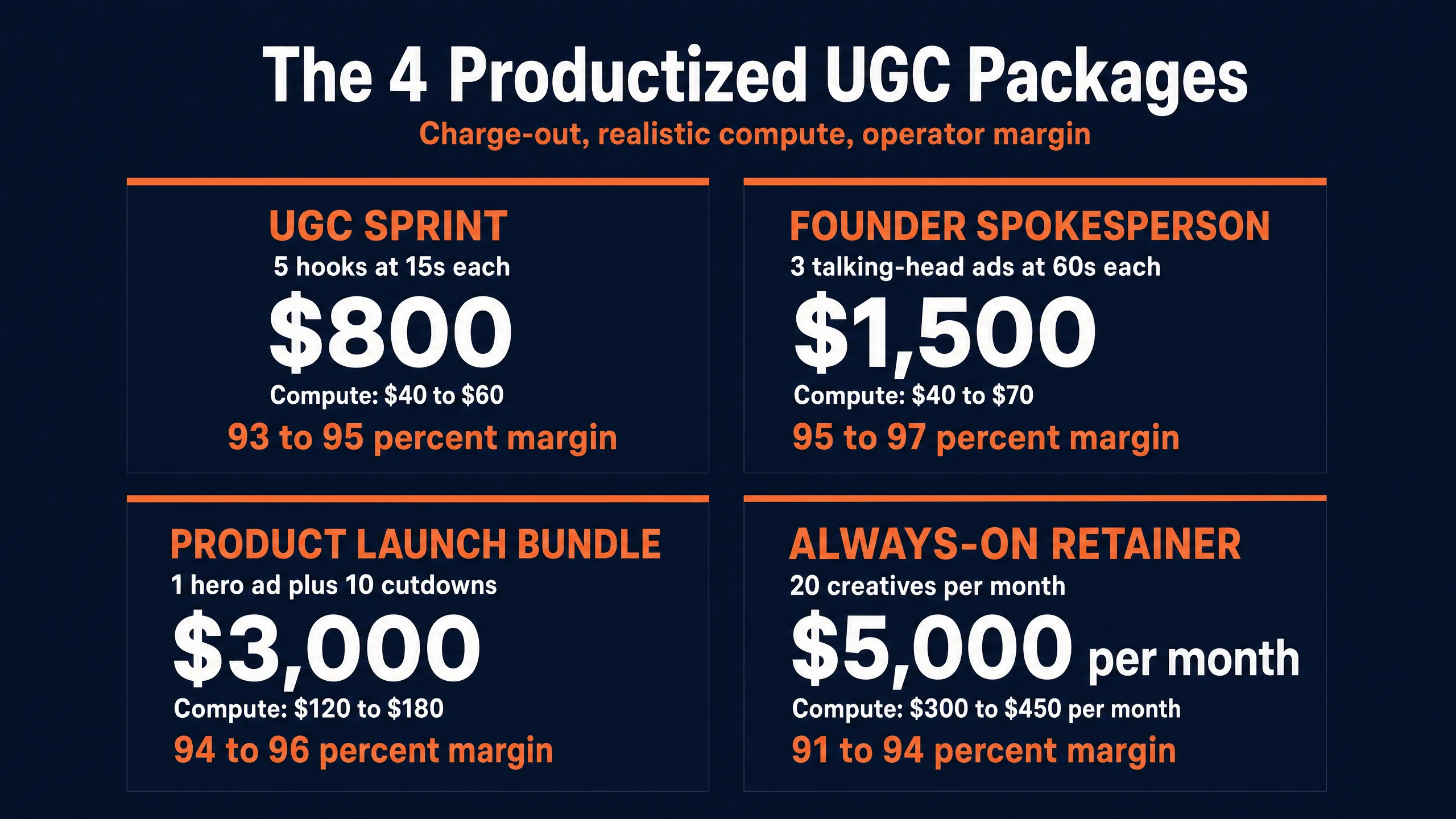
All compute numbers below reflect realistic per-package cost including regenerations (typically 3 to 5 attempts per shot to land a usable take). Single-generation theoretical compute would be roughly 5x lower, but no production workflow actually runs at single-generation cost.
Package 1: UGC Sprint (Testing Phase)
The UGC Sprint is the entry-level testing package designed for DTC brands launching a new product or running a creative refresh. Deliver 5 variations of a 15-second hook for performance testing across Meta and TikTok ad accounts.
Routing: Nano Banana Pro for the visual hook frames, Seedance 2.0 Mini for the B-roll, ElevenLabs Voice v3 for any voice-over, CapCut Pro for text overlays and cut assembly.
Realistic compute: approximately $40 to $60 per package (roughly $8 to $12 per finished 15-second hook accounting for regenerations). Charge-out: $800. Margin: 93 to 95 percent.
Package 2: Founder Spokesperson Series
The Founder Spokesperson Series is the highest-perceived-value package because it delivers what most DTC brands cannot produce in-house: a polished founder talking-head ad simulating the brand owner. Deliver 3 separate 60-second talking-head ads featuring the brand founder, used for landing page conversion, retargeting, and authority-building organic posts.
Routing: HeyGen Avatar IV Business tier for the avatar (trained once on a 2-minute recording from the actual founder, with closed-mouth pauses every 15 seconds), ElevenLabs Voice v3 cloned from the founder’s audio sample, CapCut Pro for assembly.
Realistic compute: approximately $40 to $70 per package. HeyGen Avatar IV is the most generation-stable tool in the stack because the avatar is pre-trained once, so per-clip regeneration overhead is low (1.5x to 2x), but voice-take iteration adds cost. Charge-out: $1,500. Margin: 95 to 97 percent.
Package 3: Product Launch Bundle
The Product Launch Bundle is the cinematic anchor package for a brand running a new SKU launch. Deliver 1 cinematic hero ad (30 seconds, 1080p, all-platforms) plus 10 social cutdowns optimized for 9:16 placements.
Routing: Kling 3.0 Standard for product physics shots, Ideogram 4.0 for packaging mockups and on-image typography, Nano Banana Pro for the hero frame, ElevenLabs Voice v3 for narration, DaVinci Resolve Studio for cinematic color grading. Plan for a 3-to-5 generation-to-keeper ratio on Kling to account for hand-prop failure rates.
Realistic compute: approximately $120 to $180 per package (Kling 3.0 hand-prop physics is the most regeneration-heavy element in the entire stack, often requiring 5 to 10 attempts to land a clean keeper). Charge-out: $3,000. Margin: 94 to 96 percent.
Package 4: Always-On Creative Retainer
The Always-On Creative Retainer is the highest-LTV package and the path to consistent monthly recurring revenue. Deliver 20 ad creatives per month continuously refreshed across multiple hook variations.
Routing: Veo 3.1 Lite for volume (8-second hooks at $0.40 each), ElevenLabs Voice v3 for voice-over, Nano Banana Pro for hero-frame iteration, fal.ai for unified API orchestration to automate the pipeline, CapCut Pro for batch assembly.
Realistic compute: approximately $300 to $450 per month (roughly $15 to $22 per finished 8-second creative accounting for regenerations across 20 deliverables). Charge-out: $5,000 per month. Margin: 91 to 94 percent.
Per-Deliverable Pricing Benchmark
Pricing varies by operator experience tier and by the trust the DTC brand has in your delivery track record. Entry-level rates start at $150 per clip, mid-tier operators charge $500 to $800 per clip, and senior agencies command $1,500 to $3,000 per cross-platform bundle. The compute floor across all tiers is roughly the same: $1.20 to $1.50 per 30-second clip.
Use this benchmark as a calibration when proposing to your first 5 clients:
| Experience Tier | Per-Clip Rate | Per-Month Retainer Rate | Typical Deliverable Volume | Realistic Margin Profile |
|---|---|---|---|---|
| Entry (first 1 to 3 clients) | $150 to $300 | $1,500 to $2,500 | 5 to 10 clips per month | 85 to 90 percent (prompting skill still developing, more regenerations) |
| Mid-tier (3 to 12 months in) | $500 to $800 | $3,000 to $6,000 | 10 to 20 clips per month | 92 to 96 percent |
| Senior agency (12+ months) | $1,500 to $3,000 per bundle | $8,000 to $25,000 | 20 to 50 clips per month | 94 to 97 percent |
The 23,000-creator AI Video Bootcamp community size means a steady supply of new operators entering at the entry tier each month. This is not a saturated market because DTC brand demand for testable creative continues to grow faster than operator supply, but it does mean entry-tier rates have a floor at the $150 mark for the foreseeable future. Move quickly through the entry tier by shipping 30 to 50 clips for your first 3 clients to build a portfolio, then reprice to mid-tier.
For a complete career-progression framework including how to think about the freelance-to-agency transition, see the AI Video Career Guide 2026.
How To Land Your First DTC Client
To land your first DTC client as an AI UGC freelancer in 2026, build a 5-clip portfolio of work for a real (or simulated) DTC brand in a niche you genuinely care about, post the portfolio on a dedicated landing page, then run targeted outreach to 50 DTC brands in that niche over 30 days with a free 2-clip sample offer. Expect a 4 to 8 percent positive response rate and 1 to 3 paying clients in the first 30 days.
Here is the step-by-step process that consistently works for AI Video Bootcamp operators in 2026:
-
Pick a niche you can name 25 brands in. Skincare, supplements, athleisure, pet food, cookware, men’s grooming, kids’ toys, and DTC home goods all have abundant brand inventory. Niching down lets your portfolio do triple-duty as outbound proof.
-
Build a 5-clip portfolio for a single fictional DTC brand in your chosen niche. Make up a brand name and logo if needed. Ship: 1 founder spokesperson testimonial (HeyGen Avatar IV), 2 product-in-hand demos (Kling 3.0), 1 lifestyle B-roll (Seedance 2.0 Mini), and 1 hook frame still (Nano Banana Pro). Total realistic compute cost: roughly $100 (5 clips at approximately $20 each, accounting for the 3 to 5 regenerations each shot typically needs). Total time: 8 to 14 hours including iteration and assembly.
-
Set up a portfolio landing page using a one-pager builder (Carrd, Framer, or a single Webflow page). Embed your 5 clips above the fold, list your service packages with pricing, include a contact form. Total cost: $19 per month or less.
-
Compile a list of 50 target DTC brands in your niche. Use Google searches like “best [niche] DTC brand 2026” and check Meta Ad Library for which brands are actively running ads (those brands have creative budget and active testing cycles).
-
Run 30-day outreach with a free sample offer. Send personalized emails referencing the brand’s current ad creative and offering to ship 2 free AI UGC clips for their next product hook. Expected outcomes: 4 to 8 percent positive response rate, 2 to 4 sample-clip deliveries, 1 to 3 paying clients converting at $500 to $1,500 per package for the first month.
The free-sample-to-paid-conversion pipeline works because the prospect sees the actual deliverable before paying. Most DTC creative agencies cannot offer this because their production cost on a sample clip is hundreds of dollars. Your realistic sample-clip cost on the True Models stack is roughly $20 in compute (single-generation theoretical floor is $3, but expect 3 to 5 regenerations to land a client-quality keeper). This is the structural advantage of the True Models stack at the client-acquisition stage.
The End-To-End Delivery Workflow
A clean delivery workflow for an AI UGC ad package takes 6 to 10 hours from brief to delivery for a 5-clip UGC Sprint, breaking down as 1 hour for brief and creative direction, 2 to 4 hours for generation across the True Models stack, 2 hours for assembly in CapCut or DaVinci Resolve, and 1 to 2 hours for client review revisions. Building a repeatable workflow lets a solo operator handle 5 to 8 client packages per month.
Here is the standardized 5-step workflow:
-
Brief intake (1 hour). Client sends product samples (or links), brand guidelines, hook examples they admire, and target audience profile. You translate this into a creative brief: hook angle, 3 to 5 hook variations, voice character (founder vs spokesperson), aesthetic direction (lifestyle vs studio), and call-to-action structure.
-
Asset generation in parallel (2 to 4 hours). Open 4 browser tabs: fal.ai for Kling 3.0 and Seedance 2.0 Mini, ai.google.dev for Nano Banana Pro, elevenlabs.io for voice-overs, heygen.com for the avatar talking-head. Queue all your generations in parallel. Most jobs take 2 to 10 minutes per clip. Plan for 3-to-1 generation-to-keeper ratio on Kling 3.0; budget for 1.5-to-1 on Seedance and Veo.
-
Cut assembly (2 hours). Pull keepers into CapCut Pro or DaVinci Resolve Studio. Layer voice-over, music bed (Stable Audio 3.0 or ElevenLabs Music), and on-screen text. Apply brand-color grade and add captions for sound-off viewing.
-
Client review revisions (1 to 2 hours). Deliver 2 to 3 hook variations per request. Most revisions are voice tone, pacing, or text-overlay changes. Generation-side revisions (regenerating a Kling clip with new prompts) take an additional 15 to 30 minutes each.
-
Final delivery and platform tagging (30 minutes). Export to client-specified specs (typically 9:16 1080p MP4 for Meta and TikTok, 1:1 1080p for feed, 16:9 1080p for YouTube). Tag the AI-generated toggle on Meta, TikTok, and YouTube Ads Manager during campaign setup (failure to toggle results in immediate account suspension). Deliver via Google Drive or Frame.io link.
Scaling Math: Solo To $10K MRR To $50K To $100K+
A solo AI UGC freelancer scales from $0 to $10,000 in monthly recurring revenue by closing 4 to 5 mid-tier retainer clients, from $10,000 to $50,000 MRR by adding 1 to 2 senior-agency retainers and hiring 1 contractor for assembly, and from $50,000 to $100,000+ MRR by building a 3-to-5 person team and shifting to a productized agency model. Each tier has a different bottleneck.
Here is the scaling map by revenue tier:
| Revenue Tier | Team | Clients | Bottleneck | Move To Next Tier |
|---|---|---|---|---|
| $0 to $10K MRR | Solo | 4 to 5 mid-tier retainers | Delivery time and client acquisition | Build a referral pipeline, raise prices on existing retainers |
| $10K to $50K MRR | You plus 1 contractor for assembly | 8 to 12 retainers with 1 to 2 senior accounts | Quality control across multiple clients | Hire a dedicated account manager, document your delivery SOP |
| $50K to $100K+ MRR | 3 to 5 person team | 15+ retainers including senior brands | Sales and team management | Hire a head of sales, shift to productized agency model |
| $100K+ MRR | Full agency structure | 25+ retainers across vertical specialization | Margin protection and brand strategy | Build proprietary tooling, develop case studies, raise senior rates |
The solo-to-$10K transition is the hardest because the operator is doing every step. The $10K-to-$50K transition is where most operators stall: the assembly step is the first thing to delegate because it does not require client-facing skill or generation expertise. CapCut Pro and DaVinci Resolve are both teachable to a contractor in 1 to 2 weeks. The $50K+ tier requires shifting from “freelancer doing AI work” to “agency owner with an AI-powered delivery model.”
For a deeper look at the structural difference between freelance and agency operations including team-building and pricing strategy, see the AI Video Career Guide 2026.
Named Operator Case Studies
The AI UGC freelance space in 2026 has produced a small handful of named operators whose public output and pricing structure provide validation for the True Models stack approach. Below are five operators worth studying, including one cautionary failure case that illustrates what happens when an operator over-extends.
Romain Torres
Romain Torres runs an AI-first creative shop focused on premium DTC accounts. He builds primarily on Veo 3.1 and Kling 3.0 for video, Nano Banana Pro for image work, and ElevenLabs for voice. Charge-out rate floor is approximately $3,000 per package. He has consistently demonstrated that premium DTC clients will pay agency-tier prices for AI UGC work when the deliverable quality matches human-produced creative.
PJ Accetturo
PJ Accetturo is one of the most visible AI ad operators on social platforms. He stays on premium-tier video models (Veo 3.x) rather than migrating to budget-tier alternatives, even after the budget-tier proliferation in late 2025 and 2026. His position is that the quality differential at the hook frame justifies the cost premium for clients spending six figures on ad placement, even if the per-second compute is 5x to 10x the budget tier.
Yonatan Dor
Yonatan Dor has built a public-facing AI UGC pipeline focused on talking-head spokesperson content using HeyGen Avatar IV plus ElevenLabs Voice v3. His content production cadence is approximately 30 to 40 clips per week across 6 to 8 retainer clients. Useful study for the founder-spokesperson productized package.
Brett Malinowski
Brett Malinowski operates more in the AI video education and consulting layer, demonstrating workflow patterns to a sizable audience while running client work in parallel. His public workflows around Seedance and Nano Banana provide tactical reference for new operators learning the True Models stack.
Icon (Kennan Davison) Cautionary Failure Case
Icon, the AI ad creative platform founded by Kennan Davison, attempted to scale a wrapper-style productized service around AI UGC generation. The platform raised significant funding but encountered margin compression when underlying True Model API costs and feature releases moved faster than the wrapper layer could absorb. The structural lesson for solo operators: building on the True Models stack directly avoids the wrapper-margin trap that even well-funded startups have struggled to navigate.
The takeaway across all five case studies is consistent. Operators who run on the True Models stack directly (Romain, PJ, Yonatan) preserve margin and pricing power. Operators or platforms that try to wrap the underlying models with a bundled interface face structural cost compression as the underlying API prices fluctuate.
Community Pulse: Where Operators Actually Get Burned
The AI UGC operator community in 2026 is vocal about specific failure modes that do not show up in vendor marketing. Here are the unfiltered patterns surfaced from r/aivideo, r/midjourney, r/singularity, r/StableDiffusion, and named operator commentary, organized by tool.
Kling 3.0 suffers from a high credit-burn rate due to failed prompt adherence on complex multi-shot prompts. Multi-character coreference frequently fails to maintain distinct faces, blending identities while still charging the account in full. One operator on r/aivideo documented spending $50 on the monthly ultimate plan and generating only 20 clips of 5 seconds across the entire month due to failure rates. The community workaround is to generate heavily filtered single-character base shots and run them through facial consistency restorative pipelines externally before final compositing.
Seedance 2.0 Mini has a strict safety filter that triggers on standard lifestyle prompts. Operators attempting to generate beach apparel, fitness clothing, or anything that touches on body imagery hit a hard algorithmic wall. The workaround: dilute prompts by removing trigger words like “sweat” or “tight” and rely strictly on image-to-video references rather than descriptive text to guide the model.
ElevenLabs delivers unmatched acoustic quality but the billing structure is notoriously hard to predict. One operator on r/LovedByCreators documented an 80,000-word script burning 480,000 credits with no warning. The voice cloning consent verification process frequently rejects legitimate users due to minor background noise during the consent reading phrase. Workaround: segment scripts into 5,000-character blocks for credit monitoring and run consent recording in a treated room with a quality condenser microphone.
Veo 3.1 Lite outputs always carry a permanent SynthID watermark with no parameter to disable it, even on paid API tiers. Workaround for client-facing deliverables: slight crop in DaVinci Resolve or layer brand text templates over the bottom right corner to obscure the digital artifact.
HeyGen Avatar IV has the “Witness Protection” effect where avatar facial structure subtly shifts between scenes if proper reference constraints are not applied. Slight head movements in the original training data also cause permanent artifacting in the generated lip-sync output. One operator on r/generativeAI commented: “HeyGen is too expensive at scale, works out to $370 per month at this volume.” Workaround: use HeyGen strictly for the primary 3-second hook of the ad, then cut to Seedance 2.0 B-roll with ElevenLabs voiceover for the remainder to preserve credits.
GPT Image 2.0 now reviews its own output and iterates until satisfied. While technically impressive, the self-review loop causes a single image to take up to 11 minutes to generate. One operator on r/singularity commented: “the self-review loop is interesting but 11 minutes per image is rough for any real workflow.” Workaround: default to Nano Banana Pro for high-volume storyboard iteration and reserve GPT Image 2.0 strictly for complex logical renders where rendering time is not a limiting factor.
Cost Cliffs You Cannot Cross Profitably
Pricing cliffs occur where a single resolution or quality tier upgrade doubles or quadruples the per-output cost. For AI UGC freelancers running tight per-clip margins, hitting an unnecessary cliff is the most common margin-destroyer in 2026. Here are the cliffs that matter.
| Model | 720p Cost | 1080p Cost | 4K Cost | Cliff Trigger |
|---|---|---|---|---|
| LTX-2.3 Fast | N/A | $0.04 per second | $0.16 per second | 1080p to 4K is a 400 percent surge that destroys arbitrage margins on social ads (which compress to 1080p anyway) |
| HeyGen Avatar IV | $4.00 per minute | $4.00 per minute | $5.00 per minute | 4K triggers a 25 percent premium surcharge per minute, unnecessary for mobile-first DTC ads |
| Nano Banana Pro | $0.0806 per image (via EvoLink aggregator) | $0.101 per image (Google direct at 2K) | $0.24 per image (Pro 4K direct) | Pro model at maximum resolution roughly doubles the cost vs Flash; rarely justified for hooks under 9:16 |
| Seedance 2.0 Mini | $0.073 per second at 720p | $0.146 per second at 1080p | $0.292 per second at 4K | Each resolution doubling roughly doubles the cost |
| ElevenLabs Voice v3 | N/A | $0.30 per 1,000 chars (Creator overage) | N/A | Crossing the included character allowance triggers per-1k-character billing with no notification |
The general rule: ship at the platform delivery resolution, not above it. Meta, TikTok, and YouTube all compress to 1080p in-feed. Generating at 4K and then watching the platform compress to 1080p destroys margin without improving viewer experience. The exception is YouTube long-form (which preserves 4K) and brand-website hero placements (where the brand may insist on 4K source files for future reuse).
Compliance: FTC, State Synthetic-Performer Laws, EU AI Act
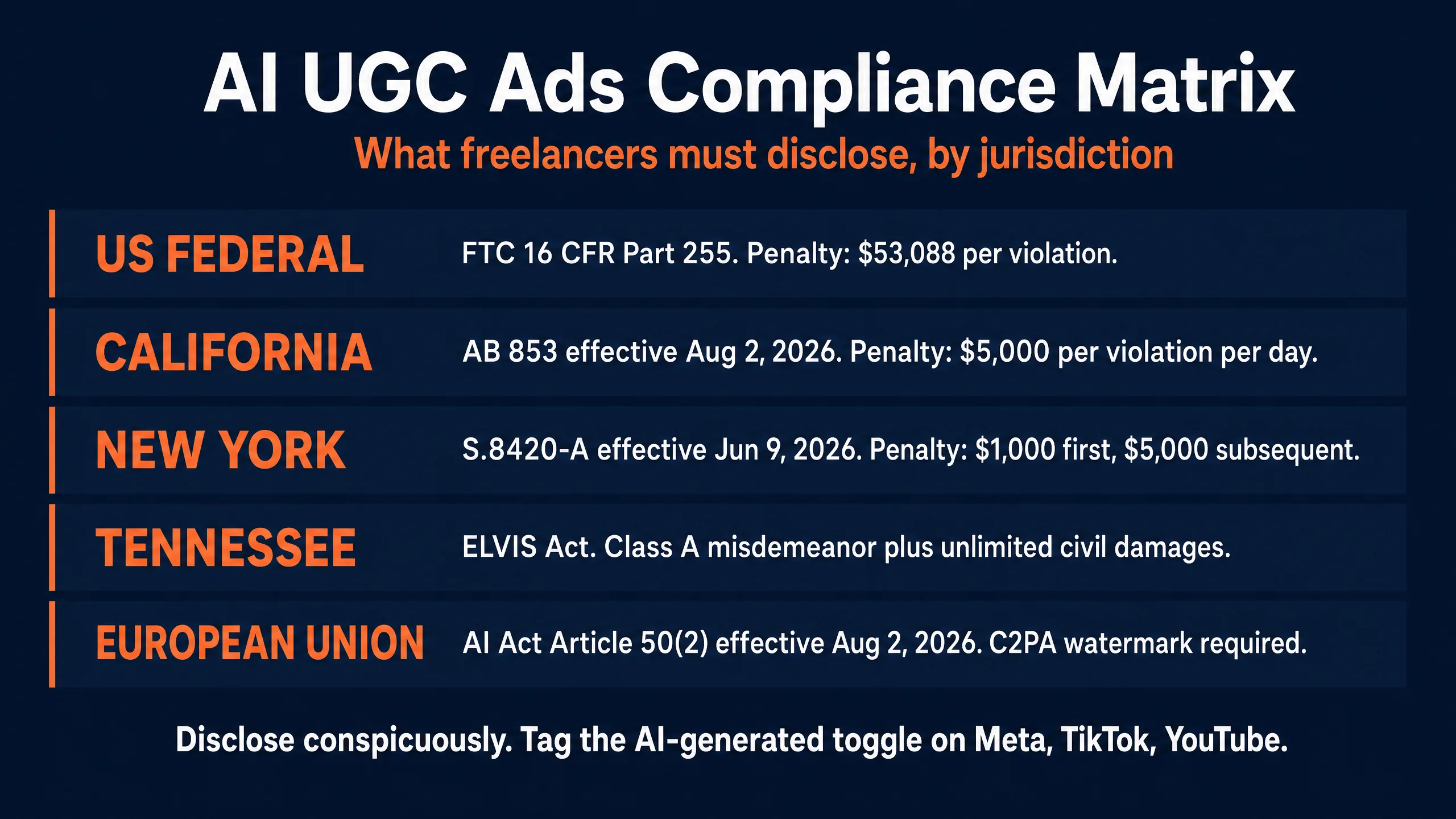
AI UGC freelancers operating in the US must comply with FTC Endorsement Guides 2024 (16 CFR Part 255) with disclosure penalties up to $53,088 per violation, plus state-specific synthetic-performer laws including California AB 853 ($5,000 per violation per day, effective August 2, 2026), New York S.8420-A ($1,000 first / $5,000 subsequent, effective June 9, 2026), and the Tennessee ELVIS Act (Class A misdemeanor plus unlimited civil damages). EU-facing campaigns must comply with EU AI Act Article 50(2) effective August 2, 2026.
FTC Endorsement Guides 2024
The FTC aggressively monitors AI-generated testimonials under 16 CFR Part 255. If an AI avatar is endorsing a product, the content must explicitly disclose that the performer is synthetic at the point of recommendation. The FTC penalty cap for endorsement-disclosure violations is $53,088 per violation. In affiliate marketing contexts, each non-disclosed video and each consumer view can theoretically be stacked as a separate violation, which compounds liability quickly for any operator running high-volume creative.
Disclosure must be conspicuous. A small text overlay reading “AI” at the bottom of the screen is not conspicuous. The FTC has indicated that disclosure should be in voice-over, on-screen text equivalent in size to other on-screen text, and integrated into the testimonial structure itself.
State Synthetic-Performer Laws
Five US states have enacted or are about to enforce specific legislation around digital replicas and synthetic performers as of mid-2026.
California AB 853 (AI Transparency Act) requires AI developers to provide tools to detect AI-generated content. The act becomes enforceable on August 2, 2026, with a penalty of $5,000 per violation per day. For freelancers, the practical implication is using detection-friendly tools (those that embed C2PA metadata by default) and being prepared to demonstrate the provenance of any AI-generated asset on request.
New York S.8420-A becomes effective June 9, 2026. Advertisers must conspicuously disclose the use of a synthetic performer. The penalty is $1,000 for a first violation and $5,000 for subsequent violations.
Tennessee ELVIS Act protects voice and likeness, making unauthorized voice cloning a Class A misdemeanor. Fines can reach $2,500 plus unlimited actual and punitive civil damages. Critical implication for ElevenLabs voice cloning workflows: obtain explicit written consent from the voice owner before training a clone, even if the voice owner is the client or founder themselves.
Illinois Right of Publicity and Washington state digital replica bills introduce similar protections with slightly different penalty structures. As an operator, treat any voice or likeness clone as requiring documented written consent regardless of jurisdiction.
EU AI Act Article 50(2)
For DTC brands advertising into the EU market, compliance with EU AI Act Article 50(2) is non-negotiable starting August 2, 2026. The article requires machine-readable watermarking at the point of creation (C2PA metadata) and conspicuous labeling for end-users when encountering synthetic audio, video, or image content.
Practical implications for the True Models stack:
- Veo 3.1 enforces a permanent SynthID watermark that cannot be disabled via API.
- ElevenLabs utilizes C2PA metadata tagging which is on by default.
- Seedance and Kling embed subtle visual watermarks on consumer tiers but allow API-tier removal.
- HeyGen Avatar IV requires explicit disclosure tagging in the published video.
IP Indemnification: Why Vertex AI Matters
To protect against intellectual property claims regarding model training data, freelancers should route premium client video work through Vertex AI for Veo 3.1. Google explicitly provides IP indemnification on this path, with the indemnification cap tied to the enterprise contract value. Consumer-tier subscriptions (HeyGen Creator, Midjourney Standard, Kling consumer) do NOT carry indemnification protection, leaving the freelancer fully liable if a generated asset infringes on existing copyright.
For deeper coverage of AI content disclosure requirements across all major platforms, see the AI Disclosure Compliance pillar and the Stable Audio 3.0 commercial-use section in the Stable Audio 3.0 pillar.
FAQ
How much does it cost to produce a single 30-second AI UGC clip in 2026?
The single-generation compute cost for a 30-second AI UGC clip on the True Models stack ranges from $1.20 to $2.84 depending on routing. In practice, this number is misleading because almost every image and video clip needs to be regenerated 3 to 5 times to land a take that meets client quality bar. The realistic average for a skilled operator is roughly $20 per finished client-quality clip. An unskilled operator can burn $100 to $200 chasing the same shot. Prompting skill is what separates the two outcomes. The same clip charged to a DTC brand client retails at $500 to $1,200.
Which AI tool is best for talking-head spokesperson UGC?
HeyGen Avatar IV is the strongest choice for talking-head spokesperson UGC in 2026 because of its lip-sync fidelity at the 30-to-60-second clip length where other models drift. Veo 3.1 and Seedance 2.0 produce talking heads but lip-sync coherence degrades after 10 seconds, requiring multi-clip cut-stitching that adds production time. HeyGen costs $4 per minute at the Business tier.
Do I need to disclose that an ad uses AI-generated content?
Yes. Both federal FTC rules (16 CFR Part 255, penalty up to $53,088 per violation) and state laws (California AB 853 effective August 2, 2026; New York S.8420-A effective June 9, 2026; Tennessee ELVIS Act) require conspicuous disclosure that AI was used to generate the testimonial. Meta, TikTok, and YouTube also require operators to toggle the “AI-generated” flag during ad campaign setup, with immediate account suspension for failure to do so.
How many DTC clients do I need to reach $10,000 MRR?
Reaching $10,000 in monthly recurring revenue typically requires 4 to 5 mid-tier retainer clients each paying $2,000 to $2,500 per month for an Always-On Creative Retainer or a custom monthly bundle. Solo operators can manage this client load while maintaining qu