
Everyone knows the story of the Kalshi ad. A solo operator made a commercial with AI, it ran during the NBA Finals, it got more than 20 million impressions, and it cost about $2,000.
That last part is wrong, and the way it is wrong tells you everything about this business.
NPR reported the $2,000 figure accurately, but read what it actually says. The number came from Kalshi’s own spokesperson, and it covers the cost of prompting the AI and nothing else: “the actual cost of prompting the AI, what is being used in lieu of studios, directors, actors, etc., was under $2,000.” And then, in the same article: “Kalshi’s Jack Such declined to disclose Accetturo’s fee for creating the ad.” (NPR, June 2025)
So what does the man actually charge? His own studio, Genre.ai, prices a 30-second commercial at roughly $100,000, while the compute behind it runs to a few thousand dollars (Semafor, September 2025).
Two thousand dollars of compute. A six-figure invoice.
That gap is not a markup on server time. That gap is you.
You are not going to charge $100,000 next month. But the gap is real at every level of this business, and the version of it you can reach this quarter is a monthly retainer between $1,500 and $4,500, paid by a brand whose ad account is permanently hungry. That is what this article is about: what the retainer is, why the platforms force it to exist, and how to get on one. It is method two in our make-money-with-AI pillar.
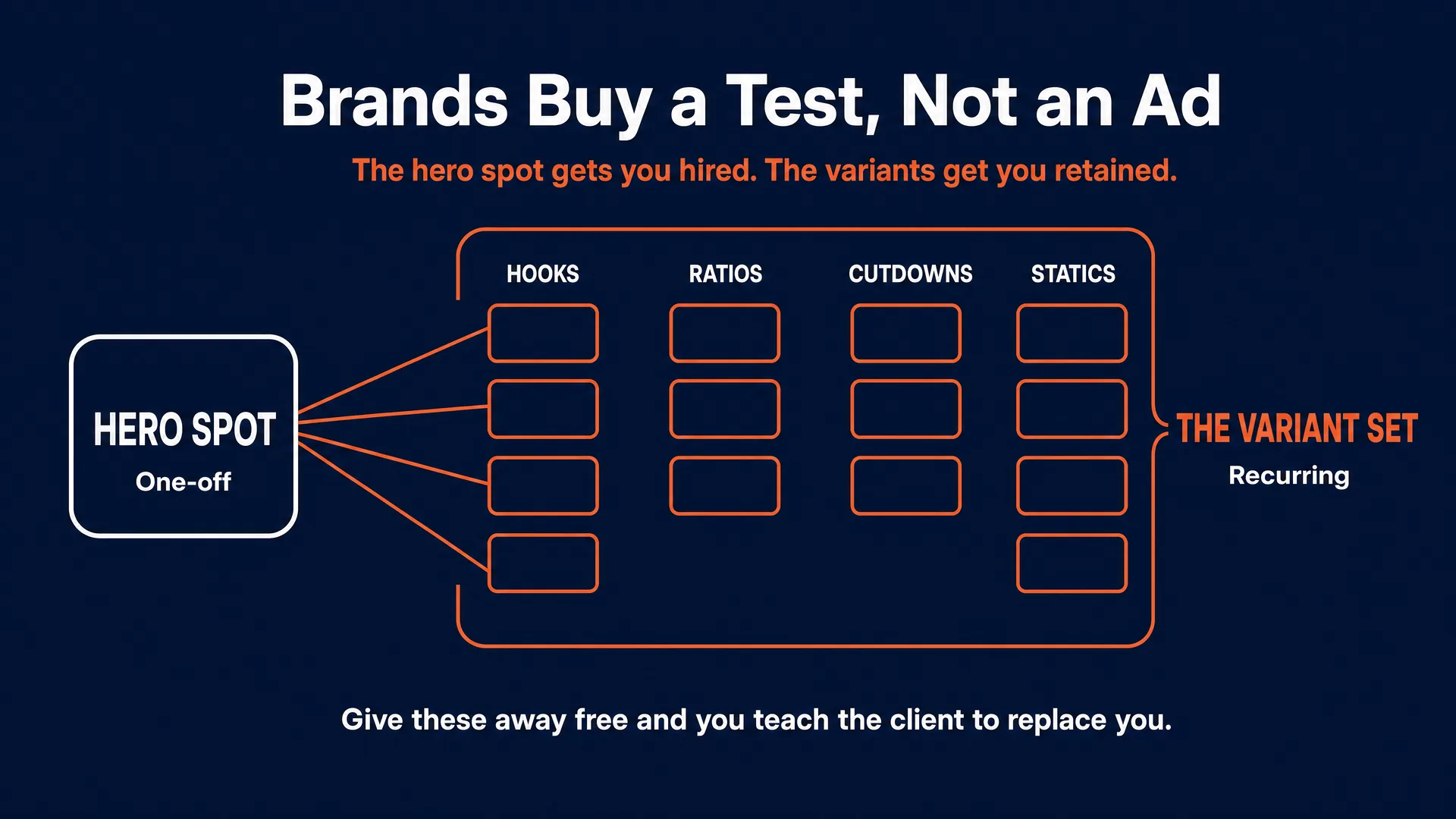
Brands do not buy an ad. They buy a test.
Here is the sentence that reframes the whole business, from Aaron Edwards, founder and CEO of The Charles Group, describing a real client brief:
The task called for “300 unique assets that are all under the same concept.” By the time his team gamed it out across four target personas with five concepts each, the job needed 1,000 creative assets (Marketing Brew, April 2026).
One concept. A thousand assets. No film crew on earth produces that.
This is not a creative brief. It is a supply problem, and it exists because modern ad platforms do not run on the strength of one beautiful video. They run on volume, and they eat creative alive.
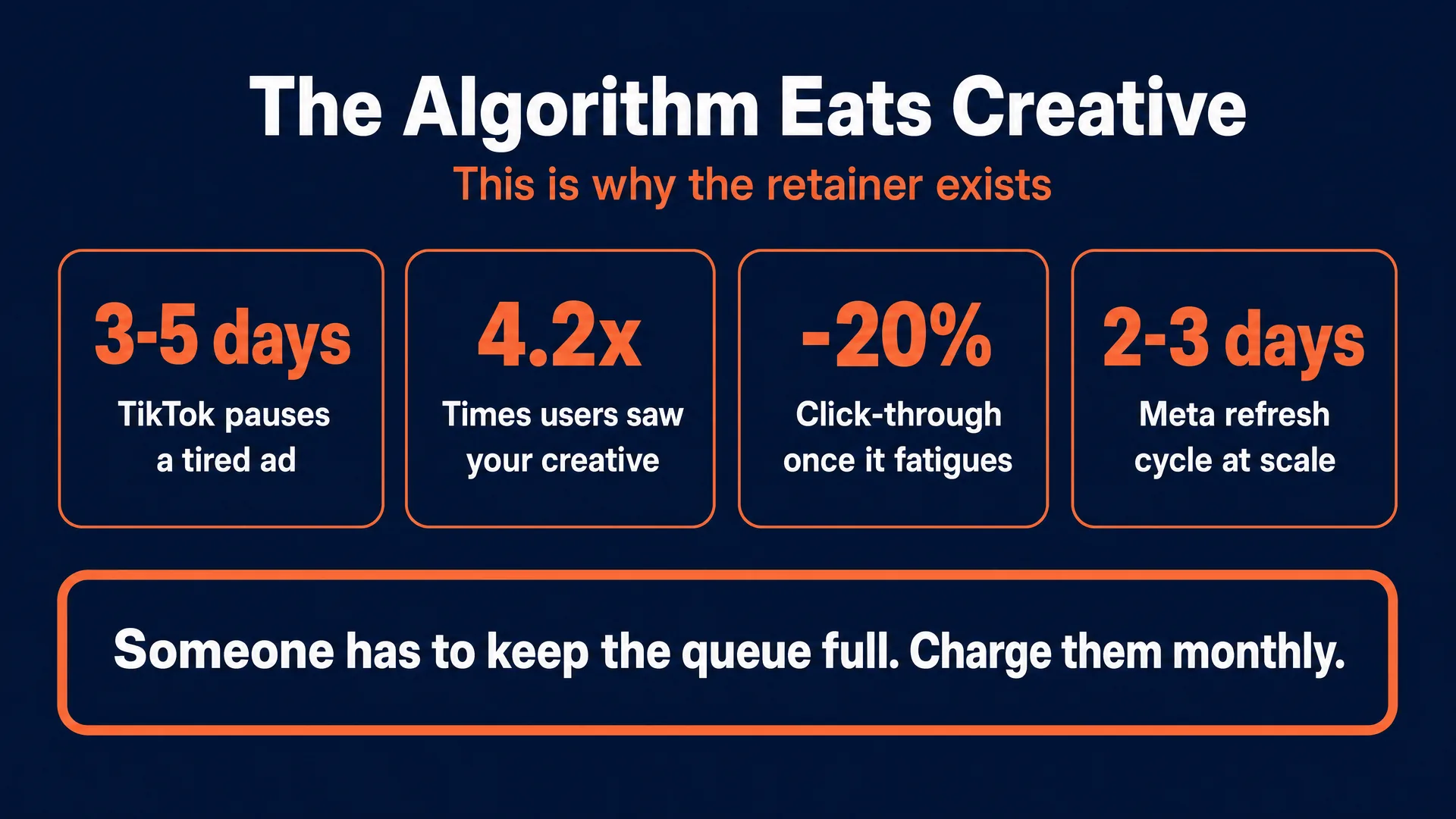
The platforms say so themselves. TikTok’s official guidance is to run “between 3-5 different creatives per ad group and 3-5 diversified ad groups per campaign,” and to refresh when performance shows “a consistently declining trend.” Its own words: “Having a consistent supply of creatives to refresh is one way to keep your campaigns going” (TikTok for Business).
And TikTok’s algorithm enforces it mechanically. Smart Creative watches your videos, pauses one showing fatigue within three to five days, and immediately substitutes the next video from a waiting list (TikTok Ads Manager). If there is nothing in that queue, the campaign stalls.
Meta has the receipts on why. Its own analytics team found the average user had already seen the same creative 4.2 times in 30 days, that nearly 19 percent of impressions land on creative someone has already seen five or more times, and that even moderate fatigue drags CTR down by around 20 percent. Their conclusion is the one that pays your invoice: adding new creative into fatigued ad sets produces a causal improvement in conversion rates.
Meta’s refresh cadence scales with the budget. Under about €2,000 a month, a monthly audit with one or two new variants is enough. Between €2,000 and €10,000 a month, frequency accumulates so fast that fresh creative has to go in every two to three days.
And the volume data backs the whole argument. Motion’s 2026 creative benchmarks, drawn from 550,000+ Meta ads representing about $1.3 billion in spend, found that at the same budget tier, average accounts ship about 11 ads a week and find 1.75 winners a month, while top performers ship about 31 ads a week and find 6 winners. Same money. Three times the volume, three times the winners.
So the business is not “make a beautiful commercial.” The business is: be the person who keeps the queue full.
The hero spot gets you hired. The variant set gets you retained.
Think of the deliverable as two things, not one.
The hero spot is the 15 or 30 second anchor. It establishes the concept, the look, and the promise. It is what wins you the contract and what goes in your reel.
The variant set is everything that turns that concept into a test:
- Hook variants. Different first three seconds. This is where the money is, because the first three seconds decide whether anyone sees the rest.
- Alternative endings and CTAs.
- The aspect-ratio set. 9:16 for TikTok, Reels and Shorts. 1:1 for feed. 16:9 for desktop and connected TV.
- The cutdown set. 30s, 15s, 6s bumper.
- Static frames pulled from the video, so the buyer has matching image ads.
The hero spot is a one-off. The variant set is the subscription. And the reason it recurs is not that you are clever. It is that the algorithm burns creative on a three-day clock and someone has to keep feeding it.
That is the retainer, and it is not an upsell. It is the actual product.
What you charge (and why $200 is not a business)
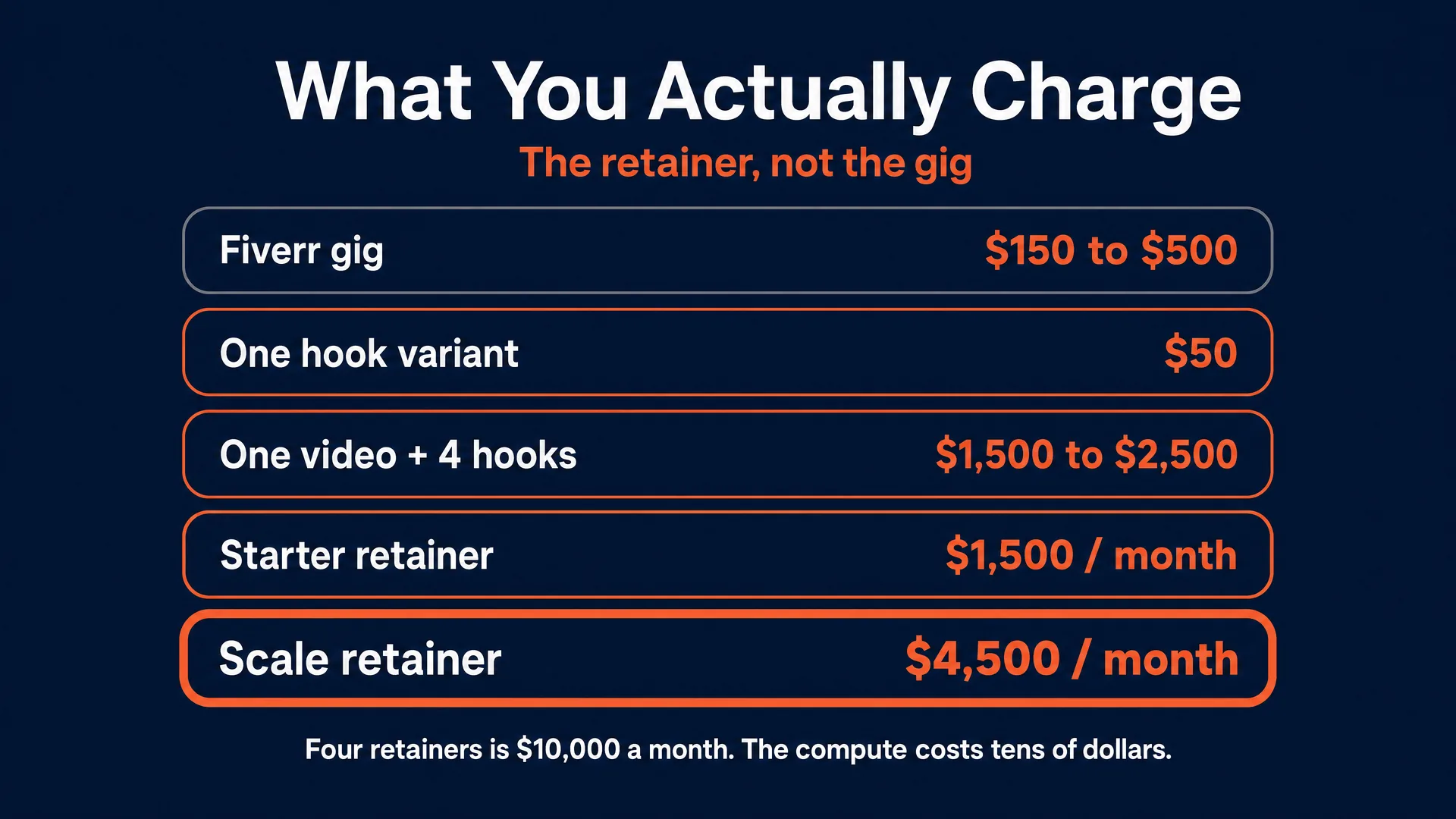
Let us be blunt about the bottom of the market. Fiverr AI ad gigs run $10 to $200. A live Upwork posting in June 2026 offered $150 fixed for an AI video ad.
That tier is real, and performance marketers reject its output. It is templated, and the media buyer can generate templated work themselves in ten minutes with a one-click tool. Templated output that the client can make in-house is exactly why nobody pays a premium for it.
Here is what the market actually pays.
| What you sell | Real price | Source |
|---|---|---|
| Hook variant (each) | $50 | Published UGC rate card |
| One video + 4 hook variations | $1,500 to $2,500 | inBeat Agency rate card |
| Starter retainer: 6 statics, 4 hook-first videos with variants, 1 revision, 72hr turnaround | ~$1,500/month | Impaqt Studios |
| Growth retainer | ~$2,500/month | Impaqt Studios |
| Scale retainer: 24 statics, 16 videos with variants, strategy, 3 revisions | ~$4,500/month | Impaqt Studios |
| Batch pricing: 20 videos / 40 videos / 80 videos | €500 / €400 / €363 per video | Admiral Media |
| 30-second commercial, top of market | ~$100,000 | Genre.ai, via Semafor |
Look at Admiral’s numbers again. The per-video price falls as the volume rises. That is exactly how a variant business is supposed to price, and you can copy the shape of it directly.
Four growth retainers at $2,500 is $10,000 a month of recurring revenue, against compute costs measured in tens of dollars.
Never bill hourly. AI compresses weeks into days, so an hourly rate punishes you for every efficiency you build. If you spend twenty hours automating your pipeline and halve your production time, hourly billing cuts your income in half as a reward. Price the deliverable and the testing volume, never the clock.
The most expensive mistake in this business
Beginners hand over the hero spot and throw in the variants free. They feel generous. The variants were “just a few prompt swaps,” after all.
Two things are wrong with that.
First, you are underpricing against the documented market. Variants are a billed line item. inBeat’s rate card literally prices “1 video + 4 hook variations” as a product. Published UGC rate cards charge $50 per additional hook or CTA variation. Give them away and you are not being generous, you are working below the going rate.
Second, and this is the one that ends your business: you are teaching the client to replace you.
Hand a media buyer one hero video plus a dozen AI variants for free and you have just demonstrated, in one delivery, that the variants are trivial to produce. They now know what the tools cost. You have shown them they do not need you. The variant set is not a bonus you attach to the real work. In a performance account, the variant set is the real work, and it is the only part that recurs.
Put a revision cap in writing too. Two or three rounds included, more billed. AI output is subjective, and unlimited revisions on subjective work will eat every hour you saved.
Usage rights: the pricing axis nobody tells you about
This is standard in advertising and almost nobody arriving from AI video has heard of it.
Your client is paying for two separate things: the labour of producing the creative, and the right to run it. That right is scoped by four dials: term (how long), territory (where), media (which channels), and exclusivity.
The broader the licence, the higher the fee. Trade-association guidance puts the default licence term at one year absent other agreement, and gives worked examples where a $1,000 base fee for three months of use scales to $2,000 for a full year. The ASMP explains the logic plainly: it is like buying a TV slot, and a Super Bowl slot costs more because more people see it.
Industry rate cards reflect it: paid-media usage typically adds 20 to 50 percent on top of the base fee, and a perpetual licence adds 100 to 150 percent.
Charge for usage. If the client wants the spot for a year, globally, across every channel, in perpetuity, that is not the same product as a 90-day regional test, and it should not be the same invoice.
The workflow, and five prompts you can run today
Which model does which job:
- Nano Banana Pro builds the locked reference frames. About $0.15 an image at 1K or 2K on fal.ai.
- GPT Image 2.0 is the alternative, stronger on structure and text. Roughly $0.005 to $0.401 depending on size and quality.
- Kling O3 Standard is the workhorse video model at $0.084/sec (about $0.42 for a 5-second clip). Cheap enough to iterate hard.
- Seedance 2.0 is the physics model, from $0.2419/sec on the fast tier. Use it where something must collide, splash, or move with weight.
- DaVinci Resolve (free tier) for the cut, the grade, and the export.
- ElevenLabs for voiceover. Note: the free tier excludes commercial use. Starter at $6/month is the real floor for anything running as an ad.
Run these through fal.ai or Replicate (AVB is not affiliated with either; check fal.ai first). PromptWise runs Nano Banana Pro and GPT Image 2.0 for the keyframe stage.
The workflow: take the client’s real assets (product photos, palette, logo, guidelines) → build the locked reference frame → image-to-video every shot from it → assemble, grade and composite in Resolve → then produce the variant set from the same shot library.
Lock the reference frame first
Text-to-video will not hold a product or a face across a multi-shot ad. Prompt the same product five times and you get five slightly different products: the label reshapes, the proportions shift, the colour drifts.
Generate one image that fixes the product, the lighting, the palette and the look. Then image-to-video every shot from that frame or its descendants. The locked frame is both your consistency anchor and your cost anchor, because every variant you build later reuses it instead of regenerating from zero.
1. The locked brand reference frame (Nano Banana Pro, text-to-image)
Commercial product photography of [the client's product], centred on a clean [surface]. Soft diffused key light from the left, subtle shadows falling right. Brand palette of [colour A] and [colour B] reflected in the surrounding props. Photorealistic, 50mm lens, shallow depth of field, sharp focus on the product. Neutral studio environment. NO text, NO logo, NO typography anywhere in the frame.Note the last line. We will come back to it, and it matters more than anything else in this section.
2. The product hero shot (Kling O3 Standard, image-to-video, 5s)
Using the attached reference image, keep the product completely identical: exact shape, proportions, colour, and materials. Slow cinematic orbit from left to right around the product. The lighting environment stays locked and unchanged. CRITICAL: do not morph the product geometry, do not invent buttons, ports, or details that are not in the reference. Do not add text or logos.Cost: about $0.42.
3. The spokesperson shot (Kling O3 Standard, image-to-video, 5s, 9:16)
Using the attached character reference image, keep the person completely identical: same face, same hair, same clothing, same skin texture. She looks directly into the lens with a confident, warm expression and nods once. CAMERA: locked medium close-up, no movement. LIGHTING: soft, neutral, matched to the reference. Do not alter her face or wardrobe.Cost: about $0.42.
4. The lifestyle in-use shot (Seedance 2.0 fast, image-to-video, 5s)
Using the attached reference image, keep the product completely identical. An over-the-shoulder tracking shot follows a pair of hands using the product naturally. Background is a bright, modern [setting], softly out of focus. Motion is smooth and physically accurate. CRITICAL: the product must not change shape, colour, or detail.Cost: about $1.21. Seedance for the hands and the physical interaction.
5. The variant prompt (Kling O3 Standard, image-to-video, 3s, 9:16). THIS IS THE MONEY PROMPT.
Using the SAME reference image as the base spot, generate an alternative opening hook. Keep the product, lighting, and environment completely identical. New action: a fast macro pull-back from a close detail of the product to reveal the whole product. CAMERA: aggressive, rapid pull-out designed as a scroll-stopping pattern interrupt. Everything else unchanged.Cost: about $0.34.
Read that price again. A hook variant costs about thirty-four cents. You can generate ten to fifteen alternative openings for less than the cost of regenerating one base spot. That is the entire economic engine of this business, and it is why the variant set is a product and not a favour.
The variant workflow
Separate the angle from the hook. The angle is the core promise. The hook is the opening execution of it. Lock the angle, then generate many hooks against the same reference frame, the same body, the same CTA. Only the first three seconds change.
Build a shot library, not a spot library. Generate the reference frames once, then a bank of clips from them, then recombine in the edit rather than regenerating whole spots. Re-cut whenever the change is structural (order, pacing, ending). Only regenerate when the variant genuinely needs new visual content.
Never generate the logo
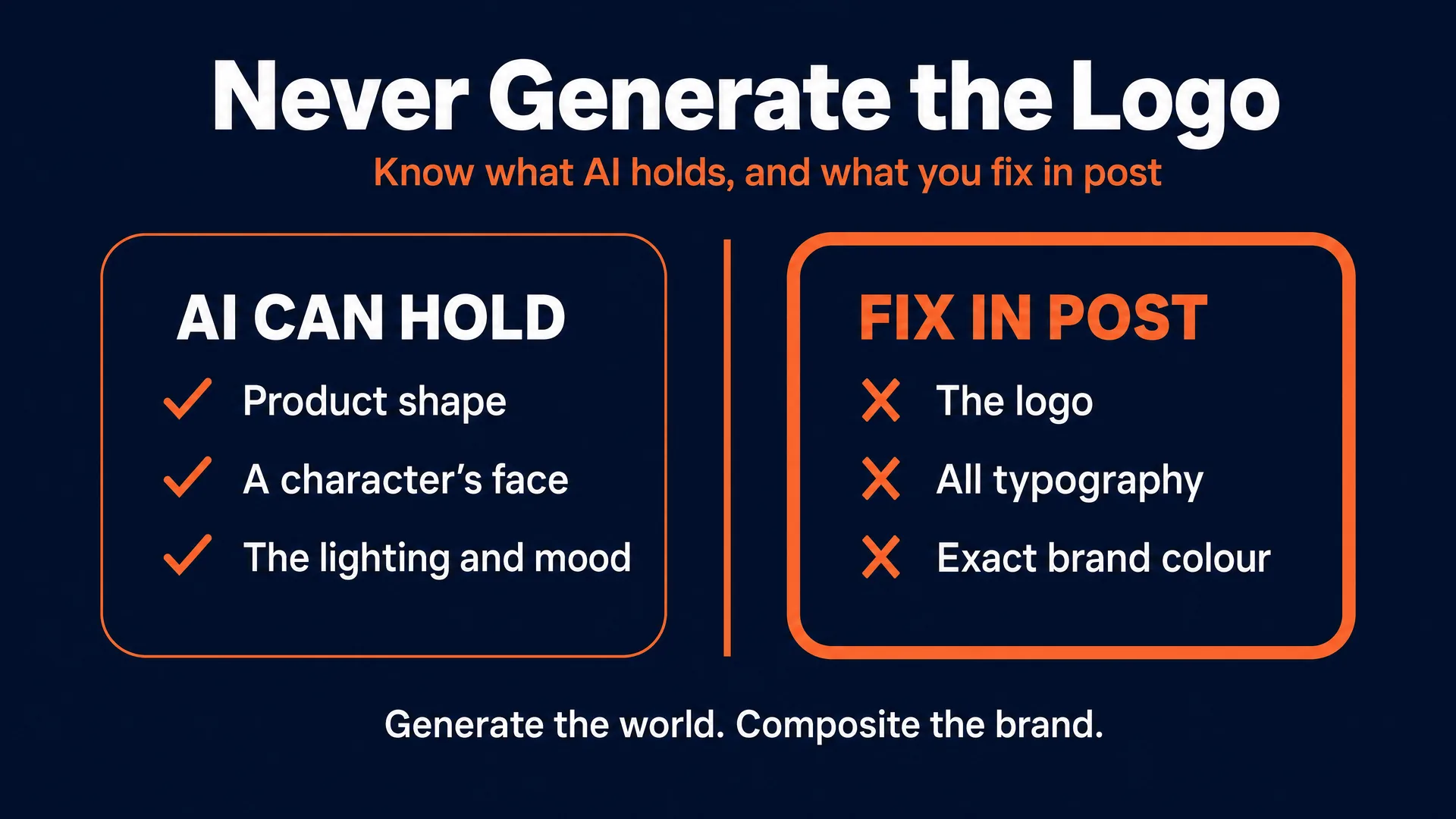
This is the single most useful sentence in this article, and no tool demo will ever tell you.
AI models cannot reliably render a logo. Under camera movement, logos warp, morph, lose their proportions and dissolve into garbled geometry. Typography is worse: hallucinated lettering, spelling errors, melting fonts, kerning that shifts mid-shot.
The professional workflow does not fight this. It routes around it:
Generate the environment and the motion with AI. Then track and composite the client’s real vector logo over the footage in DaVinci Resolve. Put every piece of typography, every subtitle, every CTA in post. That is why the reference-frame prompt above ends with “NO text, NO logo, NO typography anywhere in the frame.”
The same applies to exact brand colour. No model documentation makes any claim about hitting a precise hex value, and in practice colour drifts under whatever ambient light the model hallucinates. Fix it in the grade, matching against a locked brand swatch, rather than hoping the generator nails it.
Here is what actually holds and what does not:
| What must stay identical | Can the model hold it? | What you do |
|---|---|---|
| Product geometry | Partially. Drifts on fast pans. | Locked reference frame, low-motion prompts, ruthless QC |
| A character’s face | Partially, with effort. | Locked reference frame, avoid extreme angle changes |
| Exact brand hex | No reliable claim exists | Grade it in Resolve against a locked swatch |
| Logo | No. Confirmed unreliable. | Composite the real vector file in post |
| Typography | No. | All type goes on in post |
The honest production math
Generative video is a cherry-picking process. On the Kalshi spot, Accetturo generated 300 to 400 clips to get 15 usable ones. That is a keep rate of 4 to 5 percent.
So a 30-second spot needing eight to ten final clips means roughly 130 to 170 generations, or about $75 to $95 of raw compute on Kling O3 Standard.
The compute is cheap. The labour is not. Expect the bulk of a project to be prompt iteration, review, QC, compositing and grading. And be honest with yourself about the daily reality of this job: the overwhelming majority of paid AI ad work is methodical, repetitive variant production. It is not beer-chugging aliens on national television. It is thirty versions of the same hook so a media buyer has something to test on Thursday.
How to land brands and agencies
Go to the agencies first. This is the fastest route to volume and almost nobody does it. Agencies already have the clients and the budgets; what they lack is production capacity to feed their own testing pipelines. Standard agency markup on subcontracted creative runs 25 to 50 percent, which tells you plainly that subcontracting is normal and expected. Offer a white-labelled production service and you get high-volume work without having to manage the end client.
Target the media buyer, not the creative director. Creative directors often see AI as a threat to their craft. Performance marketers and growth leads feel the pain of the three-day fatigue clock every single week. Speak their language: hook rate, hold rate, CPA, refresh cadence. An aesthetically beautiful video that does not stop the scroll is worthless to them, and saying so out loud is how you prove you understand the job.
Find brands with tired creative. Open the Meta Ad Library, look for DTC brands running the same handful of visuals for months, or leaning on statics because they have no video budget. That is a queue about to run dry.
The outreach that should work: find an ad they are running right now, identify the weakness in its first three seconds, and build them a better hook variant. Send it. It is the ad-creative equivalent of a free sample, and it hands the buyer an asset they can drop straight into the account and test. Being honest: this tactic is widely recommended and I could not find a documented case of it landing paid work. Treat it as a strong bet, not a proven formula.
Convert to a retainer on the first call. When a client asks for one hero video, tell them the truth: it will fatigue within days, TikTok will pause it and reach for the next thing in the queue, and there will be nothing there. The retainer is not an upsell. It is the infrastructure the platform requires.
A warning about spec ads
The standard advice is to make an unsolicited ad for a brand you admire and post it publicly to attract clients.
The advertising industry’s own body says do not do that. The AICP (Association of Independent Commercial Producers), in its guidance on using third-party trademarks in spec spots, recommends a prominent disclaimer and, explicitly, to keep the commercial off the internet unless access is limited and restricted to the trade.
The reason is trademark exposure. Nominative fair use protects referential use, like comparisons and repair services. A spec ad creates new brand-styled creative, which is a much weaker position, and monetising it pushes you toward a false-endorsement claim.
So: make the spec spot. Disclaim it clearly. Share it privately in your pitch, or build it for a fictional brand. Do not post it on YouTube with the brand’s logo on it and hope.
The rules that keep you and your client out of trouble
This is practical guidance, not legal advice.
An ad is a claim, and the FTC can come for you, not just the brand. This is the one that should focus the mind. The FTC’s Endorsement Guides state that “advertising agencies… and other similar intermediaries may be liable for their roles in creating or disseminating endorsements containing representations that they know or should know are deceptive.” The FTC has been even blunter in its own guidance: more than fifty years of cases establish that agencies can be liable, “the FTC looks to the facts, not the grey flannel suit,” and, critically, “indemnities from clients will not shield agencies against an FTC action.”
So: never invent a product feature. Never fabricate a result or a statistic. Never fake a testimonial. Under Operation AI Comply, launched in September 2024, the FTC’s position is that “there is no AI exemption from the laws on the books.”
An AI spokesperson can legally count as a testimonial. The FTC’s own guidance says there is no blanket ban on AI avatars, but that using one “might be considered a testimonial,” and it is prohibited if the underlying testimonial is fake or false. Using a celebrity’s AI likeness to speak favourably about a product without permission is a violation if consumers would think the endorsement was real.
New York now requires ad-specific disclosure, and it is already in force. Under a law effective 9 June 2026, anyone who “for any commercial purpose produces or creates an advertisement” must conspicuously disclose that a synthetic performer appears in it, where they have actual knowledge. $1,000 for a first violation, $5,000 for each one after. Note the wording: it lands on the person who produces or creates the ad.
Platform ad rules are not the same as organic content rules. TikTok’s ad policy allows AI content if it is labelled, and states the consequence plainly: “If we identify AI-generated content that has not been disclosed, your ad will be rejected or restricted” (TikTok Ads Policy). Meta requires hard disclosure on political and social-issue ads, and applies a lighter “AI info” label to commercial ads, partly detected automatically through C2PA metadata that your export may carry whether you declare it or not. Google mandates a synthetic-content checkbox for election ads.
The EU AI Act’s transparency obligations bite on 2 August 2026. The “artistic or creative work” carve-out does not exempt anything; it only softens how the disclosure is presented. Advertising is not named as exempt.
Never generate a recognisable real person. Right of publicity is state law in the US and it varies. Tennessee’s ELVIS Act covers AI-simulated voice and has been in force since July 2024. The federal NO FAKES Act is still not law as of mid-2026, despite advancing out of Senate Judiciary. And accidental resemblance is a real risk, not a theoretical one: Shein had to pull an AI-generated model that closely resembled a real, identifiable person. The test is whether the output is identifiable, not whether you meant it.
One contract detail that surprises almost everyone: “work made for hire” does not legally apply to most ad creative. Under US copyright law it only covers nine narrow statutory categories, and standard ad graphics and video generally fall into none of them. Labelling your contract “work for hire” does not make it so. You need an explicit written copyright assignment clause. Get one, and carve out your right to show the work in your portfolio while you are at it.
The honest counter-signal
You should know what you are walking into.
Media buyers are not sold. Hayley Owen, SVP and group media director at Deutsch: “Most of our clients want to retain control because they put so much time and effort into crafting what their brand is… I haven’t yet come across a client that said, ‘You go for it.’” Daniel Johnson of We Scale Startups says of the platforms’ native AI creative tools: “We do experiment on a regular basis… and just consistently see worse results.” He does use AI creative, but through his own pipeline with tight brand guidelines. That distinction is the whole ballgame.
Brands have been burned in public. McDonald’s Netherlands pulled an AI-generated Christmas ad within days after backlash. Coca-Cola took criticism for its AI Christmas ad two years running.
And the purest version of this business already failed. Icon.com raised money from Founders Fund, spent $12 million on its domain, and called itself “the world’s first AI CMO.” By 2026 it had quietly pivoted to selling 100 percent human-filmed UGC ads and rebranded itself “The Human Admaker.”
Read that correctly. It does not mean AI ad creative does not work. It means AI instead of humans did not survive contact with the market, while AI under human direction is exactly where the money is. Which is precisely what Accetturo’s studio is charging $100,000 a spot to provide.
One more thing worth knowing before you cite anyone else’s numbers. A great deal of the AI-advertising content online anchors its argument on a “4As 2025 Production Cost Survey” showing a median of $342,000 per 30-second commercial. That survey does not exist. The 4As discontinued its TV Production Cost Survey in 2014. If a competitor’s article is built on that number, it was built on nothing, and you should not repeat it to a client.
Your first month
Week 1. Pick one product you can get real assets for, even a friend’s brand. Build the locked reference frame. Generate the hero spot. Composite the logo in post.
Week 2. Now build the variant set from that same reference frame: five different hooks, three aspect ratios, a 15-second and a 6-second cutdown, and four static frames. Time yourself. That set is your entire pitch, because it is the thing a media buyer actually needs and almost nobody shows them.
Week 3. Open the Meta Ad Library. Find five DTC brands running visibly tired creative. Build one better hook for one of their live ads and send it.
Week 4. Approach three small performance agencies about white-label subcontract capacity. Lead with the variant set, not the hero spot.
Your first dollar is realistically two to four weeks away. Your