
A generative AI agency produces marketing creative, video ads, UGC, product visuals, and brand content, for clients on a monthly retainer, using AI to deliver the volume a traditional studio cannot. It is one of the highest-value ways to make money with AI, and this is the complete, step-by-step guide to building one in 2026.
Here is the truth the hype skips: the tools are the easy part. Generating a slick five-second clip is trivial. Delivering thirty brand-safe, on-message, conversion-ready videos on a schedule, every month, and landing the client who pays for them, is a real business with a real sales function. Expect one to three months of consistent outreach to land your first retainer. The operators who fail almost always underestimate exactly those two things: selling, and delivering reliably.
One boundary, because it matters: this is a creative agency, not an “AI automation agency.” Automation agencies wire up chatbots and back-office workflows with tools like n8n and Zapier; that is a different business competing for a different budget. We are on the creative lane, producing content brands publish. This is one spoke of our wider how to make money with AI guide.
Below is the honest landscape, then an eight-step build you can follow start to finish, with the templates, checklists, and a 60-day plan to actually do it.
What it is, and the honest landscape
Demand is real and structural. As ad costs climb on Meta, TikTok, and Google, brands must test far more creative without inflating budgets, and traditional production (sets, talent, shipping, weeks of post) cannot keep up. So they hire partners who deliver volume through AI. Fiverr reported AI video creator searches up 66 percent in six months and AI UGC ad searches up 265 percent (Business Trends Index, Dec 2025); Upwork named AI video its fastest-growing skill, up 329 percent year on year; and Digiday found 82 percent of marketers now use generative AI for creative production.
But the market does not pay for the novelty of AI. It pays for outcomes: cheaper creative, faster iteration, better performance. And the reality is sobering. SparkToro’s 2025 survey of 376 agency owners found only 14 percent describe their sales pipeline as “healthy,” and 53 percent see AI as a threat to the model. New businesses fail at 22 percent in year one, and media and content businesses fail fastest. The operators who collapse are usually the ones who scaled generation volume without margin, or who never learned to sell.
The blunt version, from an agency founder: “AI did not kill agency value. It exposed fake agency value. If the work can be copied, templated, prompted, or bought as a software subscription, it was never defensible in the first place.” Your moat is taste, a specific niche, and reliable delivery, not “we make AI videos.” Now build it.
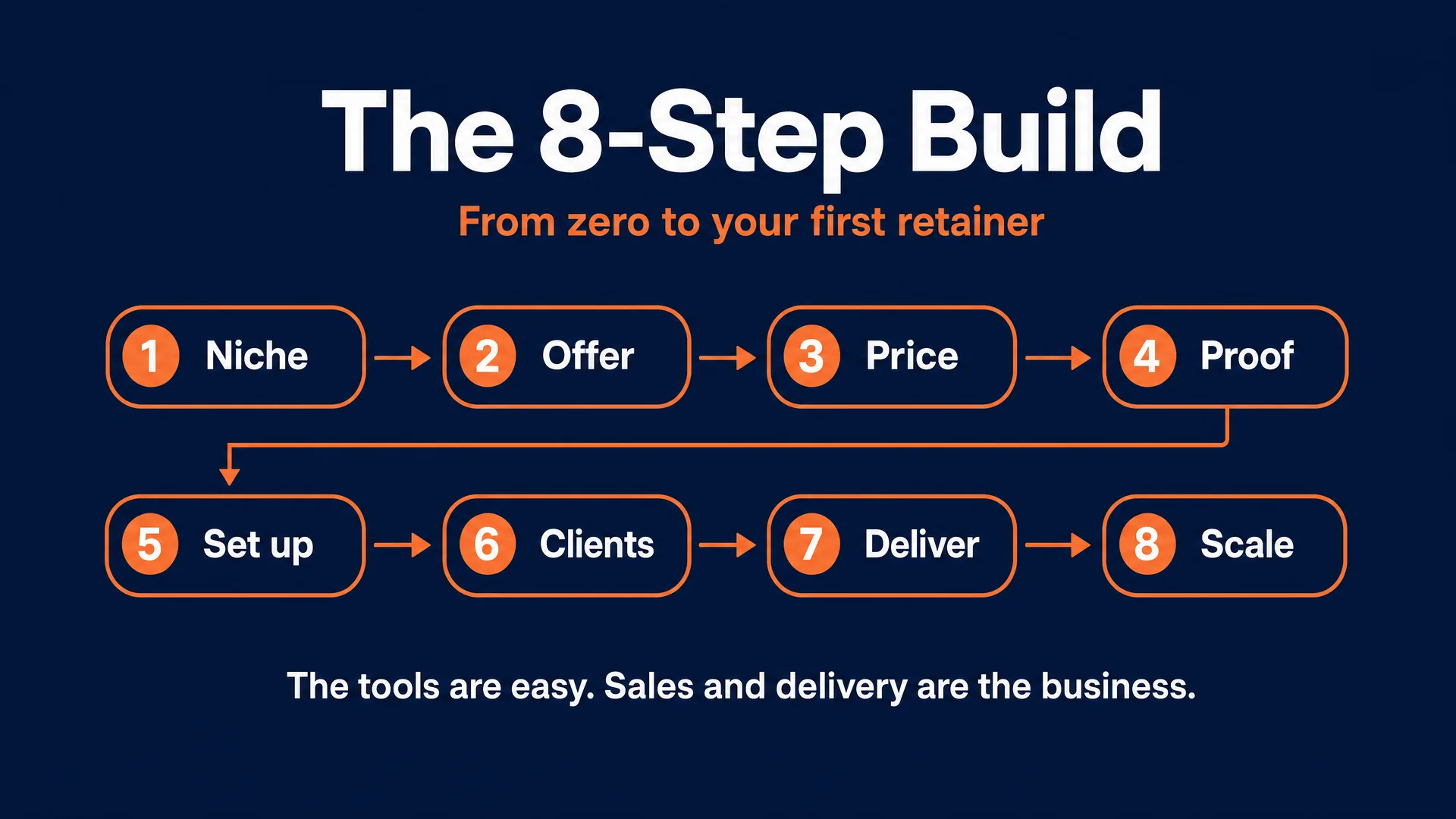
Step 1: Pick one niche (your single biggest lever)
Before an offer, before a tool, choose a niche. A generalist selling “AI content to anyone” is invisible and interchangeable. A specialist selling to one industry commands authority, charges more, and, quietly, delivers cheaper, because the prompt libraries, voices, and color presets you refine for one skincare client carry across every skincare client.
The proof is dramatic: Rankings.io niched into a single legal vertical and grew from 2 million to 12 million dollars in four years, later to 30 million, while raising minimum pricing fivefold and dropping bad-fit clients.
How to choose one:
- Pick an industry that buys creative repeatedly and has budget: direct-to-consumer e-commerce (beauty, skincare, supplements, fitness, fashion, pet, food and beverage), or local service businesses (real estate, clinics, gyms, home services).
- Pick a niche you can speak to and where you can reach the buyer directly.
- Size it sensibly: enough prospects to sustain you (thousands of brands), few enough that you can become known in it.
Write one sentence and commit: “We make [format] for [specific niche].” For example, “We make high-volume UGC video ads for DTC skincare brands.” That sentence drives everything after it.
Step 2: Define one productized offer
Pick one core service you can deliver reliably at high quality with today’s models. The four that work for a small team:
- AI UGC and performance video ads for Meta and TikTok (hook-driven, avatar plus voice plus b-roll). Deliver it with our AI UGC ads freelancer playbook and AI video ads guide.
- Product visuals for e-commerce (lifestyle and studio imagery, no shoot). Deliver it with our AI product photography guide.
- Local-business content retainers (steady social content). We have vertical playbooks for real estate, law firms, medical spas, and home services.
- Full-funnel creative (hooks, education, retargeting), the advanced offer, for later.
Now productize it: a fixed scope at a fixed price sells far faster than a custom proposal, because it skips the discovery-and-quote cycle. Write your offer in one line: format, deliverables, price, turnaround. For example: “10 UGC video ads plus 10 static ads per month, captioned, with one strategy call, for 2,000 dollars a month.” Lead with one productized package to win the first project, then convert it into a monthly retainer for stable revenue.
Step 3: Price it so you actually profit
Price for the value delivered and the human effort to finish it, never against the raw compute cost. This is where most agencies quietly go broke.
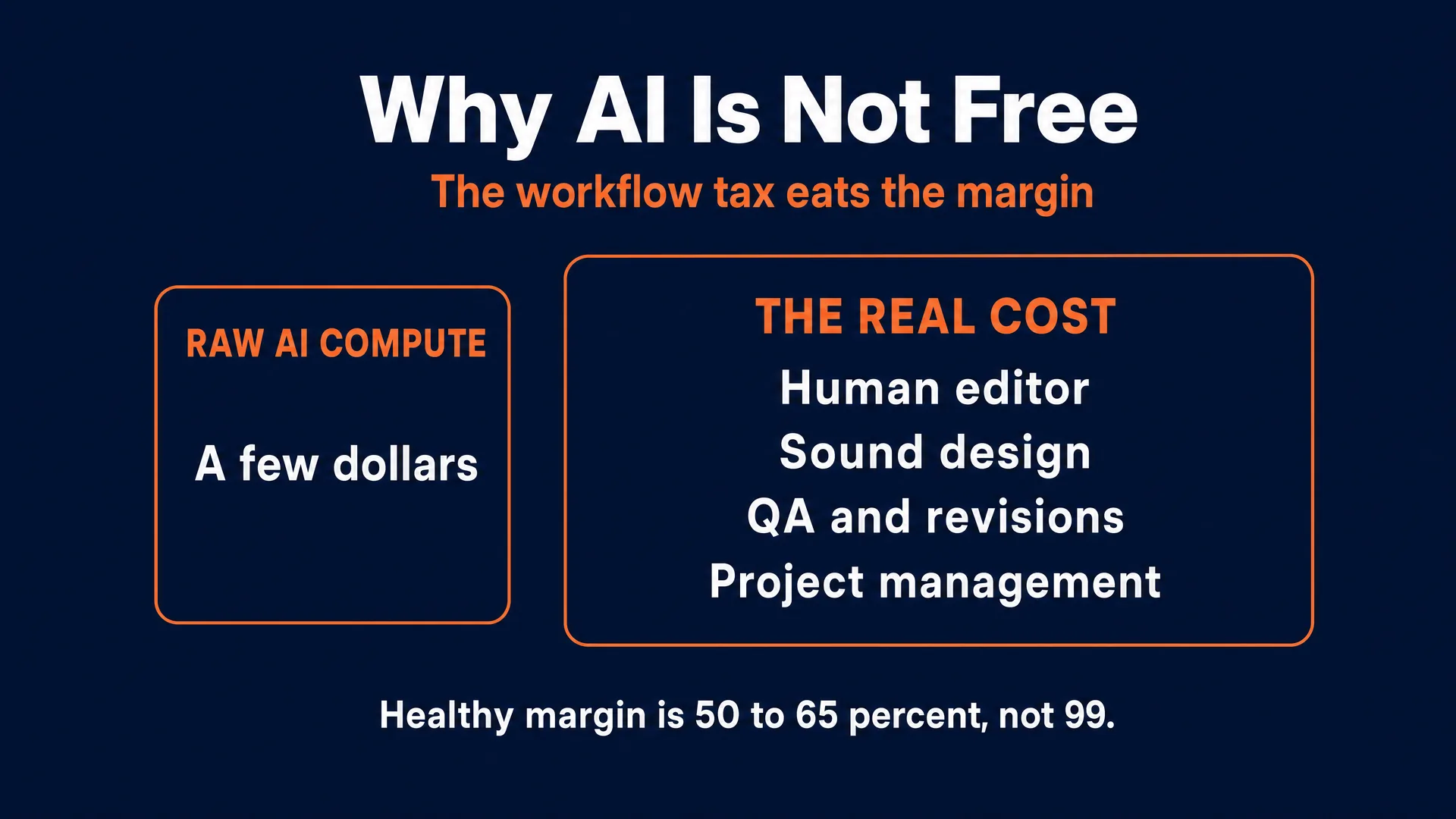
The tools cost almost nothing, and that is the trap. On fal.ai or Replicate (we are not affiliated with either, and prices are similar), a finished ad’s raw generation is a few dollars: Seedance video runs roughly 0.05 to 0.30 per second by tier, Kling around 0.07 to 0.17 per second, Nano Banana Pro 0.15 per image, GPT Image 2.0 about 0.01 to 0.13, Ideogram 4.0 0.03 to 0.10, plus paid ElevenLabs and HeyGen plans for voice and avatars. A naive operator subtracts fifty cents of compute from a 400-dollar deliverable and imagines a 99 percent margin. That fantasy is why agencies fail.
The workflow tax is the real cost:
- Iteration and discard: a usable five seconds often means generating and throwing away twenty or thirty, so real compute per usable scene is several dollars.
- The human editor: AI clips carry the “AI sheen,” inconsistent color, and abrupt cuts. An editor grades, stitches, captions, and does sound design, which as one award-winning AI studio admitted, “is doing all the heavy lifting… we spent three days just doing Foley.” Unavoidable labor.
- QA, revisions, and project management: a brand-safety review, client revision rounds (often a full regeneration), and hours of briefing and communication.
Account for all of it and a healthy margin is roughly 50 to 65 percent, not 99.
A simple method to set your floor:
- Estimate the finishing hours per deliverable (editing plus QA). Say 1.5 hours per video.
- Multiply by your blended labor rate (yours or a contractor’s). At 35 dollars an hour, that is about 53 per video.
- Add compute (a few dollars) and a per-deliverable slice of your monthly software (spread ~150 a month across your output).
- That is your delivery cost. Set the price so your margin is at least 55 to 60 percent: price is roughly your cost divided by 0.4.
- Never go below the market floor even if your cost is lower: about 300 to 500 dollars per finished video, and 2,000 to 3,000 a month for a standard retainer.
Worked example: a 10-video pack with ~700 in all-in delivery cost prices at 1,750 or more; round to a 2,000 to 2,500 retainer. Anchor the price against the client’s alternative (an in-house creative hire costs far more), and never bill hourly, because as AI makes you faster, hourly billing punishes you and invites “AI discount” requests. Here is a realistic menu.
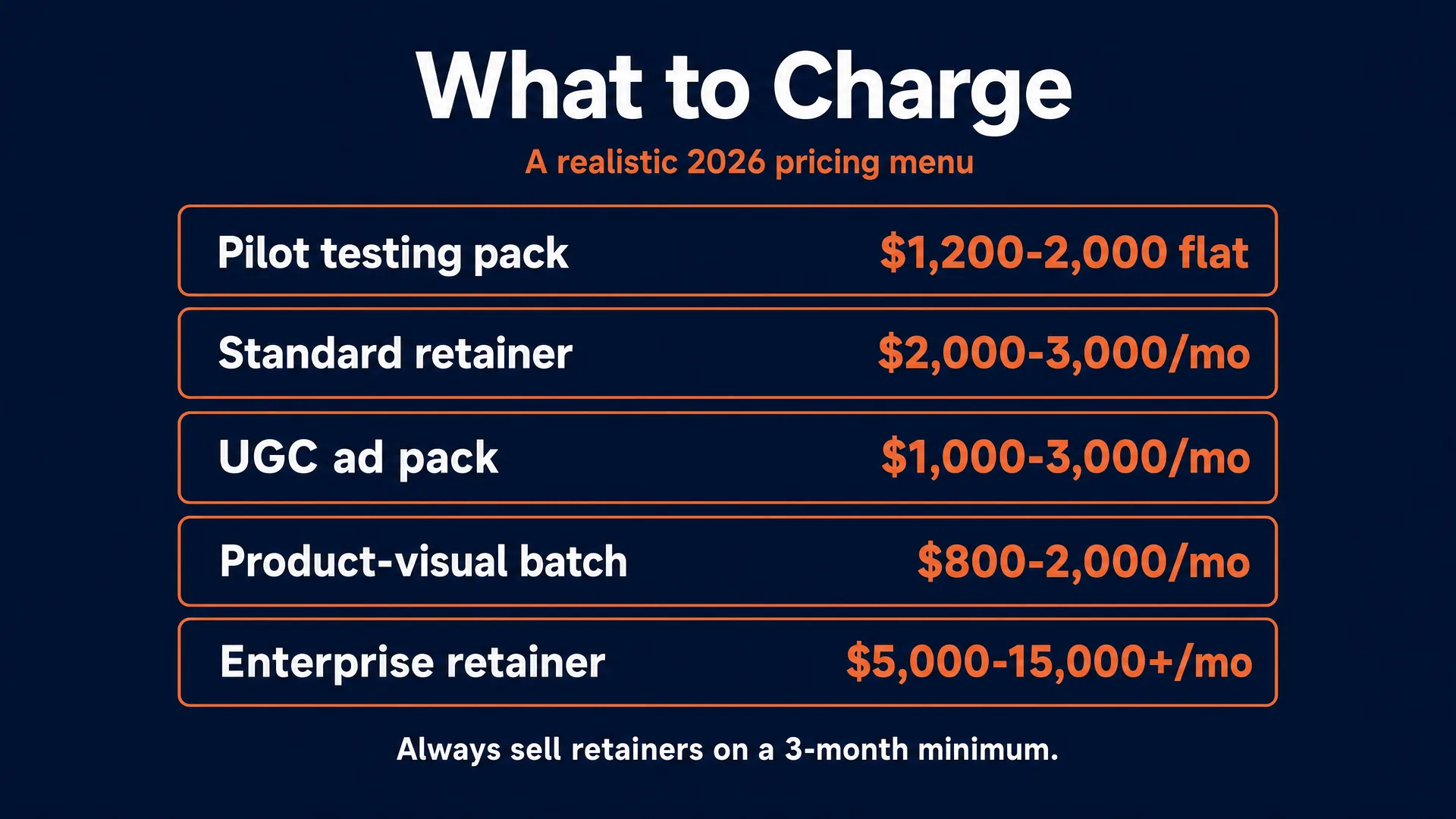
| Offer | What the client gets | Realistic price | Best-fit client |
|---|---|---|---|
| Pilot testing pack (productized) | 4 to 5 finished ads, 2 aspect ratios, ~7 days | 1,200 to 2,000 flat | A new client proving the concept |
| Standard retainer | 8 to 10 finished videos/mo, voice + avatars + QA | 2,000 to 3,000/mo | DTC / e-commerce brand |
| UGC ad pack | 10 to 20 short ads/mo | 1,000 to 3,000/mo | Brand scaling paid social |
| Product-visual batch | 10 to 20 product images/mo | 800 to 2,000/mo | E-commerce catalog |
| Enterprise retainer | High volume across markets and formats | 5,000 to 15,000+/mo | Funded or multi-market brand |
Always sell retainers on a 3-month minimum; month-to-month opt-outs kill young agencies.
Step 4: Build proof before you pitch anyone
You cannot sell an invisible service. Make one or two polished spec case studies in your niche: pick a real brand, study their current ads, and produce a genuinely better AI alternative, fully edited, graded, and sound-designed. A reel of raw, unedited generations will not convince a serious buyer; run your spec pieces through the full workflow tax so they look like real campaigns.
Present each as a mini case study, not just a clip: the problem (their creative is slow or stale), your approach, and a before/after or a clear “this took 48 hours versus a three-week shoot.” Host them on a simple, no-login page so a prospect can view and forward with one click.
Step 5: Set up the business (tools, contracts, entity)
Get the boring foundation right once, so client work is clean.
Tool stack (True Models only): Seedance or Kling for video, GPT Image 2.0 or Nano Banana Pro for stills, Ideogram 4.0 for on-image text, ElevenLabs for voice, HeyGen for avatars, run on fal.ai or Replicate, plus CapCut or DaVinci Resolve to finish. Buy the paid tiers before you bill anyone: HeyGen and ElevenLabs free tiers are non-commercial, and both fal.ai and Replicate grant commercial use of output but subject to each underlying model’s own license, so check the specific model, not just the platform.
Business setup: form an LLC to separate personal and business liability, set up invoicing, and, importantly, let the client own the underlying tool accounts and assets where possible so access and history survive if the relationship ends.
Your contract (the clauses that protect your margin):
- Scope and deliverables, with an explicit “out of scope” list.
- A revision cap (two rounds is standard), with extra rounds billed.
- IP: the client owns the final delivered asset on full payment; you keep your prompt libraries, negative prompts, and workflow templates.
- A kill fee if the client cancels mid-production.
- Payment terms: a deposit up front, the balance on delivery.
Step 6: Land your first client (the outreach playbook)
This is where agencies live or die. Nobody buys “AI capabilities”; they buy speed, savings, and performance. Run this over one to three months.
Build a list of 200 to 300 verified decision-makers in your niche: for small brands, the founder or head of marketing; for larger ones, the head of creative or performance lead. Founders at small companies reply far more than executives at large ones, so aim there first.
Run a short sequence that leads with a result, not features. Real copy you can adapt:
Day 1, cold email:
Subject: a 48-hour ad for [Brand] Hi [Name], I saw [Brand] is scaling [specific product or campaign] on [platform]. Creative testing usually bottlenecks there because production is slow. I made you one finished, brand-aligned ad to show what is possible: [link]. It took about 48 hours, versus a multi-week shoot. Open to a quick call about scaling your testing volume this quarter?
Or, as a DM (often higher engagement, because you are handing over something usable):
Loved the [specific product] launch. I made a quick 15-second demo ad of it to show what my studio can do, no strings: [link]. Hope it is useful.
Day 4, follow-up on economics:
Following up on the ad I sent. We help [niche] brands cut cost-per-asset while doubling weekly testing volume. If that fits your Q[x] goals, I have time Thursday.
Day 8, a new angle plus a new sample:
One more idea: here are three variations of your hero product in different scenes, made for A/B testing [link]. That weekly volume is exactly what we deliver on retainer.
Day 14, a clean breakup:
I will close the loop so I am not cluttering your inbox. If creative testing becomes a priority later this quarter, I would love to help. The sample is yours to use either way.
On channels: cold email averages under 1 percent reply, LinkedIn messages far higher (roughly 10 percent), and a short Loom or video pitch on freelance platforms can lift response into the high teens. Run more than one channel, and follow up, because most senders never do.
The discovery call is a diagnosis, not a pitch. Ask, then listen:
- What are you running now, and where does creative slow you down?
- How many new ad variations do you test a week, and how many do you wish you could?
- What does a piece of creative cost you today, in money and in time?
- Do you have brand guidelines, product assets, and approved claims ready?
- If a first test performs, what would you want next month?
Frame yourself as a hybrid (“AI for speed and cost, expert humans and QA for polish and brand safety”), then close a paid pilot, not a 12-month deal. Sell the 1,200-to-2,000-dollar testing pack; when it performs in their ad account, the move to a 2,500-to-3,000 retainer is a data-driven decision, not a leap of faith. Expect real acquisition cost: landing a client worth ~50,000 a year can take 4,000 to 5,000 in time and effort.
Then turn one client into the next: ask for a testimonial about a week after strong results, build a referral ask into renewals, and convert every win into the case study that powers your next round.
Step 7: Deliver it flawlessly (the production checklist)
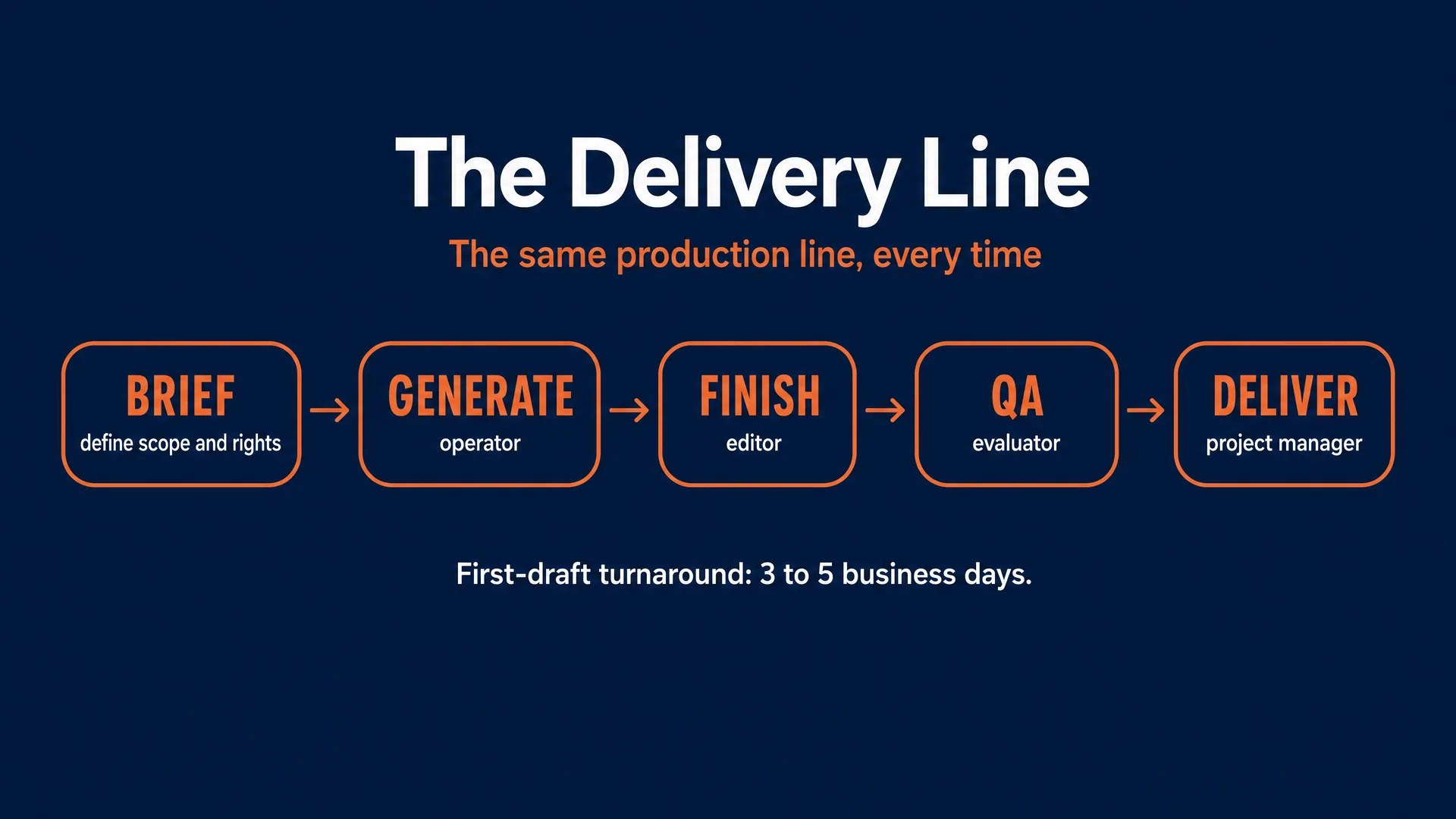
Reliability comes from running the same production line every time, not from talent alone. Here is the checklist for one deliverable, brief to delivery. (We do not re-teach the deep tool workflow for each format here; those live in the service playbooks linked above. This is the agency SOP.)
- Brief and strategy. Confirm the goal, message, format, aspect ratios, brand guidelines, the usage rights required, and the deadline. Turn it into a scene-by-scene plan and script with a chat model.
- Generate (operator). Run motion in Seedance or Kling, stills in GPT Image 2.0 or Nano Banana Pro, on-image text in Ideogram 4.0, voice in ElevenLabs, avatars in HeyGen, on fal.ai or Replicate. Generate extra coverage so the editor has options.
- Finish (editor). Unify the color grade, stitch the cuts, add captions and brand elements, and do the sound design that grounds the visuals. This is the step that makes it a commercial asset.
- QA (evaluator). Check brand fit, artifacts (warped hands, melting backgrounds, garbled text), pacing, spec compliance, and disclosure. Anything that fails goes back to generation.
- Deliver and revise (PM). Send through a client portal, set a clear turnaround (about 3 to 5 business days for a first draft), and handle revisions within the contracted cap.
Four functions run this: an operator who generates, an editor who finishes (your first hire, because finishing is the hardest, highest-leverage labor), an evaluator who protects quality, and a PM/compliance layer. At the start, you are all four.
Step 8: Scale (team and roadmap)
Once you can reliably deliver for one client, grow deliberately. Delegate editing first (it is clearly scoped and easy to QA), test a contractor with a single paid project, and fund hires from revenue, not hope. As one founder put it after stalling at 4,000 a month doing everything alone, “my ego nearly killed my business,” and doing it all yourself is “the slowest path to growth.” One operator plus one editor can realistically service 3 to 5 retainer clients before you need a real team.
| Stage | Team | Realistic revenue | Milestone |
|---|---|---|---|
| Launch (months 1 to 3) | Solo, or solo + 1 contractor | 1,000 to 3,000/mo | First paid pilot, one niche |
| Growth (months 3 to 6) | Add an editor, maybe an operator | 5,000 to 8,000/mo | 3 to 4 retainers, documented process |
| Scale (months 6 to 12) | Operator + editor + QA + PM | 10,000 to 20,000/mo | Productized offer, repeatable delivery |
| Maturity (year 1+) | Small team | 20,000+/mo | Referrals and white-label, second offer |
Revenue ranges are directional, not guarantees. Most founders reach a 5,000-dollar-a-month agency only after four to six months of real work.
The content rules that keep you out of trouble
Separate from your own business setup, the ads you produce carry their own legal exposure. Practical guardrails, not legal advice; the full legal layer is in our AI disclosure and compliance guide.
- FTC: never fake a customer. The fake-reviews rule (16 CFR 465, in force since October 2024, up to 53,088 dollars per violation) bans testimonials from people who do not exist, “such as AI-generated fake reviews.” An AI avatar posing as a real satisfied customer is exactly that. Use AI as a clear spokesperson or demo, and disclose sponsorship in-content, not just the caption.
- Likeness and IP are the litigious edge. Never generate a real person’s face or voice, a celebrity, or a brand or franchise without documented consent or a license. New laws are landing fast: Tennessee’s ELVIS Act protects voice, California’s digital-replica laws took effect January 2025, New York’s synthetic-performer ad-disclosure law is in force as of June 2026, and a federal NO FAKES Act is advancing in Congress. In practice the client is often the first target of a complaint, so your contract must spell out who clears rights and who indemnifies whom, and you should keep prompt and edit logs as evidence of process.
- Platform disclosure. Meta and TikTok both require labeling realistic AI content; build that check into your QA step so a client’s ad account is never at risk.
Your first 60 days
A week-by-week plan to go from zero to a first paying client.
- Weeks 1 to 2, foundation. Pick your niche and one offer. Write the package (format, deliverables, price, turnaround) and set your floor with the method above. Register the LLC, draft the contract, and buy the paid tool tiers.
- Weeks 3 to 4, proof. Build one or two polished spec case studies for real brands in your niche, write them up (problem, approach, before/after), and put them on a simple portfolio link.
- Weeks 5 to 6, outreach. Build the list of 200 to 300, then send 50 personalized messages a week leading with a sample, across email and LinkedIn. Post one piece of work publicly to seed inbound.
- Weeks 7 to 8, close and deliver. Run discovery calls, close a paid pilot, deliver it flawlessly through the checklist, then ask for a testimonial and a referral and convert the pilot to a retainer.
Do not expect income in the first month. Expect a live offer, real proof, and a full pipeline, which is exactly what produces income in months two and three.
Proof, and the road ahead
The model produces wildly different outcomes based purely on execution. On the success side, Jeremy Somers left traditional creative direction (for brands like Mercedes-Benz and Spotify) to build the AI-native agency NotContent.ai, insisting that “true creativity comes from humans” applied on top of AI, and the European studio YOPRST holds a 1,990-dollar floor per video and openly uses a hybrid of real hero shots plus AI environments to protect brand fidelity. One operator reported reaching around 20,000 dollars in monthly recurring revenue at roughly 5,000 in acquisition cost, with a strict “5k monthly minimum” to protect margins. On the failure side, a founder who scaled revenue without margin described being unable to keep up with compute costs and effectively going under, the clearest possible warning about ignoring the workflow tax.
Start this week
You do not need the whole business today. You need Step 1 and Step 4: pick one niche, and build one polished spec case study for a real brand in it. That single asset unlocks the outreach, the calls, and the first pilot. Everything else, the team, the second offer, the scaling, compounds from there.
The tools are commodities; your niche, your delivery, and your ability to sell are the moat. That is exactly what we build inside the AI Video Bootcamp community: the creative workflows each service needs, real member examples, personal feedback, and an Opportunity Hub that surfaces the briefs and clients where this turns into income. Membership is 9 dollars a month, but the tools are already open in your browser, so the most important thing is to build your first spec case study this week.
Written by Mateo for AI Video Bootcamp. Income, rate, and margin figures are real, dated ranges, never guarantees; results depend on your niche, your delivery, and your sales. Tool prices and laws were verified 2026 and will change.