
In June 2025, a finance app ran an ad in the middle of the NBA Finals that reached more than 20 million people. It cost about 2,000 dollars to make, and it was built almost entirely with AI (NPR).
That is the new economics of generative AI: work that used to need a studio, a crew, and a five-figure budget now ships for the price of a nice dinner. This is the honest map of every real way to turn that into income with AI images and video in 2026, what you sell, who pays, and what each path actually earns.
A quick note on the links: this is the hub, and every method below now has a full how-to guide behind it. Each one is linked in its section. Read this page to pick your lane, then go deep on the one you picked.
The one idea that makes all of this work
The cost of generating an image, a video clip, or a voice line has collapsed to near zero. On the canonical host fal.ai, a second of Kling video runs about 0.07 dollars and a polished image runs a few cents. When anyone can generate a photorealistic image for pennies, the market stops paying for the generation. It pays for the application: the taste to make it good, the consistency to make it usable, and the distribution to put it in front of someone who will pay.
So the bottleneck moved. It is no longer access to the tool. It is skill, taste, and distribution. Hold that thought through every method below, because it explains why two people with the exact same tools get wildly different results.
And the demand is real. Fiverr reported demand for AI video creators up 66 percent in six months and searches for “faceless YouTube creator” up 488 percent (Fiverr Business Trends Index, Dec 2025), and Upwork reported AI video work up 329 percent year on year, its fastest-growing skill (Upwork In-Demand Skills 2026). The work exists. The question is whether you can package it.
The three buckets
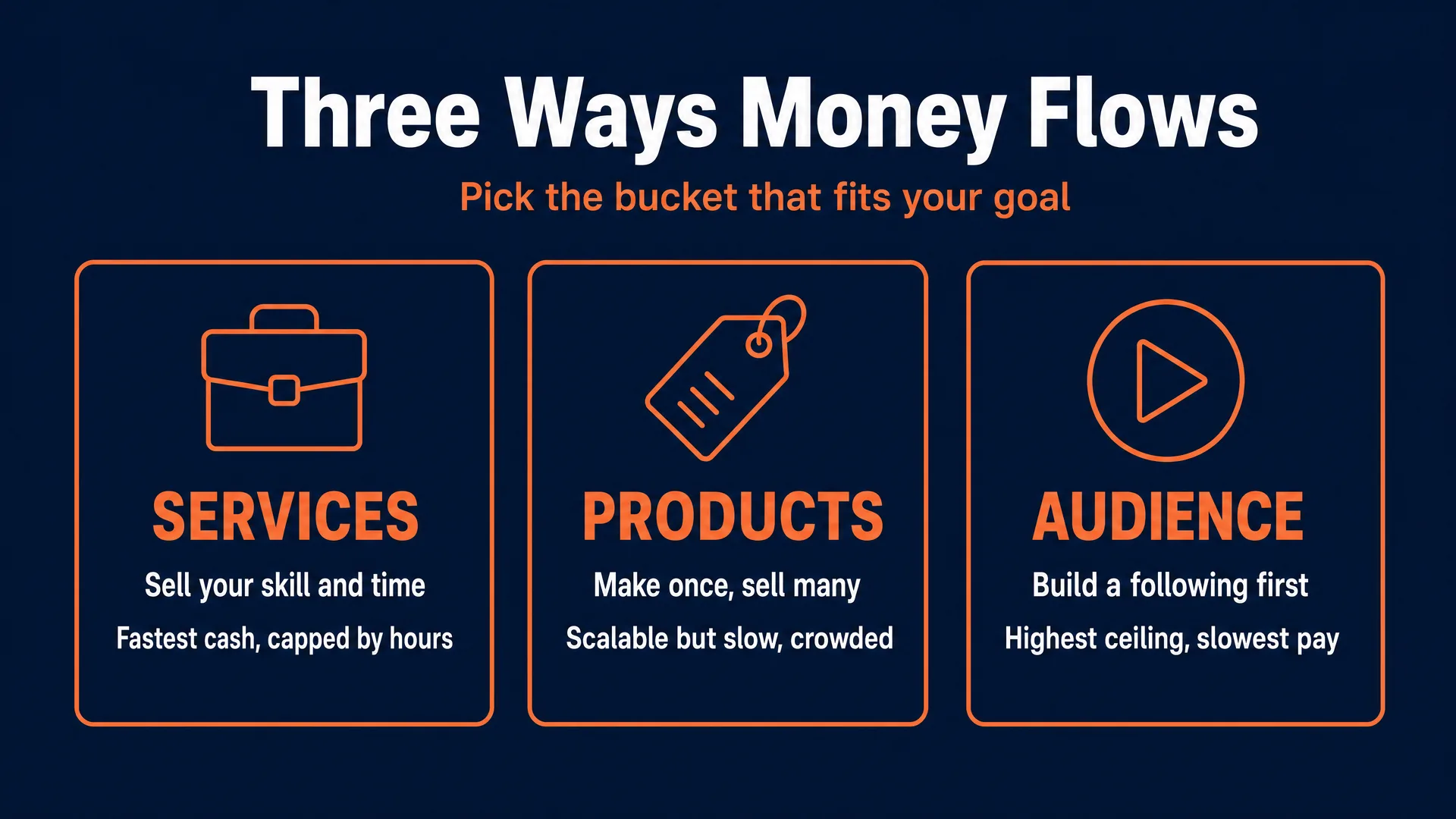
Every method below falls into one of three buckets. Choosing your bucket is the most important decision you will make, so read these first.
- Services sell your skill and time for client money. Fastest to a first dollar (days to weeks), capped by your hours. Buyers: brands, e-commerce sellers, local businesses, agencies.
- Products are made once and sold many times. Scalable but slow, and the open door means brutal competition. Buyers: consumers and other creators.
- Audience means building a following first and monetizing the attention. Highest ceiling, slowest to pay (usually 6 to 18 months). Buyers: ad networks, sponsors, your own fans.
Services: the fastest path to cash
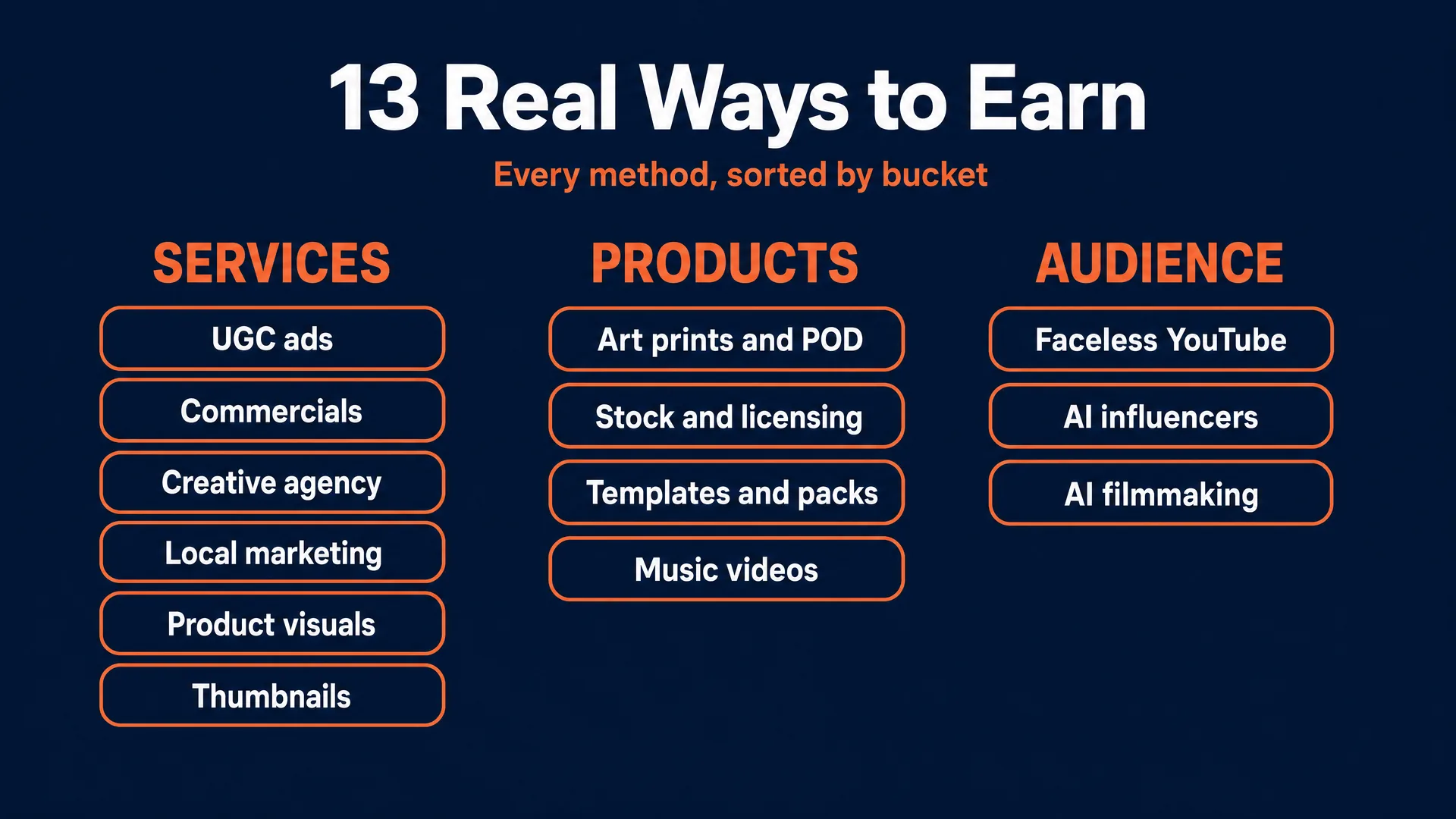
1. AI UGC ads
You make short, creator-style video ads (the casual “here’s why I love this product” format) using AI avatars and voices instead of filming yourself. E-commerce brands buy these in volume to test ad creative cheaply. Realistic income runs from 50 to 100 dollars per video as a beginner up to 1,000 to 3,000 dollars per deliverable once you can prove the ads actually convert; one operator described stacking four retainers at 2,000 to 3,000 dollars each to reach the 12,000-dollars-a-month range (r/DigitalMarketing). Tools: HeyGen for the avatar, ElevenLabs for voice, CapCut for the cut. Difficulty 2 of 5, first dollar in 1 to 2 weeks. The catch: a technically clean ad that does not sell is worthless to a brand, so the real skill is the hook, not the render. Full how-to guide: how to become an AI UGC creator, plus the deeper AI UGC ads freelancer playbook.
2. AI ad creative and commercials
A step up from UGC: ad creative for brands, DTC companies, and the agencies that serve them. The thing to understand is that brands do not buy an ad, they buy a test. A performance campaign burns through creative in days, so the hero spot gets you hired and the variant set (alternative hooks, aspect ratios, cutdowns) is what gets you retained. Price accordingly: a hook variant is about 50 dollars, one video plus four hooks runs 1,500 to 2,500 dollars, and the real prize is a monthly creative retainer of 1,500 to 4,500 dollars. Correct a myth while you are here: Kalshi’s NBA Finals spot is always cited as “the 2,000 dollar ad,” but that figure is the compute cost only, and Kalshi declined to disclose what the operator was paid (NPR, June 2025); the director’s own studio charges roughly 100,000 dollars for a 30-second commercial. Tools: Nano Banana Pro or GPT Image 2.0 for the locked brand reference frame, Seedance and Kling for the shots, DaVinci Resolve for the finish, and never let a model generate the logo, composite it in post. Difficulty 3 of 5, first dollar in 2 to 4 weeks. The catch: keeping a product or character consistent across shots, which is what separates a real commercial from a slideshow. Full walkthrough: AI ad creative and how to land a retainer (for the production fundamentals, see the AI video ads complete guide).
3. Start a generative AI creative agency
Instead of one-off projects, you run a retainer business delivering a steady stream of AI content to brands. This is the highest-revenue services path: 2,000 to 3,000 dollars per client per month is a normal starting retainer, and the ceiling is real once you have two or three anchor clients. Note: this is a creative content agency, not an “AI automation agency” wiring up chatbots and workflows; those are a different business. Difficulty 5 of 5, first client in 1 to 3 months. The catch is almost never the tools; it is sales. Most founders obsess over generation skill and neglect the client pipeline that actually pays the bills. Full how-to guide: how to start a generative AI agency.
4. Local-business and vertical marketing
You sell tailored marketing content (social posts, promo videos, listing visuals) to local businesses: real estate agents, restaurants, gyms, clinics. These owners have steady budgets and are years behind on this technology, so they happily pay someone to “just figure it out.” Realistic income is 300 to 500 dollars per month per client, stacked across several clients. One creator who tested a dozen AI side hustles found this was the one that actually worked: “helping a dentist’s office write better emails or showing a realtor how to speed up their listing descriptions… it took me until month three or four before I was consistently hitting 300 to 500 dollars” (r/sidehustle). Difficulty 2 of 5, first dollar in 2 to 3 weeks. The catch: sell “more customers,” not “AI services.” Full how-to guide: AI marketing for local businesses, with deep vertical playbooks already live for real estate, law firms, medical spas, and home services.
5. AI product and brand visuals
You act as a synthetic product photographer, generating lifestyle and studio imagery for e-commerce sellers and small brands. Per-batch pricing runs 50 to 200 dollars, with per-image work at 10 to 30 dollars for background replacement and 50 to 150 dollars for hero composites. The economics are strong: traditional product photography runs 25 to 500 dollars per image, and brands have cut photography costs 70 percent or more with AI. Tools: Nano Banana Pro for product placement and editing, GPT Image 2.0 for photoreal hero shots, Ideogram 4.0 when text has to be readable. Difficulty 2 to 3 of 5, first dollar in 1 to 3 weeks. The catch: lighting, shadows, and reflections, where AI still produces “pasted-in” results, so position this as catalog and social content, not hero-shot replacement. Full how-to guide: AI product photography, charge $150 and pay 15 cents.
6. AI thumbnails and social graphics
The fastest path to a first dollar in this entire list. You design click-optimized YouTube thumbnails and social graphics for creators and small businesses, per design or on a monthly retainer. Per-thumbnail rates run 10 to 50 dollars for beginners and 75 to 150 for proven designers; retainers land at 750 to 2,000 dollars a month across a few clients. Tools: Ideogram 4.0 for readable on-image text, GPT Image 2.0 for the concept. Difficulty 1 of 5, first dollar in about a week. The catch: a thumbnail is a click tool, not decoration, so you have to learn what drives clicks, not just what looks nice. Full how-to guide: AI thumbnails, how to make money in 2026.
Products: build once, sell many
A warning before you start here: this bucket has the lowest barrier to entry, which means the most competition. The honest counter-signal is loud. One maker tried AI print-on-demand for two months and earned 12 dollars: “the designs all look the same and the market is buried in AI slop” (r/sidehustle). Products work, but only with real niche selection and a distribution plan.
7. AI art prints and print-on-demand
You generate designs and sell them on physical products (shirts, posters, mugs) through print-on-demand fulfillment. Realistic beginner income is 10 to 150 dollars a month, heavily niche-dependent, and most beginners earn near zero in the first 60 days. Tools: Ideogram 4.0 for typography apparel, GPT Image 2.0 for high-resolution art. Difficulty 2 to start, 4 to actually earn; first sale in 1 to 2 months. The catch: Etsy and the marketplaces have tightened the rules. Etsy now allows AI art only when it is “designed by a seller” from your own prompts and disclosed in the listing, and it has cracked down hard on bulk, template-style listings (Etsy Creativity Standards). Generic prompts in saturated niches are a dead end. Full how-to guide: how to make money with AI art.
8. AI stock and licensing
You upload generated images and clips to stock libraries and earn a royalty on every download. Be realistic: this is supplemental income, not a living. Adobe Stock pays 33 percent on images and 35 percent on video, with minimum royalties around 0.33 to 0.38 dollars per license (Adobe Stock royalty rates), and crucially, the two biggest libraries (Shutterstock and Getty) do not accept AI-generated contributor uploads at all, so Adobe Stock is effectively your only door, and it is heavily oversaturated. Adobe also requires you to label AI content and bans prompts that reference real people, fictional characters, or other IP. Difficulty 4 of 5, first dollar in 3 to 6 months. Treat it as portfolio money you build slowly, not a fast track. Full how-to guide: selling AI art, prints, and stock.
9. Templates and prompt packs
You package your workflows, prompt formulas, or style templates as digital downloads for other creators. Realistic income is 50 to 300 dollars a month, with rare standouts (one creator made 1,000 dollars in two months from a 15-dollar Gumroad pack). Difficulty 2 of 5, first dollar in 1 to 2 months. Two catches. First, distribution is everything; a digital product with no audience sells nothing. Second, and this trips up many people: Etsy explicitly bans selling prompt bundles (Etsy Creativity Standards), so sell these on Gumroad or your own site, not Etsy. Full how-to guide: how to sell templates and prompt packs.
10. AI music videos
You produce visuals synced to music for independent artists and labels. Music gives you a built-in timing structure, which makes the video work more achievable than open-ended film. Be honest about the cost: a 3-minute video is roughly 45 shots, and real productions generate about 12 clips for every one they keep, so compute alone runs 250 to 700 dollars. Price the deliverable: 200 to 600 dollars for a lyric video, 600 to 1,200 for a full AI video, and 800 to 1,500-plus for a hybrid that wraps AI environments around the artist’s real filmed performance. Tools: Nano Banana Pro or GPT Image 2.0 for the locked reference keyframe that holds one look across every shot, Seedance or Kling for the shots themselves, DaVinci Resolve for the beat sync, plus Suno when the artist needs a track. Difficulty 3 to 4 of 5, first dollar in 1 to 2 months. The catch: musicians and their fans are the most AI-hostile audience in this guide, which is why the hybrid, not the fully synthetic video, is what actually sells. Full walkthrough: how to make an AI music video and get paid for it.
Audience: the highest ceiling, the longest road
11. Faceless YouTube and short-form channels
You run a niche channel with AI voiceover and generated visuals, never showing your face, monetized through ad revenue and sponsorships. Post-monetization income runs 100 to 500 dollars a month, scaling to 500 to 5,000 dollars by months 12 to 18 in the right niche. Niche choice is the whole game: finance and education pay 9 to 25 dollars per 1,000 views, entertainment pays around 2 dollars. The verified high end exists; Fortune reviewed the AdSense records of a 22-year-old running a faceless-AI network at roughly 700,000 dollars a year on about two hours a day (Fortune, Dec 2025). Tools: ElevenLabs for narration, Seedance or Kling for B-roll, CapCut for pacing. Difficulty 4 of 5, first dollar in 6 to 12 months. Two catches: most people quit in months four to six, right before the algorithm compounds, and YouTube now demonetizes purely auto-generated “inauthentic” channels, so you need a genuine editorial voice. Full how-to guide: faceless YouTube, how to make money with AI.
12. AI influencers and avatars
You build and run a fully synthetic social persona and monetize it through brand deals. This is difficulty 5 of 5 and 6 to 18 months to meaningful income, with extreme variance. The most honest account we found came from a creator who “basically matched my corporate salary” running a faceless channel plus AI-influencer pages, but was blunt about where the money came from: “AdSense payouts and creator fund have been low and inconsistent… the part that actually gets you any real income is the annoying tedious part of finding sponsors, DMing them, securing collabs, and actually posting and being reliable” (r/sidehustle). The catch: novelty fades, so the persona needs a real personality and relentless consistency. Full guide: AI avatars and influencers, step by step.
13. AI filmmaking and festivals
You make short narrative films for the festival circuit, grants, and brand storytelling. Be clear-eyed: this is a portfolio and prestige path more than an income path, and most films earn nothing. But the prize money is real and growing, festivals now hand out five and six figures, and a polished short doubles as the best possible portfolio for the paid lanes above. Difficulty 5 of 5, first dollar in 6 to 12 months. The catch: festivals judge story, not render quality, so spectacle without a script goes nowhere. Full guide: AI filmmaking in 2026.
Pick one lane (the decision framework)
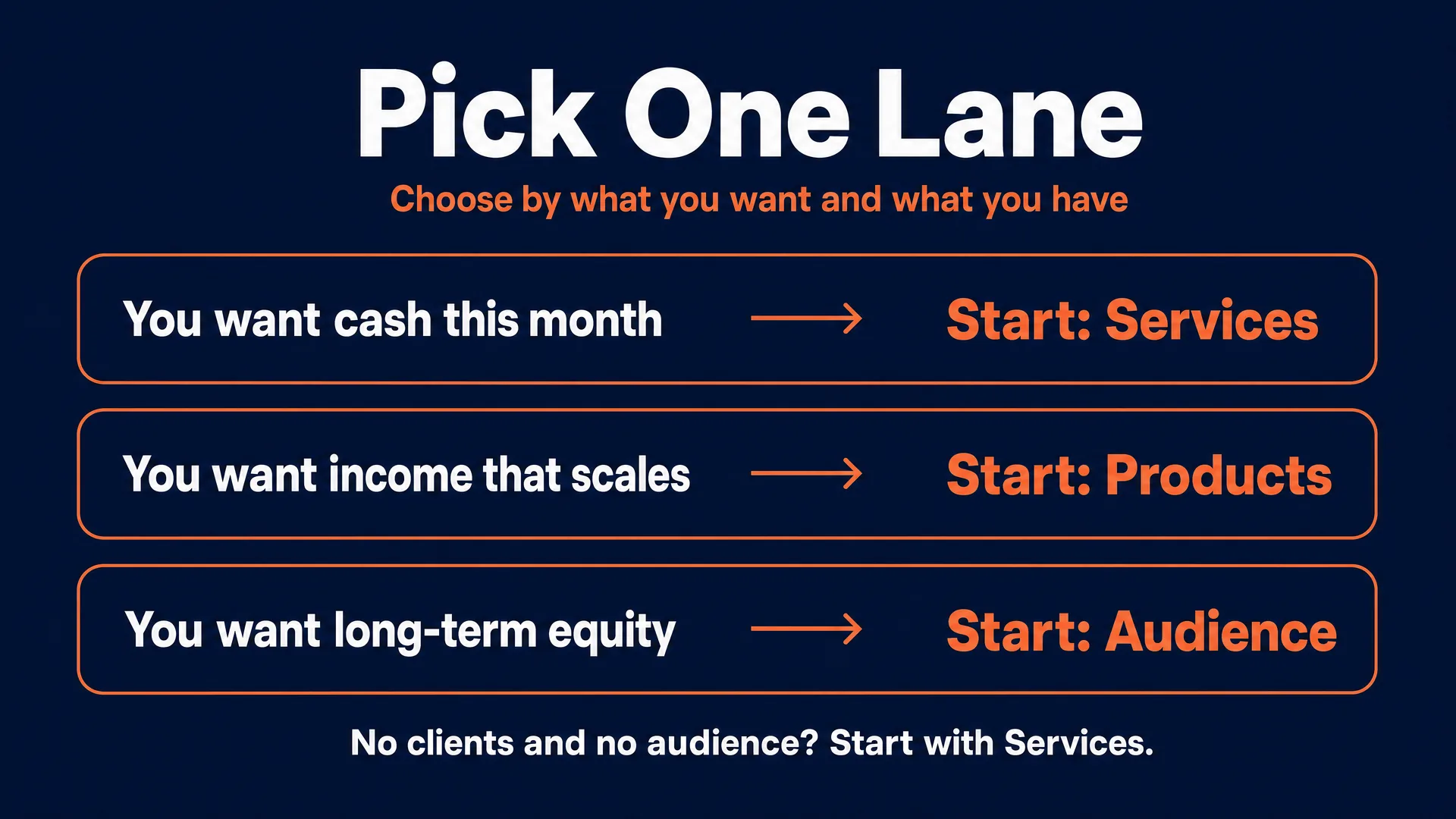
Trying several of these at once is the most common way to fail, because each has a real learning curve. Choose by what you want and what you already have:
- You want client cash this month and can handle a little outreach: start in Services, specifically AI UGC ads, thumbnails, or local-business marketing. Lowest budget, fastest payoff.
- You want income that scales without client calls and you have strong visual taste: start in Products, but accept the slow ramp and pick a real niche.
- You want long-term equity and you can post consistently for a year: start in Audience, knowing the first 6 to 12 months are unpaid.
The professional move is sequencing: start in Services to fund your tools and learning, then use that cash to subsidize a slow Audience build. If you have no clients and no audience, start in Services.
What this actually costs (the workflow tax)
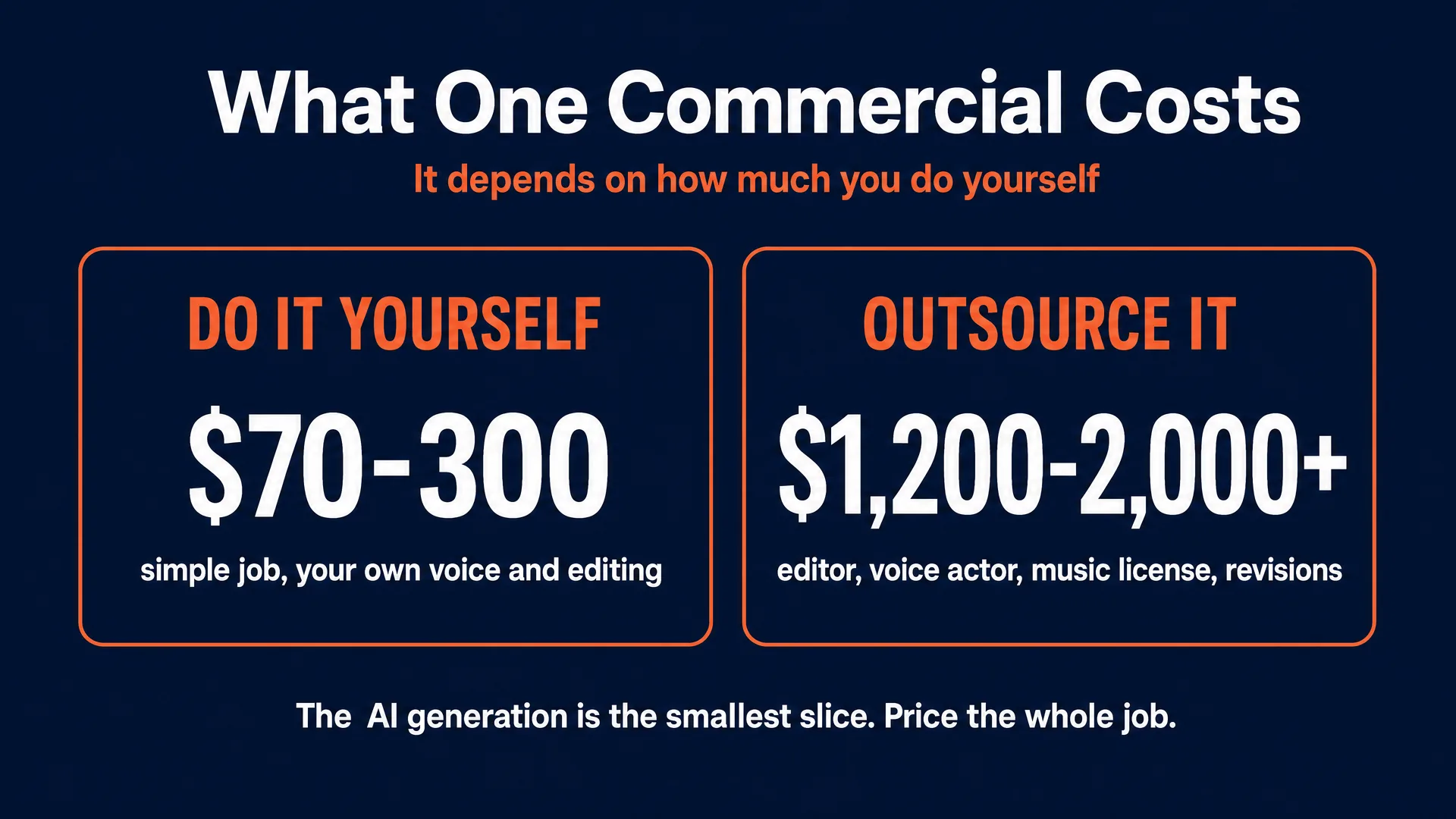
Here is the number nobody tells you. The raw compute is almost free, but the commercial work around it is not, and how much it costs depends entirely on how much you do yourself. Take one short cinematic commercial:
| Cost component | If you do it yourself (simple job) | If you outsource it (full commercial) |
|---|---|---|
| Video generation, with re-rolls | ~30 (short, few iterations) | ~90 (30s at ~0.30/sec, 10 iterations) |
| Voice and audio | 0 to 5 (your voice or ElevenLabs) | 100 to 300 (voice actor + licensed music) |
| Editing | 0 (you edit) | 250 to 500 (hire an editor) |
| Software, prorated | ~20 | ~65 |
| Legal and likeness review | 0 (clean, no real faces) | 200 to 400 |
| Client revisions | 0 (none requested) | 200 to 300 |
| Realistic total | ~70 to 300 | ~1,200 to 2,000+ |
So the honest answer is a range. A solo creator who does their own voice and editing for a simple piece can ship for under a few hundred dollars. A full-service commercial deliverable, with a hired editor, a voice actor, a music license, a legal pass, and a couple of revision rounds, realistically runs 1,200 to 2,000 dollars or more. Either way, the raw AI generation is a small slice of the total. Price your work against the all-in cost, never the API cost, or you will work at a loss. A dedicated pricing guide is coming soon.
The tools themselves are cheap: a working stack is roughly Kling Pro at about 37 dollars a month, ElevenLabs Creator at 22, HeyGen Creator at 29, plus pay-as-you-go image and video on fal.ai. The early enemy is not the software bill; it is wasted generations, chasing dead niches, and trying to scale before you have a single buyer.
The rules that keep you out of trouble
Three things will sink a beginner faster than bad output: disclosure, consent, and the free-plan trap. Our full AI disclosure and compliance guide covers it, but the essentials:
- Disclosure is required, and it does not kill your money. YouTube, TikTok, and Meta all require you to label realistic AI content, but YouTube states plainly that disclosing AI “won’t limit a video’s audience or impact its eligibility to earn money,” and TikTok says the AI label “won’t affect distribution.” So the real question is not whether you can monetize AI content; it is whether you can do it honestly and repeatably.
- The EU AI Act is now the environment you publish into. Article 50 transparency rules apply from August 2, 2026, requiring AI-generated and deepfake content reaching EU audiences to be clearly labeled and machine-readable (EU AI Act Article 50).
- For ads, the FTC is strict. AI-generated testimonials are treated as fake reviews, and “results not typical” disclaimers are no longer enough; you must show the typical outcome (FTC endorsement guides). Never present a synthetic face as a real satisfied customer.
- Never borrow a face or a franchise. Recreating a real person’s likeness or a recognizable franchise without permission is a direct path to litigation. Owning your output (which OpenAI, Google, ElevenLabs, and HeyGen grant on paid plans) does not override copyright or publicity rights.
- Free plans are a commercial trap. ElevenLabs and HeyGen restrict free tiers to non-commercial use; commercial rights start on paid plans. Win client work on a free tier and you may have to rebuild it after the fact. Get on the paid plan before you bill anyone.
The honest truth about who actually earns
The pattern across every credible success story is the same: the money is in the application, not the generation. The people earning treat AI as a way to deliver something a buyer already wants, faster. The faceless-network operator earns from sponsors, not AdSense. The UGC creator earns by solving a brand’s speed-and-cost problem, not by being “creative.” The maker who sells AI-etched coasters succeeds because of the physical product and craft layer, not the prompt.
And the people not earning are just as instructive. “It is not going to make you a passive income,” wrote one creator with 15 years in advertising; AI is a tool used alongside real skills, not a replacement for them. Another was blunter: “it is ridiculously difficult to create real monetizable content using AI,” after abandoning coloring books and game builds. A veteran freelancer warned that AI has “mostly eradicated” the low-skill gigs that used to exist. Believe all of them. The value has moved up the stack, to taste, relationships, and distribution. That is exactly where this community focuses.
Start this month
Pick one method from one bucket. Spend a weekend building three to five spec pieces (sample ads, sample thumbnails, a short reel). Get on the paid plan for the one or two tools that method needs. Then do the uncomfortable part: put the work in front of a real buyer, whether that is ten cold emails to local businesses or your first Fiverr gig. Disclose that it is AI. Measure what happens. Then decide whether to scale.
That last paragraph is the whole game. Most people never get past “learning the tool.” The ones who earn get to a buyer fast.
That is exactly what we build inside the AI Video Bootcamp community: the workflows for each of these methods, real student examples and prompts, and an Opportunity Hub that tracks the contests, briefs, and paid work where the skill turns into income. Membership is 9 dollars a month, about two coffees. But the tools are already open in your browser. The most important thing is that you pick a lane and start.
The methods at a glance
| Method | Bucket | Starter income | Difficulty | First dollar |
|---|---|---|---|---|
| AI UGC ads | Services | 50 to 1,000+/video | 2 | 1-2 weeks |
| AI commercials | Services | 150 to 500/video | 3 | 2-4 weeks |
| Creative agency | Services | 2,000 to 3,000/mo per client | 5 | 1-3 months |
| Local marketing | Services | 300 to 500/mo per client | 2 | 2-3 weeks |
| Product visuals | Services | 50 to 200/batch | 2-3 | 1-3 weeks |
| Thumbnails | Services | 10 to 50/design | 1 | ~1 week |
| Art prints / POD | Products | 10 to 150/mo | 2-4 | 1-2 months |
| Stock / licensing | Products | thin, supplemental | 4 | 3-6 months |
| Templates / prompt packs | Products | 50 to 300/mo | 2 | 1-2 months |
| Music videos | Products | 100 to 2,000/project | 2-4 | 1-2 months |
| Faceless YouTube | Audience | 100 to 5,000/mo (mo 12-18) | 4 | 6-12 months |
| AI influencers | Audience | 0 to 1,000+/mo | 5 | 6-18 months |
| AI filmmaking | Audience | prize/portfolio | 5 | 6-12 months |
Sources and further reading
Income, demand, and proof
- Fortune: the 700,000-dollar faceless AI YouTube operator
- NPR: Kalshi’s 2,000-dollar AI NBA Finals ad
- Upwork In-Demand Skills 2026 and Fiverr Business Trends Index (AI video demand surge)
Tools and pricing (canonical host)
- fal.ai pricing for Seedance, Kling, Veo, GPT Image 2.0, Nano Banana Pro, Ideogram 4.0
- ElevenLabs pricing and HeyGen pricing
Platforms, marketplaces, and law
- EU AI Act Article 50 (transparency, in force Aug 2, 2026)
- FTC endorsement and disclosure guides
- Etsy Creativity Standards (AI allowed with disclosure; prompt bundles banned)
- Adobe Stock royalty rates
- YouTube AI disclosure rules
Deep guides at AI Video Bootcamp
Already live: AI UGC ads freelancer playbook, AI video ads complete guide, AI avatars and influencers, AI filmmaking in 2026, Suno guide, Kling guide, the vertical playbooks for real estate, law firms, medical spas and home services, AI disclosure and compliance, and the skills foundations how to learn AI video and how to learn AI image generation.
Coming soon: dedicated guides for AI UGC, AI commercials, starting a generative AI agency, local-business marketing, AI product photography, AI thumbnails, AI art prints and POD, AI stock and licensing, templates and prompt packs, AI music videos, faceless YouTube, finding clients, pricing your work, and building a portfolio.
Written by Mateo for AI Video Bootcamp. Income figures are real, dated ranges, never guarantees; results depend on skill, consistency, and distribution. Prices and policies verified June 2026 and will change.