
Most “make money with AI” advice sends you to fight ten thousand other people for pennies on a crowded marketplace. This method sends you three blocks down the road instead.
The businesses on your local main street, the independent restaurant, the boutique gym, the family dental practice, the roofing contractor, have money, have customers, and have marketing that looks like it was last updated in 2019. They are not behind because they are lazy. They are behind because the owner is doing six jobs at once and has no time to figure out AI video tools. That gap is the whole opportunity. You learn the tools once, and then you quietly become the person who makes a handful of local businesses look great online for a few hundred dollars each per month.
This is the local-business marketing method, method four in our make-money-with-AI pillar. It is a Services play, which means it is the fastest path to a first paying dollar in the whole pillar: difficulty about 2 out of 5, first dollar realistically in two to three weeks, and a consistent stacked income by around month three or four if you keep showing up. Let us get into exactly how.
What this actually is (and what it is not)
You are one person selling done-for-you marketing content to local small businesses on a small monthly retainer. Social posts, short promo videos, listing or menu or before-and-after visuals, review graphics, and the captions and Google Business Profile updates that go with them. You use AI to produce it fast, and you sell the outcome, which is more customers, more bookings, more foot traffic.
Two quick boundaries so you build the right business:
This is not a generative AI agency. That is the level-up: bigger clients, retainers of two to ten thousand dollars a month, and eventually a team. This local method is the solo on-ramp. Start here, and graduate to the agency later if you want to.
This is also not a deep single-industry guide. We already publish those, and this article links down to them. When you land a real estate client and need the exact virtual-staging workflow, you go to the real estate marketing stack or its agent-headshots guide. When you land a med spa or a dental client, you go to the medical spa playbook. When you land a plumber or an HVAC company, you go to the home services playbook, and law firms have their own playbook too. This article is the umbrella: how to pick, price, sell, and deliver across any of them.
The honest money
Nobody gets rich in month one, and anyone who tells you otherwise is selling a course. The realistic picture, drawn from operators actually doing this:
The core retainer sits at $300 to $500 per client per month. That price point is deliberate. For most established local businesses, anything under $500 a month falls inside the owner’s discretionary spending, so there is no board, no budget committee, and no long approval cycle. They can just say yes.
You stack clients rather than chase one big contract. Five to eight clients at $300 to $500 is a realistic solo book, which works out to roughly $2,000 to $4,000 a month. One operator who tested a dozen different AI side hustles over six months reported that helping local businesses was the one that actually worked, and that it took until “month three or four before I was consistently hitting $300 to $500” (self-reported, r/sidehustle). Treat that as a realistic ramp, not a guarantee.
The real skill is not the software. It is walking into local businesses and selling them on more customers, then keeping them happy enough to renew. Content is easy to make now. Getting the first three clients in your own town, and stopping them from churning after month one, is the entire game. This guide spends most of its energy exactly there.
Why do local owners pay at all? Because they are drowning. A 2025 BrightLocal survey found 54 percent of small business owners handle all their marketing themselves, and only about a third had even claimed their Google Business Profile. A Constant Contact study the same year found 42 percent of small businesses have under one hour a day for marketing, and their number-one frustration is not knowing what is working. And while a majority of small businesses now use AI in some form, most only use it to summarize notes or draft an email, not to make customer-winning video and visuals. That is the exact gap you fill.
Step 1: Pick one vertical and know what it needs
Do not be a generalist. Pick one local industry and go deep. When every prospect is the same type of business, your sample work, your pitch, your objection answers, and your referrals all compound. A dentist you impressed will happily introduce you to two more dentists. A “I do marketing for anyone” pitch has none of that momentum.
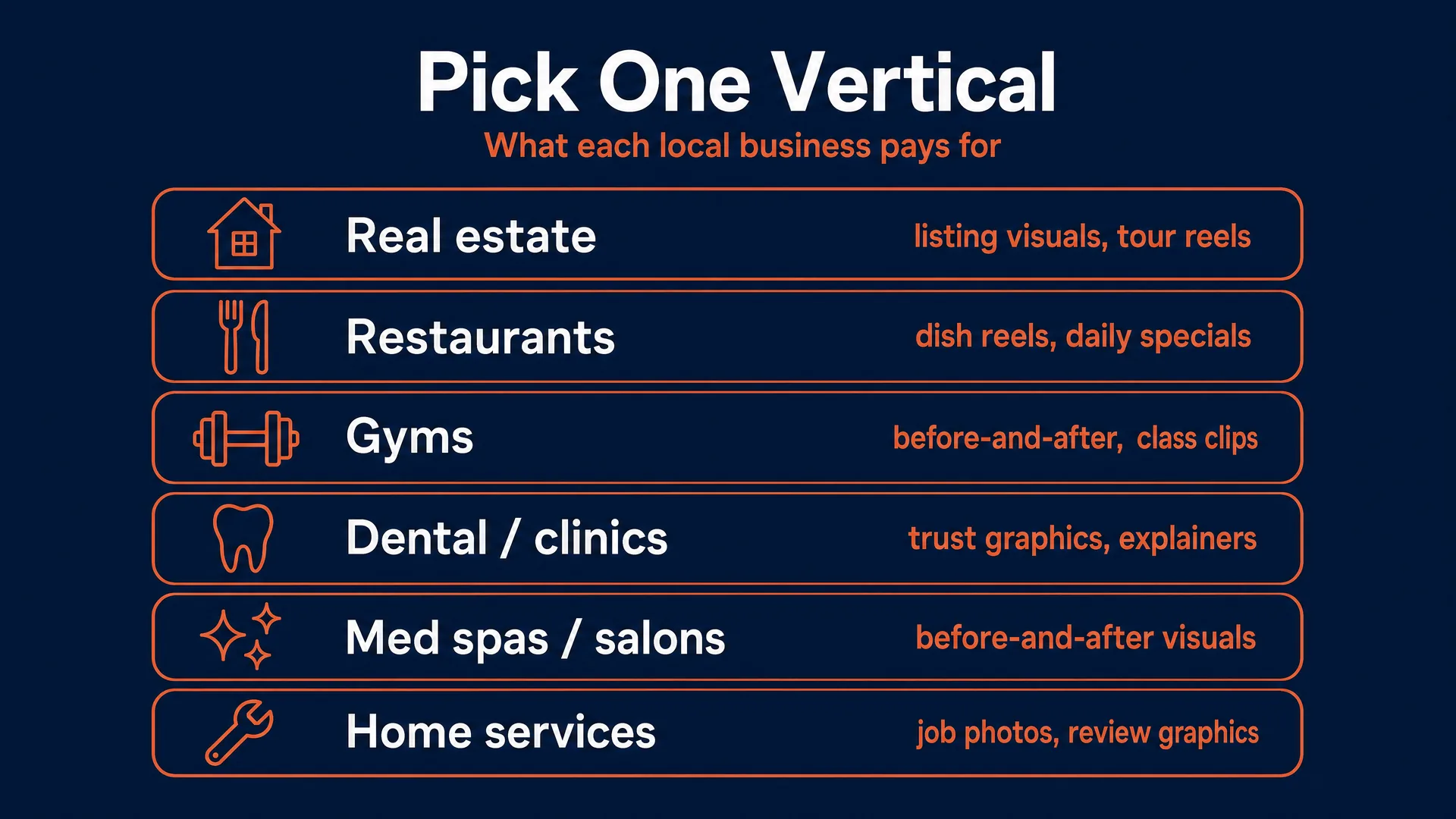
Here is what each strong local vertical actually pays for. Match the content to what moves their needle, and link down to the relevant deep playbook once you land the client.
| Vertical | What content actually works | Typical monthly retainer | Rough time to deliver | Go deeper |
|---|---|---|---|---|
| Real estate agents | listing visuals, virtual staging, short property-tour reels, “just listed / just sold” graphics | $350 to $500 | 3 to 5 hrs | Real estate stack |
| Restaurants and cafes | stylized dish and menu reels, daily-special posts, event graphics | $300 to $450 | 3 to 4 hrs | Guide coming soon |
| Gyms and fitness studios | before-and-after transformation posts, class-promo clips, schedule graphics | $300 to $450 | 3 to 4 hrs | Guide coming soon |
| Dentists and clinics | trust and review graphics, simple explainer clips, Google Business Profile updates | $400 to $500 | 4 to 5 hrs | Medical spa playbook |
| Med spas and salons | before-and-after treatment visuals, provider spotlights, short video | $400 to $500 | 3 to 4 hrs | Medical spa playbook |
| Home services (HVAC, plumbing, roofing, landscaping) | before-and-after job photos, review graphics, seasonal promos | $300 to $400 | 2 to 3 hrs | Home services playbook |
A note on picking: real estate and home services are the easiest emotional sells because the owner already treats marketing as direct lead generation. Restaurants are the most content-hungry, which means steady work but thinner patience. Dental, med spa, and other regulated niches pay the most and stay the longest, but they come with real advertising-claim rules you have to respect (more on that in Step 5). Pick the one where you either already know someone, or where you can walk into ten of them in an afternoon.
Step 2: Build the offer and set the price
Your offer should be one simple bundle, ruthlessly standardized so every client’s month looks the same to you. Price on the outcome, never on what the AI costs you. The client is not paying for “an image that cost fifteen cents.” They are paying to look active and professional online without lifting a finger.
The core package
A clean, defensible $400-per-month bundle for a standard local business looks like this:
- Eight to twelve social posts (AI-generated or AI-enhanced images with localized captions)
- Two short promo videos, fifteen to thirty seconds, built for Reels, TikTok, and Stories
- One monthly visual refresh (a seasonal offer graphic, a new menu or service highlight, a Google Business Profile header)
- Google Business Profile upkeep: a few posts a month, a photo refresh, and keeping the info current
That is consistent, visible activity for a busy owner, and it is completely systematized for you.
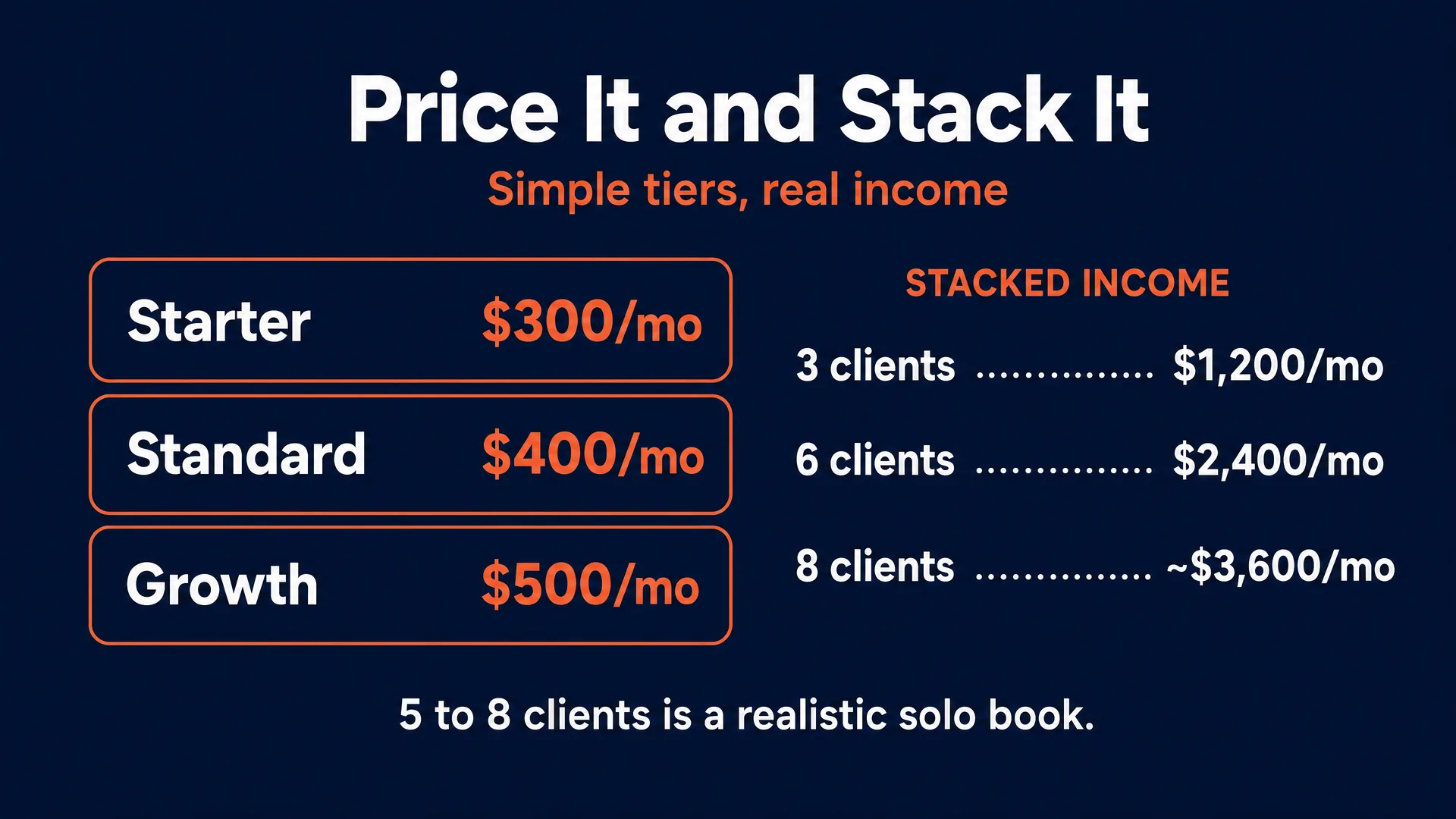
You can present it as a simple three-tier ladder so the owner picks their own level:
- Starter, $300 per month: three posts a week on one channel plus one short email or Google post.
- Standard, $400 per month: everything in Starter plus the two monthly promo videos.
- Growth, $500 per month: everything in Standard plus a second channel or an extra video, plus branded graphics for their current promotion.
Start clients at $300 to $400, then move them up to the $500 tier at the first renewal once they have seen a month of work. Do not price below $300. Below that, you are competing with $99-a-month automated tools, which is a fight you do not want.
Productized one-off packs (your foot in the door)
A one-time, fixed-price pack is the easiest first sale, because a stranger will risk $200 far more readily than a monthly commitment. Deliver it well, and the retainer pitch writes itself. Price these at roughly ten to twenty percent of the retainer’s value:
- Grand Opening or Seasonal Promo Pack, $250: one promo video, three printable flyers, and a week of launch captions for a specific date-bound event.
- Local Trust and Review Pack, $150: ten branded graphics built from the business’s real, existing five-star reviews, ready to post.
- Listing or Feature Pack, $200: full visual enhancement of one property, product line, or service, plus a short narrated video for social.
The stacking math (why this adds up)
Once the retainers stack, the economics become obvious. Here is the honest picture at $400 a month:
| Clients | Monthly revenue | Notes |
|---|---|---|
| 3 | $1,200 | a solid side income, realistically reachable in the first six to eight weeks |
| 6 | $2,400 | a robust part-time income |
| 8 | ~$3,600 | roughly the ceiling for one person keeping quality high without help |
Now the part most people skip, the true hourly value. A well-run $400 package should take a proficient operator around four to eight hours a month once the pipeline in Step 3 is humming, and the raw AI-tool cost per client runs about $25 a month. So on a single client you keep roughly $375 net, which at the low end of the time range is an effective rate near $90 an hour, and even at the high end stays comfortably above ordinary freelance content rates. That gap between raw tool cost and client price is exactly why you never anchor your price to the API bill.
Two warnings the numbers hide. First, undercharging is a trap, not a growth strategy: fifteen clients at $300 is a worse business than five at $500 for the same revenue and triple the workload. Second, there is a retention tax. If your content does not translate into visible activity for the owner, they cancel, and you are back in the acquisition grind. Communicate, show them what you shipped, and tie it to their goals.
Step 3: The fast solo delivery pipeline
You cannot treat every post as a bespoke art project and survive eight clients. The whole model runs on batching and a locked set of tools.
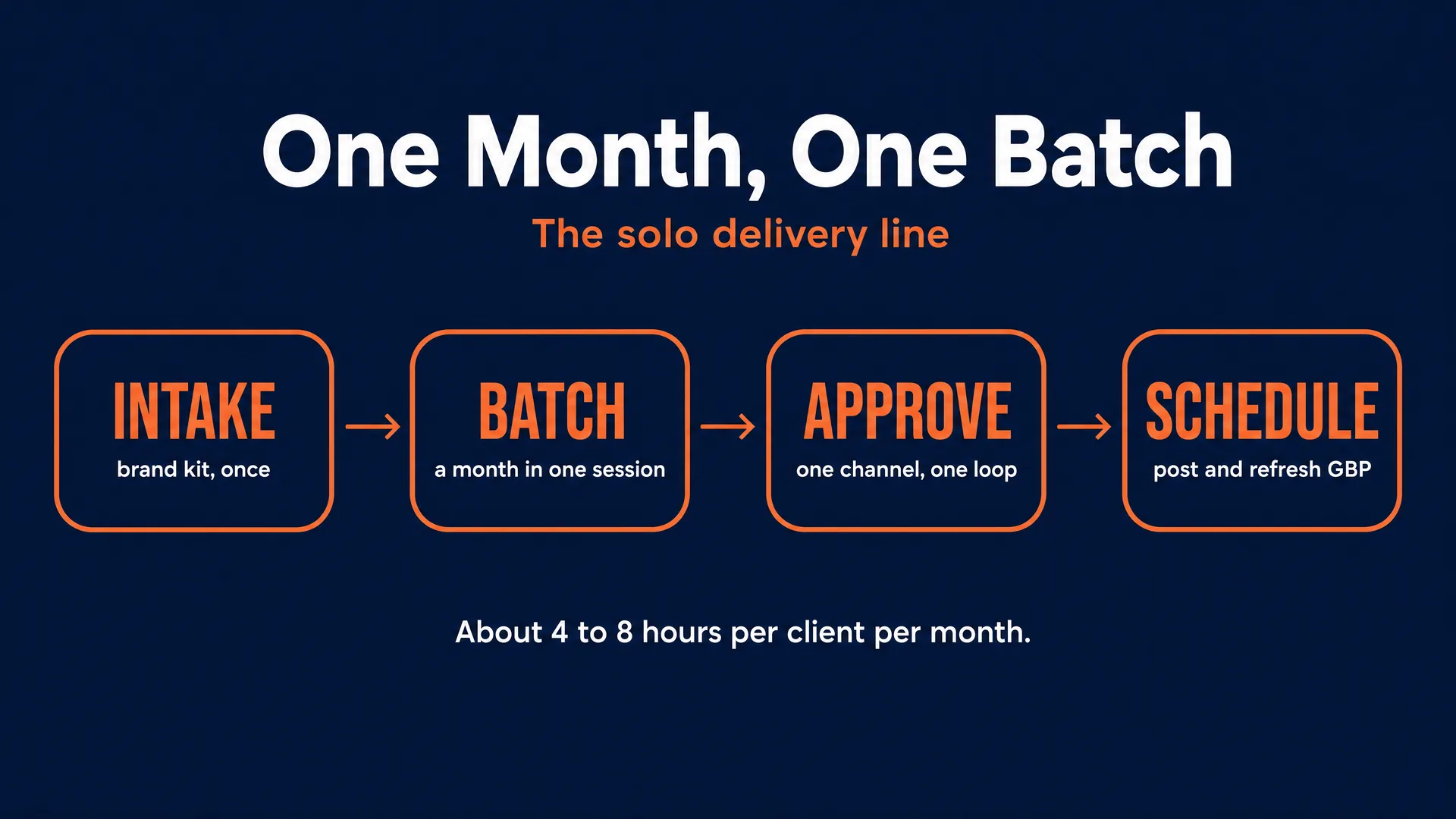
The monthly production line
-
Intake, once per client at signup (about an hour). Collect the brand kit one time: logo files, two or three brand colors, one or two fonts, a short note on voice and tone, current offers or menu, ten to twenty existing photos, and access to the Google Business Profile and social accounts. This one step is the biggest speed lever you have, because it means you never stall mid-month hunting for a logo.
-
Batch a full month in one or two focused sessions. Write all the captions first with a chat model, then generate the images, then the two videos, then any on-image graphics like flyers or menus, then a quick edit pass. Producing everything side by side is what keeps the brand’s colors, voice, and look consistent across the month.
-
One light approval loop. Send the whole month’s draft through a single channel per client, one shared folder or one simple board, with one clear approval step before anything is scheduled. Never scatter approvals across email, text, and DMs, or you will drown in threads once you have several clients.
-
Schedule or hand off. Load the approved batch into a scheduler, and push the Google Business Profile posts and photos the same day.
Realistic time budget once the brand kit exists: about four to eight hours per client per month. Build a reusable prompt template and a video template per client so each month is a reskin, not a fresh creative brief.
The tool stack
Use the models that are reliable and commercially licensable, and keep the deep tool tutorials for the vertical playbooks. For a local content pipeline:
- Images and edits: GPT Image 2.0 and Nano Banana Pro. These are the two strongest models for clean social graphics, product and menu shots, and quick photo enhancement.
- Short promo video: Seedance and Kling, which generate short, natively audio-synced clips from your text and images.
- On-image text (flyers, menus, promo cards): Ideogram, which renders addresses, prices, and headlines without the garbled text that trips up general image models.
- Voiceover: ElevenLabs.
- Spokesperson or avatar clips: HeyGen, for explainer-style content when a clinic or home-services client wants a face on camera.
- Editing and copy: CapCut or DaVinci Resolve for assembly, and any standard chat model for captions, Google Business Profile updates, and email copy in the client’s voice.
You run the hosted models through either fal.ai or Replicate (AVB is not affiliated with either); check fal.ai first for unit pricing. If you would rather not juggle separate hosts and subscriptions, PromptWise runs this whole stack, Nano Banana Pro, GPT Image 2, Seedance, Kling, ElevenLabs, and more, in one studio, with guided workflows and a built-in UGC and social-content factory that is well suited to producing a month of local-business content in one place. The honest cost picture is that a full month of content, a dozen images and a couple of short videos, runs in the low tens of dollars against a $400 invoice, before you even amortize the flat subscriptions across clients.
How many clients can you hold?
Consultant and agency surveys converge on four to eight full-service clients as the sustainable ceiling for one person before quality slips or you burn out. AI compresses the hours per client, but it does not raise that ceiling much: it buys back your time inside the same client count. Past eight, add a part-time editor or a virtual assistant for scheduling before you add more clients.
Step 4: Land your first three local clients
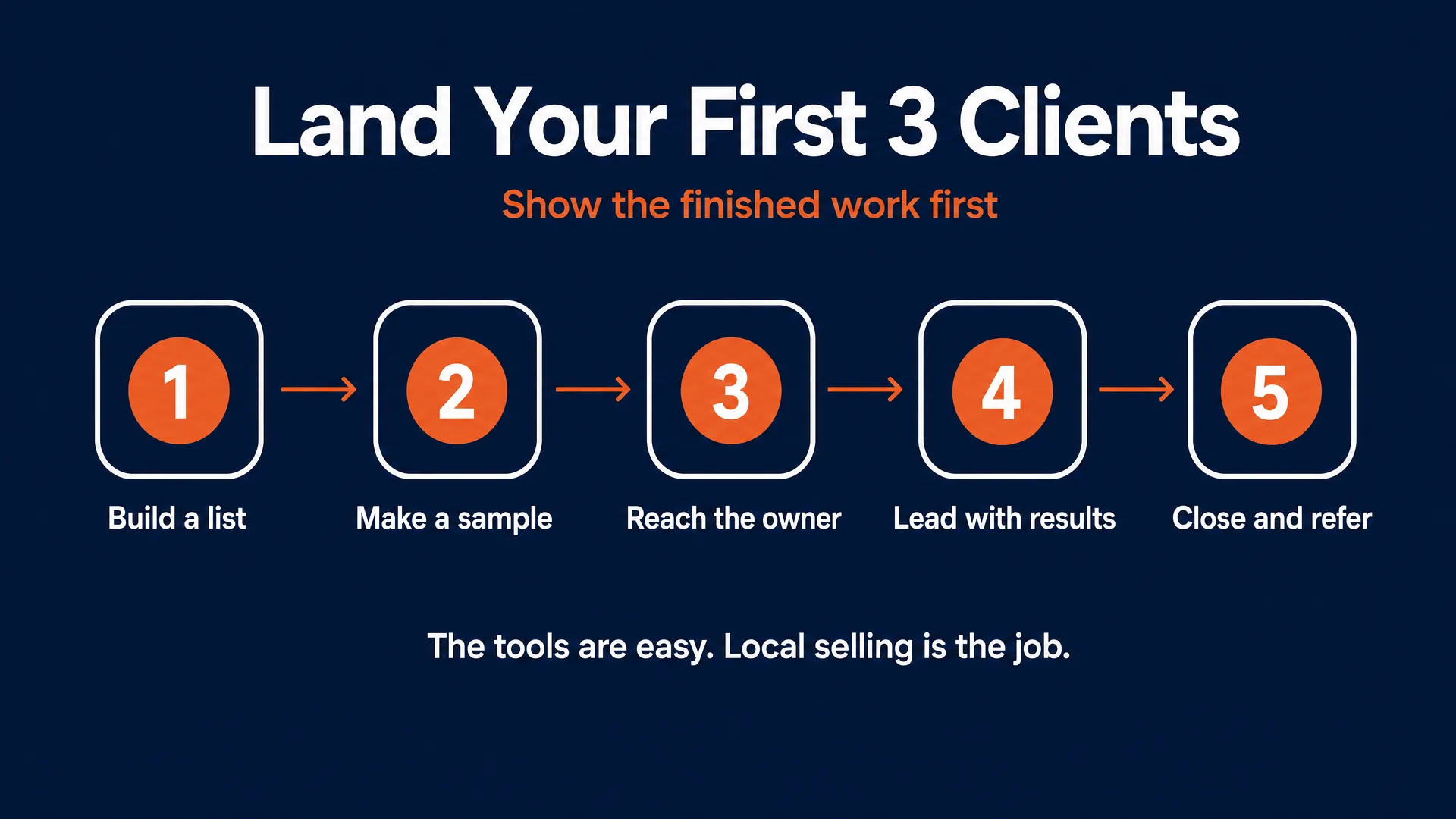
This is where almost everyone fails, so read it twice. The most polished Nano Banana Pro skills in the world are worth nothing if you cannot get a local roofer to say yes to $400 a month. Traditional funnels, broad ad campaigns, and search optimization are useless at this scale. What works for main street is a direct, value-first sequence, sometimes called the spec-sample or “100-spec-ad” method: you show the finished work first, before you ever ask for money.
The five moves
1. Build a target list of 50 to 100 local businesses. Drive or walk your commercial districts, or scan Google Maps. You are looking for businesses with bad creative, not bad businesses. The ideal target already has strong reviews, real foot traffic, and a clear offer, but a weak, outdated, or dead online presence. Businesses currently running a specific promotion (a whitening special, a bring-a-friend week) are the easiest to convert. Quick qualifying signals: no fresh Google photos in the last month or two, no posts in ninety days, under twenty or thirty reviews, and social that either does not exist or has been silent for months.
2. Make two or three finished spec samples for one specific business. Pick a target and actually build the thing they need before contacting them. If it is a cafe with dim, unappetizing photos, use your stack to produce a stylized fifteen-second reel of their real menu items with an upbeat voiceover. You are handing them the exact asset they have been failing to make. AI turnaround makes this a single evening’s work, which was not true before these tools existed. Build a fresh sample per business; a name-swapped generic sample reads as generic and kills the whole effect.
3. Reach the owner with the sample in hand. Two channels work for local. The walk-in: stop by during off-peak hours, ask for the owner, and show the video on your phone. The warm digital message: send a short screen-recording (a Loom-style clip) that puts your new asset next to their current marketing so the upgrade is obvious, or just attach the finished reel to a direct message or email to the owner by name. If you go the message route, keep the list small and personal and always follow up once, since roughly forty percent of replies to cold outreach come from the follow-up, not the first message.
4. Lead with the result, never the tech. Your script is low-pressure and outcome-first. Something like:
“Hi, I’m a local creator here in town. I saw you’re running a special right now, but the photos on your page really don’t do your work justice, so I built you a quick fifteen-second promo video using some new tools. Here it is, it’s yours to use for free either way. If it gets you some good engagement, I make full packages like this every month for a few local businesses for about $400.”
That structure disarms the usual resistance: it leads with a finished, high-quality result, it gives real value with zero obligation, and it anchors the price early so there is no sticker shock later. Never open with a feature list of AI tools. The owner does not care what a diffusion model is; they care about a busier Friday night.
5. Close a small first commitment, then mine referrals. If they like the free asset, offer a low-friction next step: a one-month trial of the $400 retainer, or one of the $150 to $250 productized packs. Because the sample already proved you can deliver, you rarely need to discount further. Once one client is happy, ask specifically and warmly: “I’ve got room for one or two more local restaurants this month, do you know another owner who could use this?” Local owners are tightly networked, and word of mouth is the entire growth engine from here. Turn your first happy client into a one-page before-and-after case study (with written permission), and use that as the lead sample for your next round.
Be honest with yourself about the timeline
Expect several weeks of consistent effort and real rejection before the first yes. Nothing here supports a “client this week” fantasy. The operators who fail almost always make the same mistakes: they pitch the AI mechanism instead of a visible result, they blast a huge generic list instead of personalizing a small one, or they undercharge so badly that one difficult client kills their motivation. The spec-sample approach and a tight, qualified list of prospects are your defense against all three.
Step 5: The rules that keep you out of trouble
This is not legal advice, but these are the guardrails that matter, and the first one is non-negotiable.
Never fake a review or testimonial. The FTC’s rule on consumer reviews and testimonials (16 CFR Part 465) took effect on October 21, 2024, and enforcement is active: in December 2025 the FTC sent warning letters to ten companies over possible violations, and civil penalties can run up to around $53,000 per violation. For you, this means: do not write, generate, or AI-draft a review and present it as a real customer’s; do not build a HeyGen avatar reading a fabricated testimonial; do not ghost-write a “review” from the owner or staff without disclosing the relationship; do not gate reviews by pushing only happy customers to Google while hiding the unhappy ones; and do not pad anyone’s following with bots. When you sell a review-graphics pack, use only genuine, unaltered text from real verified customers.
Know what disclosure is and is not required. There is no blanket US law today that forces you to stamp “AI-generated” on ordinary local marketing content, so do not claim there is. The hard line is the fake-review ban above. Beyond that, AI-content disclosure is a trust and best-practice matter, plus narrower rules for specific categories like political ads. If you want the deeper picture, see our AI disclosure and compliance guide.
Respect likeness and intellectual property. Do not clone the voice or face of a real person, staff, customer, or local figure, without written consent. Do not use a competitor’s or a franchise’s logos and marks in generated content. And put an IP-assignment clause in your contract: for an independent operator, deliverables are not automatically the client’s, so spell out that they own the work once they have paid.
Pay for the commercial tiers. Never deliver client work from a free tool tier. Commercial use starts at ElevenLabs Starter (around $6 a month) and HeyGen Creator ($29 a month). Both are trivially cheap against a single retainer, so there is no excuse to cut this corner.
Keep before-and-afters honest, especially in regulated niches. For dental, med spa, and clinic clients, before-and-after images must show real, typical, unedited results with consent. Fabricating a dramatic “after” is deceptive advertising. The client holds final sign-off and legal responsibility for published claims, and your contract should say so.
Set up the business simply. A single-member LLC, a basic recurring-invoice tool, and a one-to-two-page retainer agreement (scope, revision limits, payment terms, IP assignment, thirty-day termination) is plenty to start. One critical clause: the client owns and holds their own Google Business Profile, social, and ad accounts, and grants you access, never the reverse. That single line saves you from the classic horror story where a client parts ways and loses their own accounts.
What success and failure actually look like
The honest read on this method is that the proof and the warning come bundled together, and you should trust that more than any hype.
On the success side, operators running the spec-sample approach with tight scope do report real, repeatable revenue. One community member described sending 100 custom spec videos to local businesses cold and getting 19 replies, 4 sales calls, and 2 signed monthly retainers, for about $850 in their first month (self-reported). Another described moving from generic social-media management to an outcome-focused local service and climbing from a stagnant $300 a month to over $2,000 (self-reported). Notice the pattern in both: specific, local, outcome-first, not “I sell AI.”
On the failure side, the market punishes generic AI output fast. Operators who try to sell undifferentiated “AI content” or prompt packs get undercut and churned within a month, because no local owner needs generic filler that does not drive foot traffic. The people who quit almost always did one of three things: pitched the technology instead of the result, chose volume over personalization, or priced so low that a single demanding client burned them out. Everything in this guide, the one vertical, the finished sample, the small qualified list, the outcome-first script, the honest price, is built to keep you on the winning side of that line.
Your first-week action plan
- Pick one local vertical you can reach easily.
- Build two or three finished spec samples for two or three specific businesses in it.
- Write your simple service menu: the $300 to $500 tiers and one productized pack.
- Make a list of 20 to 30 local prospects with weak marketing.
- Show your first samples, by walk-in or warm message, leading with the free result.
The tools are genuinely the easy part now. The business is showing up in your own town, week after week, and turning “I can make good content” into “I’m the person who makes these five local businesses look great.” Do that, and $2,000 to $4,000 a month is a realistic, honest outcome.
Want the full system, the exact prompts, the vertical templates, and a community of people landing local clients right now? That is what we build inside AI Video Bootcamp. You learn the workflow, practice on real briefs, and get your work in front of buyers. Join us and turn this playbook into your first paying client. Start with AI Video Bootcamp.